



Abstract
Since 2020, the European Court of Human Rights (ECtHR) has dealt with an unprecedented number of applications concerning the prohibition of collective expulsion of aliens at land borders under Article 4 of Protocol No. 4 (A4-P4) of the European Convention on Human Rights (ECHR). Contrary to what might be expected after the Grand Chamber judgment in N.D. and N.T. v Spain – which introduced an ‘exception’ for land borders – most of those applications have led to unanimous findings of violation. In principle, this suggests that, after all, N.D. and N.T. has had a negligible impact on the subsequent jurisprudence, and that the ECtHR has embarked on a ‘migrant-friendly’ trend since. However, this paper critically reassesses and rebuts this suggestion. It argues that the ECtHR is simply holding Hungary and Poland (the States which have produced the most A4-P4 cases) to a different yardstick in order to ‘discipline’ them. This ‘disciplinary’ track of jurisprudence may not be sustained in light of the upcoming Grand Chamber judgments concerning the EU-Belarusian border.
Keywords
INTRODUCTION
Since 2020, the European Court of Human Rights (ECtHR or Court) has dealt with an unprecedented number of applications concerning the summary removals of migrants and asylum-seekers at land borders. In such cases, one of the provisions that applicants have systematically invoked is Article 4 of Protocol No. 4 (A4-P4) of the European Convention on Human Rights (ECHR), concerning the prohibition of collective expulsion of aliens. Following the Grand Chamber judgment in the landmark case of N.D. and N.T. v Spain,
1
however, the future of such claims became highly uncertain.
2
Indeed, in this case, which stemmed from a storming of the fences of the Spanish exclave of Melilla, the Grand Chamber substantially reduced the scope of protection of A4-P4 at land borders by introducing a series of novel restrictions and limitations thereto (applicable, in principle, to land borders only). Essentially, the Grand Chamber ruled that migrants could not invoke A4-P4 if three conditions were met:
the respondent State had provided for means of legal entry into its territory; the migrants did not make use of such means (especially, but not necessarily, as a group, and through the use of force); and they did not have ‘cogent’ reasons, for which the respondent State is directly responsible, to circumvent the means of legal entry.
As Carrera has noted, the above was not a ‘carte blanche’ for summarily pushing back migrants and asylum-seekers attempting to enter the territory of the Contracting States. 3 However, as Ciliberto warned shortly after the Grand Chamber decided on this case, it risked having that effect in practice. 4 In fact, she argued that ‘similar applications [that were back then] pending before the Court could be declared manifestly unfounded or adjudged in favour of the respondent State’. 5
Five years later, one might hastily conclude that Ciliberto's prediction was wrong. Indeed, the ECtHR has decided most of those cases in favour of the applicants (and, moreover, by unanimity). In principle, this could suggest that, after all, N.D. and N.T. has had a negligible impact on the subsequent jurisprudence, and that the ECtHR has since embarked on a more ‘migrant-friendly’ trend. However, this paper critically reassesses and rebuts this conclusion. It argues that the ECtHR is simply holding Hungary and Poland (the States which have produced most A4-P4 cases) to a different yardstick. 6
The argument is developed in three parts. In Section 2, the paper analyses how similar events or circumstances have been treated throughout the A4-P4 jurisprudence related to land borders during the period 2020–2025. The paper focuses only on the cases originating at land borders, 7 as the N.D. and N.T. ‘exception’ was specifically created for the latter. 8 It reveals that the Court appears to be more strict with Hungary and Poland than with other States. In Section 3, the second part of the argument explains this conclusion by contextualising the relevant jurisprudence within the current climate of hostility against Hungary and Poland, stemming out of the deterioration of the rule of law in both countries over the past decade. 9 Section 3 interprets this context as the ECtHR's attempt to ‘discipline’ both States. Finally, in Section 4, the third part offers some final reflections on the potential impact of this separate track of jurisprudence, as well as its prospects for survival in light of the upcoming Grand Chamber judgments on the instrumentalisation of migrants at the EU-Belarusian border.
LOOKING FOR PATTERNS, SIMILARITIES AND DIFFERENCES
A cursory review of the post-N.D. and N.T. jurisprudence at land borders reveals that, out of 19 judgments and decisions delivered to date, 10 most of them (14) have led to findings of violation (and, in all cases, by unanimity). 11 This may not seem like a large sample compared to the voluminous jurisprudence available under other more ‘fertile’ provisions, such as Article 3 ECHR or Article 8 ECHR. However, it is unprecedented by A4-P4 standards and, in this author's view, suffices to draw statistically relevant conclusions. Indeed, the Court has comparatively produced more A4-P4 jurisprudence (and found more violations) in the last five years than in the previous five decades. Interestingly, all the findings of violation in the past five years – except for one against Croatia – concern Hungary and Poland. This should not necessarily imply anything, besides the fact that these two States are particularly non-compliant with A4-P4. However, a closer inspection of the post-N.D. and N.T. jurisprudence raises questions as to whether this is truly the case. At least from an external perspective, Hungary and Poland's practices regarding collective expulsions do not appear markedly distinct from that of, for example, Spain; nevertheless, the latter has repeatedly circumvented accountability for such actions in Strasbourg. 12 This inevitably leads to the suspicion that there may be an unspoken reason guiding the Court's jurisprudence that does not relate solely to the actions of the respondent State, but to other factors.
In order to either confirm or discard this suspicion, the first step is to take N.D. and N.T. as a baseline, and to examine the subsequent jurisprudence for patterns, similarities, and differences. The aim of this investigation is to verify whether the striking number of violations found against Hungary and Poland (and the lack thereof in the case of other States) is ‘justified’. Yet, a careful reading of the post-N.D. and N.T. jurisprudence reveals at least four factors present in N.D. and N.T. and subsequent cases that the Court assessed differently depending on whether the respondent State was one of these two States or another.
13
These factors are:
the availability of effective and genuine means of legal entry; the existence of a State-wide policy aimed at summarily removing migrants crossing a particular border; the applicants’ conduct when crossing the border; and the lack of a concomitant Article 3 ECHR claim.
The four factors are somehow linked to the N.D. and N.T. ‘exception’. Two of these factors – the availability of means of legal entry, and the applicants’ conduct – were criteria of this ‘exception’. A third factor, the lack of a concomitant Article 3 ECHR claim, arguably enabled the Grand Chamber to carve out such an ‘exception’ to A4-P4. Finally, the existence of a State-wide policy was invoked several times, but notably not considered by the Grand Chamber. The peculiar assessment of the evidence in N.D. and N.T. was one of the most criticised aspects of this judgment, and instrumental in making the facts of the case fall within the ‘exception’. 14 The following sub-sections further explore the four factors in a comparative analysis of post-N.D. and N.T. jurisprudence against various respondent States. 15 The cases were selected because they were either the sole cases in which a specific factor was pertinent, or the ‘leading’ cases in a series of analogous rulings. A Table 1 with a succinct overview of the 19 cases is provided below.
Overview of cases.
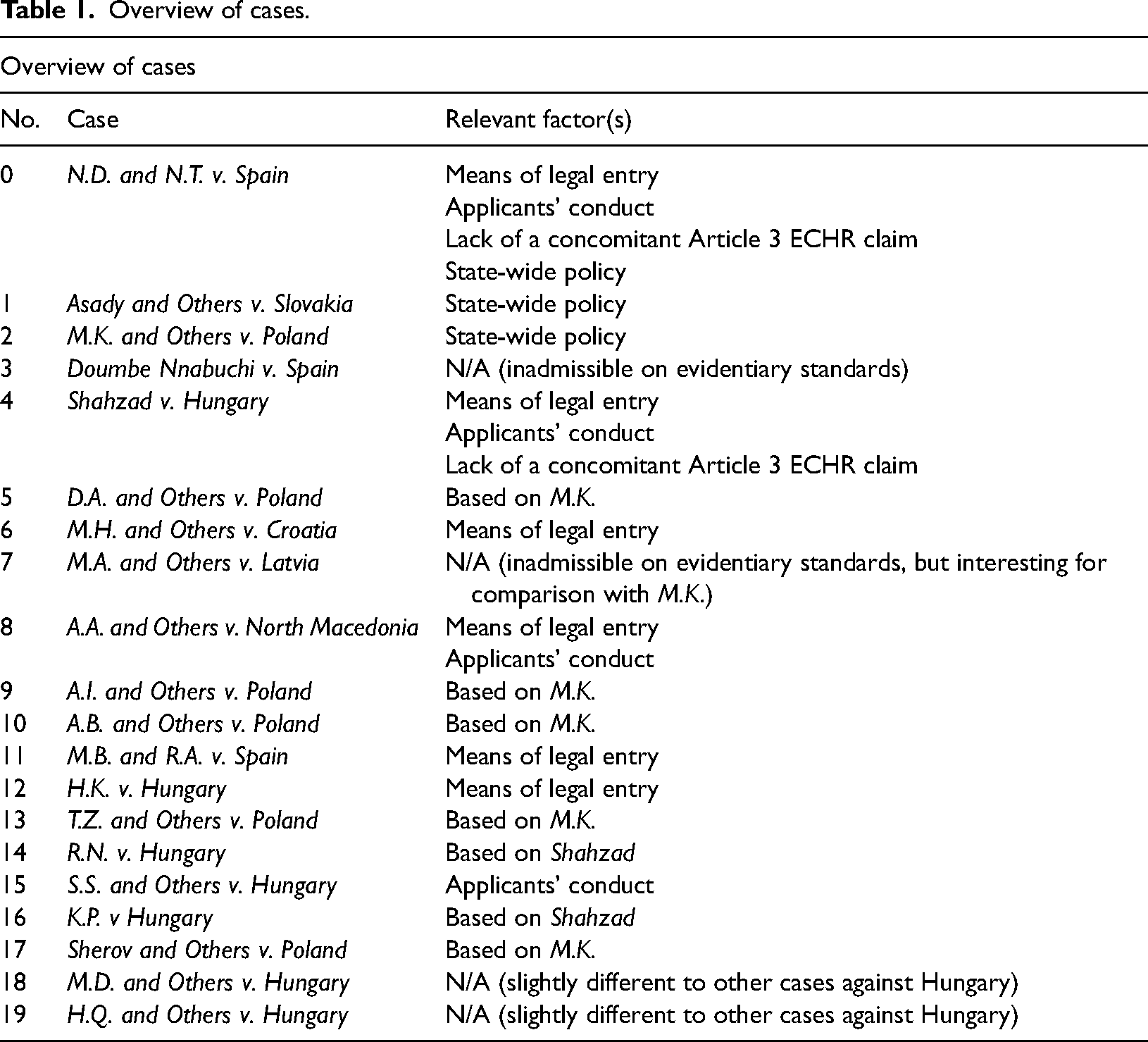
Overview of cases.
Spain
In N.D. and N.T., the ‘case zero’ of this jurisprudence, the Court was presented with abundant evidence that, in practice, the applicants, of sub-Saharan origin, did not have any available means of legal access as they stormed the Melilla fence on 13 August 2014. The official statistics discussed before the Grand Chamber showed that, between 1 January and 31 August 2014, a total of five asylum applications had been lodged at the Beni Enzar crossing point by individuals from Burkina Faso, Cameroon, Congo, Côte d’Ivoire and Somalia. 16 In the remainder of 2014, throughout 2015, and in 2017, the number declined to zero. 17 The only exception was in 2016, where two such applications were registered, but only because the applicants arrived at the border crossing point fully covered in a burqa to escape Morocco's racial profiling. 18
The above figures were remarkably low, especially if put in context. Indeed, in the last four months of 2014, while Beni Enzar did not register a single asylum application by sub-Saharans, it received over 400 applications from Syrians. This is striking, considering that Beni Enzar ‘was located on African soil, and that several African countries were amongst the top producers of asylum-seekers’. 19 However, these figures were read very differently by the parties. On the one hand, the Spanish Government argued that the fact that five persons of sub-Saharan origin had submitted an asylum request at Beni Enzar in 2014 demonstrated the availability, in practice, of a means of legal entry for the applicants. 20 On the other hand, the third-party interveners, including the United Nations High Commissioner for Refugees (UNHCR), the Commissioner for Human Rights of the Council of Europe, the Spanish Commission for Assistance to Refugees, and several NGOs, argued that such figures proved that it was ‘impossible or very difficult’ for sub-Saharans to approach Beni Enzar due to ‘racial profiling or severe passport checks on the Moroccan side’. 21
Despite the preponderance of their submissions, the Court concluded that the applicants and the third-party interveners ‘did not convincingly challenge’ the Government's version. 22 In its view, ‘the mere fact … that only very few asylum requests were submitted at Beni Enzar prior to 1 September 2014’ – that is, until the moment of the facts – ‘[did] not allow the conclusion that the respondent State did not provide genuine and effective access to this border crossing point’. 23 Moreover, it found that, ‘even assuming’ that sub-Saharan migrants encountered difficulties on the Moroccan side of the border, the Spanish Government could not be held responsible for them. 24 Of course, the Court could only reach this conclusion by refusing to take into account the cooperation in place between Spain and Morocco in migration matters, 25 which explains why Morocco prevented sub-Saharan migrants from approaching Beni Enzar in the first place. 26 However, it ‘suffice[d]’ for the Court to find no violation of A4-P4. 27
The case of M.B. and R.A. v. Spain is even more striking.
28
This case was almost identical to that of N.D. and N.T., as it stemmed from a storm at the fences that separate Spain from Morocco. However, this case originated in the Spanish exclave of Ceuta, as opposed to Melilla, and this was not an insignificant difference. As the Special Representative of the Secretary General on Migration and Refugees revealed in a 2018 report discussed in N.D. and N.T., ‘no single asylum application had been lodged [at the El Tarajal border crossing point, located at the Ceuta border] since 1993’.
29
An asylum office was created in 2015, but it mostly remained inoperative for five years following its inauguration. It is clear that, at the time of the events in 2016, the border procedure was not available.
30
Yet, the Court assumed that the situation in Ceuta was the same as in Melilla, and held that the lack of individual removal decisions … [could] be attributed to the fact that the applicants … did not make use of the official entry procedures …, and was thus a consequence of their own conduct.
31
North Macedonia
Between 14 and 15 March 2016, several Syrian, Afghan and Iraqi asylum-seekers peacefully crossed from Greece to North Macedonia as part of a very large group (over 1,000 individuals), but were intercepted and summarily forced to return to Greece. They later became the applicants in the case of A.A. and Others v. North Macedonia. 32 Therein, the Government argued that North Macedonia had several border crossing points where the applicants ‘could have expressed their intention to apply for asylum … at any time either before or after the events’. 33 The Government submitted, in this regard, that hundreds of thousands of migrants had registered their interest in applying for asylum at that particular border crossing point in the prior months. 34 In their view, this evidenced the availability of border procedures. On 7 March 2016 (that is, one week before the events of this case), the EU announced the closure of the irregular flows into Western Europe through the Balkan route. From the following day, only those who met the entry requirements or wished to seek asylum in North Macedonia would be permitted to enter the country. 35 In theory, it would still be possible to seek asylum at the border. However, as the applicants and third-party interveners argued, the issuance of certificates of an expressed intention to apply for asylum was abruptly discontinued on 8 March 2016. 36 Not a single certificate was issued from that day on, while thousands of certificates had been issued until the day before. 37 In their opinion, this demonstrated that, following the closure of the Balkan route on 8 March 2016, it was no longer possible, in practice, to seek asylum at the border. 38
Nonetheless, in a manner reminiscent of N.D. and N.T., the Court held that the applicants and third-party interveners had ‘not challenge[d]’ the Government's version. 39 In its view, the high number of certificates issued prior to 8 March 2016 was the result of a high number of requests by individuals ‘wishing to transit … towards the European Union, rather than wishing to apply for asylum in North Macedonia’. 40 The Court observed that, ‘out of 477,861 people who [had] expressed their intention to apply for asylum between 19 June 2015 and 8 March 2016, only 400 [that is, less than 0.1%] … did apply for asylum’, and that 90% of those who did it ‘left the country before the interviews were held’. 41 In its view, it was thus not surprising that, following the closure of the Balkan route on 8 March 2016, not a single person expressed an intention to apply for asylum thereafter. The Court considered that the above did not ‘call into question’ the accessibility of the border crossing point itself, and found no violation of A4-P4. 42
Hungary
In July 2021, the Court decided on the case of Shahzad v Hungary. 43 This case stemmed from the application of a Pakistani man who, together with 11 other men of the same nationality, crossed from Serbia to Hungary by cutting a hole in the border fence in August 2016. 44 Shortly after, the group was intercepted, escorted to the border fence and made to walk back to Serbia. The Court noted the applicant's submissions, corroborated by the UNHCR, that the access to the Hungarian transit zones of Röszke and Tompa (that is, the only places in which it was possible to seek asylum in Hungary) was very ‘limited’. 45 Indeed, only 30 applicants for international protection were admitted per day into Hungarian territory in total (15 at each transit zone). 46 In August 2016, the estimated waiting time for families and unaccompanied minors ranged between 30–70 days in Röszke, 35–50 days in Tompa, and could reach up to 90 days for single men. 47 Moreover, those wishing to enter one of the transit zones had to first register their name on an informal waiting list, which was managed by one of the migrants. 48 The Court noted that both the UNHCR and the Special Representative had reported irregularities and a lack of transparency in the management of the waiting list and the access to the transit zones. 49 The fact that the applicant, being a single man, did not manage to get his name on the waiting list was an example thereof. In the light of this, the Court held that Hungary failed to provide the applicant with effective means of legal entry, and found a violation of A4-P4. 50
The assessment of the facts in this case was radically different from that in N.D. and N.T. and A.A. in three ways. First, the Court attached significant weight to Mr Shahzad's version of the events and to the reports of third-party interveners. 51 This led it to establish certain facts that were indispensable to finding a violation; namely, the daily cap on applications for international protection and the lack of a formal procedure to access the transit zones. However, the Court adopted a contrary approach in N.D. and N.T. and A.A. In both cases, the Court could only have reached its findings by disregarding, or failing to adequately assess, the compelling evidence of violations before it. Second, the Court in Shahzad considered that 30 international protection applications a day was a ‘significantly low’ figure that did not suffice to meet the requirements of A4-P4. 52 It is striking that while 30 applications a day were deemed unconvincing, five applications in an entire year in Melilla and zero certificates in North Macedonia from a particular date did not raise any suspicion. Third, the lack of a formal procedure with appropriate safeguards was one of the reasons that led the Court to find a violation in Shahzad, whereas comparable ‘shortcomings’ described in A.A. did not have any impact on the Court's decision. 53
The case of H.K. v. Hungary is even more interesting. 54 The facts of the case resembled Shahzad's – however, the applicant in H.K. actually managed to register for the waiting list, enter the Röszke transit zone and claim asylum. While waiting for his turn, he attempted to cross the border irregularly several times, but was informally removed to Serbia. The fact that the applicant managed to claim asylum could have sufficed for the Court to find that Hungary had provided him with means of legal access into its territory. Nevertheless, the Court considered that ‘the Government … [had] not put forward any argument demonstrating that at the time of the applicant's removal [on a prior occasion] the procedure for legal entry had been effective’. 55 The Court also noted that, at the time of his removals prior to access the transit zone, the applicant ‘had no information as to whether or when he would be able to gain access to the asylum procedure’. 56 It is noteworthy that the Court found a violation of A4-P4 in H.K. on the basis of the lack of certainty – despite the applicant's circumvention of the admittedly limited but available legal avenues for entry.
Croatia
The case of M.H. and Others v Croatia originated from the application of an Afghan family who irregularly crossed from Serbia to Croatia in November 2017. 57 A few hours later, they were discovered by the police. They expressed their wish to seek asylum. However, the Croatian officers ignored their request, drove them to the border, and told them to walk back to Serbia by following the train tracks. Shortly after, a train passed and hit a six-year-old girl in the group and killed her.
In this case, the Court conducted a purposeful examination of the means of legal entry into Croatia, not in the abstract, but with the genuine intention to find out whether such means existed, and were available for the applicants, on the grounds of their condition as international protection applicants. It noted that such means of legal entry were only available on ‘humanitarian grounds’, and international protection was not included amongst the limited number of reasons that constituted ‘humanitarian grounds’ under Croatian law. 58 Moreover, in spite of being asked to do so, Croatia did not provide any information that demonstrated the availability of asylum procedures at the border with Serbia. 59 Similarly, it did not indicate a possibility for the applicants to submit an application for international protection in the Croatian embassy in Serbia. 60 Thus, the Court could not be sure of the availability in practice of a means of legal entry for the applicants. 61 This led it to find a violation of A4-P4. 62
This is the only case in which the Court has found a State other than Hungary or Poland in violation of A4-P4 in the aftermath of N.D. and N.T. However, it is unclear whether it bears much relevance for the purposes of this paper's analysis. This is not to say, of course, that it was an unimportant case. But the fact that it was tragically marked by the death of a six-year-old girl probably influenced its outcome. Evidence of this may be found in the separate concurring opinion of Judge Turković, who made a strong case in favour of the best interests of the child. 63 The Croatian Judge essentially argued that the best interests of the child should ‘deactivate’ the N.D. and N.T. exception, 64 ‘even if the … State had provided genuine and effective access to entry procedures … and even if the applicants … had had no cogent reasons not to make use of such procedures’. 65 The Chamber did not go that far, as it applied the N.D. and N.T. exception, although the lack of means of legal access led it to decide in favour of the applicants. Doubts remain, however, as to whether the Court would have conducted such a purposeful examination of the availability of such means had no one died (especially, if all applicants had been adults), or whether it would have blamed the applicants for not having even attempted to access Croatian territory through legal means, as it did in N.D. and N.T and in A.A. 66 The facts of M.H. and Others are so peculiar that they may not be relevant for ‘statistical’ purposes.
Existence of a State-wide Policy
Spain
By the time the Grand Chamber rendered its judgment in N.D. and N.T. v. Spain, the interception and informal removal of migrants who had entered Spain by climbing the fences of Ceuta and Melilla had been established as a widespread State practice for over two decades. For the first 15 years, the practice was clandestine and denied by all Spanish Executives. However, in February 2014, following a pushback ‘gone wrong’, which led to the death of 14 migrants trying to reach Ceuta by swimming around the fence, 67 the then-Minister of Interior had no option but to publicly recognise the practice. 68 He admitted that the migrants who reached the Spanish side of the beach on that day ‘were immediately refused entry and taken care of by the Moroccan officers, from whom they had escaped and who were claiming them back’. 69 He also explained that the actions of the Spanish officials were fully in line with a domestic procedure which had been in place for years and which had been followed by all Spanish Governments, regardless of their political hue. 70 One year later, he legalised the practice (or, as Baranowska would put it, ‘grounded it in law’). 71 In this way, Spain became not only the first Council of Europe State known to have conducted the practice at its land borders, 72 but also the first to introduce it into its domestic legal order. 73 In short, the existence of a ‘systematic’ State practice of collective summary expulsions was an established fact, and the Court was aware of it. 74 However, the Grand Chamber did not seem to attach any importance thereto in N.D. and N.T., as it did not devote a single line to discuss it.
Slovakia
In Asady and Others v Slovakia, 19 applicants (out of a group of 32 Afghan nationals) initiated proceedings against Slovakia, after crossing the border from Ukraine in November 2014. 75 Upon the discovery of their crossing, they were brought to the border police station and subjected to identity checks. According to the Government, all of them underwent a personal interview and were presented with individual decisions. 76 Conversely, the 19 applicants argued that, whereas the other 13 members of the group had been identified and channelled into the asylum procedure, they had been made to sign documents in a language they did not understand, and summarily removed to Ukraine without being able to seek asylum. 77 The Court appeared to infer that the group of 19 individuals had expressed an intention to seek asylum, whereas the group of 13 had not, thereby concluding that there was ‘no reason to assume’ that the group of 13 would have been treated differently. 78 This, amongst other (questionable) assumptions, led the Court to find no violation of A4-P4. 79
In December 2010 (four years before the facts of this case occurred), a report by Human Rights Watch revealed a bilateral agreement between Slovakia and Ukraine, wherein ‘migrants caught entering … Slovakia … without permission … [could] be summarily returned if caught within 48 h of a crossing’. 80 The NGO found that ‘migrants were often tricked into believing they would not be returned, were asked to sign papers they did not understand’ and were ‘quickly sent back within hours of apprehension in Slovakia’, ‘in [a] summary fashion’ and ignoring their asylum claims. 81 In other words, the report evidenced a long-standing practice of the Slovakian authorities of summarily removing aliens crossing the Ukrainian-Slovakian border, which bore strong resemblance to the applicants’ account of the facts in Asady. The Court was aware of the existence of this report. In fact, it included it under ‘relevant international documents’. 82 However, the widespread State practice described therein – which had been formalised through a bilateral agreement – was completely ignored in the Court's majority reasoning. It was only mentioned in the separate opinion of the three dissenting judges as an ‘evidence of [the] difficulties faced by migrants’ at Slovakian borders. 83
Poland
In contrast to the cases above, the Court heavily relied on the independent reports submitted to it to reach its verdict in M.K. and Others v. Poland. 84 This case originated from the joint applications of 13 Russians from Chechnya, including several children. 85 They had all attempted to seek international protection at the Polish-Belarusian border on multiple occasions between 2016 and 2017, to no avail. Indeed, every time they did so, the Polish authorities issued them with administrative decisions distorting their statements (presenting them as ‘economic migrants’ as opposed to ‘asylum-seekers’), and refused them entry into Poland ‘on the grounds that they did not have any documents authorising their entry … and that they had not stated that they were at risk of persecution in their home country’. 86
The Court noted that ‘each time the applicants presented themselves at the Polish border, they were interviewed … and received individual decisions concerning the refusal to allow them entry into Poland’. 87 However, it also considered the independent reports submitted to it, 88 as well as the abundant evidence that the applicants had tirelessly attempted to seek asylum at the border. 89 In particular, the Chamber based its reasoning on the reports of two national human rights institutions (the Polish Ombudsman and the Polish Children's Ombudsman), 90 which ‘indicate[d] the existence of a systemic practice of misrepresenting the statements given by asylum-seekers … at the border checkpoints between Poland and Belarus’. 91 The Court considered that such findings were supported by the statements of the then-Polish Minister of Interior in a television interview in July 2016. 92 As a result, the Court ‘attache[d] more weight to the applicants’ version’, 93 and found that Poland had ‘a wider State policy of refusing entry to foreigners coming from Belarus’. 94 This was taken into account by the Court to find a violation, not only therein, but also in all subsequent cases against Poland (including D.A. and Others v. Poland, 95 and Sherov and Others v. Poland, 96 neither of which concerned Chechen applicants and/or the Belarusian border). By contrast, the ECtHR adopted a completely different approach with Latvia. The application of M.A. and Others v. Latvia, which was based on nearly identical facts to those of M.K. and Others (and, in fact, had been submitted by the same applicants), was found inadmissible. 97 In fact, the Court found that the applicants had not provided prima facie evidence of having applied for asylum in Latvia. 98
The Applicants’ Conduct
Spain
In N.D. and N.T., the Court considered that the applicants had created ‘a clearly disruptive situation which … [was] difficult to control and endanger[ed] public safety’. 99 The Court appeared to have grounded its conclusion, inter alia, on an alleged ‘use of force’. 100 However, it neither defined ‘force’, nor explained how it had been specifically used by the applicants. ‘Force’ is widely understood to be a synonym of ‘violence’. 101 However, as Di Filippo has noted, it is not apparent from the facts that either the applicants, or any other person in the group, had ‘engaged in a violent behaviour towards Spanish personnel or infrastructure’. 102 On the contrary, most of the 75 migrants who reached the top of the inner fence peacefully remained there for hours, until they agreed to climb down with the help of ladders provided by the Spanish officials. As they set foot on the ground, they were handcuffed and handed over to Moroccan officers, who were waiting at the other side of the fence, in an orderly manner. 103 It thus appears that, as Hakiki has noted, it was actually ‘the act of climbing a border fence’ that was ‘labelled’ as ‘use of force’. 104
Hungary
In Shahzad, the Court held that ‘apart from the applicant's unauthorised manner of entry, the … case … [could not] be compared to the situation in N.D. and N.T.’, amongst other things, because there was ‘no indication that the applicant or other men in the group [had] used any force or resisted the officers’, as they actually ‘followed the orders given’ by the latter. 105 This conclusion is striking for two reasons. First, it is conspicuous that the Court found that there was no use of ‘force’, considering that the migrants had entered Hungary by cutting a hole in the fence (thus, using violence against State infrastructure). This contrasts with the Grand Chamber's reasoning in N.D. and N.T., and shows that the Court used a different (or, as Hakiki has put it, ‘stricter’) definition of ‘force’. 106 Second, the Court appeared to introduce a novel aspect into the examination of the applicants’ conduct (namely, ‘resisting the authorities’), which allowed it to further distinguish Shahzad from N.D. and N.T. In Shahzad, the applicant and the other 11 men in the group had been resting in a cornfield, and were taken aback to being ‘encircled’ by ‘numerous officers’ when they awoke (according to the case file, there were no less than 11 officers, so almost one per migrant, present during the removal). 107 This, admittedly, left the group with little to no chance at all of resisting, or not following, the orders of the Hungarian officers. In N.D. and N.T., by contrast, the migrants had been able to ‘defer’ their apprehension for some hours by remaining on the top of the fence. After they set foot on the ground, however, they no longer opposed the officers in any way, and were apprehended and handcuffed without resistance. It appears that the Court considered now that the earlier (passive) resistance was a factor to be held against the applicants. 108 Since Mr Shahzad had not even had a chance to resist Hungarian officers in a passive manner, this played in his favour. However, as Schmalz has argued, the Court introduced, in this way, a ‘rather vague’ and ‘problematic’ threshold. 109
When it comes to the examination of the applicants’ conduct, another interesting case to review is S.S. and Others v. Hungary. 110 In S.S. and Others, the applicants were two families of asylum-seekers from Yemen and Afghanistan – among which there were two minors of 11 and 14 years of age, one with Down syndrome. 111 Unlike the applicants in all other cases, who had crossed, or attempted to cross, a border by land, the applicants in this case landed in Budapest airport in 2019, having travelled by air with counterfeit documents. Shortly upon arrival, having expressed their wish to seek asylum, they were escorted to the Hungarian-Serbian border, and were ordered to walk through a gate in the fence so that they could enter through the transit zones (the only places where, based on domestic law, it was possible to seek asylum).
In this case, the Court considered that the applicants’ attempt to enter Hungary with fake passports in itself ‘could not qualify as the kind of conduct which would absolve the authorities of their obligation under [A4-P4]’. 112 According to the Court, unlike in N.D. and N.T., the applicants had ‘arrived at an official border crossing point at Budapest Airport and presented themselves to the border officers’, and they had ‘cooperated with the authorities when they were apprehended’ (implying that the applicants in N.D. and N.T. had not been so cooperative). 113 This finding is striking, as the applicants’ situation was not voluntarily disclosed by them, but, rather, discovered at the border check. 114 In this way, the Court departed from its earlier jurisprudence, in which it had positively assessed the fact that the applicants had not attempted to conceal their lack of entry documents, as this proved that ‘the purpose of their presence … at the … border was to ask for asylum’. 115 Moreover, the Court recognised that ‘persons seeking international protection are often compelled to travel without appropriate travel documents and, consequently, they might in some circumstances resort to the use of false or fraudulent documentation’. 116 Of course, this is true. Yet, it is unclear why the Court was so empathetic with applicants using forged documents (perhaps because some of them were minors?), but so harsh with applicants climbing a border fence, as if the latter did so out of personal preference.
A Lack of a Concomitant Article 3 ECHR Claim
Last, but not least, there is the final, and fourth, factor related to the N.D. and N.T. ‘exception’. As Rodrik and Hakiki have noted, some commentators have argued that, in N.D. and N.T., the Court was able to impinge upon A4-P4 because of the lack of Article 3 ECHR claims. 117 In other words, it seemed that a concomitant Article 3 ECHR claim made an A4-P4 application more likely to succeed. This appeared to be, in principle, a plausible hypothesis. As Hakiki noted some years ago, there was a period of time where the Court found no violation of A4-P4 in cases where ‘there was no substantial protection need and/or no related claim under [A]rticle 3 ECHR’. 118 However, this hypothesis no longer appears to be entirely substantiated, in light of the recent jurisprudence against Hungary. 119 Most of the Hungarian cases did not raise an Article 3 ECHR claim, 120 and yet, the Court reached unanimous findings of violation of A4-P4. 121 It becomes apparent that the lack of a concomitant Article 3 ECHR claim is only relevant to other States (for example, Spain, as previously mentioned), but not Hungary.
Conclusions
In cases involving comparable facts and/or circumstances, the ECtHR seems to have consistently applied more stringent standards when the respondent State was Poland or Hungary. Conversely, the ECtHR was strikingly ‘generous’ with other States, even in cases where there was abundant evidence against the State, or in which a finding of violation appeared to be the only possible outcome, based on the existing precedent. This becomes apparent from the above analysis of four key elements linked to the N.D. and N.T. ‘exception’ that featured in subsequent cases. It also emerges from the general approach of the Court in each of those cases when it comes to, for example, the assessment of evidence. The question is: why?
SEARCHING FOR AN EXPLANATION
A Further Exemplification of ‘Judicial Activism’?
In 2023, Gatta, Rodrik and Hakiki thoroughly examined the post-N.D. and N.T. jurisprudence on summary removals. Their studies – to this author's knowledge, the only ones of this kind – also found the cases of Hungary and Poland to have stood out from the rest. 122 However, the reasons that led them to such a conclusion were very different from the reasons articulated here. Rodrik and Hakiki appeared to argue that the Court was, in a way, compelled to find violations against Hungary and Poland due to a series of factual and circumstantial elements that were not present in any other case, and which made the cases against both States ‘exceptional’. 123 Along similar lines, Gatta argued that ‘the ECtHR had no choice but to declare violations of the ECHR in such blatant episodes of disrespect of the basic human rights guarantees at the Polish and Hungarian borders’. 124 In short, they contended the conduct of both Hungary and Poland was so well-documented that the Court, as a mere spectator of the facts before it, could not help but find violations against the latter.
This reasoning by Gatta, Rodrik and Hakiki suggests a rather ‘passive’ attitude on the part of the Court that, in this author's view, is nowhere to be seen in the post-N.D. and N.T. jurisprudence. On the contrary, as seen above, such jurisprudence is replete with examples of comparable situations that the Court assessed in a very different way, and which were invariably used to the detriment of Hungary and Poland. This indicates that the Court actually had a very ‘active’ role in reaching such outcomes, and that it deliberately used a different yardstick with these two States. The Court's approach could be characterised as an exercise in ‘judicial activism’ – understood as putting judicial reasoning at the service of achieving a predetermined outcome. 125 Indeed, this approach appears to have become the Court's standard when adjudicating alleged violations of A4-P4 in non-admission cases. There is evidence of the Court having used it to reach some of its most important A4-P4 judgments, whether the end result was to expand the protection under A4-P4 (such as in the landmark case of Hirsi Jamaa and Others v. Italy, the first case related to an interception and removal of migrants from the high seas), 126 or to restrict it (such as in N.D. and N.T. and A.A.). 127 It could be argued that the Court has exercised judicial activism to systematically find violations against Hungary and Poland. The question remains: why was the Court motivated to do so?
Attempting An Explanation
A plausible answer, this paper argues, is that, in exercising judicial activism, the ECtHR might be attempting to ‘discipline’ both countries. This is a line of reasoning that has, to some extent, been recently advanced by Goldner Lang – with respect to Hungary only and within the specific context of the Court of Justice of the EU (CJEU), but which might be helpful in accounting for the above developments. 128 This reasoning will be further discussed below. Before that, however, it is necessary to reflect on the wider context in which the aforementioned judgments were delivered.
Context
The ECtHR jurisprudence from 2020 to 2025 must be contextualised within a climate of increasing political hostility between the EU, as well as the CoE, and Hungary and, to a lesser extent, Poland. 129 This tension arose from the deterioration of the rule of law in both States, following the election of populist leaders Viktor Orbán in Hungary in 2010, and of Jarosław Kaczyński in Poland in 2015. Shortly after both came to power, they began to ‘transform the existing liberal democracies’. 130 In Hungary, this was done by adopting an illiberal constitution in 2011, whereas in Poland, abusive amendments and legislation contrary to the 1997 Constitution were introduced. 131 Amongst other things, the new executives attacked judicial independence and civil society organisations, and restricted a number of freedoms, including of assembly, press, and expression. 132 Both States rapidly abandoned the EU's democratic and liberal values that they once embraced, and became ‘illiberal democracies’. 133 As expected, this led them to clash with both the EU and the CoE. 134
Conflict with the EU
The European Commission did not take long to respond to the rising hostilities. The Commission initiated infringement proceedings against both States, initially only against Hungary, but later also against Poland. The two States differed in their reactions. 135 As Kos has noted, at the beginning, Hungary adopted a rather ‘conciliatory’ tone, at least in appearance. 136 Yet, the country, situated along the Balkan route, radically changed its approach during the 2015–2016 ‘refugee crisis’. In 2015 alone, it registered a record figure of 177,000 asylum applications (incredibly high if compared to the average 1,600–4,600 applications per year that had been registered in 2003–2012), and the number of people who travelled through Hungary to reach other European States was likely twice as high. 137 This triggered a strong anti-migrant campaign at a national level, which ‘mobilise[d] domestic support against the EU’, 138 and was accompanied by changes in Hungary's migration law. 139 Until then, various infringement proceedings against Hungary had concerned different issues, such as the freedom of the press, the Hungarian National Bank, or data protection. 140 Since 2015, the proceedings included issues of migration and asylum. 141 Hungary began to consider any infringement proceedings that were initiated against it – whether they were actually related to its migration policy or not 142 – as either covert or overt ‘political attacks’ of the EU against its migration policy, and adopted a ‘highly confrontational’ tone in following interactions with the EU institutions. 143
In contrast, Poland did not have any ‘conciliatory’ phase. Shortly after Kaczyński won the elections in October 2015, Poland directly entered into open conflict with the EU. 144 Within the first two years of its administration, the new Executive took control of the entire judiciary in an ‘unprecedentedly aggressive’ manner. 145 Kaczyński's rise to power coincided with the peak of the ‘refugee crisis’. Unlike Hungary, Poland remained unaffected by the influx of asylum-seekers coming from the south of Europe, as it was located farther away from the Balkan route. Nonetheless, migration somehow became one of the top issues of Kaczyński's electoral campaign, and the new Executive introduced an anti-migrant movement, which also led to changes in domestic law. 146 If we had to pinpoint one factor that united Hungary and Poland, it would be their strong opposition to the EU's management of the refugee crisis. 147 As Klaus noted, both States ‘went out of their way to sabotage [the EU's] relocation [scheme]’, which had been adopted to redistribute asylum-seekers amongst all EU Member States following the collapse of the Italian and Greek asylum systems. They were the only EU Member States that persistently refused to accept any refugees under the relocation scheme, 148 and this ultimately led to new infringement proceedings against both States. 149
The majority of the Commission's infringement proceedings failed to have the intended deterrent effect. Both Poland and Hungary refused to change their ‘objectionable legislation’, and were referred to the CJEU. 150 Several rulings were delivered against them in the following years. 151 Nevertheless, the CJEU rulings also failed to effectively redress the situation. On the contrary, tensions further escalated. This is illustrated, for instance, by the astronomic penalties imposed on both Poland and Hungary in 2021 and 2024, respectively, for ignoring the CJEU rulings, 152 or the 2022 joint action of the Commission and the Council to freeze EU funds (€28 billion in the case of Hungary and €110 billion in that of Poland), on account of their repeated violations of the rule of law. 153
Conflict with the Council of Europe
Where both Hungary and Poland openly resisted the CJEU judgments, Kos noted that this was not necessarily the case in their relationships with the ECtHR. 154 According to Kos, Hungary has chosen to generally ignore the ECtHR's rulings, but avoid confrontation with the Strasbourg Court: Hungary would show its commitment to comply with the rulings of the Court against them in order to ‘appease’ the situation – ultimately hiding ‘its true intention ... to either delay … or, more often, avoid implementation altogether’. 155 Conversely, Poland engaged in overt conflict with the Court, for example, by deliberately disregarding interim measures. 156 Interim measures are orders issued by the ECtHR under Rule 39 of the Rules of the Court in ‘exceptional circumstances … where there is an imminent risk of irreparable harm’. 157
The first instance where Poland ignored such measures occurred in the summer of 2017. 158 Interestingly, it did so in cases concerning Chechen families and Syrians at the Belarusian border, including those discussed earlier. The Court applied Rule 39 and ordered the Polish Government not to send the applicants back to Belarus. The Polish Government abided by the ECtHR's orders when it came to some of the applicants, though ‘only after a significant delay’. 159 This in itself defeated the purpose of the measures, insofar as it ‘resulted in the applicants being put at risk of the kind of treatment that the measures were aimed at protecting them against’. 160 Otherwise, Poland simply ignored interim measures. 161 Tensions between Poland and the ECtHR ultimately reached a new height, 162 and continued escalating after this. 163
Between Deference and Discipline
It becomes increasingly apparent that both Hungary and Poland have deliberately, and repeatedly, challenged the decisions of the two highest European courts in different ways, and have shown a considerable degree of disrespect for the ECHR, EU law, and their underlying values. It follows that they are amongst those States that, as Çalı describes, ‘flout the well-established … standards, not merely by error, or lack of knowledge …, but with suspect grounds of intentionality and lack of respect for the overall Convention’ – and, in this case, also EU – ‘acquis’. 164 This reveals, at the very least, an obvious breach of the ‘good faith’ that is presumed to all Convention States. 165 This has been very noticeable in the field of migration and asylum, where both Hungary and Poland have maintained a particularly confrontational attitude since the 2015–2016 ‘refugee crisis’. Hungary seems to have been more notorious in the EU context, insofar as it has had heavy fines imposed upon it due to its treatment of asylum-seekers. Within the CoE, Poland's non-compliance appears to stand out over Hungary's, especially where it has disregarded the ECtHR's interim measures against its summary removals.
In light of the above, it is now easier to understand why the ‘discipline’ argument partly advanced by Goldner Lang is relevant. This argument stems from Goldner Lang's examination of the CJEU's jurisprudence on migration and asylum during 2017–2022. Therein, she observes a clear distinction between the most recent cases, which essentially concerned Hungary, and some earlier cases against other Member States, or the EU as a whole. In cases against Hungary, Goldner Lang argues the CJEU ‘strongly condemned Hungary and upheld asylum-seekers rights’. 166 In contrast, Goldner Lang found the CJEU to have been rather ‘passive’ in cases against other Member States, as the Court seemed more reluctant to explore the substance of the cases (and, thus, to find potential violations). 167 Goldner Lang posits whether the CJEU's jurisprudence over the last few years reveals ‘a wind of change in the Court's approach to sensitive migration and asylum-related matters’. 168 However, she eventually concludes that it does not.
Instead, Goldner Lang argues that the CJEU refrained from finding violations in cases concerning other States because of the matters that were at stake. By finding violations in such cases, there would have been significant political repercussions – not only for those respondent States, but also for the whole EU (for example, by indirectly enabling extraterritorial asylum applications, or declaring the Dublin State-of-first-entry rule inapplicable). 169 By contrast, the issues raised in the cases against Hungary (for example, their use of the transit zones) only pertained to Hungary. As such, the effects of the CJEU's findings would be confined to Hungary's specific context. Moreover, any findings of violation against Hungary ‘would be welcomed by most EU Member States, including the most powerful ones’, considering the climate of hostility earlier described. 170 Goldner Lang ultimately finds the rulings against Hungary to not reflect a change of attitude within the CJEU towards migrants and asylum-seekers’ rights. Rather, they ‘should be viewed in the light of Hungary’[s] recent rule of law violations’, and as the Luxembourg Court's ‘attempts to use its judicial powers to correct national rule-of-law-incompliant behaviour’. 171 In other words, the Court's rulings against Hungary were opportunities to ‘discipline’ Hungary.
This paper builds on Goldner Lang's findings to analyse the ECtHR's jurisprudence from 2020 to 2025, not only in relation to Hungary, but also to Poland. First, in line with Goldner Lang's findings in relation to the CJEU, this paper finds that it does not seem possible to argue, on the sole basis of the decisions that the ECtHR has delivered against Hungary and Poland (and in spite of being unanimous and high in number by A4-P4 standards) that the Strasbourg Court has changed its approach towards migration and asylum. While the ECtHR persistently found Poland and Hungary in violation of A4-P4, the Court also showed deference towards other States, as illustrated by its decisions concerningSpain (2021, 2022), 172 North Macedonia (2022), 173 or Latvia (2022). 174 This jurisprudence does not suggest a change in the approach of the ECtHR towards A4-P4 cases. Rather, it confirms the emergence of a separate pattern of jurisprudence for Hungary and Poland.
Second, as with the CJEU, the decisions against these two States did not have an impact on any other State, as they specifically concerned the Hungarian and Polish practices. 175 Similarly, they did not undermine the interpretative ‘backsliding’ the ECtHR has exhibited since 2016, particularly in its retreat from the expansive interpretation of A4-P4 established in Hirsi. 176 As such, they were also an opportunity for the ECtHR to ‘discipline’ Hungary and Poland. This is unsurprising because, as recently noted by Kos, the CJEU and the ECtHR ‘[seem] to have joined efforts in condemning the deterioration of rule of law situations in both [S]tates’. 177
Nevertheless, the above is not to imply that the ECtHR is forcing findings of violation against Hungary and Poland ‘out of the blue’. As Rodrik and Hakiki argued, the ECtHR had plenty of evidence of the conduct of both States, which allowed it to comfortably reach such findings. 178 This approach is drastically different to other cases where the ECtHR has been perceived to rely on tenuous reasoning to substantiate findings of non-violation. 179 Arguably, it is not because such evidence existed that the ECtHR found the violations. After all, there were other cases in which the ECtHR was presented with similar amount of evidence (e.g., in N.D. and N.T. or in A.A.), and yet, it chose to ignore it. 180 Rather, in this author's view, it is because the ECtHR was ‘prone’ to finding violations against Hungary and Poland that it attached the appropriate weight to the evidence submitted to it, and found the violations as a result. The ECtHR's jurisprudence that specifically pertains to Hungary and Poland's context – characterised by a thorough and comprehensive assessment of evidence of violations – establishes a standard of adjudication that, arguably, ought to be universally applied.
Potential Limits to ‘Discipline’ in the Upcoming Jurisprudence
In principle, it would seem logical to think that, if it has developed a ‘disciplinary’ track of jurisprudence for Hungary and Poland, the ECtHR will continue on this track for as long as the States persist in their non-compliant behaviour. 181 However, new scenarios may soon force the Court to temporarily set aside its disciplinary track (if not drop it altogether). This paper has examined relevant post-N.D. and N.T. jurisprudence decided until the time of writing (August 2025). However, this is not the end of the story. There are currently over 30 cases pending before the ECtHR (a never-before-seen caseload in the history of A4-P4 since its adoption in 1968) against Poland, Lithuania and Latvia. All of these cases concern summary removals of migrants and asylum-seekers at the EU-Belarusian border between 2021 and 2023. 182 Between April and June 2024, the Court relinquished jurisdiction over three of the cases in favour of the Grand Chamber: C.O.C.G. and Others v Lithuania, 183 R.A. and Others v Poland, 184 and H.M.M. and Others v Latvia. 185 The three cases were heard in three consecutive hearings on 12 February 2025. But what makes these cases different, and why might they trigger a change in the ECtHR's approach to A4-P4 cases, at least in the case of Poland?
These cases must be read in the context of the crisis between Belarus and the EU, which began in the summer of 2021. 186 The crisis started when the EU imposed sanctions on Belarus in response to the latter's fraudulent elections in 2020, and human rights abuses. As a response, Belarus created an ‘artificial’ migration crisis in the EU by issuing tourist visas to thousands of individuals from crisis regions in the Middle East, facilitating their arrival into Belarus, and then forcing them to irregularly cross the borders of Poland, Lithuania, and Latvia in the so-called ‘instrumentalisation’ of migrants by third countries. The Polish, Lithuanian, and Latvian authorities responded by summarily removing the migrants back to Belarus, and enforcing emergency measures and regulations to ‘justify’ their actions. Belarus, in turn, pushed the migrants back into the EU, forcing the migrants to ‘repeatedly wander in minus temperatures’ over the winter months, leading to serious injuries, amputations, and even deaths. 187
It appears that the reason why these cases were relinquished to the Grand Chamber is that the ECtHR is planning to rule, for the first time, on the highly controversial issue of ‘instrumentalisation’. A restrictive interpretation of A4-P4 cannot be precluded. In fact, it seems rather likely, especially considering the political backlash a verdict of violation would certainly have, as such a ruling might be perceived as subjugating the EU to ‘hybrid attacks’ from hostile neighbours. The Court's track record of ‘making enormous concessions’ to pressure from respondent States in migration cases supports this theory. 188 The ‘disciplinary’ approach of the Court may or may not survive in this new context. For the time being, nothing suggests that it would be abandoned in cases against Hungary. It remains to be seen, however, how it will be dealt with at the Polish-Belarusian border.
CONCLUSIONS
This paper began with Ciliberto's warning, made shortly after the Grand Chamber judgment in N.D. and N.T., that future A4-P4 applications concerning summary removals at land borders ‘could be declared manifestly unfounded or adjudged in favour of the respondent State’. 189 Five years and 19 judgments later, it appeared that her prediction had not borne out in reality – at least at first sight. Most of the applications in the post-N.D. and N.T. era have actually been decided in favour of the applicants. However, a closer inspection of such jurisprudence reveals a more complicated picture. To begin with, Poland and Hungary account for the majority of the recent A4-P4 caseload. As this paper has illustrated, the Court has held these two States to a different yardstick, to the extent that it has developed a separate track of jurisprudence for them. Interestingly, despite being the respondent States in 13 of the 19 judgments delivered, Poland and Hungary have seemingly become exceptional cases. Croatia is the only other State found in violation of A4-P4 in the post-N.D. and N.T. jurisprudence – though this finding pertains to a single case. That said, Croatia could also be considered an exception, although for different reasons (namely, because the death of a six-year-old girl may have, in all likelihood, influenced the Court's outcome). This leaves us with five other cases concerning Spain, 190 Slovakia, North Macedonia, and Latvia. In this author's view, this jurisprudence is diversified enough, in both temporal scope and respondent States, to identify a sustained trend. Seemingly, it reveals the Court's prevailing, or ‘default’, approach to A4-P4 during the 2020–2025 period: the Court either finds non-violation, or issues an inadmissibility decision (regardless of the Court applying the ‘exception’ of N.D. and N.T.). The upcoming Grand Chamber jurisprudence on the EU-Belarusian border will confirm whether the Court continues on its current path, or adopts an entirely distinct approach.
Footnotes
Declaration of conflicting interests
The author declared no potential conflicts of interest with respect to the research, authorship, and/or publication of this article.
Funding
The author disclosed receipt of the following financial support for the research, authorship, and/or publication of this article: This work was supported by the Research Ireland (grant number GOIPG/2023/4800).
