



Abstract
Background
The association between alopecia areata (AA) and atopic dermatitis (AD) is common. The association of both autoimmune diseases is an indicator of poor prognosis. We hereby discuss the off-label therapeutic role of tofacitinib as concurrent treatment for both the conditions and long-term safety data.
Case report
Herein we describe a 5-year-old girl with alopecia areata and atopic dermatitis refractory to combination therapy of methotrexate and atopic dermatitis, who was started on tofacitinib 5 mg once daily. Due to inadequate response, the dose was escalated to 5 mg twice daily. The child achieved complete hair regrowth except for the ophiasis pattern and complete clearance of AD. The child was maintained on tofacitinib for the long term due to the risk of flare of both conditions.
Conclusion
We emphasize the long-term safety of tofacitinib in dermatological conditions like AA and AD. There are minimal case reports of long-term efficacy and use of tofacitinib in concurrent conditions.
Introduction
The association between alopecia areata (AA) and AD has been known for ages. The association of both autoimmune diseases is an indicator of poor prognosis. The U.S. FDA has approved abrocitinib (≥12 years), ritlecitinib (≥12 years), and upadacitinib (≥12 years) for atopic dermatitis (AD). For alopecia areata (AA), baricitinib (≥18 years) and ritlecitinib (≥12 years) have been approved. However, in countries where these agents are not available, such as India, we discuss the off-label therapeutic role of tofacitinib as a concurrent treatment option for both conditions, along with available long-term safety data.
Case
Summary of treatment history.
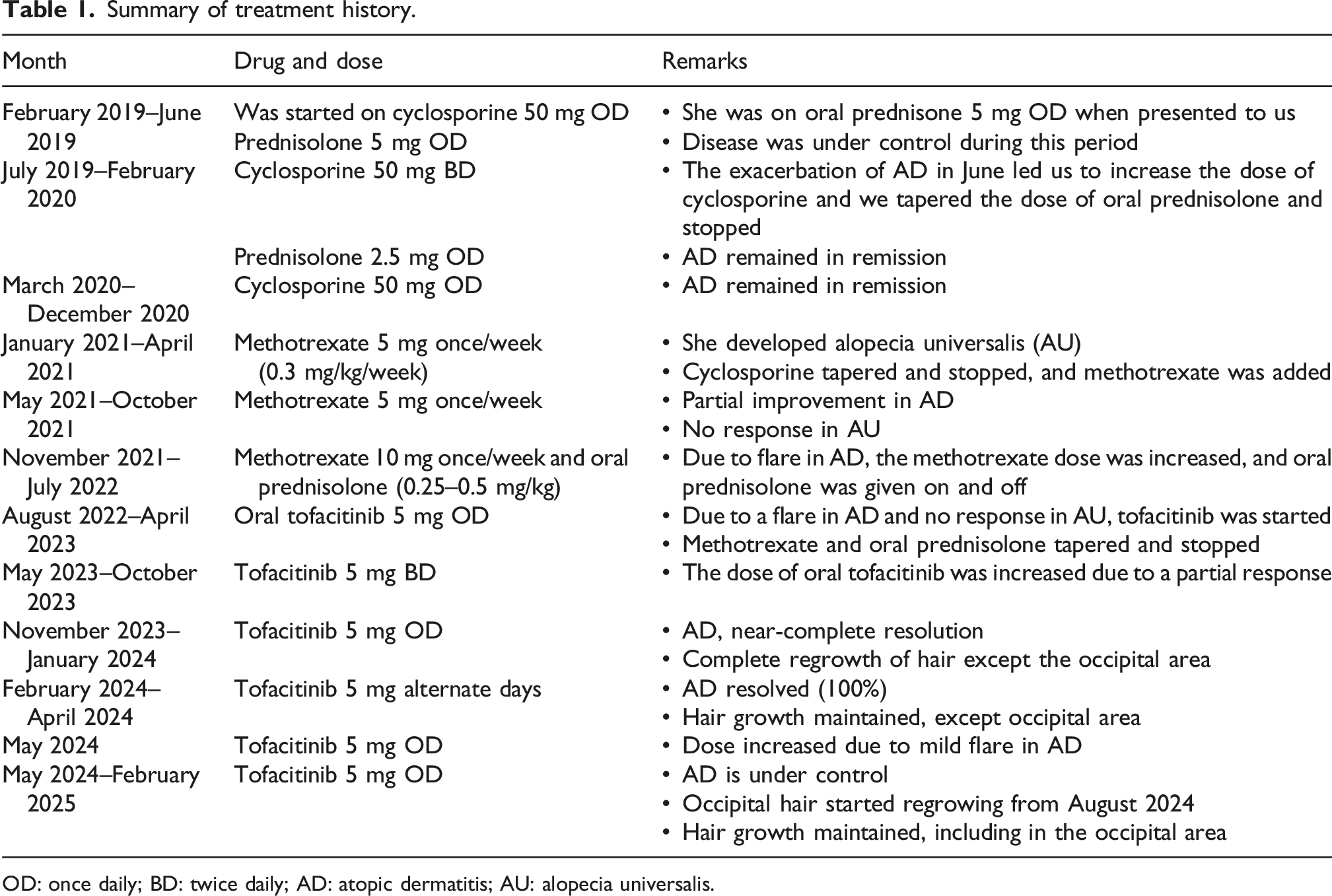
OD: once daily; BD: twice daily; AD: atopic dermatitis; AU: alopecia universalis.
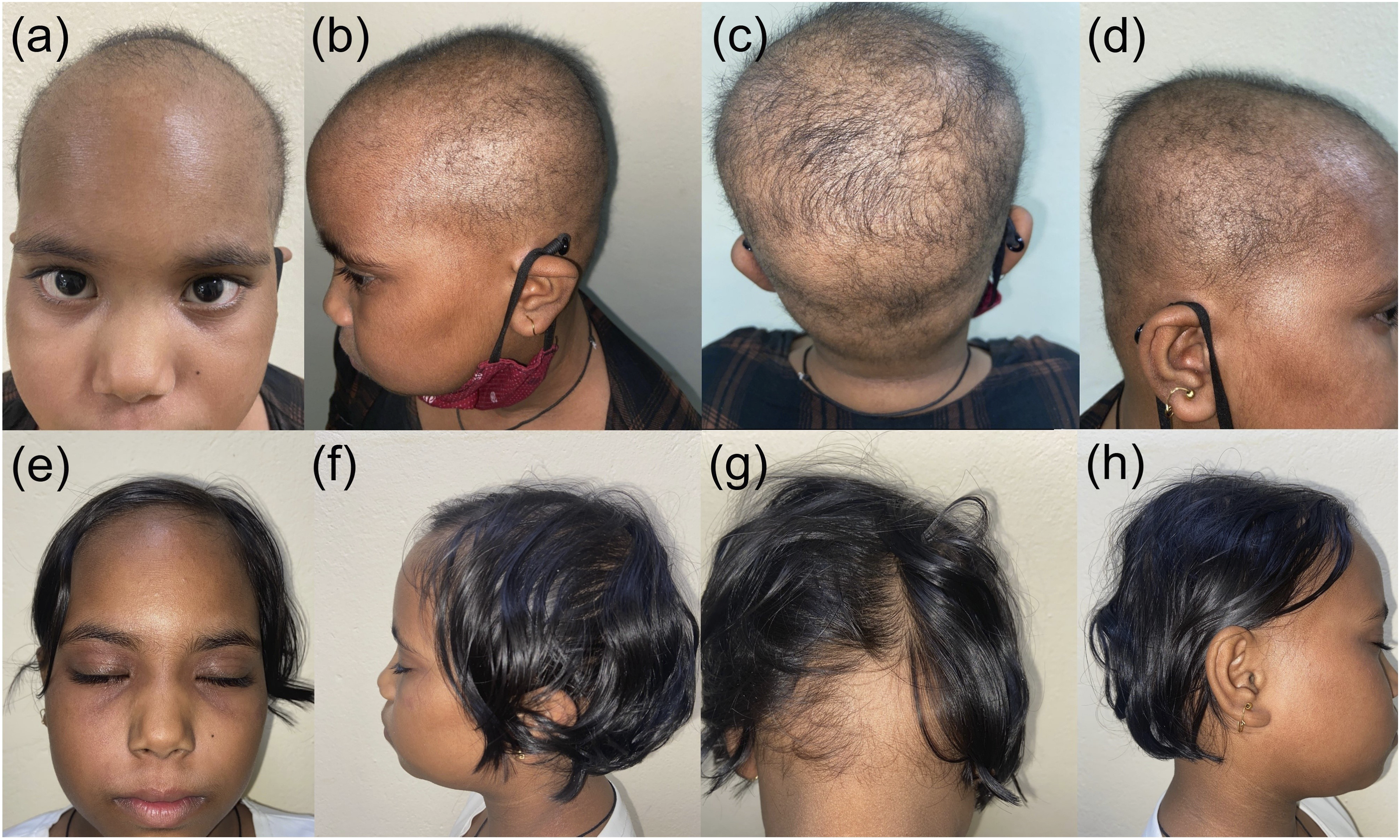
Depicts pre- (a, b, c, and d) and post-treatment (e, f, g, and h) improvement in SALT score with tofacitinib for 1.5 years.
Discussion
JAK-STAT (Janus kinase signal transducers and activators of transcription) pathway is the common pathway in both dermatological conditions. JAK activates the cytokine receptors that bind the transcription factor STAT, thereby increasing various inflammatory mediators. JAK-STAT inhibitors reduce the inflammatory cascade, such as interleukin (IL)-2, IL-4, IL-7, IL-9, IL-15, IL-21, and interferon (IFN)-γ.1,2 Tofacitinib inhibits JAK-1/3 and STAT-6 pathways, thereby regulating IL-4, 5, 10, and 13 signaling linked in the pathogenesis of atopic dermatitis. Similarly, it regulates IFN-γ, IL-13, IL-15 expression, and cytotoxic CD8 + NKG2D + T cells expressed in AA patches. IL-13 has been linked as a common cytokine associated with the pathogenesis of both AA and AD. 2
A systematic review involving 66 studies on the effect of JAK-STAT inhibitors in AD reported good responses in all cases with nil to mild adverse events. The adverse events reported include lymphopenia, diarrhea, nausea, flare of disease, and skin infection. Relapse of AD after discontinuation of therapy has been reported. 2 Similar to our case, tofacitinib (5 mg BD) was effective in a 22-year-old adult male with AA and AD who was refractory to topical steroids, phototherapy, methotrexate, and mycophenolate mofetil. The NRS has been reduced to 50% from 8 to 3, and complete hair regrowth was noted at the end of 10 months of therapy. 3 Another report of overlap of AD and AA showed dramatic response to baricitinib after 4 to 7 months of therapy. 4 In 6 patients aged between 18 and 55 years, tofacitinib was able to achieve a 54% average reduction of SCORAD at 1 to 3 months, and this reduction was maintained at 70% up to 29 weeks. The itch score decreased by 70% at 1 to 3 months of therapy and was sustained at 76% during 2 to 7 months. 5
Huang et al., in 11 preadolescent patients, reported a 50% SALT score improvement in 64% of the cases with oral tofacitinib alone. 6 Similarly, a 50% SALT score reduction was noted in 63.6% of cases with oral tofacitinib and oral minoxidil by Jerjen et al. 1 A retrospective study from India reported initial hair regrowth with oral tofacitinib within 3 months and a complete response within 6 months. 7 In our case, the child started showing regrowth of hair in 3 months of follow-up, with near-complete response at 15 months, except for the occipital area and complete regrowth at 24 months. We also observed that while tapering tofacitinib 5 mg alternate days, there was exacerbation of atopic dermatitis, while hair regrowth was preserved with no relapse. Numerous studies have individually demonstrated the effectiveness of tofacitinib in treating AD or AA. Its efficacy in patients with both AD and AA is rarely reported. Nevertheless, this highlights its potential therapeutic role in this subset of patients.3,6
Conclusion
In conclusion, we highlight the successful use of tofacitinib as a targeted therapy in a girl with concomitant therapy-resistant AD and AU. This is relevant in a country like India where baricitinib is not available and abrocitinib is too costly to afford.
Supplemental Material
Supplemental Material - Successful management of therapy-resistant chronic refractory atopic dermatitis and alopecia universalis with oral tofacitinib in a girl
Supplemental Material for Successful management of therapy-resistant chronic refractory atopic dermatitis and alopecia universalis with oral tofacitinib in a girl by Shreya K. Gowda, Bhini Ameta, Akash Agarwal, and Biswanath Behera in International Journal of Risk & Safety in Medicine
Footnotes
Consent to participate
Content was obtained as per departmental format from the guardian/parents.
Author contributions
SK and BB had full access to all the data in the study and take responsibility for the integrity of the data and the accuracy of the data analysis and were responsible for the study concept and design. SK and BA drafted the manuscript. BB contributed to the critical revision of the manuscript for important intellectual content and supervised the study. All authors contributed to the acquisition, analysis, and interpretation of data.
Funding
The authors received no financial support for the research, authorship, and/or publication of this article.
Declaration of conflicting interests
The authors declared no potential conflicts of interest with respect to the research, authorship, and/or publication of this article.
Data Availability Statement
Date will be available with the corresponding author shared when required; ethics review: not required for a single case, per journal policy.
Supplemental Material
Supplemental material for this article is available online.
References
Supplementary Material
Please find the following supplemental material available below.
For Open Access articles published under a Creative Commons License, all supplemental material carries the same license as the article it is associated with.
For non-Open Access articles published, all supplemental material carries a non-exclusive license, and permission requests for re-use of supplemental material or any part of supplemental material shall be sent directly to the copyright owner as specified in the copyright notice associated with the article.
