



Abstract
Abstract
Background
The use of social media platforms like YouTube has surged among patients and their families seeking medical information. Despite the widespread use of video content for health education, no previous study has systematically evaluated the quality of YouTube videos on dynamic spinal stabilization.
Methods
A YouTube search using the keyword “dynamic stabilization” was conducted in December 2024. Thirty eligible videos were assessed independently by two neurosurgery specialists using the DISCERN scale. Video characteristics and content quality were analyzed using descriptive statistics, correlation analysis, and regression models.
Results
The overall quality of the videos was low, with a mean DISCERN score of 39.15. A negative correlation was found between the number of views and DISCERN score (r = –0.28), while positive correlations were observed between DISCERN scores and video duration (r = 0.19), and between DISCERN-1 and DISCERN-2 scores (r = 0.957). Videos including:
a medically trained speaker, explanation of dynamic stabilization differences, surgical procedure details, and pre/post-operative information scored significantly higher, with each factor contributing to an average increase of 7.09 points (p < 0.05).
Conclusion
Most YouTube videos on dynamic stabilization offer low-quality and potentially misleading information. Medically trained contributors consistently produce more reliable and informative content, yet such videos often receive less viewer engagement. Increasing the visibility and clarity of evidence-based content is essential to improve patient education through social media.
Introduction
In today's digital era, the internet and social media have become primary sources of medical information for patients and their families. 1 Among these platforms, video-based services are particularly popular due to their accessibility and ease of understanding. 2 YouTube, launched in 2005, is one of the most widely used video-sharing platforms, hosting content in over 80 languages and serving more than 2 billion users globally. 3
Patients undergoing medical treatment—especially those recommended for surgical procedures—often experience heightened anxiety. 4 In response, many seek additional information online to better understand their condition and treatment options. However, these searches frequently lead to inaccurate or misleading content. Misinformation in online health-related videos can contribute to confusion, delay appropriate treatment, and influence the selection of suboptimal management strategies. 5 Improving the quality of health-related videos on platforms such as YouTube has the potential to reduce patient anxiety, support more informed decision-making, and increase compliance with treatment plans. 6
Spinal disorders represent a significant public health concern, with spinal pain contributing to billions of dollars in healthcare costs annually. 7 One of the most common causes of spinal pain is lumbar degeneration, particularly in aging populations. Treatment options for lumbar degeneration include both surgical and non-surgical interventions. 8 Among surgical treatments, spinal stabilization is commonly required and can be achieved through either rigid fusion techniques or more recent innovations such as dynamic stabilization systems. 9
Dynamic stabilization techniques are gaining attention due to their potential advantages, including reduced rates of postoperative complications such as adjacent segment degeneration, pseudoarthrosis, and instrumentation failure. 10 Despite these benefits, dynamic stabilization remains relatively unfamiliar to the general public compared to traditional fusion methods. When proposed by surgeons, these techniques may be met with skepticism by patients who are unfamiliar with the concept.
Currently, there is a lack of research evaluating the quality and reliability of online video content—particularly on YouTube—related to dynamic spinal stabilization. Addressing this gap is essential for understanding the nature of information accessible to patients and identifying opportunities to improve health communication.
The contributions of this study are as follows:
It systematically evaluates the quality, accuracy, and reliability of YouTube videos on dynamic spinal stabilization. It uses established scoring systems to assess video content from a patient-oriented perspective. It highlights potential risks associated with misinformation and emphasizes the need for high-quality educational content on digital platforms. It contributes to the broader literature on health communication by focusing on a novel and less-publicized surgical technique, which has not been previously evaluated in this context.
Related work
The internet has become a widely used platform for health information, with YouTube emerging as a particularly popular resource due to its visual and interactive content. Numerous studies have evaluated the quality of health-related information on YouTube, revealing significant variability in content accuracy, reliability, and educational value.
Madathil et al. systematically reviewed studies assessing the quality of health information on YouTube and highlighted concerns regarding the lack of peer review and the potential for misinformation. 11 Similarly, Azer et al. demonstrated that many videos on medical topics were created by non-professionals and often contained misleading or incomplete information. 12 These findings are consistent across various medical fields, including cardiology, orthopedics, dermatology, and neurosurgery.
To address this, several researchers have adopted the DISCERN instrument—a validated tool for assessing the quality of health information.13–15 This tool provides structured evaluation criteria to judge the reliability and completeness of treatment-related video content. Sledzinska et al., 15 for example, applied the DISCERN scale to assess videos on meningioma treatment and emphasized the necessity of professional involvement in online medical education.
The lack of peer-reviewed studies focusing on dynamic stabilization videos on YouTube represents a critical gap in the literature. Our study addresses this by applying the DISCERN scoring system to evaluate the quality and reliability of such videos, and by analyzing the influence of various video characteristics—such as video source, content type, duration, and engagement metrics—on information quality. This contributes to the broader understanding of online health education and highlights the need for higher-quality, peer-reviewed multimedia content on spinal stabilization.
Materials and methods
This study aimed to evaluate the quality and reliability of YouTube videos related to dynamic spinal stabilization using standardized assessment tools and statistical analysis. The evaluation was conducted in three main phases: video selection, scoring and categorization, and statistical comparison.
Video search and review criteria
A YouTube search was conducted on December 11th and 12th, 2024, using the keyword “dynamic stabilization.” Searches were performed in Google Chrome's incognito mode to avoid personalized algorithmic bias, and the results were filtered by relevance. The following exclusion criteria were applied:
Videos containing advertisements Low image quality Duration longer than 30 min YouTube Shorts Non-English language videos.
During the video review, four specific content-related questions were also addressed:
Was information provided about the surgical procedure? Was the concept of dynamic stabilization explained? Was preoperative and postoperative information included? Was the content presented by a medically trained individual?
Assessment Tool
The DISCERN instrument, developed in 1999, was used to assess the quality of health-related video content.
13
It contains 15 questions, divided into two groups:
Questions 1–8 assess reliability Questions 9–15 assess overall quality
Each item is scored from 1 (does not meet the criteria) to 5 (fully meets the criteria).
A total score below 27 indicates very poor quality A score between 27 and 62 indicates average quality A score above 62 suggests excellent quality (Table 1 provides further details on DISCERN scoring).
DISCERN scale. 11
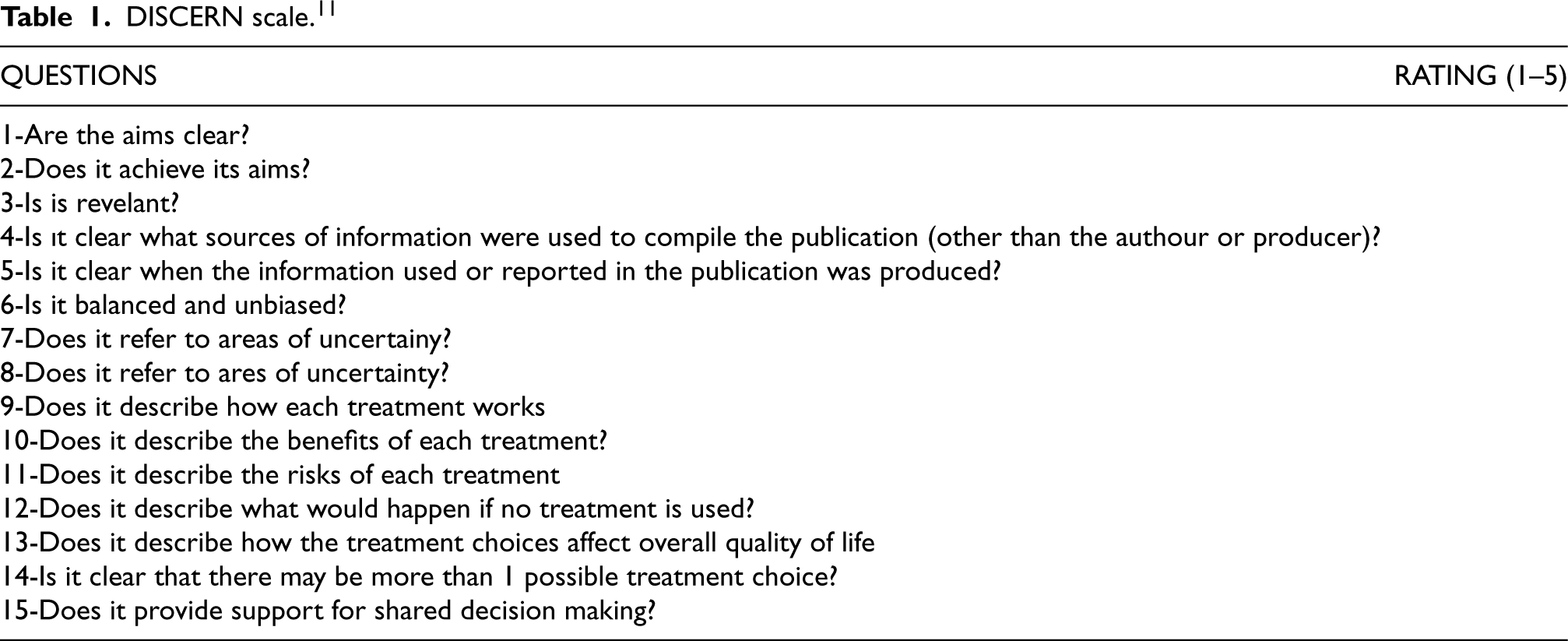
Two independent neurosurgery specialists with expertise in dynamic stabilization evaluated each video using the DISCERN tool. Additionally, six categorical variables, three continuous variables, and four direct questions (listed above) were used in the assessment.
Statistical analysis
Descriptive statistics, including frequency distributions and percentages, were calculated for categorical and continuous variables. Ninety-five percent confidence intervals (95% CI) were computed for all metrics.
To analyze differences in mean DISCERN scores between subgroups of categorical variables, the Mann–Whitney U test was employed. For continuous variables, Spearman's rank correlation was used. Regression analysis was performed to determine the relationship between DISCERN-1 and DISCERN-2 results and the associated continuous variables. All statistical tests were conducted using a two-tailed hypothesis with α = 0.05.
Results
This study analyzed 30 YouTube videos related to dynamic spinal stabilization. A wide variation was observed in video engagement metrics and content quality.
Descriptive analysis
The most frequently contributing channel was The London Spine Unit – Harley Street UK, which uploaded 4 of the 30 videos. View counts ranged from 110 to 9,425,750, with an average of 47,300.05 views. The longest video was 20 min and 27 s, while the shortest lasted 37 s, with an average duration of 6 min and 26 s.
In terms of user interaction, the most liked video received 217,000 likes, and the most disliked video received 129 dislikes. The average number of likes was 843.62, and the average number of dislikes was 1.09. Comment activity ranged from 0 to 1,976, with an average of 20.91 comments per video.
Content characteristics
Among the 30 videos evaluated:
28 videos featured a speaker with medical training. 6 videos provided information about the surgical procedure. 4 videos discussed the principles of dynamic stabilization. 8 videos contained information regarding the pre- and postoperative periods.
The mean DISCERN scores were as follows:
First evaluator: 39.40 ± 10.43 Second evaluator: 38.90 ± 10.20
Comparative analysis
The DISCERN scores were significantly higher in videos that included specific types of information:
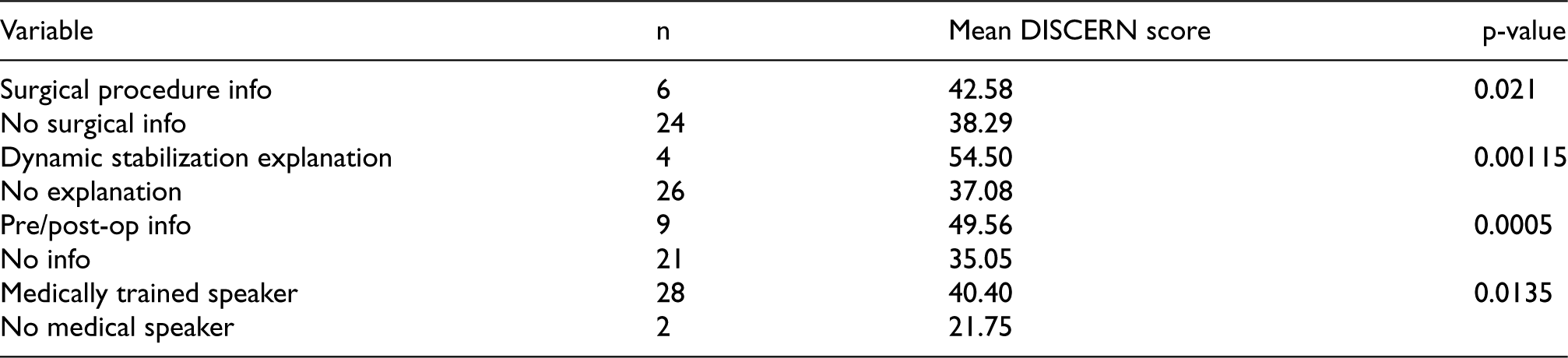
Also, Table 2 provides a full summary of DISCERN-1 and DISCERN-2 results across these categorical variables.
Average analysis results of DISCERN-1 and DISCERN-2 according to categorical variables.
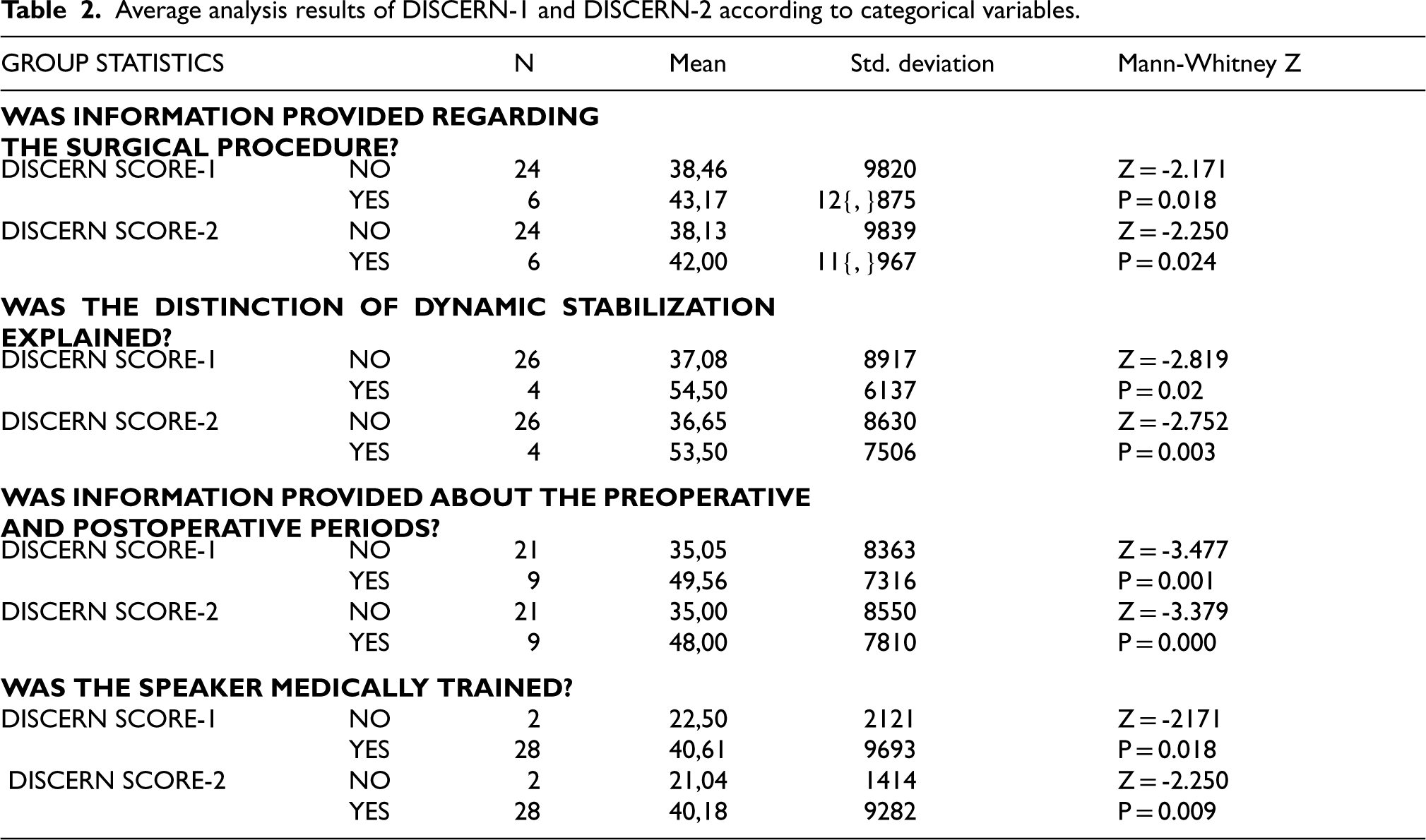
A positive correlation was found between the variables and the DISCERN-1 score.
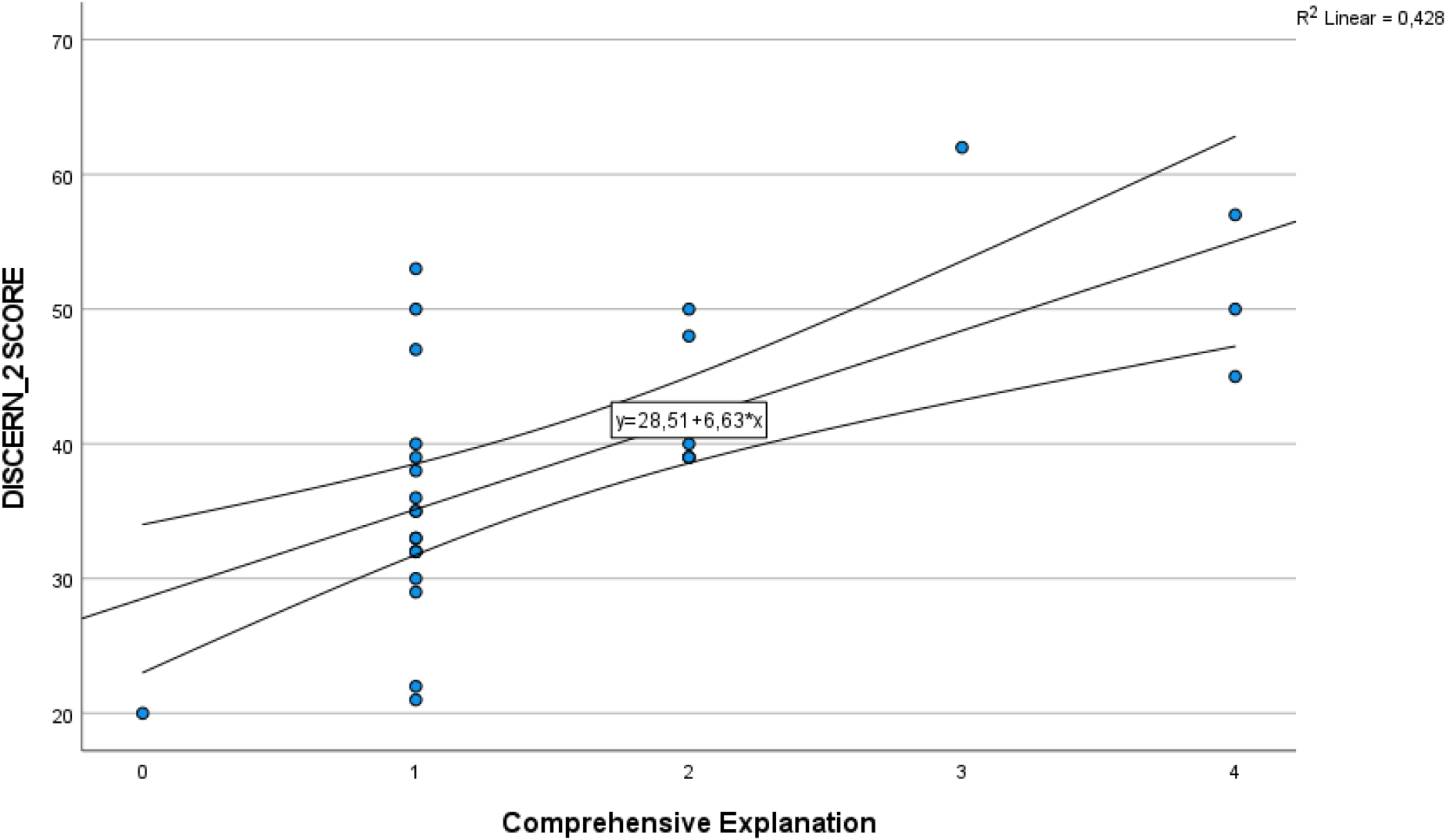
A positive correlation was found between the variables and the DISCERN-2 score.
Correlation analysis
Several statistically significant correlations were observed:
Video views and duration: r = 0.21, p = 0.001 Views and likes: r = 0.796, p = 0.001 Duration and likes: r = 0.513, p = 0.001 Duration and average DISCERN score: r = 0.19 Views and DISCERN score: r = -0.28 (negative correlation) Likes and DISCERN score: r = -0.167 (non-significant)
A strong correlation was observed between DISCERN-1 and DISCERN-2 scores: r = 0.957, p < 0.001.
Regression analysis
When a video included at least one of the following—information on dynamic stabilization, surgical procedure details, pre- and postoperative guidance, or presentation by a medical professional—the mean DISCERN-1 score increased by 7.09 points per variable (r = 0.684). The regression equation was: DISCERN-1 = 28.293 + 7.09X + E.
Similarly, the DISCERN-2 score increased by 6.63 points per variable (r = 0.684), with the regression equation: DISCERN-2 = 28.51 + 6.63X + E.
Figures 1 and 2 illustrate these regression models and correlation coefficients.
Discussion
In this study, YouTube videos related to dynamic spinal stabilization were evaluated using the DISCERN scale to assess their quality in providing reliable information to patients and their relatives. The proliferation of internet access and digital platforms has made health-related information more accessible than ever before. 16 Due to their visual and auditory components, video-based platforms are generally preferred over text-based websites, especially by lay audiences. 17 Among these, YouTube stands out as one of the most widely used platforms, offering extensive content variety, multilingual accessibility, and high-definition visual quality. 11
However, the abundance of content on YouTube also includes a considerable proportion of low-quality and potentially misleading videos. 18 This is especially concerning for patients undergoing complex decision-making processes, such as those considering spinal surgery. During the preoperative period—often accompanied by anxiety and uncertainty—many patients turn to social media for information. Inaccurate or incomplete content can lead to unrealistic expectations, poor adherence to treatment, and even the refusal of beneficial surgical procedures.19,20
Fox et al. demonstrated as early as 2006 that approximately 75% of patients use online and social media platforms to support medical decision-making. 21 This statistic underscores the importance of ensuring the accuracy and reliability of online health content. As the impact of social media continues to grow, so does the responsibility to provide evidence-based, patient-friendly educational material. 22
The rising prevalence of degenerative spinal conditions, driven by an aging population and sedentary lifestyle patterns, has increased the number of patients requiring surgical intervention to restore spinal stability. 23 Among the available surgical techniques, dynamic stabilization has emerged as a less invasive alternative to traditional rigid fusion, offering theoretical benefits such as reduced rates of adjacent segment disease, instrumentation failure, and pseudoarthrosis.24,25 As a result, understanding the comparative advantages and limitations of dynamic stabilization is essential for informed patient consent and appropriate treatment selection.
Patients recommended for dynamic stabilization must be equipped with clear, accurate, and comprehensible information. High-quality video content can help bridge the gap between complex surgical concepts and patient understanding, allowing for more informed decisions and realistic expectations regarding treatment outcomes. 15
In the present analysis, we found that the overall DISCERN scores of YouTube videos on dynamic stabilization were generally low. Notably, even videos with high engagement—measured by views, likes, and comments—often scored poorly in terms of quality and reliability. This suggests a concerning mismatch between popularity and educational value. Videos created by individuals with medical training achieved higher DISCERN scores but tended to receive less viewer engagement, likely due to complex terminology or presentation style that may not be easily understood by lay audiences.
Importantly, videos that clearly explained the surgical technique, delineated the distinctions between dynamic and rigid stabilization, and addressed preoperative and postoperative considerations had significantly higher DISCERN scores. However, these videos did not receive proportionally higher engagement metrics, highlighting the need for content that is both informative and appealing to general viewers.
Taken together, these findings indicate that YouTube currently does not serve as a consistently reliable resource for patients seeking information on dynamic stabilization. To improve the educational value of content on such platforms, healthcare professionals should aim to create videos that are both medically accurate and viewer-friendly. Furthermore, implementing a review or accreditation system—such as having videos assessed using standardized tools like the DISCERN scale before publication—could enhance content quality and guide patients toward trustworthy sources. 14
Conclusion
YouTube and other video-sharing platforms offer easily accessible content that can help reduce preoperative anxiety by facilitating information exchange among patients with similar conditions. When patients and their families have access to accurate, high-quality educational videos, they are better equipped to understand available treatment options and make informed decisions, ultimately improving treatment outcomes.
The role of social media in modern health education is both significant and growing. Consistent with our findings and previous literature, videos produced by medically trained professionals tend to demonstrate greater reliability and educational quality. Therefore, healthcare providers should be encouraged to engage more actively on social media platforms and to develop content that is both accurate and accessible. Producing informative, patient-centered, and visually engaging videos can enhance public understanding and contribute to better health literacy.
Footnotes
Funding
The authors received no financial support for the research, authorship, and/or publication of this article.
Declaration of conflicting interests
The authors declared no potential conflicts of interest with respect to the research, authorship, and/or publication of this article.
Conflict-of-interest disclosure
The authors declare no competing financial interests and no sources of funding and support, including any for equipment and medications.
