



Abstract
The changing nature and demands of work raise concerns about how workers can find time for activities such as friendship and leisure, which are important for well-being. This article brings friendship into the work-life debate by exploring how individuals do friendship in a period characterized by time dilemmas, blurred work-life boundaries and increased employer- and employee-led flexible working. Interviews with employees selected according to their working time structures were supplemented by time use diaries. Findings indicate that despite various constraints, participants found strategies for making time for friendship by blurring boundaries between friends and family and between friends and work. However, the impacts of flexible working time structures were complex and double-edged.
Keywords
Introduction
While work-life scholars acknowledge the need to focus on multiple life roles, knowledge about what constitutes life beyond work and family domains remains limited (Gambles et al., 2006). Although some work-life balance measures include an item on time for friends (e.g. Dex and Bond, 2005), this issue is rarely explored in depth. Relationships based on friendship are a source of social glue, important for well-being and social integration, particularly in the provision of social support (Spencer and Pahl, 2006; Uchino, 2004). However, there is some concern that such relationships are being squeezed out by growing demands of paid work in contemporary contexts (e.g. Williams et al., 2008).
Lack of time and feelings of ‘busyness’ are frequently reported features of modern life (Lewis, 2003) and finding time for both work and personal life is often a major challenge facing today’s workers (Rotondo et al., 2003). Trends towards long hours and intensification of work are widely reported (e.g. Kelliher and Anderson, 2010). This so-called ‘time crunch’ has been related to emerging forms of flexible working in various guises associated with continuously changing global markets (Rubery et al., 2005), which can exacerbate work-life challenges. Workplace solutions are largely sought through flexible working arrangements (Kossek et al., 2010). Yet such opportunities must be understood within the context of employers’ prerogative to organize work according to fluctuating production/service needs, a situation which also places demands on employees, e.g. extended work and irregular schedules (Costa et al., 2004). Moreover, flexible work arrangements can be double-edged since opportunities to decide when and where work is performed require employees to negotiate and ‘control’ their own time (Peters et al., 2009). Technology adds to this complexity by enabling employees to continue working after physically leaving the workplace, although the extent to which this leads to increased time pressure is contested (Bittman et al., 2009). Nevertheless, sustaining work and personal life boundaries is often challenging (Chesley, 2005).
The focus on work-related time pressures may have deterred researchers from studying the role of friendship in the work-life equation. Grey and Sturdy (2007) argue that although friendship is an important aspect of organizations, it is neglected because it was traditionally considered part of the private sphere. Both ethnographic studies of organizations (e.g. Kanter, 1977) and sociological studies on friendship (e.g. Spencer and Pahl, 2006) demonstrate interactions between friendship networks, work, family and community relations. Nevertheless, research on friendships at work focuses mainly on the impacts on organizational outcomes (e.g. Riordan and Griffeth, 1995; Song and Olshfski, 2008). A few studies of friendship within and beyond the workplace indicate its value for individual well-being and life satisfaction, vice versa, and the reported distress when such relationships are under strain (Parris et al., 2008; Spencer and Pahl, 2006). However, current understanding of how friendships are managed and sustained by workers in contemporary, time-squeezed workplaces is limited. This article therefore focuses on how workers find time for friends both in work and personal life and on the role of blurred work-life boundaries and flexible working arrangements in relation to friendship.
Understanding friendship
Despite longstanding scholarly attention, clear definitions of friendship remain problematic (Pahl, 2000; Spencer and Pahl, 2006). Contemporary concepts such as ‘families of choice’ and the ‘collapse of community’ demonstrate that relationships beyond kinship are becoming more prevalent and that individualization trends in society mould relationships (Smart and Neale, 1999). Overall, friendship is usually considered to differ from family relationships by its self-chosen and voluntary nature (Allan, 2005). Yet, the distinction between given and chosen ties is problematic since friends may become family-like and vice versa. Such suffused boundaries illustrate that friend-based communities can also include levels of commitment and obligation (Spencer and Pahl, 2006). Despite these complexities, scholars generally agree that friendship signifies informal ties between people who support each other in various ways. This may be, for example, by sharing information and practical assistance (instrumental support) and by being empathic and caring (emotional support) (Goldsmith, 2007). Friendship can take various forms and represent different levels of intimacy (from associates to soul mates), immediacy (irregular or regular contact) and stability (fixed, progressive and variable) (Spencer and Pahl, 2006). Friendship is thus considered highly context-dependent, changing across the life-course, for example in relation to work and family phases. Given the amount of time that people spend at work, close work-based relationships often evolve (Sias et al., 2004). Workplace friendships may be instrumental, for example in terms of improved information-sharing and creative/innovative problem-solving (Song and Olshfski, 2008). These relationships may also involve emotional support. Nevertheless, such close bonds may also include risks such as competition between status equals or status difference complicating relationships (Spencer and Pahl, 2006). Moreover, work schedules such as shift work and long hours can squeeze time for friendship outside of work (Spencer and Pahl, 2006). Within personal life, parenthood appears to place particular strain on friendships in the context of time and energy consuming family and career commitments (Bost et al., 2002). Thus, ‘consuming’ friendships are often relinquished, and relationships with friends who also have children often evolve on the basis of instrumental support (e.g. advice and mutual childminding) (Spencer and Pahl, 2006).
In this article the concept of ‘doing’ friendship is adopted to denote friendship relationships as fluid and highly contextual practices (Morgan, 1999) that emerge when individuals enact influence on conditions for friendship, particularly in the context of intensified work and family lives and blurred boundaries.
Theoretical framework
In exploring how individuals actively create time for friendship, this article moves beyond the deterministic conflict approach dominating much work-life literature. Scope for individual action is explored via the organizational participation approach (Heller et al., 1998) and work-family border theory (Clark, 2000; Nippert-Eng, 1996), which are treated as complementary. The former focuses on the importance of employees’ opportunities to exert some influence over their working conditions (Strauss, 1998: 15). Participation can take different forms, involve various levels of intensity and be applied in several areas (Heller et al., 1998). This article focuses on how flexible working time systems, as an example of employer-driven flexibility, both impose boundaries on and facilitate employees’ space of action. There is considerable evidence of the benefits of participatory practices in facilitating work-life interplays in general (e.g. Shockley and Allen, 2007) and particularly in relation to shift work (Jeppesen et al., 2006). Yet other studies found that employer-driven schedule irregularities and work overload are related to work-family conflict (e.g. Yildirim and Aycan, 2008), a finding which illustrates the need to understand agency within organizational structures.
Work-family border theory enables the ways individuals do friendship when domain boundaries are blurred to a greater or lesser extent to be examined. This approach positions individuals as ‘daily border crossers’ who make transitions between work and non-work domains. The extent to which individuals integrate or segment work-life domains depends on their perceptions of boundaries’ flexibility and permeability (Clark, 2000). While the ideal-typical integrator behaves the same way in different domains, the extreme segmentor understands domains as mutually exclusive (Nippert-Eng, 1996). In reality, people fall somewhere in between, combining segmenting and integrating practices. Border-crossing is characterized by temporal, spatial and psychological transitions and people’s integration/segmentation strategies can vary independently of each other. Hence, a person can be highly separating in one area and integrating in another.
Although both organizational participation and border theory acknowledge that people take part in shaping their environments, people are also considered to be shaped by these environments. For example employers’, colleagues’ and partners’ expectations can be highly influential relational constraints (Clark, 2000). Structural constraints include various work-life conditions, among others. This study focuses specifically on flexible working time arrangements as the structures within which individuals exert influence, manage borders and do friendship.
Based on this framework, three research questions were identified:
How do workers find time for friends in the context of the ‘time crunch’?
How do boundary segmenting and integrating practices (the extent of boundary blurring) affect how workers do friendship?
How do flexible working time systems shape friendship practices?
Methods
The research reported here is part of a larger study on work-life interactions and the importance of influence on working time. A predominantly qualitative approach was adopted to explore friendship dynamics from a work-life perspective.
Participants
In this study, a purposive sampling approach (Miles and Huberman, 1994) based on two predetermined criteria was applied:
1) temporal structure of work hours; and
2) number of work hours.
The former was sub-divided into daytime work per se (6 a.m. to 6 p.m. on weekdays) and beyond (some evening, night and/or weekend work). The latter included part-time work (33 hours or less per week), full-time work (34–37 hours per week) and extended work, also termed boundaryless work (more than 37 hours per week). Extended work differed from the other systems because working hours depended on workload and speed of task accomplishment. Moreover, although formal working hours were 37 hours for all participants, boundaryless workers’ contacts specified an expectation of considerable overtime (actual work hours typically above 45). A selection matrix was developed based on these predetermined criteria: part-time day work (N=1), part-time shift work (N=1), full-time day work (N=4), full-time shift work (N=9) and extended work (N=3). As a supplementary criterion, participants were also selected to reflect variations in parental status: singles, living with a partner without children, single parents and parents living with a partner and children. This made 18 participants, eight men and 10 women, with an average age of 35 (see Table 1).
Overview of participants
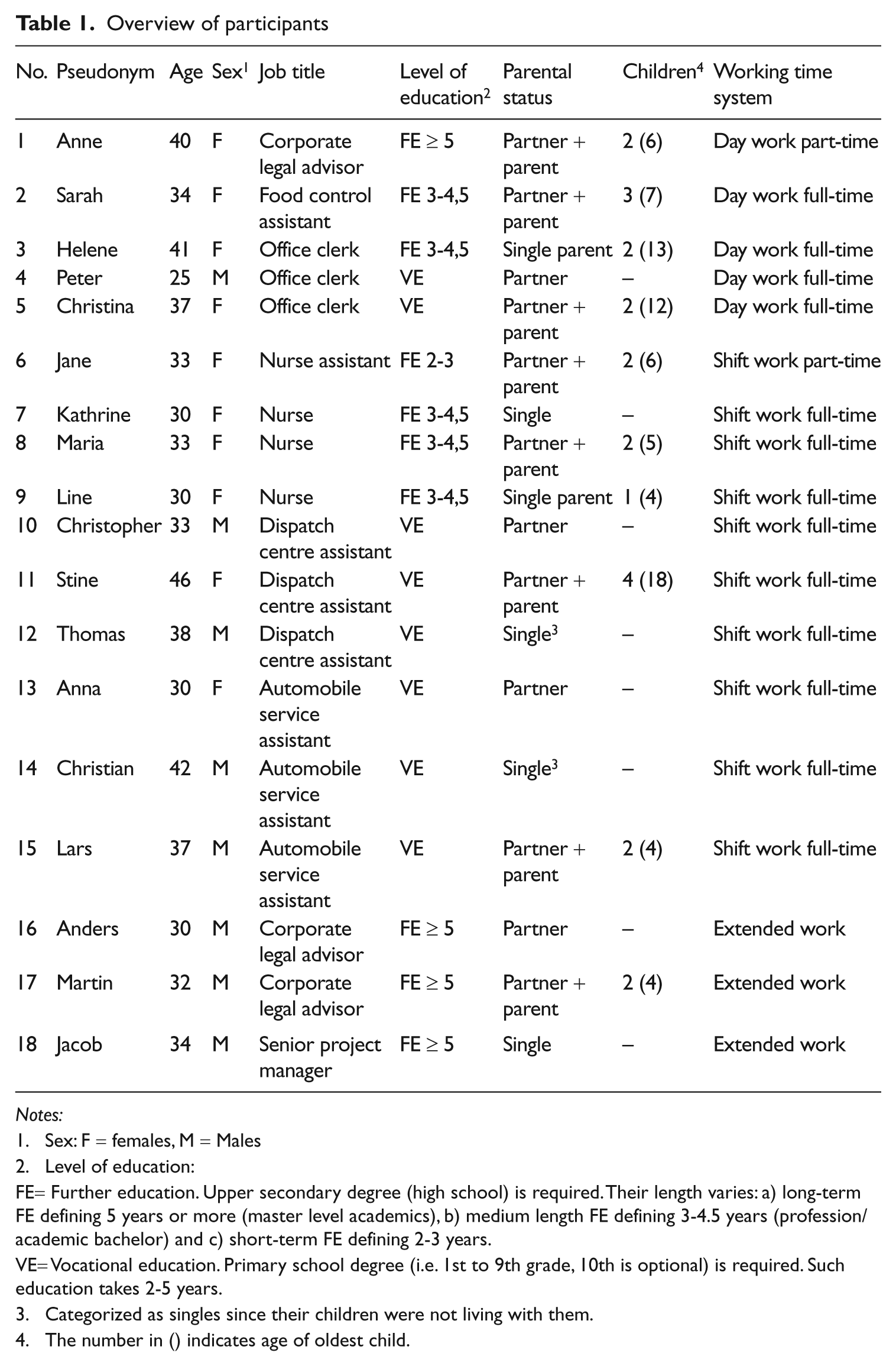
Notes:
Sex: F = females, M = Males
Level of education:
FE= Further education. Upper secondary degree (high school) is required. Their length varies: a) long-term FE defining 5 years or more (master level academics), b) medium length FE defining 3-4.5 years (profession/academic bachelor) and c) short-term FE defining 2-3 years.
VE= Vocational education. Primary school degree (i.e. 1st to 9th grade, 10th is optional) is required. Such education takes 2-5 years.
Categorized as singles since their children were not living with them.
The number in () indicates age of oldest child.
Two points are important regarding the sample used. First, the design allowed recommended criteria for data saturation in smaller, in-depth studies (Guest et al., 2006) to be met, because:
1) the sample included a relatively homogeneous population (i.e. early/mid-career workers who were pre-parenthood or had young children);
2) interviews used a similar set of open-ended questions for all participants (i.e. semi-structured); and
3) the familiarity of the central concept meant that fewer participants were required to provide an understanding of friendship dynamics (there was widespread agreement among participants that friendship is a fundamental part of life).
Second, the variance in sample composition allowed for grounded exploration of the research questions and permitted comparison to clarify whether findings were simply idiosyncratic or consistently demonstrated by several cases (Eisenhardt and Graebner, 2007).
Participants came from five Danish organizations: three production companies, a public hospital department and an automobile service company. Shift workers included nurses and automobile assistance workers who either coordinated the services (dispatch centre) or provided on-site aid. The daytime workers performed basic office jobs, including production planning and control, store management and bookkeeping. The boundaryless workers undertook legal or strategic business tasks (see Table 1).
There are both relatively unique and generic aspects of the Danish policy, industrial relations and employment context. Specific aspects include the so-called ‘social democratic’ welfare model (Esping-Anderson, 1990) in which work-family reconciliation is considered a shared social responsibility. Hence, paid parental leave and guaranteed day-care ensure high rates of women’s full-time employment and a relatively gender-equitable system (Gupta et al., 2008). Given a strong collective bargaining tradition, few working time policies and regulations are secured solely by legislation. Rather, employers’ flexibility in organizing work hours depends on central or local agreements between labour market parties. Thus, the Danish employment system is characterized by a wealth of negotiated rights and conditions. Moreover, the Danish flexicurity model, which aims to integrate both flexibility in employment and economic security for workers (Madsen, 2004), may also be a salient indirect aspect of the wider context. Nevertheless, Denmark is subject to more generic, global trends such as the intensification of work and blurred work-life boundaries (Albertsen et al., 2010) and gendered practices, which can undermine work-life friendly conditions (Holt and Lewis, 2009).
Methods
Semi-structured interviews constituted the primary data source. These data were supplemented by time diaries. The interviews (one and a half hours on average) focused on perceptions of friendship and friendship behaviour in relation to flexible working arrangements, time dilemmas and work-life boundaries. The diary, which was introduced after the first interview, comprised six categories of everyday activities identified from a pilot study. Over seven days, the participants were asked to note at the end of the day or no later than the following day how many hours they spent every day on
1) work and related activities,
2) family and partner,
3) friends and leisure (i.e. time without family and partner),
4) personal time,
5) housework/practical work and
6) sleep (total 24 hours).
When activities coincided, they rated which category they resembled most. Participants also signified whether the week was typical and, if not, how it differed. The diaries were collected at a follow-up interview, which centred on experiences of completing the diary and further questions not fully explored in the first interview. In total, this makes 18 diaries and 36 interviews. The combination of interviews with time diaries allowed the relationships between quantitative time estimates and personal experiences of time dilemmas, blurring boundaries and flexible working systems in relation to friendship to be captured.
Analysis
The selection criteria allowed both within-case and between-case analyses. Descriptive statistics were derived from the diaries in relation to the average time allocation and cross-group variations (see Table 2). Crude time diary analyses have been much criticized (e.g. Gershuny and Sullivan, 1998) and their limitations are illustrated by the varying standard deviation in the current sample. Nevertheless, the intention was not to interpret these estimates alone, but to provide a preliminary view of friendship practices which informed the interview analyses. These were based on Miles and Huberman’s (1994) interactive model in which data collection, reduction, display and conclusion-drawing constitute a continuous process. Each interview was first analysed separately to generate in-depth insights into each respondent’s ways of doing friendship. Comparative analyses were then performed; first, in relation to the various working time systems and second, in relation to parental status.
Means and standard deviations based on diary data: amount of hours spent on various activities per day

Notes:
N = Number of participants.
Numbers in () refer to standard deviations.
One participant had joined online computer games with friends which explains this high amount.
One participant changed personal status from single (at the interview) to living with a partner (before the diary was completed) which explains the different numbers to Table 1 (i.e. 4 singles, 4 living with a partner).
Findings
Analyses revealed that friendship constituted a particularly crucial part of participants’ lives, and that friendship practices were strongly shaped by work-life structures. Below, time patterns based on diary analyses are presented, followed by the more in-depth interview findings.
Time allocation: how much time was spent on friendship?
Diaries indicated that on average participants spent 1.4 hours per day on friendship/leisure with more time for friends during days off (1.9) than during work days (1.0) (see Table 2). There was no substantial gender difference, but parental status and working time systems were important. Regarding the former, parents spent least time on friendship/leisure (0.8), whereas non-parents living with a partner and single parents spent almost the same amount of hours (1.2/1.3). Singles spent most time on friends/leisure (2.9). In terms of working time systems, shift workers spent considerably more time on friends and leisure (1.7) than daytime workers (0.7) and extended workers (0.9), but also worked the least (5.3). Boundaryless workers worked the most (7.3). About one third (six out of 18) noted the week as atypical. Nevertheless, the diary data highlight considerable cross-group variation in time allocation, especially due to parental status and working time systems. This demonstrates the profound life-course and context dependencies in friendship (Spencer and Pahl, 2006). These descriptive statistical patterns fed into the qualitative analysis of the personal experiences and meanings attached to ways of doing friendship, which are discussed below.
Doing friendship within the context of work and personal life structures
Friendship was described as the sharing of common experiences and interests, for example, with respect to a particular context (e.g. workplace, mother’s group) or activity (e.g. sports, volunteer work). Friends were identified as former and current colleagues, shared friends via partner, family members and friends via education or hobbies. Meanings and functions of friendship varied and included different levels of intimacy, frequency of contact and types of support. In addition, some friendships existed in only one domain, while others were enacted across work and family. Friendship was also sustained remotely, for example via phone or Facebook. It became clear that the participants were active in defining and managing boundaries in relation to friendship in diverse ways. Some participants blurred physical and temporal boundaries greatly, others combined integrating and segmenting practices and a third group endeavoured to keep roles apart. Yet, strategies for managing psychological boundaries in relation to physical and temporal boundaries were highly context-dependent. In particular, two dynamic patterns were revealed: blurring between friendship and family and between friendship and colleagues. While the former was clearly linked to parenthood as a particular life-course phase, the latter represented a general context-dependent strategy among all participants.
Time-squeezed parents: blurring family and friendship relationships
Lack of time was widely reported as a major obstacle to friendship, particularly among parents. As a father explained: It’s now a question of getting home, having dinner, and tucking in the children. After that there’s not much time left … I think I’ve enough time [for family], it’s more all the other stuff [that suffers] … such as seeing my friends. (Martin, aged 32)
While family needs and work came first in this phase, friendship was sometimes viewed as a necessary sacrifice. However, both number and age of children were important factors with more and younger children increasing time dilemmas.
Diaries showed that single parents and non-parents living with a partner spent almost equivalent amounts of time on friends and leisure. Interview analysis revealed that most of the single parents shared parenting responsibilities with their ex-partners and therefore had more time for friends than parents living with a partner. This illustrates the different levels of commitment as parents and partners and the potential benefits of single parenthood. However, time for friends always had to be organized with ex-partners and planned well in advance, ruling out spontaneous invitations.
Despite considerable time demands, parents did not passively relinquish friendship, but specifically blurred boundaries between family and friends. In doing so, parents integrated the roles of partner, parent and friend and thus simultaneously fulfilled various interests. However, this ‘time saving’ strategy limited parents to interactions with friends who also had children. Other more time ‘consuming’ friendships, such as with friends not living locally or without children, were easily neglected in this period. Doing friendship as a family also meant adopting some of their partner’s friends and such ‘forced’ acquaintances varied in terms of intensity and meaningfulness. Rather than discussing instrumental functions of family-based friendship, these parents stressed the importance of sharing experiences with friends and simply enjoying some time together as families. The time saving and multi-tasking nature of family-based friendship was thus highly relational and enacted in pragmatic ways.
Flexible working contexts: blurring colleague and friendship relationships
Since the participants were in their early/mid employment phase of life, work constituted another important context for doing friendship. Consequently, blurring boundaries between friends and colleagues was a dominant friendship practice among all participants. The level of closeness seemed to depend on how well they matched each other personally, but also on their relative position in the organizational hierarchy. For example, one participant explained how a close colleague’s promotion resulted in a more distanced relationship. Many participants also discussed spending time with colleagues outside work, although such physical and temporal boundary blurring did not necessarily indicate closer collegial bonds. Nevertheless, various positive impacts of friendship relationships at work emerged. First, the findings illustrate how instrumental support can enhance work performance. Many participants described ways in which close relationships with co-workers led them to become more collaborative, willing to share and distribute tasks and ready to provide professional help and guidance. Some workers also explained that they accepted calls at home from work friends who, for example, needed assistance on a task. There were also examples of workplace relationships that had grown closer and more intimate and how such close collegial bonds made work more enjoyable. One woman described, for example, how workplace friendships encouraged her to stay in her job even though it lacked professional challenges. Others described how social interactions with colleagues had enabled them to become more open and outgoing outside of work. This transfer of social skills from work to personal life via friendships resembles the notion of work-life enrichment (Greenhaus and Powell, 2006). Other participants emphasized that sharing negative work experiences (e.g. a work accident) or general worries can have a buffering effect, thereby reducing potential negative spill over to family. Taken together, workplace friendship had potential win-win outcomes in term of increasing workers’ motivation, commitment and job satisfaction, and thereby supporting organizational productivity and effectiveness.
Despite these promising outcomes, workplace friendship proved to be complex and multifaceted. Friendship practices were often shaped by specific working conditions. For example, in interdependent team contexts, workers were expected to cover for each others’ absences and they described how close colleague relationships often made them feel guilty when they were unable to go to work: It’s also like, for example, if you’re sick, you feel very bad because you know that the others … have to work two hours more because you’re not in. (Peter, aged 25)
In this context, workplace friendship could involve subtle social control and cause inappropriate levels of commitment. Open plan offices were also double edged in their effects on friendships. While participants described feeling more involved in their colleagues’ personal lives because of frequent and close interactions embedded in such arrangements, they felt that this sometimes left less energy for friendship outside work. For some this was a potential drawback, but for many parents it emerged as a potential time saving strategy, fulfilling their friendship needs.
How working time arrangements mould friendship beyond work
The impact of working time arrangements on ways of doing friendship outside work was also complex, particularly in relation to shift and boundaryless work. Previous literature on shift work points to detrimental social consequences (Pisarski et al., 2008). Yet, as the diaries indicated, it was the shift workers in this study, whether or not they were parents, who found the most time for friends, despite restricted schedule flexibility in shift design (i.e. switching/requesting shifts). It became clear from the interview data that it was the occasional days off during the week within their employer-designed schedule that were crucial for facilitating friendship. All shift workers talked about the importance of these free days for seeing friends. However, these opportunities were limited to relationships with other shift workers, including current colleagues who happened to have a day off.
This also complicated friendship, both because friends’ schedules were not always compatible and because friendship took place on an irregular basis due to varying rotas. Adding to this complexity, shift workers sometimes cancelled socializing plans because evening and night shifts were exhausting. Thus, employer-led flexible working simultaneously facilitated and constrained friendship. Nevertheless, these workers did not wish to change to traditional day time schedules: No, I would prefer not to [stop shift working] … I don’t think I would know how … I wouldn’t have anyone to play badminton with … since all my friends do shift work. (Lars, aged 37)
Hence, the potential advantages of shift work in terms of friendship seemed to outweigh the disadvantages. However, it is important to stress, as the diary data also illustrate, that the shift workers worked the shortest hours and thus had more free time. Moreover, such preferences may be influenced by self-selection.
Boundaryless workers, in contrast, worked the most hours and many experienced shortage of time in general. Nevertheless, they described how they managed, within these constraints, to make use of flexible schedule opportunities in terms of friendship: We can’t get overtime payment … so flexibility is the only thing they can give us, and I really think we should use it [for seeing friends and family]. (Jacob, aged 34)
The substantial flexibility embedded in extended work made it possible for this worker to do friendship. However, not all boundaryless workers actually used these opportunities as some feared that this may be career limiting. Moreover, given that overtime was expected on a regular basis, whatever the level of flexibility, little time remained for other activities. Thus, the impact of boundaryless work on opportunities for doing friendship was mixed.
Finally, no relationships were found between flexibility (i.e. flexi-time and -place) within daytime work and friendship practices. These workers generally used such flexibility for family commitments. Nor did the analysis reveal particular friendship relationships among part-time workers, although this may be because only two part-time workers participated in this study.
In sum, the findings demonstrate that friendship practices were strongly shaped by specific work contexts and by parenthood. Workplace friendship provided potential emotional and instrumental support, but also involved possible drawbacks related to interdependent teamwork and open-plan offices. Regarding friendship outside work, flexible working time arrangements strongly influenced when, with whom and how often friendship could take place. Parenthood also shaped ways of doing time saving friendships by blurring boundaries between partner, parent and friends. This particular type of friendship evolved on the basis of shared parenting commitments and understanding. Yet, family-based friendships were often at the expense of personal and often more time consuming friendship forms, especially with non-parents.
Discussion and conclusion
This article focuses on friendship practices in work and personal life. Its main contribution is to bring friendship into the work-life debate, in the context of time dilemmas, blurring work-life boundaries and flexible working time arrangements. Friendship emerged as an important part of life for these participants, who found ways of integrating friendship into their busy lives despite various constraints. Specifically, the present study offers three key contributions. The first two relate to an understanding of how individuals do friendship, and the third concerns implications for further research and practice.
First, this study’s findings extend existing literature on work-life boundaries in various ways. Despite time constraints, especially for parents, and despite the strong influences of working time conditions, participants found ways of doing friendship by blurring boundaries between friends and family and friends and colleagues, respectively. The potential benefits of boundary blurring found in this study challenge previous research which suggests that blurring increases the risk of work invading non-work (e.g. Gambles et al., 2006; Olson-Buchanan and Boswell, 2006). On the contrary, these findings illustrate how blurring partner, parent and friendship roles and seeking a sense of relatedness through work characterized time saving strategies, which allowed parents to do certain types of friendships. Moreover, blurring co-worker and friendship boundaries was important for friendship practices for all participants, and like previous research (e.g. Song and Olshfski, 2008), the present findings have demonstrated that friendship can have a positive impact on work, both instrumentally and emotionally, by enhancing work performance, job motivation and satisfaction. Furthermore, an unexpected finding was that workplace friendship can extend positive effects beyond work through, for example, cross-boundary enrichment (Greenhaus and Powell, 2006).
However, despite the potential benefits of these blurring practices there were also drawbacks. Consistent with previous friendship literature, the findings show that intra-organizational factors (e.g. status difference) can complicate workplace friendship and that working schedules such as shift work and long hours can squeeze time for friendship beyond work (Sias et al., 2004; Spencer and Pahl, 2006). Beyond this, however, the findings suggest that interdependent teamwork can generate subtle social control and feelings of guilt and that physical work structures in some situations (e.g. open-plan offices) can exacerbate time dilemmas outside of work. The influences of flexible working time arrangements on friendship beyond work were also complex. Thus, shift workers who had the most limited schedule flexibility found most time for friendship, albeit mainly with other shift workers. In contrast, boundaryless workers with the most personal flexibility found least time for friendship. This paradox can be explained by differences in workload and number of hours actually worked, which, in turn, are linked to occupational norms and values (Lewis, 2007). Boundaryless workers, by definition, often expected and were expected to use flexibility to prioritize work over personal life (including friendship), while no such expectations applied to the shift workers. Regardless of working patterns, parenthood placed considerable strain on friendship, particularly on relationships not based on family, as reported elsewhere (Spencer and Pahl, 2006). Yet, while previous research has highlighted the instrumental functions of family-based friendships (Spencer and Pahl, 2006), the present findings indicate that these friendships centred on social get-togethers and sharing personal experiences in a highly pragmatic way (i.e. time saving and multi-tasking).
Work-life research is often criticized for lacking theoretical grounding (Geurts and Demerouti, 2003). The second contribution relates to the strength of building the research on organizational participation and work-family border theory. This framework highlighted the crucial role of work-life conditions in understanding friendship. Building on literature on relationships in flux (e.g. Morgan, 1999), the present authors explored the dynamic and context-dependent processes characterizing ways of ‘doing’ friendship while also recognizing how these are shaped by structural and contextual constraints. Specifically, these findings demonstrated that integrative and segmenting friendship strategies were not mutually exclusive and that borders were dynamic in time and space.
Despite the strength of combining two data sources to identify dynamics of time use and friendship, this design also has limitations. First, the value of the quantitative data is limited by the small number of diaries. The standard deviations question the extent to which these findings are comprehensive and internally generalizable among the participants. Second, the diaries did not clearly differentiate between friendship and leisure and this may have prevented more nuanced quantitative data. Third, the diary data may be subject to recall errors since participants were asked to note the former day’s activities. A prospective design in which participants record activities as they occur may better capture blurring practices. Finally, a larger sample may have enabled more profound group variances to be determined in relation to friendship.
Notwithstanding these limitations, this study’s third contribution regards implications for research and practice. First, this study extends research on work-life boundaries by showing that blurring boundaries can facilitate friendship, despite various constraints. It may be that boundary blurring is particularly characteristic of the 21st century way of doing friendship. An alternative conclusion, however, is that blurring of relationships is unrelated to time dilemmas and flexible working, but simply demonstrates that ‘work’ and ‘personal life’ are more porous than dichotomous categories. Nevertheless, given the potential drawbacks of boundary blurring found in other studies (Chesley, 2005; Halford, 2006), more research is needed to clarify how and in what circumstances blurring facilitates or impedes friendship. Moreover, integrating the concept of suffusion (Spencer and Pahl, 2006) with Clark’s border theory (2000) may provide deeper insight into the complexities of given and chosen ties in relation to friendship practices, and may clarify how specialized/overlapping roles relate to separated/integrated domain boundaries. Research also needs to be alert to both the benefits and drawbacks of workplace friendships. The findings presented here point to the possibility that workplace friendship can exacerbate employee stress by making it more difficult to take time off from work in the context of highly interdependent work with friends (Plantin and Back-Wicklund, 2009). Taken together, this study’s findings support the need for research to take a holistic approach in exploring the potentials and barriers of friendship within and between life domains. The contextualized and dynamic nature of friendship found in this study also indicates the importance of further examining ways of doing friendship within a life-course perspective (e.g. Moen and Sweet, 2006). For example, the dominant tendency among the participants to do friendship at work raises the question about what happens when people change jobs, are laid off or retire.
As this study’s findings highlight the importance of context for friendship practices, it is important to consider how they may reflect the overall Danish context and/or have wider applicability. This raises some intriguing questions about policy impacts. For example, the lack of substantial gender differences in friendship strategies reported here could be related to the ‘equality’ contract underpinning this welfare system. A long tradition of family-supportive policies may also have influenced participants’ sense of entitlement to prioritize friendship compared to employees in more liberal market economies where stronger time constraints may place more strain on friendship. Although the Danish flexicurity system is not directly related to workers’ schedule flexibility, it has been associated with perceived economic security, job satisfaction and employee well-being (Origo and Pagani, 2009). Taken together with the relatively consensual industrial relations system, this may be reflected in more generalized feelings of workplace and government support, providing a basis for employees to feel comfortable in defining optimal work-life conditions and, for example, finding time for friendship by blurring boundaries. Comparative quantitative and qualitative research on friendship in other national policy contexts would help to clarify how context-dependent this study’s findings are and to identify any potential policy implications.
Nonetheless, although institutional and cultural support for work-life balance differs across national contexts, there is some evidence that these differences are being undermined by a number of more global trends, especially the intensification and extension of work (Lewis et al., 2009), blurred work-life boundaries (Gambles et al., 2006) and general experiences of time shortage (Williams et al., 2008) together with increased employer- and employee-led flexible working. Moreover, cross-national research on working time shows that organizations seem to follow some common principles when designing flexible schedules (Jeppesen et al., 2006). Thus, it seems that the present study’s findings may be highly applicable beyond the Danish context.
Finally, the findings suggest a number of implications for practice. As more organizations implement flexible working arrangements, it is important to acknowledge that friendship constitutes an important part of life beyond work. This implies a need to extend flexibility to all, not just parents (Casper et al., 2007), developing initiatives friendly to ‘personal life’. This article has discussed friendship across work and non-work domains, and future research could further explore the practical implications of current ways of doing friendship for families and communities. However, some specific implications of work-related friendships emerge from the findings presented here, which suggest that friendship at work not only contributes to employees’ well-being and satisfaction at work and beyond, but also has potential organizational benefits, increasing work effectiveness through more satisfied and committed workers. It may, however, be important to consider the role of organizing structures like open-plan offices and interdependent team work, which can both facilitate and impede friendship. One final point concerns the case of enrichment which illustrates that friendship at work can have a positive effect beyond the workplace and thus, again, friendship can play a role in facilitating integration of work and personal life. Overall, this study’s findings suggest that both organizations’ and employees’ interests can be addressed by facilitating friendship opportunities, although ways of doing friendship may vary.
Footnotes
Acknowledgements
We would like to thank Professor Hans Jeppe Jeppesen for his useful feedback and guidance with the overall study of work-life interplay of which this article is a part.
Vivi Bach Pedersen, MA in psychology, PhD in work and organizational psychology and part of the research unit LINOR (Leadership and Involvement in Organizations) at the Department of Psychology, Aarhus University, Denmark. Her PhD project explores work-life interactions from a working time perspective, focusing particularly on the interplay between employer- and employee-led flexibility.
Suzan Lewis is Professor of Organizational Psychology in the Department of HRM at Middlesex University Business School. Her research focuses on work-personal life issues and workplace practice, culture and change, in diverse national contexts. Her latest book is Work, Families and Organizations in Transition: European Perspectives with Julia Brannen and Ann Nilsen, published by Policy Press.