




Abstract
In the aftermath of the global financial crisis of 2008, youth unemployment has risen worldwide. In cross-national perspective, research on youth employment has thus far paid attention to the transition from school to work, but underemphasized the importance of the social psychology of labour market entrance. In this article, European young adults’ perceptions of the first-job opportunities in their country are analysed. The result of a multilevel regression analysis on the 2008 wave of the European Social Survey (ESS) shows that differences across countries can mainly be explained by the public’s perceptions of levels of unemployment, and public spending on education. At the individual level, youth in a precarious socioeconomic situation have a rather pessimistic view on these opportunities. Moreover, women perceive the opportunities as less positive than men while young people of foreign origin have, contrary to the expectations, a more positive outlook on the chances for young people.
Introduction
In the aftermath of the recent global financial crisis, young adults have been hit excessively hard. While the total unemployment rate in the EU27 area increased by 1.5 percentage points from 8.0 to 9.5 from January 2009 to 2010, youth unemployment rose by 3 percentage points from 17.7 to 20.9 (Eurostat, 2010a). Policy makers are aware of the importance of the integration of young people into the labour market, exemplified in the European Commission’s European Pact for Youth, which describes labour market opportunities for young people as ‘essential for ensuring a return to sustained and sustainable growth in Europe’ (Commission of the European Communities, 2005), and the recent Youth on the Move plan. Since both initiatives are especially interested in benchmarking the school-to-work transition, knowledge of this transition is of vital importance to shape policies.
Cross-national research into school-to-work transitions has thus far paid particular attention to national characteristics that condition a smooth entry into the labour market (Breen, 2005; Müller and Gangl, 2003; Ryan, 2001; Scherer, 2005). Self-evidently, this entry is facilitated in times of economic prosperity when job scarcity is at its lowest (Wolbers, 2007). Additional characteristics of the educational system and the labour market have also been invoked to explain these transitions: for example, vocational training and apprenticeships (Breen, 2005; Wolbers, 2007) which are able to match educational skills with labour market demands, and low employment protection that enables dismissing employees to create opportunities for young people (Breen, 2005; Müller, 2007; Scherer, 2005), are relevant for smooth labour market entrances.
Such structural and institutional approaches to the school-to-work transition do not, however, fully consider the range of determinants of a young person’s decision process in whether or not to enter the labour market or to opt for alternatives, like pursuing another educational goal. In this respect, social cognitive career theory (Lent et al., 1994) emphasizes the importance of physical and environmental characteristics in addition to personal agency. While the empirical research following on this theory has disentangled the link between personal assets and labour market entry (Haase et al., 2008; Pinquart et al., 2003), the environmental factors have received little attention (Lent et al., 2000). In this respect, Lent et al. (2000: 37) argue that career development is not only influenced by objective, but also by perceived contextual factors.
One of these perceived environmental factors that may hinder students’ smooth school-to-work transition regards the perception of whether the labour market is generous in offering jobs to young people. When asked about potential barriers for a first job, American college students rate a lack of labour market opportunities as the most prominent impediment, above others such as missing necessary qualifications (Lent et al., 2002: 66; Swanson and Tokar, 1991). Also, in Scotland, similar evidence has been provided by research on young people not in employment, education or training (NEET) (Furlong, 2006). Asked why they are NEET, these young people attributed external (no suitable job or course, no decent jobs or courses available) rather than internal causes (not decided what job or course to do, need more qualifications). Thus, the perception that the opportunities for work are rather limited might hinder the decision to work, giving incentives to consider alternatives.
In this article, we are interested in the individual and contextual factors from which these perceptions of labour market opportunities for young people originate in the first place. Hypotheses drawn from relevant theories are formulated and tested by analysing these perceptions among a cross-national sample of people aged 30 or younger taken from 22 countries that participated in the 2008 wave of the European Social Survey (ESS). First, the theoretical models that might explain these youth perceptions towards the labour market are introduced. Then, the used data and applied methodology is outlined, the results are presented, and the implications of the analysis are discussed. Furthermore, the findings are framed in a conclusion about youth in a volatile labour market.
Individual and context level influences on youth perceptions of first-job opportunities
In specifying our hypotheses, arguments from various sources, mainly within the literature of labour market research, are combined. Both individual and country determinants will be surveyed.
Individual level factors
A first theoretical model concerns human capital (Becker, 1962), which assumes that in an unconfounded labour market, differences in market entrance arise because of educational and skill deficiencies, leading to better access and higher rewards for people with more valuable and well developed skills (Rosenbaum et al., 1990). Empirical research on career success has shown positive correlations between schooling and, for example, levels of income (Ashenfelter and Rouse, 2000), career outcomes (Kerckhoff et al., 2001), and a smooth school-to-work transition (Bratberg and Nilsen, 2000). Additionally, with regard to perceived employability, the higher educated tend to regard their employability as significantly higher compared with the lower educated (Berntson et al., 2006). The expectation that levels of schooling influence labour market outcomes would therefore suggest that the perception of labour market chances among young people is also positively determined by one’s educational attainments.
The second theoretical model of the dual labour market provides the insight that the labour market is not monolithic but can instead be differentiated in a primary segment (with stable employment and good working conditions) and a secondary segment (with unstable employment and worse conditions) (Doeringer and Piore, 1971). As Rosenbaum et al. (1990) note, dual labour market theory usually departs from the understanding that school-leavers a priori enrol into the most precarious labour market conditions. Yet, the authors contest this idea since also at a younger age different segments can be diagnosed (Granovetter, 1981, cited in Rosenbaum et al., 1990). Moreover, concerning perceived employability, those with characteristics of the secondary segment perceive themselves as less employable (Berntson et al., 2006). One of those secondary segment characteristics, namely having had the experience of being jobless, has been shown to leave ‘scars’ on future career outcomes, like lower wages (Arulampalam, 2001; Luijkx and Wolbers, 2009). The findings that characteristics of the dual labour market result in more negative labour market outcomes leads to the hypothesis that those young adults with secondary labour market characteristics will perceive the labour market entry opportunities as rather pessimistic.
A third theoretical model, signalling theory, predicts that the labour market depends on the exchange of information, or ‘signals’ from the employee to the employer (Spence, 1973); gender and ethnicity are both examples of well described signals. Nevertheless, students of the labour market repeatedly warn that, despite no overrepresentation in European youth unemployment statistics (Eurostat, 2010b), women are still faced with disadvantaged labour market positions, such as for instance a persistent outlook of ‘sticky floors’ and ‘glass ceilings’ (Arulampalam et al., 2007). Compared with natives, then, ethnic minorities have had demonstrably less success in the labour market, which can be explained not only in terms of lack of educational success and language proficiency but also of structural discrimination on the labour market (Heath et al., 2008). Social psychological research has documented that women and ethnic minorities have internalized these objective disadvantages in the perception that they are faced with higher career barriers (Luzzo and McWirther, 2001; McWirther, 1997). Consequently, evidence from research implementing signalling theory promotes the expectation that social groups with objective signals, namely young women and young people of foreign origin, will endorse rather depressed perceptions of first full-time job opportunities.
A fourth theoretical model regards the influence of social networks on labour market outcomes. Since Granovetter’s (1973) seminal research into the importance of networks in job selection, researchers have concluded that social ties define labour market success (Lin, 1999; Marsden and Gorman, 2001). Social networks imply both the distribution of information to applicants and economization on information from the recruiter’s side. Social ties beyond the labour market, like associational involvement, additionally have the function of teaching individual norms and behavioural patterns that may be of benefit in the longer run (Granovetter, 2005). Young adults that can rely on diffused social ties will have internalized relevant norms and values, as well as access to resources that facilitate labour market entry. Therefore, the positive externalities provided by networks lead to the hypothesis that young persons with a wide social network will be rather optimistic towards first-job opportunities.
The four aforementioned labour market theories need to be amended with sociological theories that enable framing these youth perceptions for 2008, the year of interviewing. The transition from a Fordist to a post-Fordist society implied individualized labour market trajectories, leading to increased job flexibility (Schmid, 1998). Applied from insights from the ‘risk society’ (Beck, 1992), Furlong and Cartmel (2007: 50) argue that, for young people, explaining the success of the transition from the school bench to the labour market has shifted from objective social categories to ‘subjective perceptions of risk and uncertainty’. Therefore, derived from past research of transitional youth labour markets, the hypothesis is that individual risk perceptions, thus perceiving one’s individual employment situation as rather problematic as well as observing the economic situation as depressed, spill over into specific negative perceptions of labour market opportunities for young people.
To summarize, from the theories discussed we derive the hypotheses that perceptions of the labour market entry opportunities for young people are less optimistic among: people with a lower educational level (human capital theory) (hypothesis H1); females and people from ethnic minorities (signalling theory) (H2); people with characteristics associated with the secondary labour market segment (H3), like having a low income level, being unemployed or having had the experience of being without a job (dual labour market theory); and those that are less integrated in networks (social network theory) (H4). In addition, the perception about the availability of jobs for young people is expected to be negatively influenced by individual subjective risk (H5), expressed by being uncertain of becoming unemployed and perceptions of inflated unemployment levels in the country.
Context level factors
Bringing in explanations at the national level, elements concerning the availability of jobs need to be distinguished from characteristics of national prosperity, information on the educational system and the rigidity of labour market legislation. First of all, most plausible is a negative relation between unemployment levels and individual perceptions of job opportunities. Perceived levels of employability have already been shown to be correlated with the general national economic conditions (Berntson et al., 2006). Unemployment rates vary across Europe, from which it is expected that young adults have positive perceptions of labour market opportunities where unemployment rates are low. Additionally, economic prosperity may also be relevant: when the national accounts are beneficial, young adults might perceive the economy as in a positive cycle, resulting in positive outlooks on first-job chances. However, not only national wealth per se but also the way it is redistributed might influence youth labour market perceptions. In countries with larger income inequalities the sense of general competition among individuals might be widespread (Wilkinson, 1996), translating into the feeling that jobs are not that easily available for anybody, including the young.
In addition to these objective factors it is important to consider the effect of the general populations’ interpretation of the economic situation. Essentially, this falls back on the Thomas theorem, saying that ‘if men define situations as real, they are real in their consequences’ (Thomas and Thomas, 1928: 572, cited in Merton, 1995: 380). In the present case it would mean that it is not actual figures of unemployment that count but instead the public’s assessment of unemployment levels. This leads to the expectation that in countries in which the population rates unemployment levels as fairly high, the youth perceive the opportunities for a first-job for young people as rather unfavourable.
Next to the economic realm, educational systems matter for the school-to-work transition (Müller and Gangl, 2003) as this transition is facilitated in those systems that offer the lowest barriers between school and work, namely vocational and apprenticeships systems (Breen, 2005; Wolbers, 2007). We can thus expect that young adults rate the labour market chances for the youth as better in countries where these systems are well developed. Additionally, barriers towards employment can also be lowered by weakening employment protection and consequently making it easy to dismiss employees and recruit school leavers (Breen, 2005; Müller, 2007; Scherer, 2005). The hypothesis derived from this strand of the literature is thus that young adults will be negatively oriented towards first-job opportunities in countries with rather rigid employment protection legislation.
In short, we propose the hypotheses that young people living in countries with the following characteristics have a more negative perception of the labour market opportunities for young people: higher actual (hypothesis H6) or perceived unemployment rates (H7), lower wealth level in terms of GDP per capita (H8), larger income inequality (H9), more strict employment protection legislation (H10) and an educational system that hinders smooth school-to-work transitions (H11).
Data and methodology
The data are from the 2008 wave of the European Social Survey (ESS, 2010). This comparative biennial survey project was carried out in 31 countries, of which 22 are included in the analysis. 1 Out of theoretical considerations, 2 the analysis is restricted to the cohort of respondents aged 30 and younger, which in the sample adds up to 10,398 individuals.
Dependent variable
The dependent variable is people’s perception of first-time job opportunities for young people in their country. More precisely, the question is: ‘What do you think overall about the opportunities for young people to find their first full-time job?’, with a response scale ranging from 0 (very bad) to 10 (very good). Figure 1 shows that across the ESS this young cohort is rather pessimistic towards first-time employment opportunities: on the 0-10 scale, the score falls with an average value of about 4 below the scale mean (see also Appendix Table A1). 3 Nevertheless, there is a considerable variation between countries with Danish, Dutch, Finnish and Norwegian youth as most optimistic and Croatian, Turkish and Hungarian youth as rather pessimistic. An additional comparison of this young age cohort with respondents aged 31 and older (see Appendix Table A2) has shown that the young age cohort is nevertheless more positive about first-job opportunities, leading to the notion that those who are in the gutter actually look at the stars.
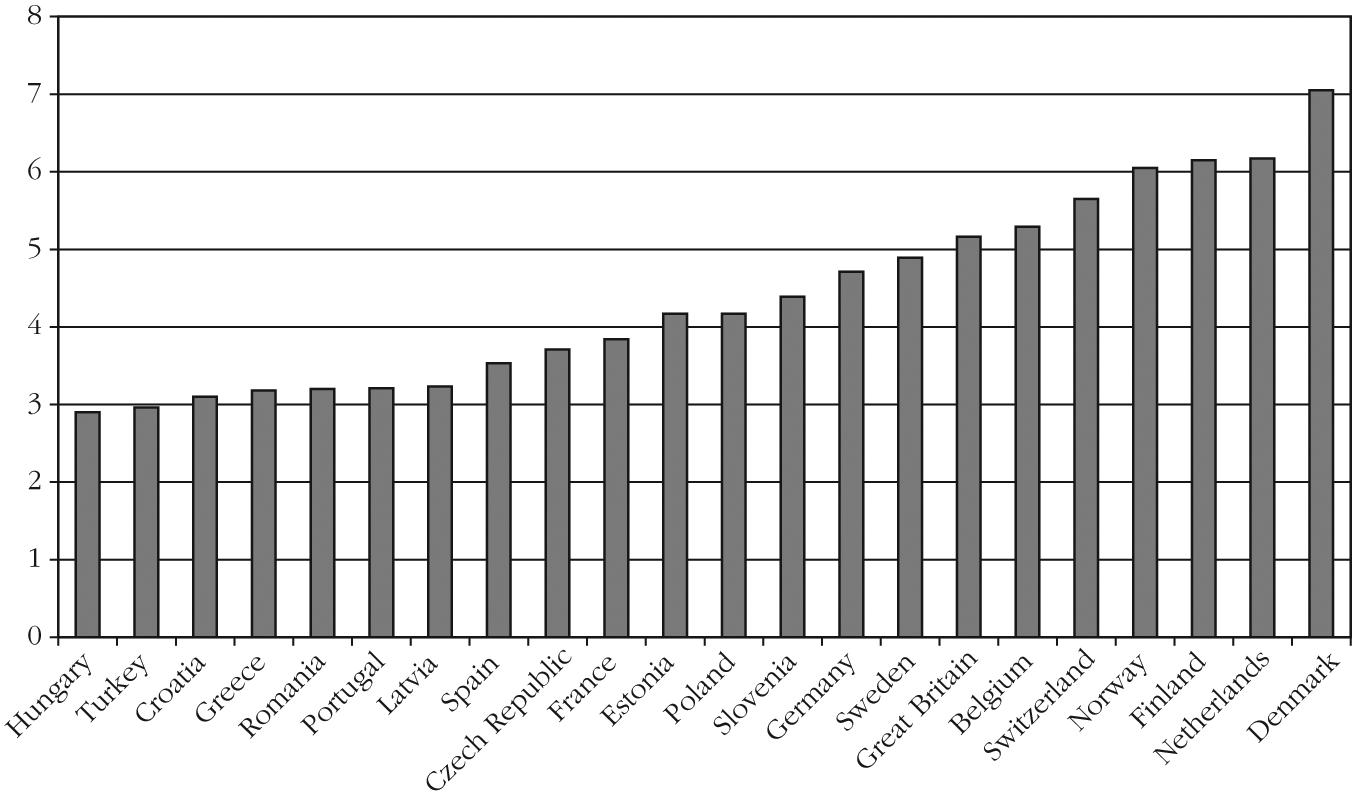
The distribution of perceptions of first-job opportunities among European young adults
Independent variables
Sex is measured as male (reference) or female. Young people of foreign origin are defined as being born outside the country or having at least one parent born abroad. Achieved level of education is operationalized by having had none or primary (reference), lower secondary, higher secondary and tertiary education. Employment status at the time of interviewing is coded as having paid work (reference), being unemployed, being a student, or being in another position (which basically refers to NEET without the unemployed). Income level is categorized in a low (reference), middle and high category, with a separate code for item non-response. Additionally, an item covers whether one has previously been unemployed for a period of more than three months. One’s organizational involvement has been derived from the question about whether one has, in the last month, done only paid work (reference), only voluntary work, both or neither. Perceived unemployment risk regards how likely it is to become jobless in the next 12 months. The perceived level of unemployment is based on the question ‘Of every 100 people of working age, how many would you say are unemployed and looking for work?’ For more information about the variables, see Appendix Tables A3 and A4.
The national level variables have, unless otherwise defined, been gathered from Eurostat (2010b). Since the interest is in the influence of levels of unemployment on youth perceptions of first-job opportunities, unemployment is approached from a multidimensional perspective by considering not only total unemployment rates, but also youth and long-term unemployment rates, and the ratio of the youth to total unemployment rates on the one hand, and the ratio of the long-term to total unemployment rates on the other hand. To test the applicability of the Thomas theorem, the ESS survey item questioning the perception of the number of unemployed active people is, for the whole population surveyed, aggregated to the national level. National prosperity is operationalized by the GDP per capita of 2008 and the GDP per capita growth rate of the same year. For income inequality, the S80/S20 ratio of the highest income quintile over the lowest income quintile is considered. For educational systems three indicators are considered: the share of the GDP spent on institutional training (training in schools) (OECD, 2009a), the spending on apprenticeships (OECD, 2009a) and the GDP spending on education. Employment protection legislation (EPL) is measured by the OECD EPL Index (OECD, 2009b). In Appendix Table A5, all national covariates are displayed.
The fact that an individual perception of the labour market is expected to be determined by individual and country level covariates requires the use of multilevel multiple regression analysis (Gelman and Hill, 2006). Given the drawback of the technique regarding statistical power in the case of a limited number of countries involved (Maas and Hox, 2005), as in the present case, the national level covariates are dealt with in a parsimonious manner.
An estimation of the ‘null’ multilevel model revealed an intra-class correlation coefficient of .24, meaning that almost one fourth of the variability in perceptions of first-job chances can be explained by national level factors.
Results
Individual level determinants of youth perceptions of first employment
In Table 2, the individual level determinants of youth perceptions of first full-time employment chances are summarized (for bivariate associations, check Appendix Tables A6 and A7). The first model is restricted to gender and ethnic origin (Model I), to which current socioeconomic status (Model II), work experience (Model III) and risk perceptions (Model IV) are added. Looking at gender and being of foreign origin (Model I), perceptions towards first-job opportunities are differentiated along basic background variables. In line with the theory but contrary to actual unemployment rates, female youth are less optimistic about general job chances for young people. These pessimistic sentiments may be explained in two ways. Women might perceive the market value of their diploma as less valuable and therefore assume that the labour market is less responsive. Alternatively, in line with the dual labour market theory, women base their judgment of first-job chances on persistent labour market disadvantages, as are articulated by ‘sticky floor’ and ‘glass ceiling’ phenomena.
As for foreign descent, contrary to the proposed hypothesis, young people of foreign origin are more positive about labour market chances. Importantly, the significance of this effect increases when adding additional covariates; the positive stance of respondents of foreign origin towards first-job opportunities is thus clarified when socioeconomic disadvantages are taken into account. When giving meaning to this positive minority status effect, a number of interpretations are possible. It can, first of all, be explained by the ‘immigrant optimism hypothesis’ (Andriessen and Phalet, 2002; Fischer, 2010; Hirschman, 2001; Kao and Tienda, 1995), which argues that immigrants’ success on the labour market depends on career-oriented motivations resulting from their parents’ optimistic life stance. However, the data also shows that ethnic youth experiences higher perceived employment risk, refuting this interpretation. Alternatively, based on the overrepresentation of minorities in the secondary segment, ethnic youth might perceive their labour market chances as beneficial when having the secondary segment in mind. Third, and more plausibly, the sampled respondents of foreign origin might interpret the question towards the perceptions of first-job opportunities in terms of in- and out-groups, meaning that they might perceive the overall labour market chances as more beneficial for youth in general, yet not for themselves.
In Model II, current socioeconomic status is introduced. It shows that those with secondary education are significantly less positive about first-job opportunities compared with those with a primary education; those who achieved tertiary education do not differ significantly from the reference group, although the higher educated become less positive about labour market opportunities when adding other relevant covariates. In line with the negative female outlook on first-job opportunities, this might first of all mean that the higher educated do not have an accurate view of the market value of their diploma. Alternatively, the response patterns might reflect orientations towards different segments of the labour market. While the higher educated are attracted by the primary segment and the lower educated by the secondary, the middle educated might receive hardly any signals from either segment, i.e. they are overeducated for the primary segment but undereducated for the secondary, leading to depressed views on overall job opportunities.
With regard to employment status, those who are presently unemployed are more pessimistic about labour market chances than are the employed, while students are slightly more optimistic. Yet, these effects fade when adding the effect of the likelihood of becoming unemployed in the next 12 months, resulting in a weak significant effect of being a student and a null effect of being unemployed. Thus, it is especially the feeling of a persistent precarious condition that drives down perceptions of labour market opportunities among the young unemployed. On the contrary, the group that still needs to make the transition from school to work is slightly more positively orientated towards the labour market than those young adults that have already left their school desks and joined the labour market. Those having a different employment status do not significantly differentiate from the employed in their assessment of labour market opportunities. Regarding income, there is a positive association: the higher the income, the more positive young people’s outlook. Or, to put it differently: those young adults that are financially worse off do perceive the first-job opportunities as rather negative.
In Model III, work experience is taken up. Those who have been previously unemployed for more than three months carry over that negative experience to their perception of labour market opportunities for young people, supporting the interpretation that unemployment also leads to psychological scars. While the bivariate relationship points to a positive effect of being involved in social networks on perceived labour market opportunities, this effect disappears when other relevant explanations are held constant.
Adding risk perceptions in Model IV, the results of subjective unemployment risk and the economic conditions in one’s country are highly relevant for explaining perceived labour market opportunities for young people. The employed who fear being without a job in the future extrapolate their individual risk assessment to the general labour market. We also see that young adults who think that unemployment rates in the country they live in are rather low perceive the labour market opportunities as more favourable.
The impact of national characteristics on first-job perceptions
To assess the impact of context factors, first the individual perceptions of labour market chances on each of the contextual variables are regressed singly, controlling for the individual level covariates of Model IV of Table 1. Column A of Table 2 shows, first of all, the effect of unemployment levels: in countries with a high level of jobless people, young adults perceive employment opportunities for the youth less favourably. Importantly, the t-statistics show that long-term unemployment is most significant, outweighing the significance of other unemployment rates, including youth unemployment. This finding suggests that it is especially longer-term labour market malaise that affects young persons’ perceptions of labour market opportunities negatively. Apparently, young peoples’ perceptions of their own labour market chances are more dependent upon general job losses than upon the unemployment of their peers. This interpretation is given additional weight by the finding that also the general public’s perceived level of unemployment is closely related to youth perceptions of first-job chances. In other words, in those countries in which the general population regards unemployment rates as high, young adults perceive the opportunities for a first employment as more negative.
Individual model for explaining perceptions of first-job opportunities
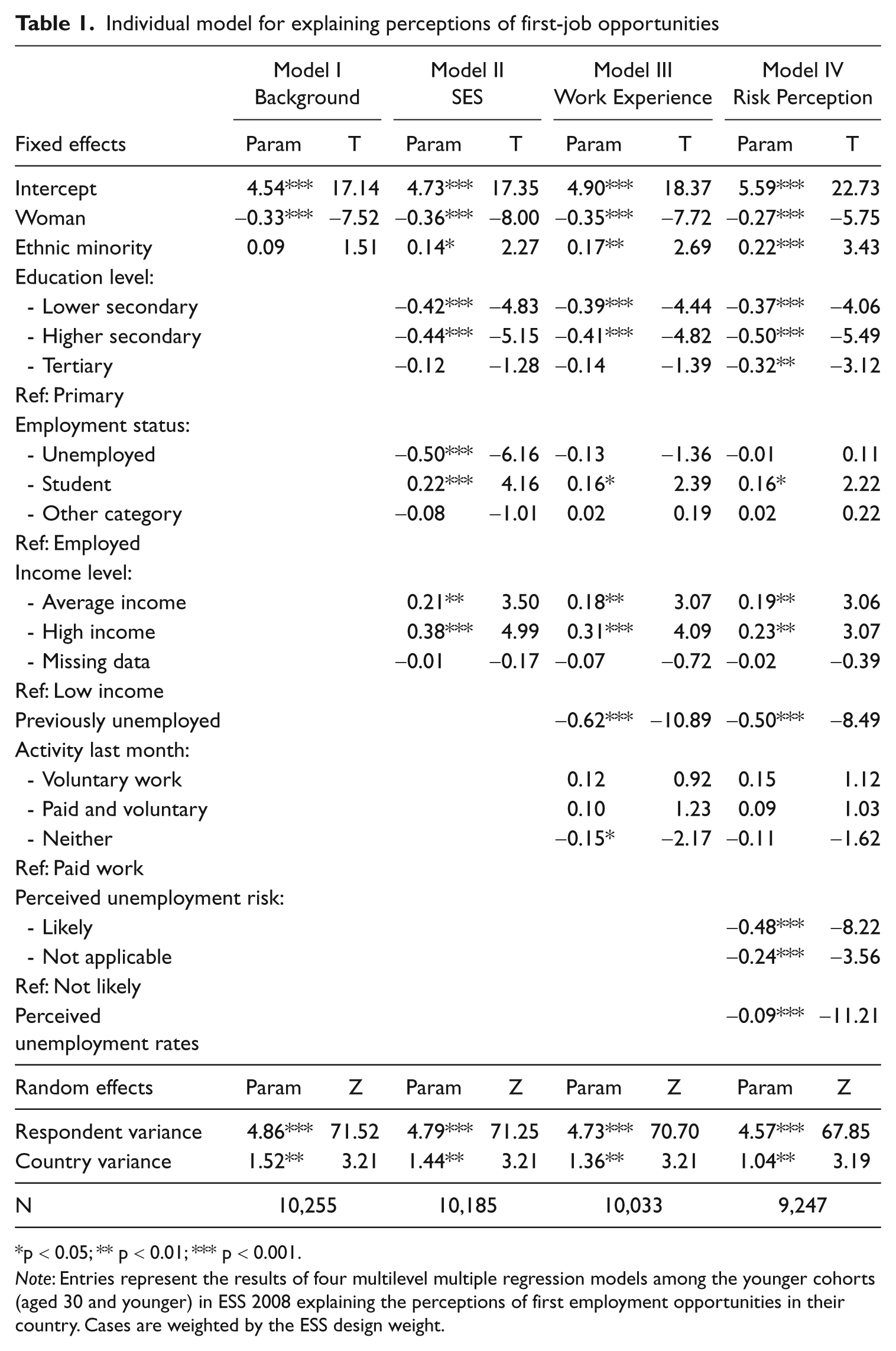
p < 0.05; ** p < 0.01; *** p < 0.001.
Note: Entries represent the results of four multilevel multiple regression models among the younger cohorts (aged 30 and younger) in ESS 2008 explaining the perceptions of first employment opportunities in their country. Cases are weighted by the ESS design weight.
The effect of national characteristics on individual first-job perceptions
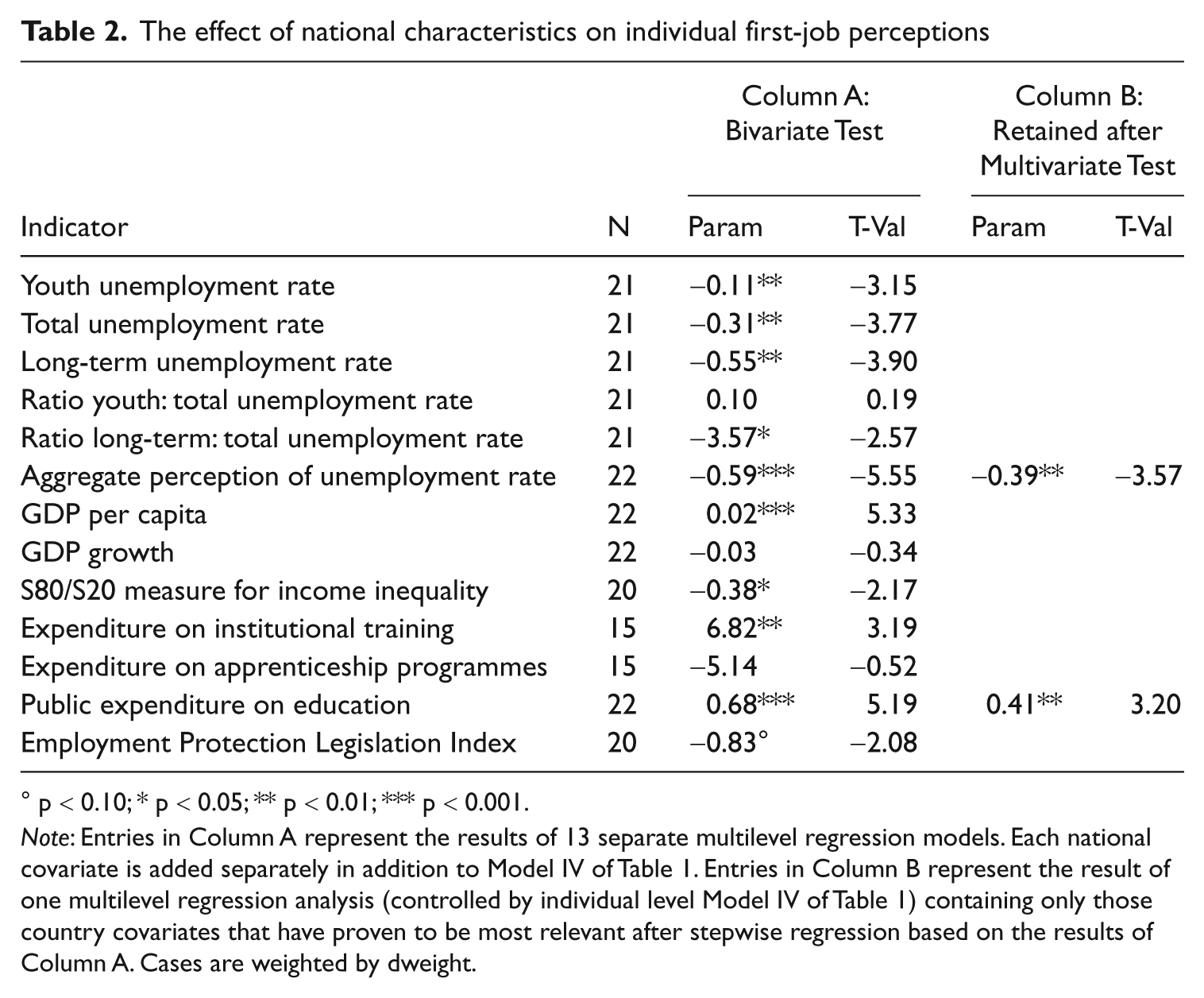
° p < 0.10; * p < 0.05; ** p < 0.01; *** p < 0.001.
Note: Entries in Column A represent the results of 13 separate multilevel regression models. Each national covariate is added separately in addition to Model IV of Table 1. Entries in Column B represent the result of one multilevel regression analysis (controlled by individual level Model IV of Table 1) containing only those country covariates that have proven to be most relevant after stepwise regression based on the results of Column A. Cases are weighted by dweight.
With regard to general levels of economic prosperity, young adults living in countries that have a higher standard of living, expressed by their GDP per capita, hold on to more positive perceptions of young people’s job opportunities. However, doing well economically at the present time, i.e. in the short term, as expressed by GDP per capita growth, is not related to these perceptions. So, as was the case for the unemployment indicators, it seems that the longer-term situation is of more importance for perceptions than is the shorter term. As expected, the distribution of wealth is also related to first-job perceptions: larger income inequalities are associated with more negative outlooks. The results of educational covariates are mixed. In countries that invest significantly in education, the young age cohort is more positively oriented towards the labour market. This positive parameter of public expenditure on education also translates into the positive relation of institutional training. 4 Contrary to the proposed hypothesis, perceptions in countries where apprenticeship programmes are well funded do not differ from those in countries with less spending. Finally, while the parameter estimating the relationship between employment protection and youth perceptions is in the expected direction, conventional significance levels are not reached, meaning that in those countries that have a rigid legislation, young adults are not significantly less positively oriented towards first-job opportunities. Thus, while educational systems and employment legislation have been shown to explain the school-to-work transition (Breen, 2005; Wolbers, 2007), they are only weakly related to perceptions of first-job opportunities for young people.
To assess the effects of context factors in a multivariate setting, 5 forward stepwise regression is applied, starting from the analysis with the GDP per capita in 2008 added to the individual level Model IV of Table 1. The results (Column B of Table 2) show that of all the relevant country characteristics that have been discussed above, the general public’s perception of unemployment rates and public expenditure on education are best able to explain youth perceptions of first full-time job opportunities in their country. First of all, the actual level of unemployment of their peers is less important for explaining young adults’ perceptions of labour market opportunities than could have been expected; also, these objective indicators of unemployment are outweighed by the effect of the general population’s assessment of national unemployment levels. Third, while economic prosperity is related at the bivariate level to perceptions of first-job chances, it is of importance how the wealth is distributed: having an extensive school system generates positive orientations among all young people. Thus, while the effect of education at the individual level is curvilinear, in countries where there is a well developed school system all young adults benefit from beneficial outlooks on labour market opportunities for young people.
Discussion
Before concluding this article with the implications for understanding youth perceptions of first-job opportunities in a volatile labour market, it is first of all desirable to relate the outcomes to the proposed theories. Beginning with social network theory (Granovetter, 1973), at the bivariate level, being involved in networks correlates with more optimistic perceptions of labour market opportunities, although these positive stances can largely be explained by related professional activities; we thus find only partial evidence for hypothesis H4. Second, human capital theory (Becker, 1962) proved its relevance for explaining youth perceptions of job opportunities, but not in the expected linear fashion: those with a secondary education perceive labour market opportunities as worse, meaning that hypothesis H1 is accepted but nevertheless not in its original interpretation. Third, regarding signalling theory (Spence, 1973) mixed findings have appeared: whereas (in line with hypothesis H3) women endorse more depressed views of labour market opportunities, young people of foreign origin are nonetheless (contrary to H3) rather optimistic. In sum, the interpretation of most findings gives support to hypothesis H2, referring to dual labour market theory (Doeringer and Piore, 1971). The apparent curvilinear effect of education can be interpreted as if the lower and higher educated look out over two different segments of the labour market, with those having secondary education falling in between. While official youth employment rates are not significantly lower among women compared to men, women perceive the job market as worse, which can be explained by the fact that female perceptions are determined by secondary segment phenomena of the ‘glass ceiling’ and ‘sticky floor’. Also, the positive orientation towards first-job opportunities among young people of foreign origin can be interpreted as if this group looks out over the secondary segment or, alternatively, interprets the question of first-job opportunities in terms of ‘Yes, of course there are opportunities, only not for us.’
In order to comprehend youth perceptions of labour market opportunities for young people fully, the four classic labour market theories have been supplemented with insights derived from the theory of the risk society (Beck, 1992; Furlong and Cartmel, 2007). While objective social categories, like gender or level of education, are indeed relevant for explaining youth perceptions, this study has confirmed hypothesis H5 by showing that individual risk perceptions associated with one’s personal employability as well as the assessment of the situation of the labour market spill over into perceptions of the level of responsiveness of the labour market in providing jobs for young people. This explanation is given additional weight with findings from the national level, as youth perceptions of labour market opportunities are mostly determined by the subjective interpretation of the labour market malaise by the general population (hypothesis H7). Furthermore, while the positive effect of government spending on education, which confirms hypothesis H11, can be given many interpretations, young people might interpret it as a signal for the level of concern of political authorities about young people. However, this interpretation requires further investigation.
Conclusion
In order to comprehend young peoples’ individual decision making process concerning whether or not to enter the volatile labour market of 2008, one may turn to students of the social cognitive career theory (Furlong, 2006; Lent et al., 1994) who have suggested that perceptions of opportunities in the labour market are relevant factors. From this perspective, it is necessary to keep in mind that, first of all, European young adults are more optimistic about first-job opportunities when compared with their elders. Second, students are also less pessimistic about labour market opportunities for young people than those that have already entered the labour market. If it can be assumed that those that already made the transition are best suited to assess the chances for young people to get a first job, then students had a biased view of how responsive the market actually was in the year 2008. This biased view may represent a desirability bias, meaning that students adjust their perception of labour market opportunities in an upward manner in order to be successful in application strategies, which is in line with predictions of the social cognitive career theory.
This desirability bias is at the same time a reflection of the uncertain situation this age cohort is in. Individualization of society has caused labour markets to become transitional, leading to an increased role for individual risk perceptions of perceived labour market opportunities. To give but one example, young people base their perceptions of labour market opportunities not on the situation their peers are in, as youth unemployment figures have a significant but not overwhelming effect, but rather on subjective interpretation of the labour market malaise by the general population. Next to the subjective interpretation of the labour market by the public, young peoples’ perceptions of opportunities on the labour market are further explained by individual assessment of how bad the economy is today. The finding that both individual risk perception and the levels of unemployment perceived by the general public simultaneously impact first-job perceptions shows that they are conceptually different, i.e. that the ecological distinction of how macro level perceptions drive individual level perceptions needs to be taken into account.
We need, however, to be aware of the fact that this study only scratches the surface. For one thing, the year of questioning of our respondents dates back to the outbreak of the 2008 global financial crisis. As is shown, since the articulation of the labour market malaise by the general public has a major impact on the formation of perceptions of first-job opportunities, it is plausible that youth perceptions of first-job opportunities have become more pessimist in subsequent years, as Europe has faced a severe economic downturn. Moreover, in this research, data for a conglomerate of countries has been analysed. The analysis has revealed that country characteristics determine these youth perceptions, and therefore it is even more likely that countries additionally influence the way the individual determinants affect youth perceptions.
In this respect, there are several points at which future research might qualify the findings of our study. First of all, as we have only touched upon European ‘grand mean’ effects across various national contexts, further research might touch upon country case studies. Second, as 2008 might have been an interesting case to study youth perceptions of first-job opportunities, as economy worsened by then it would be interesting to observe to what extent the findings hold in the present recession. Third, to qualify individual interpretations of the labour market, qualitative research among young adults needs to disentangle what labour market young people actually have in mind. Taking these suggestions in mind will contribute further to the understanding of the social psychology of the youth labour market.
Footnotes
Acknowledgements
The authors would like to thank Tineke Cappellen, Mikko Niemelä, Régis Scheidegger, Leen Vandecasteele, Matthew Wright and the participants of the workshop ‘Youth on volatile labour markets’ of the 2010 Annual Conference of the European Social Policy Network (ESPAnet), as well as the anonymous reviewers for their thoughtful and detailed comments on earlier versions of this article.
Notes
Tim Reeskens is a Postdoctoral Fellow of the Research Foundation - Flanders (FWO) at the Centre for Sociological Research at Katholieke Universiteit Leuven, Belgium, and currently holds a visiting fellowship at the Department of Government at American University, Washington, DC. His main research interests include the cross-national analysis of political and social attitudes. His research has appeared in the Journal of European Social Policy, Comparative Political Studies, and Psychological Science.
Wim van Oorschot is Professor of Sociology at Tilburg University, The Netherlands. He is co-founder and honorary president of the Network for European Social Policy Analysis (ESPAnet) and director of the European Data Centre for Work and Welfare (EDAC). His research interests regard social reforms in a European comparative perspective and cross-national research on welfare state legitimacy.