




Abstract
This study examines how changes in gender role attitudes of couples after childbirth relate to women’s paid work and the type of childcare used. Identifying attitude-practice dissonances matters because how they get resolved influences mothers’ future employment. Previous research examined changes in women’s attitudes and employment, or spouses’ adaptations to each others’ attitudes. This is extended by considering how women and men in couples simultaneously adapt to parenthood in terms of attitude and behavioural changes and by exploring indirect effects of economic constraints. Structural equation models and regression analysis based on the British Household Panel Survey (1991-2007) are applied. The results suggest that less traditional attitudes among women and men are more likely in couples where women’s postnatal labour market participation and the use of formal childcare contradict their traditional prenatal attitudes. Women’s prenatal earnings have an indirect effect on attitude change of both partners through incentives for maternal employment.
Introduction
This article explores how childcare and women’s employment are associated with changes in gender role attitudes of British men and women across the transition to parenthood. In particular, possible dissonance between their prenatal attitudes and postnatal practice is examined, regarding maternal employment. In Britain, like most other European countries, recent governments have aimed at increasing the labour market participation of mothers. At the macro level, this is motivated by the need to provide sufficient labour supply to finance an ageing population. At the micro level, continuous attachment to the labour market is seen as a crucial safeguard against poverty following family splits, for mothers and children. It also helps protect women’s long-term prospects for good earnings and pensions. British parents of young children face very high childcare costs. Over the past decade, the typical cost of a nursery place was more than one-third of average full-time gross earnings and exceeded average household spending on either food or housing (Daycare Trust, 2001, 2008). The study therefore also explores the importance of couples’ economic resources for their work and care arrangements and attitudinal adaptations.
Previous research shows that women’s economic resources have a positive effect on their labour market return and career progression. In Britain, highly educated women return to full-time work sooner after childbirth than those with lower qualification levels (Dex et al., 2008; Smeaton, 2006). In recent years, there has been a marked increase in research on women’s gender role attitudes or work-family preferences as predictors of their labour force participation (e.g. Hakim, 2000; Kan, 2007; Kangas and Rostgaard, 2007). Many of these studies suggest that the relationship is context-dependent with financial resources and policy entitlements constraining or enabling choice, e.g. in terms of childcare arrangements (Crompton and Harris, 1999; Debacker, 2008; Gash, 2008; Kangas and Rostgaard, 2007; Kremer, 2007; McRae, 2003; Singley and Hynes, 2005). Much of this research, however, is based on small-scale qualitative interviews or cross-sectional snapshots of different countries at one point in time. Furthermore, many of these studies focus on women and pay little attention to attitude change among men or to dynamics between partners. Psychological studies exploring alignment of gender role attitudes between partners often do not consider parallel change in employment practices (Johnson and Huston, 1998; Kalmijn, 2005).
While gender role attitudes are seen as important predictors of behaviour, much less is known about the drivers of attitudinal change across the life course. One possible driver of attitudinal change is cognitive dissonance, whereby attitudes may change if they are at odds with a person’s behaviour (Festinger, 1957). Alternatively behaviour might change. How dissonance is resolved matters when the conflict concerns beliefs about the detrimental consequences of maternal employment. If women give up work on childbirth then this has knock-on effects on women’s longer-term employment prospects, as well as heightened economic risks for children if the couple splits. If attitudes change then, over time, this will contribute to a shift in population-level gender roles beliefs, which may in turn have some impact on social norms.
Some recent studies have explored how life course events and changes in women’s labour market participation are associated with gender role attitude change. They find increases in educational attainment and full-time employment result in more egalitarian attitudes, while marriage, parenthood and reductions in paid work are associated with more traditional attitudes (Cunningham et al., 2005; Fan and Marini, 2000; Himmelweit and Sigala, 2004; Kan, 2007). Berrington et al. (2008) suggest that it is not entry into parenthood as such, but the change in women’s economic activity as a consequence of parenthood which is associated with attitude change. Himmelweit and Sigala (2004) show that changes in attitudes or behaviour are more likely when mothers’ labour market status is inconsistent with their attitudes towards women’s employment. Some qualitative studies also provide evidence of a complex interplay of economic and identity-driven motivations for mothers’ labour market participation (Himmelweit and Sigala, 2004; Singley and Hynes, 2005). There has been little quantitative longitudinal research, however, on how contextual factors shape work and care arrangements of new mothers and fathers (with some exceptions such as Gash, 2008); how such arrangements conflict or not with existing attitudes; and how any possible dissonances between attitudes and practices are resolved.
This study contributes to the literature by exploring whether gender role attitude change is more likely among new parents when mothers’ labour market participation and the type of childcare they use show some discrepancy with prenatal gender role attitudes. Given the substantial costs of formal childcare in Britain, this research also examines how economic resources, in particular education and earnings, impact on parents’ work and childcare arrangements and whether they have an indirect effect on gender role attitude change by influencing the likelihood of dissonances between attitudes and practice. The analysis is based on a representative sample of 337 British couples from before pregnancy to two or three years after their first birth.
Gender role attitude change during the transition to parenthood: theories and hypotheses
This article’s hypotheses about gender role attitude change during the transition to parenthood are derived from both theoretical perspectives and empirical observations about constraints and opportunities concerning parenting and employment strategies in the UK.
The first hypothesis (H1) is that men and women in couples where maternal employment behaviour is consonant with their prenatal gender role attitudes are less likely than those who experience dissonance to change attitudes after having children.
The notion of cognitive dissonance comes from the social psychological literature, where psychologists have argued that personal experiences promote attitudinal change in particular when a situation involves dissonant cognitions based on one’s own attitudes and behaviour (Festinger, 1957; Wickland and Brehm, 1976). A person who has dissonant or discrepant cognitions is thought to be in a state of psychological discomfort, which is experienced as frustration, anger or anxiety. One way to reduce cognitive dissonance is to change either attitudes or behaviour to make it consistent with the other. In practice it is often attitudes that change as behaviour is more constrained.
Cognitive dissonance can be linked to gender role attitudes through theoretical approaches focusing on gender identity (Stets and Burke, 2000; West and Zimmerman, 1987). These suggest that male and female roles as partners or parents serve as core standards on which to evaluate gendered aspects of paid work and childcare arrangements. Discrepancies between these standards and actual practice are likely to lead to changes in identity or behaviour or both. Attitudes are relatively general beliefs that are only tangentially related to identities (Himmelweit and Sigala, 2004). Nevertheless, changes in women’s or men’s gender role attitudes are expected to be more likely when they are in conflict with postnatal work and care arrangements. The phrasing of the attitude questions in the data used in this study only allows a differentiation between agreement and disagreement with relatively traditional statements. Therefore, the focus here is on dissonances between traditional attitudes and more egalitarian practices of women’s work and childcare arrangements. The available measures are less suitable for capturing conflicts between egalitarian attitudes and traditional practices.
The second hypothesis (H2) is that dissonance is likely to result in greater attitudinal change among couples that use formal childcare rather than care by family members or friends. Type of childcare is therefore assumed to have an additional effect to any dissonances arising from mothers’ labour force participation.
In Britain, the care ideal for young children has been family care, preferably by the mother (Kremer, 2007). The institutional context including gendered family policies and associated social norms provide clear incentives for mothers to be the main carer for young children. Since the early 1990s, maternity leave provisions have been extended from less than six months to a year, while leave options for fathers are still very short and largely unpaid (Moss and O’Brien, 2006). Leave policies and the widespread availability of part-time employment for women therefore promote a gendered division of labour among parents with young children. Although father care recently has gained greater acceptance, even egalitarian men are often limited in the time they have available for childcare, as the work hours of British fathers are some of the longest in Europe (OECD, 2004).
Informal care by relatives, especially by grandmothers, has been perceived as the most acceptable substitute for mother care and has been widely used (Dench et al., 1999; Wheelock and Jones, 2002). Although the availability and use of formal childcare, such as nurseries and childminders, has increased since the implementation of the childcare strategy in 1998, provision of subsidized childcare places has focused on four and five year-olds. For younger children, most couples still prefer informal care by relatives over formal daycare. Thus mothers who use formal care are expected to be more susceptible to attitudinal change than mothers using informal childcare, if their prenatal gender role attitudes were relatively traditional.
The third hypothesis (H3) is that women’s larger economic resources will have an indirect effect on women’s and men’s attitude change through positive incentives for women’s labour force return.
In the UK, formal childcare is primarily paid and informal childcare is unpaid. Following a growing literature on the structural embeddedness of attitudes and preferences (e.g. Crompton and Harris, 1999; Debacker, 2008), it is assumed that structural constraints, in particular the large costs of formal childcare, may limit some women’s choices. Women’s low earnings may make good-quality childcare unaffordable thus restricting options to return to work; relatively high earnings may provide a strong incentive to return to the labour market. The association of men’s economic resources with dissonances between attitudes and practice is assumed to be weaker. Higher earnings may have contradictory effects on paid work and childcare arrangements, in part depending on couples’ attitudes. Some women will use their partner’s earnings to pay for childcare, while others will interrupt their employment for longer in the absence of the financial necessity to work.
The fourth hypothesis (H4) is that partners will influence each others’ attitudes directly as well as indirectly through the extent of the mother’s reduction of paid work and the choice of childcare.
According to the psychological theory of interdependence (Kelley and Thibaut, 1978), partners will sometimes modify attitudes or behaviours to bring them in line with their spouses’ preferences, rather than their own. Men, in particular, may be more influenced by their partners’ views as, in general, husbands change work patterns less than their wives in response to the transition to parenthood. However, an alternative scenario is that wives are more likely to adapt to their husbands’ views because women tend to take more responsibility for ‘emotion work’ than do men (Hochschild and Machung, 1990). Existing studies provide contradictory evidence for which partner’s attitudes are more influential (Johnson and Huston, 1998; Kalmijn, 2005). Thus there are no clear theoretical or empirical grounds for predicting which partner’s attitudes will exercise the most influence.
Data and methods
The data is drawn from couple responses in the British Household Panel Study (BHPS) from 1991 to 2007. The BHPS is based on a probability sample of households from Great Britain in the year 1991. All members of the household are interviewed annually. In addition to relationship and fertility histories and annual questions on employment, earnings and childcare, the BHPS has asked biannually repeated questions on gender role attitudes since 1991.
Change models are used in this study to measure how gender role attitudes, paid work and childcare arrangements in the second or third year after birth are related. Whether it is the second or third year depends on when gender role attitudes were measured, as these indicators are only available every other year. Postnatal attitudes and practice are not measured in the first year because most women take maternity leave for at least part of the year and their employment status is therefore somewhat unclear. In the second and third year after birth, about three-quarters of mothers in the sample have returned to the labour market.
Structural equation modelling (SEM) is applied to investigate the effects of couple’s earnings and gender role attitudes before childbirth on postnatal changes in women’s paid work hours and gender role attitudes of men and women. The advantage of SEM is that it allows direct and indirect effects to be investigated and the correlated measurement errors between attitude indicators before and after childbirth to be taken into account. However, because structural equation models normally require interval or ordinal variables, it is problematic to incorporate the type of childcare used in the structural equation models used in this study. Therefore, in a second step, ordinary least squares (OLS) regression is used to examine the impact of childcare type on postnatal attitude change. Consistent with Smith et al. (2009), no substantive differences are found in the coefficient sizes or significance levels when OLS and SEM models are compared. This suggests that correlated errors in attitudinal measures are not significantly biasing the OLS results. To reduce the possibility of other biases through the bounded categorical gender role attitude variables, three gender role attitude indicators based on a Likert-scale are combined into one continuous factor for the dependent variable and the results are compared with Tobit regressions, which adjust for bounded variables.
Men and women who become parents may be a select group in terms of gender role attitudes, age and educational qualifications (e.g. Rendall et al., 2005). This concern was tested using Heckman selection correction factors. Couples’ pre-pregnancy relationship duration and marital status were used as identifying variables, which were only included in the selection model. Both are expected to be positively associated with parenthood, but after controlling for prenatal attitudes about gender, religiosity and economic resources they are not expected to contribute to explaining the change in women’s paid work and both partners’ gender role attitudes. Marital status and relationship duration were statistically significant in the model of selection into parenthood but none of them proved significant in the main models of interest. As the Heckman models did not provide qualitatively different results and rho as a measure of selectivity was not significant, only the results without selection correction factors are presented.
Sample selection
The sample is limited to couples, irrespective of marital status, where women are at least 20 years old at their first birth. This is because maternal employment choices for teenage mothers are likely to be subject to different constraints. The selection of couples who become parents is based on women’s fertility history. Therefore the birth observed is the first birth for the woman. Although some of the men will have fathered children in a previous relationship, this information is not captured with the same reliability as women’s fertility. Of the 775 couples observed where the woman had a first child during the observation period, there were no prenatal observations for 310 couples, usually because they only started cohabiting during or after the pregnancy. A further 39 couples dropped out of the sample in the second or third year after the birth and also have to be excluded. Out of the remaining 426 couples, only 337 have complete information on all variables.
Sample bias because of attrition and item non-response is always a potential problem with longitudinal research. However, the 337 couples in the sample were compared with the 310 who joined later. The latter, on average, have shorter relationship durations. This occurs most frequently among women with less than GCSE education and therefore the sample slightly under-represents the less well educated. Results were also compared using multiple imputation techniques for item non-response, but as the results were not substantially different, results are reported using the sample with complete responses.
Measures and descriptive statistics
Gender role attitudes
Three of the six available gender role attitude statements in the BHPS are used, for which respondents are asked whether they agree or disagree (strongly) on a five-point Likert scale:
1) ‘A preschool child is likely to suffer if his or her mother works’,
2) ‘All in all, family life suffers when the woman has a full-time job’, and
3) ‘A husband’s job is to earn money; a wife’s job is to look after the home and family’.
The first and second statements tap into similar concepts of consequences of women’s employment on children’s and families’ well-being. Statement 3 addresses people’s ideologies about women’s and men’s roles in different spheres. The BHPS contains three other statements which are sometimes used to measure gender role attitudes. These are omitted since it is conceptually less clear what attitudes they capture. Empirical tests of internal consistency based on Cronbach’s alpha also suggest a greater reliability of a latent gender role attitude construct based on these three rather than all six items. For the three items, the alphas are 0.80 for women and 0.82 for men, respectively. Factor analysis is used to create latent factors of the underlying attitude construct. In this study, one gender role attitude factor for women and one for men are created by multiplying the responses with the respective factor loadings and summing them up. Higher values represent greater egalitarianism. To facilitate interpretation of effect sizes, the factors are rescaled to a five-point scale similar to the original Likert scale.
Table 1 shows the descriptive statistics for the variables used in the analysis. The average change in gender role attitudes from before to after birth is very slight, approximately 0.05 on a five-point scale, as changes in both directions partly offset each other. The percentage of people who experience changes in attitudes measured as plus or minus one standard deviation are also included. About 12 per cent of women and 16 per cent of men experience a change of this size towards more egalitarian attitudes, while 15 and 11 per cent of women and men, respectively, become more traditional.
Descriptive statistics
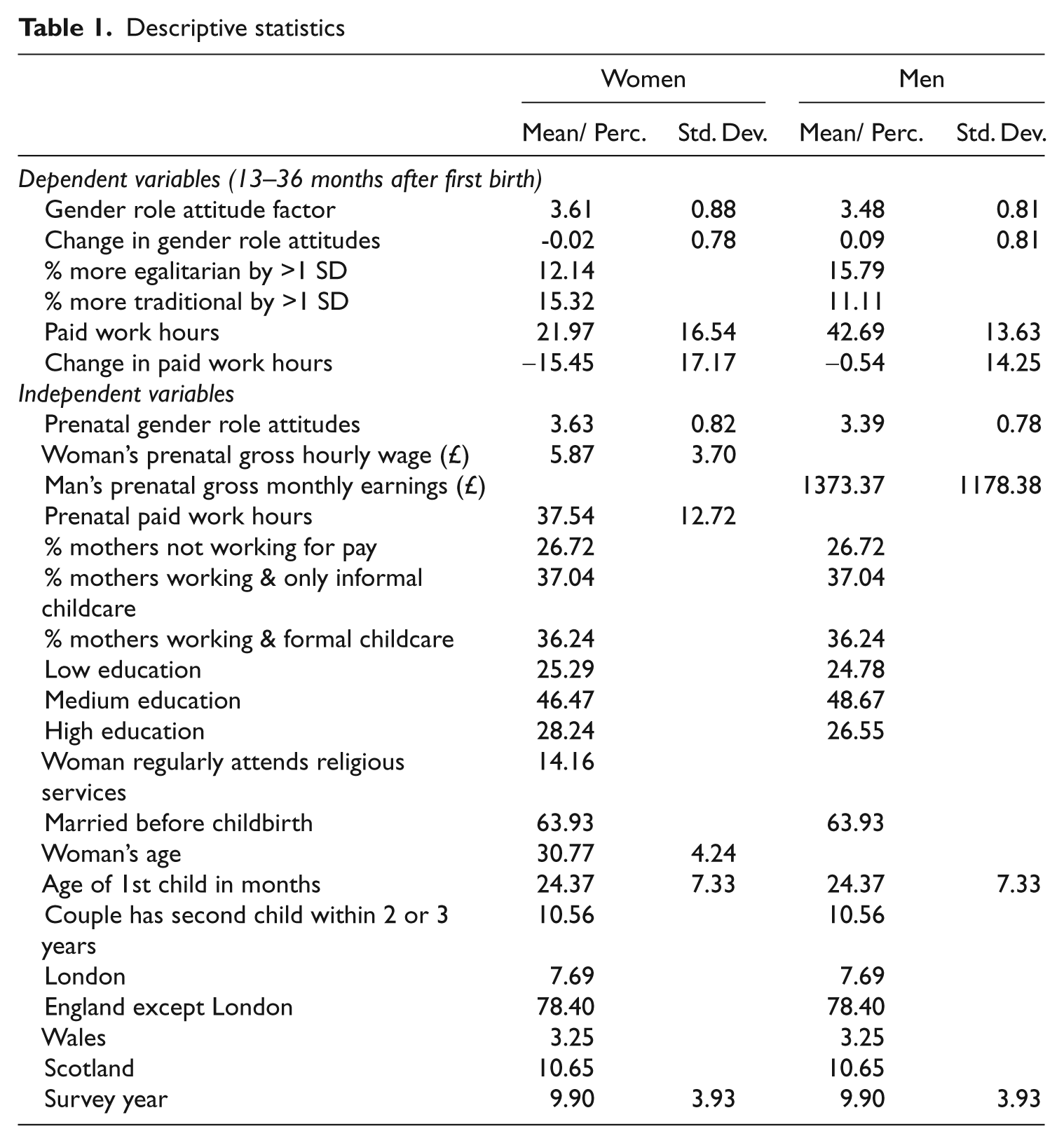
Women’s paid work and childcare arrangements
Women’s paid work hours are based on a question asking for the respondent’s usual weekly hours in employment or self-employment plus overtime hours. The amount of change in women’s labour market hours is calculated as the difference between women’s paid work time in the second or third year of parenthood and the time they spent on it before pregnancy. Only families where mothers are working for pay have been asked about their childcare arrangements. Therefore, it is not possible to explore whether formal childcare use is associated with greater attitudinal change also for mothers who do not work for pay. The question is phrased ‘who is looking after the children while the mother works’ and the answer options include the father, relatives, neighbours or friends and various types of formal childcare, i.e. day nurseries, nannies and childminders. This study distinguishes between:
1) mothers who do not work for pay and act as the main carer for their children,
2) couples whose children are looked after by family members, neighbours or friends while the mother works, and
3) those who use some sort of formal daycare.
Only 55 people mentioned using a second form of childcare arrangement (mostly the father or relatives). Since this study is interested mainly in whether using formal childcare as opposed to only informal arrangements has an effect on attitude change, only the type of childcare that respondents mentioned first is considered.
As can be seen in Table 1, women reduce their paid work time on average by 15 hours per week from before pregnancy to the second or third year after the first birth. Also, 27 per cent of mothers do not work for pay when their first child is between one and three years old. Among the remaining 73 per cent of mothers, about half have family members or friends looking after their children, while the other half uses mainly formal childcare.
Independent variables
The independent variables are measured at least nine months before the woman gives birth. This helps to reduce but does not eliminate the possibility that couples alter work and earning patterns in anticipation of birth. The prenatal economic resources of the couple are measured in terms of the log of women’s prenatal gross hourly wage and the log of men’s monthly gross earnings. All earnings variables are adjusted for inflation using the retail price index with 1991 as the base year. As another proxy of future earnings potential, women’s levels of education are included. A differentiation is made between three levels of educational attainment: ‘GCSE or less’, ‘A-levels or similar qualification’ or ‘university degree’. Men’s highest educational attainment is also controlled for. Women’s prenatal work hours are considered as a proxy for labour market attachment and unobserved career orientations. Other controls include woman’s age, the age of the first child in months and whether or not the couple has had a second child. Whether the woman regularly attends religious services is also accounted for, and regional dummy variables for Scotland, Wales, London and the rest of England are included. Religion is included because of its possible links with traditional values, whereas region matters because of variation in employment and childcare availability. To reduce the risk of bias due to correlated trends over the observation period in dependent and independent variables, the survey year is included. It is, however, still possible that short-term period effects such as changing labour market conditions affect gender role attitude change in specific years. In order to examine possible cohort effects, women born before or after 1970 (the sample mean) were compared, but no discernible cohort effects were found with this sample. Potential confounding events such as unemployment of the male partner and illness of either partner from the year before birth, and other controls such as occupational status, educational or occupational homogamy of partners, women’s wages relative to their partner’s, mothers’ employment sector, company size and fathers’ ages were also tested. These were not significant and are therefore omitted in the final model.
Results
Gender role attitude-practice dissonance
This study is unable to measure directly the dissonances between gender role attitudes, mothers’ employment and childcare arrangements. However, the frequency of when dissonances are likely to occur among men and women after they become parents can be estimated. Among the 27 per cent of women who had traditional gender role attitudes before the birth, two-thirds nevertheless worked for pay after having children and just under a half of these couples used formal childcare. As most women hold non-traditional views, overall only 18 per cent of the women in the sample held traditional attitudes and worked. This includes 8 per cent who used formal childcare. Men are, on average, more traditional than women before having children, and thus are more at risk of dissonance between their prenatal attitudes and their partners’ postnatal employment (32%) or the use of formal childcare (9%).
Comparing preferred work hours and actual hours after childbirth might also capture dissonance. However, this measure was not used, as some women may have adjusted their preferred hours to their actual practice to reduce cognitive dissonance. Looking at prenatal preferences does not solve this problem because few childless women prefer part-time work, even if they do so after they become mothers.
Structural equation models
Structural equation models are used to investigate the pathways from women’s and men’s prenatal gender role attitudes and economic resources to postnatal changes in women’s paid work hours and gender role attitudes. Only the significant control variables are included in the final structural equation model.
Figure 1 shows the main paths of the structural equation models (details of the measurement model and error correlations are available on request). All the goodness of fit indices suggest a close fit. The indirect effects of the exogenous variables are obtained by multiplying the direct effects on the mediating endogenous variable, i.e. women’s paid work change, and the direct effect the latter has on the dependent variable, i.e. postnatal gender role attitudes. The sum of direct and indirect effects gives the total effect.
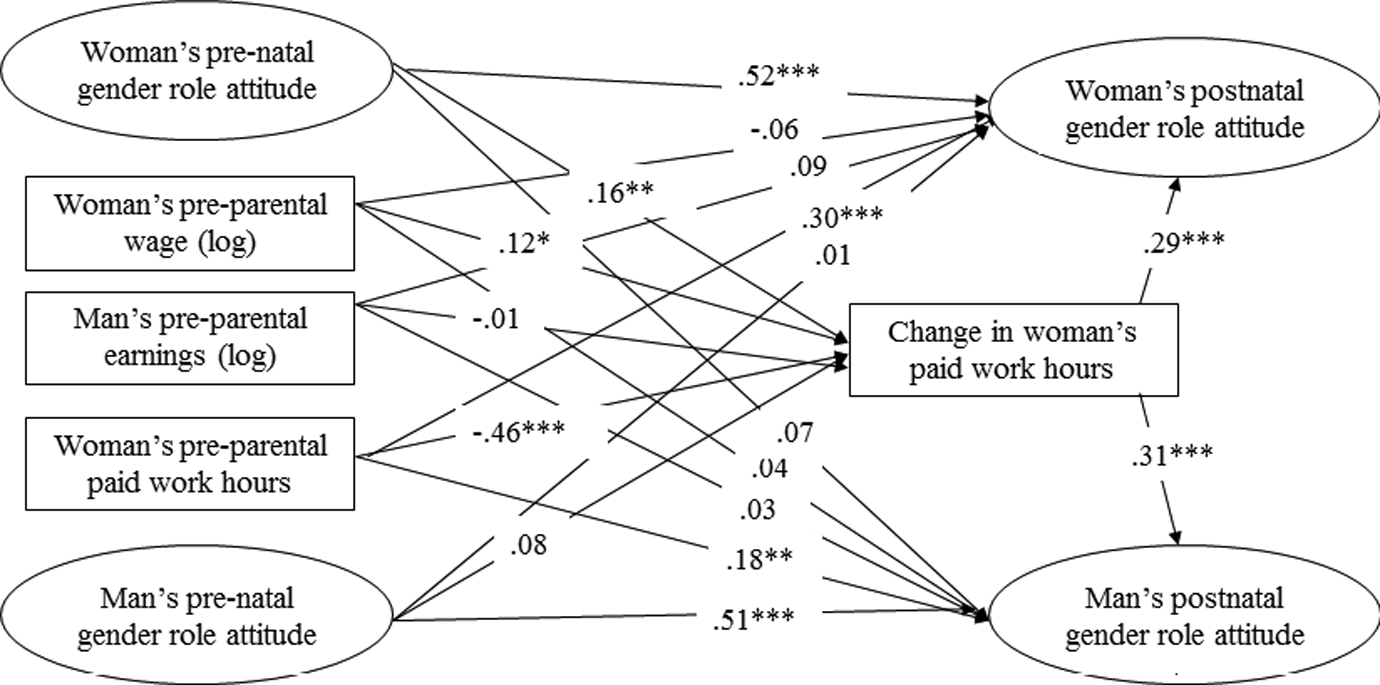
Path diagram of structural equation model for women’s and men’s gender role attitudes after transition to parenthood
In line with hypothesis H1, Figure 1 shows that a larger change in women’s work hours subsequent to birth is associated with more egalitarian postnatal gender role attitudes for both women and men (coefficients 0.29 for women and 0.31 for men). More egalitarian prenatal gender role attitudes of women also have an additional indirect effect by lowering the reductions in women’s paid work which usually follow childbirth. A one standard deviation increase in women’s egalitarianism before having children raises their paid work by about 10 hours and indirectly increases women’s postnatal gender role egalitarianism.
The change in women’s paid work hours is significantly associated with gender role attitudes of men and women even after considering the effects of women’s prenatal work hours on women’s or men’s gender role attitudes after childbirth. Not surprisingly, women who work longer hours before their pregnancy reduce their paid work time more (coefficient -0.46). However, the positive direct effect of prenatal work hours on gender role attitudes (0.30), which possibly reflects labour market attachment and unobserved career orientations, more than offsets the negative indirect effect.
As expected in hypothesis H3, women’s prenatal earnings show a significant positive association with the change in women’s paid work hours from before to after the transition to parenthood (0.12). Thus higher wages of women lead to more egalitarian attitudes among new mothers and fathers, as a result of less reduction in women’s paid work hours. A rise in women’s prenatal hourly wages by one standard deviation (₤3.70) increases their paid work change by over 5 hours a week, which is associated with greater egalitarianism for women and their partners. Women’s prenatal earnings do not, however, affect their own or their partner’s postnatal gender role attitudes directly, but only indirectly by influencing maternal employment.
Models which included women’s education instead of their prenatal wages were also tested. These also confirm hypothesis H3 about the indirect effect of women’s economic resources on their own and their partners’ gender role attitudes. Women with university degrees reduce their work hours less than those with A-level qualifications or below. The two measures of women’s economic resources, however, are correlated and reduce each others’ effects to only marginal significance if included simultaneously. This is not surprising given that they capture closely related concepts.
Hypothesis H4 assumed that women’s and men’s prenatal attitudes would also influence the change in their partners’ gender role attitudes after childbirth, either directly through unobserved relationship processes or indirectly through the change in women’s labour market participation. However, after controlling for each partner’s own prenatal attitudes and the change in women’s employment, no evidence was found of women or men adapting their attitudes to those of their partners. Also, men’s prenatal attitudes do not seem to influence how much women reduce their paid work after becoming mothers. Hypothesis H4 is therefore rejected, except for the indirect effect of women’s prenatal attitudes on men’s postnatal attitudes, which is mediated by the change in women’s employment.
Childcare choices and gender role attitude change
In a second step, whether the type of childcare used may also promote gender role attitude change was examined. Table 2 shows OLS models of women’s and men’s gender role attitudes in the second or third year after the first birth. The dependent variables are composite attitude factors based on the three gender role attitude questions. Both models include a combined variable of mothers’ labour market status and whether they use mainly formal or informal childcare. The omitted category is ‘working mothers whose children are looked after only by family members or friends’. In line with the results from the structural equation model, it can be seen that gender role attitudes of mothers and fathers become more traditional when women do not work for pay after childbirth. Holding everything else constant, the postnatal attitudes of non-employed women and their male partners are more traditional by about 0.4 and 0.5 points on a five-point scale compared to families where informal care is used while the woman works. By contrast, women and men in families that use formal childcare while the mother works seem to become more egalitarian in their attitudes by 0.2 and 0.4 points, respectively. Hypothesis H2 therefore cannot be rejected. As in the structural equation model, women’s prenatal wages and partners’ attitudes are not significantly associated with women’s and men’s postnatal gender role attitudes.
OLS regression models of women’s and men’s gender role attitudes after the first birth

Note: Other controls included: man’s educational level, woman’s age and religiosity, marital status, age of the first child in months, presence of a second child, regional controls for London, rest of England, Scotland and Wales, and the survey year.
p< 0.05; **p< 0.01; ***p< 0.001
The effects of mothers’ paid work change or labour market status on women’s and men’s postnatal gender role attitudes are modest, with a maximum of 0.5 change on a five-point scale. However, this is not surprising given that the available gender role attitude measures represent relatively conservative statements, with which only 27 and 32 per cent of women and men, respectively, agree before having children. Based on these statements, only a minority of couples are likely to experience attitude-practice dissonance. However, the results provide substantial support for the hypothesis that cognitive dissonance is an important mechanism of attitudinal change. In Figure 2, the amount of gender role attitude change is plotted for women and men who could be expected to experience some dissonance with paid work and childcare arrangements versus those whose work and childcare practices are in line with their prenatal gender role attitudes, after controlling for other characteristics.

Change in gender role attitude score (five-point scale) after the first birth, by categories of prenatal attitudes and postnatal practice
There is less attitude change when paid work and childcare arrangements are in line with the prenatal attitudes of women and men in categories 5 and 6. Surprisingly, even traditional women who do not work for pay (category 1) become somewhat less traditional after childbirth; whereas non-traditional women who are not employed (category 4) become more traditional. Attitude change, however, is largest for women and men in categories 2 and 3, whose postnatal paid work and childcare arrangements seem dissonant with their prenatal traditional stance. For some of these traditional couples, postnatal employment of mothers is likely to be an economic necessity; yet, even so, postnatal attitude change is in a less traditional direction.
Discussion and conclusions
This research investigates changes in gender role attitudes after couples become parents. The results suggest that gender role attitudes remain relatively stable among the majority of new parents, whose work and care arrangements do not conflict with their prenatal gender role attitudes. However, about a quarter of parents do change their attitudes and this appears particularly likely if paid work and care arrangements are at odds with their prenatal gender role attitudes. The analysis shows that the labour market return of mothers and childcare choices are significantly associated with changes in both partners’ attitudes. The prenatal economic resources and attitudes of women are also found to impact on the extent of change in their labour market participation after having a child and this indirectly alters their own and their partners’ gender role attitudes.
In line with previous studies (Berrington et al., 2008; Himmelweit and Sigala, 2004), evidence is found of a reciprocal relationship between women’s gender role attitudes and labour market participation, suggesting that behaviour and attitudes reinforce each other. Women with less traditional attitudes before having children decrease their labour market hours less. This reduces the extent of postnatal attitude change towards greater traditionalism. Longer prenatal employment hours of women are also associated with less traditional postnatal gender role attitudes.
As found in previous studies (Dex et al., 2008; Smeaton, 2006), higher levels of education and earnings increase women’s labour market participation after having a child. Low wages before motherhood seem to discourage the labour market return even of women with non-traditional prenatal attitudes. The significance of women’s earnings, despite controlling for the presence of a second child, suggests that the relatively high cost and limited availability of formal childcare in the UK constrain the labour market return of low paid women. The lack of significance of men’s earnings agrees with previous studies (Himmelweit and Sigala, 2004). In Britain, couples’ work and care strategies still seem to be largely based on women’s earnings rather than on their husbands’ or the sum of both.
It is also found that using formal childcare rather than having fathers, extended family, friends or neighbours look after the children is associated with greater change towards less traditional attitudes for mothers and fathers. This suggests that formal childcare is more likely to be problematic than informal care, for those with negative views about the consequences of maternal employment on children’s well-being. This is in line with previous literature, according to which British mothers favour family members as carers for young children (Kremer, 2007; Wheelock and Jones, 2002).
In line with previous studies on American and Dutch couples (Johnson and Huston, 1998; Kalmijn, 2005), it is found that changes in attitudes between the female and male partners in couples are strongly correlated. However, once the change in women’s paid work and the childcare arrangements are taken into account, the partner’s prenatal attitude does not have a significant direct effect on the postnatal attitudes of either women or men. Women’s prenatal gender role attitudes do, however, have an indirect effect on men’s postnatal attitudes through influencing change in maternal employment. This is consistent with Kalmijn’s (2005) finding that husbands change more often in the direction of the wife than vice versa. However, it contradicts the notion that wives adapt to their husbands’ attitudes because women see it as their responsibility to do emotion work (Johnson and Huston, 1998). The most plausible explanation is that decisions about how to combine working and caring are still seen as women’s business.
One should note that the pathways examined in the structural equations and regression models cannot be interpreted as causal. Suitable instrumental variables for women’s paid work which do not affect gender role attitudes through other channels are not available to test this further. However, cognitive dissonance between traditional prenatal attitudes and subsequent maternal employment and formal childcare use is a more plausible explanation for the observed changes towards less traditional attitudes among certain groups than alternative factors such as social norms of family networks and gendered policy entitlements, which would rather point to greater traditionalism after childbirth. The authors do not claim that dissonance between prenatal attitudes and postnatal employment and child care arrangements is the only driver of gender role attitude change. Rather the findings indicate that a combination of psychological and structural factors help shape gender role attitudes. Unfortunately, the available measures do not allow us to explore all the various sociological and psychological mechanisms that might explain changing gender role attitudes among couples. However, while explanations for attitudinal shifts are likely to be a complex mix of preferences and constraints, dissonance seems a useful concept for helping explain part of the attitudinal change across the transition to parenthood.
The identification of cognitive dissonance as a likely mechanism of attitudinal and behavioural change in maternal employment is important for understanding shifting gender roles in British society. In general, attitudes may be moving in a less traditional direction but changes in gender role attitudes (in both directions) after childbirth confirm that parenting brings well recognized conflicts between work and family. It is clearly desirable if such conflicts can be ameliorated through more family friendly policies, by employers or the state, such as maternity or paternity leave, flexible working and provision of affordable childcare. Yet family friendly policies are not sufficient alone. An important part of the problem is that parenting tends to be viewed in conflict only with maternal employment. Gender role egalitarianism, on such terms, is at best lop-sided. Advances in gender equality will only occur when the roles of mothers and fathers in parenting and employment become more symmetrical.
Footnotes
Pia Schober currently holds a British Academy Postdoctoral Research Fellowship and is based at the Department of Sociology, University of Cambridge. Her research interests include gender inequalities in paid and unpaid work, life course research, comparative family policy and family demography. Previously she was an ESRC postdoctoral fellow at Cambridge University and completed a PhD in Social Policy (2005–9) at the London School of Economics. Recent publications include ‘Paternal Child Care and Relationship Quality’ in the Journal of Marriage and Family.
Jacqueline Scott is Professor of Empirical Sociology at the University of Cambridge and a Fellow of Queens’ College. From 2004 to 2010, she was the Director of the Economic and Social Research Council’s Research Network on Gender Inequalities in Production and Reproduction. Her former positions include Director of Research at the ESRC Centre for Micro Social Change at the University of Essex. Her research interests include life-course research; gender-role change; attitudinal research; and ageing and well-being. She has recently co-edited the Blackwell Companion to the Sociology of Families (2004); the Sage Benchmark Series on Quantitative Sociology (2005), Women and Employment: Changing Lives and New Challenges (2008, Edward Elgar) and Gender Inequalities in the 21st Century (2010, Edward Elgar).