




Abstract
This article addresses the changing nature of factory regimes in China. It analyses worker attitudes to management control and workplace change in three state-owned automotive enterprises. In the context of the diffusion of new management methods that, for some writers, are seen to contain the potential for blending western concepts of unitarism with traditional Chinese values centred on harmony and loyalty, the article provides case study evidence of tightly controlled and highly disciplined work environments which generate a countervailing pattern of interest dissonance between workers and their managers. This raises the possibility of a broader underlying dynamic of disharmony and conflict in the Chinese economy.
Introduction
In recent years there has been much academic interest in the implications for workers of the rise in foreign direct investment in China and the role of multinational corporations, international joint ventures and other privately owned enterprises in workplace reform and reshaping factory labour processes (see, for example, Chan, 2001; Morris et al., 2009; Pun and Smith, 2007). By contrast, China’s state-owned sector has been treated as less dynamic and more resistant to change (Hassard et al., 2006). Nevertheless, while the share of state-owned enterprise (SOE) productive output has gone into decline, the sector remains a central part of the Chinese economy with around 170,000 enterprises in operation (Warner, 2008: 775).
This article investigates worker attitudes to management and workplace change in three SOEs in China’s automotive sector. It focuses on HRM-related questions of pay, job contract, work intensity, worker voice and trust relations. As with much of the debate concerning HRM in the west, the focus of attention in the case of China has been primarily managerialist. That is, a concern with management strategy, managerial behaviour and values. While these themes are important, one hears less about the attitudes of Chinese SOE workers towards the management of enterprise reform.
Many writers on Chinese management have highlighted how the diffusion of new management methods contains the potential for blending western concepts of unitarism with traditional Chinese values centred on harmony and loyalty (Child and Warner, 2003; Warner, 2009). This development has recently been conceptualized as ‘Confucian HRM’ (Warner, 2010). Situated in the broader context of mounting evidence of localized worker resistance to workplace restructuring, this article provides case study analysis that challenges this managerialist view. It traces the consequences of the emergence of a countervailing pattern of interest dissonance between workers and managers employed in authoritarian and highly disciplined workplace regimes.
State-owned enterprise reform and its impact upon labour
The reforms launched by Deng Xiaoping three decades ago have had a considerable effect on workers’ employment rights. First, enterprise managers were granted the right to set staffing levels, recruit required skills and dismiss workers when necessary. Second, China’s centrally controlled wages system gave way to a more localized process where wage levels were partly dependent on individual and/or company performance. Third, state welfare, which was partly supported by company provision, was superseded by a new social insurance system. Finally, the separation of enterprise management from state control aimed to increase local managerial autonomy (Zhu et al., 2007).
Of these reforms, the weakening of state control over employment and wages was to have a more immediate and profound impact on many Chinese workers. Considering job security first, reform programmes established in the early 1990s acted to ‘corporatize’ SOEs by clarifying property rights, separating government from management functions and introducing modern management methods (Hassard et al., 2006). Ownership reform accelerated from the mid-1990s when many smaller and medium-sized SOEs were partially or fully privatized, or closed. As a result, by the turn of the century, tens of millions of China’s SOE workers were losing their jobs through closure programmes, in accordance with the dictates of the market. Between 1994 and 2005, 30 million SOE workers were laid off (China Labour Bulletin, 2007, 2008). At the same time, the practice of lifetime employment was further eroded through experimentation with labour contracts, a process that culminated in the adoption of the Labour Law of 1995. This reform legalized individual employment contracts and union-negotiated collective contracts. It laid the basis for a standard two-year fixed-term contract and, for workers with more than 10 years’ employment, an open-ended contract which provided employers the legal right to dismiss these more permanent workers. In 2007, a further Labour Contract Law introduced a number of labour protections, including access to a written contract and greater consultation rights for representatives of the All China Federation of Trade Unions (ACFTU). While too early to assess the impact of this latest measure, Warner (2009) notes that the legislation was based on the principles of the ‘harmonious society’ and constitutes an attempt by China’s leaders to rectify some of the inegalitarian outcomes of the reform process. Nevertheless, the overall impact of reform on many SOE workers was to cut them adrift from their elite public status as ‘masters of the enterprise’. Large numbers of workers (and managers) endured real hardship as a result of loss of employment and welfare support, while survivors within enterprises were rendered as labour commodities and subjected to work intensification, longer hours and more disciplined work regimes (Hassard et al., 2006, 2008). During this period, instances of worker resistance to reform in both the private and state-owned sectors came to the attention of Western commentators. While incidents are probably under-reported, official Chinese statistics indicate that official labour disputes increased from 19,098 in 1994 to 317,000 in 2006, of which 14,000 were collective disputes involving 350,000 workers (Brown, 2007).
The restructuring of wage allocation provided a further example of the recasting of power relations within enterprises. Prior to the most recent changes, the state determined different job grades and associated pay levels. This system was modified in 1985 with the introduction of seniority or longevity pay and an individual reward bonus. In 1993, a third reform simplified this but inserted a more explicit performance incentive component by establishing a fixed wage and a flexi-wage, the latter aligned to individual and organizational performance (Cooke, 2005). While this new system did not necessarily reduce workers’ wages and, in the context of reductions in non-wage welfare benefits could provide compensatory increases, the effect was to weaken the worker’s position vis-a-vis the employer (Nichols et al., 2004). Indeed, as Nichols et al. also argue, the net effect of the loss of lifetime employment coupled with a shift to a wage system which is increasingly performance-related is one of a ‘dismantling of established labour’. In other words, the new dominance of market relations in SOE activity has undercut traditional workers’ privileges in quite profound ways.
New management methods in a Chinese context
Warner (2008: 772) describes how, in the earlier stages of the reform process, China’s leaders were concerned not to merely replicate western management techniques but to develop a hybrid management style, drawing on traditional cultural concerns. Of note here is the Chinese Communist Party’s recall to service of Confucianism as a legitimizing ideology that potentially served to undermine political and industrial dissent by emphasizing harmony as a social virtue (Chan, 2003; McGregor, 2010).
At the enterprise level, the precise nature of this new management style – or ‘human resource management with Chinese characteristics’ as it has come to be known – is hard to pinpoint. Cooke (2005) argues that HRM in larger Chinese organizations has become more systematic and strategic, involving more flexibility in labour utilization, more sophisticated recruitment and selection methods, investment in workers’ skills training, more diverse employee reward methods (with linkages to performance management systems) and a growing interest in enterprise culture management. Zhu and Warner’s (2004) survey of a mix of 12 state-owned, private and partly or fully foreign-owned enterprises provided a more nuanced picture. They found no single HRM model, though larger clusters of practices such as teamworking, salient line manager roles and harmonized work environments were present in foreign-owned firms and also SOEs with external market orientation. By contrast, Morris et al.’s (2009) survey of Chinese plants in different electronics and garments commodity chains uncovered a ‘hard’ HRM pattern shaped by cost-reduction strategies. Management techniques were characterized by low-skill, tightly controlled labour processes, typically one-year labour contracts, rudimentary training provision, low pay, marginalized unions and minimal, top-down consultation.
Notwithstanding these conflicting patterns, there is now a considerable body of work that emphasizes the increasing importance of traditional Chinese values for institutional factors such as management style and workplace relations. While the prevalence and form of modern management methods might vary in accordance with such factors as sector, ownership and size of establishment, it is argued that a more cohesive underlying ideology is beginning to unify management approaches. Just as HRM in the west is associated strongly with unitarist principles of integration and harmony, managerial values in China are seen to be shaped increasingly by Confucian beliefs in benevolence, harmony and loyalty to higher authorities. This might be called ‘unitarism with Chinese characteristics’.
The relational norms associated with the principles of Confucianism are noteworthy here. Ideas about high moral standards, harmonious relationships and social obligation to those in higher authority positions in family and society are held to form the basis for a more humanistic management approach in China (Le, 2003; Lin and Ho, 2009). Child and Warner (2003) emphasize how such cultural traditions impact primarily on individual attitudes and actions that can then shape managerial practices and styles in distinctive ways. In China’s SOE sector, for example, bureaucratic management behaviour is partly a function of the size and legacy of government administration, and some influences from Chinese culture reinforce this. For instance, the large power distance between managers and subordinates and the vertical links within hierarchies mean that identities and loyalties are primarily vertical in nature and reflect respect for the idea of loyalty to the ruler (Child and Warner, 2003: 35). Child and Warner’s review of studies of managerial values in China suggests that while some younger managers in the urban coastal locations are becoming attracted to western individualism, Confucian philosophy still retains influence over managerial values. For Warner (2009: 2180–81), it is this contradiction between individualism and collectivism that embodies one of the key paradoxes facing China in its attempts to pursue the modernizing reform process. In the workplace, it is suggested that a narrowing gap between the myth and reality of HRM is allowing such paradoxes to be managed. In other words, the Confucian values of authority, hierarchy and respect are providing an ideological framework that can encompass modern management methods such as HRM. As Warner observes, ‘We will no doubt hear more about the “harmonious society” over the coming years […] and what might well be called “Confucian HRM”’ (2009: 2188).
Worker perspectives on these changes constitute the prime focus of this article. In respect of the literature’s interest in the questions of harmony in the employment relationship and respect for authority, our point of departure is a related article by Nichols and Zhao, 2010. This systematically investigated sources of worker disaffection with ACFTU unions in the same three SOE auto plants that form the empirical basis of our attention here. Nichols and Zhao found that workers’ dissatisfaction with pay, work conditions and workplace influence was strongly related to their disaffection with a union form that was widely perceived as weak and marginal. Their research also found that self-reported dissonance between the interests of workers and managers was a powerful predictor of disaffection with the union. It is precisely this question of interest dissonance – rather than Confucian interest harmony – and its potential effects on broader worker attitudes that concern us here. Drawing on a mix of qualitative and quantitative data, this article explores the extent to which management and working conditions have changed in recent years at three automotive SOEs and, in this context, whether differences in worker attitudes concerning interest harmony have impacted upon their views on management, job quality and employment conditions. This analysis questions the assumptions of managerialist writers who assume that the mobilization of traditional ideologies of harmony and consent in China can translate into new ‘Confucian’ management styles at the workplace. In so doing, this study highlights the potential of a broader dynamic of disharmony and conflict in the Chinese economy, centred on growing worker recognition of underlying conflicts of interest in the employment relationship.
The article is structured as follows. A description of the characteristics of the three case studies precedes presentation of the qualitative and quantitative findings. The qualitative analysis focuses on worker attitudes to modern management methods, paying particular reference to workplace control and discipline, work intensity and worker voice. The quantitative analysis focuses on different patterns of interest dissonance.
Methods
A total of 532 interviews were completed. Of these, 512 30-minute workplace interviews were conducted with 424 manual workers (primarily production operators, labourers and maintenance and tool room fitters) and 88 staff (line supervisors, quality control technicians and production support staff): 148 in AutoA, 150 in AutoB and 214 in AutoC. These interviews employed a combination of structured and semi-structured techniques. The interview schedule comprised a series of closed questions (that were subsequently coded and analysed using SPSS) and a number of open questions designed to explore workers’ views on management and processes of change. An additional 20 purely qualitative interviews of much longer duration were completed with production workers, managers and company level and regional level trade union officials.
All interviews were conducted in 2007 by Wei Zhao and four additional co-workers associated with the China Labour Studies Centre (Beijing Normal University). After successful negotiations with the ACFTU in Hubei province, union officials secured access to the three SOE enterprises. Interviews were initially arranged with the co-operation of Party and trade union officials and conducted in workshop offices during shift periods or lunch-breaks. The sample size in each factory approximated to the size of their respective workforces. Overall, three-quarters of workers surveyed were male. Similar numbers were trade union members. In each plant interviews captured the broad range of manual and non-manual occupational groups, of which just over half were skilled and semi/unskilled manual workers.
Three automotive SOE case studies
The three case studies were located in Hubei province in China and formed part of a ‘group company system’ (Hassard et al., 2006), sharing a parent holding company with around 20 other subsidiaries. The province is an important industrial base with major industries including metallurgy, machine building, textiles, electronics and foodstuffs as well as motor vehicles. AutoA was established in the late 1950s. Initially an important military truck manufacturer, it verged on bankruptcy from the 1990s and only turned to profit in 2006. Now only a third of its orders come from military sources. Employees have fallen from 1800 in the 1980s to about 530 today. ACFTU union officers see it as their most important task to help management to promote production. AutoB is situated in a small city. It was founded in the late 1950s as a small-scale farm machinery repair plant. It is now a medium-sized steering gear manufacturer with more than a thousand employees. More than half of AutoB’s factory output is exported and managers own 20 per cent of its stock, priding themselves on the fact that the reformed company has never been reliant on government orders. Lean production has been introduced into the factory, specifically in response to the demands of its major foreign customer. Almost no union activities of any kind have been undertaken recently. AutoC is situated in a medium-sized city and began operations in the 1970s. It is currently under threat in its main market, the domestic lorry industry. It employs 1800 employees, of whom half are migrants working mostly on the assembly lines. Lean production and other management methods have been adopted in name only. Unlike AutoA and AutoB, collective contracts have been signed since 1997 and the trade union Chairman claims that workers’ interests have been protected through ‘equal negotiation’ with management. However, few workers who were interviewed in the plant claimed knowledge of this contract and it seemed to have little material impact on working conditions.
Open-ended employment contracts were most common in AutoA (nearly 60% of those interviewed), a plant which came closest to the stereotype of a traditional SOE. At AutoB and AutoC the majority of workers were on fixed-term contracts (93% of those interviewed at AutoB and 53% at AutoC). Of the fixed-term contracts at AutoA and AutoC, over two-thirds held by those interviewed were of just one year’s duration whereas 95 per cent of contracts at AutoB were of five years. AutoC also employed a significant number of migrant workers who were mostly offered temporary contracts.
Worker attitudes to modern management methods
Warner (2008) outlines three distinct types of HRM implementation in China. These are minimal, transitional and innovative. In a number of respects, the adoption of western management methods by the three auto firms corresponded to these categories. AutoA fell most obviously into the minimal category. For instance, managers in this traditional SOE paid lip service to the practices of lean production and total quality management. In the context of low orders and a factory survival environment, the challenge of just keeping the factory open was prioritized over production innovation. At one time, quality circle groups involving some workers had operated but these had fallen into inactivity for a number of years. No training was offered to managers or workers since, as the factory director put it, ‘The situation of the factory is too bad – survival of the factory is the most important matter.’
By contrast, management practice at AutoB fell somewhere between the transitional and innovative categories. The company director felt that although he ran a state-owned enterprise, ‘a private enterprise management style has been introduced.’ In response to pressures from a major customer in India, a cost-cutting ‘lean system’ was implemented:
The order is our God. Therefore, we try our best to meet the customer’s demand. Sometimes, the time required for the order is very short. We ask the workers to work overtime. Also, the quality requirement is very serious. We have set up a serious assessment system to ensure the quality of the products.
Systems had been put into place to strip out ‘non-productive’ human and material waste. For example, every procedure in the production process was costed and deductions were taken from workers’ wages if the real measured cost of any operation exceeded the prescribed level. The director commented that, ‘as a result, workers are now very careful with their work’. The company had also introduced new quality inspection and quality assurance processes. Unlike AutoA, the managers at AutoB emphasized the importance of skills training to improve product quality. However, only managers and team leaders received this training.
AutoC was in a more transitional phase. Management had attempted to introduce a just-in-time production system but their efforts were constantly impaired by material supply shortages. Nevertheless, workers had been involved in Japanese-style 5S continuous improvement campaigns and managers had sought to mobilize peer pressure for greater productivity by placing work teams into competition with each other. For instance, a 200 yuan (£19) team leader’s allowance was introduced, comparative team leader performance was assessed and teams took part in competitions to be graded the factory’s ‘model team’. Workshop leaders were responsible for organizing skills training for their workers but the HRM manager at the plant felt that they were often too busy to complete this. Managers and technicians, however, did attend regular training sessions to discuss new technologies and different management methods.
In all three factories, production and workshop heads played a crucial role in the control and disciplining of the labour process. The demise of lifetime employment and imposition of labour contracts constituted one instrument of control. While managers were reluctant to dismiss workers on open-ended contracts (who only constituted a quarter of workers overall), those of the majority on fixed-term contracts who were deemed ‘poor performers’, or who had sickness and absence records, were likely to be refused further employment at the end of their contract. However, the most immediate form of punishment was wage deduction. At the time of the research, AutoA’s average monthly wage of 1300 yuan (£123) was below the local area average. Between 20 and 30 per cent of this constituted the basic wage, piecework payments making up the remainder. By contrast, at AutoB monthly wages (around 2000 yuan or £189) were well above the local area average. Of this, only 300 yuan (£29) was paid as a basic wage, the remainder being based on individual performance assessment. At AutoC wages were lower than the area average. A piecework system generated an average wage of between 1600 and 1700 yuan (£151–£160), with no basic component. In each case, production and local workshop heads retained the right to decide the flexible element of the workers’ wage. As well as incentivizing individual performance, this was conducted in a disciplinary manner to penalize workers for absence, lateness and production and quality problems. For instance, at AutoC, the piecework system was divided between 80 per cent of the total rewarding output and the remaining 20 per cent contingent upon satisfactory quality. If worker output did not pass regular inspection tests then the workshop head would deduct the 20 per cent wage component. In an increasingly harsh economic environment where accessing a minimum living wage was paramount, these ‘flexible’ wage systems clearly afforded managers considerable disciplinary power over their subordinates. As the head of HRM at AutoB commented:
The head of the workshop’s right to discipline is very important. He has the right to punish the workers. We don’t sack the workers. But if a worker is always punished, especially monetary punishment, he will leave himself.
Inevitably, the exertion of such supervisory power, or continual threat of this, instilled a sense of fear on the shop floor. As a female production operator at AutoB remarked:
Every day, the head of the workshop told us to pay attention to quality. And he told us the factory had introduced the foreign management methods to control us. I don’t know the foreign stuff. The only thing I know is that if you make any mistake, you will be punished.
Workers also articulated a good degree of cynicism towards the idea that modern management methods might improve their job quality or job prospects. Harsh experience had informed them that to survive what really counted was worker compliance with the factory regime and reliance upon the ability of the factory to win new orders to protect job security. A production worker at the threatened AutoA commented:
The managers in my factory are stupid. They could not win in the market competition. As you can see, the factory has been in difficulty for many years. What they can do is sack the workers. Management methods? I have no idea of this. The head of the workshop always announces new management methods. But I have not seen any improvement.
The employers’ control over the labour process extended to control and coercion over working time. Increases in work effort derived mostly from prolonging the working day, in other words greater ‘extensive effort’ (Green, 2001: 56), a pattern that is becoming commonplace elsewhere in China (see, for example, Pringle, 2001; Pun and Smith, 2007). To respond to late-order completion, or problems with machine downtime and production stoppages, managers would regularly require workers to work on, unpaid, at the end of a shift or to work all or most of the weekend. A female workshop head at AutoC described this:
In order to meet the market demand, we have to produce according to the ‘order’. Last fall, I had to ask the workers to work for 14 hours a day. Due to the problem of logistics, the workers had to stay in the workshops for two to three hours to wait for the materials. The workers were very tired and complained a lot. I had to clear up some offices and buy some bedding to let the tired workers have a short sleep in the factory.
Many workers, especially those at AutoB and AutoC where factory orders were higher, reported experiences of recurrent fatigue. For instance, a worker at AutoB remarked:
I think there are a lot of workers’ complaints about the intensity of work. Actually, it is true. I remember last month, the factory got a big order from abroad. In order to finish the work, we always worked 12 hours a day and 6.5 days a week. We can have a rest on Sunday afternoons. I felt very tired every day.
The quantitative data reflected these interview responses. Overall, 79 per cent of workers either strongly agreed or agreed that their ‘job requires that I work very hard’; 65 per cent felt ‘very tired in the last month’ either every day or most days; and 71 per cent ‘worked with physical pain’ at least half the time, 42 per cent indicating this for every day or most days. In AutoA, where factory orders were lower at the time of the research, slightly lower proportions of workers reported these experiences whereas at AutoB and AutoC the figures were higher still.
In a related article to this one (Nichols and Zhao, 2010), evidence was provided of the lack of rank and file ‘voice’ or influence over management decisions that affected these workers’ interests. This was significantly associated with disaffection with the union (Nichols and Zhao, 2010). The authors were aware of the possibility, nevertheless, that managers might attempt to substitute a weak form of direct involvement for collective union influence, a development that has become common in the UK (Kersley et al., 2006). All three factories operated daily production team briefings, end of week communications sessions and occasional factory meetings to discuss site-wide issues. These were mostly instruments for transmitting information from senior management to the shop floor. Suggestion schemes also operated to allow workers to submit their ideas for improving work organization and factory management. It was expected that two-way communications would be more prominent in factory Workers’ Congresses, held twice every year. In these forums, directly elected worker representatives discussed company business plans and related issues such as employment and welfare policy. In reality, at AutoA and AutoC, Workers’ Congress meetings were held but firm decisions were rarely reached and discussion was limited. At AutoB, no Workers’ Congress meetings were held.
Consequently, although many workers acknowledged a degree of management communication a good number felt that the structures afforded very little worker participation or ‘democratic management’. Our quantitative data showed that only between one-quarter and one-third of workers were satisfied with management communications while far fewer felt that employees or their congress representatives could influence management decisions. For example, in this respect, a production worker at AutoA felt that:
There are union, Workers’ Congress and Party committee. But all these have no relations with me. The head of the factory makes the decision and the workers obey. That’s it. ‘Participative management’? I know there is a mail-box in the office building which asks the workers to write ‘rationalization suggestions’ letters. I don’t think there is a letter in the box.
Some workers also felt that the advent of the labour contract and loss of lifetime employment meant that workers on fixed-term and temporary contracts now had less interest in the management of the factory and were solely concerned with earning a wage, while it was available. The following production operator at AutoC held this view:
About 10 years before, the workers were positive in making suggestions. Currently, the majority of the workers are migrants. They come here to work just for money and don’t care about the future of the factory and they have no idea about democratic management.
Overall, then, the management regimes at the three plants were marked by a common coercive and disciplinary approach, despite variations in the extent and nature of western management methods adopted. There was no evidence (or history) of collective forms of worker opposition to these conditions, a situation that may be partly attributable to residual cultures of trust in those SOEs that have yet to be subject to privatization pressures but equally to the lack of independent union organization (Nichols and Zhao, 2010). Nevertheless, as the next section explores, new labour process and employment conditions were generating interesting patterns of interest dissonance between workers and managers. As will be argued, these patterns contradict assumptions concerning the possibility of a unitary, ‘modernized’ Chinese management underpinned by Confucian principles.
Patterns of interest dissonance
Three sets of questions were used to explore emerging attitudinal differences among workers and between workers and management. These were assessments of the extent of work-related change over time, of management consultation and employee influence and of trust in management (for the latter two, questions used for the 2004 Workplace Employment Relations Survey were adopted). Specific questions related to these themes were cross-tabulated with two variables that reflected potential sources of worker divisions. The first was satisfaction/dissatisfaction with pay and the second was a measure of interest dissonance. Pay satisfaction was selected as an important variable because during the worker interviews the point was consistently made that concerns about good pay and conditions over-rode all other considerations that western commentators might assume are central to HRM practice and the quality of working life (for instance, satisfaction with the intrinsic characteristics of a job, good staff relations, employee wellbeing and so on). Workers were asked how satisfied they were with their pay. Those indicating very satisfied or satisfied (22% of the total) were recoded as ‘Pay: satisfied’ and those either very dissatisfied or dissatisfied (71%) recoded as ‘Pay: dissatisfied’.
To explore the extent of unitary or conflicting interests between workers and managers, workers were asked whether they believed they had the same interests as five different levels of management staff (head of team; head of production; head of workshop; head of management department; and general manager). The responses to these questions, which were each rated on a five-point scale, strongly agree to strongly disagree, were summed (Cronbach’s Alpha = 0.869) and then split into thirds to represent highly dissonant views of interests, medium and low dissonant views (see Nichols and Zhao, 2010). A little over a quarter of workers (28%) expressed low interest dissonance with their managers, 37 per cent expressed medium dissonance and 35 per cent high dissonance.
Table 1 presents the results for assessments of the extent of work-related change over time. Workers were asked, ‘Compared to when you started to work here how have things changed in the following respects?’ The results for those indicating better or worse are shown along with a change ratio (adapting the method of Waddington and Kerr, 1999: 191). This was calculated by subtracting the sum of those reporting ‘worse’ from the sum of those reporting ‘better’. A positive score shows a tendency for workers to report that conditions have improved over time and the greater the magnitude of the score the larger the proportion of workers indicating this. A negative score shows a decline in conditions and again its magnitude reflects the proportion of workers indicating this.
Indicators of change in work and employment conditions (n = 512)
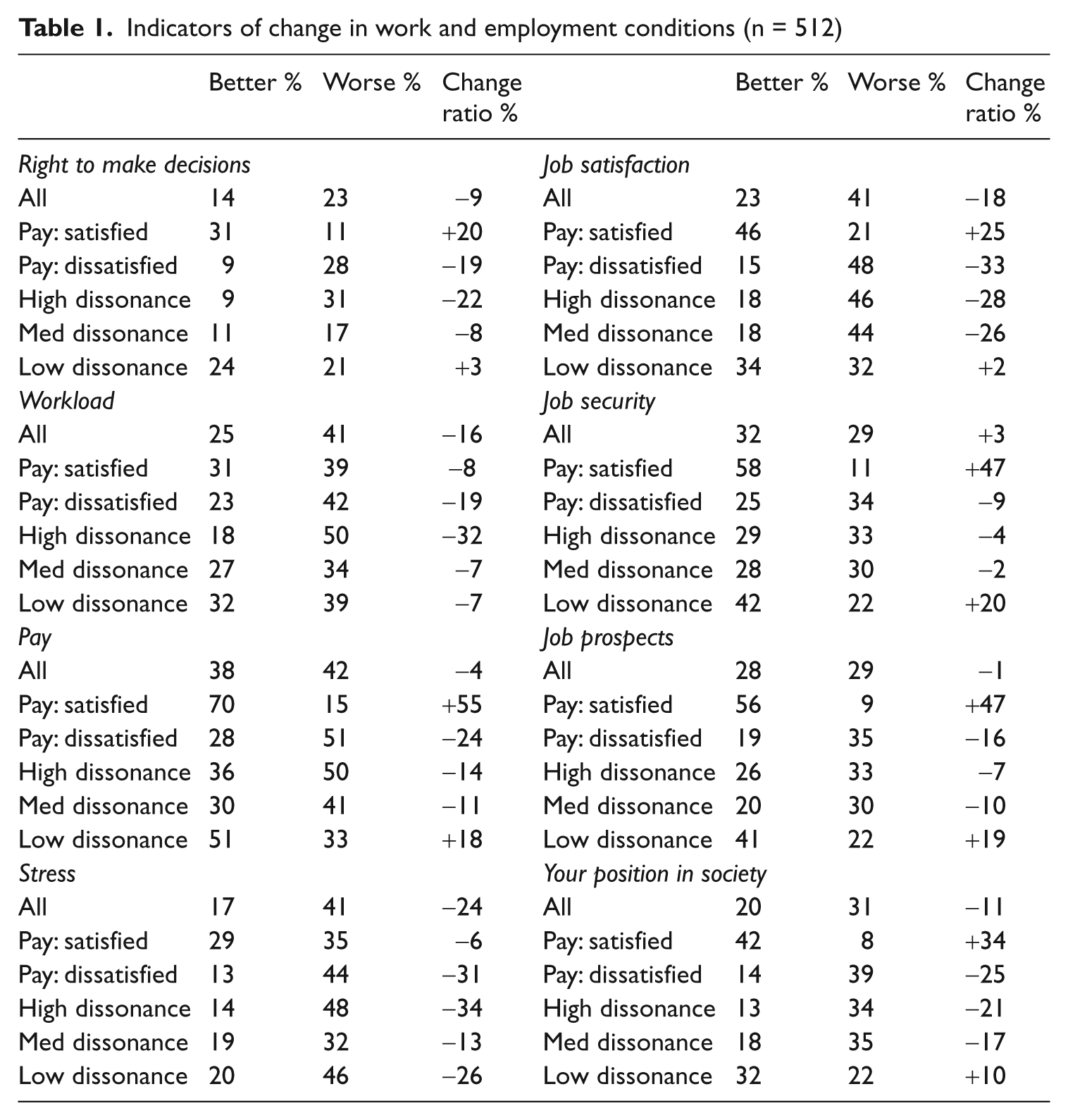
The first pattern to note is that, with the exception of job security, 1 the overall results show a reported decline in conditions over time. This was particularly the case for workload, workplace stress, job satisfaction and position in society, while substantial numbers also reported a decline in pay and job prospects. Although they are not presented in the Tables, there were some notable differences between the three plants, however. Whereas the right of workers to make decisions and experience of stress had worsened in the three plants, many workers at AutoB reported better pay. Feelings of job security had also improved for a good number of workers at AutoB and AutoC, where order books were healthier. Perceptions of job prospects and position in society had also improved at AutoB but declined at the other two plants. In some respects, AutoB stands out because average monthly wages were higher there compared to the other two plants and the plant was offering better wages and more secure jobs than other employers in its small-town location. Despite this, like AutoA and AutoC, a majority of workers at AutoB remained dissatisfied with their pay.
Differences by pay satisfaction and interest dissonance are also presented in Table 1. Without exception, these show that workers who are dissatisfied with their pay, nearly three-quarters of the total, exhibit markedly different attitudes to those who are satisfied. For example, those who are dissatisfied were far more likely to state that their pay, experience of workplace stress, job satisfaction, job security, job prospects and position in society had deteriorated compared to those who were satisfied. This suggests that pay dissatisfaction has engendered disaffection with changing workplace conditions; indeed, a perceived deterioration in working conditions over time. Precisely the same patterns obtain for interest dissonance. Workers who adopt the oppositional view (that workers and managers have different interests) are more likely to feel that conditions have worsened compared to those who believe they share the same interests with their managers. With the exception of stress (for which there is a more uniform experience of worsening stress levels) workers indicating high interest dissonance with their managers were far more likely to feel that job quality and employment conditions had declined: for example, their right to make decisions (an indicator of job autonomy), their workload, pay, job satisfaction and position in society. While not quite as marked in every case, similar patterns obtained for those indicating medium interest dissonance.
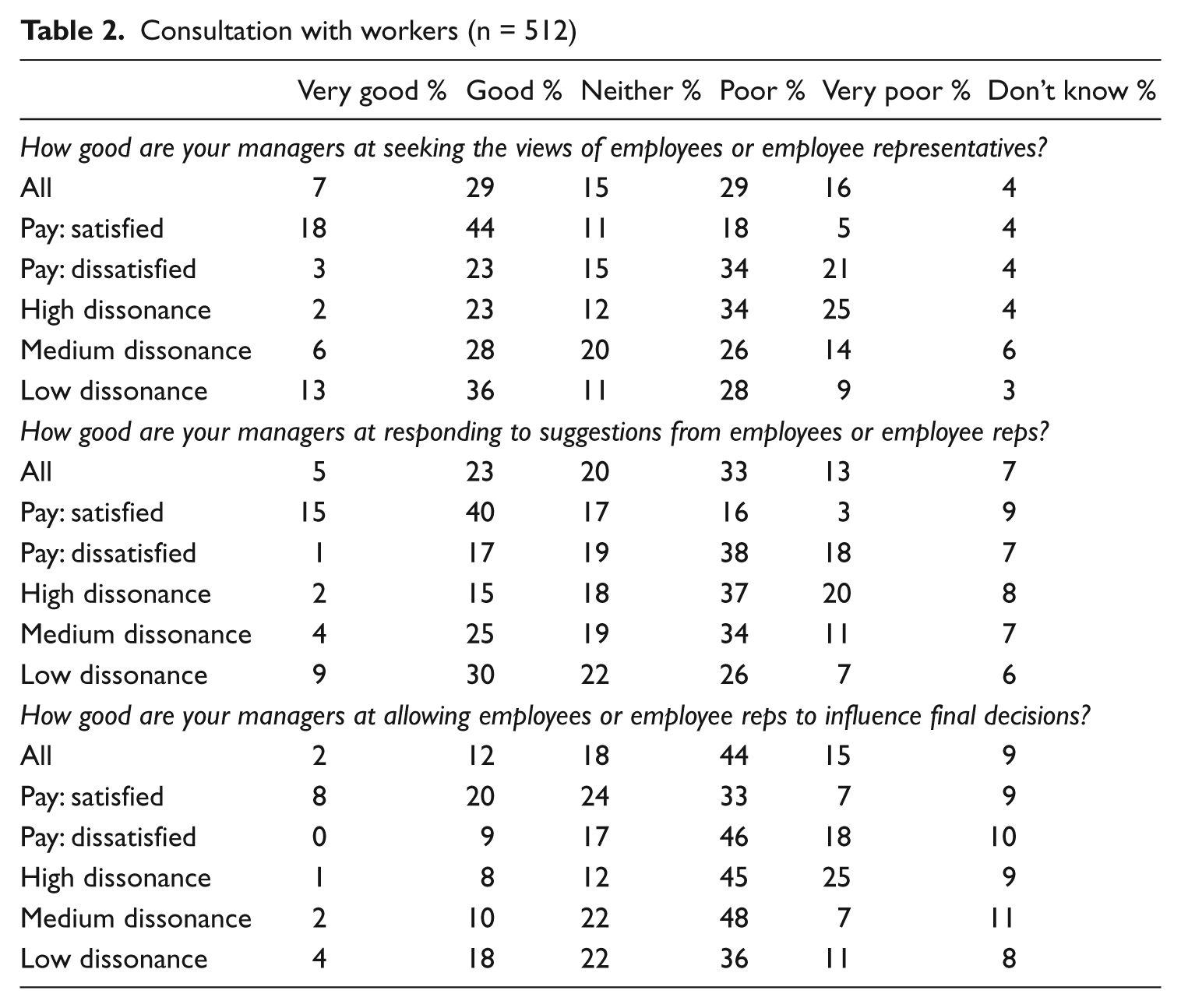
Worker assessments of the performance of their managers in consulting with employees are presented in Table 2. While our data showed little significant difference between the plants, some contrasts emerge once these data are cross-tabulated with the pay satisfaction and interest dissonance variables. Those who are dissatisfied with their pay, or who believe their interests conflict with their managers, are more likely to rate their managers as poor or very poor in respect of seeking the views of employees or their representatives and responding to suggestions. The one area marked by a more unified response is the rating of managers in allowing employees or their representatives to influence final decisions – a key HRM signifier of mutual trust. In this case, all groups were more likely to indicate poor or very poor.
Consultation with workers (n = 512)
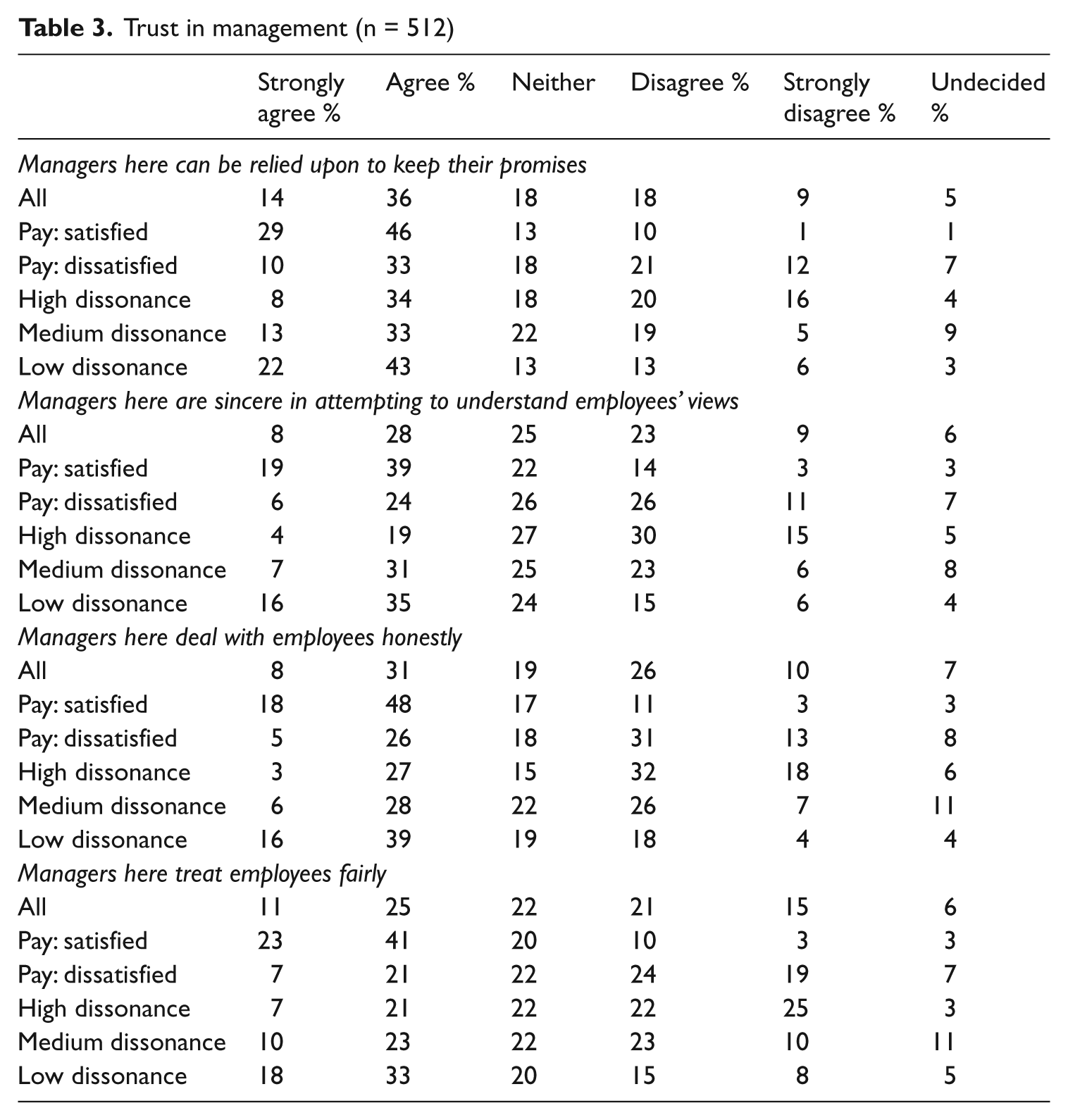
Finally, results of three questions concerning the extent to which workers trust their managers and an additional question concerning fair treatment of employees are presented in Table 3. Loyalty and trust in management are held to be significant manifestations of Confucian cultural characteristics in China (Wong et al., 2002) and the data suggest patterns of a residual loyalty in the three plants that may be associated with the erstwhile high status of China’s SOE workers as ‘masters of the enterprise’. There is also evidence that these relationships are weakening in the three plants. The proportions of those agreeing with these trust and fair treatment propositions tended to be higher at AutoB and AutoC, though differences were not, in the main, significant. Moreover, there were again underlying patterns of difference when pay satisfaction and interest dissonance were taken into account. The substantial numbers of workers who were dissatisfied with their pay or who indicated higher interest dissonance were, in the main, less likely to trust their managers and less likely to believe that managers treat their employees fairly.
Trust in management (n = 512)
Conclusion
In the case of China, academic interest in the global diffusion of western management methods has taken a singular turn with increasing weight being placed on the potential influence of Confucian principles in generating a hybrid management model. Specifically, Confucian ideas governing moral standards, harmonious relationships and loyalty and respect for those in authority are held to retain extant influence over Chinese managerial values. For some writers, this constitutes a cultural basis for the development of a more humanistic approach to the management of labour (for example, Le, 2003; Lin and Ho, 2009).
It is not easy to reconcile these views with the case study evidence presented here. This research shows that if there is a consistent management style emerging in the three automotive plants it is more homologous to a ‘hard HRM’ cost reduction strategy of the type identified by Morris et al.’s (2009) analysis of electronics and apparel sector plants in China. All three plants were operating in highly challenging mass production markets, requiring tight control over labour costs and labour deployment. In each case, management was able to exert greater discipline over the conduct of work through the use of non-permanent labour contracts and flexible wage systems that incorporated the threats of pecuniary punishment to workers who did not comply with work attendance, work output and quality demands. As a result of this, the workers interviewed reacted with scepticism to the idea of engaging with more ‘humanistic’ western management methods. Instead, for many, a more realistic alternative was one of regime compliance in order to retain a hold on existing employment and income. This generated a ‘harmony’ of sorts but not of the type one might associate with the concept of Confucian HRM.
Thus, in these conditions, ‘survival within the factory’ as well as ‘factory survival’ constituted a prime worker concern. This militated against the emergence of any conventional manifestations of worker contestation of management initiatives. Moreover, as Nichols and Zhao (2010) demonstrate with systematic evidence from the same case study research, these workers had no recourse to independent trade union organization to mobilize around collective grievances. Instead, their realization that the ACFTU provided only a token representation and voice at work generated widespread disaffection with the workplace union (though not to the idea of trade unionism itself).
The regularity of tight labour control and workplace discipline does correspond with the typical picture of employment relations in China provided by many western media commentators. However, what is distinctive about our case study analysis is the emergence of clear patterns of interest dissonance between managers and workers, that not only allows us to question the prospects for harmonious workplace relations outlined by the HRM analysts but which suggests a development quite contrary to this. Workers indicating both medium or high interest dissonance with their managers and dissatisfaction with their pay (in both cases nearly three-quarters of the total) were much more likely to register discontent with different facets of their job quality and employment conditions. For example, feeling that job autonomy, pay levels, job satisfaction, job security, job prospects and position in society had all worsened, while also expressing dissatisfaction with voice mechanisms and manager-employee relationships.
Two arguments arise from this. The first is that, despite the extant SOE status of the three case studies, the systems of management control and work organization were replicating in important respects the capitalist labour processes seen in the privatized firms and multinational commodity producers that are now central to manufacturing capital accumulation in contemporary China. In such environments, Confucian-based ‘unitarism with Chinese characteristics’ is as inadequate a frame of reference as western unitarist treatments of ‘mutual gain’ HRM regimes for addressing the conflict of class interests that is inherent to capitalist workplace dynamics. The second argument is that the growing realization of conflict of interest in the employment relationship raises the possibility of a broader underlying dynamic of disharmony in the Chinese economy that might transcend particular sources of discontent such as those associated with employer controls in dormitory labour regimes (Pun and Smith, 2007), the non-payment of wages (Lee, 2007) or the mass layoff of workers in SOEs (Hassard et al., 2008). It is notable that these types of practices and problems were not present at the three case study firms at the time of the research; nor had the plants displayed a history of strike activity or official labour disputes. Despite this, in environments of tightly controlled labour process and employment conditions, patterns of dissatisfaction with pay and interest dissonance were associated with negative assessments of enterprise management and their work reforms, a latent oppositional stance that contains the potential for more systemic industrial conflict in the future. While the case study evidence contains obvious limitations in terms of its restriction to SOEs located in a single province and sector, the views and attitudes elicited directly from over 500 workers in the three plants are instructive. As an era that some refer to as ‘China’s century’ approaches, they highlight the need for further, systematic cross-sectoral research into Chinese workers’ attitudes to their management, work organization and employment conditions.
Footnotes
Acknowledgements
We would like to thank the Editor and anonymous referees for their useful comments and also Professor Theo Nichols for his advice.
Funding
This research received no specific grant from any funding agency in the public, commercial or not-for-profit sectors.