



Abstract
While the rise of non-regular women workers in Japanese firms drew much attention, little attention has been paid to employment barriers that regular women workers continue to face in Japanese firms today. Based on in-depth interviews with 64 men and women workers, this article examines gender inequality in Japanese firms in which women’s structural power is extremely low. Using the analytical framework of organizational masculinity, it explores organizational processes by which vertical sex segregation is legitimized by workplace culture. The article concludes with suggestions for improving the prospects for women’s employment in Japanese firms.
Introduction
With the breakdown of financial institutions in Japan in the1990s, much attention was paid to the deregulation or liberalization of the Japanese employment system, a system traditionally characterized by lifelong employment and seniority promotion (Keizer, 2008; Schoppa, 2006; Wolff, 2008). Lifelong employment, in which firms only hire new graduates as regular workers and provide seniority wages and benefits until retirement, has been criticized as ‘a drag on labour mobility and an economically inefficient anachronism’ (Wolff, 2008: 57). While firms’ cost-saving reforms since the 1990s have resulted in a substantial increase in the number of non-regular workers (Keizer, 2008), a large group of middle-level and senior male workers in the firms have remained untouched by the economic recession (Kimoto, 2008). Lifelong employment remains intact, with widespread support in the Japanese business community (Schoppa, 2006; Wolff, 2008). Continuation of lifelong employment in Japanese firms has often been discussed by researchers in terms of its impacts on workplace culture, including bolstering of communitarian bonds based on trust, loyalty and seniority (Olcott, 2009), and reinforcement of the norm of working long hours (Wolff, 2008). However, little research has been done on organizational practices in Japanese firms that continue to hinder women’s employment.
Recent studies on women’s employment in Japan, largely focused on deregulatory changes to Japanese firms, have mostly emphasized the increase in non-regular workers, as well as temporary and part-time women workers, since the 1990s (Broadbent, 2002; Keizer, 2008; McCormick, 2007; Shire, 2002). These workers serve as a buffer to protect the economic security of lifelong male workers (Keizer, 2008; McCormick, 2007). The increase in non-regular women workers has further reinforced the 1970s-era state-driven male-breadwinner work/welfare regime, in which a large number of women, in return for tax deductions and pension benefits, were promoted into part-time jobs and were additionally expected to take care of family members as unpaid caregivers (Gottfried and Hayashi-Kato, 1998; Schoppa, 2006).
However, the rapid increase in highly educated women and women regular workers throughout the 1990s and 2000s, another aspect of ‘the double-edged effects of neoliberalism’ (Ueno, 2010: 32), has not been much discussed. During this era, more women entered higher-learning institutions than ever before (Ueno, 2010: 31): from 1990 to 2009, the percentage of women attending four-year colleges or universities soared from 15 to 44 per cent – nearly tripling – while the percentage of men only increased from 33 to 56 per cent (Cabinet Office, 2010). Accordingly, from 1989 to 2008, the proportion of newly hired women workers who were college graduates increased from around 14 per cent to 55 per cent of the total (Ministry of Health, Labour, and Welfare, 2008a). Firms’ hiring of women in career-track jobs has also increased (Ueno, 2010: 31), from 11 per cent in 2000 to 17 per cent in 2008 (Ministry of Health, Labour, Welfare, 2001; 2008b). Schoppa (2006: 74) calls the increase in highly educated, highly motivated young women, and the strides they have made in employment, a ‘gender revolution’ in Japan. In combination with the nation’s rapid population decline and the diffusion of the egalitarian imperative, this trend is expected to further erode the pre-eminence of the male-breadwinner model of work and family in Japan (Gottfried and O’Reilly, 2004: 104).
Numerous formal reforms have also promoted women’s employment in Japan. The 1985 Equal Employment Opportunity Law (EEOL) was revised in 1997 and 2006 to include a clearer definition of sex discrimination, although critics still raise questions about its effectiveness because it lacks punitive measures (Geraghty, 2008). In the 1999 Basic Law for a Gender-Equal Society, the Japanese government promised an increase in the number of females in leadership positions to 30 per cent by 2020; the measure, however, is seen as largely symbolic (Shire and Imai, 2000: 3). Because of governmental and legal pressure, Japanese firms have enacted egalitarian policies, including policies dealing with sexual harassment, as a major element of corporate compliance (Wolff, 2007). In 2006, about 70 per cent of large firms (those with over 5000 employees) used positive action (Ministry of Health, Labour, Welfare, 2006).
Despite these gains, some scholars (Yu, 2009: 182) caution that employed women have made insufficient strides in Japanese firms because Japan’s system of lifetime employment rewards men over women and legitimizes discriminatory gender practices (Benson et al., 2007; Kimoto, 2005; Ogasawara, 1998). Yet beyond traditional customs such as double-track hiring or women leaving their jobs in Japanese firms upon marriage, the organizational processes of sex segregation in Japan have been under-investigated by researchers. In particular, studies of Japanese firms that take into account the increase in women’s employment since the 1990s are rare. This article, based on in-depth interviews with 64 men and women workers in five Japanese firms, and using workplace masculinity as an analytical framework, examines how organizational customs and beliefs in Japanese firms continue to constrain regular women workers and prevent them from expanding their opportunities in the workplace.
While past studies that analysed organizational culture in Japanese firms have mostly focused on non-career-track women (Ogasawara, 1998; Shire, 2000), this article explores the experiences of men and women managers as well as those of career-track and non-career-track women. The article adds to previous studies of Japanese firms which mostly argued that sex segregation derives from the Japanese custom of lifelong employment, including the hiring-track system and the tradition of women leaving a job upon marriage. Yet this article’s application of the concept of organizational masculinity to the case of Japanese firms enables us to see that, more than the expectation of marriage or track hiring, it is a set of gendered beliefs and practices in the workplace that disadvantages and marginalizes women workers and thus shapes sex segregation. The article concludes with suggestions for improving the prospects for women’s employment in Japanese firms.
Vertical sex segregation within Japanese companies
‘Vertical segregation’ refers to women’s exclusive concentration in clerical and low-level management positions (Reskin and Roos, 1990: 154–62); vertical sex segregation is a major cause of gender inequality in Japanese companies (Brinton, 1993; Charles and Grusky, 2004). Women managers are rare in Japan. In 2006, women made up only 10.8 per cent of all subsection chiefs (kakari-cho), 5.8 per cent of section chiefs (kacho) and 3.7 per cent of department heads (bucho) or general managers (Otake, 2006). The lack of women managers in the Japanese workplace has been explained as resulting from the track-hiring system (Brinton, 1989, 1993; Ogasawara, 1998), which relegates a large number of women to ‘non-career-track’ positions that involve clerical assistant-level work, and ‘area-career-track’ positions that are similar to career-track positions but with no obligation to relocate. Neither non-career-track workers nor area-career-track workers are given the same benefits and promotion opportunities as career-track workers. Most men with a college education are hired as career-track workers, in contrast to the handful of women with the same education who work in these positions.
In response to the sex discrimination lawsuits that have been filed in Japanese courts, the courts have typically claimed that double-track hiring and the corresponding pay gap do not constitute sex discrimination, for three reasons. First, the practice of double-track hiring began prior to the enactment of EEOL. Second, this practice is not prohibited by Japanese labour law, which only prohibits sex discrimination in payment. Third, double-track hiring is said to provide opportunities for women workers to change tracks and jobs through examinations and the acquisition of necessary skills (e.g. Sasanuma, 2006; Tsujimura, 2007). Past studies (e.g. Ogasawara, 1998; Shire, 2000) have found considerable evidence of vertical segregation with regard to non-career-track workers. However, employers’ use of the track-hiring system also varies across companies of differing sizes and across industries. In 2006, only 11 per cent of 6000 companies in Japan used the double-track system, yet about 55 per cent of large companies and 43 per cent of financial and insurance companies used it (Ministry of Health, Labour and Welfare, 2006). Thus further investigation of sex discrimination beyond track hiring is necessary.
The absence of women managers in Japanese firms has also been explained as resulting from women’s choice of marriage over careers, women’s lack of ambition (Tachibanaki, 2005: 2), or discriminatory practices that push women to marry (Kimoto, 2005; Ogasawara, 1998). Under the system of lifelong employment, workers are expected to be willing to accept unlimited overtime and to sacrifice their lives for the company, and women who do not follow these practices are seen as lacking in ambition and likely to quit upon marriage (Benson et al., 2007).
Regardless of the surge in the postponement of marriage among employed women workers (Nemoto, 2008) and the decline in the desire of young educated women to be full-time housewives (Schoppa, 2006), ‘nearly 70 per cent of women workers leave their jobs upon marriage and childbirth and this figure has remained the same in the last two decades’ (Ueno, 2010: 30). This may indicate polarization among Japanese women, between those who are unmarried and remain career-oriented and those who quit work to devote themselves to the caretaker role (Schoppa, 2006: 206).
The absence of female managers remains noteworthy in Japanese firms. In 2006, about 46 per cent of large companies (those with more than 5000 employees) responded to a question about having few female managers by stating that there were not many women with the necessary knowledge, experience and judgement to fill such positions. About 37 per cent reported that women quit before they became qualified to be managers (Ministry of Health, Labour and Welfare, 2006). Lam (1992: 204) calls the lack of women in Japanese management the result of a ‘self-reinforcing cycle’, in which the lack of women managers further lessens women’s motivation for upward mobility. It is critical to examine how organizational culture, in which female authority is absent, reinforces women’s low status and lack of power.
Organizational masculinity and women’s positions of power
The concept of the gendered organization (Acker, 2006) offers a useful analytical framework, revealing the organizational processes whereby gendered beliefs and customs shape workers’ construction of identity in the workplace (Ely and Padavic, 2007). Although masculine customs and practices in the workplace – such as aggressiveness, competitiveness, autocracy and market-/profit-driven behaviour – have been postulated as common factors that deprive women of power (Acker, 2006; Kerfoot and Knights, 1998), men’s and women’s beliefs about and practice of masculinities in the workplace differ depending on the structural position of women and their degree of power and authority (Dellinger, 2004: 563).
Men’s use of ‘boundary heightening’ behaviours (Kanter, 1977), or exclusion of token women, is common in highly male-dominated workplaces. Kanter (1977: 233) argues that men differentiate themselves from token women by stereotyping or ‘encapsulating’ each woman worker as a ‘mother, seductress, pet, [or] iron maiden’ or as a ‘secretary’. Expanding Kanter’s argument, Ely (1995: 618) finds that women in male-dominated firms in which few women with power are present perceived women playing two roles as critical to their success: the masculine role and the seductress sex object role – ‘roles defined by men’s preferences’. She notes that women workers in male-dominated firms expressed stronger gender stereotypes, a sense of less competence and satisfaction and lower expectations for promotion than women in gender-integrated law firms.
Certain masculine practices may be more pronounced in workplaces in which women of authority are present in smaller numbers. For example, the long work-hours norm serves as a masculine imperative that men often use to bolster their sense of sacrifice, devotion and heroism, and this contributes to hyper-masculinization of the management culture (Collinson and Collinson, 2004). As an example of this, women managers in the civil engineering industry, in which there are few women in positions of authority, are pressured to abide by ‘presenteeism’ or the necessity of making themselves constantly available (Watts, 2009).
The collective masculine customs described here often communicate a message to women of irrelevance, disrespect, unimportance and exclusion (Martin, 2001). Men may boast about their competence and superiority by ‘peacocking’ (self-promoting) or by exhibiting ‘affiliating masculinities’ in which they align and connect with other men through frequent visits to, expressing their fondness for or ‘sucking up to’ other men (Martin, 2001). Homosocial bonds, often bolstered by ‘locker-room’ or adolescent behaviours such as attending sports-related events, engaging in sexual banter and making jokes, provide men with a sense of power, identity, competition and solidarity (Gregory, 2009). Executive men in the highly male-dominated advertising industry engage in such behaviours ‘with an attitude of entitlement and enjoyment’ (Gregory, 2009: 343). The woman worker is often excluded from these practices, or encounters men’s use of the double standard if she does try to participate (Gregory, 2009); as a result, she may lose networking and promotion opportunities.
In order to climb higher on a management ladder on which females are invisible, women may find it necessary to emulate masculinity – being ‘tough’ or even ‘thrusting’ and ‘ruthless’ (Liff and Ward, 2001: 25–7) to fit in. Sacrificing femininity and expressing combativeness to join ‘the corporate crusade’ (Coates, 1998: 9) are common strategies among female managers and professionals. Conversely, women may also feel pressure to act feminine (Mavin, 2006), because ‘women who fail to practice femininity according to feminine stereotypes that define women as subordinate lose approval and end up with even lower status’ (Martin, 2003: 360). Female managers may also become the target of ‘female misogyny’ as ‘women find it difficult to deal with senior women’ (Mavin, 2006: 272), particularly since women workers may normalize or even eroticize positions in which they are subordinate to male managers or men with power (Mavin, 2006: 273–4). Regardless of whether they display masculinity or femininity, women managers in highly male-dominated workplaces evoke anxiety and ambivalence among women as well as among men.
Meanwhile, men are also under pressure to prove their masculinity in the workplace, and they pay a price for this behaviour. In fact, men have less latitude in their gender identity enactment and thus are even more constrained in their choices than women (Ely and Padavic, 2007: 1135). Even in structural positions of power, men risk their health, compromise decision-making and workplace safety, and engage in harmful practices as a result of these behaviours (Ely and Meyerson, 2008; Ely and Padavic, 2007).
Methods
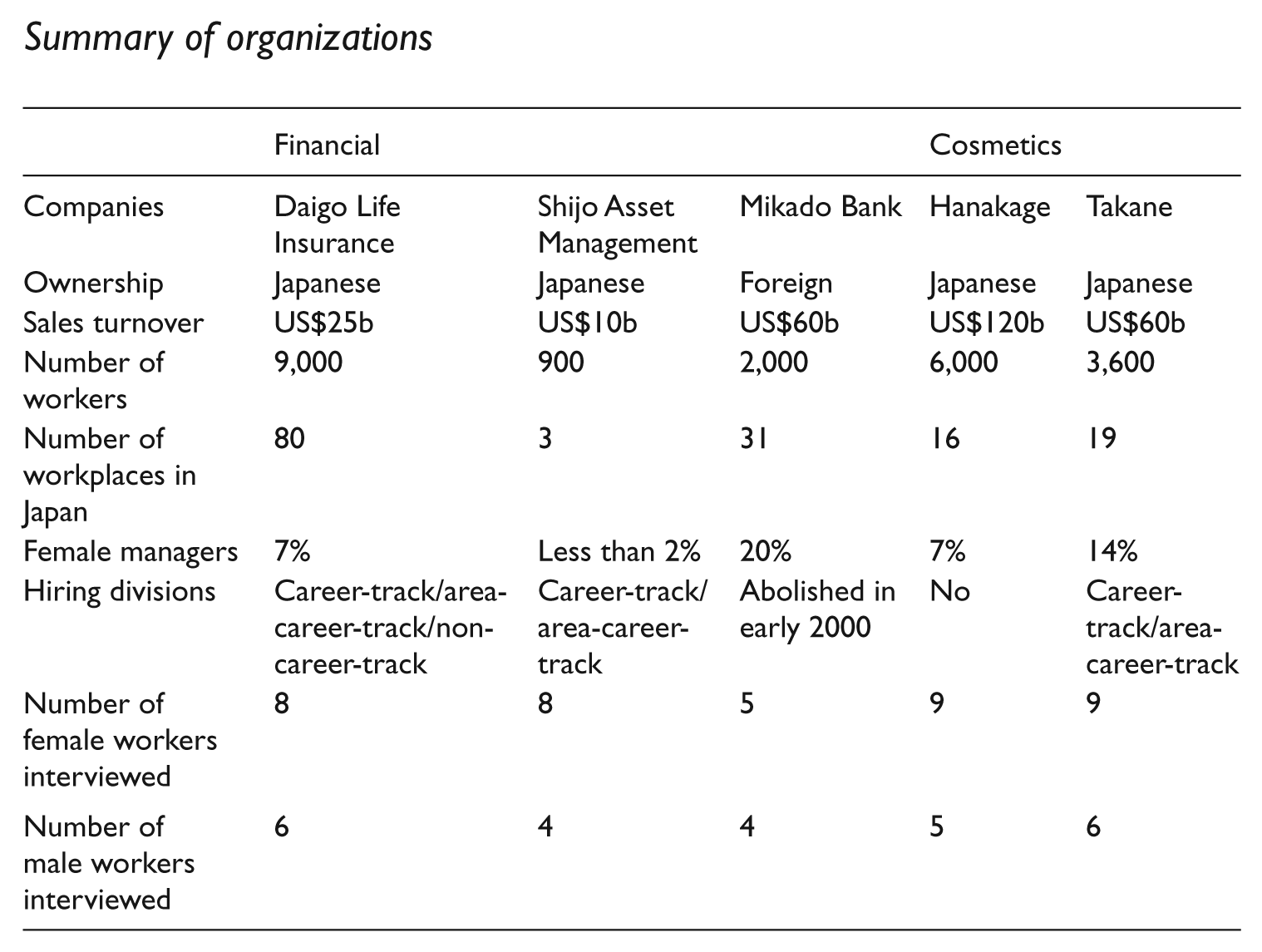
In 2007, using a snowball sampling method, 64 in-depth interviews were conducted with a diverse group of workers in Tokyo, Japan, at three financial companies and two cosmetics companies: Daigo Life Insurance, Shijo Asset Management, Mikado Bank, Hanakage and Takane (see Appendix 1 at the end of this article).
The researcher had contacted university faculty and alumni at a few universities in Tokyo regarding the study and, as a result, was introduced to the initial contacts in each firm. The five companies were chosen in two industries that are distinctly different in terms of public image and gender composition of career-track workers. The two cosmetics companies employed a much higher number of career-track women workers than the three financial companies. The cosmetics industry is also seen as one of the most ‘women-friendly’ in Japan, whereas the image of financial companies, due to their operation as conglomerates and their close ties with political parties, is highly patriarchal. However, female upper managers were absent in almost all the firms, which exhibited more similarities than differences with regard to their male-dominant cultures.
Daigo Life Insurance Company has about 9000 employees (at the time of the interviews, half of the workers were women) and over 30,000 sales employees (mostly women) across Japan. Women constitute 7 per cent of managers. Until a few years prior to the interviews, the company had an informal policy of forcing women to resign upon marriage. Shijo Asset Management has about 900 employees and operates under a large parent firm, Shijo Securities, which has an annual sales turnover of US$250b and employs over 10,000 workers across Japan. Fewer than 2 per cent of managers are women. Mikado has about 2000 employees. The company abolished double-track hiring in early 2000 and increased the percentage of women in management to 20 per cent.
Hanakage Cosmetics, which sells both cosmetics and household products, has about 6000 employees, with an annual sales turnover that is about twice that of Takane Cosmetics, which focuses on cosmetics alone. At Hanakage, only about 7 per cent of management positions are filled by women. Takane has about 3600 employees. The company is traditionally seen as a woman-friendly Japanese firm, mostly because of its greater number of female career-track workers and its generous childcare leave policy. However, the percentage of female managers at Takane, at the time of the interviews, was only about 14 per cent.
All five of the companies had started increasing the hiring of career-track women workers in the early 2000s. Regardless of this increase, however, two of the firms continued to use a track-hiring system. Four out of the five had special task-force committees to promote women’s employment – charged with, among other things, increasing the hiring of career-track women workers and expanding paid and unpaid leave for childbirth. Also, all the firms had experienced some level of departure from traditional Japanese management styles by the early 2000s, such as tightening the regulation of working hours and introducing the concept of productivity-based promotion.
In total, 39 women and 25 men were interviewed. All the men were career-track workers. Of the women, 29 were career-track workers; nine worked as non-career-track workers; and one was a temporary worker. All the men and 32 of the 39 women had college or higher degrees and six had graduated from two-year colleges. One woman had only a high school degree.
All of the interviews were conducted in coffee shops or at the firms’ offices. Relying on Acker’s concept of the ‘gendered organization structure’ (2006), each individual was asked about workplace culture and individual experiences, including training, career prospects, workplace interactions and work–life balance. Subjects were also asked about recent changes in company policy with regard to the hiring and promotion of women workers. Each interview lasted from one to three hours. The interviews were recorded and transcribed for analysis. Pseudonyms for the names of the companies and individuals were used. The sample was too small and non-random to allow for thorough generalizations, but it provided critical insights into the types of gender inequality and hierarchy in Japanese companies. For this article, data on practices and customs were analysed with respect to hiring, promotion and workers’ relationships. Women were intentionally overrepresented in the study group to allow their experiences to be studied in greater depth.
Findings
Men differentiating themselves from women
Men’s assertion of masculine superiority by engaging in long working hours, collective bonding and camaraderie is a common way to reinforce the gender hierarchy in the workplace (Collinson and Collinson, 2004; Gregory, 2009; Martin, 2001). In the interviews the male managers often expressed a lack of interest in their firms’ efforts to recruit women and promote them to middle management. Many women managers saw working long hours and emulating masculinity as necessary and deciding not to marry or have children was common among them. (Eight out of 12 woman managers in the five firms did not have children and five were not married.)
At Mikado Bank, the number of career-track women workers has significantly increased due to the firm’s abolition of career-track hiring, but the number of women managers remains low. Eisaku, a 38-year-old general manager in investment banking, boastfully claimed, ‘I would deserve a million-dollar salary if I worked on Wall Street’. Eisaku’s was a life of going home by taxi after working until midnight or straight through to the early hours of the morning. About women managers, he said, ‘I am sure the number of “ornamental” female managers will increase … Most females who are given the title of “manager” or “chief” have nothing to do with the actual management of the company.’
The male managers in the financial firms frequently pointed out women’s lack of competence. A male manager at Daigo Life Insurance said, ‘It is useless to put in some token woman who doesn’t know anything about management.’ Another manager at Shijo Asset Management said, ‘I am not sure if the company really wants women … Their perspectives differ from or are narrower than men’s. It is difficult to work with them.’ Eisaku also noted:
You cannot make money if you work nine to five. The number of women who work from nine to five may increase. But, for me, full-time means nine to midnight. If a baseball player like Ichiro said, ‘I don’t practice after five’, that would be stupid. It is the same thing … There are so many things women cannot do. How many women with children are able to work long hours like I do? Can a woman get a business contract after drinking until four in the morning? … You must ‘grab a ball’ to get a business partner, so that you negotiate the amount and interest rate. Can a woman do that?
By using the metaphor of a successful baseball player, Eisaku asserted his masculinity and his competitive edge over women. Overwork is a gendered marker of the ideal worker and women are seen as incapable or unwilling to work long hours. This corresponds to the findings reported in Kimoto’s study of a general merchandise supermarket in Japan, in which a male worker made a comment about a female worker that was similar to Eisaku’s: ‘If you want to be accepted like the men in this company, then work like a dog’ (2005: 199).
Also, for Eisaku, a man can do more because he can ‘grab a [man’s] ball’, or achieve a level of intimacy with business clients. Many of the men who were interviewed value the daily after-hours drinking and socializing they are expected to do, even though the after-work activities vary from locker-room bonding in hostess clubs to intra- or inter-firm study groups and business negotiations. In Gregory’s study of the advertising industry, the workers noted their clients ‘won’t deal with women, even women in top positions’ (2009: 337–8). The exclusion of women at homosocial business events often derives from management’s interest in keeping clients happy (2009: 327), thus reflecting the culture of misogyny inherent in big business.
Male workers commonly noted the intra- and inter-firm networking among men. Seiji, a 40-year-old male manager, talked about the solidarity among the men, saying, ‘Within the Shijo group, we call each other by the Japanese imperial year in which we joined the company.’ Yoshio, a male business attorney, said, ‘Shijo Securities has a culture of training men well. Some of the men there are practically legends.’
Many men feel pressured by the rituals of male bonding. Takashi, a 37-year-old male section chief at Daigo Life Insurance, likened his first month’s training to military experience.
I was so scared. I was expecting men to throw ashtrays at each other. You get up at four in the morning and run a marathon. The senior men train you how to bow over and over. So much drinking at night.
Takashi was also in charge of 550 women sales workers in a local branch. He said, laughing:
There was sexual harassment everywhere. I had to dance with many women. These women would kiss me and touch me all over. I was totally an otoko geisha [a male worker who is forced to entertain male bosses or clients by engaging in degrading performances in drinking settings].
Men-only rituals as a means to indoctrinate gaman (fighting spirit, hierarchical relationships, obedience to authority, group cooperation and especially respect for tradition; Larson, 2007), a critical component of masculinity in Japan, continue to exist in many firms. In contrast, women are commonly excluded from male networks. When the top individuals in management who strongly supported Yuko, a 42-year-old section manager at Hanakage, resigned, not only did her evaluations go down but her future promotion chances significantly diminished. ‘The fact that there are so few female managers in this company definitely relates to how promotions take place’, said Yuko. She continued, ‘They wanted guys who would be loyal to them and who would always say “Yes, sir” to them. They don’t develop this kind of relationship with women.’
At Daigo Life Insurance, an occasional woman who demonstrates a strong sales background, works long hours and participates in after-work drinking gatherings can successfully become one of ‘the boys’. Tami, a 38-year-old manager, attained her assigned goal of US$50m in sales in 12 months. Tami joined in with after-work drinking sessions with her male bosses every day and played golf every weekend. She described attending hostess clubs with upper managers and their clients as enjoyable. In contrast, Tami explicitly expressed her annoyance with female culture in the company. ‘Women cry, women eat so slow and so little. I feel very exhausted when I talk with women.’
Similar to her male co-workers, Tami also opposed the company’s increase in career-track women hires. ‘It is unfair to men who work hard … All women must do all the given work and make a sincere effort before they demand what they want. The women’s consciousness must change first.’ By changing ‘women’s consciousness’, Tami meant that the women need to learn that they must ‘work like dog[s]’ before they demand equal treatment.
Customs such as working long hours and emphasizing male bonds reward only a handful of women who are willing to emulate masculinity. This legitimizes the workplace exclusion of women who are seen as unwilling to work and incapable of working like most men. The absence of women with power and authority who can disrupt traditional beliefs about masculinity appears to reinforce the persistence of gender stereotypes in Japanese firms.
Objectifying women
Male workers’ acts of ‘symbolic subordination’ of women, treating them as ‘mother[s], seductress[es], pet[s], [or] iron maiden[s]’, may be common in workplaces in which women with power are absent (Ely, 1995; Kanter, 1977). In the interviews, the women reported that senior male workers assign women ‘extra’ secretarial or assistant tasks and expect female workers to be listeners or sex objects. Such patterns, while frequently reported in financial firms that have double- or triple-track hiring, are also not uncommon in cosmetics companies.
Emili, a 26-year-old and a non-career-track worker at Daigo Life Insurance, reports that her boss, a department head in his 50s, started ‘using me as a substitute for his wife’ as soon as she started at the company. Emili said:
I would pick up medicine for him, I would make all his phone calls for him and I would manage his schedule. So I ended up doing a lot of overwork, because by the time you start on your own work, it is already afternoon.
Many non-career-track women at Daigo Life Insurance insisted that they did not want to move to career-track positions. If they move to a career-track position, they must be at work until nine or ten o’clock at night. Also, in order for a woman to change to a career-track position, she has to work six years with excellent evaluations, receive training in insurance sales and pass a few internal exams.
Even women managers and career-track women in financial firms said that, when they were new or low in seniority, they did all the typical assistant tasks, including tea pouring and cleaning of workers’ desks, so as not to ‘stick out’ from the large number of non-career-track women. Maki, a deputy manager at Mikado Bank, said, ‘The bank hired me on the condition that I get along with non-career-track women.’ Misa, a 24-year-old at Daigo Life Insurance, said, ‘The male workers held a departmental meeting to discuss if I should do tea pouring or not, because they had never worked with a career-track woman before. They decided I should do tea pouring because I am the youngest.’ The workers were constantly reminded of ‘women’s roles’ – in other words, that they should act as willing caretakers or ‘wives’ who can ‘get along with’ other women. Also, young female employees of the cosmetics companies claimed that they did extra secretarial work for the senior men. Rie, a 26-year-old worker at Takane, managed a department head’s schedule, answered all the phones for her section and did extra research for a department head. ‘Men are not asked to do such things’, she insisted.
‘Depressed aspirations’ (Kanter, 1977: 140) may be common among temporary workers who are expected to do only the work of assistants. Akiko, a 30-year-old, had worked as a career-track stockbroker in a large securities company, yet because she had taken one year off from her previous company, she was given only assistant-level work as a temporary worker at Shijo, with no benefits. ‘If I pour tea more than ten times a day, it takes time and I cannot do my own work’, she noted. Akiko, feeling that she was wasting time in the company, was about to quit to get married at the time of the interview.
According to Kanter (1977: 234), men’s projection of seductress images onto women workers is another form of gender subordination. Misa, a 24-year-old career-track worker at Daigo Life Insurance, reported that she was often asked to sit next to male workers or managers in after-work drinking meetings because ‘[the men] want me to listen to them’. Although attending drinking events was important for her new career, she believed she was wasting her time and felt uneasy about her career prospects. ‘I feel like I am a hostess in a club … I have to constantly say, “Wow, that is great”, or “I understand” and nod at whatever they say’, she asserted. Men may also attempt to deprive a female superior of her power by sexually objectifying her. Reiko, a general manager at Takane, said:
I have always worked twice as hard as the men … But they say things like, ‘What kinds of sexual tactics did you use to get a promotion?’ It is disgusting. They see women only as sexual objects.
An organizational culture that sees young women as men’s assistants, or that expects women to be caretakers, mothers or sex objects, harms women workers’ self-confidence and productivity, both because they must spend extra time doing assistant-level tasks and because they feel they are valued for their caring and serving rather than for their competence.
Negatively stereotyping female mangers
In highly male-dominated firms, a misogynistic perception of female managers may be common not just among men but also among women, especially when women workers are more accustomed to being subordinate only to male managers, not to female managers (Mavin, 2006).
The two cosmetics companies in this study are known as ‘women-friendly businesses’ and all the women I spoke with in this industry could name quite a few lower-level female managers. Yet the rapid increase in women managers is seen as unwelcome by some workers. Seven of the 14 workers interviewed at Hanakage complained about female managers and 6 referred to gender stereotypes during the interviews, while 7 of the 15 interviewed at Takane mentioned their relationships with senior female workers as a great concern.
The narrative of men putting up with or taming irrational, emotional, incapable or unprofessional women was a common theme expressed by the Hanakage workers. Shigeo, a 41-year-old and one of two males in a group of 10 workers in a section of Hanakage doing household research, was one who expressed his frustration about women workers. ‘The meetings are not really meetings. They are just women chitchatting’, Shigeo said, raising his voice. ‘Their presentations and discussion of the research are too subjective and emotional. They don’t pay attention to others’ feedback and perspectives at all.’ Similarly, Toshio, a 41-year-old at Takane working on lipstick development, said, ‘My [male] boss told me to be really patient with the women in my section because “women change their feelings often”’.
Young women workers in the company often contrasted female bosses’ hysterical treatment of workers with male bosses’ paternalistic management style. Yuka, a worker at Hanakage, said that her current female-dominated section exhausts her, because she expends much more energy trying not to offend women than she does men. ‘I think the organization functions in a healthier manner when it has more men … The section loses integration without men’, said Yuka. When another worker, Mariko, was working on marketing a shampoo, she had a hard time getting along with her female manager. ‘She never really listened to me. She yelled at me all the time: “Why can’t you do this? I told you …”’. She said she never wanted to work for a female manager again. ‘I can say anything to male managers.’
In the interviews, many male workers noted the ‘boss’s yelling’ and characterized it as being an aspect of ‘old-fashioned’ organizational masculinity. However, women managers’ expression of negative emotions is not seen as an enactment of corporate masculinity; instead, it is sanctioned as a marker of deviant femininity. One worker, 33-year-old Kaoru, said, ‘The managers sometimes yell at male workers. But I got this from a female manager, too. She even started gossiping about me and excluded me.’
Some interviewees characterized female managers’ struggles as being the result of a gender hierarchy in management. Yuka said, ‘The top managers are all men. So the women managers want approval from those male managers. That is why those low female managers constantly try to show their power by being mean to us.’ Kaoru also observed her male boss frequently ignoring and belittling her female manager; each one only communicated with the other through Kaoru.
Ogasawara (1998: 56) notes that young women in Japanese workplaces are explicitly valued by male workers, and this creates tension among women of different ages and levels of education. Yet the misogynistic views of women managers discussed earlier reveal deeper levels of distrust of female mangers and concerns that go well beyond mere tensions based on age and education. Kanter (1977: 201–4) argues that ‘mean and bossy’ behaviours on the part of relatively powerless managers often reflect their insecurity about their organizational status, regardless of their gender. Workers’ concerns and complaints about female managers may derive from the low confidence level of these managers, which in turn result from gender-biased or lethargic management that does not provide adequate training for them. The absence of women in upper management thus feeds the culture of misogyny in Japanese firms.
Discussion
Whereas previous studies have explained sex segregation in Japanese firms as deriving from particular characteristics of the Japanese employment system – such as the large number of non-regular employees, the custom of track hiring or the tradition of women leaving their jobs upon marriage – the status of women managers and career-track women, whose numbers have increased since the 1990s, has received little attention. This article has built on previous studies by drawing attention to the experiences of career-track and non-career-track workers, and by further illuminating organizational processes by which the dominant culture of masculinity reinforces vertical segregation and the gender hierarchy in Japanese firms. Just as previous studies have noted that the lifelong employment system favours men over women (Benson et al., 2007; Brinton, 1989, 1993; Kimoto, 2005; Yu, 2009), masculinity remains safeguarded in Japanese firms where women are absent from positions of power. This article also confirms the findings in a previous study (Ely, 1995) which showed that the distinct difference in men’s and women’s structural positions of power in the workplace negatively affects women in both upper- and lower-status groups.
Male workers in Japanese firms bolster their business success by expressing their camaraderie and engaging in male-only training and intra-firm networks, working long hours and espousing negative views of women. For the small number of female managers in the five Japanese firms discussed in this study, emulation of masculinity through working long hours and suppressing reproduction and motherhood is a common tactic for successful assimilation; this is similar to the situation found in some western firms (e.g. Liff and Ward, 2001; Watts, 2009). Young women workers are expected to display traits of subordinate femininity, behaving as assistants or sex objects. Regardless of the increase in the number of female workers and managers in Japanese firms, negative stereotypes of women managers and workers as mean, incapable and unprofessional remain strong.
Because of the limited sample size used in this study, the findings cannot be assumed to reflect the situation in all companies or industries across the board in Japan. Further large-scale studies on masculine organizational culture and sex segregation in Japanese firms will be necessary. In particular, further study of the individual and organizational costs of masculine culture, in which men are pressured to prove their manliness while risking their health, harming their personal relationships and compromising the quality of their decision-making as well as discriminating against women (Ely and Meyerson, 2008), will be useful in addressing the harms caused by gender stratification in Japanese society.
As revealed in this article, explicit and implicit forms of sex discrimination persist in Japanese firms. One aspect of the EEOL in 2007 was the government’s promotion of firms’ use of positive action. Large firms, rather than acting on their own initiative, have implemented positive action only as a result of this legal and governmental pressure. Yet the current EEOL neither offers guidance regarding the steps that should be taken nor mandates positive action, and it certainly does not suggest penalties for the violation of sex discrimination laws (Geraghty, 2008: 523). Since the Japanese government is reluctant to take initiatives to tackle sex discrimination as a critical civil rights issue, seeing it as a compliance matter to be dealt with by private industry (Wolff, 2007), it may be a long time before significant change occurs in the EEOL.
Besides positive action, Japanese firms need to implement targeted interventions such as the recruitment of women for jobs in upper management, the abolition of career-track hiring and a more substantial reduction in long working hours. Relegating women to non-career-track positions promotes discrimination, even though it is a major cost-saving tactic in many Japanese firms. The article’s findings suggest that double-track hiring impedes women’s career prospects, particularly as the gender gap in education further narrows. The lack of qualified women managers has long been recognized as a serious concern by many firms (Ministry of Health, Labour and Welfare, 2006), and changing monolithic stereotypes of women managers will require firms to increase the number of upper-level women managers with diverse management styles and mentoring abilities. The question of how to increase the number of women in management when top managers are almost always insiders will merit further study.
Of course, policy-based institutional interventions in Japanese firms are not a panacea to eliminate discriminatory customs in organizational culture. The abolition of career-track hiring in Japanese firms will not lead to gender equality, as findings suggest that women who are in career-track positions face as much sexism as women who are not. Likewise, sex segregation and discrimination continue to be a problem even in western countries in which there is no career-track hiring. Ely and Meyerson (2000: 112) argue that the following organizational interventions that are common in the United States, while effective to a certain extent, are also limited in their ability to transform the gender hierarchy in the workplace: (1) promotion of women’s assimilation into male culture, or enabling women to acquire skills and training so that they perform on a par with men; and (2) policy interventions such as affirmative action or expansion of female role models and mentoring. They maintain that these organizational interventions do not challenge the sources of power that derive from cultural beliefs regarding masculinity, and thus continue to reinforce sex stereotypes and generate a backlash from men.
Indeed, many of the masculine beliefs and practices in Japanese firms that are discussed in this article, such as exclusion of women from the men-only network, workplace views of women as assistants or sex objects and stereotypes of women as incapable and unprofessional mirror Japanese society’s common view of women as caretakers of and assistants to men. For example, Japanese hostesses, as caretakers and sex objects, are well known for catering to male workers; their flattery and attention improves the men’s self-image and enhances their ability to form homosocial bonds (Allison, 1994). This script of male authority and subordinate femininity is mirrored in workers’ interactions in many Japanese firms (Nemoto, 2010). In another study, male workers made frequent mention of women’s low status as deriving from their role as caretakers (Kimoto, 2005: 227). Pervasive gender stratification in Japanese society legitimizes essentialized beliefs about femininity and reinforces women’s low status (Ogasawara, 1998: 166). The absence of women with authority and power in Japanese firms, who can stand in opposition to these stereotypes while earning recognition and respect as effective workers, is a serious problem. Japanese firms must put greater effort into enhancing employees’ awareness of the fact that discriminatory practices and beliefs in the workplace often derive from the sexism and gender inequality that are embedded in the larger Japanese society.
Footnotes
Appendix
Summary of organizations
| Financial | Cosmetics | ||||
|---|---|---|---|---|---|
| Companies | Daigo Life Insurance | Shijo Asset Management | Mikado Bank | Hanakage | Takane |
| Ownership | Japanese | Japanese | Foreign | Japanese | Japanese |
| Sales turnover | US$25b | US$10b | US$60b | US$120b | US$60b |
| Number of workers | 9,000 | 900 | 2,000 | 6,000 | 3,600 |
| Number of workplaces in Japan | 80 | 3 | 31 | 16 | 19 |
| Female managers | 7% | Less than 2% | 20% | 7% | 14% |
| Hiring divisions | Career-track/area-career-track/non-career-track | Career-track/area-career-track | Abolished in early 2000 | No | Career-track/area-career-track |
| Number of female workers interviewed | 8 | 8 | 5 | 9 | 9 |
| Number of male workers interviewed | 6 | 4 | 4 | 5 | 6 |
Acknowledgements
I would like to thank Christine Williams and Paula England and the anonymous reviewers for their insightful comments on earlier drafts of this article.
Funding
This research was supported in part by regular faculty and summer faculty grants from Western Kentucky University.
