




Abstract
This study examined to what extent gender, occupation and family situations influenced the occurrence and frequency of overnight work-related travel that US employees experienced. Unlike previous work, the data analysis allowed for differentiation of the factors associated with being in jobs with any overnight travel demand and the factors related to how frequently respondents travelled. This study particularly tested the hypotheses of occupational segregation and family demands, separately by gender. Consistent with the occupational segregation hypothesis, the occurrence and frequency of work travel varied across the types of occupation and men had a higher chance both to be in jobs with travel overnight demands and to travel more often than women did. The family demands hypothesis was supported by the findings that living with a spouse or partner and taking responsibility for a family member in need of extensive care were associated with the prevalence of work travel.
Introduction
In the era of global economy, work travel has become common through the 2000s (Edwards and Rothbard, 2000; Gustafson, 2006). Scholars have examined the effects of work-related travel on individual, familial and career levels and found both positive and negative aspects. On one hand, those who travel for work are away from their daily routines and direct supervision and they can enjoy freedom and independence (Presser and Hermsen, 1996). Frequent work travellers also experience better career opportunities than those whose jobs do not require travel (Gustafson, 2006). On the other hand, higher levels of job travel, like other job demands, can be associated with more work-family conflict, negative work to family spillover and marital distress for married individuals (Crouter et al., 1999; Roehling and Bultman, 2002).
Travelling for work is clearly a job requirement and its prevalence depends on the type of occupation in which an individual is engaged. Due to the interplay of work and family and the consequences of work travel on family life, in addition, workers may negotiate the prevalence of work travel to minimize loss for their families. Given gender norms instilled in both work and family domains, occupation and family situations can play out in the prevalence of work travel in different ways for men and women. Regarding the level of overnight work travel, this study considers two aspects: occurrence and frequency. First, some workers never travel overnight for their job while others do (occurrence). Among the latter, there exists some variance on the number of nights of travel (frequency). Despite the two distinct aspects of work travel, to the authors’ knowledge, little research has systematically examined predictors of occurrence and frequency simultaneously. Using a US representative dataset, this study utilizes a novel statistical technique to examine to what extent gender, occupational and familial factors are related to the occurrence and frequency of work travel concurrently. In this article, 1 work travel refers to overnight travel that an individual has away from home for work as opposed to day-to-day commuting to their workplace.
Gender, market and non-market labour and overnight work-related travel
Gender is a key factor when examining work-related travel because men have been found to travel more frequently for work than women (Gustafson, 2006; Presser and Hermsen, 1996). The gendered experience of work travel is interpreted as a product of the gendered labour market and ideology of household work (Duncan et al., 2003; Gustafson, 2006). In general, men are more likely than women to be engaged in occupations involving frequent work-related travel. Drawn from the Mid Life Development Data Set (MIDUS), Zvonkovic and Peters (2003) found that women were predominantly employed in occupations less likely to engage in very frequent travel (e.g. clerical professions and teaching) than other occupations. Another important demand in workers’ lives can be found in the private sphere in the form of domestic work obligations. At home, women tend to shoulder greater family work responsibilities than do men (Coltrane, 2000; Duncan et al., 2003; Walker, 1999). Furthermore, the type of household tasks for which women tend to take responsibility involve daily work, such as doing dishes and cooking, whereas men can be occupied with occasional domestic work such as yard work. Women also tend to be socialized to feel responsible for tasks that could interfere with work performance such as scheduling appointments for children and spouses (Tichenor, 2005; Williams, 2000). It is likely that the pattern of domestic work obligations results in gendered experiences of work-related travel. Women may limit their employment choices away from those that require travel and the frequency of their work trips as compared to men. Therefore, gendered family demands suggest that women would have lower travel occurrence than men and that their travel frequency would be suppressed as compared to their male counterparts.
Family situations and work-related travel
Researchers have examined the association between travelling for work and family situations, including marital status and the presence of family members in need of care. Previous research failed to reveal consistent results for these associations, however. Regarding the relationship of marital status with work travel, some researchers reported that those living with a spouse or partner were less likely to travel than those who lived alone (Markham et al., 1986; Rach, 2000). For example, single government employees were more willing than married ones to travel for work (Markham et al., 1986). Similarly, women who travelled more frequently were twice as likely to live alone compared to those who were married or cohabitating (Rach, 2000). Extensive travel for work is likely to interrupt time for married or cohabiting employees to spend with their family members and perform duties for their families. The desire for time with family may be demonstrated through married individuals having less travel occurrence and less frequency. On the contrary, others suggested that being married or cohabitation would increase willingness to travel for work (Gustafson, 2006; Humble and Zvonkovic, 2002). The notion of family demand, that is, supporting family members financially through the function of breadwinning, may help to resolve this conundrum. When workers live with family members whom they need to support financially, they may be highly engaged in the idea of breadwinning for their families and willing to invest time and energy in their work. This investment includes willingness to travel for work to maximize chances for promotion (Gustafson, 2006). The breadwinner role, for which men are socialized, emphasizes dedication to income generation for one’s family. Breadwinners may be found in the group of workers who travel at all as compared to those who do not and dedication to breadwinning may be expected to carry through to higher frequencies of travel as well, especially for men.
In addition to marital status, having family members who require intensive care is a family situation closely tied to the prevalence of work travel. Past studies particularly examined the effect on work travel of having a child at home (e.g. Humble and Zvonkovic, 2002; Roehling and Bultman, 2002). Previous research yielded inconsistent results concerning the presence of children. Some scholars have argued that employees with young children tend to limit the numbers of work trips, due to the burden that being responsible for providing care may place on employees (Williams, 2000). Others have suggested that those with young children may be more willing to travel for their work, but reluctant to do so frequently. Having travel provides a respite from family demands and the relentless responsibility of child care (Westman and Etzion, 2002) but frequent travel keeps them from their child caring role in their family. Furthermore, Gustafson (2006) has stated that the presence of children affects men’s and women’s travel in opposite ways, tying men more to the breadwinning role and increasing their willingness to travel to advance their careers, while suppressing women’s willingness to travel. If the burden placed upon adults who provide family care is addressed in the datasets, these inconsistent findings in the previous literature could be resolved. Distinguishing between adults who are responsible for providing care to children and other family members may allow for a more cogent test of the role of family situation by reconciling how far providing care to others may be burdensome and limit work travel occurrence and frequency and how far individuals with family responsibilities may in fact have higher occurrence but a lower frequency of travel.
The inconsistent findings described above indicate that work travel is a complicated phenomenon which is located in the intersection of gender, occupation and family situations. In an attempt to reconcile some contradictory findings through an analytic method that allows for simultaneous analysis of the two aspects of work travel, occurrence and frequency, this study pursues the research question: how are gender, occupations and family situations (including marital status and family care demands) associated with work travel? The following hypotheses are specifically tested:
The occupational segregation hypothesis – that there will be occupational differences in the occurrence and frequency of travel and men are more likely to travel (occurrence) and to travel more often (frequency) because men tend to engage in the occupations that require more work travel.
The family demands hypothesis – that marital status and being responsible for the care of family members will be associated with the occurrence and frequency of work travel. Given gender norms, the direction and strength of the effects are expected to be different by gender. Therefore, breadwinning men will be more likely to have higher travel occurrence in their jobs than women. However, responsibilities for care of family members will increase men’s travel frequency but suppress women’s travel frequency.
Methods
Dataset and sample
This study employed the 2002 National Study of the Changing Workforce (NSCW), conducted by the Families and Work Institute. Between October 2002 and June 2003, 3504 US workers completed the telephone interview either in English or Spanish. The response rate was approximately 52 per cent for potentially eligible households in that there was more than one person who worked in a paid job or operated an income-producing business, was 18 years old or older, in the civilian labour force and resided in the contiguous 48 states (see Families and Work Institute, 2004). For the sample, this study included those who worked for someone else and excluded the self-employed. Self-employed workers may have different levels of motivations for work and flexibility in their work schedules. In the dataset, 2810 individuals with 1170 men and 1640 women were employed by others for pay. Due to missing values, the sample size in the multivariate analysis decreased to 2516 employees, 1444 women and 1072 men.
Measures
The number of overnight work-related trips
The dependent variable was measured by the question: ‘During the past three months, how many nights have you been away from home on business travel?’
Occupation
Based on 1990 Census Bureau occupation codes, seven categories of occupation presented in the dataset were used: ‘Executive/administrative/managerial (e.g. managers, accountants, construction inspectors)’; ‘professional (e.g. engineers, scientists, teachers, nurses)’; ‘technical (e.g. technicians, computer programmers)’; ‘sales (e.g. sales representatives, sales workers)’; ‘administrative support (e.g. computer equipment operators, secretaries, communication equipment operators)’; ‘service (e.g. private household occupations, protective service occupations)’; and ‘production/operation/repair (e.g. farm operators and managers, drivers, mechanics, repairers)’. With ‘professional’ as a reference category, six dummy variables were included in the analysis.
Family demands
Family demands included marital status, having a major responsibility for a child under 18, having a family member in need of special care at home and being responsible for an elderly relative. For marital status, first, taking ‘being single’ as a reference group, the two dummy variables (i.e. ‘legally married’ and ‘cohabiting’) were employed.
Second, having major responsibility to take care of a child under 18 was treated as a dummy variable based on two factors: whether a respondent had a child under 18 to live with and who took the greatest responsibility for routine care of children at home. When respondents said ‘yes’ to both questions, they were assigned to one for the variable of having a major responsibility for child care.
Third, having a family member who needed special care in the home was included as a dummy variable (0 = no; 1 = yes). Respondents were assigned to one for the variable when they said ‘yes’ to at least one of the two questions: ‘Do you currently provide special assistance or care for a disabled, emotionally disturbed or seriously ill child in your home?’ and ‘Do you currently provide special assistance or care for a seriously ill or disabled non-elderly adult relative in your home?’.
Lastly, a respondent’s responsibility for an elderly relative was included as a dummy variable. This variable was assigned from the question: ‘Do you currently provide special attention or care for a relative or in-law 65 years old or older − helping with things that are difficult or impossible for them to do themselves?’
Covariates
This study controlled for the age, education and personal annual income of an employee. Age was counted in years and education was a categorical variable ranging from one (= less than high school) to five (= more than college degree). Due to the skewed distribution, personal annual income in 2002 was transformed by log.
Data analysis
For the analysis, a zero-inflated negative binomial regression model was employed using Stata 11, separately for men and women. Employing this method has both theoretical and methodological benefits. First, a zero-inflated negative binomial model allows researchers to investigate the factors related to the occurrence (i.e. whether a worker travels for work) and frequency (i.e. how often one travels for work) simultaneously (Long and Freese, 2006). Indeed, Presser and Hermsen (1996) found that the determinants of the frequency of travel differed to some extent from the determinant of whether a person travels at all or not. While the level of education increased the likelihood for men and women to travel, for example, there was no significant effect on the extent of travel among travellers. The employment of a zero-inflated negative binomial model also overcomes a methodological challenge that researchers interested in work travel have faced due to the non-normal distribution of travel counts (Long and Freese, 2006). The count data of work travel is highly skewed because a large number of people have the value of zero for the number of overnight work trips for a certain period of time. Among other possible models for count data, in particular, a zero-inflated negative binomial regression model was chosen by using countfit. This study used a sampling weight for waged and salaried workers (WAGEWT) in order to generalize the findings to all employees in the US workforce (Families and Work Institute, 2004). The sample was weighted by the number of employed persons 18 and older per household with any employed person 18 or older, gender and educational levels.
Results
Descriptive analysis
Regarding the prevalence of work travel, a majority of the sample reported that they had never travelled for work during the past three months. Some gender differences were found. Approximately 84 per cent of women and 72 per cent of men belonged to the ‘non-traveller’ group. The number of nights away from home ranged from zero and 90 for men, whereas it ranged from zero to 60 for women. The mean number of nights away was 3.45 for men and 1.04 for women (t = 8.46, df = 2804). (See Table 1.)
Descriptive statistics of variables (n = 2810)
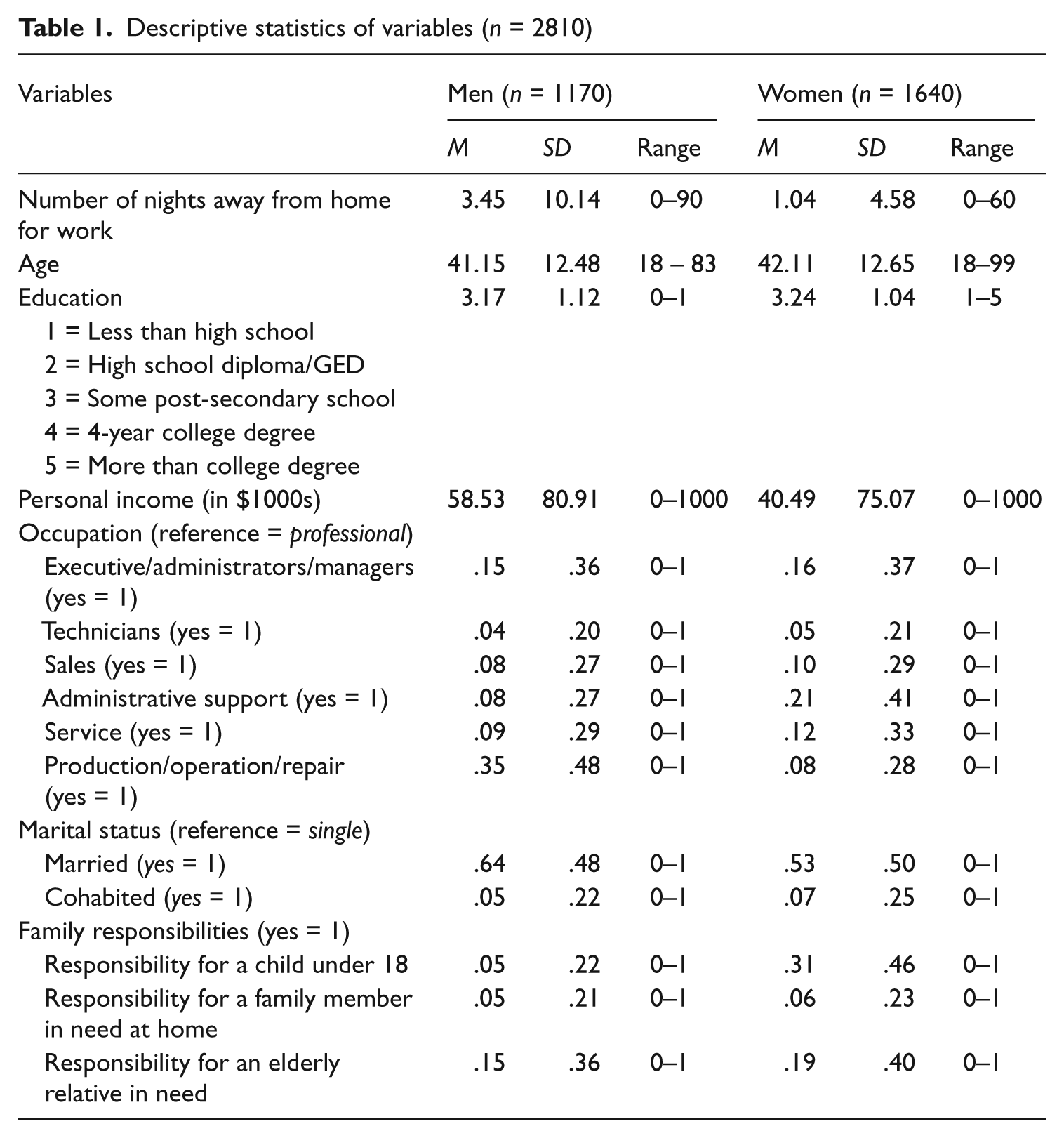
Women were more likely than men to engage in ‘administrative support’, χ2 (1, N = 2797) = 88.80, p <.001 and ‘services’, χ2 (1, N = 2795) = 7.04, p <.01 whereas more men worked in ‘production’, χ2 (1, N = 2797) = 306.38, p < .01. Women were less likely than men to be married, χ2 (1, N = 2803) = 30.83, p < .01, but more likely to cohabit, χ2 (1, N = 2803) = 4.21, p <.05. In addition, women were much more likely than men to report themselves as a major caregiver for their children under 18, χ2 (1, N = 2806) = 287.08, p < .001. Women also tended to be responsible for their elderly relatives in need more often, χ2 (1, N = 2805) = 8.31, p < .01. Female employees in the sample earned less annual income than their male counterparts (t = 5.7973; df = 2540). There was no significant gender difference in age and education, however.
The occurrence of work travel
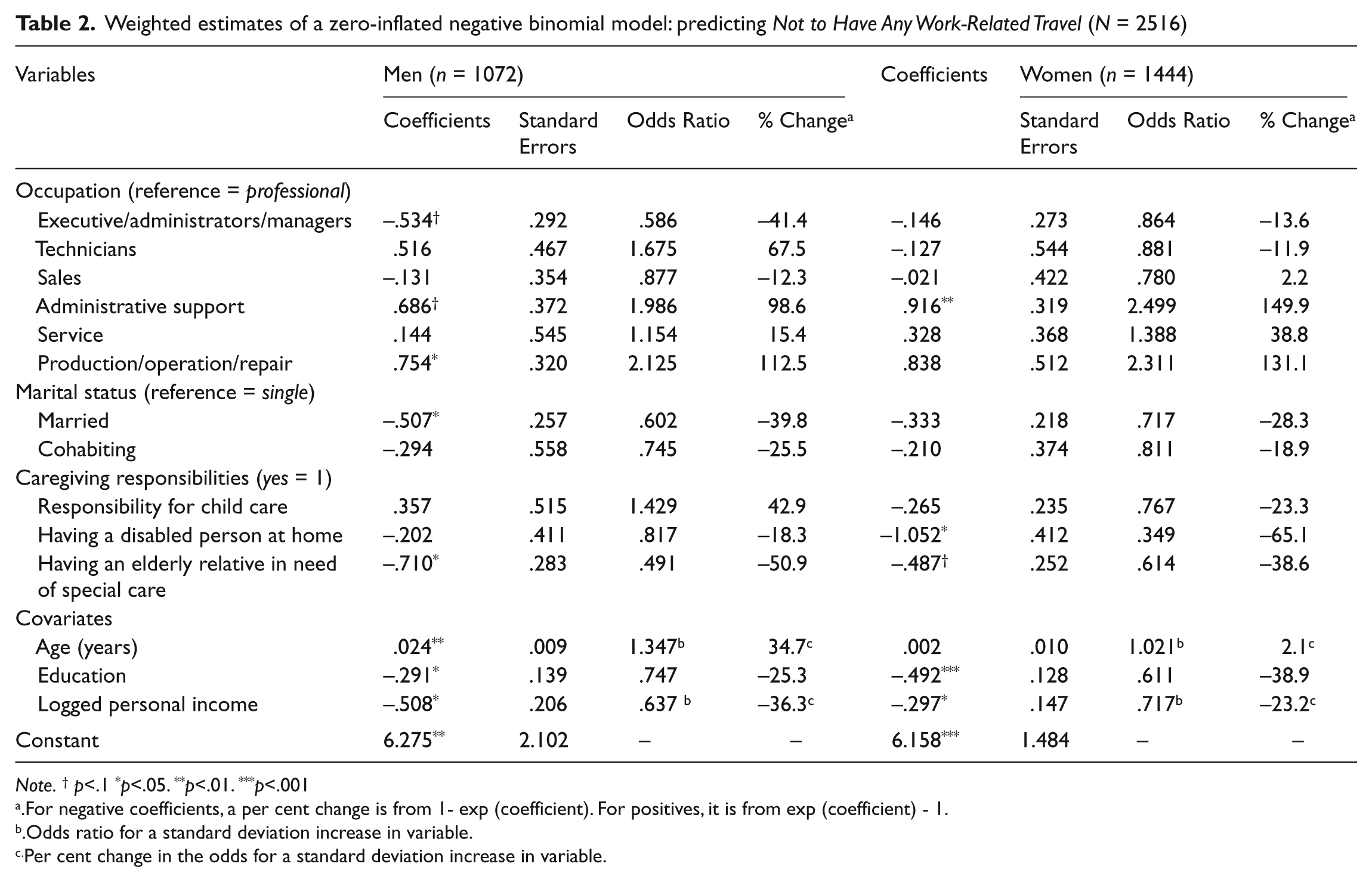
Table 2 shows the results of the zero-inflated negative binomial model to predict the odds for an employee not to travel for work. In interpreting the results, special attention is required because the odds ratios in Table 2 indicate the odds to be in the ‘always no-travel’ group, indicating those who are not likely to have any work-related overnight travel.
Weighted estimates of a zero-inflated negative binomial model: predicting Not to Have Any Work-Related Travel (N = 2516)
Note. † p<.1 *p<.05. **p<.01. ***p<.001
Note. † p<.1 *p<.05. **p<.01. ***p<.001
For negative coefficients, a per cent change is from 1- exp (coefficient). For positives, it is from exp (coefficient) - 1.
Odds ratio for a standard deviation increase in variable.
Per cent change in the odds for a standard deviation increase in variable.
Occupation
A couple of types of occupation made a significant difference in the odds for an employee not to travel and some occupations had different effects by gender. With professional occupation as a reference category, working in executive, administrative or managing occupations was not associated with the odds for men not to travel for work. Compared to the odds for those with a professional occupation, that is, the odds for male employees with an executive, administrative or managerial occupation not to travel for work decreased by 41.4 per cent (OR = .586, p<.1). With professional occupation as a reference category, in contrast, the occupations classed as production/operation/repair increased male employees’ odds not to travel for work by 112.5 per cent (OR = 2.125, p<.05) but the chances for their female counterparts not to have overnight work travel were not affected. When employees were engaged in an administrative supporting occupation, the odds of being in the non-travelling group increased by 98.6 per cent (OR = 1.986, p<.1) and 149.9 per cent (OR = 2.499, p<.01) for men and women, respectively.
Family demands
Compared to single status, being married was negatively associated with the odds only for men not to have any overnight work-related travel by 39.8 per cent (OR = .602, p<.05). Being responsible for an elderly relative who required special care was negatively associated with the odds not to have any work-related travel for both men and women (OR = .491, p<.05 for men; OR = .614, p<.1 for women). When male employees had an elderly relative in need of special care, the odds not to travel for work decreased by 50.9 per cent. The per cent change dropped down to 38.6 per cent for female employees. Having a family member with disability at home decreased the odds not to have overnight work-related travel only for female employees by 65.1 per cent (OR = .349, p<.05).
Control variables
Among the demographic covariates in the analysis, age was positively related to the odds not to have work-related overnight travel for men (b = .024, p<.01) but not for women. Education and income decreased the odds for both men and women to belong to the ‘non-traveller’ group (b = -.291, p<.05 for men; b = -.492, p<.001 for women). Personal income was negatively associated with the odds for an employee not to have any overnight work travel, regardless of gender (b = -.508, p<.05 for men; b = -.300, p<.05 for women).
The frequency of work travel
Table 3 shows the results of the zero-inflated negative binomial model to predict how many nights the respondents expectedly spend away from home for work. As will be explicated, this analysis provides a supplemental vantage point on the phenomenon of work travel because by and large the variables that predict the occurrence of travel (whether or not to have any work travel) are not the same as the ones that predict travel frequency.
Weighted estimates of a zero-inflated negative binomial model: predicting How Many Nights Away From Home for Work

Note. † p<.1 *p <.05. **p< .01. ***p< .001
factor change (incident relative ratio) = exp (coefficient)
factor change for a standard deviation increase in a variable
Occupation
Compared to the number for men engaged in a professional occupation, the expected number of nights away from home for work increased by 4.65 times for male employees with a production/operation/repair occupation (IRR = 4.649, p<.001), controlling for all other variables. When female travellers were employed in a service occupation, the number of nights that they would expectedly spend away from home for work was 3.54 times as great as it was for women engaged in a professional occupation (IRR = 3.544, p<.01).
Family demands
The effects of family demands on the expected number of work travel nights differed by gender. For men, living with a family member with disability increased the expected number of nights spent outside home for work by 1.62 times (IRR = 1.620, p<.1). On the contrary, having an elderly person in need of special care decreased the expected number of work travel nights that male employees would have by .64 times (IRR = .637, p<.05). When female employees were married, the expected number of nights that they would spend away from home for work was .63 times smaller than it was for single women (IRR = .634, p<.1), holding other variables constant. Among female employees, having major responsibility for child care also decreased the expected number of nights away from home for work by .49 times (IRR = .486, p<.01).
Control variables
As shown in Table 3, gender differences were found in the effect of education on the expected number of work-related travel nights for those whose job required some overnight travel. Education significantly increased women’s expected number of nights away from home for work (b = .304, p<.05). Regardless of gender, however, the annual income of a respondent was significant for predicting how many overnights were experienced due to work during the previous three months (b = .252, p<.05 for men; b = .255, p<.05 for women).
Summary and discussion
This study aimed to further knowledge on the variables associated with the prevalence of work travel that employees experienced in the USA. In particular, the hypotheses were tested with a focus on occupational segregation and gender socialization related to family demands. The underlying notion was that the frequency of travel would be responsive to current family demands, and more so than the choice of occupations that demand travel occurrence. The statistical method used in this study allowed for a test of these factors that had not been examined heretofore. The factors associated with the frequency of work travel among the employed in the USA differed from the variables related to the occurrence of work travel. Moreover, gender differences were found in the factors associated with the prevalence of work travel. Findings by and large confirmed the hypotheses addressing the occurrence and the frequency of overnight work travel, undergirding the importance of separating gender in analyses.
First, the analysis found gender differences supporting occupational segregation. Consistent with Presser and Hermsen (1996), overall, the findings of this study confirmed that travelling for work was a gendered experience. More men were in the group that experienced job travel; and of those workers whose jobs required travel, men had higher frequencies of travel than women. This result implies that horizontal occupational segregation by gender was related to the gendered experience of work-related travel. The horizontal occupation segregation in work-related travel experience may also lead to gender inequality in the work sphere because travelling for work often provides better career opportunities for employees (Gustafson, 2006). The type of occupation in which workers were classified was also associated with travel occurrence and frequency. For male employees, for example, being in the production/operation/repair occupation category decreased the occurrence of work-related travel while the same condition increased the frequency of work-related travel. Men in such occupations may have a lower level of agency than other men to refuse work trips or to limit the number of nights away from home because professionals are likely to take a higher position in a company. This finding indicated that the occupational codes could also be vertical although the categories employed in the study were generally coded in a horizontal manner in the data. Occupational level is not the whole story behind these data because the type of occupation was not generally associated with women’s work travel occurrence. Occupation tells part of the story for men, more so than it does for women.
The family demands hypothesis postulated that marital status and responsibilities for taking care of family members would be related to the occurrence and frequency of work travel. Due to gendered family roles, furthermore, it was assumed that family demands would have different effects depending on gender. The hypothesis was supported in that being married increased the occurrence of work travel for males but not for females. Regarding the effect of being married on the frequency of work travel, marital status increased the number of trips that female but not male employees would have for work. Putting these results together, married men were more willing than their female counterparts to travel for work. Married women may not have been reluctant to have jobs requiring some travel but opted to suppress its frequency for reasons already cited in the literature, involving family roles (Coltrane, 2000; Duncan et al., 2003; Walker, 1999). The different effect of being married by gender may imply that men still served as a major breadwinner for the family in the USA despite women’s increasing labour market participation in the country (Dolado et al., 2002).
The family demands hypothesis was also supported by the results that family care responsibilities were associated with the frequency of travel. This inquiry focused not on the presence of children in the home, as had some earlier work (Gustafson, 2006; Presser and Hermsen, 1996), but instead focused on whether the respondent had responsibility for providing care. Taking responsibility for care of children and elderly family members, as expected, was particularly related to suppressing travel frequency for women. This finding reflected women’s greater responsibility for family care (Coltrane, 2000; Duncan et al., 2003; Tichenor, 2005; Williams, 2000). Interestingly, family care responsibilities in terms of providing care for a family member with disability operated more in accordance with the respite notion (for men’s travel frequency and for women’s travel occurrence). Perhaps this non-normative and more time consuming care provision unfolded in a different way than did care for other family members.
Along with the major findings guided by the hypotheses, this study reported some effects of age, income and education on the occurrence and frequency of overnight work-related travel in the US context. First, age was positively related to the occurrence of work related travel but not the frequency for male employees. This result perhaps indicates that those who are in the older age group had more influence to determine who travelled and they had more freedom to demur on travel assignments (Presser and Hermsen, 1996). Possibly older male employees who had already become established in their occupations were less likely than younger counterparts to take into account the advantages of travelling for work, such as autonomy, the chance for job mobility and greater earnings (Gustafson, 2006; Presser and Hermsen, 1996). The non-significant relationship of age with the likelihood for women to travel reflected the gendered labour market (Gustafson, 2006). Compared to men, women were active in the paid labour force for fewer years and experienced more work interruptions to full-time work, partly in order to minimize the conflicts between work and family (Bianchi, 2000). As a result, older women may have lacked the power that men at a similar age may have experienced in the workplace (Haas, 1999). Given that the percentage of women who work during their pregnancy and after birth has been rising since the 1960s (US Census Bureau, 2008), it is possible that women’s labour participation will be likely to be continuous in the future. It will be interesting to examine whether women will be likely to experience the seniority that enables them to limit their amount of work travel as men appear to.
In addition to age, education and income were associated with travel occurrence and frequency, except for education and men’s frequency. Formal education may have enhanced the willingness of individuals to travel for their jobs because education facilitates the development of a globalized worldview (Gustafson, 2006; Presser and Hermsen, 1996). However, this pattern held true when accounting for the frequency of work trips among female workers but not among their male counterparts. Highly educated women may have been better able to strike career bargains that permitted frequent work travel to occur regardless of their family status (Tichenor, 2005; Williams, 2000). Given the association between some manufacturing jobs that men usually hold and the frequency of work travel, in addition, these results may reflect the gender segregated labour market in terms of the jobs held by men and women who have not completed college. Regardless of gender, income increased both the occurrence and frequency of work travel.
Some limitations should be noted. Because this study used US data, first, it may be inappropriate to generalize the findings to work-related travel experience of employees in other countries. In particular, different work and family policies that exist in different countries are important to account for in future studies.
Like other previous research, second, the dataset employed in this study asked only the number of nights that an individual spent away from home due to work, which is a limited aspect of work travel demands. Two individuals who travelled away from home for ten days during the last three months may have quite different experiences of work travel demands. The first person may be required to be away from home throughout the ten consecutive days, for example, whereas the second one may have two-day work trips five times in the same three months. In addition, one may have domestic travel and the other may have an international trip. These different aspects of work demands differentiate the experiences of work travel, which in turn may result in influencing employees’ decisions whether to travel or/and how often to travel for work. In future research, therefore, it will be helpful to include more information on the work travel demands, such as the destination (i.e. where they have to travel for work) and the duration of each trip (i.e. how many nights does a worker stay away from home per trip).
Lastly, this study did not take into account the effects of workplace characteristics and family situations other than marital status and family care responsibilities on the work-related travel experience of US employees. For example, family-friendly workplace policies may influence the prevalence of work travel. The size of a company and the gender composition can also affect the occurrence and frequency of an individual’s work-related travel. In addition, the availability of other family members to provide care may be important as employees weigh their work demands against their responsibilities. To answer these questions, future research needs to include more detailed information about the family, such as the availability of getting help from non-co-resident relatives for family care.
Despite the limitations, the findings of this study underscore the importance of gender in work arrangements in the US context. Differences found between men and women in terms of work travel were partly due to the differential placement of men and women in occupations that demanded travel but were also associated with non-market work done by men and women in families. Future work integrating employment characteristics with family factors in different countries will further illuminate these dynamics for the growing number of men and women whose jobs require work travel and who navigate travel demands.
Footnotes
Funding
This research received no specific grant from any funding agency in the public, commercial or not-for-profit sectors.