




Abstract
Interest in data on job satisfaction is increasing in both academic and policy circles. One common way of interpreting these data is to see a positive association between job satisfaction and job quality. Another view is to dismiss the usefulness of job satisfaction data, because workers can often express satisfaction with work where job quality is poor. It is argued that this second view has some validity, but that survey data on job satisfaction and subjective well-being at work are informative if interpreted carefully. If researchers are to come to sensible conclusions about the meaning behind job satisfaction data, information about why workers report job satisfaction is needed. It is in the understanding of why workers report feeling satisfied (or dissatisfied) with their jobs that sociology can make a positive contribution.
Introduction
There is an increasing interest in measures of job satisfaction in academic and policy debates. Traditionally, these measures have been associated with the belief that job quality is to be understood in subjective terms – high job quality occurs where workers report that their jobs give them high satisfaction (Clark, 2011). This subjective approach to job quality can be contrasted with an objective approach that defines job quality in terms of the fulfilment of work-related needs such as autonomy over work, opportunities for skill development and the creative content of work, which can be measured objectively (Green, 2006; Gallie, 2007; note that it is common for social surveys to measure these objective properties of work by asking workers about their experiences, so in effect these surveys consist of subjective measures of objective characteristics). The objective approach to job quality just outlined links to broader approaches to well-being such as that of Sen (e.g. 1999; cf. Orton, 2011). More specifically, it raises questions about the usefulness of job satisfaction data; in particular, it points to the effects of social conditioning in inflating reports of job satisfaction that are often given by workers in objectively low-quality jobs, and rejects the assumed one-to-one relationship between job quality and job satisfaction. Similar concerns have led sociologists working in the Weberian tradition to follow the judgement of Goldthorpe et al. (1968: 12) that job satisfaction data are of limited use. Other sociologists from within the Marxist tradition have also rejected job satisfaction data in favour of an objective evaluation of the ‘alienation’ of workers under capitalism (Spencer, 2009: 47–68).
The main objective of this article is to question these judgements by reconsidering (and ultimately defending) the use of measures of job satisfaction. Used in the proper way, these measures can play a useful role in an understanding of the quality of working life. This article offers a novel interpretation of job satisfaction data that draws on and develops some existing insights gained from an objective approach to job quality. It argues that reported job satisfaction may not track job quality. Research, indeed, has shown how job satisfaction scores vary across jobs in ways that are not fully explained by the objective characteristics of those jobs (Rose, 2003). This disconnection between reported job satisfaction and objective job quality does not mean that job satisfaction data are worthless, however. Rather, it means that understanding the channels through which job satisfaction is achieved or not is critically important: does high reported job satisfaction arise because workers have developed strategies to cope with objectively poor-quality jobs, or does it arise because high reported job satisfaction indicates high job quality? Qualitative sociologically informed research on work orientations, culture and class can help answer the aforementioned question by unravelling the complexity and diversity of experiences that lie behind patterns in the quantitative data contained in large-scale surveys, and thus can offer potentially profound explanations of such patterns.
The article is organized as follows. First, the prevalent subjective approach to job satisfaction is reviewed and critiqued. Second, an alternative objective approach to interpreting job satisfaction is advocated alongside the vital contribution that strands of sociology can make to it.
From subjective well-being at work to job satisfaction
It is first necessary to define a broad concept prevalent within the psychology discipline – ‘subjective well-being at work’. The latter, as it is commonly measured by psychologists, comprises three dimensions: (i) the pleasure or displeasure associated with work (job satisfaction); (ii) enthusiasm/depression; and (iii) anxiety/comfort (Warr, 2007). The three dimensions are directly related to one another (Green, 2010) but it is usual for them to be evaluated discretely rather than combined into a single index. These dimensions of subjective well-being at work are captured through indexes of different facets of subjective well-being. Although some psychologists have argued that subjective well-being simply reflects the prior psychological dispositions of individuals, there is abundant evidence that environmental factors are also important determinants of subjective well-being at work (Warr, 2007). Drawing from a large literature, Warr (2007) highlights 10 key aspects of jobs that are associated with high subjective well-being at work; these are: opportunity for personal control; opportunity for skill use; external demands of the job; variety; environmental clarity; availability of money; physical security; supportive supervision; opportunity for interpersonal contact; and valued social position.
Over the last two decades, economists have joined psychologists in studying subjective well-being at work (e.g. Clark, 1996, 1997; Clark et al., 1996; Green, 2006, 2010; Booth and van Ours, 2008; Brown et al., 2008). Where psychologists have tended to base their analyses and judgements on small-scale studies of occupations or workplaces, economists have made use of the increasing volume of nationally representative social surveys that include measures of subjective well-being at work. Significantly for the following argument, economists have tended to focus on the job satisfaction component, often reflecting the availability of data in nationally representative surveys, and they have portrayed job satisfaction as an overall measure of ‘well-being at work’ (Sousa-Poza and Sousa-Poza, 2000; Green, 2006) or the ‘utility’ provided by work (Clark and Oswald, 1996; Frey and Stutzer, 2002). Clark (2011) has gone as far as to suggest that job satisfaction (or some other measure of subjective well-being gained from work) can be used as a summary index measure of job quality, the implication being that if a worker is satisfied with her job, it must indicate that her job is a high-quality one.
This subjective approach contrasts with an objective approach to job quality, where job quality depends on the provision of capabilities to meet a broad range of work-related needs, facilitating the ongoing development of individuals through free creative activity (Sen, 1999; Green, 2006; Brown et al., 2007). Objective job quality is defined in terms of multiple overlapping job characteristics that satisfy work-related needs. These include pay, the creative content of work, the interest of work itself, relations with work colleagues, position within organizational and class hierarchy, influence and discretion over work, skill and effort levels (Brown et al., 2007; Sengupta et al., 2009). A high-quality job, then, affords the opportunity to fulfil a greater number of work-related needs than a low quality one. This objective approach is discussed further later. In the next section, attention is given to problems associated with the subjective approach.
The pitfalls of studying job satisfaction
The idea that reported job satisfaction in nationally representative survey data is a summary measure of job quality is problematic in several respects. For example, a number of researchers have identified gender as a key determinant of job satisfaction, with women on average reporting higher levels of job satisfaction than men despite their doing jobs which are of objectively poorer quality. When confronted with difficult to explain results like these, researchers sometimes invoke differences in norms and expectations as an explanation. Clark (1997), for instance, suggests that higher reported job satisfaction for women may be explained by the fact that many women in low-paid, part-time work expect less than male and female workers seeking a career, so are more likely to report high job satisfaction. Here Clark uses norms and expectations as a catch-all term to explain otherwise puzzling results. There is no attempt to explore and explain the formation and impact of workers’ norms and expectations regarding work. Yet unless norms and expectations are studied in a more systematic way it is not possible to know whether high job satisfaction is the result of high job quality where a full range of work-related needs are met, or norms and expectations that have developed as a response to low job quality and so an indication of unmet work-related needs.
The issue of norms and expectations raises two related problems. First, reported job satisfaction may not vary with job quality. Second, norms and expectations may conceal the level of job quality. The potential for job satisfaction survey data to mask a low level of job quality is well illustrated by Rose (1988: 260) in his reflections on the ‘affluent worker’ studies (Goldthorpe et al., 1968). Car assembly workers reported that their work was fragmented, machine-paced and monotonous with little opportunity for meaningful social interaction, so that objectively speaking these workers were deprived of intrinsic satisfaction from work. Further, this deprivation was keenly felt by the workers themselves. This fact, however, did not lead to job dissatisfaction in survey data – the car assembly workers expressed broad satisfaction with their jobs as a whole because, when making evaluations, they placed the greatest weight on extrinsic rewards.
Figure 1 tries to illustrate how research that equates job quality with job satisfaction portrays the responses given by workers to survey questions. Reported job satisfaction is seen as the product of two factors: (1) personal characteristics plus norms and expectations; (2) job characteristics. In this approach, norms and expectations enter as an additional variable that adds to or subtracts from reported job satisfaction. Because reported job satisfaction is taken to indicate job quality, norms and expectations likewise add to or subtract from job quality. For example, if women workers report in surveys that work is more satisfying because they have lower norms and expectations about work (Clark, 1997), then the aforementioned approach interprets this result to mean that women have higher job quality. The problem here is that the link between reported job satisfaction and job quality may actually be broken through the impact of norms and expectations. It is this point that is frequently overlooked in modern research into job satisfaction.

A subjective model of the determinants of job satisfaction and job quality
Instead of seeking to qualitatively understand why workers report high or low job satisfaction by looking systematically at the formation and impact of norms and expectations, researchers studying job satisfaction often prefer to use econometric techniques to try to control for them. The standard assumption is that if personal characteristics can be controlled for by using econometric analysis of panel data to difference out the effect of personality traits and norms and expectations, then the derived results will show the ‘true’ impact on job satisfaction of particular jobs or particular job characteristics. However, norms and expectations may not be fixed in the way that these methods assume. While there is evidence that general values may be fixed in childhood and that life aspirations shift slowly (Inglehart, 1977), research into work orientations suggests that norms and expectations related to work can change rapidly in response to changes inside and outside of the workplace (Beynon and Blackburn, 1972; Wedderburn and Crompton, 1972; Corby and Stanworth, 2009). One response to the difficulty of discerning whether job satisfaction data are the result of variations in job characteristics or variations in norms and expectations would be to abandon measures of job satisfaction altogether and to focus solely on more objective measures of job quality. This would be a mistake, however, because data on job satisfaction, if interpreted with proper attention to the formation and impact of norms and expectations, can provide important information about the lived experience of work, a point elaborated on later.
Why study job satisfaction?
If measures of job satisfaction in large-scale social surveys do not correlate with job quality and do not tell us whether work-related needs are being met, why bother studying them? Five points can be made here. First, there is a rational-cognitive aspect to workers’ responses to questions about job satisfaction (Rose, 2003). Even if job satisfaction data do not capture job quality, they do capture workers’ cognitive evaluations of their jobs against a benchmark of available alternatives, including a personal weighting of the importance of different aspects of work, which will also depend on the benchmark against which the evaluation is made. Second, data on job satisfaction are correlated with labour market behaviour. Workers with low job satisfaction are more likely to quit their jobs (Freeman, 1978; Green, 2010). Third, meta-analysis of numerous small-scale studies that use measures of job satisfaction suggests that low reported job satisfaction is associated with a range of mental health problems (burnout, low self-esteem, high stress and anxiety, and depression), and is weakly associated with cardio-vascular disease (Faragher et al., 2005). Fourth, job satisfaction data reveal various systematic patterns: for example, the correlations with quits and with gender mentioned earlier – other correlations found in the literature include those with age, with union membership, and with education. Fifth, without a sociologically informed explanation for such large-scale patterns then the intellectual ground is ceded to happiness economists and others who take such patterns as evidence that job satisfaction is a valid measure of ‘happiness at work’ and job quality. Job satisfaction is worth studying for these reasons.
Developing a needs-based perspective on job quality and job satisfaction
So far it has been argued that job satisfaction data should be studied but that the conventional way of conceptualizing and understanding job quality and job satisfaction represented in Figure 1 is inadequate because insufficient attention is given to the question of why workers report satisfaction with their jobs. Is it because a full range of work-related needs are being met, or is it because workers’ norms and expectations have adjusted to accommodate a situation in which a full range of needs cannot be met? An objective approach that is informed by qualitative sociological research and associated theory can help us to understand the answer to this question (and indeed to broaden and nuance the question itself).
Figure 2 sets out a model of the determinants of job satisfaction and job quality that, unlike the model represented in Figure 1, incorporates the objective, needs-based definition of job quality explained earlier. A second point of difference with Figure 1 is that Figure 2 recognizes explicitly that job characteristics and norms and expectations associated with work depend, in part, on the strategies that workers adopt in response to managerial control strategies. Consequently, both job quality and job satisfaction are in part the result of the complex interplay of conflict and consent in the workplace. A third difference is that the model further unpicks the determinants of norms and expectations, recognizing that they have social, not merely individual origins, drawing on well-known strands in the sociology of work. These points are elaborated on later.
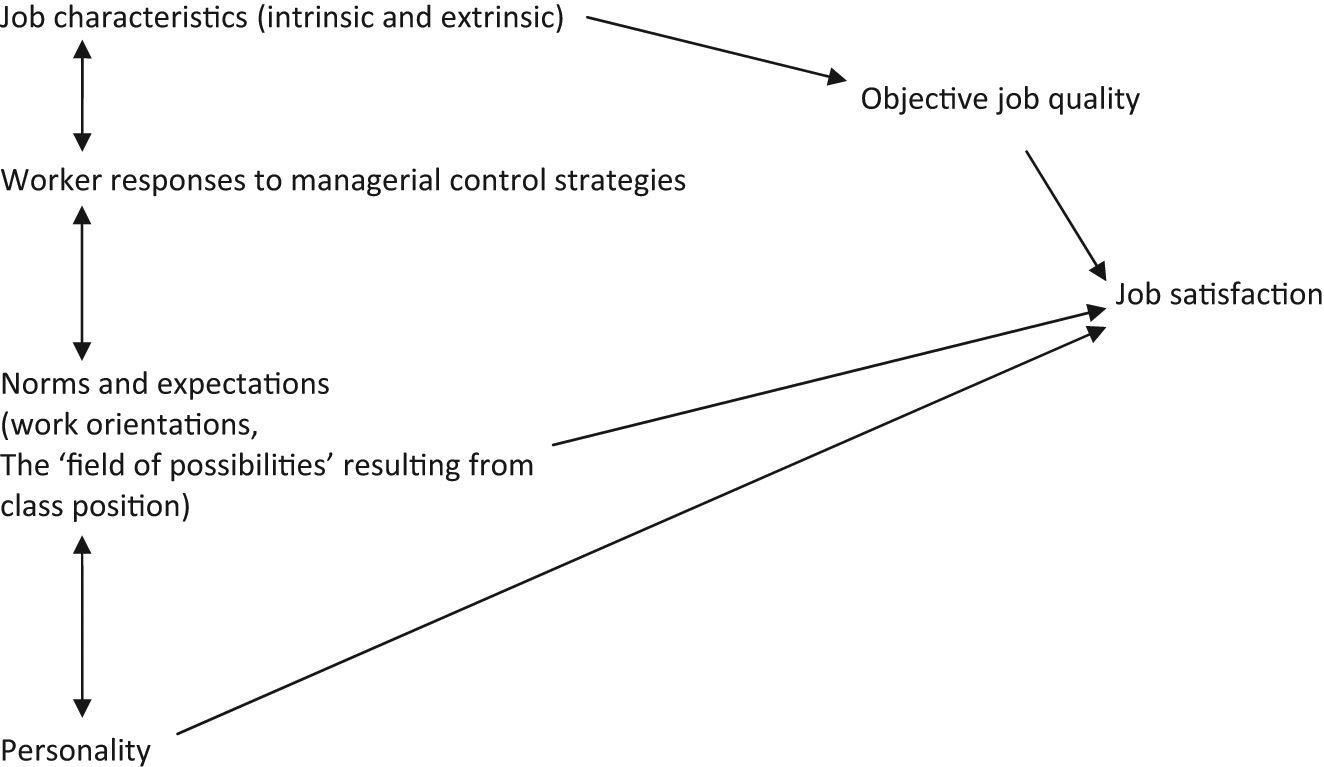
An objective (needs-based) model of the determinants of job satisfaction and job quality
Worker responses to managerial control strategies
Ethnographic studies of the workplace have shown how workers cope (so reporting higher satisfaction) with jobs that are of objectively poor quality because of their boring, repetitive nature and the physical and mental demands that they place on them. Workers often become inured to repetitive, physically demanding work, such that the effort expended pulls them through the shift, mitigating the effects of physical exhaustion and dissipating resistance (Strangleman, 2012). The performance of physically demanding and dangerous work may result in workers developing a strong emotional attachment to it, which again can deflect negative assessments of work (MacKenzie et al., 2006). Workers may also develop systems and conventions of informal interaction, often in defiance of managerially imposed work rules, that have the effect of generating job satisfaction despite poor quality work (Roy, 1959; Burawoy, 1979). Workers also develop individual strategies for resisting managerial demands to avoid undue strain or pressure (Molstad, 1986), which, it can be inferred, results in higher levels of job satisfaction than would have been the case if managerial authority had been unimpeded. Conversely, ethnographic studies have revealed how jobs that appear to be of high quality, because of status, wages and skill level, can result in lower levels of job satisfaction because of social processes in the workplace. One study of a software engineering team revealed how the team’s collective use of time perpetuated a ‘time famine’ that forced workers to work excessively long hours. This resulted in high levels of stress, from which, it can be inferred, workers experienced commensurately lower levels of job satisfaction (Perlow, 1999).
Job quality and job satisfaction are not solely determined by a set of managerially prescribed job characteristics, but in part by social processes and conventions generated by workers themselves. These social processes can alter norms and expectations about work and change the characteristics of the job itself, both of which will affect job satisfaction. Further, this is a dynamic process – norms may shape the social organization of work and in turn job characteristics, which may then lead to an alteration of norms as workers habituate to a new reality.
Unpicking norms and expectations
A chief complaint about the standard model of job satisfaction and job quality is that insufficient attention is paid to the issue of norms and expectations – they are deployed in an ad hoc manner, to explain otherwise puzzling results, and they are assumed to be time invariant over short to medium run time periods (so amenable to being controlled for with panel econometric techniques) despite evidence to the contrary. There is a lack of precision in explaining what exactly norms and expectations are, which itself reflects a lack of research about how norms and expectations influence job satisfaction. This gap in the literature cannot be filled in any simple way. However, existing sociological theory and evidence can be used to begin to develop an understanding of the meaning of norms and expectations as they relate to job satisfaction.
Consider the sociological concept of ‘work orientation’. The concept originated with Goldthorpe et al. (1968), who posited three broad work orientations: ‘instrumental’, ‘solidaristic’ and ‘bureaucratic’. It was applied in an individualistic fashion by Hakim as a tool for making sense of women’s choices about labour market participation. Hakim (1991) posited that a large number of women had a ‘home-worker’ orientation, and so chose poorer quality jobs that gave them more flexibility and more time for family life (Clark, 1997, and Booth and van Ours, 2008, both draw on Hakim’s work to explain high job satisfaction levels among women). The idea of work orientations has been operationalized in some social surveys. For example, Rose (2003) finds that work orientations measures included in the British Household Panel Survey (BHPS) do impact on job satisfaction. The limitation of work orientations as a measure of norms and expectations, however, is that there is no clear consensus on how work orientations should be conceptualized or measured. This means that it is difficult to gauge how well work orientations measures capture norms and expectations. Further, the original formulation of Goldthorpe et al. has been criticized, as has Hakim’s individualistic theorization.
One of the many articles written in response to Hakim, which illuminates these criticisms and which is directly relevant to job satisfaction, is Walters’ (2005) study of part-time women workers. Walters asked her interviewees to fill in a job satisfaction questionnaire, before questioning them in more detail about their responses. A number of Walters’ findings are particularly pertinent for the understanding of job satisfaction given in this article. Three that stand out are:
Benchmarking against previous experience: workers rate their current jobs against the benchmark of previous employment experiences.
Structure/agency interplay: workers are constrained but not determined by social structure, so high reported job satisfaction may indicate making the best of a bad social situation – what Walters terms ‘satisficing’ as opposed to genuine satisfaction.
Individual complexity: a positive response to a survey question about job satisfaction may be contradicted by the respondent’s negative evaluation of her job as revealed in an in-depth interview.
These points support the argument that job satisfaction cannot simply be taken as a measure of job quality. The first two points suggest how job satisfaction responses are made against norms and expectations influenced by past experiences and by social structural constraints. The third point is interesting methodologically, because it suggests that responses to questions about job satisfaction are sensitive to the methods used – surveys elicit different responses to interviews. This suggests that survey evidence on job satisfaction needs to be supplemented by more in-depth interviews to understand why respondents report particular levels of job satisfaction – are they deriving pleasure from the intrinsic aspects of their job, or are they expressing no more than qualified satisfaction with factors like extrinsic reward or flexibility that best allow them to try to balance family life and work, under severe social structural constraints?
These findings also have implications for quantitative measures of work orientations used in social surveys, which are likely to suffer the same limitations as responses to survey questions about job satisfaction: expressed work orientations may reflect the constraints of social structure, and different methods of asking the same or similar questions may yield different responses. It is not enough to try to account for norms and expectations empirically (e.g. econometrically) through data on work orientations. Rather, it is important to better theorize the social and individual processes that influence workers’ norms and expectations, including their work orientations. One source of understanding can be found in cultural analyses of class (e.g. Savage, 2000; Sayer, 2005; Hebson, 2009). Modern cultural class analysis posits that agents are placed within a particular social space, producing a set of routine experiences and social interactions, which produce dispositions, outlooks and habitus within a specific ‘field of possibilities’ (Bourdieu, 1984; Atkinson, 2010: 415–16). It is easy to see the link between norms and expectations as they are used in the study of job satisfaction and this field of possibilities. The Bourdieu-inspired approach to the study of class can be criticized: Bourdieu did not provide the methodological and procedural elaboration that would have facilitated the reproduction of his approach (Atkinson, 2009) and its best-known terms are described by one proponent as ‘incomplete summarising concepts’ (Sayer, 2005: 16). Nevertheless, this emerging field of research offers the prospect of fresh insights into how norms and expectations shape the way that workers think and feel about their jobs, which may help us to better understand patterns of responses in large-scale surveys of job satisfaction. Both Hebson (2009) and Atkinson (2010) stress that the best way to understand the dispositions, outlooks and habitus associated with class is through qualitative research: interviews plus observation. To make sense of job satisfaction, in short, it is necessary to supplement survey analysis with qualitative research that illuminates the channels through which workers come to express satisfaction or dissatisfaction with their jobs.
Conclusions
In summary, research on job quality can be roughly divided into two types: research that focuses on the objective characteristics of jobs as dimensions of objective job quality (e.g. Gallie, 2007), and research that focuses on self-reported job satisfaction (e.g. Clark, 2011). The latter generally argues that a high-quality job is one that results in high reported job satisfaction. Of course, this distinction is not binary: some research draws on aspects of both approaches (e.g. Green, 2006). However, researchers working from an objective perspective, including many sociologists, tend to be wary of measures of job satisfaction because they observe that workers often express satisfaction with jobs that are of objectively poor quality. This position has some merit. Job quality should not be measured by job satisfaction as revealed by survey data; rather, it should be defined in terms of the capabilities that workers have to meet a broad range of work-related needs, facilitating their ongoing development as freely creative beings (Sen, 1999). Nevertheless, survey data on job satisfaction can yield valuable information about the experience of work which should not be ignored. What matters is how these data are interpreted. A more nuanced understanding of the channels through which survey respondents come to report job satisfaction is needed. In particular, it is important to consider the formation and impact of workers’ norms and expectations. An interdisciplinary, mixed-methods approach is needed, where quantitative analysis of survey data is combined with qualitative evidence from interviews and observation, and where analysis of individual attitudes and behaviour is complemented with analysis of the social context that shapes attitudes and behaviour.
Footnotes
Acknowledgements
Thanks to Colin Lindsay and David Angrave for comments on an earlier draft.
Funding
This research received no specific grant from any funding agency in the public, commercial, or not-for-profit sectors.