



Abstract
This article shows how both employers and the state have influenced macro-level processes and structures concerning the content and transposition of the European Union (EU) Employee Information and Consultation (I&C) Directive. It argues that the processes of regulation occupied by employers reinforce a voluntarism which marginalizes rather than shares decision-making power with workers. The contribution advances the conceptual lens of ‘regulatory space’ by building on Lukes’ multiple faces of power to better understand how employment regulation is determined across transnational, national and enterprise levels. The research proposes an integrated analytical framework on which ‘occupancy’ of regulatory space can be evaluated in comparative national contexts.
Introduction
The European Information and Consultation (I&C) Directive (2002/14/EC) was introduced to promote social dialogue and elements of shared decision-making. The directive required member states to introduce permanent arrangements so managers would support dialogue at the workplace level in three broad areas: (i) provide ‘information’ pertaining to the economic situation of the company; (ii) enable ‘information and consultation’ concerning developments or threats to employment; and (iii) ‘inform and consult employees, with a view to reaching agreement’ on decisions likely to lead to changes in work organization or contractual arrangements. One main disincentive in the United Kingdom (UK) and Irish context is that employees have to ‘trigger’ the right and request an information and consultation forum, which may actually discourage voice and participation (Hall, 2010; Wilkinson et al., 2007). There was a perception that the directive was introduced with specifically the UK and Ireland in mind, given that they were the only two European Union (EU) member states at the time lacking generalized employee voice legislation (Hall et al., 2011).
The research in this article addresses the policy determination and transposition of the I&C Directive within liberal market economies (LMEs). It asks what impact the directive has had in encouraging employers to share decision-making powers with employees (unions) through new or revised consultation mechanisms. Existing evidence reports that the transposition of I&C regulations favour direct communications rather than collective systems of worker voice, as the original directive proposed (Hall et al., 2011). The contribution in this article, however, is to show how actors dominated the regulatory space for I&C regulation by integrating and linking both macro and micro contexts. The evidence illustrates how employer tactics for ‘neo-voluntarism’ and the politics of ‘common knowledge formation’ (Culpepper, 2008) shaped the parameters on which statutory rights are formulated and enacted across different governance levels. In short, macro-level regulation reinforces, ironically, a micro-level voluntarist dynamic by legitimizing subjective meanings among social actors as objective fact. The I&C regulations did not prompt a new politic of common knowledge formation around shared social dialogue diffused from the macro policy to micro workplace level. The research further adds to knowledge by integrating Lukes’ three ‘faces’ of power (1974, 2005) to the concept of regulatory space. In so doing, the article advances a multi-level, multi-dimensional analytical framework on which ‘occupancy’ of regulatory space can be evaluated in comparative national contexts.
The article is structured as follows. Next, the concepts of ‘regulatory space’ and Lukes’ ‘faces of power’ are discussed, leading to a simplified schematic theoretical integration. Section three briefly informs the reader about the content of the I&C Directive and the issue of ‘light touch’ legalism. This is followed by an outline of the research methods. The evidence is presented in section five by integrating macro-level data concerning employer and government responses to influence the ‘content’ and ‘transposition’ of the I&C Directive. Subsequent linkages with micro-level evidence show how Lukes’ faces of power translate to workplace practices reflecting I&C practices on the ground.
Integrating ‘regulatory space’ and Lukes’ dimensions of power
‘Regulatory space’ has been advanced as an important analytical tool for assessing the impact of employment regulation (Crouch, 1985; Hancher and Moran, 1989; Martínez-Lucio and MacKenzie, 2004; Scott, 2001). Regulatory space can be defined as: ‘the range of regulatory issues subject to public decision. Proponents claim that its dimensions and occupants can be understood by examining regulation in any particular national setting, and by analyzing that setting in terms of its specific political, legal and cultural attributes’ (Berg et al., 2005: 73).
A number of theoretical issues are important. First, space, by definition, is open for occupation. The extent to which actors concerned with work and employment can occupy regulatory space heavily depends on their ability to mobilize resources and their capacity to prevent others from occupying the same resources (Edwards and Wajcman, 2005: 118). To this end possession of positional power resources are central to processes of occupation (Lukes, 1974, 2005). Power resources connect to what MacKenzie and Martínez-Lucio (2005) refer to as ‘shifting regulatory processes’. Thus employment actors seek to influence labour market outcomes by virtue of ‘positional power’, in which a sense (or discourse) of legitimacy is afforded to dominant groups to alter the rules of the game, rather than assuming some simple or overarching deregulatory trajectory based on government politics alone. Allen (2004) suggests that boundaries upon which regulation is contested at the micro level are shaped by multiple sources of influence at higher levels, stressing the interrelated connections across multiple levels of analysis.
A second theoretical issue is that space can be unequally distributed, with actors mobilizing resources to either advance or retreat their frontier of control (Goodrich, 1975). For example, employers and their representative associations are exemplars of institutions that colonize regulatory space for voice, while trade union power recedes (Hancher and Moran, 1989). Third, power resources influencing employment regulations can be institutionally conditioned, depending on national or enterprise-level circumstances. The concept of regulatory space is therefore both multi-level and multi-dimensional, with vertical and horizontal governance factors shaping actor capacity to mobilize power resources to occupy space at different levels. MacKenzie and Martínez-Lucio (2005) show that factors affecting change at one level, say the workplace, are better understood by assessing complex interactions across multiple spheres in which employment actors interact, for example across national and even transnational levels. Implications relate to, for example, union federations and employer associations potentially bypassing national (government-level) institutions and lobbying EU policymakers directly (Allen, 2004). Fourth, employment actors may contest regulations or labour market rules in pursuit of their own ideological preferences (Edwards and Wajcman, 2005; Hancher and Moran, 1989). In assessing if the I&C Directive has led employers to involve employees (or unions) in decision-making relates also to the ideological preferences of managers to share or control power. This means that regulatory space is both a politicized and power-centred construct. The greater the space colonized by one employment actor, then the greater the probability of achieving desired preferences (Martínez-Lucio and MacKenzie, 2004).
Viewing governance of work and employment in such multi-dimensional ways requires analysing exchange of power between institutions and actors. In assessing the impact of the I&C Directive on whether employers share decision-making, unwrapping different layers of power is vital. Analysis of power, articulated by Lukes (1974, 2005), has an established pedigree in workplace sociology (Edwards, 2006; Edwards and Scullion, 1982; Sisson, 2012). Power, as it relates to work relations, is used in two ways at both the macro and micro level. The first, ‘power to’, is a positive-sum notion directed towards advancing common interests to get things done in a productive manner (Haugaard, 2012). Examples might be cooperative union–management forums aimed at problem-solving, or managers devolving power to create workplace empowerment. In contrast, ‘power over’ is about domination and is a zero-sum game where one party wins what the other party loses. ‘Power over’ concerns the ability of one party to persuade another party to do something they would not otherwise do (Haugaard, 2012). Both ‘power to’ and ‘power over’ infer the use and deployment of resources between key actors. For example, to obtain a wage, employees have to labour under the directed rules and authority of an employer that, typically, has greater access to resources than individual workers (Sisson, 2012: 177–83). Thus the employer’s ‘power over’ an employee usually means they can mobilize a greater range of resources to enforce a given preference, and hence the notion of regulatory space proves useful to conceptualize this as a zero-sum power approach. The result is that regulation of employment is typically unequal, with a structural inequity of resource allocation and distribution skewed in favour of employers.
Table 1 advances a simple schematic to integrate Lukes’ (1974, 2005) three dimensional ‘faces’ of power with the concept of how employment actors can occupy regulatory space at macro and micro levels. Using Dahl’s (1961) organizational decision-making approach, Lukes’ first face of power is about observable domination and occurs when one party has the power to secure its aims over another. Open and transparent distributive bargaining is one notable example. However, it is the other less obvious two faces of power which resonate to the tactics used to occupy regulatory space considered in this article.
Integrating regulatory space and the mobilization of power in employment relations
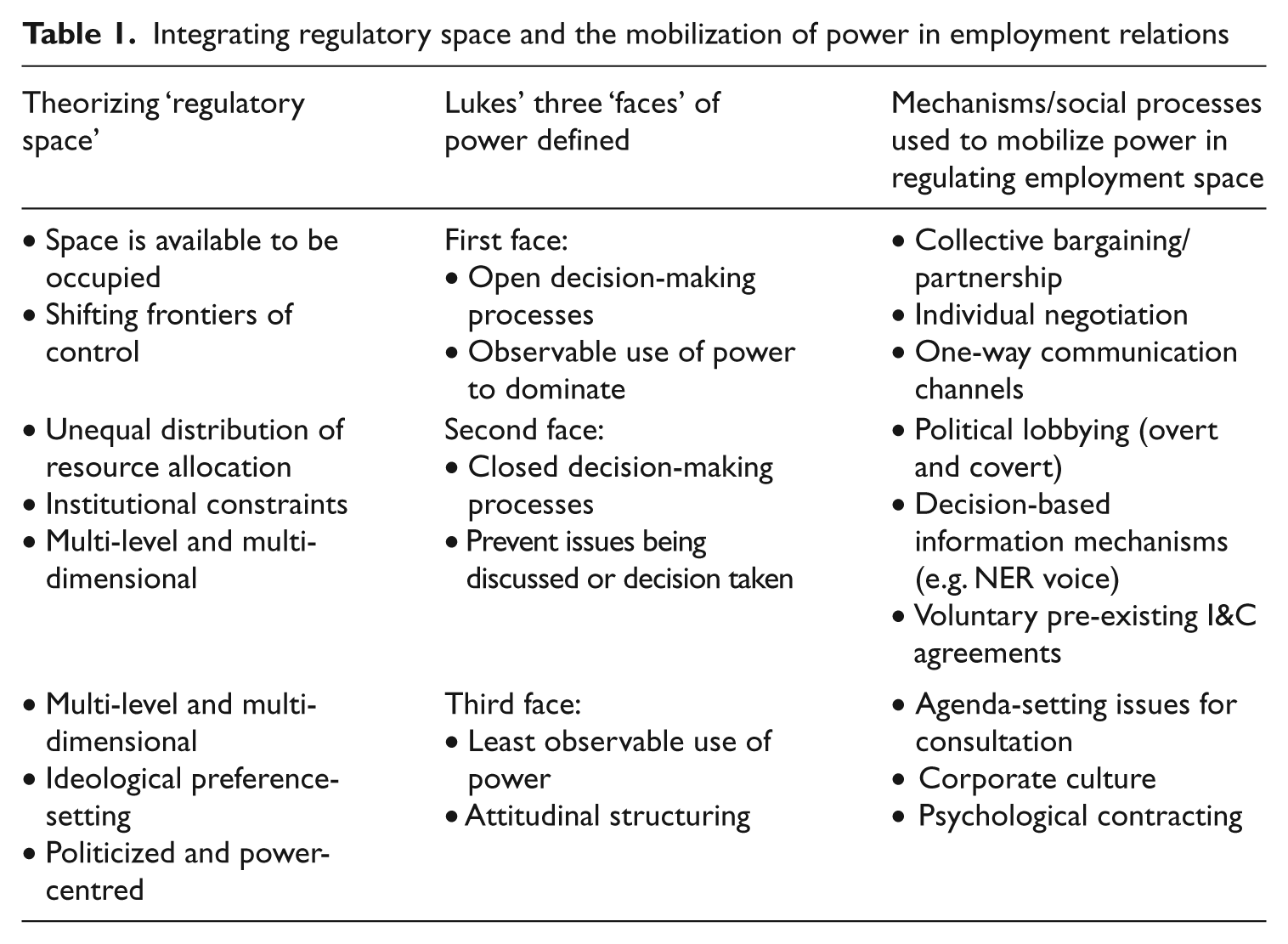
The second approach has its roots in Bachrach and Baratz’s (1970) ‘non decision-making’ power, explaining how actors prevent certain issues being discussed in the first place, or prevent decisions about them being taken. An example is political lobbying by employers at a transnational level which can subsequently dilute employment legislation at lower (workplace) levels. Sisson (2012: 186) illustrates this dimension of power by distinguishing two types of employee consultation: ‘decision-based’ and ‘option-based’. With ‘decision-based’ consultation, management considers various options for restructuring, makes its preferred decision and then consults employee representatives on how to proceed with a decision already made. With ‘option-based’ consultation, management presents a range of restructuring options, and then employees (or their representatives) are invited to discuss alternative preferences with a view to reaching agreement. While management makes the final decision in both instances, employee representatives have more voice under ‘option-based’ consultation to influence employment regulation.
The third face is ideological power. Although not without critique (Edwards, 2006), this is the least observable and concerns the power to shape and manipulate people’s preferences. Lukes argues that ideological power is overarching and effectively shapes and places constraints on the first and second faces of power. In employment, ideological power can ensure that employees accept or desire management-led practices that may be contrary to their own interests. Examples include various corporate culture or quality management initiatives that espouse the virtues of empowerment as a source of influencing employee attitudes to win their ‘hearts and minds’ (Willmott, 1993). Managerial claims about seeking to satisfy the so-called psychological contract for employees may be viewed as an ideological form of employer control and manipulation (Cullinane and Dundon, 2006). Sisson (2012: 187) likens ideological power to Walton and McKersie’s (1965) use of ‘attitudinal structuring’ during bargaining and consultation interactions. For example, information and consultation are processes that influence employee expectations and outcomes. Communicative dialogue may be a source of power by limiting worker perceptions of what they might gain from management during a consultative or bargaining interaction. Thus by manipulating worker attitudes as to what may be legitimate or common knowledge, managers can promote communication channels as some sort of de facto consultative voice systems, implying a degree of power-sharing that is in reality constrained. Beyond the workplace, a similar continuous discourse promulgated by many employers and politicians depicting the role of employment regulation as not interfering with management’s right to manage has gained ideological currency across neo-liberal economies, which similarly shapes attitudes and expectations at other socio-political levels of state regulation (McDonough and Dundon, 2010).
By integrating faces of power with mechanisms that may be deployed to regulate employee voice, this research unpicks factors influencing both the determination and the transposition of the I&C Directive. In doing so, the research asks what impact the directive may have had in encouraging employers to share decision-making powers with workers or their representatives to facilitate ‘power to’ and advance common interests.
Regulation of I&C: voluntarism and light touch labour law
The ability of employment actors to mobilize ‘power to’ or ‘power over’ employee voice depends on context. In particular, the legal setting is especially important for establishing parameters within which power is exercised by one party over another. Historically, governments have intervened to import a semblance of counter-veiling power in employment relations and, indeed, a prime purpose of legal regulation was protecting employees against laissez-faire capitalism and its power asymmetries. However, discourse about the purpose of such employment regulation has changed significantly (Dobbins, 2010). Growing emphasis on market liberalization and human resource management (HRM) practices has coincided with reassessment by the state (at EU and national level) of the purpose of legal regulation (Martínez-Lucio and MacKenzie, 2004). This reassessment of regulatory purpose can now be partly interpreted as a means of employer protection against collectively organized employees, rather than the other way round (Donaghey et al., 2011). EU-led regulations have gravitated from hard or protective laws (such as equal pay and health and safety) towards ‘softer’ light touch measures allowing member states greater latitude to transpose arrangements fitting national cultures (Gold, 2009; Hall et al., 2011). What distinguishes emerging EU social policy is its ‘low capacity to impose binding obligations on market participants, and the high degree to which it depends on various kinds of voluntarism … in the name of self-regulation’ (Streeck, 1995: 45–9). This has provided employers with greater latitude in shaping their ‘preferred mode of intervention’ (Barnard and Deakin, 2000: 341). Indeed, light touch regulation, combined with the unitarist advance of HRM, makes it easier for employers to shape practice and determine policy options for and on behalf of workers (Thompson, 2011).
The impact of the transposed I&C Directive on employer decision-making powers remains an important and neglected issue. Both the UK and Irish governments transposed the directive in a way that reflected variation in national custom (Hall et al., 2011). In Ireland, the overriding concern was to avoid legislation that favoured mandatory collective voice systems which might jeopardize inward investment from (non-union) United States (US) multinationals (Lavelle et al., 2010). The Information and Consultation of Employees (ICE) Regulations (2004) in the UK, effective in Northern Ireland in 2005, and the Employees (Provision of Information and Consultation) Act (2006) in Ireland broadly constitute light-touch mandates. The implication is that the state effectively favoured individualized arrangements over harder statutory provisions for collective representative participation that might have encouraged stronger power-sharing collaborations (Dundon et al., 2006). Extant empirical evidence five years after the transposition of I&C regulations indicates that management dominate I&C provisions and control the agenda (Hall et al., 2011).
The transposed regulations in both jurisdictions differ substantially from the directive itself, in that direct (individualized) I&C is encouraged despite the directive explicitly favouring indirect (collective) dialogue via ‘employee representatives’ (Donaghey et al., 2012). The UK and Irish legislation is broadly, but not wholly, similar. In both countries employers need take no action unless 10 per cent of their employees actively ‘trigger’ statutory procedures to request an information and consultation forum; in Ireland this is capped at 100 employees and 2500 in the UK. Even then, voluntary ‘pre-existing’ arrangements can continue if the employer can show that employees (or unions) are in agreement. To this end, there is considerable scope for employers to establish organization-specific I&C arrangements, including direct communication and non-union employee representative (NER) systems (Cullinane et al., 2012). In sum, the directive’s transposition is fraught with contestation and lack of clarity between national-level laws and intended European-wide regulations.
Research methods: macro and micro-level integration
The rationale for data collection in both the Republic of Ireland (ROI) and Northern Ireland (UK) is important. The cases are comprised from multi-site organizations that operate I&C practices in sites covering both jurisdictions, thereby offering a comparative unit of analysis. ROI and the UK are similar open liberalized economies, although they differ in some notable ways regarding employment regulation (Dundon and Collings, 2011). In Ireland there is an explicit reference to trade union involvement in a new I&C forum where unions exist, which is not the same in the UK. However, in ROI there is no statutory trade union recognition legislation, unlike the UK.
The research approach integrates macro and micro-level analysis across each jurisdiction, rather than looking at each separately. At the macro level, 127 public documents were obtained using Freedom of Information (FoI) legislations: 122 obtained from the ROI government; five from the Employment Department in Northern Ireland, in addition to the UK tripartite agreement between the Confederation of British Industry (CBI), the Trade Union Congress (TUC) and the government concerning transposed ICE regulations. At the micro level, three qualitative workplace case studies were conducted at companies with operations in both jurisdictions. Taken together, this presents an integrated analysis of how employment regulation was shaped across transnational, national and local workplace spaces.
The content analysis of documentary material involved a specific ex post facto procedure, following Cohen et al. (2000: 206). The first step was to acquire official documents about the I&C Directive and its policy determination. In ROI 149 documents were reported to be relevant by government officials. Of these, access to 122 was given: 43 were provided in full while 79 were partially granted with sections or words censored by civil servants. Access to 27 documents was refused. In the UK all five submissions made to the Northern Ireland Employment Department, along with the aforementioned tripartite ICE agreement, were all scrutinized using content analysis. The second stage involved document coding according to key themes; for example, articulated employer, union or government preferences. Attention was paid concerning employer type: whether a multi-national or indigenous firm, for example. The third step involved searching for local, national or transnational implications as a result of I&C policy preferences previously coded. Fourth, documents were searched for possible influences on the content of the I&C Directive along with articulated concerns about transposition issues according to actor type and jurisdiction. Finally, categories and sub-categories indicating opposition or favouritism towards employment regulation were examined.
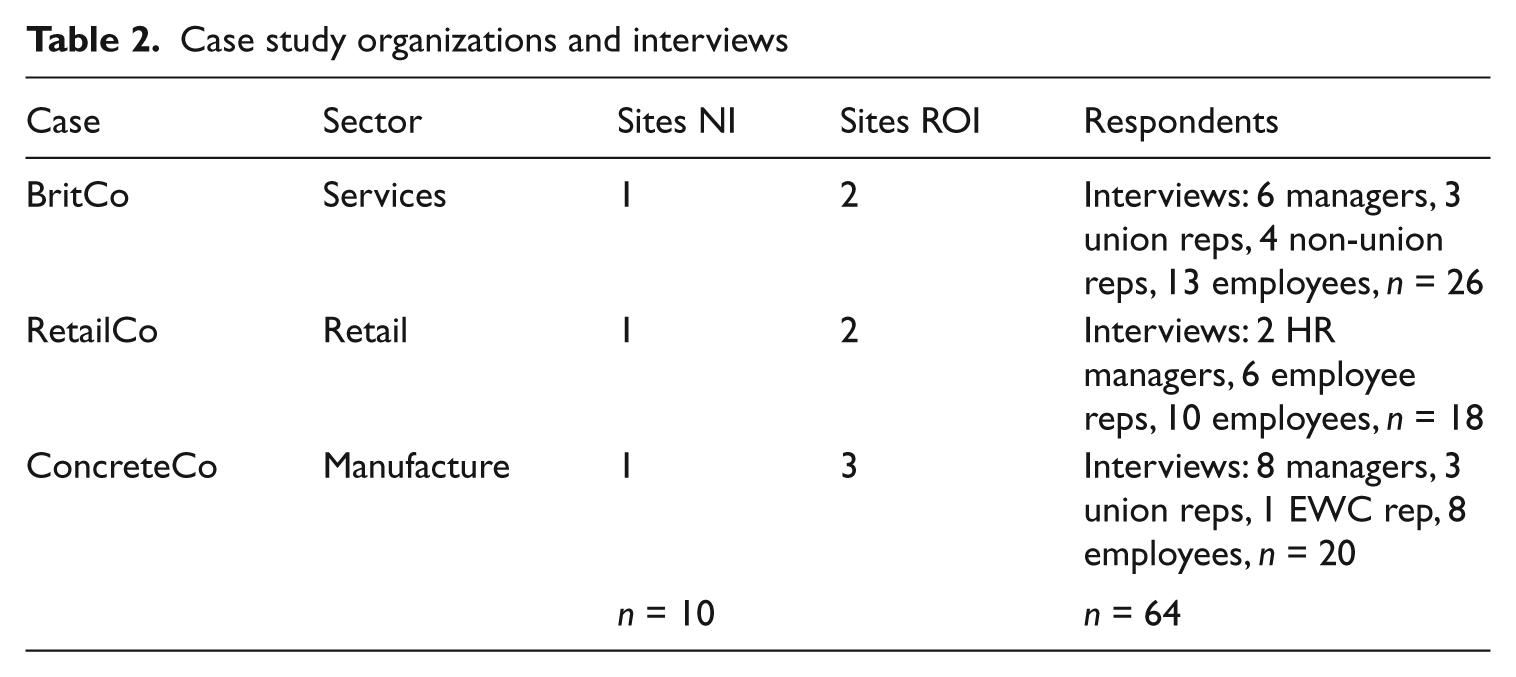
Following this, comparable micro-level data collection and analysis examined the impact of I&C regulations at the workplace level in three case studies. The cases also represented different sectors of economic activity: manufacturing (ConcreteCo), services (BritCo) and retail (RetailCo). The cross-border, multi-sector approach provides scope for both ‘between’ and ‘within’ sector and jurisdictional comparisons. A further selection criterion was premised on achieving a mix of companies with union and non-union practices adopted or re-evaluated specifically because of the I&C Directive. A total of 64 interviews at 10 separate workplaces were completed over two years (summarized in Table 2).
Case study organizations and interviews
Findings
I&C and regulatory space at government level
Macro-level evidence shows two related patterns of influence on occupancy of I&C regulations. The first relates to processes of politicized negotiation affecting content of the I&C Directive, and the second concerns transposition issues relative to the national laws enacted in each jurisdiction.
Activity influencing the content of the I&C Directive occurred in both jurisdictions. In the UK, and for the first time, a tripartite agreement was struck between the UK government, CBI and the TUC concerning transposed regulations. Such an agreement is significant in its own right and relates to Lukes’ first face of power, evident through public and observable negotiation that led to the content of the ICE (2004) regulations. In Ireland, however, political lobbying sought to limit the content of institutional regulation by influencing the agenda for I&C, reflecting Lukes’ second face of power. For example, evidence shows that civil servants held exclusive meetings with employer associations concerning the detail of the I&C Directive (e.g. Irish Business and Employers Confederation [IBEC]; US Chamber of Commerce [AmCham]; and the Irish Management Institute [IMI]; AmCham, 2001; Department of Enterprise Trade and Employment [DETE], 2001c, 2001d). IBEC sought to preserve non-statutory arrangements surrounding union recognition in ROI, expressing its concern that the directive ‘may lead to trade union recognition by the back door’ (DETE, n.d.). In a note circulated by the Department of Foreign Affairs (DFA, 1998), governmental opposition to the I&C Directive at the EU level was based on supporting business and foreign investment concerns:
[The directive would] … restrict business in making the crucial and speedy decisions that are required in today’s competitive market; cut across the HRM practices of Irish operations of US multi-nationals and thus damage FDI [foreign direct investment]. (DFA, 1998)
Overarching the second and into the third dimension of power, employer preferences articulated flexible market demands as important content elements in the directive. This shows hegemonic values reified into market-driven behaviours at subsequent lower levels. For example, the US multinational company Intel met the relevant government minister and DETE officials on several occasions to lobby for amendments to the I&C Directive, reflected in a document entitled ‘Elements of the Draft Directive which must be changed’. Intel summarized their distinct unitarist preferences as follows:
The insistence of communicating and consulting with employee representatives rather than with employees fosters an opposition, ‘them versus us’ culture, which is the hallmark of the old and discredited conflict-based industrial relations model … requiring the nullifying of company decisions is a further draconian step which simply drives business to conclude that creating employment in the EU is to be avoided at all costs because the consequent risks far outweigh any benefits. (Intel, 2000)
Further politicized negotiation by the government sought to influence the content of the I&C Directive to reflect business interests. In a briefing note to the Minister for Enterprise Trade and Employment (DETE), it is observed that ‘during March/April we had secured key concessions’ prior to the enactment of the directive at a Social Affairs Council meeting on 11 June 2001 (DETE, 2001b). Subsequent alterations of the I&C Directive evidently favoured employers and not workers or unions:
The requirement for enterprises to report on the ‘probable economic and financial situation’ of the enterprise has been replaced by ‘probable economic situation’ only. This reduces the level of financial reporting obligations in the directive. (DETE, 2001a)
Relating to the second macro-level pattern (transposition of the regulations by government) the public consultation exercise allowed interested parties to offer their interpretation of how the I&C Directive should be transposed. Various employer bodies sought to protect small businesses by insisting that the regulations be restricted to organizations employing more than 50 staff (Hall et al., 2011). In addition, employees have to actively ‘trigger’ their rights, something that can be extremely risky for unorganized and non-union workers who might fear employer reprisals (Dundon and Gollan, 2007). In the UK, employer groups such as the CBI and Chartered Institute of Personnel and Development (CIPD) lobbied government to ensure their preferences were reflected in the transposed regulations (Hall, 2010). For example, while signing the agreement with the TUC, the CBI actively opposed the principle of ‘collective’ worker rights contained in the I&C Directive (CBI, 2003), in a manner akin to Lukes’ first observable public face of power. However, a neglected aspect of power mobilization in this regard is the role of informal dialogue in shaping attitudes, linking into the second face of power. In Ireland the DETE observed that it would ‘not help the partnership process’ if the extent of government and employer opposition to the directive was publicly known (DETE, 1998), thereby seeking to obscure the ‘hidden’ level of collaboration (collusion) between the state and employer bodies, with unions excluded.
In summary, in both jurisdictions employers appear to have gained by marginalizing collective worker rights and ideologically legitimizing direct communication as part of the I&C content and its transposed national-level regulation. Trade unions, meanwhile, vacated their ‘power to’ influence the space by viewing the issue with relative disinterest or uncertainty. Relative to unions, employers have been strategically organized and pro-active in relation to: (a) influencing content of the I&C Directive at the EU level; and (b) setting the agenda for transposition arrangements when enacted into national regulation. However, the extent to which this ‘power over’ regulatory space for I&C at the macro level has been diffused into workplace micro-level practices and preferences remains an empirical issue, which is reported next.
I&C and regulatory space at the firm level
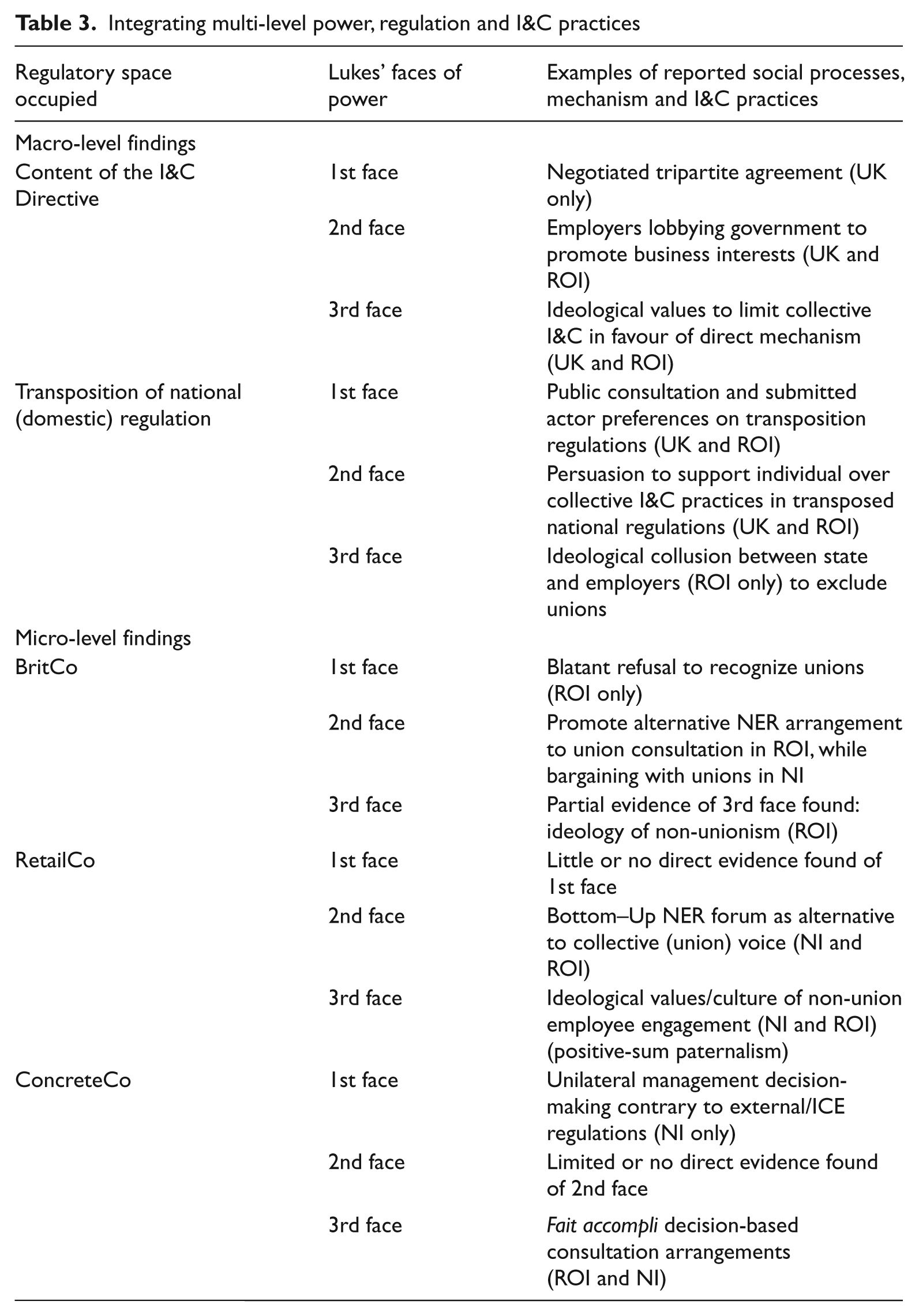
The way worker voice was regulated in the three case organizations reflected variation in deployment of multiple power resources (see Table 3). Importantly, processes of social formation concerning the I&C regulations at the macro level, as reported earlier, underpinned diffusion of knowledge and ideological assumptions at the micro level that can be seen to be inter-subjective. That is to say, many local managers assumed, as objective fact, that the I&C regulations promoted continuation of flexible information-sharing arrangements for voice because these attitudes were structured by employer associations and government at national and EU levels. Processes of common knowledge formation in each case and the linkage to power resources, where evident, are outlined next.
Integrating multi-level power, regulation and I&C practices
BritCo: employees contest managerial occupation of voice in ROI
Evidence from BritCo illustrates the importance of countervailing collective power which mediated employer occupation of I&C space at the workplace level. A group of union members in ROI mobilized to contest management’s preference for non-union employee representation (NER) arrangements by instigating a union recognition campaign. BritCo has dual I&C arrangements that are union-based in NI and non-union in ROI. Management responded to the union organizing campaign in ROI by re-constituting a previously defunct NER staff forum (BritCo Vocal). At the same time, BritCo Vocal was used to promote a new approach to employee representation because of the I&C Directive. As a result, NER representatives were elected, the HR Director would outline company developments to Vocal representatives, followed by an economic update by the Chief Executive and meeting agendas publicly promoted employee concerns. In terms of the first observable face of power, NER representatives achieved some negotiated gains from management through the newly constituted Vocal forum, specifically concerning parity of redundancy terms. Reflecting the second dimension of power, the revamped arrangement did more than ‘comply’ with external I&C regulations: it also staved off a union recognition drive and embedded managerial preferences for non-union I&C in ROI. In effect, BritCo management consciously sought occupation of regulatory space for voice by excluding unions and maximizing non-union channels.
However, the recast Vocal forum was only partially successful. Many employee respondents felt the non-union forum degenerated into an ineffective ‘talking-shop’, more appropriate to ‘tea and toilet’ issues than substantive ‘option-based’ consultation with a view to reaching agreement. Significantly, once the union recognition drive subsided in ROI, the range of issues on which employees could engage with management waned and the desire among employees for union voice had not diminished:
Some employees see it (non-union forum) as management paying lip service. Because we have no union, we have no power … There is a whole culture among employees that we should be unionized. (Employee Representative, ROI)
At the same time, exercise of the first and third faces of power took place within an ideology where management used direct communication and labelled unions as ‘external influences’, as a means of mobilizing bias away from employee desire for union representation towards the in-house non-union representation forum.
Retail Co: occupying regulatory space through culture and attitudinal manipulation
RetailCo prides itself on being a ‘good’ non-union employer that supports its workforce through psychological engagement. The company does not recognize unions anywhere in Ireland or the UK and operates the same non-union I&C structures in both jurisdictions. The company offers an attractive employment package including above-market pay rates and extensive training and employee engagement. The I&C centre piece is known as ‘Bottom–Up’, an NER committee covering store, regional and divisional levels. To some extent RetailCo management would view power as a positive-sum concept expressed through empowerment and inclusion, rather than domination or ‘power over’ employees. The overarching approach signifies a paternalistic-type culture by supporting individual employee engagement rather than collective union bargaining. For example:
From its inception it has never been really explicit … we don’t deal with trade unions … We engage with employees and we operate a culture where we hope employees would not feel the need for joining unions. (Manager)
The processes by which management occupied regulatory space at RetailCo symbolizes less transparent dimensions of Lukes’ second and third faces of power and combined both dominant and positive assumptions of power resource mobilization – evident in its subtle if somewhat strategic union avoidance approach. The non-union employee committee, Bottom–Up, was revised in 2002 with a preference for I&C without union interference. The passing of the I&C Directive in the same year was a catalyst for management to review voice arrangements. However, desire to comply with external regulation was perhaps a less significant factor than management’s primary objective to support and engender positive employee attitudes that reflected a unitarist union-free culture. In revising I&C arrangements, each retail site has one representative for every 50 employees, and meetings normally consist of five people: site manager, HR executive, another manager and two employee representatives. In the two stores visited, Bottom–Up meetings were meant to occur four times a year but happened only twice. In part, management shaped the space for I&C by influencing both the agenda and sequence of meetings. With regard to Lukes’ second face of power, management allowed employees to suggest agenda items for the Bottom–Up forum, but retained ultimate control as to when and what issues made it to the actual meeting agenda. This equates to what Sisson (2012) calls ‘decision-based’ consultation.
The third face of power was to some extent evident in processes used to shape a distinctive corporate culture at RetailCo. The revised ‘Bottom–Up’ structure combined also with an ideological value for individual employee engagement which enabled management to affect change compatible with their own rather than employee preferences. For example, reservations about the utility of Bottom–Up were expressed by line managers: ‘it’s not utilized properly … and it has become negative … a venting exercise’. Employees viewed the forum as shallow: ‘something that’s not really taken seriously by management’. A non-union representative described a problem with excess heat that had been raised at all levels, although management refrained from acting until the Health and Safety Inspectorate issued the company with an enforcement notice.
ConcreteCo: dual voice in cross-border jurisdictional space
At ConcreteCo there was duality in terms of how processes of social formation related to Lukes’ dimensions of power across the two jurisdictions of ROI (unionized) and NI/UK (non-union). Importantly, preferences that I&C regulations need to be cognizant of business interests were strongly advocated by managers. In part this concurs with Lukes’ first dimension of power in that employers openly dominated space for I&C at the workplace level. In NI, management simply refused to consult workers and viewed I&C regulations to be at best irksome, at worst an intrusion on managers’ right to manage:
I think the word ‘consultation’ is a misnomer, it is very much communication … Consultation implies there is a party with information, there is an opportunity to give feedback on that information, the feedback is listened to, and as a result decisions are taken. That does not happen here. (HR Manager, NI)
The unilateral decision not to consult or involve workers was confirmed by other employees and managers. Some NI employees expressed dissatisfaction and wanted more opportunity to ‘have a say and get feedback’. However, management control circumvented the limited rights employees had regarding consultation. For instance, an administration manager was the ‘nominated’ employee representative for the European Works Council (EWC). In doing this, management could screen out potential issues and control the I&C agenda, reflecting the second face of power mobilization. Similar power utilization was evident in ConcreteCo sites in ROI, although in different ways. Rather than the managerial unilateralism evident in NI, unions occupied elements of regulatory space in ROI owing to long-standing multi-union bargaining and consultation: something the senior HR manager called a ‘good system of information and consultation’. In this regard, employees saw the visible role of adversarial union bargaining as an effective channel for regulating voice. At the same time, management often presented decisions as a fait accompli in collective forums, and thereby restricted power-sharing. In short, the second face of power meant that ‘decision-based’ rather than ‘option-based’ consultative arrangements emerged in reality. For example:
You get the sense that decisions are already made at a higher level, then the unions are told. Unions don’t have real influence, say if new machinery or work practices come in. There is no real participation. (Union Steward, ROI)
Discussion and conclusion
Integrating multiple evidence and predicting cause and effect is always problematic in sociological analysis, and it is not the intention here to offer such predicative causality between multiple processes affecting the regulatory space of the I&C Directive. However, there are a number of evident patterns in terms of preferences articulated by employment relations actors within and across multiple levels of analysis. Such a multi-level and multi-dimensional focus is important in helping to understand how social processes of regulatory formation and transposition are mediated and manipulated, often using direct but also more subtle forms of power and persuasion. The theoretical schematic in Table 1 earlier is reproduced in Table 3, this time summarizing key findings for each level, power dimension and links to I&C practices. In so doing, it illustrates macro–micro interaction and linkages.
The contribution of this multi-level framework is to show how both employers and the state in the LME contexts of ROI and the UK (NI) have shaped the macro-level processes of the I&C Directive to reinforce preferences for voluntarism and employer ‘power over’ workplace decisions. The outcome of this – illustrated by linkages to the micro case studies – has been to exclude workers from shared decision-making about aspects of workplace governance that the directive initially intended. The potential for the directive to act as a spur towards the positive uses of ‘power to’ empower workforce decision-making has not materialized. The ICE regulations (2004) in the UK and I&C Act (2006) in Ireland provide an insufficient legislative counterweight to shift the power balance in workplace governance from employer dominated ‘power over’ to more positive collaborative mutuality.
The article suggests that a schematic multi-layered governance framework of regulatory space serves as a useful integrated analytical tool (see Table 1) for understanding variable impacts of policy formation and transposition of the I&C Directive across transnational, national and enterprise levels (see Table 3). In this way, the contribution adds something to Lukes’ three faces of power. The concept of power, as Edwards (2006: 573) argues, remains a ‘necessary element’ when seeking to understand institutions regulating work and it is possible to extend Lukes’ analysis of the multiple dimensions of power when examining processes of regulatory space. To this end the article addresses some missing pieces in Lukes’ work by analysing the nuances of ideological power, the distinction between ‘power over’ as domination and ‘power to’ get things done for productive ends, empirically connecting the dynamics of how work relations shape power relations across macro and micro levels. The data also expose inherent problems with Lukes’ third face of power given the ambiguity of capturing ideological intent and preference-seeking behaviours.
In terms of regulatory effects, the evidence pointed to a pattern of space occupation that favoured employer over worker interests in two ways: first, direct influences on the ‘content’ of the I&C Directive; second, political dialogue that affected the ‘transposition’ arrangements for national regulation which embedded a sharing of common-knowledge formation among employers and employer associations promoting the dominance of voluntarism and employer choice over voice options. While union actors were not found to be weak or powerless per se, they did lack the capacity to establish a more collectivist voice regime serving their members’ long-term interests relative to those of employer bodies, especially for lobbying in the political sphere. Significantly, unions in the UK and ROI have long been ambivalent and defensive about I&C rights, tending to view them as a possible threat to traditional collective bargaining. Accordingly, unions did not mobilize to affect either content or transposition arrangements of the I&C Directive and were unable to challenge a prevailing employer (ideological) orthodoxy. In view of this, employers displayed a more effective (efficient) capacity to mobilize ‘power over’ an emerging and evolving regulatory space affecting workplace governance powers. Notably, in relation to the less observable third power face, a continuous and seemingly omnipresent discourse was promulgated by many employers (and policymakers) that employment regulation should not interfere with management’s right to manage as it sees fit.
Therefore the I&C Directive has not prompted a new politics of ‘common knowledge’ formation between employers and unions based on robust representative consultation. Rather, employers, facilitated by the state, legitimized an ideological mind-set that primarily promoted direct employee communications as policy content, even though the directive itself was framed to embed a more collectivist element to workforce consultation and shared decision-making. Employer domination over the regulatory space of I&C has lubricated an ideological preference for voluntarism across neo-liberal market regimes – in line with Lukes’ third ‘face’ of power. In Ireland especially, US multinational companies and their representative associations have exerted considerable ideological power over the content and transposition of the I&C Directive. In so doing, employers not only asserted strong lobbying pressure on the national government (indeed, there was ideological collusion between the state and big business to ensure the I&C Directive did not intrude on managerial prerogative), but also bypassed national institutions in influencing European social policymakers directly.
The macro context had implications for events at the micro level, evident in the case organizations (examples in Table 3). Macro-level preferences for laissez faire voluntarism associated with the third face of power, union ambivalence and subsequent minimal transposition of the I&C Directive meant national regulations had little impact in the case organizations in encouraging employers to share decision-making powers for productive ends (‘power to’) through new or revised consultation mechanisms, as originally intended by the directive. Rather, employers at the micro level tended to occupy regulatory space for I&C governance by utilizing ‘power over’ domination. This was evident by influencing workforce expectations and attitudes that legitimized as normal weaker ‘decision-based’ information rather than more robust ‘option-based’ consultation arrangements (Sisson, 2012: 186–7). To this end shaping attitudes and worker expectations about what management might deliver on joint workplace governance was a power resource for employer occupancy of regulatory space. Many local managers assumed as inter-subjective objective knowledge (Culpepper, 2008) that direct communications and/or ‘decision-based’ consultation were acceptable and the preferential mode to regulate I&C. This meant I&C regulations did not prompt a politics of new common knowledge formation around robust representative social dialogue at the micro level.
Importantly, the multiple power dimensions articulated by Lukes were not exclusive but tended to co-exist as resources for employer colonization of regulatory space at the micro level. The overlapping faces of power and employer capture of regulatory space for voice were more complete in some cases than others. There were important differences relating to context-specific factors affecting power to regulate I&C, notably the presence of unionized workers and their capacity to contest management preferences. The most robust forms of I&C were evident in highly unionized BritCo (NI), and shallow in non-union ConcreteCo (NI). In workplaces where unions were not recognized, employers deployed non-union voice mechanisms to avoid unions. At BritCo (ROI) all three faces of power were in play as union members mobilized collectively to pursue union recognition rights and, thereby, opposed the management-sponsored non-union forum. While this collective counter-mobilization did not mean employees achieved union recognition, they did set certain limits to employer capture of regulatory space that unorganized workers would be less able to achieve. In RetailCo, management had an ideological agenda to win employee ‘hearts and minds’ by using corporate culture by espousing non-union relational values over unionized structures. This did not fully translate into dominating ‘power over’ within Lukes’ framework, but instead reflected elements of positive ‘power to’ emancipate employees at RetailCo with strong ideological undercurrents of paternalism.
To conclude, this article makes an important contribution to the processes of common knowledge formation as sources of power mobilization affecting occupation of employment regulation. It integrates the concept of ‘regulatory space’ with Lukes’ ‘faces’ of power to provide a schematic integrated macro–micro analytical framework to better understand how employment regulation impacts across transnational, national and enterprise levels. The research addresses some gaps in Lukes’ theory by analysing the nuances of ideological power, the distinction between ‘power over’ as domination and ‘power to’. It also shows, however, there are limits to Lukes’ (1974, 2005) categorization of ideological power at the micro level given its ambiguous dynamic. By capturing regulatory space for I&C, employers have preserved and even reinforced voluntary modes of regulation in the work and employment sphere, while excluding workers from shared decision-making (‘power to’), which the directive initially intended.
Footnotes
Funding
The work was funded under a bilateral research grant from the Irish Research Council (IRC) and the Economic and Social Research Council (ESRC) [RES-062-23-1139].