



Abstract
Software work is often depicted as a ‘sunrise occupation’, consisting of knowledge workers that are able to craft stable careers. The aim of this article is to question this account by analysing the experiences of mobile applications developers, with a focus on Apple and Google platforms. The analysis is situated in the context of wider socioeconomic trends and developments in product and technology markets, since these structures frame the working practices of software developers. Drawing on qualitative fieldwork in Sweden, the UK and the USA, the study reveals how changing market structures have given rise to increasingly precarious working conditions and unstable labour markets.
Keywords
Introduction
IT work is frequently portrayed as a ‘sunrise occupation’ (Kraft and Dubnoff, 1986) with ‘new economy’ writers projecting the benefits of a self-managed and ‘boundaryless’ career (Baldry et al., 2007). Yet broader changes in work and employment, such as sub-contracting or outsourcing (Taylor, 2010), the decline of standard labour contracts (Baldry et al., 2007), rising self-employment (Smeaton, 2003) and mounting insecurity (Green, 2009; Thompson, 2010) appear particularly pronounced in software work. While a small body of research reports on the labour process within the IT industry (Barrett, 2001; Beirne et al., 1998; Kennedy, 2010; Marks and Scholarios, 2008), there is limited knowledge regarding what software developers do, how they react to changes within the industry and how technology developments impact upon shifting labour markets (Barrett, 2001; Gill, 2007; Pratt, 2009). Therefore, this study investigates these broader changes within the area of mobile application development and distribution (MADD), based on platforms owned by the current market leaders: Apple and Google. The focus lies in understanding how changing market structures shape and control developers’ working experiences.
Employing software developers is costly to firms and controlling their productivity is notoriously difficult (Barrett, 2001). With mobile development, the coming together of new technology platforms with a changing market environment has enabled Apple and Google to outsource development to a global base of developers; this business model, which harnesses the creativity of a distributed network of individuals, has been termed ‘crowdsourcing’ (Brabham, 2008: 76). Structural changes in the IT sector have resulted in increasing casualization and insecurity (McDowell and Christopherson, 2009), which has triggered crowdsourcing as an attractive and viable form of employment for developers; at the same time products designed by the crowd enable companies to generate substantial profits. Crowdsourcing mobile applications entails a move away from salaried forms of exchange within an internal labour market to an external market of competing contractors, thus allowing large firms to avoid the incurred costs of the direct employment contract while profiting from the productivity of what is effectively a volunteer workforce. This broader context is relevant to understanding the dynamics shaping the working environment of software developers.
The purpose of the article is to analyse the experiences of MADD developers and the coping strategies they adopt in the context of wider environmental changes and an intensification of market relations. The authors’ interest lies in the commonalities experienced by developers that cut across employment categories, rather than exploring distinctions. Drawing on compelling evidence, the research details how software workers react and respond to increasingly precarious employment and insecure prospects. Before presenting the evidence from developers, the broader context of the IT sector and mobile application platforms is established, followed by an explication of the research approach.
Setting the scene: IT work, entrepreneurism and mobile applications development
While software development is frequently portrayed as an exemplar of knowledge work (Castells, 2000), the more critical literature has described it as ‘white collar manufacturing’ (Marks and Baldry, 2009: 61) and ‘a scientific management of mind work’ (Kraft and Dubnoff, 1986: 194). Over the last decade or so, the IT workforce has been confronted with considerable turmoil including the burst of the dot.com bubble, the offshoring of software work and a more general thinning out of the industry. Although regulatory contexts differ, sectoral transformation has resulted in a bifurcation with large firms consolidating their position as the proportion of small firms increases, confirmed by studies in Australia (Barrett, 2001), Holland (Gill, 2007), Sweden (Movitz and Sandberg, 2009), the UK (Marks and Huzzard, 2010) and the USA (Batt et al., 2001).
For IT workers, the archetype of a stable career begins to waver as firms change size, location, projects and organizational structures, with a modification from full- to part-time work and from employees to freelancers (Lash and Wittel, 2002). Even when hopes were high for the ‘new economy’, the IT workforce experienced an increase in casual contracts, self-employment, multiple job holding and low paid work (McDowell and Christopherson, 2009). These trends are coupled with the ‘projectification’ of work (Maylor et al., 2006) which has seen project-based working patterns becoming the norm (Kennedy, 2010). Workers move rapidly between different types of employment – freelancing, working for a company, setting up their own business – not necessarily sequentially and often in parallel (Gill, 2007). While new media workers may be celebrated as ‘model entrepreneurs’ (Florida, 2002) often the reality is the disintegration of stable careers and discontinuous employment. Entrepreneurism is frequently presented as offering new opportunities, but the erosion of salaried employment sees a reduction in security (Christopherson, 2004) and is market dependent. Precariousness can be a typical concomitant, often associated with self-exploitation (Ross, 2003).
Changes in the IT sector echo trends of casualization and insecurity, which have become increasingly relevant to high paid, high skilled workers (Gill and Pratt, 2008). Pongratz and Voβ (2003) argue these changes have contributed towards a fundamental transformation of work, which they conceptualize in terms of the ‘entreployee’ or self-employed employee. This concept is used to explain the response to highly flexible forms of capitalism with an increasing lack of distinction between employee and employer, as the former redefine their capacity both within the firm and the wider labour market. The quasi-entrepreneurial nature of working life sees the promotion of employee responsibility as they are tasked with transforming their labour power into concrete performance. The conceptualization of ‘entreployee’ refers primarily to individuals working within firms and is typified by the rise of performance metrics, profit centres, project/team work and increasing flexibility. Between firms, the ‘autonomization’ of work sees the growth of outsourcing and increasing cooperation with freelancers.
The research was further developed by Pongratz (2008) who theorized a ‘society of entrepreneurs’ as one in which entrepreneurial functions are relegated commonplace and everyone potentially faces the prospect or acting as an entrepreneur at some point throughout their working life – either selectively or permanently, self- or other-directed, partially or comprehensively, successfully or not. In contrast to the conventional definition of the capitalist entrepreneur as social elite (overseeing a large firm in the Schumpeterian sense), Pongratz provides a more encompassing classification which broadens out the category to include the self-employed (more commonly referring to a single person business or freelancer) and the ‘entreployee’. Faced with changing market structures, the category covers overlapping forms of entrepreneurial action. In this regard, enterprise is not simply an organizational form, but a certain mode of activity that could be applied to organizations, individuals within organizations and to everyday existence (Miller and Rose, 1995: 455). Depending on the particularities of given markets, workers will occupy different positions and perform various entrepreneurial functions; this could be within the roles of formal employment, self-employment and freelancing. Fluidity is key, so that while workers may sit in a particular category at any given career point, they are inclined (and often forced) to adapt. In this market reorientation workers as entrepreneurs become ‘profit-seeking sellers of commodities’ (Pongratz, 2008: 3) as they channel their individual labour power into producing and marketing goods or services to maintain their economic existence. This allows for a reconceptualization of work so that productivity is maximized, innovation is assured and worker commitment is guaranteed. The political vocabulary of enterprise offers a means for improving employee capacity and enhancing self-fulfilment and responsibility (Miller and Rose, 1995).
The critical lens on emerging forms of entrepreneurism and entrepreneurial behaviour in the context of changing market structures will be drawn upon to analyse mobile applications developers and their experiences. Management face numerous challenges when managing software workers as they nurture creativity while maintaining a semblance of control. The crowdsourcing of MADD by Apple and Google facilitates access to a mass of labour while placing responsibility for productivity firmly at the door of developers themselves, allowing capital to reap the financial benefits while sidestepping the costs of recruiting, training and sustaining labour.
Apple and Google
Understanding IT work requires an appreciation of how wider socioeconomic trends and developments in product and technology markets frame working practices. Until recently, the mobile phone market was one of maturity and sophistication, with five manufacturers covering 75 per cent of the world market (Nokia, Motorola, Samsung, Siemens and Sony Ericsson) (Hess and Coe, 2006). This changed significantly in 2007 when Apple launched the iPhone and entered the mobile phone market with a product equipped for internet access. Apple is renowned in the industry for the extreme secrecy surrounding product launches, which enhances the anticipation. The unveiling of the iPhone was marketed with staged launches outside retail stores, as queues of young film extras were paid by Apple to generate interest among passers-by (Goggin, 2009). Apple artefacts are embedded into a digital ecosystem that seamlessly links products with the electronic marketplace (iTunes, the App Store). As the lead firm in the supply chain, Apple enhances control using multiple sourcing and working closely with even the suppliers’ suppliers (Dedrick et al., 2009).
In March 2008 Apple released the iPhone Software Development Kit (SDK) which enables third-party developers to create applications for the iPhone, iPod touch and iPad. In keeping with their centralized strategy, Apple commandeers the distribution and sales channel for mobile applications via the App Store. Developers set their own price for the application and Apple top-slice 30 per cent of sales revenues. The process is mediated by Apple who may halt the release of applications if they are deemed inappropriate or unsuitable; their control is underlined with 113 guidelines outlining acceptance criteria.
Turning to Google, their entry into new markets includes mobile technology and so in 2008 they announced their open source Android platform for mobile phone development. Open source is perceived by many as anti-corporate, which ostensibly links neatly with Google’s image, exemplified in their mission statement: ‘Don’t be evil’. At the same time Android was released, Google founded the Open Handset Alliance (OHA). This business consortium consists of around 50 technology and mobile firms (such as Samsung, Motorola, LG, Vodafone and Intel) that are committed to open standards for mobile devices. In contradistinction to its name, membership of the OHA is based on personal invitation from Google (Grotnes, 2009), which suggests that Android is far from an open source project.
By using the OHA to assemble together mobile phone handset makers and carriers, Google has managed to mobilize a range of manufacturers to develop products for the Android platform. The founding of the OHA supports Google’s endeavour to have Android available across a range of devices and the OHA’s declaration that ‘building a better mobile phone would enrich the lives of countless people across the globe’ (Open Handset Alliance, 2009) suggests that their strategy is geared towards the global distribution of Android handsets. This is of particular interest given the United Nations report on the information economy (United Nations, 2010) which points to mobiles emerging as the preferred ICT tool, with rapid increases in the numbers of subscriptions, particularly within developing economies.
Although variations exist between Apple and Google platforms, common to both are the provision of the SDK to enable the creation of applications and the distribution channel, which, crucially, provides the link between developers and consumers. In opening up the platform, Apple and Google have outsourced mobile applications development to a global base of freelancers, thereby minimizing risk, while developers create and market applications that may or may not be successful. This form of crowdsourcing has been described by Business Week (Hempel, 2006) as a novel way of ‘milking the masses for inspiration’.
Research approach
In 2009 a qualitative study of developers’ experiences of MADD was undertaken. The research focuses on how market relations (and significant institutions such as Apple and Google) interact with, shape and control developers’ experiences and expectations. The study covered Sweden, the UK and the US since they have significant levels of maturity in the mobile marketplace. The aim was to capture the everyday working experiences of developers with varying expertise and a mixture of employment contracts. Topics discussed included: working practices; reasons for developing for mobile devices; attraction to and experience of particular platforms; the development process; and marketing strategies. The study was piloted using two focus groups, each consisting of six Android/iPhone developers, a strategy which provided a vantage point from which to launch the broader study. In total, 60 developers were recruited using social media channels, including online forums and blogs, as well as sending personal messages via email and Facebook. A mixture of face-to-face, co-located interviews, synchronous Skype interviews and asynchronous online discussion forums was adopted, depending on preferences and geographical location (Table 1). Interviews lasted from one to two hours; all were recorded and transcribed.
Number and type of interviews
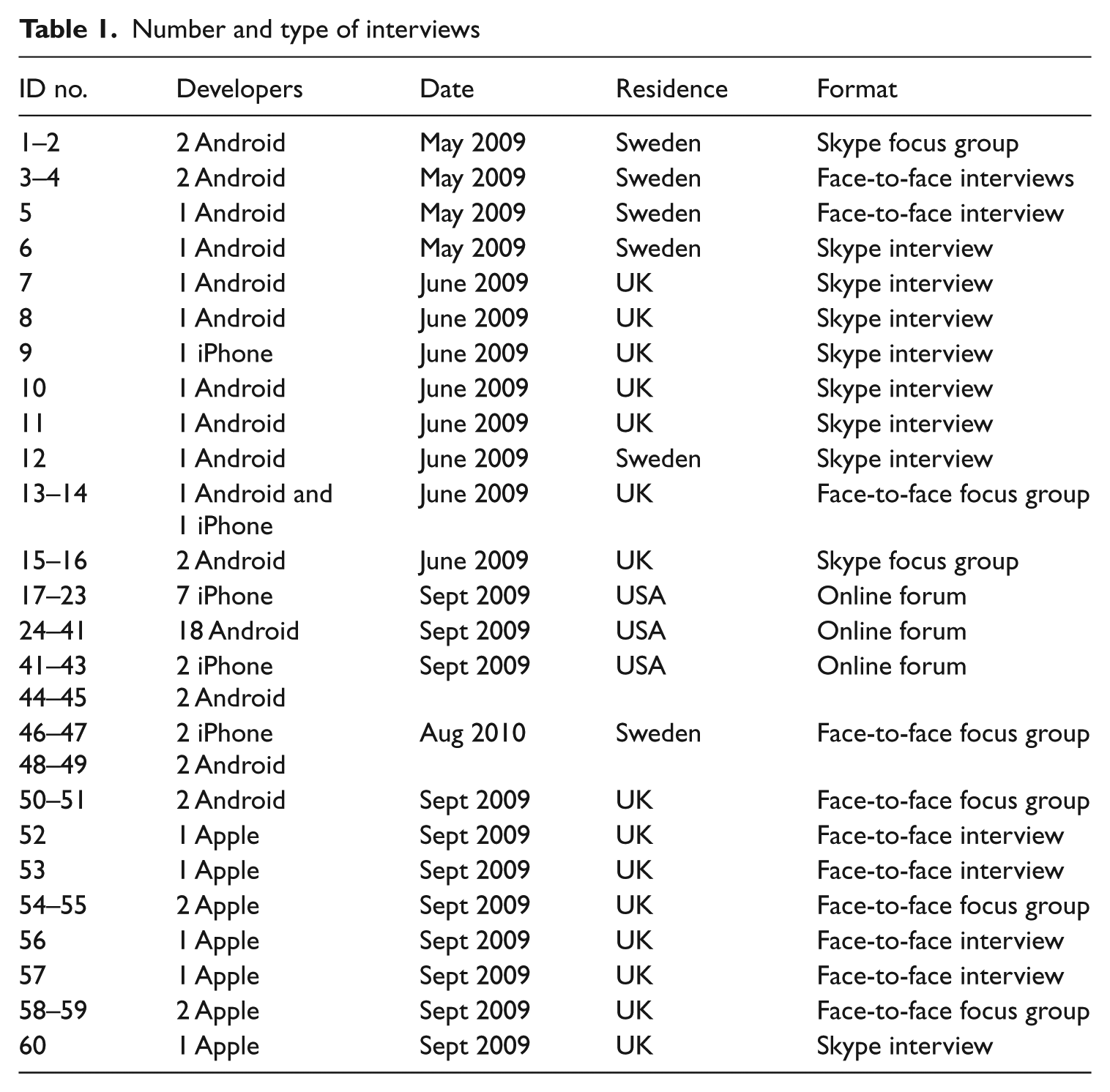
Three online forums were created, which lasted for 10 days with a question posted daily. This was not perceived as onerous and so the response rate was excellent (100%). Every participant answered each question and often commented on each other’s answers, thereby generating debate in a similar way to a focus group. Given the IT sector is characterized by a multitude of firm types, no one organization was studied and in this respect the research is neither organizationally nor spatially bounded.
The process of data collection and analysis occurred dynamically and interactively as the data was input into a data analysis tool (NVivo). The method of analysis was based on an ongoing iterative process of reflection to help identify concepts and themes (Miles and Huberman, 1984). As the data collection progressed the predominance of precarious work became apparent and the boundaries between different employment structures appeared permeable. A mapping of the relationships between data and emerging themes was created, guided by the literature, with the work of Pongratz and Voβ (2003) seemingly apposite. Initial findings were shared with participants and their comments confirmed and elaborated the themes. The quotes have been selected from the full range of participants to highlight the multiplicity of views.
The developers’ profile
The developers represented a fairly homogeneous grouping with extensive experience and platform knowledge. In total, 60 developers participated in the study. Given the IT industry is notorious for the under-representation of women (Adam et al., 2006), effort was placed into recruiting developers from ‘Girl Geeks’, resulting in five female participants. Overall, publishing experience spanned from one to 45 applications, with around half of the developers having published between 10 and 40. The development process varied and could range from half a day (e.g. a new ringtone) to several months (e.g. the Edinburgh Festival app). Some developers and firms specialized in developing one main product (e.g. a self-employed developer spent 18 months creating an e-book reader), investing time in updates and user support, while others released numerous apps and offered limited support, quickly moving on to the next development project.
Most of the developers opted for single platform development to focus their expertise and their preference was largely pragmatic as opposed to evangelical. Many began using the iPhone platform because it preceded Android and provided a digital infrastructure supported by strong branding. Conversely, other developers chose Android because its open source features enabled them to share code. Android developers stressed their reasons for not developing for Apple: the iPhone is ‘too controlled’ with numerous conformance rules and applications risk rejection from the App store. Some developers worked on outsourced applications, but the majority ‘owned’ the product they were developing. For those developing outsourced applications, platform choice was dictated by the terms of the contract. There were differences in levels of success as the number of downloads for their most successful application ranged from over 1m to just over 10,000, but there were examples of some applications receiving zero downloads. While this was relatively uncommon, more widespread was the level of unpredictability (either positive or negative) which points to the unstable nature of app development. The amount of revenue generated also varied widely – from $150,000 from one application to just $50 for a developer with six applications.
The developers represented a diversity of employment types (see Table 2), a fact which reflects market structures, the nature of the commodities and the competitive environment. The employment categories are derived from Pongratz and Voβ (2003) and are fluid as developers move between categories. Our interviewees often experienced multiple types of employment simultaneously, such as formal employment and freelancing in their leisure time, or freelancing and sub-contracting for a specific project. As Pongratz (2008: 9) notes: ‘An actor is not per se an entrepreneur or non-entrepreneur, but is one or the other with regard to a certain market.’ Almost 60 per cent of the participants were self-employed, either working as contractors or managing their own start-up. Of interest is the small proportion of developers that are formally employed to develop apps as compared with those that are formally employed yet developing apps as a sideline, outside of the boundaries of the firm. Even for those developers that are formally employed, the sector predominantly consists of micro firms with self-starting individuals (Barrett, 2005) and an expectation of ‘enterprising’ behaviour.
Employment categories
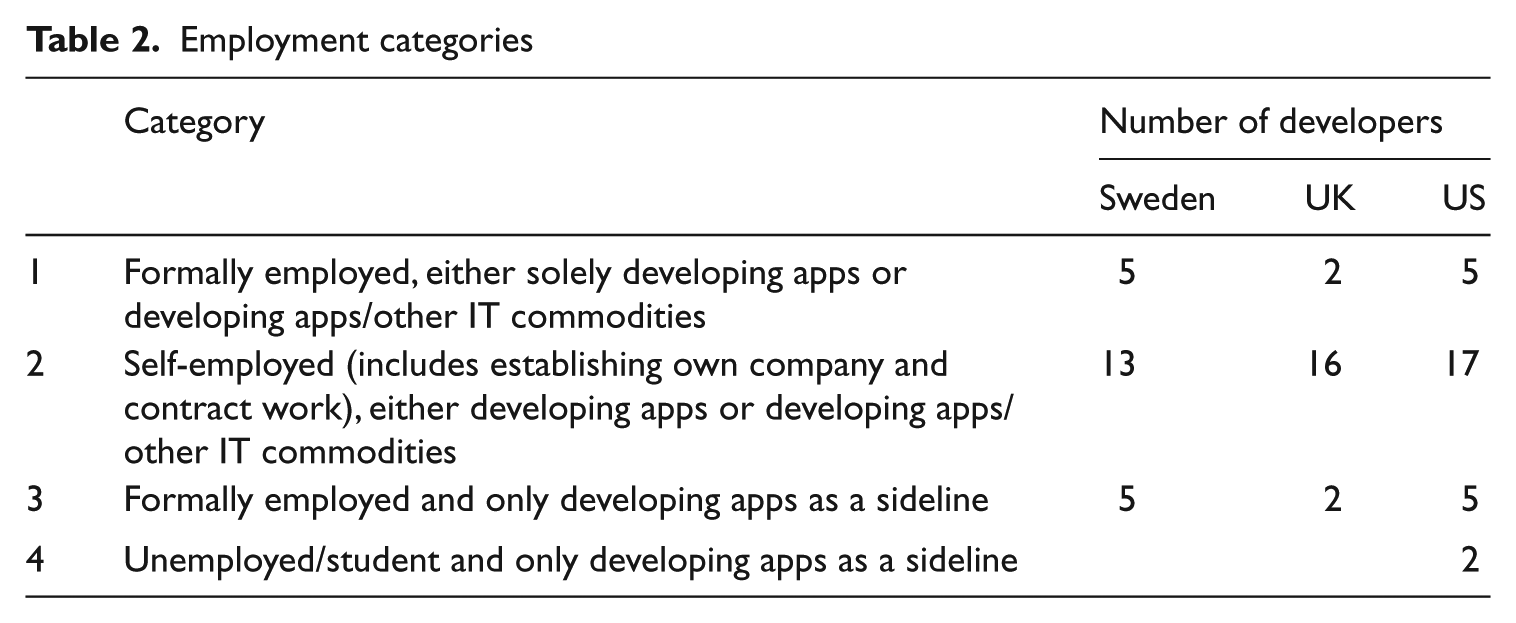
In the three geographical locations selected for the research, different regulatory frameworks govern employment conditions and may result in variations (Christopherson, 2004). In the USA, there was a predominance of entrepreneurial contractors (Batt et al., 2001). In Sweden, work is predominantly based on an employment-based professional model, with studies in the early 2000s demonstrating a prevalence of full-time, permanent employees (Movitz and Sandberg, 2009). However, there is an adjustment towards self-employment and micro firms, with 98 per cent of Swedish IT companies having less than 20 employees (Statistics Sweden, 2008). The UK sits midway between these extremes with increasing emphasis being placed upon the growth of small firms and self-employment. Despite regional distinctions, there are also common patterns across these economies, such as urban orientation, the tension between creativity and control, continuous re-skilling and gender segmentation.
Findings from the study
The data has been analysed according to Pongratz and Voβ’s (2003) ideal type of the ‘entreployee’; this analysis is used to illustrate the increasingly entrepreneurial and precarious nature of software work. The categories derived from Pongratz and Voβ (2003) are those of self-control, self-commercialization and self-rationalization. These will be discussed next.
Self-control
Integral to the concept of ‘entreployee’ is the manner in which individuals have to independently plan, control and monitor their work activities (Pongratz and Voβ, 2003: 8). In the context of MADD, of relevance are the restrictions created by Apple and Google as they consolidate their position while the remainder operate predominantly as small firms, freelancers and sub-contractors.
Exercising self-control in a sector reliant on continuous innovation requires developers to redefine their capabilities in response to changing markets. The mobile market was typically described by interviewees as ‘where everything is moving’ and lagging behind is viewed as detrimental: ‘If you are developing for an outdated or dying device then you’re wasting your time’ (36; category 2) 1 . The desire to work on leading-edge technology and become enriched motivates many developers, given socioeconomic mobility is seen as more accessible as compared with traditional professions (Marks and Baldry, 2009). Yet entering emerging markets represents new risk. A couple of developers described how their SME had changed from web to iPhone development within a six-month period: ‘Essentially, we have no other income than our iPhone applications. So we have kind of jumped into it with both feet’ (9; category 2).
Many developers focus on continuous competence development (Adams and Demaiter, 2008) which is key to self-control, enabling them to keep pace while remaining attractive in the jobs market. Indeed, studies show career and remuneration distinctions between those working with advanced technology and those working with older systems (Marks and Scholarios, 2008). Yet the pressure of ‘keeping up’ (Ross, 2003) could be a source of anxiety and allocating time for up-skilling frequently occurred outside of office hours: For personal development, I wanted to try a new [programming] language. I mean, how hard can it be? But it turned out to be quite hard! The opportunity to earn some money has crossed my mind, but I did it more for my own sake than to get crazy rich. (7; category 3)
Many of the developers displayed intense self-motivation and commitment, so receiving a positive response to their labour was highly desired. Peer group recognition enhanced self-control as it could lead to lucrative contracts in the future: ‘My motivation to create games is to get recognition within the community. You’re the guy that has done this’ (44; category 3). Success was equated with getting noticed, described as having ‘celebrity status’, which could become self-fulfilling as publicity often correlated with product downloads and higher commercial value. In this respect, reputation among peers was crucial since future employment was dependent on past performance, yet peer group response was difficult to direct, which could heighten the lack of control.
Self-control remained limited given that Apple and Google owned the development and distribution platform. Although developers had considerable discretion over how they organized their work and participated in the market, this market was shaped by business models determined by Apple and Google. Prior to Apple and Google’s incursion into the MADD market, there were limited opportunities for developers to access this marketplace and so many viewed crowdsourcing as opening up opportunities. However, criticism frequently surfaced regarding lack of control. Particularly problematic for iPhone developers was that Apple ultimately decided whether or not applications were permitted on the App Store: ‘Occasionally we have had apps refused for no reason. You have heard all the horror stories and they apply to us’ (13; category 2). One developer was irritated by the lack of consistency: [Apple] rejected us for a feature that wasn’t functional apparently. But we can actually see from their server logs that they had tested it and it worked, but they said that it didn’t work because they were doing it so quickly. They didn’t give it their full attention. We know countless people that have been rejected for crazy reasons …. (9; Category 2)
The digital infrastructure created by Apple pointed to diminishing control by developers, but criticism of Google also emerged regarding restrictions which limited developers’ ability to function effectively in the market: There are significant barriers to me as an independent developer. The Android Market has very limited searching capabilities. That’s especially disturbing since this is an application created by Google. The payment system is still not available to all countries. In fact I was reading the other day that even Canada is still not accepting payments. Incredible! So, let’s assume the customers are in a country where they can make a payment and even if they enjoy your app, they can return it within 24 hours. Insane! … Google is not interested in selling apps, they are interested in the advertising carried by the platform. (27; category 2)
The cost of developing mobile applications was front-loaded as they were digitally reproduced, with more copies sold yielding a greater return. However, products often had a short shelf-life within a highly competitive marketplace: ‘There are so many apps now that it’s hard to be noticed’ (41; Category 2). Consequently, price cutting occurs: The top 50 list is just flooded with 99-cent applications. Some individual developers say that those prices are too low to get any money, real money. But that’s not really Apple’s problem – it is the developers’ problem. (48; category 1)
While developers had the freedom to determine pricing, this was seldom applied. They were constrained by the market as well as pricing categories recommended by Apple and Google, which imposed normative control to the extent that the majority of applications sat within predefined (low-price) categories. Furthermore, top-slicing 30 per cent by Apple caused resentment: I find it very unfair that 30 per cent of my application bill goes to a company that had nothing to do with it. Apple gets the money from the actual hardware [iPhone] and even the software [SDK] they created. When you develop apps this makes the phone better, so Apple shouldn’t then be making money out of developers as well. (14; category 2)
Developers tried to maximize self-control with competency development, by adopting strategies for enhancing recognition and the generation of future work. However, self-control was hampered considerably by market structures within which they operated, which were directed by Apple and Google.
Self-commercialization
The concept of self-commercialization is central to ‘entreployees’ whose activities are directed towards active production and commercialization of one’s own capacities, both within the firm and in the wider labour market (Pongratz and Voβ, 2003: 8). The very nature of mobile applications means that there is strong individual association with the product and therefore the commercialization of applications is intimately linked with the commercialization of oneself. The relationship is symbiotic in that product success feeds off worker success and vice versa.
IT development weaves together multiple skills, with MADD requiring creativity and ideation, along with technical skills. Yet market structures mean that generating interest from consumers is also crucial to success. Given that Apple and Google’s e-marketplaces offer limited showcasing beyond the ‘top 100 lists’ (in a market consisting of hundreds of thousands), the volume of applications means high visibility is a challenge. Therefore developers invest time in commercializing their capacities and drawing attention to products, using social network sites like YouTube, Twitter and blogs.
Ostensibly, the purchase of predominantly low-cost applications appears to represent a clear separation of production from consumption, but how products are received by the user community can strongly influence sales and reputation. Therefore, many developers put effort into fostering loyalty from users. One developer maintained an electronic list with around 10,000 users, informing them of product updates, while other developers cultivated user contact via blogs. A common theme was the importance of responding positively to users: ‘I think the only way is to listen to the feedback and really try to deliver exactly what the user wants. You have to keep the updates coming which have noticeable new features’ (32; category 2). The ease with which users could digitally review products meant that negative feedback could enter the public domain with ease: I don’t like the ratings system on the market. If you have a couple of people who give your app 1 star for no good reason, while the predominant score is 4 or 5, you’re still affected by those 1-star reviews – it’s not an accurate measure, in my opinion. (34; category 1)
Another element of self-commercialization concerns how people generate work based on respect and recognition from the occupational communities of which they are part. As the ‘job for life’ diminishes, future prospects become reliant on contacts, as well as information on past achievements. In one study of IT professionals only 2 per cent of work was secured through formal means (Gill, 2007), which signifies that personal standing and social relations are crucial. A developer explained that the value of social networks centred on ‘awareness inwards and outwards’ (50; category 2). These networks enhanced awareness of ‘who you are and what you’re doing’ as well as providing access to future employees. A CEO of a small firm commented, ‘I pay a lot of attention and try to stay involved in different communities and that’s how we’ve managed to find our staff’ (53; category 2). A freelance culture requires an active and effective network, both in terms of finding work and workers, becoming a key conduit of knowledge about job opportunities.
Many developers participated in numerous social networks and while this could be time consuming, it was essential for self-commercialization. The types of networking described by interviewees were a form of ‘network sociality’ (Wittel, 2001) whereby social relations were primarily informational, based on transient encounters, reflective of the project-based nature of the work. While developers simply existed as the ‘crowd’ to Apple/Google, they relied upon their own occupational communities for support in surviving crowdsourcing. These networks create a form of ‘voluntary collegiality’ (Kennedy, 2010) and enable developers to cope with highly fragmented labour markets while being leveraged as a mechanism for work distribution. Given the low levels of unionization among the IT workforce (Beirne et al., 1998) networks can provide developers with a sense of control. Those who do not participate can suffer serious disadvantages as networks operate increasingly as informal labour markets, as individuals self-market their capacities and potential. Given the IT industry is notoriously gendered (Adam et al., 2006), working in an industry centred around personal recommendation and informal meetings means that gender discrimination may be enhanced (Christopherson, 2008; Pratt, 2002). Inequalities are exacerbated as traditional terms and conditions are rendered irrelevant in an environment of crowdsourcing as opposed to one centred on an employment contract.
Self-rationalization
Another characteristic of ‘entreployees’ concerns the self-determined organization of daily life and long-term plans, often willingly accepting the centrality of work (Pongratz and Voβ, 2003: 8) and the blurring of boundaries between work and home life. Common among respondents was the intensity of working life, typified by long hours. One CEO described his circumstances over the past three years: ‘I work too many hours. It’s somewhere over 80 … it’s far too many’ (56; category 2). Although long hours were prevalent, equally challenging was how life was organized around accommodating unpredictability and the peaks and troughs of projects. Even when projects were completed, the pressure to acquire the next contract was unrelenting: ‘I very rarely turn down an opportunity to sell an application, which lumps more pressure on me’ (54; category 2). While the apparent flexibility seemed appealing, many developers had limited power over either the quantity of work or the conditions under which it was undertaken and the level of control was less substantial than assumed. The consequences of being forever present were commented on by a female developer: ‘The one thing I don’t think you can do in this profession is to take maternity leave. For that you would have to take a year off and then you’d never get back in’ (59; category 3).
When working in an uncertain market where the future direction of Apple and Google is undisclosed, maximizing revenue is key to survival. However, some developers offered their application for free (‘freemiums’) to encourage downloads and stimulate interest. The data analysis identified a repertoire of practices which entailed sacrificing pay in anticipation of forthcoming rewards. The CEO of a start-up explained: ‘There are more shareholders than myself. But they are all sort of employees – or past employees – who’ve worked below the market rate and so taken some of the risk of getting involved’ (57; category 2). A recurring theme was a willingness to accept intensive working conditions in the hope that success lay just around the corner. For some this involved developing their small firm to a level that required less input: ‘I’m trying to get the company to a stage where I can work less’ (19, category 2). For others, future success rested on the expectation of funding from elsewhere, with some optimistically anticipating being bought out by a large firm such as Google: ‘My strategy for growth is finding someone who’ll pay for it. Doing software development well is expensive’ (60; category 2).
While economic factors predominantly dictated the prevalence of working life, other motivations were apparent. Frequently mentioned was the fun element of work as developers described the pleasure associated with creating an innovative product: ‘most people watch TV, I programme’ (11; category 1). Enjoyment arose not simply from developing ‘fun’ products such as games, but from the intrinsic satisfaction associated with mastering a technical conundrum. For software developers, occupational identity is closely aligned with gratification derived from interesting work (Barrett, 2001): I didn’t start out doing this for money. I’ve had a lifelong fascination with gadgets and I like the idea that new technologies make it possible to create applications that simply didn’t exist three years ago. (17; Category 3)
Yet this playful attitude enhances the centrality of work, weakening the distinction between work and private life which yields higher performance (Wittel, 2001). A female developer who was formally employed but hoped to move into self-employment explained: ‘I want to prioritize this [app development], but I have three kids and I’m a single parent so I’ve quite a busy life at home. It’s a case of sorting out the family and then spending a couple of hours at night on it’ (58; category 3). The informal extensions of work into the domestic sphere were also captured by a developer who worked with her partner: ‘I don’t think we would have started the company if it wasn’t for my husband. We actually came up with the idea on our honeymoon’ (55; category 4). She went on to explain how working with her partner enabled her to justify paying reduced attention to domestic duties.
The predominant economic logic of work also permeated social activities with a blurring of demarcations: There’s not much time for a social life, but I do love what I do. A lot of it is work-related. I don’t count the networking as work, there is a social element to it … definitely. But I would like more of a social life. (51; category 2)
Profession-driven communities centred on ‘talking shop’ to cement occupational cohesiveness yet also closely integrated work and non-work activities, accentuating the relative importance of work. While this might foster deep attachment to careers, those with families might well resent the negative spillover into domestic life.
Common among interviewees were the ways in which the enhanced centrality of work was largely accommodated without question, creating distance from other significant aspects of living. Their professional circumstances heightened their acceptance of the relative importance of work for a number of reasons. Firstly, socioeconomic trends and changing market structures meant software workers had to adapt to greater instability and insecurity. Secondly, the IT industry was predominantly masculinized (this seemed especially pronounced with MADD) and so IT workers were more likely to exercise some measure of control over work-domestic boundaries. Thirdly, the technical nature of the job suggested an appropriate domestic infrastructure, enabling virtual work and thereby further allowing the public sphere of work to encroach upon the private sphere of home.
Discussion and conclusions
This study aims to provide a counterpoint to the hyperbole that characterizes IT work as a ‘sunrise occupation’ and an exemplar of ‘new economy’ working practices. Software developers are often portrayed as being driven by love of the job, rather than shaped by their environment. This article offers an examination of the everyday practices of mobile developers within the backdrop of socioeconomic changes and considers how the wider context influences working lives.
As a comparatively new arena of employment, social commentators had high hopes for IT work. Optimism was quickly dashed as research highlighted the replication of traditional control and command structures (Kraft and Dubnoff, 1986) and an ageist and gendered profession (Adam et al., 2006). Persistent IT failures intensified management control, resulting in routinization, fragmentation and the imposition of rationalistic models (Beirne et al., 1998). Yet enhanced control failed to deliver significant improvements in a sector faced with labour shortages while requiring high levels of productivity. Consequently, the industry is deemed ripe for commodification, as market pressures are leveraged to enhance efficiency, reduce costs and engender enterprising traits among workers.
Broader workplace trends indicate the cultivation of ‘enterprising subjects’ as a ‘commercially compelling’ project that responds to the problems of productivity and control (Miller and Rose, 1995: 453). Pongratz and Voß’s (2003) conceptualization of ‘entreployee’ and rising entrepreneurism illuminates increasing market orientation, as workers strive for economic survival. This reorientation appeals to capital as it generates improved productivity while neutralizing the problem of control; it also entices labour with the promise of self-fulfilment, self-discipline, responsibility and flexibility. As the study of MADD developers revealed, the facade of self-control is restricted by market conditions and power asymmetries. Self-commercialization obscures the hidden pressures associated with developing ‘successful’ products and generating a reputation in an environment that is dependent upon ‘who you know’. The process of self-rationalization reveals the centrality of the economic logic of working life as developers are regularly exposed to project-based work, excessive working hours and discontinuous employment. Survival necessitates the development of entrepreneurial behaviour and it is in this context that crowdsourcing is able to thrive.
In the context of MADD, the power base within the mobile industry has adjusted over a relatively short period of time as Apple and Google have risen to prominence. This duopoly control centralized digital platforms for development and distribution, constructing a circuit of production whereby micro companies and individual developers create products and market them in vertically disintegrated systems. The success of Apple and Google can be attributed to various inter-related elements: the adaptation of mobile phones into internet-enabled devices; enhanced content-driven functionality arising from a multitude of applications; Apple’s and Google’s brand reputation and infrastructure; and the success of the crowdsourcing business model. While these changes are aided by technology platforms, it is not pre-determined that technology per se will influence direction in any one specific way. It is the combination of technology, firm strategies and regulatory context which enable technology to steer change along a particular course. The distinctive aspect of this buyer-seller network is the centralization of control via the platforms, providing the gateway to consumers, while leveraging the crowd to boost capital. Developers provide intellectual labour, which, when aggregated, has a combined value that is far higher than revenue generated. However, developers shoulder the burden of costs while Apple and Google circumvent the investment and resources required for in-house product development and marketing. This is the essence of crowdsourcing as corporations are able to harness creative labour at little or no cost, while minimizing risk.
Given dominating market structures it is tempting to depict MADD as simply exploitative, yet unique to this setting is how crowdsourcing potentially enables developers to craft a viable career. This does not appear to be replicated in other crowdsourcing environments, where the emphasis is purely (low) cost-driven (e.g. Amazon’s MechanicalTurk.com, where ‘requesters’ post tasks for a fixed monetary payment). The reasons why MADD seemingly promises an alternative career path may be explained by contextual changes such as: the move to a more enterprising model; increasing projectification; the normalization of outsourcing/freelancing; and the connotation of formal employment status as ‘corporate, staid, and boring’ (Pratt, 2002: 16). Barriers to entry are comparatively low and the ‘myth of success’, epitomized in exceptional cases such as Angry Birds, 2 bolsters the crowdsourcing model. However, there are significant drawbacks with crowdsourcing, since there is no guarantee of success and income is both variable and unpredictable. Indeed, the downside of working on emerging technologies is that their contemporaneousness is characterized by uncertainty and impermanence. Unless developers can secure a third-party contract, revenue generation is difficult to predict. The higher status accrued from working on leading-edge technologies, combined with a strong sense of personal identity, means that job satisfaction can further impinge on private life. Elements of self-control exist, but it would be folly to overplay the level of influence MADD developers are able to exert. Boundaries are set and controlled by Apple and Google and the relationship is uni-directional, with glaring power asymmetries as the workforce contends with minimal influence over platform owners and their future strategic direction.
In relation to careers, Baldry et al. (2007) argue that diversity in the IT industry is reflected in various career paths with ‘organizational careerists’ as well as ‘horizontal-boundaryless careerists’. The former category often relates to those deemed less employable in the external market, while the latter proactively pursue wider opportunities in the profession with high levels of autonomy and market value. Crucial to careers is whether preferences arise as an active choice or emerge in response to workplace conditions and the constraints of market structures. As the IT industry is confronted with permanent restructuring and reorganization, organizational careers shrink and boundaryless entrepreneurism looks like a good option. Market relations take prominence, workplace conditions alter and project-based workers assume responsibility for productivity. The changing nature of IT working practices provides the groundwork that complements the crowdsourcing business model. Almost three decades ago, Kraft and Dubnoff’s (1986) study showed how IT occupations replicate rather than revolutionize existing patterns of work and employment; our findings confirm the continuation of this tendency. MADD, as the archetype of ‘new economy’ work, accentuates persistent trends and further enhances precarity and uncertainty.
Finally, the MADD arena is dynamic and has not yet achieved stabilization. Although prediction is futile, it appears that the dominance of Apple/Google looks set to continue, especially given the limited emergence of strong competitors. However, although the crowdsourcing model may seem to be in extremis, the triumph of Apple and Google has seen other firms wishing to emulate their success with the adoption of comparable business models and platforms (e.g. Nokia, Microsoft and Blackberry). None of which bodes well for software developers.
Footnotes
Acknowledgements
We would also like to extend our thanks to Ian Fitzgerald and the anonymous reviewers who steered the article in the right direction.
Funding
We would like to thank FAS (Swedish Council for Working Life and Social Research) for providing the funding to support this research.