



Abstract
Empirical studies increasingly reflect the importance of service work in the economy. This article analyses the implications of this evolution for theories of work and employment. It critically reviews some key notions that are taken for granted in the research literature on service work and elaborates an alternative conceptual model. A deeper understanding of service work is possible only if the worker-customer interaction is conceived as part of the social structure that shapes it, namely the employment relationship. This article throws light on the interconnections between management control and customer demands and suggests that these have a mutually reinforcing effect which puts pressure on employees. It insists on both the distinctive features of front-line service work and the founding principles of the employment relationship that still apply beyond such categories.
Keywords
Introduction
Service work has come to ‘occupy the centre stage in empirical sociology of work studies’ and this shift in research is particularly notable in Work, Employment and Society (Korczynski, 2009: 952–4). For some, the shift towards services requires theoretical re-casting. This view prevails particularly among authors who put the emphasis on consumption and consumerism. For instance, Gabriel states that the ‘cult of the consumer’ results in ‘a radical reconfiguration of workplace relations’, ‘transforming the old dyad – workers and managers locked in their long-standing feud – into a ménage à trois’ (2005: 20; see also Gabriel, 2009: 178–9, 185–6). As noted by Warhurst and colleagues in their useful critique of post-modernism, in such writings ‘the focus on services leads not just to the marginalization of production but to the eclipse of the employment relationship in all forms of work, for the hallmark of a service economy is consumption’ (2009: 94).
But much of the empirical work on services in fact shows that speculations about a grand transformation of work relations are exaggerated. This article builds on these studies and throws light on the underlying mechanisms at play. It argues against the view that the predominance of services requires a new theoretical approach, suggesting instead that an established materialist analysis remains as relevant as ever. However, it needs adaptation and extension to account for the realities of service work.
In this conceptual development, a key starting point is to better specify what is distinctive and what is not in service work. With this aim, this article is structured in two levels of analysis. First, it is useful to compare the employment relationship in services to that in manufacturing in order to specify its distinctive features. The notion of a trilateral relationship has become usual to characterize front-line services; although appealing, this notion does not consider the structure of the relations at play. In this article, the interactive dimension with the customer is conceptualized rather as a significant change in the way the labour process connects with outside agents in the economy. While work relations are still structured according to bilateral relationships between management and labour, the way these agents are tied to the spheres of economic exchange is different in front-line services and this has many implications.
The second level of analysis considers how the labour process actually works. An alternative classification of workplace regimes is introduced and it shows that the dividing line is not necessarily between manufacturing and services; empirical studies show much variation in service work. It looks into the rationalization of production and the management control systems that are developing, with particular attention to call centre employees and nurses. Rather than analysing the worker-customer interaction on its own, this article shows the linkages between the service interaction and management control, hence uncovering a set of constraints that are underpinned by the objective of value creation. In short, a deeper understanding of service work is only possible if the worker-customer interaction is conceived of as part of the social structure that shapes it, namely the employment relationship.
The first section reviews critically the central concepts and lines of analysis in the research literature on service work. It specifies some limitations that suggest the need to elaborate an alternative framework. The second section briefly outlines the key concepts for understanding the employment relationship. The two levels of analysis introduced above are elaborated in the third and fourth sections, respectively.
Service work at centre stage: looking critically at key notions
While the vast majority of employees work in services, it is agreed that ‘services’ is much too broad a category for analysing patterns of work. This article focuses on front-line service work (FLSW), defined as work in direct contact with customers (or any other service recipient) and in a subordinate position in the employment relationship. ‘Interactive service work’ is a term commonly used by North American scholars; in this article it is taken as a synonym for FLSW.
In the research literature on service work, two recurring notions are found that are limitative and in need of critical analysis. The first is the idea of a trilateral relationship between employer, worker and customer. It has now become usual to conceive of the employment relationship in services as triangular, or as a ‘service triangle’, instead of as the conventional bilateral relationship between employer and employee. Leidner was influential in establishing this conception, which is now taken for granted (Bolton and Houlihan, 2010; Lopez, 2010). Discussing the ‘distinctive nature’ of interactive service work, she points out that ‘the power dynamic of the workplace shifts from a tug-of-war between workers and management to a three-way contest for control between workers, management, and service recipients’ (Leidner, 1999: 91). Her analysis clearly moves away from any orthodox account of a structural divide between management and labour. Indeed, she submits that ‘which of the three parties to service interactions achieves their goals depends on the resources available to them in particular settings and on their willingness to use those resources’ (Leidner, 1993: 174).
Leidner’s (1993) conceptualization takes the necessary step of accounting for the social dynamics between management, labour and customers. Albeit necessary, this is also insufficient because these complex sets of interactions do not evolve at random; they are much more structurally defined than suggested here. There is a need to move beyond a contingency-based approach and to ‘recognize that the customer-management-agent “triangle” is not equilateral’ (Taylor and Bain, 2005: 264). While the notion of a trilateral relationship is intuitive, it does not go deep enough in understanding FLSW. An alternative will be suggested in the third section.
The second recurring trend is the predominant focus on the worker-customer interaction, disconnected from the structural basis of the employment relationship (Korczynski, 2009; Lopez, 2010). Korczynski points out that ‘the role of the customer is the most important unique aspect of service work’ (2002: 2), its defining feature. This leads to the conceptual model of service work as a ‘customer-oriented bureaucracy’. This model is influential and useful in many ways, not least in highlighting the inherent tension between the search for rationalization and efficiency on the one hand and, on the other hand, the requirement ‘to enchant, responding to the customers’ desire for pleasure, particularly through the perpetuation of the enchanting myth of customer sovereignty’ (Korczynski, 2002: 64).
The author elaborates these ideas in further work (Korczynski, 2005; Korczynski and Ott, 2004, 2005). However, while the objective is to better comprehend the connections between the spheres of production and consumption, the analysis focuses mostly on ‘sales interaction’. Thus, within the sales interaction there is considerable potential for the underlying contradictions of a relationship of instrumental empathy to become manifest. Within a face-to-face encounter sales workers are charged with showing empathy to the customer, persuading the customer that they have the customer’s best interests at heart and with obtaining the customer’s money. (Korczynski, 2005: 73)
While it is agreed that understanding these tensions is highly relevant, it is not clear why there is a contradiction here. The FLSW is certainly managing competing demands, for example, to satisfy the customer while meeting managerial performance standards regarding sales. But the former is surely a constraint or limit on the latter: the worker is employed to meet goals specified by management and satisfying the customer is a means to this end. It is true that the customer is a necessary part of the relationship and it is also true that tensions have to be managed. However, these tensions are not ‘underlying’ in any fundamental sense. And this article will elaborate on the fact that they are underpinned by the relations between management and labour.
There are several lines of analysis that derive from this same theoretical limitation, which consists in focusing on the worker-customer interaction as disembedded from the employment relationship. Two specific issues reflect this limitation. The first is the conception of customers as ‘co-producers’ of the service considering ‘the inseparability of the worker from the product or service and the involvement of nonemployees in the work process’ (Leidner, 1999: 93–4, 83). The idea is now recurrent (for instance, Gittell and Seidner, 2010: 510; Korczynski, 2002: 6; Lachman, 2000). Commenting on its frequent use in French sociology, Jeantet observes that this notion of co-production does not help an understanding of the structure of service relationships (2003: 194–7).
The second issue relates to the material basis of power relationships. Hanser comments on useful contributions on class relations in recent ethnographies on services in the USA. She notes, however, that the classic model of industrial sociology focused mostly on the relationship between capital and labour. ‘By contrast, interactive service work often entails contact among managers, workers, and customers who do not easily fall into one or the other of those two reductive categories. In some cases, all three groups may even be co-equals, in an economic sense’ (Hanser, 2012: 299). It is submitted that agency and structure both have to be considered seriously here. On the one hand, all agree that power relations between employees and customers do not always bend in the same direction, depending on a complex set of factors including professional qualifications and economic and social capital. However, on the other hand, the customer-worker-manager relationships are not ones of ‘co-equals’. The customer is an individual who can clearly exercise power in bargaining with the supplier of a product but who does not directly shape the development of the productive system. That is, the customer has specific sources of power but these operate within a commodified set of relations defined by the contradictions of generating surplus value.
To develop an alternative interpretation this article draws upon several contributions, mostly from labour process theory. Warhurst et al. (2009) have argued for the value of a materialist approach to service work. There is also a significant body of empirical research that can be drawn upon to counter the theoretical limitations outlined in this section. For instance, Bolton and Houlihan point out that the employees and the management of call centres are facing market constraints, all of them responding to dynamics that ‘keep everybody’s focus on a singular bottom line of keeping calls answered’ (2005: 698). The need to ‘locate call centres within the wider political economy’ was also stressed by Taylor and Bain (2005: 264). In their important contribution on customers as agents in the development of management control, Fuller and Smith (1991) already gave an insight into the mechanisms by which customer feedback was sought after and used by the employer. More recently, Sherman (2011) has shown the influence of customers’ demands on the work of luxury hotel employees.
The employment relationship in service work: starting from key concepts
The materialist analysis applied here takes its foundations from Marx, but it is also distinct (Edwards, 1986). It draws upon related approaches such as labour process theory. It is also influenced by other contributions that consider seriously the structures that condition action and strategies (e.g. Streeck, 2011). The focus is the employment relationship, the core concept in industrial relations, arguably since the origins of this field in Britain (Kaufman, 2012). In an employment relationship, labour power is used under subordination and therein lies the foundation of conflict. Nevertheless, further understanding demands some elaboration around three concepts, namely indeterminacy, structured antagonism and the connection between the labour process and external economic agents.
Indeterminacy is most commonly mentioned as the keystone of labour process theory. The indeterminate (or open-ended) nature of the employee contribution to production makes management control a necessity. In this social structure, it is well established from workplace studies that much of the employees’ attention often turns on ways to regain some control over time; and it is striking how this standard item of industrial sociology is commonly observed in case studies on call centres, in particular.
However, indeterminacy is not unique to the employment relationship; any contract where the supply of a product or service cannot be exactly specified has an element of indeterminacy. Hence the need for a second concept, that of ‘structured antagonism’. This is found ‘in all work organizations in which workers’ ability to work is deployed in the creation of a surplus that goes to another group’ (Edwards, 1986: 5). This antagonism exists because workplace relations are exploitative. And crucially, exploitation has to do not only with the distribution of the surplus created but also with the mode of control that characterizes the organization of work under capitalism (Edwards, 1986: 5).
In spite of this asymmetric relationship, a materialist analysis does not take anything for granted as regards employees’ cooperation. The contradictory nature of the employment relationship (for both capital and labour) can never be dissipated (Cressey and MacInnes, 1980). As noted by Hyman, ‘capital is thus faced with essentially contradictory requirements: to limit the discretion which workers may apply against its interests; and to harness the willing application to profitable production of that discretion which cannot be eliminated’ (1987: 40). The current development of more abstract, less tangible and more emotional labour in the post-industrial economy makes the problem of control and consent in some ways harder for management (Bélanger and Thuderoz, 2010).
The third distinctive theme is the connection between the labour process and external economic agents. This theme helps to clarify the linkages between the productive organization and the economy, by conceiving of the labour process as the stepping stone of capital accumulation. For students of the employment relationship, this is vital because employment can only be reproduced over time if the surplus created at the point of production finds its value in the market economy. This is also a key for understanding workplace compromise in spite of the antagonism between capital and labour (Bélanger and Edwards, 2007). This article pays particular attention to the connection by which what is created in the labour process finds its value outside the organization. This is the object of the following section.
What is distinctive in front-line service work?
Customers necessarily influence any labour process. The classic example in manufacturing is the retail firm Marks and Spencer which, when it had a dominant position in the UK clothing market, exerted very tight control over its suppliers. Customer influence has probably been reinforced in manufacturing with lean production and the growing externalization of segments of production as part of broader value chains. The question is not whether customers are involved, but their role and influence and how these features are mediated by relations within organizations. As suggested by Sherman, ‘analyses of both service and manufacturing work need to amplify their understanding of customers’ (2011: 31).
In order to compare manufacturing and services, it is worth insisting on the analytical distinction between the labour process and the sphere of exchange. Within the labour process, the creative resources (physical, mental and emotional) of labour power are used under management control in order to transform materials or provide a service. The other sphere is the exchange by which the product or service created finds its value. The product has use value, defined by Marx as ‘something useful […] something capable of satisfying a want of some sort’ (1954: 173). But, he points out, ‘use-values are only produced by capitalists, because, and in so far as, they are the material substratum, the depositories of exchange-value’ (Marx, 1954: 181).
The concept of circuit of capital is well established. It stems from Marx’s conception of capitalism and is useful in portraying the linkages between the successive stages in the process of capital accumulation (Dicken, 2003: 200–202; Edwards, 1986: 66–9; Kelly, 1985). The conceptual distinction developed here is more specific. In order to explain the difference between manufacturing and front-line services, a distinction is made between the contribution of the employee in the labour process and the way in which this finds its use value and its exchange value with a customer.
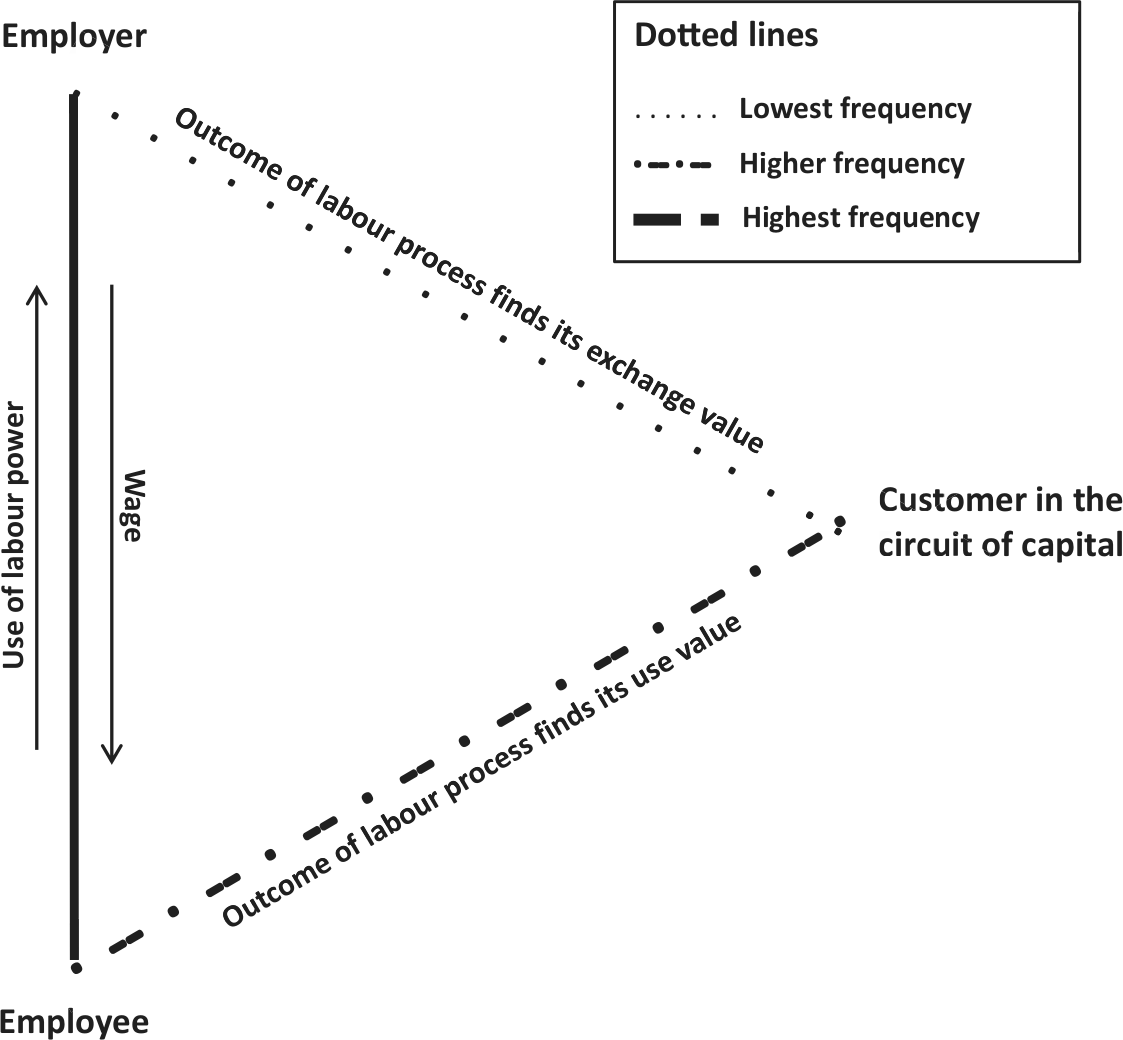
These two spheres are illustrated in Figures 1 and 2, with the labour process presented on the vertical axis and its outcome represented by distinct linkages to external economic agents. The figures are indicative of how employees see these connections, that is, how they appear at the phenomenal level. The two figures are meant to be studied concurrently in order to indicate a contrast between connections that are more obscured in manufacturing (hence the dotted lines with lower frequencies in Figure 1), as opposed to connections that are revealed to a greater extent, albeit never to a full extent, in front-line service work (Figure 2).
Employment relationship in manufacturing.

Employment relationship in front-line service work.
For manufacturing, the movements through which the product of the labour process finds its exchange value in the broader circuit of capital are illustrated in Figure 1. Burawoy was able to define the ‘essence of the capitalist labor process’ as ‘the simultaneous obscuring and securing of surplus value’ (1979: 30). Asking questions about the ‘mystification’ of unpaid labour under capitalism (Burawoy, 1979, 2012), he finds most of the answers in the labour process itself. There the origins of profit are ‘concealed in a number of ways’, not least the setting of wages. He points out that, for workers, ‘what they produce is but a fraction of a useful object that they may never even see. Nevertheless, the process of production appears to workers as a labor process, that is, as the production of things ― use value ― rather than the production of exchange value’ (1979: 28, emphasis added). Indeed, while the worker appreciates that something useful is being created and allows the firm to stay in business, the complex process by which this product finds its exchange value in markets, through value chains, is hidden by the very nature of capitalism. The globalization of value chains has subsequently made the production of surplus value even more obscure. Hence the dotted lines with the lowest frequency for illustrating exchange value in manufacturing.
As pointed out by Burawoy, manufacturing workers appreciate to some extent the use value of what they produce (Collinson, 1992). Workers take pride in their craft and the quality of their work and it is often in order to preserve the integrity of their skills that they contest management’s ways of organizing production (Hodson, 2001). Indeed, the creation of use value is one of the key underpinnings of employee resistance (Bélanger and Thuderoz, 2010: 145–6; Edwards, 2010: 33). This is illustrated in Figure 1: the dotted lines for use value have a higher frequency than those relating to exchange value.
Attention is now turned to front-line service work. The contrast between manufacturing and FLSW has to do with the ways in which the employer and the employee relate with external economic agents. Both exchange and use value are more revealed than in manufacturing. Figure 2 on FLSW illustrates this with dotted lines of higher frequency (than manufacturing) regarding exchange value and those of the highest frequency for use value.
In services, in general, the outcome of the labour process finds its exchange value through a set of connections that are less extended than in manufacturing. Hence, in Figure 2, exchange value in FLSW is illustrated by dotted lines that have higher frequency than those for exchange value in manufacturing. However, these dotted lines (exchange value in FLSW) have a lower frequency than those portraying use value for front-line employees. This reflects the fact that this process of exchange is still obscure to a considerable degree. When interacting with a customer, the service worker often deals with a specific matter, as part of a labour process that is only one part of a larger organization.
The main contrast highlighted by this conceptual model concerns how the outcome of the labour process finds its use value in FLSW. The activity of workers is, by definition, aimed at providing a service to a person with whom they interact directly. The fact of doing something useful for this individual customer or service recipient, either as part of a short encounter or a more extended relationship, is made open and use value is revealed. Hence the dotted lines of the highest frequency (in Figure 2). Indeed, one of the recurrent findings of research on FLSW is the emphasis on the part of employees on helping customers as individuals, in spite of working conditions that are often demanding. This is obviously experienced differently in different segments of service work, a point which is elaborated on in the following section.
A key point is that the contribution of the front-line employee to the labour process and the creation of use value appear at the same time. But these two steps can nevertheless be distinguished analytically; and such a distinction is useful in at least two ways. First, it shows a contrast with manufacturing, where these two stages are seen as distinct because the product only finds its use value through the broader circuit of capital. This is not a fundamental change in the way capitalism operates but it certainly represents a distinctive feature. Second, this distinction explains why some authors, as noted above, see the customers as co-producers of the service. Because the two processes occur at the same time, they are seen as a single phenomenon. The analytical distinction brought here helps go beyond this confusion between the employee as producer and a service recipient, who have distinct positions and distinct roles in the structure of the relationship.
These key features of the employment relationship are not exclusive to front-line service work. They also apply, in theory in a less salient degree, for a much larger segment of service employees who are not in direct contact with customers but nevertheless feel the constraints their organization is facing in meeting the demands of customers or the needs and requirements of citizens, as in the public sector. Such a dynamic is shown eloquently by Sherman from her ethnography of luxury hotel workers (2007). She explains how housekeeping and room service employees are influenced by customer desires and high expectations although they have minimal interaction with them (Sherman, 2011). Back-office workers may be subjected, albeit in an indirect way, to the logic and discourse of ‘customer needs’, a point stressed by Ó Riain (2010) in a study of software developers. In short, while the focus here is on front-line workers, this conceptual model has some relevance for other categories of employment in services more generally.
An alternative classification of workplace regimes
The second level of analysis aims at showing that the founding principles of the employment relationship under capitalism go beyond the differences noted above. A classification is proposed that encompasses both FLSW and manufacturing and suggests an alternative way to establish analytical distinctions between workplace regimes.
Several studies stress that FLSWs have positive relationships with their clients, the classic case being personal care workers. But there are degrees of such engagement. It is also the case that the production of exchange value will be rationalized to varying degrees. Table 1 outlines some patterns. The horizontal dimension identifies the extent to which the production of exchange value is rationalized. Such rationalization is a tendency in capitalism, but it can be counteracted by other forces and it will thus exist to varying degrees. The vertical dimension indicates how directly workers are engaged in the generation of use values for customers. FLSWs will certainly tend to congregate in certain places, but it is not the fact of being a FLSW that is decisive.
Classification of workplace regimes.

The most straightforward case is highly rationalized production systems where the worker has little engagement with customers on a continuing basis (Cell 1). Call centres and fast food production, and much of manufacturing, would fall here. There will of course be variations. Thus call centre research finds that some customer service representatives can achieve a degree of rapport with clients and that is discussed below. But such space is relatively constricted. One could readily turn the categories used here into dimensions by addressing the degree of engagement with use values in any specific case. A degree of engagement with customers is also not impossible in manufacturing.
The opposite situation (Cell 4), of high engagement with customers and low rationalization, characterizes traditional personal care work, where the employer is absent from the delivery of the service and service delivery targets are loosely defined. Some restaurant work has also been placed here. For example, situations where restaurants have a regular clientele and where personal relationships are likely to evolve. Such relationships may be particularly likely where a restaurant serves a group defined by ethnicity or familial ties with the owner, or both.
Care work is, however, subject to rationalization and monitoring in terms of service standards, the number of clients served per day and so on. This pushes such work more towards Cell 3. This is the case for nursing work in large organizations, as discussed below. Some professional services have also been placed here. An example might be consultants who work under rationalized production systems such as measured billable hours but who also develop some long-term relationships with clients.
Finally, Cell 2 captures cases of low rationalization and low engagement with customer use values. Small restaurants are often non-rationalized but they also deal with a passing clientele. Such cases would fit here, in contrast to those in Cell 4. A refinement of this idea would recognize that there may be differentiation by the individual client. Thus some clients may be regulars with whom waiting staff develop long-term relationships of a Cell 2 kind, while others are handled more anonymously. This cell also embraces the situation of non-rationalized production in small manufacturing firms (Edwards et al., 2009).
The operation of this classification is now illustrated using two examples of FLSW: call centre employees and nurses. Call centre employees and nurses are two key occupational groups that have received much attention in the research literature. They have contrasting features that are useful for illustrating how this classification operates.
Call centre employees (Cell 1)
Work in call centres is intensive and routinized and highly conditioned by a technology that allows for close monitoring by management (Callaghan and Thompson, 2001; Taylor et al., 2002). Russell (2009: 107–8) observes that what is striking in call centres in comparison to industrial work is not so much work intensity as the ‘relentlessness’ of the process, in that the operators, once ‘rostered onto the phones’, have little control over work flows, from call to call. This feature was portrayed by Taylor and Bain as ‘an assembly line in the head’ (1999).
But call centres do not rely only on technical control. The key is the complementarity between modes of technical, bureaucratic and normative control. Hence Callaghan and Thompson (2001) explain the development of bureaucratic control through the standardization of data on a set of attitudes and behaviour expected from call centre customer service representatives (CSRs). The demanding objective of inducing CSRs to please customers and sell by using a highly standardized production system is also supported by variants of normative and ‘neo-normative control’ (Fleming and Sturdy, 2011; Sturdy et al., 2010). Such forms of management control lead to some resistance (Mulholland, 2004; Russell, 2009: chapter 8) but, overall, these forms of opposition are relatively contained when compared to manufacturing in particular. However, there is much evidence that the control systems discussed here breed cynicism (Fleming and Spicer, 2007). Taylor and Bain (2003) also show how humour can have a subversive character in call centres, by fostering countercultures and social cohesiveness.
Call centre work is located in Cell 1 and the very high extent of rationalization of production has been stressed. It is also important to account for the other dimension, that is engagement in use value generation with customers. There is much empirical evidence that CSRs do find relief and satisfaction in ensuring the quality and usefulness of services to customers. This is use value from their perspective. Indeed, there are many situations where CSRs take sides with customers against their management in order to preserve quality. Russell (2009) analyses such a case in the context of the introduction of new software designed to improve customer service in a large energy distribution company in Australia. In spite of its promises, the new software actually led to a degradation of services and to the weakening of the CSRs’ discretion when interacting with customers. He documents how the employees invented ‘work-arounds’ and shared among themselves ways of ‘lying to the computer’ and ‘outwitting the machine’ (Russell, 2009: 156–8). Their resistance was driven by the frustration of not being able to support customers efficiently (Russell, 2009: 161).
In a sense, management and the employees agree with the objective of helping customers. But the real issues are, first, what is meant by that and, second, the capacity for CSRs to do so in a way they would see as acceptable. On the first point, Korczynski et al. bring a key distinction between contrasting conceptions of the customer: management, driven by efficiency requirements, wanted CSRs to relate to a disembodied concept of the customer. CSRs, for whom a central satisfying aspect of the job involved helping specific customers, preferred to identify with embodied customers. (2000: 684)
The rhetoric of management is about customer empathy and they seek to recruit employees with these attitudes and social competencies (Callaghan and Thompson, 2002). The second point is about the contrast between rhetoric and reality. Empirical studies show that in practice the employees can only help customers within severe constraints; they have to give priority to time limits, sales and quantity over quality. There is awareness of this contradiction on the part of employees and it generates much tension and frustration (e.g. Callaghan and Thompson, 2002: 247–50).
But some of those customers the CSRs want to help can be difficult too. Empirical studies stress that they want ‘value for money’ and often do not resist expressing emotions and frustration, also aware that, in many sectors, the competition between firms is intense. A survey in call centres in Australia confirms qualitative studies in establishing the link between customer interactions and emotional exhaustion (Deery et al., 2002). A key factor is that customers are sometimes abusive because they talk briefly to a person they do not (and will never) see. As observed by Taylor and Bain, ‘work consists of an uninterrupted and endless sequence of similar conversations with customers she never meets’ (1999: 115).
Hence, to a large extent, CSRs are caught between the pressure and constraints from management and from the service encounter. The rationalization of production and the emotions that stem from the interaction with the customer (who wants better value, good service and efficiency) are related in many ways.
This connection between managerial control and customer control is also exemplified by the use of customers’ reports. The contribution of Fuller and Smith (1991) was to uncover the many practices by which management proceeds to gain such feedback, one of these being the use of ‘mystery shoppers’. In call centres, technology obviously makes the use of mystery callers readily available. Indeed, there is evidence that many firms are subcontracting with other firms to provide such service for the purpose of evaluating the work of CSRs. For instance, Doellgast explains that since such forms of surveillance are regulated by works agreements in Germany, some firms hire other companies to perform ‘mystery calls’ for them (Doellgast, 2012: 5, 78–81).
Nursing work (Cell 3)
Nursing work is pertinent for establishing the contrast and also the similarities with CSRs on the aspects being studied here. The research literature pays much attention to the professional autonomy and the high level of medical skills and social competencies demanded from nurses. There have been significant efforts at rationalization of production, at least in the large organizations under focus here, but the engagement of nurses in use value production is obviously different from that of CSRs. Hence the location of nursing work in Cell 3. In that much of this work is within the public sector, it may be objected that there is no use value in the classic sense. However, there is much evidence that budgetary constraints and the rhetoric of rationalization and consumerism are predominant; the need for efficiency is no different in kind from that in a private sector organization.
The policies and programmes of rationalization implemented in the NHS over the last decades are well documented. While there is a broad consensus in sociological research on work intensification among nurses (Ackroyd and Bolton, 1999; Adams et al., 2000; Cooke, 2006a), there are debates on managerial intents as regards the control of nursing work. The idea of Taylorism is frequently mentioned. However, unless the meaning of ‘scientific management’ is stretched beyond usefulness, field studies show a more complex picture.
A rich insight is provided by Cooke’s study in three hospitals in the north of England. The workloads of nurses had expanded with the addition of routine medical and managerial tasks under a discourse of ‘empowerment’ (Cooke, 2006a). Managers were distant from the wards but also showed distrust, a defensive culture and attention to details; this is portrayed as ‘seagull management’. They were asking for more documentation and ‘paper trails’ on nurses’ interventions, in fear of patients’ complaints and litigation. Indeed, patients’ complaints were the most common reason leading to formal disciplinary action against nurses (Cooke, 2006b: 698–9). The author explains that the pressure felt in the wards was much influenced by the ‘customer care’ discourse that was heightening the expectations of patients. This pressure was obviously felt by managers as well. Indeed, strained relationships between nurses and managers reflected the conflicting pressures felt by both parties. Nurses felt torn between their responsibilities to their patients and the demands of managers. (Cooke, 2006a: 232)
From a longitudinal study in an NHS hospital, Ackroyd and Bolton (1999) report on the intensification of the work of nurses, mostly as a result of a major increase in the number of patients. It follows that patients stayed in hospital for shorter periods, which increased their vulnerability and needs for care. Nurses were ‘caught […] in a vicious crossfire of competing demands’ (1999: 384). Other studies also reveal an increase in the workloads of nurses (McBride et al., 2005). Considering, however, the professional autonomy of nurses, the fact that patient needs vary and the lack of detailed knowledge of nursing tasks among managers, the authors do not see this approach as Taylorism (Ackroyd and Bolton, 1999; Bolton, 2004). In short, even if managers had the intent of implementing direct control, they could hardly do so.
In further work on this hospital, Bolton provides a rich insight into the rhetoric of ‘patients as customers’ in the NHS, which relates directly to the vertical dimension of Table 1 on use value. Three key points are particularly relevant here. First, the rhetoric of ‘consumer as king’ has raised the expectations of the general public; patients are more demanding and nurses feel it in the wards (Bolton, 2002, 2004: 326–9; Cooke, 2006a: 232). Second, nurses are not only ambivalent but are often torn by these demands because this rhetoric endorsed by management clashes with their professional training and identity, based on a distinct conception of caring for patients’ needs, both physical and emotional (Bolton, 2002, 2004: 326–30). Third, Bolton explains that management relies on customers’ feedback, and especially the complaints system that underlies it, as a mechanism of management control. And again, the link with the notion of customer control elaborated by Fuller and Smith is made explicit (Bolton, 2002: 134). Indeed, ‘nurses have little doubt that they are being “managed by the customer”’ (2002: 136).
Here again, management control and customer control are not only interconnected but also mutually reinforcing. Nurses are torn between the demands of management and customers. Whatever may be their motives and intent, each of these two controlling agents finds much of its power leverage in the role played by the other. And these demands do not fit with what nurses, as professionals, mean by caring for patients.
The case of nurses is useful for illustrating Table 1. The efforts, over the last decades, to rationalize production are obvious and it is striking how many programmes dealing with production management, for instance on quality control and other dimensions of lean production, are applied in health services, with much time lag from their development in manufacturing. However, in contrast with call centres, it is (fortunately) not possible to standardize and routinize nursing work. The main reasons for this have to do with technology, with the distinct nature of each patient’s needs in health care and with the professional knowledge, identity and autonomy of nurses.
Conclusion
This article elaborates a conceptual model to overcome the theoretical limitations discussed in the first section. This model is structured around two levels of analysis, in the third and fourth sections. The first level throws light on the distinctiveness of interactive service work, where both use value and exchange value are less concealed and are seen more openly than in manufacturing. The proximity with an individual whom the employee seeks to serve, to help or to care for, is a distinctive feature of FLSW. The utilization of labour power and the interaction with the customer occur at the same time. But these two dimensions can nevertheless be distinguished analytically, hence stressing the different set of constraints of the employee as a producer under management control and the service recipient.
The second level of analysis builds on these concepts of exchange and use value and looks at how they operate in the labour process. The alternative classification that is developed indicates that the dividing line here is not between manufacturing and services, as different workplace regimes cut across these categories. The cases of CSRs and nurses illustrate that, albeit in very different ways, the employees are torn between the demands of management and those of the customer they seek to help. This throws light on the interconnections between the sphere of management control and the service encounter between the employee and the customer. The rationalization of production and the standardized routines that are analysed in the research literature (the employer-employee axis) and the pressure and emotions that stem from the employee-customer axis should not be dissociated; they are interdependent in many ways. Indeed, to the extent that they are both conditioned by broader market forces, they are often mutually reinforcing.
It is worth indicating briefly how this conceptual model could be useful for understanding other aspects of front-line service work, of which two will be mentioned. First, it offers key conceptual tools for studying the important question of emotional labour. It helps to explain why, overall, emotional labour is more salient in interactive service work. The direct interaction with service recipients makes the use value of labour more manifest, more concrete, revealing how the employee helps or provides care to a human being. Also, employees feel the conflicting demands of management and those of a service recipient they wish they could help more. Such conditions are likely to generate many of the tensions, feelings and emotions that are studied in the rich literature on emotional labour.
A second area of research on which this approach makes a difference is employee resistance. The fact of providing a service to an individual, in the framework of an asymmetric relationship with the employer, is likely to generate frustration and different forms of opposition. This throws light on the ultimate paradox of service work, in comparison with manufacturing: as a general rule, service employees have more objective reasons for resistance but less capacity to do so. On the one hand, the foundations of conflict are made more explicit, as employees see more openly how their contribution to the labour process has both use and exchange value. And very often, the value of this contribution does not show in their conditions of employment. In such a social structure, their relations with customers are likely to create frustration and dissatisfaction. On the other hand, the second part of the paradox is that they have less capacity to resist or oppose. In the main, service workers do not want to act ruthlessly with customers or service recipients to express discontent.
It is hoped that this framework provides a guide to further research. The categorization of workplace regimes (Table 1) is intended to model sources of variation. Research might illustrate and further develop the relevant contrasts between ways in which jobs are structured. It is not the immediate nature of the job, but rather the economic and social relations in which it is located, that is critical.
Footnotes
Acknowledgements
The authors are grateful to the editor and three anonymous referees for their helpful comments.
Funding
This research was supported by the Social Sciences and Humanities Research Council of Canada (SSHRC) and the Fonds québécois de recherche sur la société et la culture (FQRSC).