



Abstract
This article explores the types of work undertaken by jazz musicians in London, categorizing their activities using two axes derived from debates over ‘creative labour’. Firstly, the extent to which different jobs offer scope for creative autonomy and, secondly, the extent to which they involve collective as opposed to individualized working relationships. It focuses on the process of becoming established on the London ‘scene’, presenting qualitative interview data primarily with young workers seeking to build their careers. Musicians may make conscious decisions to pursue types of work which enable greater creative autonomy, but in doing so they may exacerbate fatalism about poor working conditions and undermine professional solidarity. The article also explores how pressures towards ‘entrepreneurialism’ in other forms of music work constitute further barriers to collective contestation of working conditions. Finally, it points towards types of music work where notions of professional economic interest have more traction.
Introduction
Musicians’ working lives have not yet attracted substantial scholarship within the field of work and employment, generally having being encompassed under the overlapping categories of creative labour (McGuigan, 2010; Smith and McKinlay, 2009a) or cultural work (Banks, 2007; Gill and Pratt, 2008). Recent exceptions notwithstanding (Coulson, 2012), musicians’ work is assumed to present similar issues to other ‘creative’ occupations like theatre or screen production. This is unsurprising, as many characteristics of creative work – tensions between artistic and economic goals; informal project-oriented employment; the importance of networking; overcrowded labour markets and a youthful workforce (Banks and Hesmondhalgh, 2009: 420; Blair, 2001; Gibson, 2003; Gill and Pratt, 2008; Haunschild and Eikhof, 2009; McRobbie, 2002; Ursell, 2000) – also apply to music. Musicians, however, constitute a distinctive and important study. Their careers are organized in particularly complex ways, with elastic amounts of more stable employment (i.e. teaching) helping to subsidize diverse and informal playing work (Hesmondhalgh and Baker, 2010). The transient and informal constitution of jazz projects in particular, combined with the often esoteric and personal nature of jazz itself, mean that important labour process debates over control and autonomy are strikingly amplified for jazz musicians.
This article presents qualitative data exploring the working lives of jazz musicians in London, focusing on recent labour market entrants. In this sense, it fulfils a need for more detailed descriptions of the creative labour process itself (Smith and McKinlay, 2009a). Its primary contribution is a two-by-two typology mapping the varied work activities undertaken by interviewees. This typology reflects two key themes of the creative labour debate. Firstly, the extent to which jobs allow for creative self-expression. Secondly, the degree to which jobs engender collective or individualized working environments. Where recent scholarship highlights the prevalence of communitarian, non-utilitarian interaction between musicians (Coulson, 2012), it is important to recognize that deliberate distancing from creatively constraining jobs can also exacerbate fatalism over working conditions and bolster ‘status’ competition. Likewise, pressure towards ‘entrepreneurialism’ among musicians also undermines possibilities for collective solidarity. The article first reviews broader debates on creative work and then looks at music work in greater detail. Following a note on methodology, the article explains its typology.
Creative labour and music
Key issues in creative work
Creative work’s value as a growth engine in post-industrial economies is debated (Florida, 2002; Garnham, 2005; Pratt, 2008), but its normalization as a career path (Banks and Hesmondhalgh, 2009) makes it an important field for employment scholars. Hence, while influential writers (e.g. Bourdieu, 1984) have famously explored the connections between artistic judgements and social hierarchy, the focus here concerns the work experiences of young people pursuing music careers. Consequently, the starting point is more recent labour process debates over ‘creative labour’. Smith and McKinlay (2009a) highlight the definitional problems raised by this terminology. The borders of ‘creative’ work are inevitably hazy, as no job can be said to be wholly ‘uncreative’. Creative labour is distinctive partly because workers in jobs such as music, theatre or television are relatively ‘more involved in conceptual and operational elements of work’ (Smith and McKinlay, 2009b: 33) than others. Following this, it is clear why creative work should attract the interest of labour process researchers. Engaging in creative work may be construed as a rejection of the separation of conception and execution that, for Braverman (1974), epitomized the subordination of the worker under capitalism (McGuigan, 2010). Moreover, creative labourers might anticipate greater opportunities for creative satisfaction through work (Gill and Pratt, 2008).
Therefore despite the inevitable lack of clear boundaries to ‘creative labour’, Smith and McKinlay’s work is important because it centres analysis on the classic labour process theme of control. This theme takes on a particular form in ‘creative’ occupations, where the often esoteric objectives of the worker conflict with the business priorities imposed by ‘suits’ (Thompson et al., 2009). Thus, a defining characteristic of creative labour is this inherent tension between artistic and commercial logics (Haunschild and Eikhof, 2009). Even jazz musicians, seen by Smith and McKinlay (2009b) as the ultimate creative workers, encounter settings in which artistic autonomy is tightly constrained, as the data will show. This research therefore illustrates the impossibility of precisely delineating a ‘creative labour process’, but suggests that the heterogeneous labour processes encountered by creative labourers are best analysed in terms of the conflict between creative autonomy and business imperatives entailed within them.
Therefore the first question that a labour process-inspired analysis must ask of creative labour is the extent to which it enables participants to pursue their own artistic objectives. Critical scholarship has suggested that ‘entrepreneurial’ discourses may encroach on creative work (Banks, 2007; Gill and Pratt, 2008; McGuigan, 2010) and consequently undermine scope for self-expression (Banks and Hesmondhalgh, 2009). Moreover, even where creative labourers themselves retain substantial control over their output, resources and distributive channels may be controlled by ‘suits’ (Thompson et al., 2009). Economic imperatives may also threaten the ‘transgressive’ desire for collaborative and meaningful working relationships (Fenwick, 2002) found among creative workers (Coulson, 2012). Wittel’s (2001) idea of ‘network sociality’, defined as the subordination of workplace community to business-oriented interpersonal encounters, is epitomized by creative industry hallmarks like networking events, which catalyse the instrumentalization of artistic scenes as business networks (McRobbie, 2002).
Even assuming creative occupations do enable artistic expression at work, this could indicate individualized distancing from tightly controlled work conditions rather than contestation of them; a ‘utopian’ bypassing of the nine to five grind (McRobbie, 2002). Hence a second question labour process scholars may ask of creative labour concerns the prospects for collectively contesting the terms of work. The proliferation of youthful labour market entrants in creative sectors (Gibson, 2003) produces a perpetual oversupply of labour, meaning that working for low pay, or for free, is common (Banks and Hesmondhalgh, 2009). The need to subsidize periods of low paid activity explains the often middle-class demographics of the creative workforce (Smith and McKinlay, 2009a). Thus, the bohemian appeal of creative work as a means of evading the capitalist labour process contributes to undermining the labour market strength required for collective contestation of its terms.
The centrality of networking to creative work has been widely discussed (Antcliff et al., 2007; Blair, 2001) and this contributes to normalizing low paid work. The creative ‘economy of favours’ (Ursell, 2000: 813) provides incentives to take jobs beyond monetary remuneration. This, combined with the short-term, informal nature of jobs, impedes the development of a ‘workplace politics’ (McRobbie, 2002) that could enable collective discourse around working conditions. Union representation typically assumes a servicing form, supporting members’ positions in external labour markets through insurance provision rather than regulating relations with specific employers (Heery et al., 2004; Saundry et al., 2007). Moreover, creative labourers often lack awareness of collectivist innovations such as minimum rates for jobs (Hesmondhalgh and Baker, 2010). Fatalism about conditions is therefore common among creative workers (Banks and Hesmondhalgh, 2009). A final barrier to solidarity in creative work is the rewards that accrue to individuals gaining prestige in particular scenes (Ursell, 2000). In jazz, the financial scale of such rewards is relatively modest but, as shown below, they remain important for earning potential and status.
Here, the topic of creative labour was introduced by highlighting two general questions: the extent to which it enables creative autonomy and the extent to which it enables collective interaction at work. While much of the literature is sceptical about these prospects, Coulson (2012) has argued that in the specific case of musicians this pessimism must be countered, pointing to the endurance of communitarian and non-instrumental relationships in music. This suggestion is the starting point for the next section, which looks at musicians’ work more specifically.
Community among musicians
Given the informal nature of employment and propensity for musicians to drift in and out of the labour market, concrete employment statistics are limited. Nonetheless, recent Musicians’ Union (MU) research offers some revealing findings. Most pertinently, the union posits a striking imbalance between musicians’ education levels (finding that 61% are university- or conservatoire-educated) and earnings outcomes. The majority of musicians earn less than £20,000 p.a. and 60 per cent of survey respondents reported working for free (Musicians’ Union, 2012). While low pay and exploitative working conditions might therefore be inferred, qualitative data are needed in order to better understand musicians’ work. Coulson’s (2012) study of musicians in Northern England is the strongest recent example. Coulson seeks to counter more pessimistic accounts by highlighting the non-utilitarian sense of community that endures among musicians. For Coulson, musicians are ‘accidental entrepreneurs’ who do not initiate careers through business drive and who therefore continue to exhibit non-entrepreneurial behaviour. For example, while low fees might be construed as exploitative, Coulson suggests they can also reflect musicians’ desire to collaborate on creative projects even where there are limited economic incentives to do so. Thus, Coulson suggests that the music profession’s sense of community, to some extent, counters business hegemony.
Little literature exists concerning the employment sociology of jazz musicians, though the nature of the music provides interesting resonances for the study of work. The typical jazz ensemble is a quartet or quintet featuring three ‘rhythm’ instruments (drums, bass, piano or guitar) and one or two ‘frontline’ instruments (commonly saxophone, trumpet or trombone). Ordinarily, in jazz performances band members take turns to perform improvised solos which are often highly virtuosic. Simultaneously, the rest of the band collectively improvises an accompaniment. Thus, jazz performances embody both close group collaboration and intense individual showmanship. Their improvisatory character and small group dynamics also mean creative projects are often spontaneous and inspired by deeply personal artistic visions. Because of limited work opportunities for ‘creative’ music, jazz musicians usually branch into a wider range of performance settings (Pinheiro and Dowd, 2009). Most commonly this means ‘function’ work; for example, performing at weddings or corporate events. Here, ensembles may feature a larger array of ‘frontline’ instruments, but the scope for improvisation is subordinated to the need for professional renditions of well known standards and the skills required are refocused on sight-reading and sectional accuracy. This heterogeneity also extends to the structuring of work relationships. As will be shown by the data, musicians encounter a diverse array of roles ranging from employee to freelance contractor. However, while labour process analysis is traditionally focused primarily on the wage relationship, it will be suggested that its central tension between creative objectives and business imperatives shapes musicians’ trajectories through all of these settings.
Stebbins’s (1968) theorization of the ‘jazz community’ is somewhat dated, but his analysis of cliques and the ‘jazz job’ highlight the practical implications of the characteristics described above. Stebbins viewed jazz musicians as a status group based around mutual esteem rather than economic interest. Cliques, for Stebbins, provided internal hierarchy within the jazz scene and tended to be related to instrumental capability rather than economic success. Consequently, social ordering was worked out primarily through jam sessions, which could assume an intensely competitive character. Jams might therefore evoke Wittel’s (2001) ‘network sociality’ insofar as they may constitute a faux community masking individual rivalries. In Stebbins’s view, however, these rivalries are not related to economic instrumentalism, but rather musical prestige. Indeed, Stebbins argues that jazz musicians may assess the desirability of work according to the degree of freedom from commercial demands afforded by individual jobs. Consequently, Stebbins observes that institutions like trade unions may align uneasily with jazz musicians’ own priorities, because in their pursuit of work the qualitative criterion of creative autonomy competes for importance with quantitative remuneration.
Coulson (2012) and Stebbins (1968) both reveal the importance of non-instrumental interaction among musicians. Stebbins’s account, however, highlights how this interaction provides grounds not just for community, but also for individual rivalry and cliques. Stebbins’s research also shows that the distinction between creative autonomy and economic priorities may consciously inform the decisions jazz musicians make in pursuit of work: an important theme of the research presented here and one which reflects the tension between artistic and commercial logics highlighted in labour process debates. The next sections will show that jazz musicians encounter heterogeneous labour processes and that the degrees of creative autonomy and the nature of collective interaction engendered differ greatly in these settings. They also show how the pursuit of creative autonomy is critical to understanding musicians’ experiences within this variegated work environment.
Methods
The primary research instrument here involved qualitative interviews with London jazz musicians, supplemented with observations. The geographical focus on London proved advantageous. Almost all participants considered relocating to London a critical career step, believing it to offer a more vibrant creative scene than elsewhere in the UK. Therefore, emphasis was placed on participants who had migrated to London from elsewhere to build music careers. This ‘critical life event’ (Gardiner et al., 2009) constituted a focal point for biographical interviews exploring respondents’ experiences as they sought to establish themselves.
One-to-one interviews with 30 musicians were conducted between January and December 2012. Two contacts provided starting points for snowball sampling, both in their late 20s and both having recently moved to London. The great majority of participants fell into the 25–35 age range, with three above (late 30s or early 40s) and one below (early 20s). This relative youth contrasts with Coulson’s (2012) sample, whose modal age range was 50–59. This factor was consciously embraced, enabling sharper focus on the activities and choices involved in establishing a career. Participants’ decisions when pursuing work and the tension between hopes and working reality could be depicted more vividly. ‘Peripheral’ activity, in particular, is dominated by recent scene entrants. All interviewees were instrumentalists on bass, drums, guitar, piano, saxophone, trumpet, or trombone. All participants had backgrounds in jazz, though most had diversified to differing extents in pursuit of work. Five participants had left London after periods working there and their inclusion enabled further reflection on the difficulties of this career move. One notable limitation is the comparative lack of female participants (four) which reflects recognized gender imbalances in jazz (Heckathorn and Jeffri, 2001; MacDonald and Wilson, 2005). This imbalance represents an important topic for future study, but one which lies beyond the scope of this article.
Most interviews were recorded discussions lasting between one and two hours, fully transcribed and manually coded. Where interviewees had left London, or where touring commitments prevented face-to-face contact, telephone interviews were used. Interviews prompted respondents to describe their experiences of working life, career developments as they became more ‘established’ on the London scene and reflections on creativity and community in music. In addition, 14 participants were available for follow-up interviews, which were used to bring accounts up to date and to address further issues that emerged over the course of the investigation.
Seven observation sessions took place: a public jam attended by two participants (November 2011); a bar jazz gig at which three participants performed (January 2012); a self-organized ‘door money’ event attended by one participant (February 2012); a private jam organized by three participants (April 2012); a jazz performance at which one participant performed (August 2012a); a public jam attended by two participants (August 2012b); and a small bar performance undertaken for promotional purposes by a band featuring two participants (October 2012). These observations strengthened first-hand descriptions of experiences such as jams and small-scale jazz performances and provided discussion points for interviews.
Work, creative autonomy and collective interaction among jazz musicians
Figure 1 represents four types of activity undertaken by participants, divided by axes which reflect key themes discussed above. Firstly, the extent to which activity affords creative autonomy. Secondly, the extent to which activity engenders collective interaction. Different types of activity connect with different orientations along these axes. One obvious question is that of causation. Were orientations towards creative autonomy and collective interaction a consequence of the jobs undertaken, or vice versa? Power relations within the labour process shaped opportunities for self-expression and collective interaction. However, particularly given the early career stages of most research participants, interviewees also exercised some degree of choice over the work they pursued, primarily via the contacts they cultivated most diligently. Where musicians did seek work with more creative autonomy, this often reflected a conscious self-distancing from seemingly more creatively constricting jobs, which might have had the unintended consequence of exacerbating exploitation.
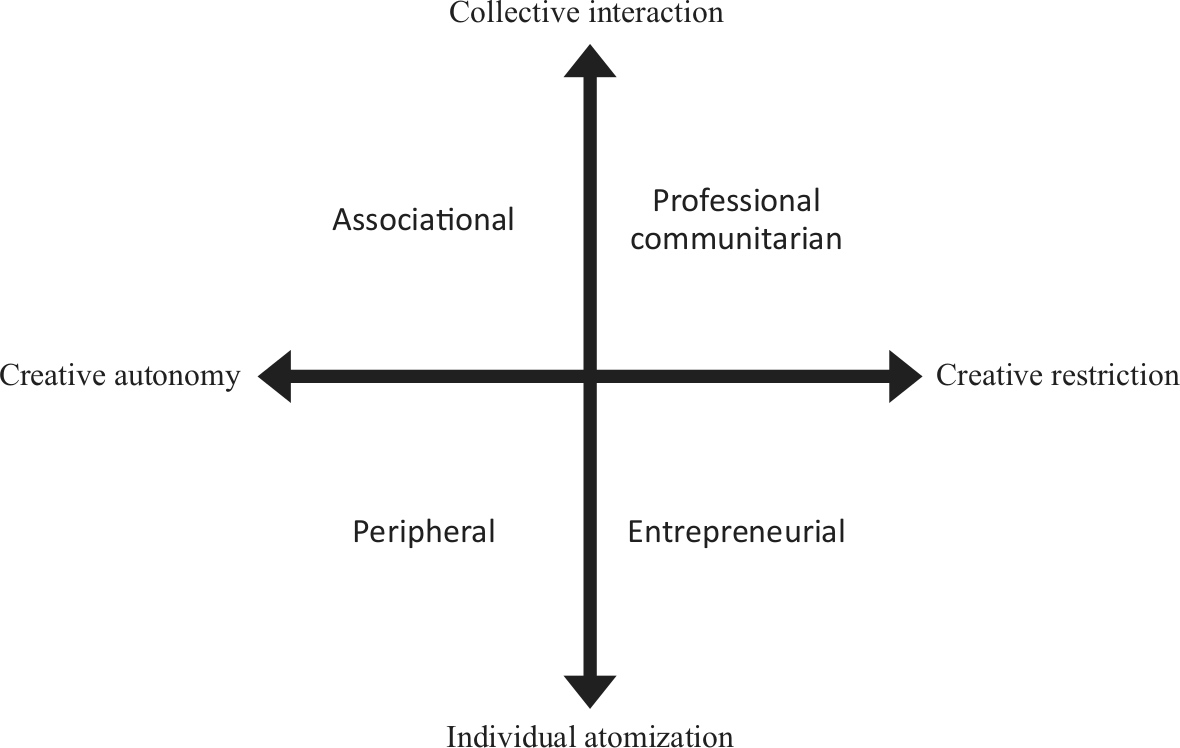
Categories of activity undertaken by research participants.
Because participants undertook complex combinations of jobs, individuals could not be rigidly inserted into different quadrants. However, as participants came to prioritize certain jobs over others, particular pathways could be discerned. Figure 2 highlights five participants whose trajectories were broadly representative. In what follows, the reasons why participants may have followed particular directions will be discussed, emphasizing how the pursuit of greater creative autonomy led some musicians down different routes to others. In particular, note Oliver’s line, the directional shift of which indicates the likely connections between ‘associational’ and ‘entrepreneurial’ activity which are explored in greater detail below. The article avoids discussion of activities such as session work, which are generally undertaken by established professionals rather than recent entrants seeking to build careers.
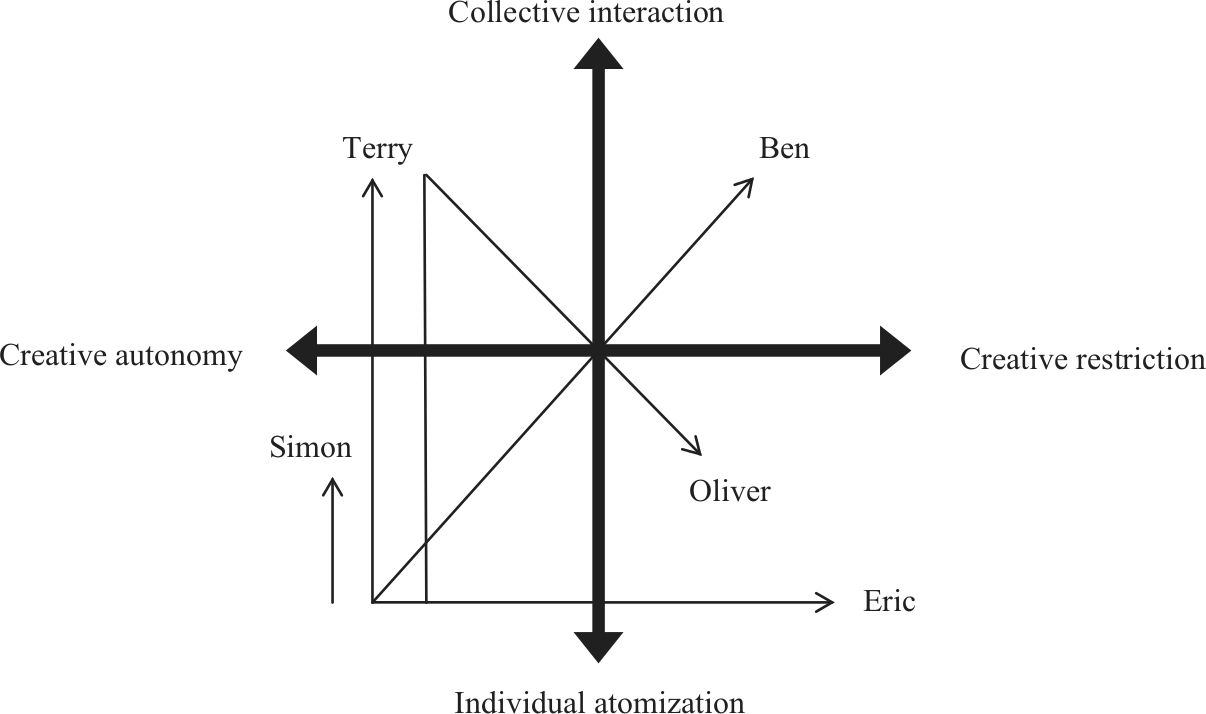
Examples of participant trajectories.
Peripheral activity
‘Peripheral’ activity was often a starting point for new scene entrants. Typically, new arrivals had to build contacts through attending performances or jam sessions. There were many regular jams around London, serving primarily as community hangouts, but the environment created could be highly competitive. Usually, a house band invited individuals to join them for certain songs, potentially involving several front-line players, each taking improvised solos in front of an audience of peers (observations: November 2011; August 2012b). Jams thus required a specific skill set (a pyrotechnic vocabulary of solo ‘lines’) distinct from ‘jobbing’ attributes such as sight-reading and sectional accuracy. Individuals might guide repertoire towards their own favourite tunes, thus dominating the stage (Harry, 26, trumpet). As Mark (27, drums) argued, the environment could therefore be ‘aggressive [with performers] calling tunes that you know people don’t know, so you sound really good and they sound shit … You end up really not liking the people that you’re playing with and you come away feeling rubbish’ (Mark, 27, drums).
For these reasons, interviewees were observed preferring to arrange private playing sessions with a closer-knit network of collaborators (April 2012). A critical attraction of studying at the elite London music colleges was a ready-made circle of acquaintances, lessening the need to pursue this kind of activity. This last point also meant that jams might be cliquish, with certain nights or venues being dominated by students or graduates from certain music colleges, as was particularly evident at one event attended in South London (November 2011). Interviewees might also have experienced snobbishness towards those educated outside London (Patrick, 26, guitar).
As contacts formed, entrants might join others on paid employment. The most basic engagements for jazz musicians involved playing background music in bars or restaurants, which was low paid and precarious work. They might be one-off performances or regular residencies, arranged verbally with venue managers. One interviewee (Simon, 28, guitar), shortly after moving to London, was undertaking two or three such performances weekly as his main paid activity, typically receiving £30 to £60 per evening. Fees were often bolstered by payments in kind, but these arrangements were changeable. Stephen (28, bass), referred to one such agreement: [The bar] would pay us some money and they would feed us as well. And it was fine, the first two weeks. And then week three they refused to feed us. That manager was away for Easter … And then another manager came up to us and said ‘We’re not going to feed you any more’ … Well, that’s fine, but it’s not really what we had agreed.
Musicians expected these kinds of encounters. Owners reneging on cash remuneration were less common. Mark (27, drums) had played a bar gig where the corresponding manager had been absent on the night and then claimed that the performance had never taken place; a farcical incident resolved by appealing to the testimony of on-duty staff. Residencies were subject to short-notice cancellation and musicians were often resigned to the whittling down of prices: ‘I’ve come to expect it … If you don’t take it you won’t work that week’ (Simon, 28, guitar).
The downwards pressure on fees partly reflected labour oversupply but there was also a positive incentive to take such work even where remuneration was poor. These engagements enabled musicians to create new contacts in a more controlled way than through jams. Where musicians obtained regular residencies they acquired the ability to control opportunities for other people, giving slots to different musicians each time (Connor, 33, guitar; Stephen, 28, bass). This process involved dual motivations. Being the key contact on a residency served an instrumental purpose in the musicians’ ‘economy of favours’. However, interviewees also testified how this expansion of economic opportunity coexisted with a desire to further creative interaction within an expanded pool of collaborators (Connor, 33, guitar; Harry, 26, trumpet) which for many interviewees was a primary reason for the move to London in the first place. While this speaks to an enduring non-instrumentalism among musicians which was to some extent compatible with economic imperatives, the above discussion of jams shows that this did not necessarily equate to communitarian solidarity. Though interactions in these environments were not purely, or even mainly, economically driven, status-seeking or cliquish behaviour might still be incubated. These characteristics resurface in the discussion of associational activity below.
Importantly, peripheral work was not merely a starting point. Its positive attraction for many interviewees was rooted in the desire for creative autonomy. Because venue owners generally had few specific expectations of performers playing background music, the criteria on these engagements loosened. One participant described them as like a ‘paid rehearsal’ (Mark, 27, drums) in which musicians could exert control over how they played. Evoking Stebbins’s (1968) discussion of the ‘jazz job’, peripheral engagements might therefore be seen as allowing greater freedom for self-expression than better paid function work. This attraction, however, exacerbated labour market oversupply and rendered musicians more tolerant of poor working conditions. This fatalism was commonplace on the periphery. The small sums of money involved reinforced the idea that terms were hardly worth contesting: ‘When the gig fees are so pitiful, why would you waste your time even writing an email to dispute it?’ (Eric, 28, saxophone). Instead, interviewees managed peripheral instability by seeking out teaching work wherever possible. Exploitation and unpredictability was thus an inevitability that should be compensated for rather than countered: ‘Just [gig] at your own risk. If you get ripped off … then you just don’t do a gig with that guy again… That’s the experience’ (Bryan, 28, bass).
In summary, peripheral activity was precarious and poorly remunerated work, about which musicians were generally fatalistic. The MU had little relevance on the periphery, beyond provision of discounted insurance. Participants rarely, if ever, consulted union-devised fee guidelines or venue blacklists. More informally, one example was uncovered of musicians using Facebook to publicly attack a bar which had reneged on payments. The venue was forced to acknowledge its debts to the musicians, but a musicians’ boycott of the venue was expected to remain strong (Richard, 29, drums). This, however, appeared to be a relatively rare example, in which social media accelerated, rather than qualitatively altered, the long-running strategy for dealing with bad ‘peripheral’ employers – simply not working with them again. Peripheral work served an important purpose in developing contacts, but it also retained a positive appeal because it afforded a degree of creative autonomy absent from many other engagements. Simon (28, guitar – see Figure 2) had been in London for four months and, while he was reluctantly taking on some ‘function’ gigs, he was purposefully seeking out contacts for more ‘creative’ jobs. Because, at this stage, his network was limited, he was primarily confined to peripheral activity. Where scene entrants succeeded in establishing collaborative networks, but where they continued to avoid more commercial work, they moved towards ‘associational’ activity.
Associational activity
While peripheral activity provides little means of contesting working conditions, the non-instrumental interactions within it incubate other forms of collective organization. Initial networking activity can develop into ‘scenes’ solidified by common creative aims. Emblematic here are ‘door money’ gigs, where performers reserve venues to showcase events, typically attended by other musicians and friends of the bands playing. Small entry fees are charged and the money split among participants. Such events enable musicians to perform their own original music in front of an engaged, often sympathetic audience (observations: February 2012; August 2012a). These arrangements sometimes solidify into loose ‘collectives’; networks of bands featuring overlapping personnel and staging shared performances.
Terry (31, bass – see Figure 2) had minimized his function work, concentrating on building opportunities to develop his own jazz output (‘keeping my soul alive’). He helped found a London collective which provided venues and audiences for members’ projects, albeit on a small scale. Such activity furthered creative objectives outside commercial economic structures. In this sense, associational activity reflected a pursuit of autonomy and mutual support among creative collaborators: I don’t believe in making money out of other musicians. I’d rather get a gig, in a venue, run a night, put effort into it and take £20 to cover my envelopes and phone bills … than go crawling to an agent and get him to do it for me. (Richard, 29, drums)
Following Stebbins (1968), these developments might also reflect stratification within status groups, engendering cliquishness and rivalry. Creative collectives germinated specific scenes, coalescing around tightly knit groups of musicians which, once established, might not admit others (Theo, 33, bass). While artistic common cause may supersede rivalry between instrumentalists, the cliquishness of jam sessions was reinforced with heightened emphasis on specific localities or venues. Through associational activity, music as a profession fractured into particular scenes defined in aesthetic, social or geographical terms. Associational activity crystallized in the ‘band’ unit, where wider networking became refined to a handful of trusted collaborators, providing refuge from the often demoralizing process of networking.
The social and artistic appeal of performing for sympathetic audiences may override material questions. As one participant referred to a bandmate, ‘He just calls me up and asks if I want to play. I don’t even ask if there’s any money involved’ (observation: August 2012a). Associational activity was therefore often more poorly remunerated than peripheral work. For example, one collective event attended (February 2012) saw band members taking home £4 each. However, successful bands could also form a platform for more entrepreneurial behaviour. The process of staging small, poorly paid events to build a scene parallelled the early stages of a business. As collectives developed they faced dilemmas over formalizing business-imported roles, becoming managers and promoters despite a generally ‘anti-business’ attitude (Theo, 33, bass). Oliver (29, bass) had gained esteem within a particular scene, which had attracted wide commercial interest. This put him, suddenly, in demand as a performer, enabling him to abandon teaching and function work. Instead, he gained several touring commitments in Europe and America, each lasting several months, which provided him with an annual income of at least £30,000. Thus, associational scene development had endowed an individual interviewee with marketable skills and status. This point is developed below.
Associational activity, while prizing collective interaction, obstructed the emergence of professional economic interest for three reasons. Firstly, successful scene-building channelled economic rewards to individuals or small groups. Secondly, it engendered pockets of mutual support defined in aesthetic or social terms. Abstractly, musicians might profess identification with a wider music community, but this community itself is ‘pocketed … there’s lots of little scenes with their own identity’ (Edward, 27, saxophone). Thirdly, like peripheral activity, it represented a distancing from jobs where commercial imperatives constrained collective autonomy, potentially leading musicians to even more poorly paid work. Hypothetically, a role in collective economic advancement might be envisioned for associational activity. For example Alice (30s, saxophone) stressed how collectives could provide work opportunities and cultural development in local areas. Nonetheless, this side was rarely prominent in the data.
Some interviewees criticized the tolerance of poor working conditions in favour of (sardonically stated) ‘artistic integrity’: ‘That jazz attitude of playing with backs to the audience, playing what they want, you can guarantee their parents are worth a bit of money’ (Mark, 27, drums). However, many interviewees consciously pursued ‘creative’ work, often informed by negative experiences of explicitly commercial ‘function’ gigs. Younger interviewees often saw the minimization of such activity as a career aim, hoping to acquire sufficient teaching to enable a selective approach to gigs. The next section considers more explicitly commercial work.
Entrepreneurial activity
‘Function’ gigs – engagements providing music at parties or corporate events – are typically more alienating for musicians but usually better paid. Musicians faced rigid expectations, generally performing soul, swing or pop classics often by rote. ‘You feel a bit like a CD player’ (Mark, 27, drums). Such work was unchallenging and therefore frustrating. One interviewee juxtaposed his countless unpaid daily hours of practice, which he considered part of his job, with his main income source: ‘The function gigs that I do … I could have done those gigs when I was 14’ (Bryan, 28, bass). Some potential for creativity remained. For example, developing innovative arrangements for functions afforded Emily (27, saxophone) scope for self-expression. Nonetheless, the repertoire and playing styles on functions were constricted. One interviewee (Eric, 28, saxophone – see Figure 2) had neglected his artistic development to perfect the administrative role of the ‘fixer’, advertising for functions and developing reserves of potential ‘employee’ musicians: As a musician you’ve got to be an accountant, you’ve got to be a salesman, you’ve got to have a marketing qualification, you’ve got to be able to do funding applications, you’ve got to be articulate, you’ve got to have a good phone voice … having to constantly sell yourself is exhausting … All I do is sit on my computer all day replying to emails, sending emails, catching up on some accounts from last year, hoping that the phone’s going to ring and some gigs will come in. (Eric, 28, saxophone)
Interviewees typically described fees of £150 to £250 for function work. Employment fluctuated, with more engagements over summer and Christmas. Gigs were often organized by an individual band leader who had a relationship with a booking agent and who selected band members individually through personal contacts. Because function gigs generally featured easier material, decisions often reflected the ‘fixer’ view of desirable band mates. One interviewee, for example, lost a regular function engagement because the bandleader had rekindled a romantic relationship with a partner who played his instrument (Richard, 29, drums).
The ‘fixer’ dynamic brought an ill-fitting employment hierarchy to the organization of music work. Band members might be cynical about such engagements. Accordingly, where bands comprise predominantly ‘mates’ without a disciplinarian bandleader, function gigs might involve subtle misbehaviour, for instance inserting incongruous musical ‘quotations’ into performances (Alex, 27, trumpet; Harvey, 32, guitar). Band members might view fixers as ‘a kind of semi-agent … one of those guys that does the hiring and firing … kind of an infiltrator’ (Simon, 28, guitar). One interviewee described widespread opprobrium directed at fixer-musicians engaging too enthusiastically in price-based competition, resulting in fees of as little as £80 for functions (Harry, 26, trumpet). Emily (27, saxophone), who often ‘fixed’ bands, felt a strong responsibility to protect fellow musicians from ‘insulting’ fee offers, while Eric (28, saxophone) worried about letting down those that depended on him for work. Thus, the ‘entrepreneurial’ characteristics of this environment, with fixers under intense pressure to deliver competitive quotes, coexisted uneasily with musicians’ own expectations of working life.
The client-agent-fixer-band member chain was further complicated by ‘depping’. Musicians with regular function band seats, where calendar clashes arose, often delegated particular gigs to others. The unpredictability of musicians’ work diaries meant depping is common and an important source of work for many performers (Harry, 26, trumpet). Counter-intuitively, rivalry between same-instrumentalists in entrepreneurial settings might be milder than in peripheral ones, given the possibility for productive reciprocal depping. Consequently, the precise personnel of even the most established function bands might fluctuate unpredictably. Such opacity prevented the emergence of close relationships at work (Edward, 27, saxophone) and also meant individual musicians rarely interacted directly with actors such as agents. Consequently, interviewees typically had strikingly little concrete knowledge about agent fees and were frequently vulnerable to slow payments. Some were owed several weeks’ pay, but actors at each stage of the musician-fixer-agent chain were often reluctant to pursue such issues for fear of jeopardizing relations with the next contact along. Function work was thus characterized by opaque chains of individual dependencies from client through to performers. One often cited benefit of agents is the degree of formality they add to engagements. When interviewees experienced disputes with clients, the original agreement with agents was a valuable resource. However, agents might also exercise substantial control over individual musicians; for example stipulating that they only distribute agents’ business cards rather than their own, even when asked directly by potential clients.
A second type of entrepreneurial activity was alluded to above. The most successful scene building activity might imbue leading figures with unexpected labour market strength as performers and session musicians. Their music and scene associations then became commodities to be managed. One interviewee (Oliver, 29, bass) in particular had found himself suddenly able to demand better conditions. This ‘individual militancy’ was likened by the interviewee to the behaviour of a stereotypical ‘diva’ and accrued to small pockets of people – individuals or bands – who had attained prestige in a scene. The stability he had gained enabled greater assertiveness that other musicians could not afford, due to their need to maintain contacts in a precarious working environment.
If a function gig doesn’t pay you for a while, a regular member might not get militant because they really need the function gig … It’s not that I don’t care, but I’d rather be militant, piss them off and not get called again, than [accept it]. (Oliver)
As his scene had gained success, Oliver considered music in increasingly commercial terms. While he retained various ‘creative list tickers’, he increasingly expected economic rewards from his musical capabilities. His next objective was to start selling his time in consistently priced blocks of ‘session’ work. Most strikingly, while he spoke of close friendships with other bassists he also acknowledged that, since building a reputation based on specific instrumental techniques, he had become reticent about discussing his instrument with other, particularly younger, musicians. Oliver’s trajectory illustrated how associational activity may incubate more entrepreneurial behaviour (see Figure 2).
Professional communitarian activity
The final quadrant of Figure 1 most typically describes musical theatre work, frequently in London’s West End or touring performances. Here, musicians worked in long running shows, often in large orchestra pits. It also encompassed cruise ship work; a common means for recent music graduates to save money in preparation for moving to London. Theatre work represented the most stable employment available to participants, but was regarded ambivalently due to the high degree of routinization and control entailed. Only Ben (28, guitar) worked in musical theatre exclusively – the interviewee who most emphatically claimed to have ‘cut off my creative side’. Another interviewee likened such work pejoratively to an ‘office job’: ‘It ruins you as a musician … just playing the exact same notes every night for years’ (Alex, 27, trumpet). Various participants, however, undertook such work sporadically, viewing it as a potential outlet for future stability. Ben himself had avoided the jam scene, instead seeking to secure cruise work immediately after graduating (see Figure 2).
There was often a strong sense of community in cruise work, provided musicians could embrace the hard drinking lifestyle (Ben, 28, guitar; Richard, 29, drums). Rigid expectations over working hours, combined with prolonged daily interaction within stable ensembles, meant that relationships took shape based on shared workplace experience rather than creative objectives. Cruise work demographics were often older than in peripheral or associational jazz performance, with the ‘conservatoire attitude’ (Sam, 29, guitar) emphasizing individual creative expression greatly diminished. Young musicians entering cruise work as a stop-gap before pursuing jazz careers were perceived as somewhat naive or self-indulgent, out of step with the ‘trade’ (Edward, 27, saxophone) mindset of cruise work. One interviewee (Rob, 27, saxophone) who had somewhat reluctantly taken on seasonal theatre work described being berated by workmates for practising his jazz soloing between sets: ‘We’ve finished the gig, come to the pub!’ While Arran (27, drums) spoke of the pride gained from professional execution of complex theatrical charts, in these types of work extended tours of daily performances nonetheless produced a routinized labour process in which playing style was tightly prescribed.
Theatre and function work shared similarities. ‘Depping’ and fixer relationships were equally important, but the day-in-day-out nature of theatrical work meant that ensemble line-ups were more stable and the work even more routinized. Employment terms varied, through different fixer relationships, or where individual musicians were particularly high profile. The fixer here was a buffer, cushioning musicians from potentially ruthless employers, but also preventing ‘troublemakers’ from disrupting stable bands. Unique to this quadrant was a relatively widespread awareness of expected contract conditions negotiated between the MU and production companies (Arran, 27, drums; Ewan, 30, piano; Harvey, 31, guitar; Rhys, 31, bass). The MU negotiated with employers’ associations in order to establish guideline contracts, which fixers used in recruiting. Individuals gaining work by undercutting accepted prices might be ostracized and struggle to find work through fixers (Ben, 28, guitar). One interviewee just entering theatrical work was struck by the visibility of MU literature, something he had never encountered in other jobs (Richard, 29, drums).
A fuller investigation into the regulatory institutions within theatrical work is beyond the scope of this article. The most important observation here is the trade-off between a desire for creative expression on one hand and regularity and professional community on the other. Because professional communitarian work was routinized and controlled, a sense of professional solidarity may form which in other settings might be fractured by different artistic objectives or status competition. Thus, while fierce rivalry contested the initial earning of seats in theatre bands, interviewees referred to a mutual respect and common purpose within these ensembles (Arran, 27, drums) that contrasted the often judgemental atmosphere at jam sessions, preoccupied with criteria like instrumental skill and style (observations: November 2011; August 2012b). Where they purposefully avoided such routinized labour processes, musicians also avoided these communitarian working relationships.
Discussion and conclusion
This article has explored the working lives of London jazz musicians, showing the diversity of labour processes they encountered. In categorizing them, this article has centralized the pursuit of creative autonomy, arguing that the exacerbation of fatalism and powerlessness over working conditions may be an unintended consequence of it. In highlighting four categories of activity, the article also mapped the paths of recent entrants to the London jazz scene. All interviewees took on varied combinations of jobs; hence rather than rigidly sorting each participant, the article plotted five broadly representative general trajectories. Most of these were straightforward journeys from ‘peripheral’ scene entry to particular types of work. Musicians broke into particular ‘scenes’ through cultivating particular contacts and pursuing particular jobs. These trajectories reflected the interaction of choice and path dependency. Musicians established in one quadrant would more easily obtain further work in the same environment, but they also exercised choice over the kinds of contacts and gigs they sought out. One trajectory deserving particular mention was Oliver’s, in which the pathway indicated a clear shift in direction. However, rather than indicating a change of heart by the participant, this line reflected the ‘entrepreneurial’ characteristics which were often incubated in ‘associational’ behaviour.
These arguments make some new contributions to existing debates. Most obviously, an attempt has been made to advance the still underdeveloped scholarship on music work. Within limits the authors concur with Coulson (2012) in acknowledging the importance of non-instrumental values among creative workers. However, while Coulson highlights the progressive components of collective creation among musicians as a non-utilitarian and communitarian counterweight to business hegemony, this research has tended towards a more pessimistic discussion of ‘associational activity’, which may be cliquish and can often engender more commercial behaviour. Moreover, sketching a typology of highly variegated labour processes emphasizes how the degrees of communitarianism and economic instrumentalism encountered by musicians differs substantially. The pursuit of creative autonomy is a critical factor here; those who afford it higher priority gravitate towards ‘peripheral’ or ‘associational’ jobs.
This last point is the article’s central contribution. Certainly, parallels may be drawn between these findings and employment scholarship outside the traditional ‘creative’ sectors. For example, Cohen’s (2010) notion of ‘work seepage’ resonates with this discussion of peripheral and associational quadrants. Cohen explains work seepage among hair stylists in terms of economic structure. Freelancers must perform more ‘favours’ (unremunerated services) for clients because they have a commercial interest in generating goodwill that a salon employee does not. Likewise, in this research, participants in more informal settings were more likely to undertake free work, partly because of their greater need to self-publicize. However, the findings suggest that this effect was heightened by musicians’ desire for creative autonomy, which led them to seek out more informal playing environments regardless of working conditions. This observation is primarily relevant to the creative industries and this article argues that in wider ‘creative labour’ debates this trade-off between creative autonomy and factors such as remuneration and regularity should be centralized.
The discussion of function work in this article reveals a secondary point with wider relevance. Entrepreneurial work settings were characterized by complex, individualized relationship chains, which obscured the terms of transaction between economic actors. This outcome may be a logical result wherever an ‘economy of favours’ (Ursell, 2000) predominates; it raises an interesting issue for creative labour scholarship. The well established question of the relationship between ‘creatives’ and ‘suits’ has typically emphasized the latter’s imperative to control the labour process of the former (Thompson et al., 2009). To this important point, it can be added that the sheer opacity of relationships between creative workers and other actors such as agents and clients, not to mention the blurring of these roles when musicians encounter ‘fixers’, is an important form of control in itself. In this research, it helps to explain the reluctance of workers to challenge the terms laid down by managerial actors like agents.
In summary, well established labour process debates over control and autonomy at work are vividly illustrated through the study of musicians. This article has contributed to this debate by highlighting how creative labourers developing highly variegated careers may consciously distance themselves from particular types of labour process; it has also considered the consequences of this. Expressed most abstractly, this research suggests that wherever the qualitative criterion of creative autonomy competes with quantitative remuneration in determining the attractiveness of work, solidaristic concepts like established minimum rates are likely to be weakened. Hence, the article highlights the unintended consequences of the pursuit of creative autonomy in creative labour.
Footnotes
Acknowledgements
We would like to thank Irena Grugulis, Mark Stuart, Sarah Nies and Ian Greer for comments on previous drafts of this article, along with the anonymous reviewers. Thanks to all participants, but especially to ‘Richard’ and ‘Simon’ whose help in gaining access to the London music scene was invaluable.
Funding
This research received no specific grant from any funding agency in the public, commercial or not-for-profit sectors.