




Abstract
This study examines how the educational level of parents with children below age six affects their work arrangements. Based on Austrian microcensus data from 1980 to 2009, multinomial logistic regression models are used to investigate changes in this effect. The findings show converging trends between different educational groups. Couples with children below the age of three whose mothers are highly educated increasingly turn away from the dual breadwinner model and, rather unexpectedly, choose the male breadwinner model. Over the period covered, parents with various combinations of educational attainments opted more and more frequently for the modernized male breadwinner model in which women work part-time. The latter has become the most common arrangement among parents with preschool children. These results are interpreted in the light of institutional and cultural factors, paying special attention to parental leave regulations, the availability of childcare places and attitudes towards mothers’ employment.
Keywords
Introduction
Parents’ educational levels decisively shape their employment behaviour after the birth of a child. This paper investigates how the combined level of parents’ education is related to their work arrangements in the presence of infants and preschool children. Specifically, it examines whether they live in a male breadwinner household, a modernized male breadwinner household (in which women work part-time) or rather according to a dual breadwinner model. The Austrian data from 1980 to 2009 show changes in the link between educational composition and work arrangements over these 30 years. This period is characterized by a surge in women’s labour force participation, which went along with a spread of part-time work, shifts in family policies and far-reaching educational expansion.
With regard to family policies, mothers’ employment and attitudes, Austria is very similar to Germany, which is commonly taken as a model case of a conservative welfare state (Esping-Andersen, 1999). While a large body of research exists with respect to Germany, studies on Austria are scarce. In both countries, support is given both to mothers’ comparatively long absence from the labour market and to their taking part-time work upon return. Approximately two-thirds of parents currently opt for the male breadwinner model when their child is below age three, with the remaining third balanced between the two other models outlined above. This pattern is unique in Europe. Eastern European countries have similarly low maternal employment rates, yet much higher shares of full-time work, while mothers’ labour force participation with an infant is more pronounced in the other Western European countries (OECD, 2012). When their youngest children are three to five years old, parents choose one of the three models (Steiber and Haas, 2010). Large parts of the population hold negative attitudes towards working mothers with young children (Wernhart and Neuwirth, 2007). Besides these similarities, the housewife model was and is less prevalent in Austria than in Germany, while full-time employment among mothers is more widespread. Important reasons for this situation are Germany’s system of joint taxation, with income splitting for married couples, and differences in leave policies (Dearing et al., 2007).
Highly educated parents make different decisions about work than their lower-educated peers. Across a range of countries, a positive relationship (albeit varying in strength) is seen between women’s education and employment. Austria belongs to those (few) countries where education matters for both labour market participation and the amount of working hours (England et al., 2012; Rubery et al., 1999). Empirical research demonstrates that highly educated mothers in German-speaking countries re-enter the labour market more quickly after a child-related break, work full-time more frequently and earn higher wages (Gangl and Ziefle, 2009; Gutiérrez-Domènech, 2005; Prinz and Thalhammer, 1999).
It is well worth exploring parents’ labour force arrangements in the first years of their children’s life, as they affect family resources and further career prospects. First of all, parents’ working hours are crucial for their family’s economic resources and their available family time (McLanahan, 2004). More financial resources enable families to afford more, for example better housing or quality childcare. However, employed parents can spend less time with their children, although the difference is not proportional to the hours they work, because they restrict the time they dedicate to housework or their own leisure activities (Bianchi, 2000). The distribution of paid and unpaid work in a couple also influences other areas, and particularly gender equality between spouses and family members’ well-being and satisfaction. Second, the period for which mothers leave the labour market around birth has strong repercussions for their future career development. Labour market theories indicate that human capital deteriorates during the time people are not in the labour market (Staff and Mortimer, 2012; Ziefle, 2004). The likelihood of individuals changing employers increases with the duration of the leave, which implies a drain of firm-specific human capital (Lutz, 2004). The immediate loss of income increases with the length of the interruption (Lutz, 2003) and once mothers return, they are confronted with negative consequences in terms of hourly wages (Ziefle, 2004).
Consequences may not only arise within families: inequality between families may also increase. Highly educated women are more strongly dedicated to the labour market and thus acquire the associated benefits of this, in addition to their higher earnings potential. This process is accelerated by assortative mating by level of education and leads to an unequal accumulation of resources among the top and bottom educational strata (McLanahan, 2004). The establishment of couples with similar productivities and career prospects, preferences and values entails a polarization, with highly educated dual-earner households at one end and low-educated households with one or no earners at the other end. Not least in view of children’s unequal life chances, concerns about these growing disparities have recently been persuasively advanced (Esping-Andersen, 2009; McLanahan, 2004).
This analysis is based on Austrian microcensus surveys conducted between 1980 and 2009. Each wave contains 1 per cent of all households in Austria. Focusing on parents’ combined level of education, multinomial logistic regression was used to explore the predictors for different work arrangements among couples with infants (0 to 2 years) and preschoolers (3 to 5 years).
Previous empirical results
Secondary and tertiary education in Austria started to expand in the 1960s, mainly among women, resulting in improved gender balance. This altered educational structure has entailed a reversal of traditional mating and marriage behaviour. In several countries, it has eroded the norm of men marrying down and women marrying up the educational ladder in favour of educationally homogamous couples (Blossfeld and Timm, 2003). As a consequence, resources are pooled among highly skilled couples at the top, which widens disparities. In Austria, however, no evidence was found for a rise in educational homogamy (Appelt and Reiterer, 2009).
The relationship between education and employment may be mediated by the number of children and the timing of childbearing. Childlessness was twice as high among women with a university diploma (30%) than among the overall Austrian population (Prskawetz et al., 2008). This signifies a strong self-selection of highly educated women out of motherhood, while those who do have children might be more committed to parenthood. The difference in the mean age at first birth amounted to as much as six years between women with compulsory and women with tertiary education (Städtner and Spielauer, 2002). A lengthy employment episode before entry into motherhood often leads to a stronger commitment to work thereafter.
Women’s higher involvement in lifelong employment is linked to these educational shifts. In line with international evidence, Austrian studies on the role of education find that highly educated parents are more strongly involved in the labour market (Prinz and Thalhammer, 1999; Ressler, 2005). However, the link between parents’ education and their employment has received only scant attention so far. The research is dominated by descriptive cross-sectional studies on mothers’ employment only, and many investigations do not explicitly focus on education. Recent international contributions have studied the effect of partners’ resources on labour market participation. Examination at the couple level allows deeper insight into the relevant mechanisms than research on the individual level. Still, empirical findings are contradictory. Some studies report a negative effect between husbands’ educational levels and their wives’ labour market participation or (re-)entry (Brynin and Schupp, 2000; Konietzka and Kreyenfeld, 2010), some document a positive effect (Bernasco et al., 1998), while others show no effect whatsoever (Brynin and Schupp, 2000; Verbakel, 2010; Verbakel and de Graaf, 2009). It is also unclear whether or not husbands’ educations negatively impact on their wives’ working hours (Verbakel, 2010; Verbakel and de Graaf, 2009). In part, these inconclusive results may be due to changes in the effect of education across the family life-cycle: for instance, Verbakel (2010) reports an effect of both partners’ education on each others’ labour market behaviour only when children are present. In part, contradictory results may be attributed to changes over time. Evidence is available that the effect of male partners’ educational level (and earnings) has weakened over time, while that of women’s education has increased (England et al., 2012; Konietzka and Kreyenfeld, 2010; Verbakel and de Graaf, 2009). Investigating trends over time facilitates a focus on the impact of changes in macro factors. For instance, a German study examined trends in mothers’ employment since the mid-1970s, concluding that full-time employment has decreased more strongly among lower-educated mothers than among mothers with a tertiary degree, which has led to growing inequality in employment patterns (Konietzka and Kreyenfeld, 2010). This finding is interpreted in the light of deteriorating labour market conditions for lower-educated women and shifts in family policies.
In exploring the relationship between employment and education, few prior contributions have taken into account changes over time, the couple level and the given stage in the family life-cycle. The present study thus adds to the existing literature by: (1) providing a trend analysis on the (changing) relationship between parents’ employment and their education over three decades and (2) on the couple level, and also by (3) accounting for the family phase.
Theoretical framework
What differences in labour market behaviour can be expected by considering parents’ educational composition according to theories? Neo-classical theory is traditionally based on the view that a family’s welfare is most efficiently secured by gender specialization (Becker, 1981). In the past, husbands invested in human capital and market activities and thus had a higher earning power, while their wives specialized in non-market activities to allow their husbands to dedicate a maximum of time to their work. Women’s market productivity rose along with the gender convergence in educational attainment, rendering it more rational for them to step up their labour market participation and spend less time on home production to avoid foregone earnings (opportunity-cost effect). The value of home production varies across the life-cycle and is the highest during the childrearing years (Blau et al., 2006). Under the condition of educational homogamy, different expectations result for the couple level due to an income effect: if one partner, typically the male partner, has a high income, his highly educated spouse will be less compelled to take on gainful work. Low-educated women who have a low-educated partner, typically with low income, may simply be forced to work for pay by economic considerations.
In Austria, returns to education decreased during the 1980s and 1990s, both for men and women (Fersterer and Winter-Ebmer, 2003). Male and female university graduates were confronted with the steepest decrease in returns, while a weaker decline took place among graduates from secondary academic schools and secondary vocational colleges (ISCED 3A). Returns remained relatively stable among those who had completed apprenticeship training and vocational schools (ISCED 3B) (Fersterer and Winter-Ebmer, 2003). These trends imply diminishing financial incentives to engage in paid work for the higher-educated. The differences by educational level in relative earnings among men and women in Austria are close to the OECD average (OECD, 2011). While the gender earnings gap is relatively large, it is also rather similar within the lower and higher socio-economic groups (Mandel, 2012). Thus, no clear country-specific expectations regarding the returns to education can be laid out.
Non-economic explanations for an education effect refer to differences in preferences, intrinsic job rewards and attitudes. Compared to their low-educated peers, highly educated women articulate stronger relative preferences for work than for families (Hakim, 2003). Important reasons include attractive job characteristics and the greater investment in their education, which is connected with the expectation to have a career and to advance in it. Their higher relative bargaining power towards their partners enables them to negotiate out of some part of domestic work and thus reach a more gender-equal distribution of paid and unpaid work (Bittman et al., 2003). Higher-educated women, moreover, face lower normative constraints to work since they have more egalitarian gender role attitudes and are less likely to expect negative consequences for children whose mothers work (Braun and Scott, 2009). In Austria, the relative gap in attitudes by education has remained stable over time. Between 1988 and 2002, the share of women who (strongly) agree that preschool children suffer if their mothers work declined from 79 to 60 per cent among the less-educated and from 56 to 43 per cent among the highly-educated (own computations based on the International Social Survey Programme; low/high education = (no) general qualification for university entrance; age group 18–54).
Even though with the data at hand, it may be impossible to identify in detail which of the processes described above will come to apply, one can still explore whether opportunities (i.e. own education and preferences) or push factors (i.e. partner’s income) gain in relative importance for the woman’s decision to be active in the labour market (Cloïn et al., 2011; Cohen and Bianchi, 1999; Verbakel and de Graaf, 2009).
The intensifying norms of motherhood are another associated aspect (Hays, 1996). Based on increases in parental time with children, scholars suggest that mothers face growing expectations to prioritize their time with children. Children’s upbringing has become ‘child-centered, expert-guided, emotionally absorbing, labor-intensive, and financially expensive’ (Hays, 1996: 8). The middle class may be particularly aware of such norms, as conveyed in the pertinent literature, and more responsive to them because of their better insights into the relation between time investments and human capital outcomes (Sayer et al., 2004). In Austria, parents’ time spent on childcare has increased during the last decades and is lengthier at higher levels of education (Berghammer, 2013). Even though the Austrian education system is free of cost and characterized by a small private sector, it is selective due to its two-track principle that sorts pupils after primary school, while producing low numbers of university graduates. At the same time, children’s educational success is strongly dependent on their socio-economic background (OECD, 2011). Highly educated parents may want to provide their children with a competitive advantage by investing more time in them, thus cutting back on (mothers’) working hours.
From a demand-side perspective, high- and low-educated women face different opportunities in the labour market. Women with lower qualifications are at a higher risk of unemployment and re-entering the labour market tends to be more difficult for them (Russell and O’Connell, 2001). In Austria, the only group that has clearly become more disadvantaged over time – due to the erosion of the industrial sector – is people who are merely educated at a compulsory level (Bock-Schappelwein, 2008). On the whole, labour market conditions are favourable in Austria, and its unemployment rate has for some time been among the lowest in Europe.
Changes in parental leave and the childcare infrastructure
Opportunities and constraints imposed by family policies constitute the framework in which people act, while their perception of them and the means for handling them are arguably related to education (Debacker, 2008). The length of parental leave has strong repercussions for mothers’ (re-)entry into the labour market. In Austria, the maximum duration of leave was increased from 12 to 24 months in 1990, reduced to 18 (+6) months in 1997 and again prolonged to 30 (+6) months in 2002 (Kreimer, 2011). To promote flexibility, two shorter options were introduced in 2008: 15 (+3) and 20 (+4) months. The figures in brackets indicate the additional months granted if the parents share the leave. Under the current legislation, the leave period is not identical with the job protection period that ends at the child’s second birthday. The reforms in 2002 abolished requirements for eligibility related to former employment. Beneficiaries receive flat-rate payments during the leave period to the advantage of low-income women for whom the earnings replacement ratio is higher. However, the low amount paid cannot be taken as a wage substitute and nor does it ensure mothers’ subsistence. The prolongation of leave led to a longer absence of mothers from the labour market after childbirth. In response to the extensions in 1990 and 2002, women postponed their return back to work, while the reduction in 1997 stipulated a faster re-entry (Lalive and Zweimüller, 2009; Lutz, 2004). The 1990 reform similarly affected low- and high-income mothers (Lalive and Zweimüller, 2009), while the change in 2002 led to a prolonged delay among low-income mothers, with the exception of the lowest income group (Lutz, 2004).
Labour-market policies implemented during the observation period fostered an adoption of the modernized male breadwinner model upon re-entry. Entitlement to part-time leave was introduced in 1990. Since 2004, parents who had been working in a company with more than 20 employees for at least three years have been entitled to work part-time until their child’s seventh birthday. Furthermore, an upper ceiling now limits additional earnings, even though it was raised over the period under consideration (Kreimer, 2011; Prskawetz et al., 2008).
Childcare infrastructure in Austria reinforces an employment break of two to three years, followed by part-time work. The care system is underdeveloped, in particular, for children below the age of three. Until the mid-1990s, less than five per cent of children in this age group enrolled in formal care, and the percentage had risen to 17 per centby 2010 (Blum, 2012). Regional disparities in childcare provision are vast: the share of under-2-year-olds ranged from nine per cent in the southern province of Styria to 28 per cent in Vienna, the capital. Instead of formal care arrangements, parents often resort to relatives and, to a lesser degree, to home-based childminders (Plantenga and Remery, 2009). Kindergarten, on the other hand, is widely accepted and put to use. Between 1980 and 2010, the percentage of three- to five-year-olds in formal care increased from around 50 to 91 per cent, yet parents still struggle with short opening hours and long breaks during the holiday season. Only one-third of all childcare places for three- to five-year-olds meet the criteria for reconciliation with full-time work (Festl et al., 2009). Childcare costs in Austria are close to the European average, they are income-related and they depend on the type of childcare (public/private) and region (OECD, 2012).
Data, measures and method
Statistics Austria has been conducting the Austrian microcensus since 1974, sampling one per cent, that is, approximately 55,000 private households. Participation in this survey is obligatory. The microcensus surveys all household members. Though the programme has been consistent over time, the sampling design and items are revised every 10 years (Mitterndorfer, 2008). Until 2003, the microcensus took the form of a quarterly face-to-face survey in which each selected household participated eight times. After a major modification in 2004, it has been conducted continuously throughout the year. Each household is interviewed five times, starting with a face-to-face interview which is followed up by telephone interviews. The focus of the microcensus is on structural variables. It does not contain questions about values or attitudes. The analysis started with the 1980 wave and went up to 2009, pooling data into five-year intervals. Information on education has only been collected since 1978. Only first-time interviews in a particular year were included here to avoid dependency in the data. Given that the unit of analysis were couples, single parents were disregarded and also cases beyond the age range 18 to 49. All analyses were weighted to correct for systematic non-response and random sampling error.
Based on these data, changes were studied in the effect of parents’ educational levels on their employment arrangements by age of the youngest child. A combination of both partners’ employment was used as dependent variable: male breadwinner (men working full-time, women not employed), modernized male breadwinner (men working full-time, women part-time), dual breadwinner (both partners working full-time) and other arrangements. Full-time employment comprised employed respondents who normally worked for at least 30 hours per week, corresponding to the OECD standard, part-time employment included employed individuals with 1 to 29 working hours per week, and the non-employed category encompassed respondents who were on parental leave, non-employed or unemployed. If parents were officially on parental leave but had worked in the week prior to the survey, they were put into one of the employment categories, since this study intended to capture actual employment. Until 1993, the employment classification was based on the subsistence concept and subsequently on the labour force concept. 1 Higher-educated respondents who obtained the general qualification for university entrance (‘Matura’) were distinguished from lower-educated respondents lacking this degree. 2 The categories for age of the youngest child were two or under or between three and five years
In addition, the following variables were included in the models (see Appendix for the distribution in per cent). Calendar year was categorized into 1980–84, 1985–89, 1990–94, 1995–99, 2000–04 and 2005–09; mother’s age was grouped in quartiles (18–27, 28–31, 32–35, 36–49); the number of children was included as dummy variables (one, two, three and more), children up to age 18 who lived in the household were taken into account: marital status was coded as either married or cohabiting; three municipality sizes were distinguished in terms of inhabitants (0–5000; 5001–500,000; 500,001 and more = Vienna); citizenship was either Austrian or other.
Multinomial logistic regression was used to analyse the determinants of parents’ work arrangements. In these models, the baseline category (i.e. the male breadwinner) was paired with the three other categories, that is, the modernized male breadwinner, the dual breadwinner and other arrangements. Several tests and alternative models were applied to validate the results. Tests on the assumption of the independence of irrelevant alternatives (IIA) were inconclusive. A logit selection model on (not) being in a partnership was estimated, as was a sequential logit model, considering first, the decision to be employed and second, the decision to work full-time or part-time. Moreover, a three-way interaction between education, calendar year and birth cohort was included, yet as the results did not further contribute to a better understanding of the phenomenon, they are not reported here.
Results
Trends in education and parents’ work arrangements
The most conspicuous change in parents’ educational make-up is the decreasing number of couples with low education (Figure 1). This development has been accompanied by a surge in the number of couples with at least one highly educated partner. A striking trend can be noted among the latter group: the number of couples in which women have a higher educational status than their male partners has risen from four to 15 per cent (given the definition of education). This development signifies a change in traditional mating behaviour. In the second half of the 1990s, there was a cross-over between the models of men marrying down and men marrying up, with the latter overtaking the former. Likely consequences at the couple level include greater resources among women (higher relative earnings and non-economic resources), entailing higher bargaining power and greater gender equality. The percentage of two highly educated partners doubled over the period under observation.
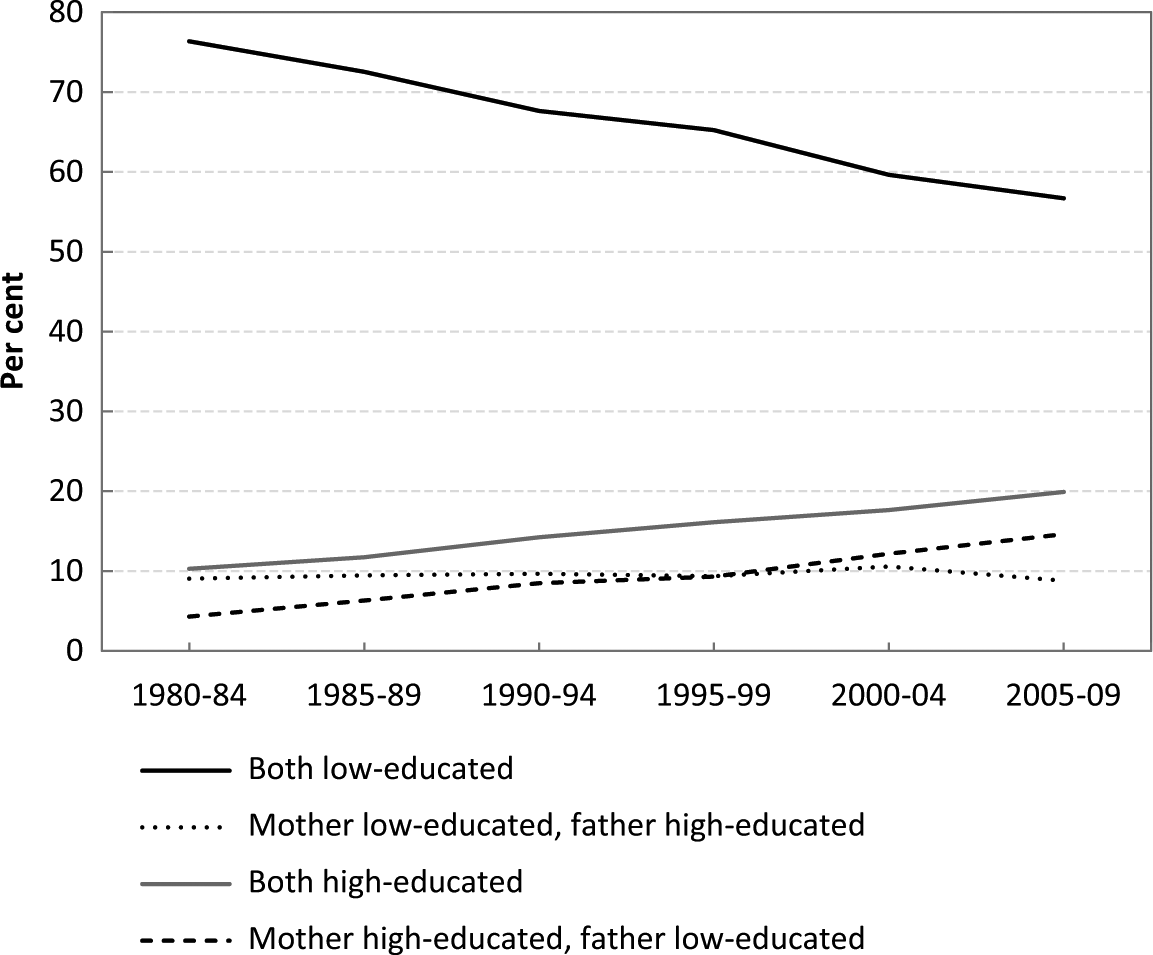
Parents’ educational composition with children below age six, Austria, 1980–2009.
Figure 2 maps the trends in employment arrangements as a function of the age of the youngest child. With a range of 62 to 71 per cent, the share of parents with a child below age three who settle for the male breadwinner model proves to be surprisingly constant over time. The graph clearly shows the point in time when mothers started to prefer part-time work and the dual breadwinner model began to fade. In effect, this surprising development implies a sharp reduction in women’s work volume, which may be interpreted as a re-traditionalization of gender roles. It is a consequence of policies extending parental leave and setting incentives for part-time work, as well as the insufficient availability of childcare places which make full-time work ‘costly’ and difficult to implement. The next section will analyse whether highly educated couples are the forerunners of this reduction in female work time or whether they pursue full-time employment.
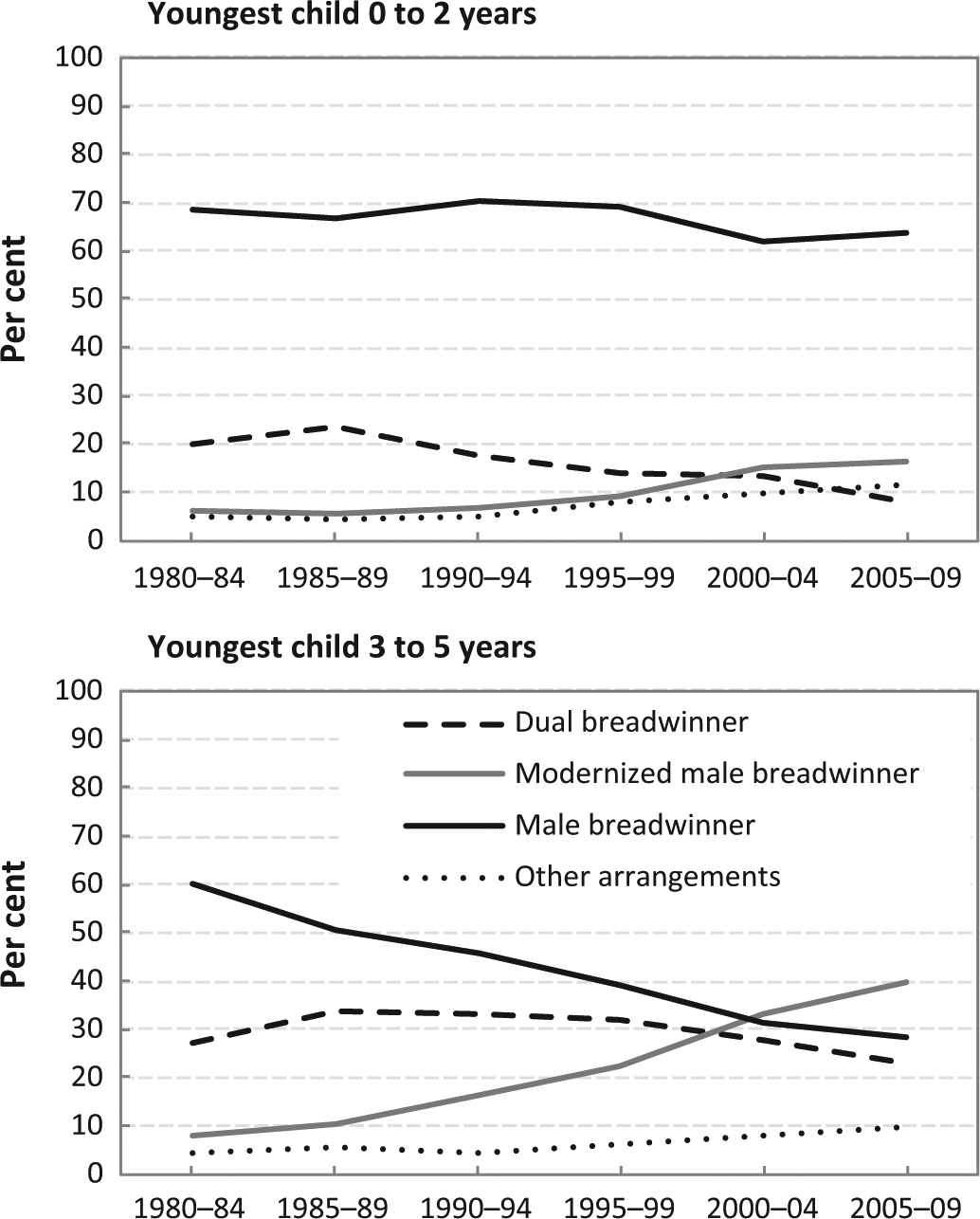
Parents’ work arrangements by age of youngest child, Austria, 1980–2009.
Once the youngest child has reached preschool age, the prior dominance of the male breadwinner model is replaced by the modernized male breadwinner model. It may be speculated that the part-time option has been shown to be a bridge into the labour market for mothers who previously would have stayed at home. Their participation in gainful employment may partly be a consequence of men’s deteriorating labour market conditions, that is, higher unemployment risk and the increase in atypical employment. To a certain extent, the popularity of part-time work could be the result of having to cope with institutional factors (part-time childcare, legal support for part-time work). It may also be due to a tension between persistently negative attitudes towards the full-time employment of mothers with young children and an opposing ‘emancipatory’ trend towards more independence and self-realization for women. The following section ascertains whether this compromise solution is uniformly embraced by parents with different educational levels.
Educational effects on parents’ work arrangements
Educational composition as a determinant of parental work arrangements was evaluated in two steps. First, a main effects model was estimated and second, a three-way interaction between calendar year, parents’ education and age of the youngest child was included.
The first model depicts the marked increase in the modernized male breadwinner model and the decline of the dual breadwinner model (Table 1). There is a similar likelihood that families with two low-educated parents or a low-educated mother opt for the modernized male breadwinner model instead of the male breadwinner model. However, two low-educated parents more often choose the dual breadwinner model than couples in which only the mother has a low education. This suggests an effect of partners’ income, as the economic necessity to work is more pressing in the former group. Couples in which mothers are highly educated are more prone than the reference group to select the modernized male breadwinner model and the dual breadwinner model instead of the male breadwinner model. High-educated mothers with a high-educated partner are more likely to be involved in the labour market than their low-educated peers with a high-educated partner, since the former are able to gain a higher income and have higher non-economic motivation. In families with only a highly educated mother, the dual breadwinner model is significantly more likely than in families with two highly educated parents. Conceivably, women compensate for their partners’ lower income. However, the fact that highly educated women in a homogamous relationship behave very similarly to their peers with a low-educated partner suggests that their own opportunities and preferences play a crucial role.
Determinants of parents’ work arrangements with children below age six, multinomial logit model, Austria.
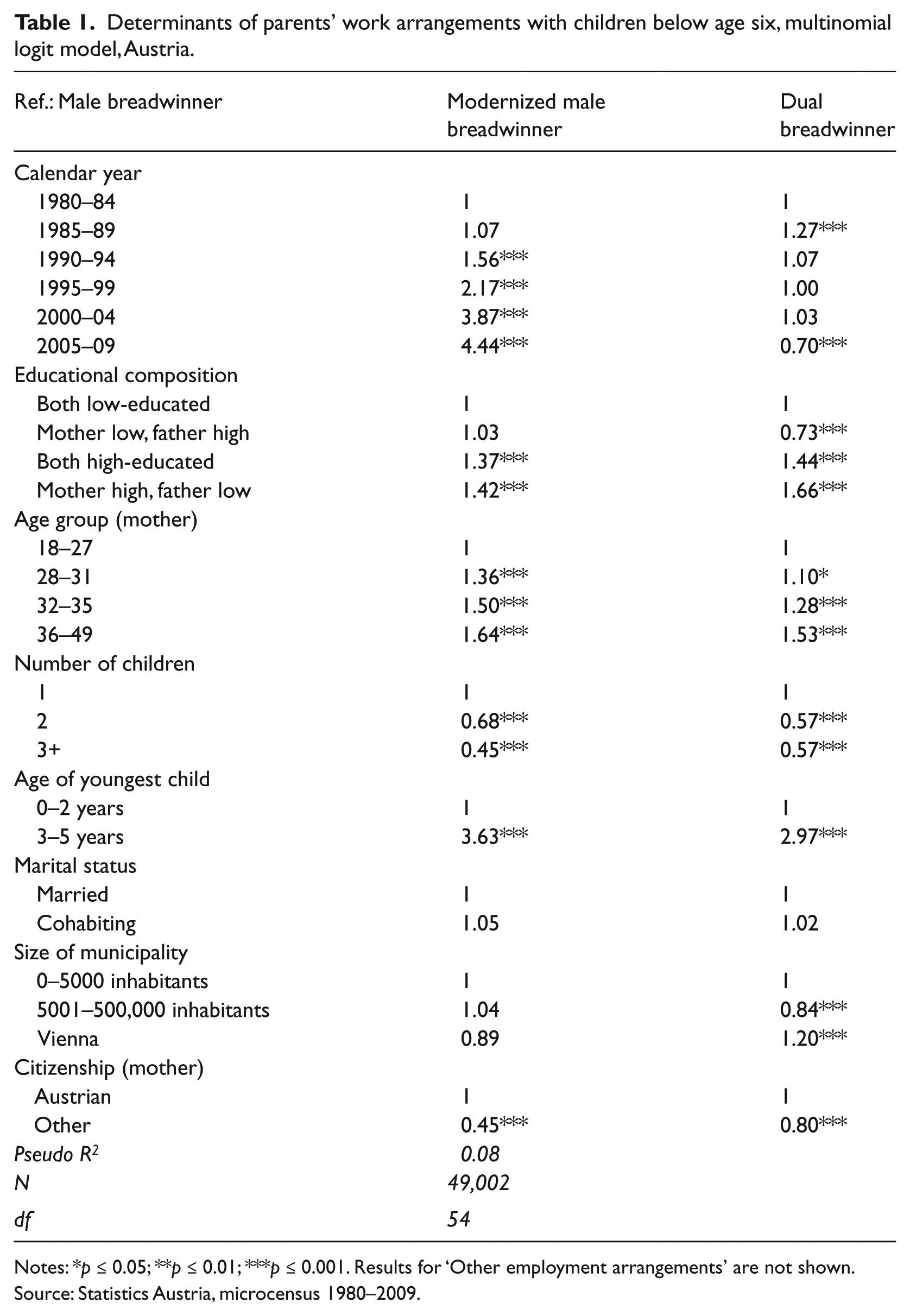
Notes: *p ≤ 0.05; **p ≤ 0.01; ***p ≤ 0.001. Results for ‘Other employment arrangements’ are not shown.
Source: Statistics Austria, microcensus 1980–2009.
The other effects are as follows. If women have children at an advanced age, both the modernized breadwinner model and the dual breadwinner model become more popular than the male breadwinner model. Apparently, a (quick) return to the labour market is more probable once a woman has established herself in the working world. One reason underlying this effect could be that less family-oriented women tend to be in the labour force for a longer period of time before they have children at a more advanced age. With a higher number of children, the odds that parents will select the modernized male breadwinner and the dual breadwinner model rather than the male breadwinner model decrease, as childcare becomes more demanding. A larger family size could also be indicative of a more traditional value orientation. Marital status exerts only a minor effect. When analysed by municipality size, the dual breadwinner model is more widespread (as compared to the male breadwinner model) in Vienna than in smaller municipalities. More developed childcare infrastructure may play some role in this respect. Finally, as compared to their foreign peers, mothers with Austrian citizenship more frequently choose the modernized male breadwinner model or the dual breadwinner model than the male breadwinner model.
As a second step, Figure 3 illustrates the changing impact of parents’ educational composition on their work arrangements by the age of their youngest child. The results are presented as predicted probabilities. For example, among two low-educated parents who had a child under the age of three in 2005–09, 66 per cent lived according to the male breadwinner model, 17 per cent chose the modernized male breadwinner model and eight per cent opted for a dual breadwinner arrangement (the remaining nine per cent lived in another arrangement). Three results are particularly interesting. First, the convergence pattern is most apparent. When their youngest child was younger than three, couples with a highly educated mother tended to adapt to the traditional male breadwinner model predominantly favoured by their lower-educated peers. The increase totalled close to 10 percentage points over the period. The shape of the curve corresponds tightly (with some expected delay) to changes in the length of parental leave, that is, a prolongation in 1990, a reduction in 1997 and again a prolongation in 2002. The dual breadwinner model faded at different paces, thus leading to convergence. It seems that incentives introduced to encourage mothers with a child below the age of three to work part-time (together with an upper ceiling limiting additional earnings) were less successful in attracting housewives to the labour market, but instead reduced the work volume of those who used to work full-time, that is, the highly educated. Thus, rather unexpectedly, the findings show that inequality between educational groups declined over time. Second, all four groups increasingly adopted the modernized male breadwinner model in a similar way; its emergence did not further inequality. Third, the effect of partners’ education on low-educated women’s employment declined over time. While there was a clear gap between low-educated women with high-educated partners and their peers with low-educated partners, both groups show almost identical values from the mid-1990s.
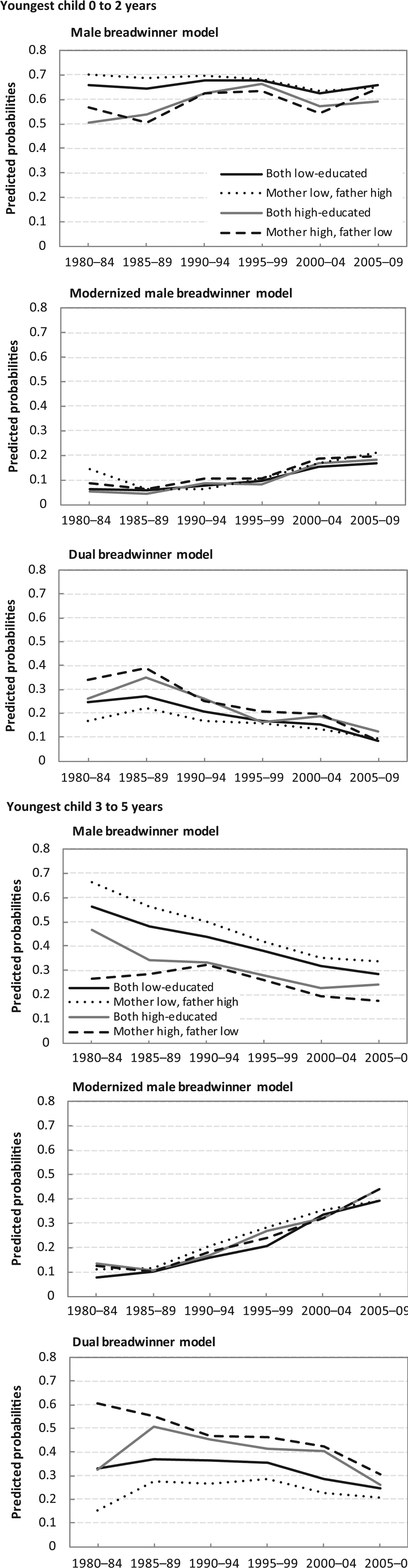
Predicted probabilities of parents’ work arrangements by educational composition and age of youngest child, Austria (multinomial logit model).
The findings for parents whose youngest child was age three to five closely resemble those just described. Again, a convergence is observed regarding the male breadwinner and the dual breadwinner model. Alignment in the former model was reached because parents with low-educated mothers abandoned the male breadwinner model – which was initially more widespread in this group – at a faster rate than their highly educated peers. The convergence of the dual breadwinner model among all groups was due to its decreasing prevalence among couples in which women had a higher education. The modernized male breadwinner model was accepted in all four groups of parents. It became the most common choice among parents with preschool children regardless of their education. Low-educated women have become less responsive to their partners’ education. The decline of the male breadwinner model is steepest among low-educated women with a high-educated partner, and some increase is seen in preference for the dual breadwinner model. A general finding is that the strength of the educational effect hinges on the age of the youngest child. Educational differences influence employment patterns to a much lower extent when the youngest child is below the age of three than older.
Summary and discussion
This study examined how the educational level of parents with infants and preschoolers influenced their work arrangements over the period 1980 to 2009. Let us first revisit the question posed in the title: is the male breadwinner model returning? This definitely applies to couples in which women are highly educated and have an infant. The result is rather unexpected given a seemingly universal trend towards higher gender equality and mothers’ rising labour market participation. Highly educated women are commonly considered to be in the vanguard of this development, while becoming more family oriented when certain conditions are met.
Another important result of this study is that the educational effect has declined over time, that is, employment patterns between educational groups have converged. When the youngest child is less than three years old, highly educated mothers increasingly adapt to the behaviour of their lower-educated peers in that they delay their return back to work. This development can most likely be explained by the repeated prolongation of parental leave during the observation period. By the time the children are preschoolers, the decline of the dual breadwinner model is steeper among parents with a highly educated mother than among their lower-educated peers. Instead, the modernized male breadwinner model gains acceptance in all education groups. This model has been interpreted as a compromise in the attempt to resolve the tension between institutional and cultural obstacles, on the one hand, and women’s quest for independence and self-realization, on the other. Part-time work seems to suit couples with different educational backgrounds, although the underlying motivations are likely to differ. The Austrian findings are surprising in view of the fact that results for Germany document a growing divide between mothers with different educational backgrounds (Konietzka and Kreyenfeld, 2010). Hence, concerns about growing inequalities due to differential employment patterns between educational groups cannot be supported (Esping-Andersen, 2009; McLanahan, 2004).
In Austria as well as in other countries (England et al., 2012; Konietzka and Kreyenfeld, 2010; Verbakel and de Graaf, 2009), the negative effect of men’s educational levels declines over time. The observation that the positive effect of women’s own education has been reinforced while the negative effect of their partners’ education (or earnings) has diminished (England et al., 2012) has been interpreted as an enrichment of women’s opportunities. An explanation based on opportunities or pull factors seems to have become more relevant at the expense of a needs-based explanation (Cohen and Bianchi, 1999). Similarly, an individualization process is argued to have taken place in which people are less dependent on others while their own preferences and interests gain importance (Verbakel and de Graaf, 2009).
Although policy targets have been formulated in an attempt to increase women’s employment, the present study shows that there are some counter-developments in Austria. Among the five targets of the European Union’s strategy is the aim that 75 per cent of the 20- to 64-year-olds should be employed by 2020 (Austria set 77% to 78% as a national target), an increase that will mainly concern women. While the connected objective is to promote economic growth and combat poverty, non-economic arguments may also be put forward in favour of women’s employment (such as improvements in gender equality). However, the findings show that before their youngest child reaches age three, women’s labour volume declines, most strongly among the higher-educated. In the presence of a preschool child, the male breadwinner model erodes, however, and part-time work becomes the most common choice. In the scholarly discourse, part-time employment is viewed sceptically, as it cannot secure employees’ subsistence and significantly reduces career opportunities. In Austria, a cutback of mothers’ working hours is not limited to the first years of their children’s lives but is almost a permanent arrangement. Approximately half of the parents live according to the modernized male breadwinner model, regardless of whether their youngest child is three to five, six to nine or 10 to 14 years old (Klapfer, 2010).
Given these developments, are there any signs of (future) changes in attitudes and policies? The Austrian population adopted on average a more positive stance towards working mothers with young children, as measured in 1988 against 2002. Nevertheless, a stable share of approximately 30 per cent strongly agreed that pre-school children suffer when their mothers work (Wernhart and Neuwirth, 2007). With regard to policies, a short and well-paid parental leave alternative of 12 (+2) months was added to the three existing schemes in 2010. Beneficiaries may either receive a flat-rate payment of €1000 or 80 per cent of their previous income. Nevertheless, the longest version of 30 (+6) months remains by far the most popular option, which around half of the parents opt for. While claims to this longest version are very slowly declining, the shorter versions are becoming more attractive (Rille-Pfeiffer and Kapella, 2012). They are disproportionally used by mothers with a high income, and fathers engage most frequently in them. If this trend should continue, the shorter versions could become a stimulus for mothers’ employment, yet with a parallel widening of the educational divide. Without explicit policy measures, an increase in fathers’ take-up of parental leave is not very likely given the high gender pay gap, the vertical sex segregation of occupations and traditional gender norms. Part-time work generally continues to be viewed as a desirable option to reconcile work and the family and a trend reversal is not yet in sight. The availability of childcare facilities for children under three is growing slowly and steadily, albeit at an unequal rate in regional terms. In 2012 Vienna reached the European Union Barcelona target value, which envisaged one-third of all children under three in formal childcare by 2010 (European Council, 2002). In spite of progress in availability, both opening hours and the quality of childcare need to be improved. In this regard, Austria occupies a place at the lower end of the ranking of child-to-staff ratios for infants (OECD, 2012).
In the enactment of the recent short-term parental leave option, Germany was adopted as a model for Austrian policy makers (Blum, 2012). In that country, in 2007, the parental leave period was limited to one year with an income-related benefit (unlike in Austria, longer options were abolished). From 2013 onwards, parents have been provided with the right to a childcare place for children above the age of one. In the future, policy transfers from Germany and the European Union could provide an impetus for change in Austria.
Footnotes
Appendix
Predicted probabilities of parents’ work arrangements by educational composition and age of youngest child, Austria (multinomial logit model).
| 0–2 years |
3–5 years |
|||||
|---|---|---|---|---|---|---|
| 1980–89 | 1990–99 | 2000–09 | 1980–89 | 1990–99 | 2000–09 | |
|
|
||||||
| Both low-educated | 0.643 | 0.675 | 0.639 | 0.512 | 0.402 | 0.286 |
| Mother low, father high | 0.674 | 0.704 | 0.643 | 0.620 | 0.459 | 0.341 |
| Both high-educated | 0.487 | 0.649 | 0.539 | 0.253 | 0.269 | 0.246 |
| Mother high, father low | 0.349 | 0.532 | 0.521 | 0.106 | 0.129 | 0.124 |
|
|
||||||
| Both low-educated | 0.060 | 0.087 | 0.164 | 0.092 | 0.189 | 0.364 |
| Mother low, father high | 0.096 | 0.072 | 0.185 | 0.126 | 0.243 | 0.388 |
| Both high-educated | 0.105 | 0.063 | 0.212 | 0.097 | 0.164 | 0.402 |
| Mother high, father low | 0.040 | 0.092 | 0.173 | 0.143 | 0.147 | 0.237 |
|
|
||||||
| Both low-educated | 0.261 | 0.191 | 0.123 | 0.355 | 0.367 | 0.285 |
| Mother low, father high | 0.196 | 0.180 | 0.116 | 0.195 | 0.265 | 0.215 |
| Both high-educated | 0.392 | 0.241 | 0.199 | 0.636 | 0.554 | 0.332 |
| Mother high, father low | 0.475 | 0.282 | 0.203 | 0.681 | 0.663 | 0.569 |
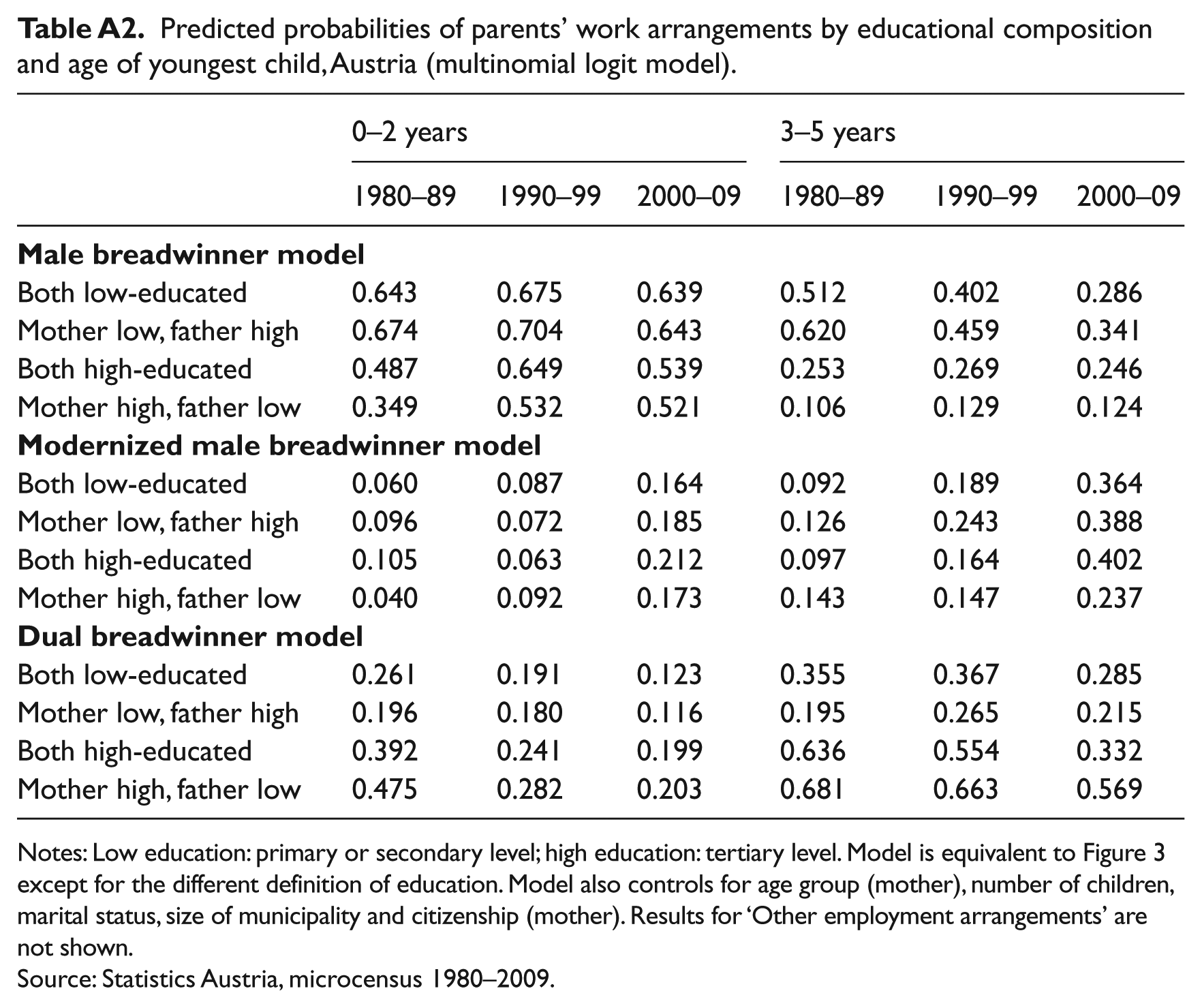
Notes: Low education: primary or secondary level; high education: tertiary level. Model is equivalent to Figure 3 except for the different definition of education. Model also controls for age group (mother), number of children, marital status, size of municipality and citizenship (mother). Results for ‘Other employment arrangements’ are not shown.
Source: Statistics Austria, microcensus 1980–2009.
Acknowledgements
I am grateful to Sonja Blum, Bernhard Riederer, Tomáš Sobotka, Roland Verwiebe and three anonymous reviewers for their constructive comments on earlier versions of this article. I also thank Karin Klapfer from Statistics Austria for support with the Austrian microcensus surveys and Karl Thomanek and Sylvia Trnka for language editing.
Funding
This research received no specific grant from any funding agency in the public, commercial, or not-for-profit sectors.