




Abstract
Gender differences in perceived quality of employment (achievement, content, job insecurity, time autonomy and physical and emotional conditions) are examined. The study asks whether women’s occupations provide better conditions in areas that facilitate their dual role in society, as a trade-off for low monetary rewards. Specifically, it examines the association of women’s concentration in broader occupational categories, embedded in particular national contexts, with gender differences in job quality. Utilizing the 2005 ISSP modules on work orientation shows that women lag behind men on most dimensions of job quality, countering the hypothesis that women’s occupations compensate for their low wages and limited opportunities for promotion by providing better employment conditions. However, as women’s relative share in occupations grows the gender gap narrows in most job quality dimensions. The implications of these results are discussed.
Introduction
That men gain higher rewards than women from formal employment is well documented: men’s employment is more stable, their salaries are higher and they have more opportunities for advancement and access to lucrative jobs (Blau et al., 2006). Equally documented is the high level of sex segregation in labour markets, indicating that men and women work in occupations heavily populated by same-gender employees (Charles and Grusky, 2004; Reskin and Roos, 1990). These two phenomena are said to move in tandem: as more women populate an occupation, its rewards tend to decrease (Padavic and Reskin, 2002; Rubery and Fagan, 1995). One explanation for this centres on women’s dual role in modern society. Burdened by both economic and family responsibilities, women supposedly satisfy the former by choosing ‘women-friendly’ jobs in order to accommodate the latter (Petit and Hook, 2009; Polachek, 1976). These jobs do not offer high economic rewards; however, since they suit women’s preferences to accommodate their dual roles in society, women are expected to be more satisfied than men with the quality of their employment (cf. Glass, 1990).
This study focuses on gender differences in job attributes to explore whether women’s occupations offer conditions and characteristics that evidently compensate for the lack of high wages and good opportunities for advancement. Specifically, the main interest is in the extent to which women’s concentration in occupations embedded in specific national labour markets might explain gender differences in the subjective assessment of job quality. Utilizing the 2005 ISSP modules on work orientation, the findings show that women lag behind men on most dimensions of job quality. This result runs counter to the expectation that women’s occupations compensate for their low wages and limited opportunities for promotion by providing better employment conditions. However, the findings also demonstrate that the gender gap has narrowed in most job quality dimensions as women’s relative share in occupations has grown.
This study joins a growing body of research on quality of employment, which adds to wages as the main indicator of labour market success a wide variety of job characteristics, including job discretion, autonomy, flexibility, skill utilization, physical and emotional conditions, as well as job security and the more general notion of job satisfaction (Brown et al., 2012; Clark, 2005; Esser and Olsen, 2011; Gallie, 2007a, 2007b; Gallie et al., 2012; Green, 2006; Munoz de Bustillo et al., 2011; Stier, 2012).
Literature review
Occupational sex segregation and gender differences in the quality of employment
Several accounts have been proposed for the link between rewards and occupational gender segregation. Supply-side explanations hold that women choose specific occupations because of the particular attributes they offer. One line of explanation sees women’s occupational choice as compensating for the low earnings or poor opportunities for upward mobility. These jobs often require shorter working hours and a flexible work schedule and entail lower penalties associated with work separation. Women, constrained by their dual role as caregivers and providers, might therefore select these occupations to meet family responsibilities (Polachek, 1976). This argument is also in line with Hakim’s (2002) ‘preference’ theory, namely, women select occupations that allow them to maintain the life style they value. Most women, according to this argument, prefer a balanced work–family life, therefore select occupations that allow a better combination of the two roles. These ‘preferences’, however, do not necessarily reflect a choice free of constraint, as many women, in the absence of public support, are bound to adjust their occupational choices so that they meet their familial responsibilities (Gash, 2008). Somewhat differently, it has been argued that women select occupations for the characteristics they entail due to ‘gender essentialism’ (Charles and Grusky, 2004; England, 2010), i.e. women select occupations populated by women because they prefer to work with other women (Kanter, 1977). It is also argued that women value job attributes that allow social contacts and have a low level of stress (Glass, 1990). From this point of view, although women’s jobs are poorer than men’s in material rewards, they should offer better work conditions, such as time autonomy and security, as well as physical and emotional conditions. This is especially true for female-dominated occupations, because they offer work conditions that most women value or because women, as a group, can influence work conditions to allow them a better fit between paid work and care work.
The demand-side explanation, by contrast, rests on theories of structural barriers and gender discrimination (Petersen and Saporta, 2004): women are denied access to good and rewarding labour market positions by employers and because of their inferior power position in society their work is devalued and they are often ‘pushed’ into low quality jobs (Findlay et al., 2009; Reskin and Maroto, 2011; Reskin and Roos, 1990). Theories of discrimination and devaluation of women’s work accordingly see a general detrimental effect of occupational sex segregation on women’s market rewards. Along similar lines, Reskin and Roos (1990) invoke the gender queue argument, according to which the better jobs are allocated to men, who are perceived by employers as preferred employees. Women’s entrance to formerly male-dominated jobs takes place when work conditions in these jobs deteriorate. Hence the concentration of women in any occupation is likely to have a detrimental effect on job quality (see also Fagan and Burchell, 2002). Furthermore, the gender gap in female occupations will be larger than in more neutral occupations since men are in a much stronger position than women. In sum, the above discussion suggests that women’s quality of employment will be lower than men’s in all aspects of job attributes and more so in occupations identified as female-type (see e.g. Kraus and Yonay, 2000; Yaish and Stier, 2009).
Deriving from these two opposing arguments on the possible impact of occupational sex segregation on the quality of women’s employment are two sets of hypotheses. The first two, H1 and H2, arise from the ‘compensation/preference’ arguments:
In sharp contrast, the discrimination and devaluation of women’s work give rise to:
Studies on the gender gap in job quality yield mixed results. In her pioneering study, Glass (1990) examined the effect of women’s occupational segregation in the USA on job quality and found that women were generally disadvantaged in their work conditions compared to men, even in aspects of employment deemed to compensate for the lack of monetary rewards. Other studies report inconsistent gender differences on a variety of job quality measures.
Gallie (2007b) found no gender differences in task discretion in the United Kingdom, France and Germany, some advantage for men in Sweden and a disadvantage for men in Spain. Fagan and Burchell (2002) reported on lower levels of job training for women in all occupational categories and lower levels of autonomy in professional, managerial and clerical jobs (though not in blue-collar occupations). Green et al. (2001), as well as Erlinghagen (2008), did not find statistically significant gender differences in job insecurity across European countries, while Mauno and Kinnunen (2002) reported lower levels of job security for women in Finland. Similarly, Tahlin (2007), who analysed skill formation in several countries, found that women were generally disadvantaged, while Dieckhoff et al. (2007) found no gender differences in training in most countries and a slight advantage for women in Spain. Notably – and contrary to expectations that men and women have different preferences for job characteristics – Gallie et al. (2012) found no gender differences and a similar effect of education on workers’ intrinsic work orientation.
These inconsistencies can be partly attributed to the focus on a single or very narrow array of countries that are also characterized by different labour market arrangements, characteristics and, most importantly, employment conditions. An exception is Muhlau (2009) who examined gender inequality on a wide range of job characteristics and across a large number of countries; his study supports the claim that men hold jobs that demand high commitment to paid work, while women work at jobs more compatible with their role as caregivers. These provide safer work and more conventional hours, whereas men’s jobs are more likely to offer good opportunities for advancement, skill enhancement, autonomy and complexity. Muhlau further showed that women in more egalitarian countries did not enjoy any advantage in terms of job characteristics. On the contrary, in those countries women lost their advantage in job aspects such as work safety and working hours.
While Muhlau’s work sheds some light on country differences in job quality, it is not entirely clear whether these differences result from country-specific work conditions or from the particular occupations men and women are engaged in. As argued below, work conditions often depend on specific occupations, while country differences might result from a variation in the occupational structures of men and women. With some exceptions (e.g. Fagan and Burchell, 2002; Glass, 1990; Smith et al., 2008), little attention has been paid to occupations as determinants of gender inequality in the quality of employment.
Occupational differences in job quality
Occupations are important contexts for understanding job quality because of both their content and the workers’ characteristics. As stated earlier, female-dominated occupations may be organized differently from male-dominated occupations. Employment in the former entails less physical hardship and more opportunities for social contacts. Female-dominated occupations are also characterized by lower wages and fewer opportunities for advancement (Levanon et al., 2009; Padavic and Reskin, 2002; Reskin and Roos, 1990).
Nonetheless, the sex composition of occupations is only one aspect affecting the quality of employment. For example, white-collar occupations offer different work conditions from blue-collar occupations. Employment-related tasks in each category of occupation are conducted in different environments and each category requires employees with different compositions of skills, tasks and demands (Fagan and Burchell, 2002). While white-collar occupations are more likely to be concentrated in the public sector and to be populated by more educated employees, blue-collar occupations are more likely to be in the private sector and populated by less educated employees. Further, workers in high-level white-collar occupations enjoy more training and better skill formation opportunities than blue-collar workers (Dieckhoff et al., 2007; Fagan and Burchell, 2002; Tahlin, 2007). These differences affect monetary rewards, but also other dimensions of employment.
Glass (1990), for example, found important differences in work conditions between occupational groups. Blue-collar workers were shown to have lower levels of job flexibility, wages, promotion prospects and other social rewards than high-level white-collar workers. She further showed that workers in clerical occupations had relatively high job flexibility, as well as ease of work, compared to workers in other occupational categories. Similarly, Fagan and Burchell (2002) found a disadvantage in employment characteristics such as training, problem-solving and autonomy in occupations populated by women (see also Smith et al., 2008).
Occupations, however, are embedded in specific national labour markets, so how occupations are distributed in countries should also matter (Rubery and Fagan, 1995). This is mainly because countries differ in how their labour markets are organized and in their general conditions of work. Studies have documented the importance of countries in assessing employment quality (see e.g. Erlinghagen, 2008; Esser and Olsen, 2011; Gallie, 2007a; Holman, 2013). Theoretical arguments (e.g. Gallie, 2007a, 2007b) as well as empirical evidence highlight differences in employment conditions associated with institutional arrangements, mainly labour market structures and workers’ power (Esser and Olsen, 2011; Gallie, 2007a; Holman, 2013; Muhlau, 2009). Moreover, countries differ in the demand for specific occupations, depending on factors such as technological level, service sector size and general demand for skills. Countries also vary in workers’ characteristics: education level, female labour force participation rates and the types of occupation populated by women (Rubery and Fagan, 1995).
The overlooking of potential effects of occupations in previous research and, more importantly, how occupations are organized in each country makes it difficult to compare the results of the various studies, or to generate informative and operable conclusions. That is, inconsistencies in the findings, including those related to gender disparities along different indicators of job quality, as reviewed above, might partly result from this limitation. This study, therefore, examines job quality while considering specific national occupational characteristics in order to account for the context in which work conditions are determined in each nation. The focus of this study is on women’s concentration in occupations; its effect on the gender gap in job quality should be understood in this context.
Data, variables and analytical technique
Data and methodology
The methodology in the current study combines macro- and micro-level research, as it seeks to explain relations at the individual level, embedded in specific institutional contexts. Because the study aims to explain gender differences in job quality by occupational characteristics, a multi-level modelling technique is employed (Bryk and Raudenbush, 1992). Specifically, the study is based on three levels of analysis: individuals, who are embedded in occupational groups, which are embedded in countries. The individual-level data are from the 2005 ISSP module on work orientation. The ISSP is an internationally collaborative survey programme with annual modules on a topic important for social science research. The 2005 data contain national probability samples from 31 countries that were collected, for the most part, by face-to-face interviews (a few are based on a self-completion questionnaire), with a response rate that varies considerably across countries: 17 per cent to 85 per cent. 1
The 2005 ISSP module on work orientation includes detailed information on job values, job characteristics, perceptions and outcomes of job characteristics, as well as extensive background information on participants. The study sample includes men and women in the labour force at the time of the survey. The working file contains about 17,500 respondents (8500 men and 9000 women) in the following 27 countries: Australia, Belgium (Flanders), Bulgaria, Canada, Cyprus, Czech Republic, Denmark, Finland, France, Germany, Great Britain, Hungary, Ireland, Israel, Japan, Latvia, New Zealand, Norway, Portugal, Russia, Slovenia, South Africa, Spain, Sweden, Switzerland, Taiwan and the USA. Because the country samples in the ISSP data set are relatively small, only four macro occupational categories are defined: high white-collar (professional, semi-professional and managerial occupations); low white-collar (clerical and service occupations); high blue-collar (skilled and semi-skilled occupations); and low blue-collar (mainly unskilled occupations). Occupational characteristics are country-specific to reflect country variations in labour market characteristics and arrangements (Appendix Figure A1 illustrates country differences in women’s share in each occupational category). ISSP data files from 2000–2005 were pooled in order to obtain country-specific occupational characteristics, as explained below.
Dependent variables
Quality of employment, which has several dimensions, is the dependent variable. Following earlier work in this field (Clark, 2005; Gallie, 2007b; Handel, 2005), the study highlights six dimensions of employment quality: material rewards; job content; job security; time autonomy; physical conditions; and emotional conditions. These dimensions are tapped by questions pertaining to individual’s perceptions on each one in their current job.
Rewards and content were measured with a battery of questions, whereby respondents were asked to state how appropriate each of the following statements was in respect to their main job. Answers ranged from (1) highly appropriate, to (5) highly inappropriate:
My income is high.
My opportunities for advancement are high.
My job is interesting.
I can work independently.
My job gives me a chance to improve my skills.
Factor analysis of these items confirmed a two-dimensional structure pertaining to materialistic rewards – or as Glass (1990) termed it, achievement (items a and b, r=0.47) – and to job content (items c through e, α=0.69). Two indices were then constructed (achievement and content) by averaging the relevant items and recoding these indices so that each ranged from 1 (low quality) to 5 (high quality).
Job security was measured by respondents’ response to the question ‘To what extent, if at all, do you worry about the possibility of losing your job?’ Answers were recoded to range from (1) ‘I don’t worry at all’ to (4) ‘I worry a great deal.’ The variables were recoded so that 1 indicated the lowest job quality (low security) and 4 the highest. Time autonomy was defined by factor analysis of the answers to the following three questions (α=0.67):
Can respondent decide when to start and end work? (1=No – employer decides; 3=Yes – respondent decides).
Can respondent decide how to organize the daily work? (1=Yes – respondent is free to decide; 3=No – respondent is not free to decide).
Can respondent take time off during working hours? (1=Yes; 3=No).
The variables were recoded so that a high score implied a high level of time autonomy (high-quality job).
Finally, physical and emotional conditions were measured separately, with responses to two five-point scale questions for each. For physical conditions: (a) How often does respondent perform hard physical work? (b) How often does respondent work in dangerous conditions? (r=.483). For emotional conditions: (a) Is the work stressful? (b) Does the respondent get home exhausted? (r=0.448). Again, these variables were recoded and each pair of questions was averaged, so that high value indicated high job quality.
Independent variables: individual-level
The main independent variable of interest is gender (1=female). The models control for other individual-level characteristics as well: age (years); working hours; years of education; with dummy variables, indicating: married; children at home; employment in the public sector; union membership; job authority. Earlier studies have found that these variables affect job quality (e.g. Clark, 2005; Handel, 2005; Stier, 2012).
Independent variables: occupational level
The main interest of this study is the effect of gender composition of occupations on gender differences in job quality. In line with this article’s theoretical discussion and hypotheses, each of the four occupational categories was then characterized, separately in each country, by two indicators: per cent women employed and per cent workers with academic degree. The educational level was included as a control variable, since women’s concentration in occupations may be related to education. Estimates of these occupational characteristics per country were calculated by combining ISSP data files for 2000–2005. These pooled data sets provided large enough samples of individuals for each country-specific occupational category (N ranged from 51 to 594 with an average of 192) to yield reliable estimates of the two indicators in question. The country-specific occupational indicators enable country variation to be controlled for in occupational distribution and occupational characteristics. This takes into account national variation as well as occupational variation in job quality.
While countries differ in the general level of job quality due to policies, regulations and other factors, these differences are not expected to affect gender inequality in job quality within occupational groups, since work conditions are largely determined within occupations. Hence, the hierarchical models include only a random component for the country level (third level) to account for possible variation in the general level of job quality because the data are clustered by countries, but explaining this variation is not an aim of the study. Attention in these models thus focuses on the effect of per cent women in occupations on the gender inequality in employment conditions (i.e. the gender slope), net of other individual-level and occupational-level characteristics. In other words, the models examine the interaction between gender and women’s concentration in (country-specific) occupational groups. A positive interaction implies that women benefit from occupational segregation in job quality, as suggested by the ‘compensation/preference’ argument, whereas a negative interaction provides support to the discrimination/devaluation hypothesis.
Findings
Table 1 presents the values of all six measures for men and women in the total population and within the four occupational groups. From the first column in this Table, which disregards occupational group differentiations, men had a clear advantage over women in achievement (wage and promotion). While achievement is expected to be higher for men, the other five employment conditions in Table 1 are not. Nonetheless, the figures in the first column reveal a mixed picture. Contrary to expectations, men had a statistically significant advantage over women in time autonomy and in emotional conditions, while the two sexes had similar levels of job security and job content. Only in physical conditions did women appear to have a statistically significant advantage over men. That is, men reported having more physically demanding jobs than women.
Dimensions of job quality by occupational groups and gender, ISSP 2005.

Gender differences are significant at p<0.05.
The remaining entries in Table 1 (columns 2–5) present men’s and women’s scores on each dimension across occupational categories. Two points are noteworthy here:
The general pattern discussed above was also apparent across occupations. Thus, men had an advantage over women in achievement and time autonomy across occupational groups as well, while women had an advantage over men in physical conditions. It is worthy of note that the way ‘physical conditions’ were measured in this study may be gender biased as it took account of what conventionally describes ‘hard men’s work’ but not ‘hard women’s work’.
In job security and job content, where men and women had similar levels overall, interesting gender differences appeared across occupations. Women had lower levels of job security and lower quality in content in the blue-collar occupations, whereas gender differences did not exist in the white-collar groups. Moreover, women had lower job quality regarding emotional conditions in high white-collar occupations. Inasmuch as employment rewards and conditions were related to gender, they were also clearly related to occupation categories, so for the most part high white-collar workers perceived their jobs as providing higher rewards and conditions than those perceived by low blue-collar workers to be provided by their jobs.
To summarize, the analysis of Table 1 does not support the claim that women enjoy a more relaxed and convenient work environment to compensate for their lack of achievement. Further, the analysis shows that both men and women in white-collar occupations enjoy better work quality in most dimensions than those in blue-collar occupations. Whether the gender gap in job quality relates to more specific characteristics of the occupations, namely the level of female concentration in occupations, is explored below.
Figure 1 presents, for each dimension of employment, how the gender gap is linked to per cent females in occupations. The dots in each of the six panes in Figure 1 represent each of the four occupational categories in each of the 27 countries covered. In all, each pane contains 108 dots. The x-axis in each pane indicates the per cent of women in occupations; the y-axis indicates the gap in each dimension’s score between men and women. A score of zero represents gender equality; positive values represent gaps in favour of men. Each pane also includes a regression line from regressing the proportion of women in occupations on the gender gap.
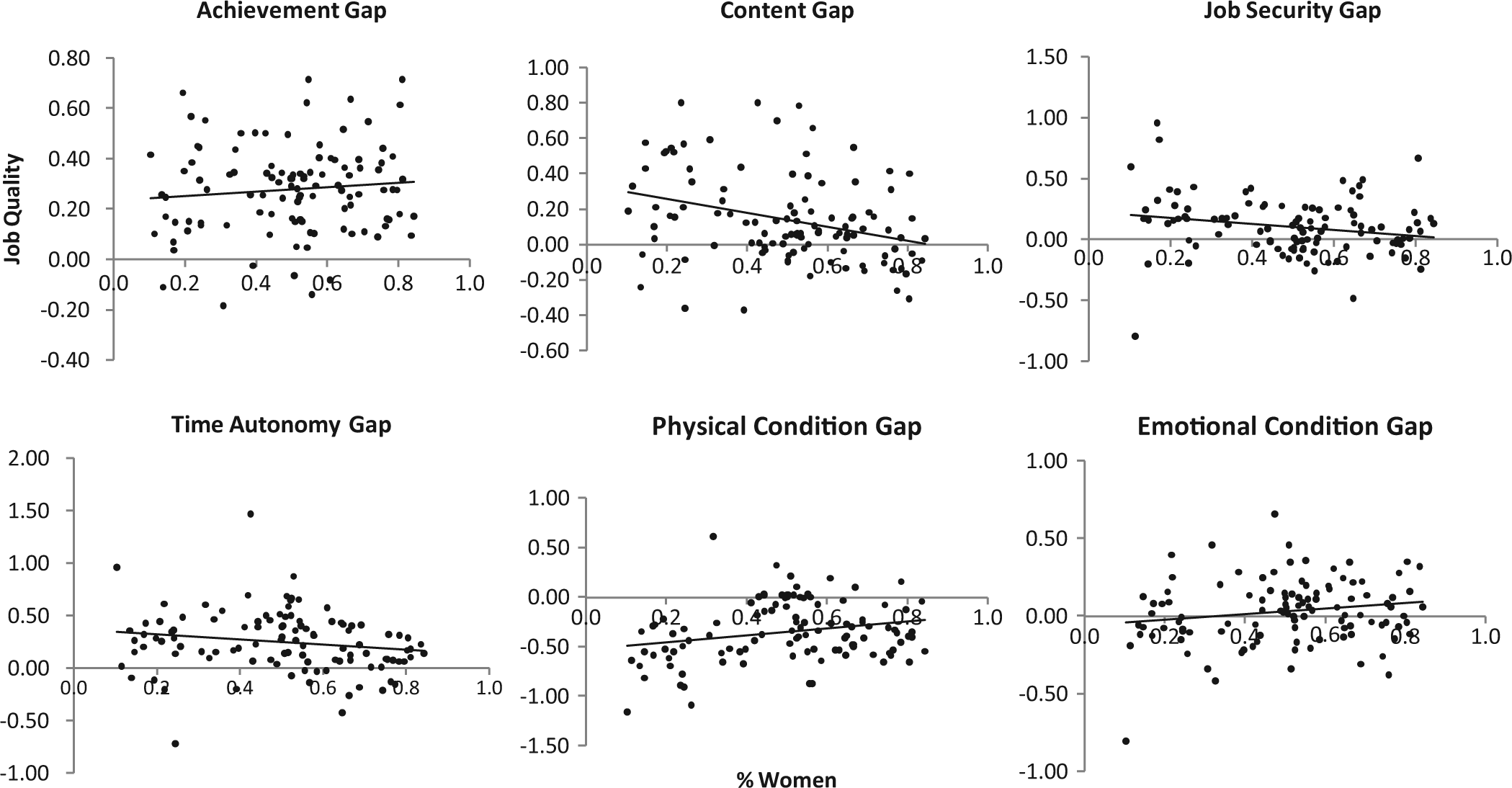
Relation of gender gap in job quality to per cent women in occupations.
It is clear from the Figure that, as expected from the compensation hypothesis, the gender gap narrowed in all but the achievement and emotional conditions dimensions. This narrowing trend in certain dimensions – job content, security and time autonomy – arises apparently because men tend to lose their advantage as the proportion of women in occupations increases. The exception is physical conditions, where women have an advantage over men. However, Figure 1 indicates that women’s concentration in occupations greatly contributed to the erosion of this advantage. Whether this pattern holds even after individual compositional differences and other occupational characteristics are controlled for is the focus of the multivariate analysis.
Multivariate analysis
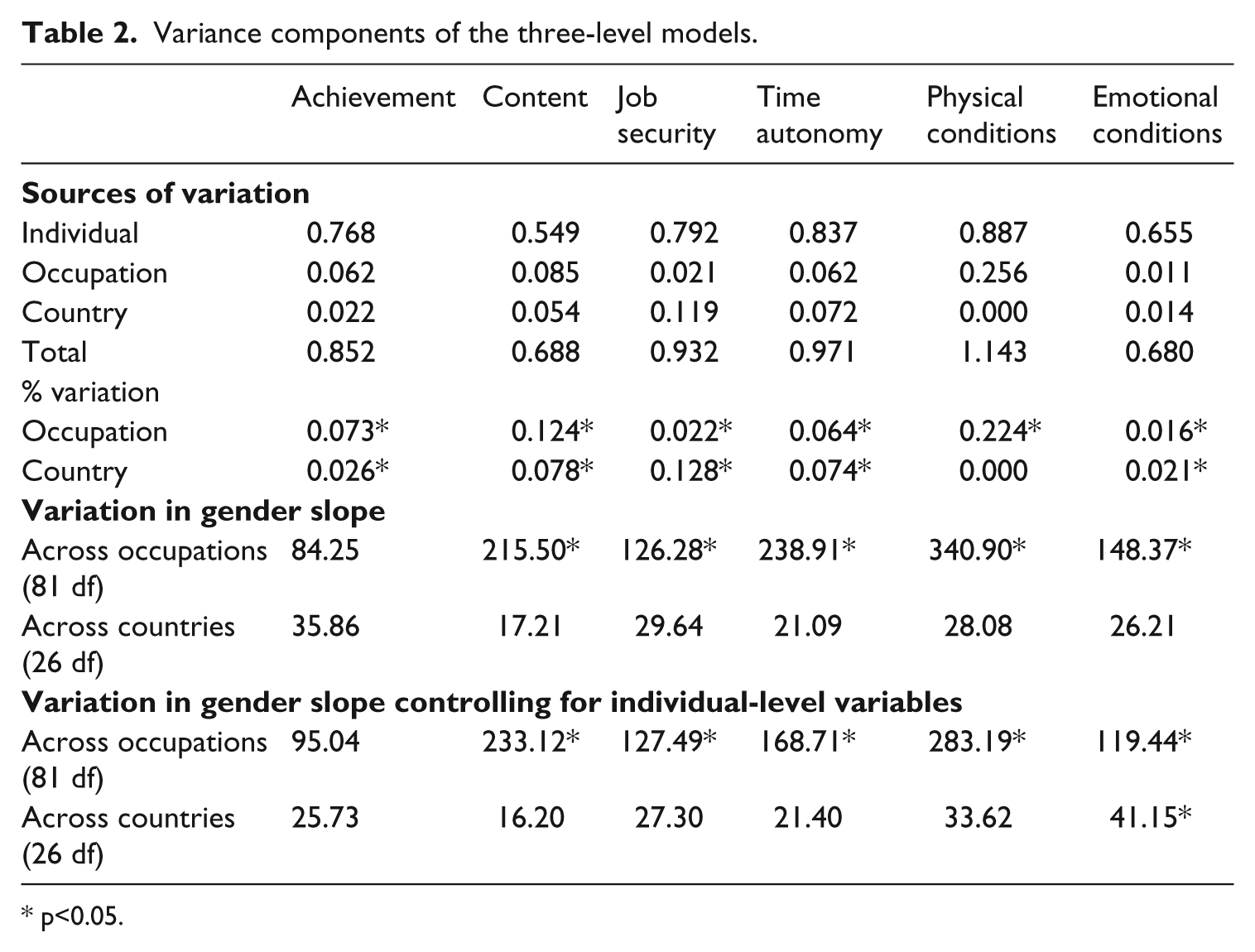
A three-level model was used to test the effect of women’s concentration in occupations on the gender gap in job quality. These three levels pertained to the individual worker, the occupational group and the country. Here the last serves as a control, since countries differ in their occupational composition as well as in the general level of job quality reported by workers. Since the main interest of the study is the effect of occupational indicators on the gender slope, attention is focused on the cross-level interaction effect between country-specific occupational characteristics (level 2) and gender (level 1). 2 The main effect (effect on the intercept) in this case pertained to male workers, while the interaction effect (effects on the gender slope) denoted the deviation of the women’s slope from the men’s. Table 2 presents the results of the analysis of variance across the three levels.
Variance components of the three-level models.
p<0.05.
Most of the variation in job quality is evident between individuals. The variation in the gender slope is statistically significant across occupations in all indicators of job quality, except achievement. Just as important, the gender slope does not vary across countries. This reinforces the lack of any discussion – theoretical or analytical – on country-level characteristics and their possible effect on the gender gap in job quality. Finally, as can be seen at the foot of Table 2, variation across occupational categories in the gender gap remained largely unchanged and statistically significant, even after individual-level variables were controlled for.
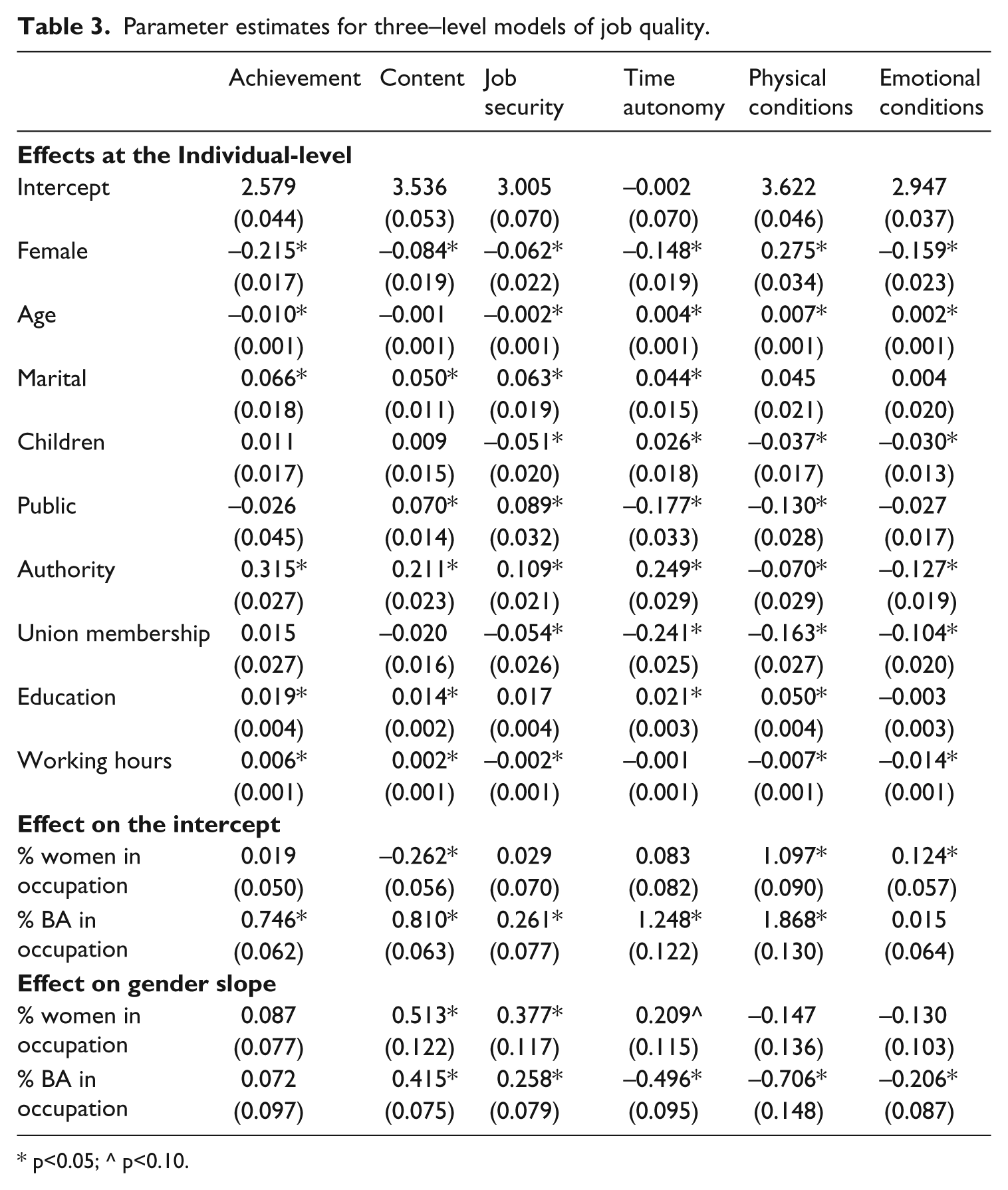
The models in Table 3 reveal marked gender differences in job quality. After individual characteristics, country and occupational distributions are taken into account, in all but the physical conditions dimension women lagged behind men in their perceived quality of employment. Women had lower achievement (b = −0.215), lower quality in terms of job content (b = −.084), lower job security (b = −0.062) and time autonomy (b = −0.148) and lower quality in emotional conditions (b = −0.159) than men. The only dimension where women had an advantage over men is physical conditions (b=0.275), indicating that women worked in a less dangerous environment than men. These findings echo those presented in Table 1 and run counter to the first hypothesis, suggesting that women’s work is devalued in general and therefore less rewarding in all aspects of employment conditions.
Parameter estimates for three–level models of job quality.
p<0.05; ^ p<0.10.
As for other individual-level variables, which served mainly as controls, most job quality dimensions were generally higher for more educated workers and for those who were married (although being married is not related to physical and emotional conditions). Workers with job authority reported higher quality on achievement, content, time autonomy and security, though they seemed to suffer from worse physical and emotional conditions. Workers who worked longer hours had better achievement and higher job content quality, but also more physical and emotional hardship and lower levels of security. Older workers had lower quality in achievement and job security but better quality in time autonomy and physical and emotional conditions. Other individual-level variables show much less consistent effects: e.g. working in the public sector was associated with better job content, more job security and better physical conditions, but also with lower time autonomy. Further, being a union member was associated with lower quality in all job attributes except achievement and content, probably because of the nature of the jobs that tended to be highly unionized (mostly blue-collar workers).
As stated at the outset, however, the main interest in this study was to test whether women’s concentration in occupations affects the gender gap. The interaction of this occupational characteristic with gender – net of individual characteristics as well as education level across occupational categories – revealed interesting patterns across the different dimensions. The theoretical discussion, as well as Figure 1 above, suggests that the gender gap in job quality might be narrowed in all but the achievement and emotional dimensions.
Controlling for compositional differences, however, the results in Table 3 indicate that the gender gap was affected by female concentration in occupations in only three of the six dimensions of job quality: job content, job security and time autonomy. Importantly and supporting hypothesis H2, when women’s concentration in occupations affected job quality, it did so by reducing the gender gap. To better comprehend these cross-level interactions, Figure 2 presents a simulation based on the models presented in Table 2, for each job dimension separately. The graphs present the predicted level of job quality for men (straight line) and women (dashed line) with average individual-level characteristics, but in occupations that differ by women’s percentage.
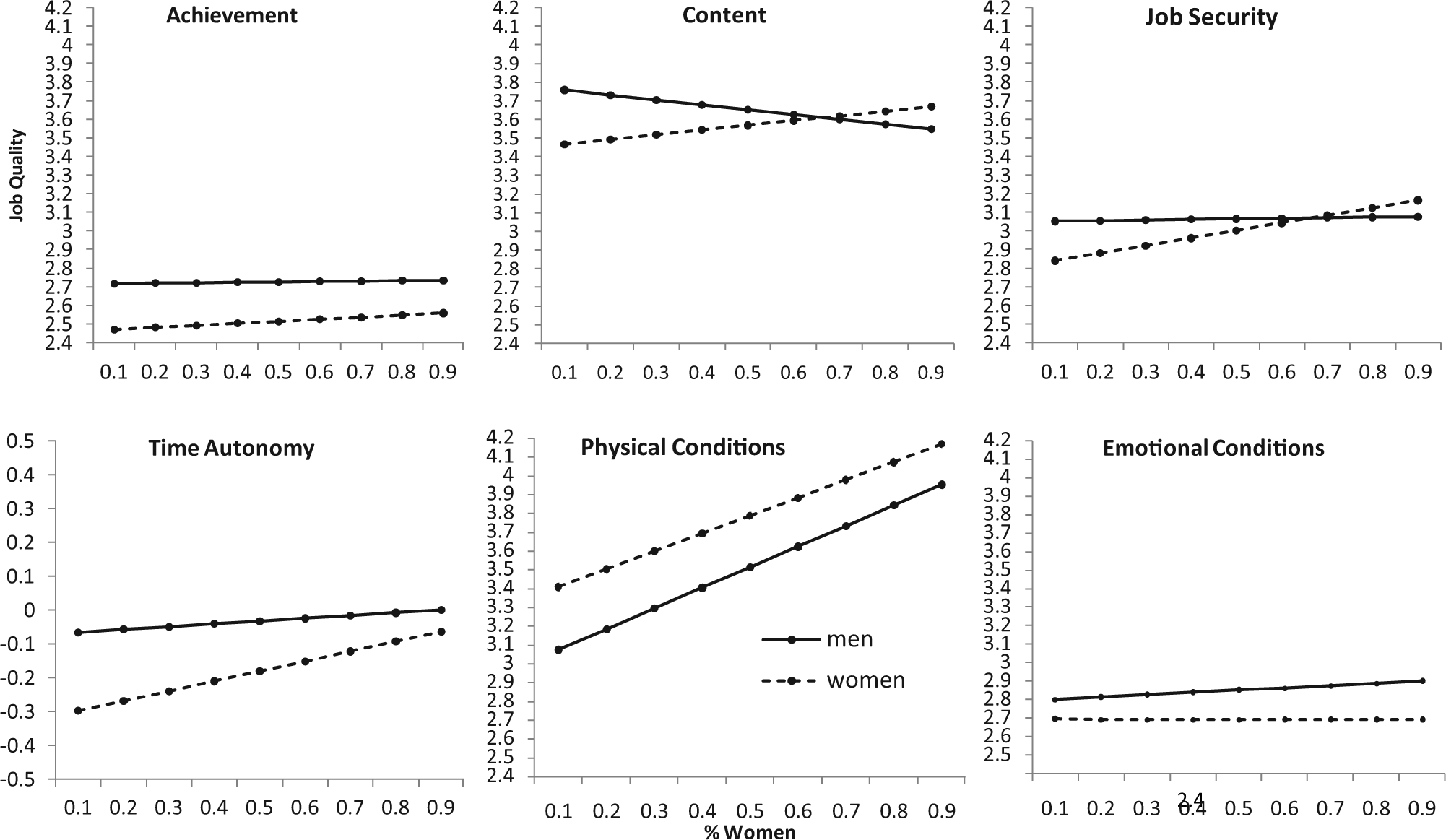
Predicted job quality for men and women by per cent women in occupations.
From the first model in Table 3 and from the graph pertaining to achievement, the gender gap in job quality is clearly seen to be quite resistant to changes in women’s concentration in occupations. This result suggests that women were discriminated against in the labour market, because they consistently had lower rewards in the jobs they occupied, within and across occupational groups, as the ‘queuing’ theory (Reskin and Roos, 1990) would argue.
The second model in Table 3 reveals that an increase in women’s concentration in occupations resulted in narrowing gender gaps in job content: men’s job content significantly deteriorated (γ= −0.262), while women’s improved as their proportion in occupations increased (γ=0.513). At the extreme, in female-dominated occupations, the gender gap seemed to be reversed, as illustrated in the second panel of Figure 2. The gender gap in job security seemed to narrow too and then reverse as the proportion of women in occupations increased (see Figure 2). Here, however, the narrowing was mainly due to the positive effect of the rising proportion of women in occupations on their job security (γ=0.377), coupled with an insignificant effect of this rise on men’s job security. This probably reflects the fact that many female-dominated occupations were located in the public sector, which offers workers better protection (cf. Yaish and Stier, 2009). Women’s concentration in occupations had a slight and not statistically significant effect on men’s time autonomy, combined with a positive (γ=0.209) but statistically significant effect only at p=0.07 level on women’s time autonomy. 3 As Figure 2 illustrates, the gender gap in time autonomy narrowed as women’s concentration in occupations increased.
Finally, two dimensions of employment appear where women’s concentration worked to their disadvantage. In the case of physical conditions, women’s ‘initial’ advantage eroded as their concentration in occupations increased. The entries in Table 3 reveal that women’s initial advantage in this dimension (b for gender=0.275), which was not affected statistically significantly by an increase in women’s concentration in occupations, was reduced as men benefited from such an increase (γ=1.097). In the case of emotional conditions, the gender gap in this particular dimension widened as women’s concentration in occupations increased. Table 3 indicates that this was so because men’s emotional conditions ameliorated as more women were concentrated in occupations (γ=0.124) while women’s were not affected statistically significantly by their concentration in occupations.
These findings suggest a complex effect of women’s concentration in occupations on their job quality, while only partly supporting the expectations. In some dimensions women indeed gained an advantage when they worked in female-dominated occupations. 4 Possibly, women prefer jobs that are interesting and autonomous, improve skills and provide security in exchange for pay and promotion. Similarly, the findings show that women concentrated in occupations that provided time autonomy, probably to meet both work and family demands.
These results are net of a national average level of education in an occupational category. When this effect is the focus of the analysis it shows that as the proportion of graduates increased in occupations the quality of work changed, but not necessarily in the same way for men and women. For example, with the rise in graduates in occupations, men’s time autonomy increased (the effect of % BA in occupations on the intercept, which refers to men, γ=1.248), while that of women declined (the effect of % BA in occupations on the gender slope, which indicates women’s deviation from men, γ = −0.496), resulting in an increase in the gender gap in time autonomy. With the rise in proportion of graduates in occupations, women’s quality of employment also deteriorated in physical and emotional conditions (γ = −0.706 and γ = −0.206, respectively). As this deterioration was coupled with an improvement or no change in men’s quality of employment, the inevitable result was a widening of the gender gap in these dimensions. A positive relationship with graduate proportion in occupation was also apparent in achievement. However, the gender gap in achievement was not affected by changes in per cent graduates in occupation. It is probably the specific type of occupation that counts here. Men are more likely to work in professional occupations providing much higher monetary rewards than women’s occupations such as teaching or nursing. This may also explain why in job content and security women gained more than men from the concentration of graduates in occupation, resulting in a narrowing of the gender gap in these two dimensions. Many of the women’s occupations mentioned above were located in the public sector which offers better employment conditions both in security and content (Fagan and Burchell, 2002; Yaish and Stier, 2009).
This uneven improvement in job quality for men and women suggests that part of the gender gap in job quality is located in occupations characterized by a relatively high proportion of college graduates.
Conclusions and discussion
Influenced by Glass’s (1990) pioneering study, this article focuses on gender differences in subjective perceptions of various dimensions of employment. As such, it also reflects the growing research interest in the quality of employment (Clark, 2005; Esser and Olsen, 2011; Gallie, 2007a, 2007b; Munoz de Bustillo et al., 2011; Stier, 2012). The study was guided by two questions: first, how differently, if at all, do men and women perceive the quality of their jobs? Second, can women’s concentration in occupations embedded in specific national labour markets explain these differences? These questions then feature in much larger, cross-disciplinary discussions and debates on women’s labour force behaviour.
In this debate, economists argue the view that gender segregation in the labour market is a product of women’s preferences for particular types of job which allow them to combine work and family demands with a minimum level of penalties (Polachek, 1981). Sociologists, also adopting a ‘preference’ approach, invoke the ‘gender essentialism’ argument (England, 2010): men and women prefer different qualities in their employment, so women are more likely to concentrate in occupations that are more interesting, allow them to work with other people and are not as strenuous as men’s occupations. These two views lead to the expectation that women are engaged in occupations that compensate for the lack of monetary rewards or opportunities for advancement by offering other work conditions such as job security, time flexibility, autonomy, skill enhancement or high interest. It is also expected that women’s concentration in occupations is associated with improved employment conditions. Contrary to these preference arguments, proponents of the gender discrimination approach (Glass, 1990), which emphasizes both structural constraints that render women to the least favourable positions in the labour Market (Reskin and Roos, 1990) and the devaluation of women’s work, assert that women’s disadvantage in the labour market extends to all aspects of their employment. That is, women’s employment quality is expected to be lower than men’s in all job aspects.
With respect to the first question above, the findings indicate that women enjoyed hardly any advantage over men in the labour market. Women lagged behind men on most employment dimensions: their jobs offered lower salaries and fewer opportunities for advancement, but also lower job security, worse job content, less time autonomy and worse emotional conditions. These findings contradict the compensation arguments and accord with the discrimination argument. They also echo those reported by Glass (1990), suggesting that women’s allocation to occupations is less likely to be the result of choice and preference, as the supply-side arguments imply, but of discrimination on the demand side.
Nevertheless, the findings highlight some compensating mechanisms. With regard to women’s concentration in occupations, in most dimensions the gender gap narrowed as women’s concentration in occupations increased. Yet this trend did not always result from an improvement in women’s employment quality but from deterioration in men’s. For example, in job content the concentration of women in occupations resulted in deterioration in men’s job quality, and consequently in a narrowing of the gender gap. The case might be that men in these occupations possessed a weaker position in the labour market either because of specific skills or because of their socio-economic characteristics. As for wages and promotion prospects, the results indicate a very resilient gender gap, where women were perceived to gain lower rewards than men in all occupations, independent of gender composition.
Taken together, these results suggest a possible trade-off, or compensation, between monetary rewards and other employment characteristics, i.e. gender segregation in the labour market might be partially the result of choices made by women. This, however, does not make women’s position better in the labour market. For example, their dual roles force them to ‘choose’ female-friendly occupations. These – often forced – choices are made under conditions of an initially disadvantaged position in both society and the labour market relative to that of men (Reskin and Roos, 1990).
The finding that female-dominated occupations were associated with relatively high levels of work strain illustrates the difficult position women face given their dual roles. There are two plausible explanations for this finding. First, as Fagan and Burchell (2002) argue, women’s occupations often involve service and caring dimensions, which create emotional stress. Second, women experience more stress even prior to entering the labour force – due to the burden of family. This is especially so in female-dominated occupations, which on the one hand furnish better conditions for combining work and family, but on the other hand leave these women sole responsibility for care work at home.
Finally, the results cast a dark cloud on women’s employment prospects. This is illustrated most vividly in the finding that part of the gender gap in job quality lay in occupations characterized by a relatively high proportion of college graduates. As demand for college graduates increases the relative size of these high white-collar occupations is growing; the gender gap in job quality is not expected to vanish any time soon.
These findings thus indicate the direction national policies should take: reducing gender occupational segregation. Attempts to increase men’s participation in care work (Hobson, 2002) may contribute to the blurring of gender roles, but thus far, has not affected the gendered occupational distribution. Reducing the barriers associated with care work and the constraints of women’s choice is but one avenue of policy direction. Another important effort should be made to affect pre-market decisions of male and female students in order to achieve a more equal occupational distribution.
This study is limited in that specific occupations could not be measured, while gender segregation is much more pronounced in more detailed occupations. Nonetheless, the study does highlight some advantages and disadvantages due to gender segregation. Future research should investigate in depth the role of detailed occupations embedded in different labour markets, in order to understand women’s work conditions and the role of their occupational concentration in achieving gender equality.
Footnotes
Appendix
Estimates of job quality indicators controlling for selection to the labour force.*
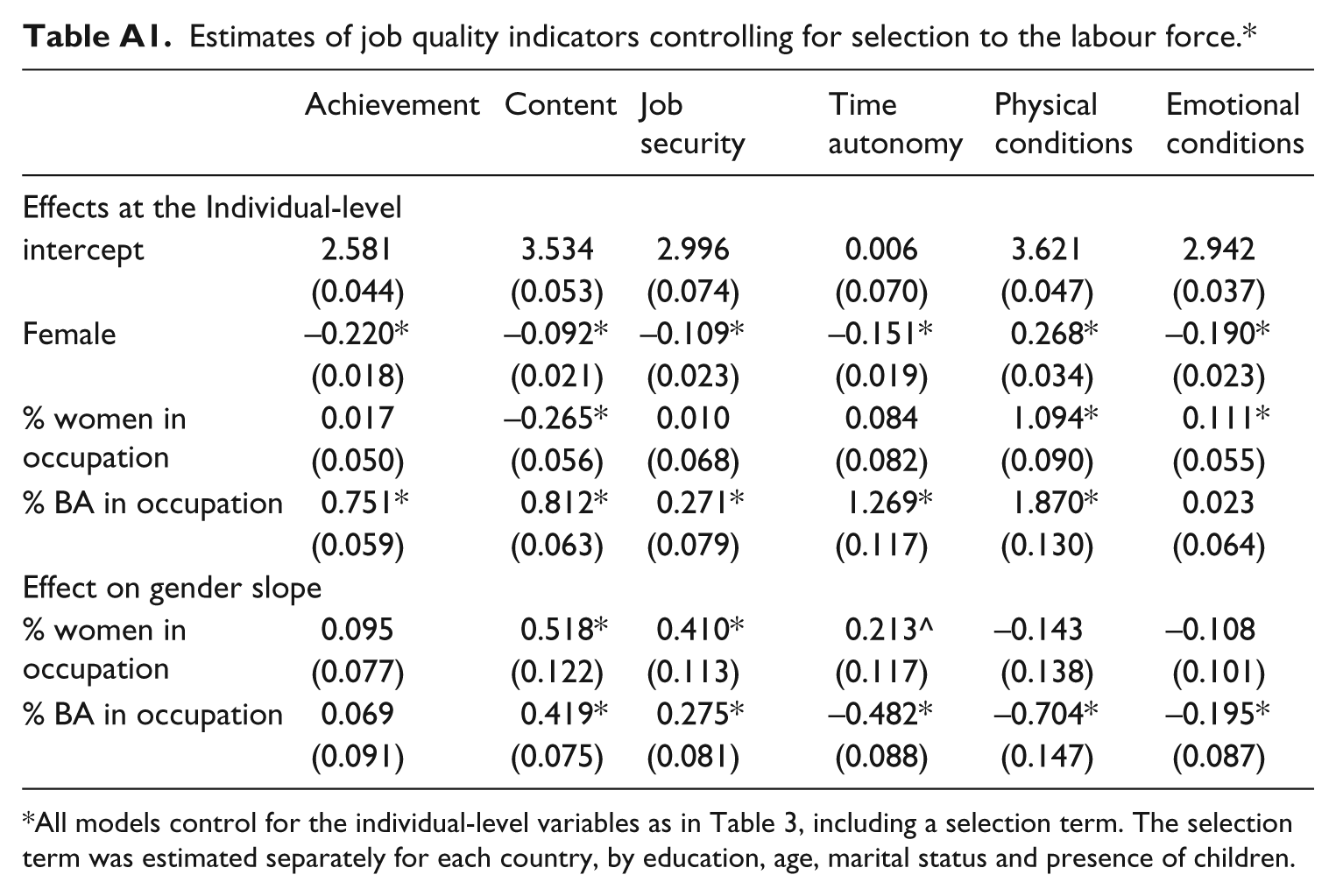
| Achievement | Content | Jobsecurity | Time autonomy | Physical conditions | Emotional conditions | |
|---|---|---|---|---|---|---|
| Effects at the Individual-level | ||||||
| intercept | 2.581 | 3.534 | 2.996 | 0.006 | 3.621 | 2.942 |
| (0.044) | (0.053) | (0.074) | (0.070) | (0.047) | (0.037) | |
| Female | −0.220* | −0.092* | −0.109* | −0.151* | 0.268* | −0.190* |
| (0.018) | (0.021) | (0.023) | (0.019) | (0.034) | (0.023) | |
| % women in occupation | 0.017 | −0.265* | 0.010 | 0.084 | 1.094* | 0.111* |
| (0.050) | (0.056) | (0.068) | (0.082) | (0.090) | (0.055) | |
| % BA in occupation | 0.751* | 0.812* | 0.271* | 1.269* | 1.870* | 0.023 |
| (0.059) | (0.063) | (0.079) | (0.117) | (0.130) | (0.064) | |
| Effect on gender slope | ||||||
| % women in occupation | 0.095 | 0.518* | 0.410* | 0.213^ | −0.143 | −0.108 |
| (0.077) | (0.122) | (0.113) | (0.117) | (0.138) | (0.101) | |
| % BA in occupation | 0.069 | 0.419* | 0.275* | −0.482* | −0.704* | −0.195* |
| (0.091) | (0.075) | (0.081) | (0.088) | (0.147) | (0.087) | |
All models control for the individual-level variables as in Table 3, including a selection term. The selection term was estimated separately for each country, by education, age, marital status and presence of children.
Acknowledgements
We would like to thank Efrat Herzberg and Dina Maskileyson for their valuable research assistance and helpful comments.
Funding
This study was supported by Israel Science Foundation, grant no. 323/10.