



Abstract
Using a national population survey, this article examines how high-involvement work processes affect employee well-being. The analysis shows that greater experiences of autonomy and participation in decision-making have positive or neutral effects. Higher involvement is a key factor predicting higher job satisfaction and better work–life balance while it has no relationship to stress or fatigue. In contrast, higher levels of work intensity increase fatigue and stress and undermine work–life balance. If the quality of working life is a key objective in a reform based on greater employee involvement, close attention needs to be paid to the balance between processes that release human potential and those that increase the intensity of work.
Keywords
Introduction
In contrast to Taylorist forms of work organization, the high-involvement model fosters the participation of workers in decisions about their work. It aims to enhance their scope to exercise discretion and assume responsibility. Such a process holds the promise of releasing untapped human potential through greater use of workers’ existing skills and greater opportunities for learning (e.g. Ashton and Sung, 2002; Felstead et al., 2010; Gallie, 2013). It thus forms an important stream of thought within the wider literature on how to create high-performance work systems (HPWSs). As in that literature generally, a fundamental question is whether such reforms deliver what they promise (Boxall and Macky, 2009; Godard, 2004). There are both serious questions around the circumstances under which they might benefit employers (e.g. Cappelli and Neumark, 2001; Kaufman and Miller, 2011) and a line of critique that the outcomes for workers are mixed, at best, or decidedly malign, at worst (e.g. Danford et al., 2008; Ramsay et al., 2000; White et al., 2003).
Using a national population survey, our goal in this article is to address the question of how involvement processes affect worker well-being. The survey measures workers’ job satisfaction, fatigue, stress and work–life balance when they experience greater levels of job autonomy and participation in decision-making, and assesses their perceptions of three related dimensions of their employment context: the quality of channels for management communication and employee voice, the strength of effort–reward linkages and the quality of training and development opportunities. The analysis compares the effects of these processes with the impacts of work intensity on employee well-being, along with a range of demographic and job-quality controls.
The article commences with the literature on high performance and high involvement. Within this body of research, it is important to include work intensification in the assessment of employee well-being. The article then undertakes an analysis of a survey of New Zealand workers, which was designed to assess the impacts of involvement processes and work intensity on a range of measures of well-being. The article finishes with our discussion and conclusions.
High performance, high involvement and work intensification
Studies of high-performance work systems continue to attract the interest of researchers, policy makers and practitioners who are concerned with how the quality of workplace relations can be improved (Lloyd and Payne, 2006; Stewart and Danford, 2008). However, efforts to reach any kind of conclusion about the outcomes of HPWSs are affected by the fact that the terminology is inherently non-descriptive. What is highly performing is not self-evident and the practices that constitute a HPWS are subject to a confusing array of definitions and assertions (e.g. Becker and Gerhart, 1996; Wood, 1999). Furthermore, when one moves away from any single national context, socio-cultural variations in employment practices have to be accommodated (e.g. Gallie, 2007; Paauwe and Boselie, 2003). Even if a set of context-delineated practices could be agreed upon as likely to enhance performance, there is the problem that data that simply count practices, or even the proportion of the workforce covered by them, do not account for variations in how the practice is implemented, which is critical from the worker perspective (e.g. Marchington and Grugulis, 2000; Purcell, 1999). The ‘how’ of work and employment practices is decisive, especially with complex practices such as teamwork and performance appraisal. Do workers experience genuine improvements in their autonomy as a result of the development of team-based production or do they experience these changes as increasing their work pressures without commensurate improvements in their discretion? Do they experience the advent of a performance appraisal system as enhancing their opportunities for personal growth or do they perceive it as an increase in bureaucratic control, which reduces their chances to express themselves? Observers cannot know the answer to such questions simply by taking these practices at face value and ignoring how they are experienced by workers. The how question is critical to any kind of theoretical explanation of high performance and to an understanding of the impact on employees. Assuming that certain practices are inherently highly performing and/or beneficial to workers is therefore a major mistake.
There are, fortunately, two main variations on the HPWS terminology that are more descriptive of the nature of the underpinning process (Ramsay et al., 2000; Wood, 1999). One term traces back to Walton (1985) and is concerned with ‘high-commitment’ practices. Higher commitment, however, can be achieved through policies that improve fairness, trust and employment security without touching the design of work (Boxall and Macky, 2009). The other term traces back to Lawler (1986) and is concerned with ‘high-involvement’ management. This term implies efforts to redesign jobs to enhance worker responsibilities and authority, using empowerment – greater task discretion and participation in decision-making – as the gateway to higher performance (Kalleberg, 2011). It is associated with companion improvements in skill development, managerial communication and incentives to participate, as envisaged in the model developed by Appelbaum et al. (2000).
Such terms are a better way of describing workplace reforms because they indicate the dominant theme underpinning managerial action. They are not, of course, without their complexities. Involvement, for example, can vary in the levels at which it occurs. Wood et al. (2012), in an analysis of WERS 2004 data, distinguish between role-based involvement or ‘enriched job design’ and wider, organizational involvement, in which they include quality circles, team briefing, formal teams and appraisals, inter alia. The desired outcomes can also vary. Management may pursue greater employee involvement to enhance the quality of individual work or to improve organizational processes, including coordination among workers (e.g. Gittel et al., 2010), innovation within and across work teams (e.g. Hoyrup, 2010), or the quality of its relationships with labour (e.g. Frenkel et al., 2013). Some blend of these outcomes may be sought. Despite these complexities, terms such as ‘high involvement’ pick up a shift in management philosophy in a way that ‘high performance’ does not.
The other virtue of using such terms is that they do not assume that ‘the particular configuration of management practices is necessarily performance-enhancing’ (Bryson et al., 2005: 460). This has to be demonstrated, not treated as self-evident. In Wood et al.’s (2012) study, greater organizational involvement has a negative effect on organizational performance, via lower job satisfaction, which actually undermines its positive, direct effects. Whatever they are called, it is unwise to assume that workplace reforms will have beneficial impacts on the stakeholders they affect.
Lawler’s (1986) framework has been developed further by Vandenberg et al. (1999) in a model in which high-involvement processes link to worker psychological states and organizational effectiveness through two paths: a cognitive path which takes ‘greater advantage of the skills and abilities’ employees possess, and a motivational path which increases ‘workers’ satisfaction and other affective reactions’ (Vandenberg et al., 1999: 304). Their framework operationalizes Lawler’s (1986) ‘PIRK’ rubric: power (P), information (I), rewards (R) and knowledge (K). High-involvement processes enable workers to exercise greater control over their work and participate in those decisions that concern them (the power or autonomy dimension), enhance the quality of communication and voice supporting this involvement process (information), reward workers fairly for their contribution to success (reward) and provide the training and development they need to participate effectively (knowledge). The model can be applied to both individual and team-based forms of empowerment and, through its incorporation of communication processes and perceptions of reward fairness, goes some way towards recognizing the embeddedness of empowerment within the social context of the organization. Existing studies using this framework find that worker attitudes are more positive, and well-being is enhanced, when they experience greater levels of these involvement processes (e.g. Mackie et al. 2001; Macky and Boxall, 2008; Vandenberg et al., 1999).
It is this model, in which worker autonomy and participation in decision-making are central, that is used in this study to assess the impacts of high-involvement work processes (HIWPs) on employee well-being. As Gallie (2007: 4–9, 212–13) explains, multiple theoretical traditions see the question of autonomy or control as fundamental to the quality of working life. It is important in enabling employees ‘to make use of their individual creativity in work and to develop their abilities over time’ (Gallie, 2007: 212), as demonstrated in analysis of the British Skills Survey 2006 (Felstead et al., 2010; Gallie, 2013). The Lawler (1986) framework recognizes this. A weakness, however, is that it does not address the relationship between involvement processes and work intensity, which has important implications for worker well-being. In the Employment in Britain survey, for example, Gallie et al. (1998: 42–3, 79–80) found that up-skilling and greater levels of task discretion were associated with higher levels of work intensity, with mixed impacts on employee well-being. More recently, Kalleberg et al. (2009) and Gallie et al. (2012) report greater stress or pressure in self-managing teams. To create a more comprehensive assessment of how HPWSs affect employee well-being, then, work intensity ought to be studied alongside employee involvement, as implied by Karasek and Theorell’s (1990) psychosocial model of job strain. In their framework, the physical and psychological health of workers is at greatest risk when high levels of work demand are accompanied by low levels of worker control. Intensified work puts greater demands on an individual’s resources, and is associated with greater fatigue (e.g. Ono et al., 1982), physiological and psychological health deterioration (e.g. Sparks et al., 1997) and work–family conflict (e.g. Eby et al., 2005). Work overload has also been linked to lower job satisfaction (e.g. Yousef, 2002), while work under intensified pace and demands is associated with increased stress (e.g. Landsbergis et al., 1999).
Like HPWSs, the definition and measurement of work intensity poses some issues. The simplest measure relates to the hours that individuals work. In Britain, those working 48 hours or more a week report a much higher level of work strain (Gallie et al., 1998: 224–5). Working hours, however, are an ambiguous indicator of intensification because there are various reasons why employees choose to work extended hours (Drago et al., 2009). It is therefore preferable to include measures of the qualitative experience of effort demands and work overload (Gallie et al., 1998; Macky and Boxall, 2008), such as assessments of the level of pressure workers feel during their work. Green (2006) shows this to be one of the two principal causes, along with declining task discretion, of a recent decline in British job satisfaction. Our approach, then, is to measure hours worked, as well as whether employees experience overload in what is expected of them in their work and whether they feel pressure to take work home or work longer than they desire. This can happen when greater involvement in decision-making requires greater effort through exposure to problems that are more difficult, or take longer, to solve. It can also happen in lean-production environments that are accompanied by heightened production pressure (Danford et al., 2008; Delbridge, 2007; Eurofound, 2012). However, researchers should not imagine the issue is mainly a problem in assembly-line or lean environments. In the Employment in Britain survey, Gallie et al. (1998: 221–3) found that the highest level of work strain was associated with ‘people-work’, for which professionals and managers have greater responsibility.
In this study, then, measurement includes the impact on employee well-being of both involvement processes and those that increase their work intensity. Based on the literature reviewed, positive outcomes are predicted from higher levels of involvement and negative outcomes from higher levels of intensity, giving the following hypotheses:
Hypothesis 1: Employees reporting greater autonomy, better two-way communication, a stronger linking of rewards to performance, and better opportunities for training and development will report better well-being in terms of satisfaction, fatigue, job-induced stress and work–life balance.
Hypothesis 2: Employees experiencing greater work intensity will report poorer well-being in terms of satisfaction, fatigue, job-induced stress and work–life balance.
Method
Our survey is based on scales that measure worker perceptions of what is happening in their work, and is not reliant on management reports of the practices that are assumed to enhance employee involvement. Management reports are frequently different from, and more positive than, those of employees (e.g. Geare et al., 2006). Employee perceptions of what is happening to them at work, rather than someone else’s statements about that environment, are the stronger influence on their attitudes, behaviour and well-being (e.g. Wood and De Menezes, 2011). For these reasons, it is appropriate that our level of measurement is the individual employee. However, the study is potentially subject to the methodological artifact of common-method variance. Following Whitener’s (2001) example, a factor analysis of all scale variables was performed (available on request) and found most items to clearly load onto the expected separate factors. For the unrotated solution, 32.3 per cent of the variance was accounted for by the first factor, which goes some way to obviating common-method concerns. In addition, following Conway and Lance (2010), only measures with well-established construct validity were used and, as outlined below, satisfactory internal reliability (see Table 1). And, finally, the questionnaire was structured such that the dependent variables were measured before the independent variables, reducing the likelihood of social desirability contributing to common-method variance (Kline et al., 2000). The questionnaire also contained reverse-scored items in an attempt to reduce response acquiescence effects. Unless stated below, Appendix 1 shows all items for the measures used, with reverse-scored items indicated by (R).
Correlations and descriptive statistics.
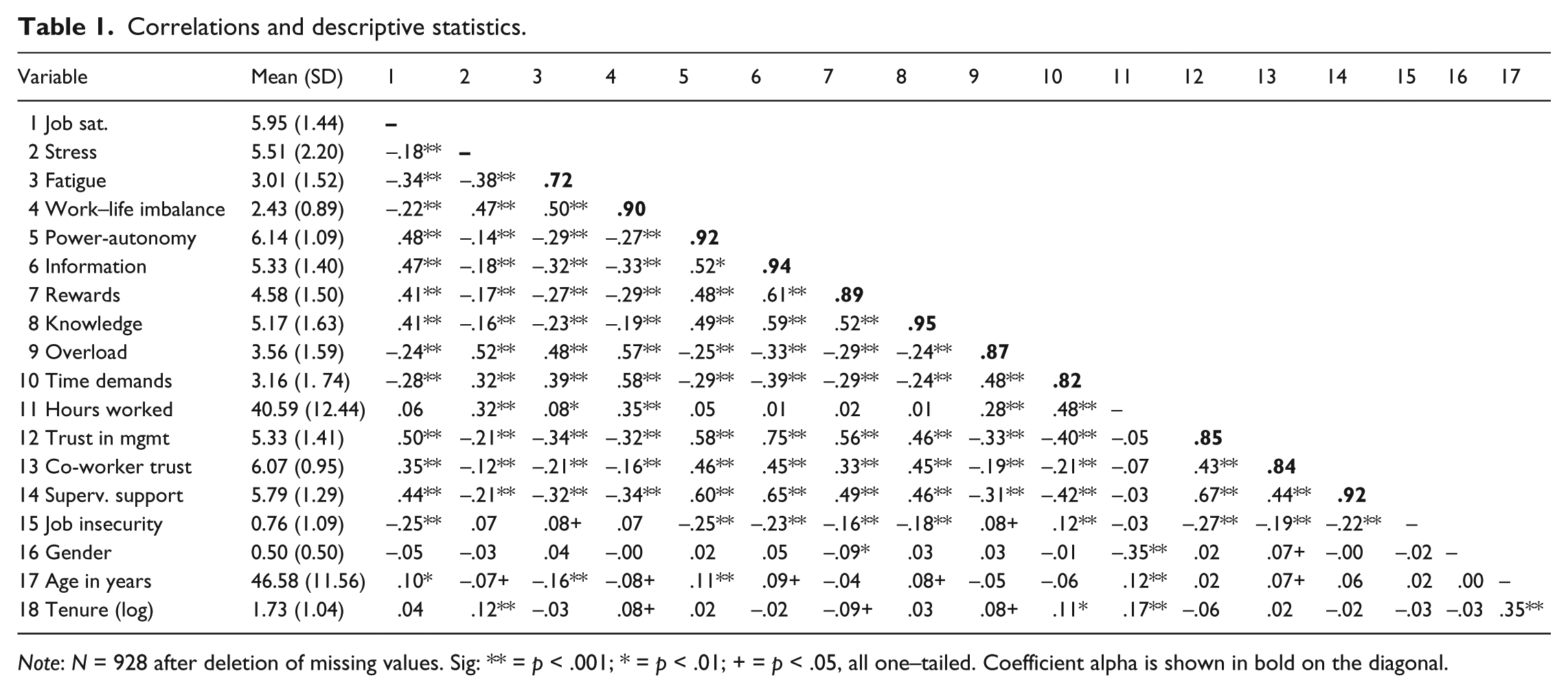
Note: N = 928 after deletion of missing values. Sig: ** = p < .001; * = p < .01; + = p < .05, all one–tailed. Coefficient alpha is shown in bold on the diagonal.
Data collection and participants
Data were collected in 2009 using computer-assisted telephone interviewing (CATI). Random sampling with replacement for ineligible contacts and no-contacts was used, with three call-backs before a contact was replaced. To be eligible, those contacted needed to be at least 18 years of age, to have worked for their current employer for more than six months (to control for the possibility that newer employees would have too little experience of the firm’s management practices) and to work in a firm with at least 10 employees.
A total of 1016 people were interviewed, giving a response rate of 31.5 per cent. Just over half of the participants were male (50.3%). The average age was 46.87 years (SD = 11.58), the median tenure was six years (range: six months to 52 years). Most respondents were permanent full-time (71.3%) or part-time employees (19.4%) and worked an average of 40.43 hours per week (SD = 12.29). Only a small number were on limited or fixed-term employment agreements, either part-time (4.7%) or full-time (4.5%). Over two-thirds (69.7%) were in a workplace with a union that they could join, with 55.5 per cent of these being a member of that union. Occupations were coded using the Australian and New Zealand Standard Classification of Occupations (ANZSCO). The majority of the respondents were either managers (21.4%) or professionals (34.6%), followed by clerical and administrative employees (16.0%), technical or trades occupations (11.7%), an aggregate group of labourers, machine operators and drivers (9.8%) and, lastly, sales workers (6.4%). Comparing these occupational codes with those of the 2006 New Zealand Census found no statistically significant differences (χ2 (5) = 7.66, p = .176). Similarly, no significant differences were found for full-time/part-time status (χ2 (1) = 0.06, p = .812) or respondent gender (χ2 (1) = 0.36, p = .548). In these terms, the respondent sample appears broadly similar to the population to which it belongs.
Intensification and involvement variables
While participants were asked to report on the hours usually worked each week, work intensity was measured through perceived role overload and managerial demands on personal time. Role overload, defined as ‘having too much work to do in the time available’ (Beehr et al., 1976: 42), was measured using a six-item scale. Time demands refers to the expectations that managers place on an employee’s time that might interfere with non-work activities, and was measured using a slightly modified four-item measure developed by Thompson et al. (1999) (see Appendix 1). Responses on both measures were obtained on 7-point Likert-type scales, bounded from 1 = strongly disagree to 7 = strongly agree, with higher scores therefore indicating higher levels of role overload and time demand.
Following Lawler’s (1986) PIRK framework for employee involvement, the four involvement scales developed by Vandenberg et al. (1999) were used. Responses for all items (see Appendix 1) were obtained on a 7-point Likert scale bounded from 1 = strongly disagree to 7 = strongly agree, with higher scores indicating higher involvement. The power-autonomy variable (seven items) measures the extent to which employees feel they can control how they do their job and can participate in relevant decisions, while information (11 items) measures the extent to which employees feel there is effective communication with management. The rewards variable (nine items) taps the extent to which employees feel rewarded for their effort and performance, while the knowledge variable (eight items) is concerned with the extent to which employees feel they are provided with the training and development opportunities they need.
Employee well-being variables
Employee well-being can usefully be thought of as encompassing happiness, health and relationship-oriented elements (Grant et al., 2007). The survey includes global job satisfaction, as an indicator of overall happiness with the job, but complements it with the health-related concepts of fatigue and stress and the relationship-oriented notion of work–life balance.
Global job satisfaction was measured using a slightly modified version of Warr et al.’s (1979) single-item measure: ‘Taking everything into consideration, how satisfied do you feel with your job as a whole?’ Responses were obtained on a seven-point scale bounded from 1 = very dissatisfied to 7 = very satisfied. Single-item measures of job satisfaction have been found to have adequate convergent validity with multi-item measures of satisfaction (Oshagbemi, 1999; Wanous et al., 1997).
Job-related stress was also measured using a single item (Stanton et al., 2001). The wording was: ‘On a scale of 1 to 10, how would you rate the amount of stress you feel in your job, where 1 is no stress and 10 is extreme stress?’ Stanton et al. (2001) found that this item correlated well with multi-item measures of job pressure, a physiological measure of work stress, and perceived threat in the experience of work, while Macky and Boxall (2008) found a correlation of 0.72 between this measure and a seven-item measure of job-induced stress. As with the job satisfaction measure, this measure helped to reduce questionnaire length.
Fatigue was measured using Beehr et al.’s (1976) three-item scale (see Appendix 1), with responses obtained on a seven-point Likert scale from 1 = strongly disagree to 7 = strongly agree. A slightly modified instrument Frone and Yardley (1996) developed to measure work–family conflict was used to measure work–life imbalance. The wording of the six items goes somewhat beyond family to include negative work spill-over to non-familial aspects of personal life and friendship. The response scale was ‘never, seldom, sometimes, often, very often’ (scored from 1 to 5), with higher scores suggesting greater work–life imbalance.
Control variables
To control for job-quality variables other than involvement and intensification, four variables were included in the analyses: trust in management, trust in co-workers, perceived supervisor support and perceived job insecurity. With the exception of job insecurity, responses were obtained on a 7-point agree–disagree Likert scale, with higher scores indicative of higher trust and perceived support.
Trust in management and trust in co-workers were both measured using Cook and Wall’s (1980) six-item scales. In both instances, trust represents the degree of faith placed in the intentions of others and confidence in their abilities, with connotations of reliability and capability. Perceived supervisor support was measured using a modified version of the eight-item short form for perceived organizational support (e.g. Rhoades and Eisenberger, 2002). Where the original items referred to ‘my’ and ‘organization’, the words ‘your’ and ‘manager’ were substituted (see Appendix 1).
Job insecurity perceptions were measured using a single item where respondents were asked ‘How likely do you think it is that you will be made redundant or lose your job through organizational downsizing or restructuring in the next two years?’ with a response scale from 0 = not at all likely to 5 = extremely likely.
Demographic control variables included in the analyses were respondent age in years, gender (1 F, 0 M), tenure (log), unionized or not (1,0), permanent or temporary employment (1,0), full-time or part-time (1,0) and dummy variables for each occupational group. Due to its non-normal distribution, the natural log for tenure was used. While the age and hours worked variables have large standard deviations relative to the means, their distributions do not depart from the normal.
Results
Means and standard deviations for all variables, together with the simple correlations between variables, are shown in Table 1. Coefficient alphas for the scale variables are shown on the diagonal, and indicate that all have satisfactory reliability. Excluded from this table, in the interests of space, are those demographic variables (occupational category, unionization and permanent–temporary employment status) that the multivariate analyses (Tables 2 to 5) show do not predict employee well-being.
Hierarchical regression: standardized coefficients for job satisfaction.

Note: N = 928 after list-wise deletion of missing values. Sig: *** = p < .001; ** = p < .01; * = p < .05.
Hierarchical regression: standardized coefficients for fatigue.

Note: N = 928 after list-wise deletion of missing values. Sig: *** = p < .001; ** = p < .01; * = p < .05.
Hierarchical regression: standardized coefficients for job-induced stress.
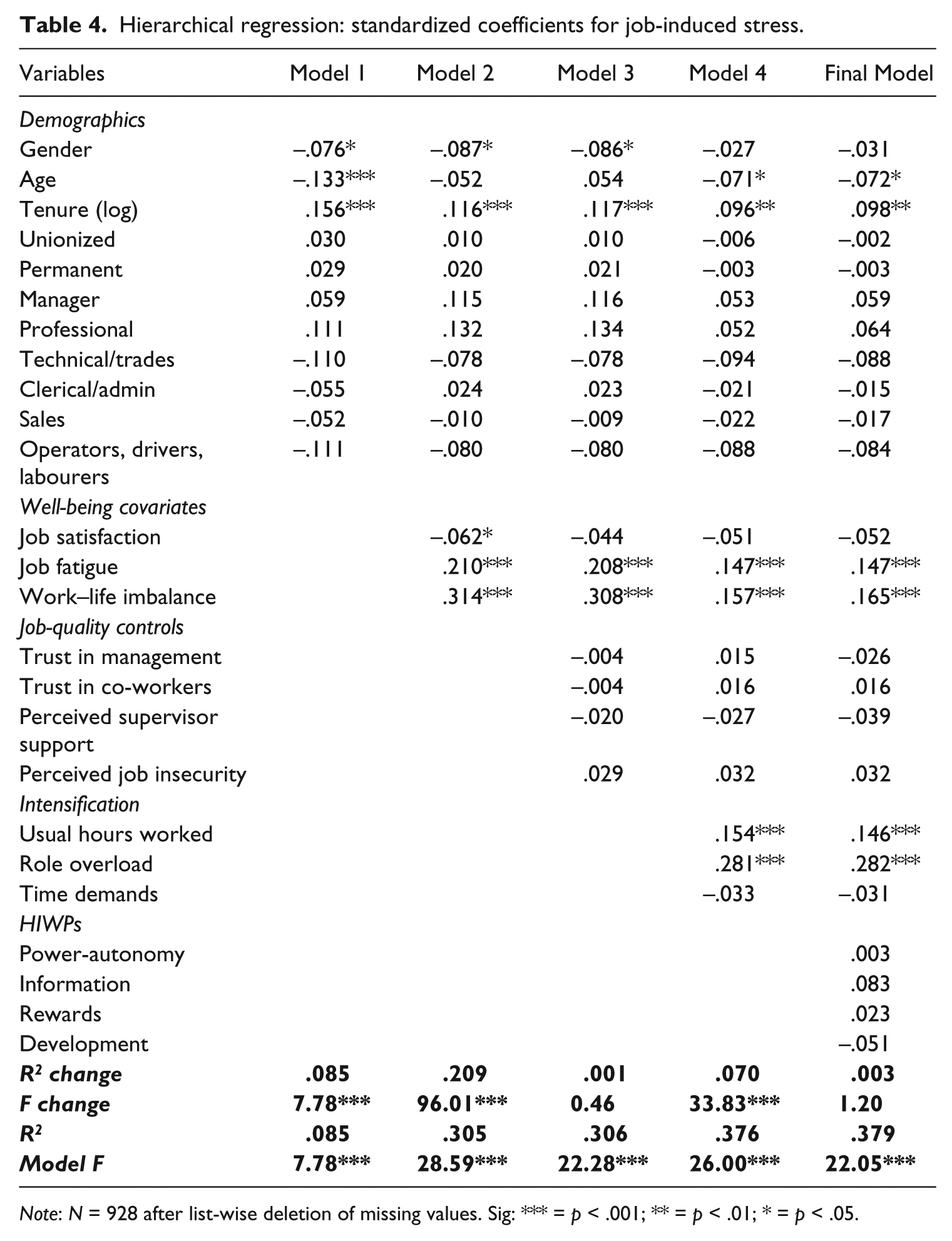
Note: N = 928 after list-wise deletion of missing values. Sig: *** = p < .001; ** = p < .01; * = p < .05.
Hierarchical regression: standardized coefficients for work–life imbalance.
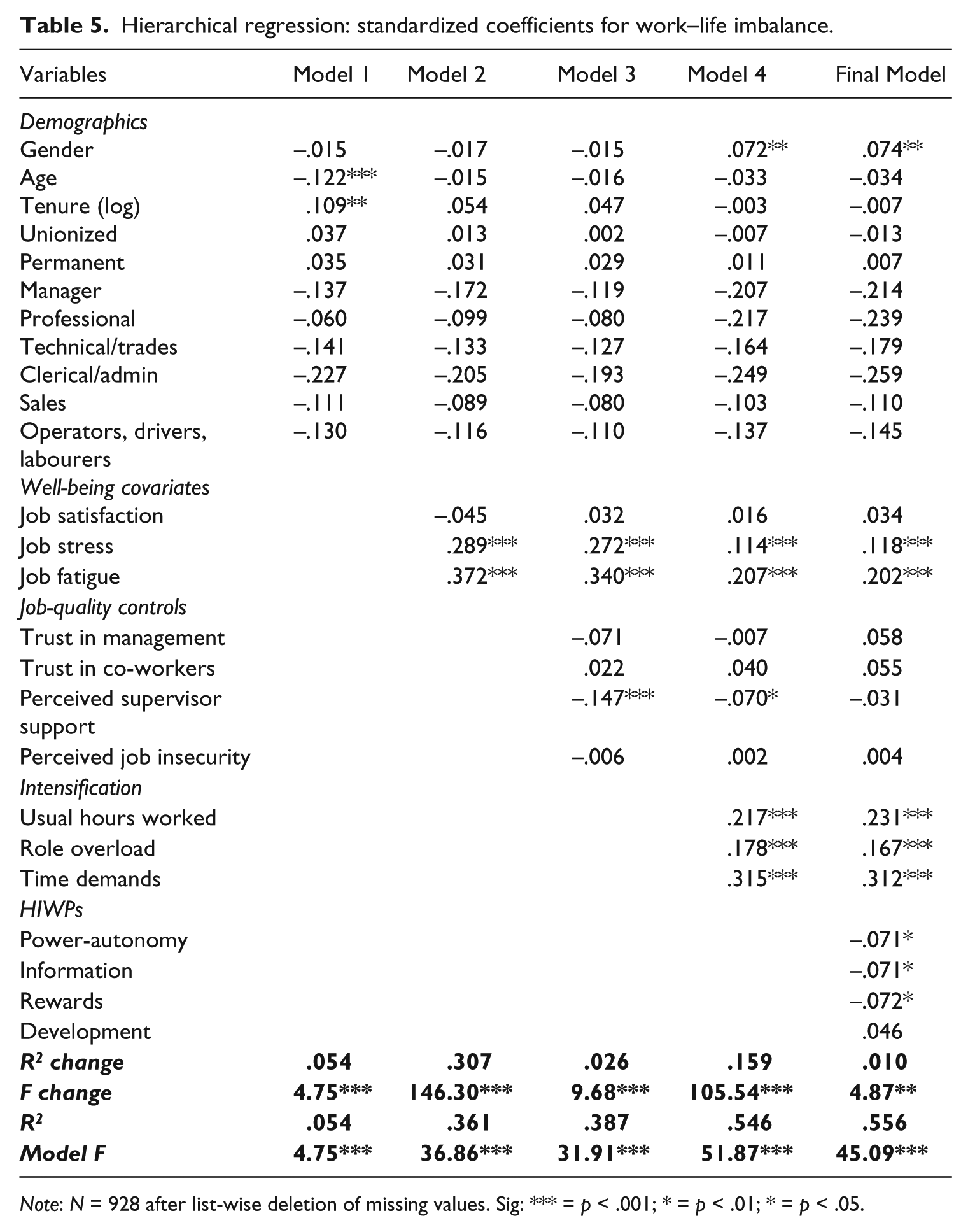
Note: N = 928 after list-wise deletion of missing values. Sig: *** = p < .001; * = p < .01; * = p < .05.
Several patterns can be observed from Table 1. First, all four PIRK involvement variables are significantly but negatively correlated with both role overload and time demand variables. In other words, higher levels of power, a better quality of information sharing, a stronger connection between effort and reward, and better development opportunities tend to be associated with reports of lower overload in the work role and lower demands by managers on personal time. This implies that involvement and intensification processes are clearly differentiated in the minds of New Zealand workers.
Secondly, the four high-involvement variables are also connected to other indicators of job quality, with higher involvement associated with greater trust in management and co-workers, higher levels of perceived support from one’s supervisor and lower expectations of being involuntarily removed from employment. The relationships between involvement and the well-being variables are also informative, with, as predicted in hypothesis 1, higher involvement levels being associated with lower levels of job-related stress, lower reported fatigue, reduced levels of negative spill-over from work to non-work life and higher job satisfaction.
Consistent with hypothesis 2, role overload and work pressure are associated with lower job satisfaction, higher stress levels, greater fatigue and greater work–life imbalance. Hours usually worked in a week are also associated with higher reported stress, poorer work–life balance and, to a lesser degree, fatigue.
Multivariate analyses
Given the number of significant relationships with the employee well-being variables shown in Table 1, hierarchical regression analyses were performed for each dependent variable to further test the hypotheses proposed here and shed light on which variables most clearly predict employee well-being (Tables 2 to 5). In each analysis, the respondent demographic variables were entered as potential control variables as a first block. The second block in each regression model contained the employee well-being covariates. While the tolerance and VIF indicators of multicollinearity were all found to be within the acceptable limits proposed by Hair et al. (1998), it can be anticipated that at least some of the variance in each well-being variable is explained by the others. The third block of variables contained the job-quality control variables of manager and co-worker trust, supervisor support and perceived job insecurity. The final two blocks contained the three intensification and four high-involvement variables, respectively.Each block was entered separately to identify the amount of variance independently explained by these different types of predictor variable.
For job satisfaction, the final regression model explains 37 per cent of the variance (Table 2). The strongest predictors in the model are trust, autonomy and fatigue, followed by opportunities for development, rewards and perceived job insecurity. Having greater job autonomy, experiencing a stronger link between performance and reward and having better access to development opportunities are all predictive of job satisfaction while lower trust, greater fatigue and greater perception of job risk predict dissatisfaction. Interestingly, none of the three intensification variables significantly predict job satisfaction, although it is reasonable to expect these to influence fatigue (Table 1). Supervisor support and trust in co-workers drop out of the model when the involvement variables are added, suggesting that involvement mediates the influence of support and co-worker trust on satisfaction.
In contrast, work intensification predicts employee fatigue (Table 3) and stress (Table 4), while none of the high-involvement variables do so. The regression model explains nearly 40 per cent of the variance in fatigue, with work–life imbalance and role overload the strongest predictors. The results imply that fatigue is a function of experiencing greater role overload, or work pressure, in fewer hours (the sign for overload is positive while that for hours worked is negative).
The regression model shown in Table 4 explains nearly 38 per cent of the variance in job-induced stress. Greater role overload and longer working hours are clear predictors of higher stress, together with fatigue and work–life imbalance. The addition of the involvement variables makes no significant improvement in the explanatory power of the final regression model.
The work–life imbalance model is the strongest of the four, with 55 per cent of the variance explained (Table 5). All three intensification variables significantly predict imbalance (collectively explaining nearly 16% of the variance), with perceived time demands from managers being the strongest single predictor followed by hours worked and overload. Three of the four high-involvement variables negatively predict imbalance, suggesting that having greater autonomy, receiving rewards based on merit and perceiving a better quality of communication with management may have a mitigating effect on jobs characterized by intense work.
Discussion and conclusions
Our national population survey including multiple measures of involvement, intensification and employee well-being, together with a wide range of controls, enables a rich picture of the relationships among these variables to emerge. The multivariate analyses show that high-involvement work processes are associated with greater satisfaction and better work–life balance and have no relationship with fatigue and stress, which means that hypothesis 1 is largely supported. Similarly, hypothesis 2 is largely supported because work intensification, particularly through role overload, is associated with greater fatigue, stress and work–life imbalance.
While women have worse work–life balance, and age and tenure are implicated in stress, an individual’s occupational category is not, in itself, a predictor of negative outcomes. Although this is not a finely-grained analysis of occupation, it is consistent with Van Veldhoven et al.’s (2002) study of a large sample of the Dutch workforce and echoes Green’s (2006, 2008) analysis, which shows the detrimental impact of declining discretion and rising bureaucratic control in professional occupations. In other words, negative forces can undermine job quality at any level.
Our findings must, of course, be viewed in relation to the study’s limitations. First, it is cross-sectional, restricting inferences about causality, although this limitation is somewhat mixed. While happier workers might be offered greater opportunities for involvement, it is much less likely that stress, fatigue and work–life imbalance cause work intensity than the other way round. Second, the study is limited by its New Zealand location, a country in which organizations are typically of smaller size and more informally managed, which may foster greater involvement and bring more positive attitudes to it. Third, the study does not incorporate management reports of practices but gathers data on the ways in which workers interpret their environment. This raises the issue of common method bias, something that should, for the most part, be regarded as unproblematic because the experiences of workers are most authentically reported by them. For the remaining concerns, such as social desirability, the precautions taken are noted in the method section. Recognizing these limitations, what do the results imply?
They suggest that workers distinguish between processes that foster their involvement in decision-making and those that intensify their working life, and that they see the former as providing gains to their well-being or, at the least, an absence of threat. Greater autonomy, fairer reward and better development opportunities are factors that contribute to higher job satisfaction. Higher involvement is also connected to a better balance between work and life. Very importantly, there are no significant connections between any of the involvement processes and the negative outcomes of stress and fatigue. Overall, then, this survey shows gains to workers from empowerment, and from the companion processes that foster it. As far as New Zealand workers are concerned, this vector of change is benign. These findings confirm prior research using the Lawler model (Mackie et al., 2001; Macky and Boxall, 2008; Vandenberg et al., 1999) and resonate with analysis of WERS 2004 (Wood et al., 2012) and the British Skills Survey 2006 (Felstead et al., 2010; Gallie, 2013).
In stark contrast, our results show that higher levels of work intensity pose risks to employee well-being, increasing fatigue and stress and contributing to work–life imbalance. They imply that the risks are there in every occupational category, including, it should be noted, management. No matter where a person’s job is located in the occupational spectrum, excessive pressure can undermine their well-being while greater autonomy, and supportive processes, can enhance it.
What are the implications for the debate around high-performance work systems? In a nutshell, one can expect implementations of HPWSs to be beneficial for workers when two conditions are met. First, the individual’s experience of autonomy is genuinely improved, fostering the skill utilization and creativity that can come from greater control (e.g. Felstead et al., 2010; Gallie, 2013). This, as Appelbaum et al. (2000) argue, is likely to work best when involvement sits within an organizational context that fosters good communication, reward fairness and individual development. These factors show a positive contribution to well-being on top of job-based empowerment and participation in decision-making. Second, employee welfare is more likely to be safeguarded when the accompanying effort levels are tolerable: when workers do not experience excessive in-work pressure or unwanted demands on their personal time.
In reality, financial and production pressures will continue to influence the design and implementation of work reforms (e.g. Eurofound, 2012). However, if a better quality of working life is a key objective in a reform based around employee involvement, close attention needs to be paid to the balance between releasing human potential and increasing work intensity. Employee well-being is more likely to improve when the scope for discretion and creativity is enhanced while simultaneously ensuring that workloads are reasonable and that workers can lead balanced lives.
Footnotes
Appendix 1
Funding
This research received no specific grant from any funding agency in the public, commercial, or not-for-profit sectors.