




Abstract
This article considers points of convergence and divergence in English-language publications in the sociology of professions. While research on professions in the US, UK, Canada and Western Europe shares many similarities, UK researchers have devoted more attention to professional regulation, while their US counterparts focus instead on organizational challenges facing professionals. Contrasting these empirical and theoretical approaches opens up new research directions, and highlights the importance of socio-historical and cultural context to professions. More international and comparative work is required to develop a better understanding of professions and professional regulation.
Recently two American sociologists announced the death of the sociology of professions. In their 2011 article, Gorman and Sandefur declare that the field has been in major decline since the 1960s, although the study of knowledge and expert work is alive and well, and living under alternate names – the ‘sociology of occupations’, ‘sociology of organizations’ and ‘social inequality’. According to Gorman and Sandefur (2011: 276–81) scholars began to find the field conceptually and theoretically moribund, so they decided to take their research in new directions. While formerly researchers studied professional power and privilege, they now focus on organizational arrangements and rationalization trends that threaten to deprofessionalize expert workers, as well as the changing career paths of knowledge workers (Gorman and Sandefur, 2011). An empirical focus on institutional arrangements and the labour market characteristics and experiences of expert workers appears to be becoming dominant, while broader theoretical frameworks have been abandoned (Gorman and Sandefur, 2011).
This present article questions this perspective, arguing that it is an inaccurate depiction of trends in the sociology of professions, and one that hangs on a narrow reading of American research on professions. Even a cursory glance at the sociological literature shows a thriving field characterized by both new empirical and theoretical developments, and a renewed interest in issues that concerned sociologists generations ago: professional development and organization; professional practice; state–profession relations; and professions’ roles in social governance. Growth in the field is partly due to an expansion of interest in professions in Europe – research that Gorman and Sandefur give short shrift – but there is continued interest in professions from American scholars as well. This article identifies dominant research interests over the last two decades, finding points of convergence and divergence across nation. Notably, researchers in the UK, Western Europe, Canada and Australia have identified significant changes in state–profession relations, and professional regulation. In contrast, US scholars are virtually silent on regulatory issues, focusing instead on organizational challenges faced by professions. Such divergences point to the need for international and comparative research on professions to improve theorizing and to develop a more accurate empirical picture of the changing nature of professions in Western societies.
Empirical research trends
The sociology of professions is a burgeoning research field. A search of the literature databases Sociological Abstracts and SocIndex for terms such as ‘professions’, ‘sociology of professions’ and ‘professions and professionalization’ shows generally steady publication growth since the 1950s. 1 As Figure 1 shows, the increase since the year 2000 is particularly notable. The increase identified may simply reflect a general increase in the number of journals, published research, and the greater international reach of the search engines. Nevertheless, there is little doubt that the field is thriving, with growing English-language research contributions from scholars based in Australia, Canada, the US, the United Kingdom and other European countries.
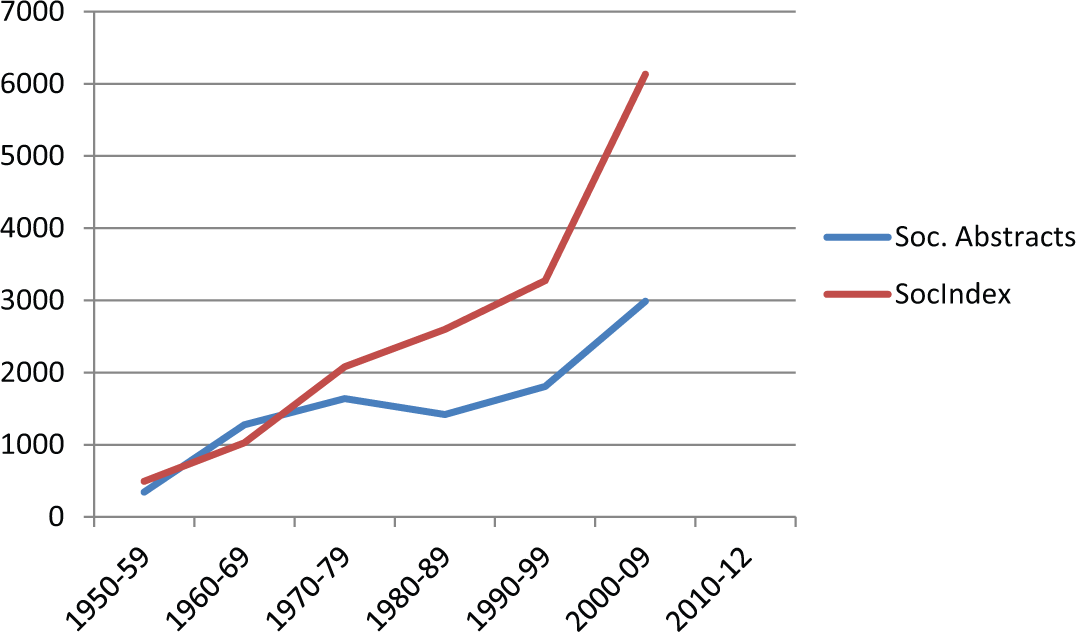
Number of publications listing ‘profession’ in the abstract in two databases.
Literature searches reveal that the sociology of professions is a broad field, encompassing numerous empirical directions. A look at approximately 500 articles, books and book chapters identified in a literature search for English-language publications on the ‘sociology of professions’ or ‘professional employment’ since 1988 reveals several dominant research themes. 2 The top 10 themes (articles and books typically have more than one) are shown in rank order in Table 1. As others have noted, the study of professions has long been characterized by at least two foci: (1) the study of professions as occupations, and a focus on professional work, labour markets, and inequalities; and (2) the study of professions as a component of social order and social regulation (Sciulli, 2009). Both of these major themes are well-represented in the literature reviewed here.
Ranked themes in publications in the sociology of professions after 1988 (by regional location of primary author).
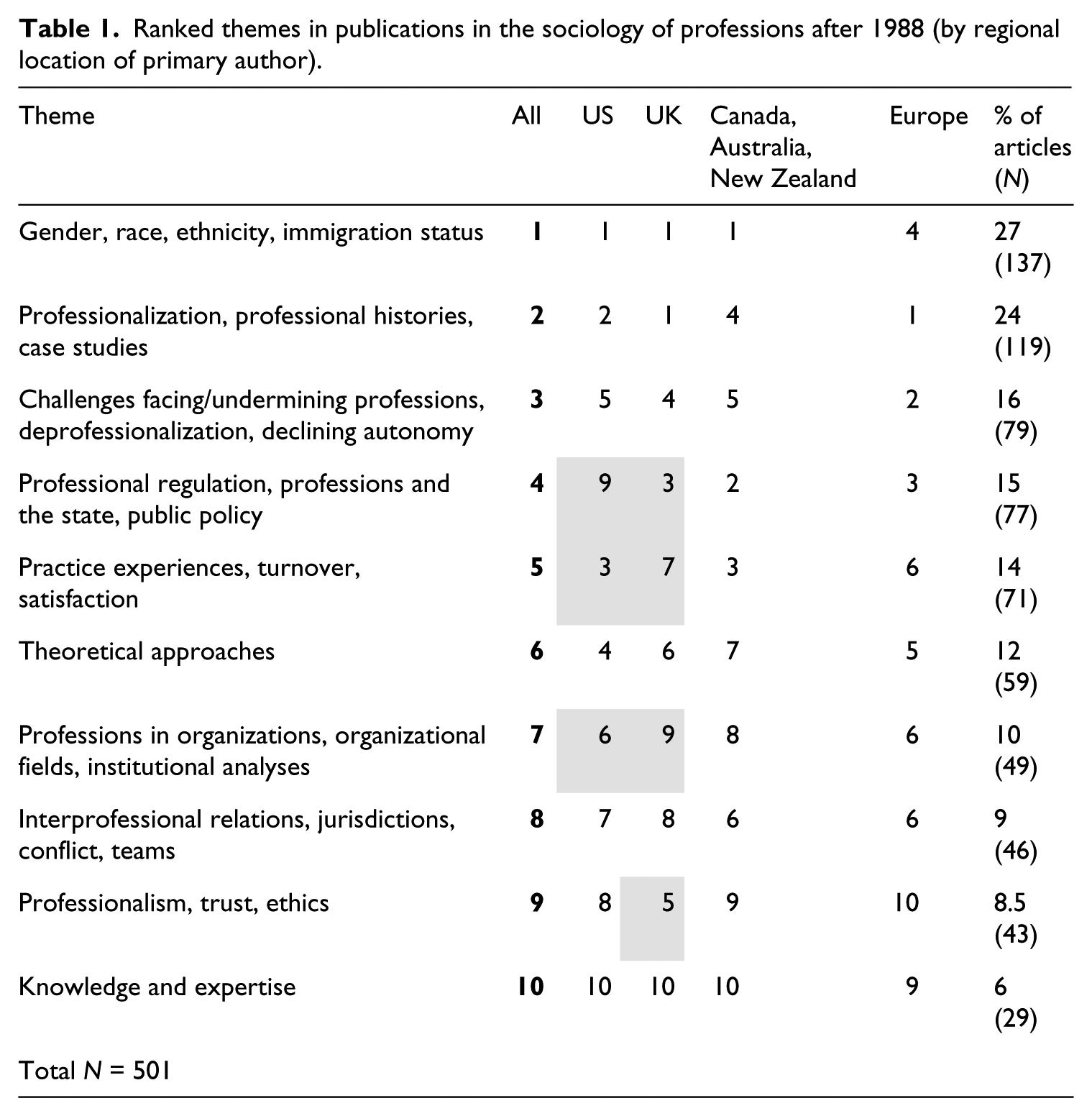
The most popular topic of articles on professions over the last 25 years has been inequalities in professional practice, and access to practice and rewards, by gender, race/ethnicity, immigration status and to a lesser extent, socio-economic status (in 27% of all articles identified). A large number of articles also document processes of professionalization and professional development, and/or provide case studies on the emergence of professional groups (24%). Also quite popular are the following: studies of deprofessionalization, challenges faced by dominant professions, and declining autonomy; studies of professional regulation, state–profession relations, and changing public policy affecting professions; and studies of the characteristics and experiences of professional workers, including accounts of labour turnover and job satisfaction. Rounding out the top 10 are theoretical articles: those exploring professions in organizations or applying organizational theory to professions; studies of interprofessional relations; and studies focusing on professionalism and trust, and/or knowledge and expertise. Scholars approach the field from many sociological traditions, including the sociology of work, social inequality, medical sociology, the sociology of law and the sociology of organizations. Health care professions (especially medicine and nursing) appear to be the most-studied groups, but the legal profession(s), social work, teaching, accounting, architecture, journalism and engineering are well-accounted for.
Empirical divergences across region and nation
A closer look at the themes and focus of English-language articles on professions reveals evidence of national similarities and differences, as shown in Table 1. The third to sixth columns rank themes by nation/region, where the latter reflects the institutional affiliation of a work’s first author. Some themes are popular across country/region: most notably, the focus on gender and other dimensions of inequality in professional practice. Some others differ. For instance, research focusing on professional careers, job satisfaction and turnover has tended to be more common in the US than in the UK or Europe, although research in this field has expanded dramatically in the UK since 2005: only two articles turned up in the search prior to 2004, but 16 were published by UK scholars between 2005 and 2013. The most dramatic difference can be seen in research on professional regulation. As a research area regulation and policy is ranked third in the UK, second in Canada and Australia and third in Europe, but ranks ninth in frequency in studies by US scholars. Most of the studies by American-based researchers that fall into this area are actually on state–profession relations more broadly, not regulation per se; scholars in other regions tend to discuss state–profession relations and professional regulation together. A few other differences are also worth noting. Firstly, UK literature has explored professionalism, professional ethics and trust more often than have researchers based elsewhere (for example, Evetts, 2011; Fournier, 1999; Thursfield, 2012). Secondly, while UK scholars have looked at the impact of organizational change on professional workers, they have not embraced organizational and institutional theory to the extent that their American counterparts have.
A closer look at these variations is revealing. In the UK, the third, fourth, fifth and sixth most common themes actually blend together to reflect a prominent research agenda over the last two decades. These themes include the following: regulation, policy, and state–profession relations; challenges to dominant professions; professionalism and trust; and theorizing about professions. Research on UK professions has identified a decrease in public trust in dominant professions (Dixon-Woods et al., 2011; Evetts, 2006), as well as regulatory and organizational changes that are combining to reduce professional self-regulation, change the nature and content of professionals’ work, and decrease professional autonomy (Allsop and Saks, 2003; Chamberlain, 2010; Collins et al., 2009; Dixon-Woods et al., 2011; Evetts, 2002; Kuhlmann et al., 2009). In fact, UK scholars have argued that self-regulation was perhaps never a common attribute of professions, and is now a relic of the past (Dixon-Woods et al., 2011; Evetts, 2002); however, dominant professions like medicine have been able to maintain their discretion, and are characterized as having ‘acquired regulation’ (Evetts, 2002).
Scholars from both the UK and Western Europe have also explored regulatory changes that have resulted from efforts to harmonize professional entry across the European Union, and reduce barriers to practise for the foreign-trained (Evetts, 1998; Johnson et al., 1995; Le Bianic and Svensson, 2008). 3 Further, researchers explore the impact of these changes on professional workers and their work (Prowse and Prowse, 2008), inter-professional relations (Currie et al., 2009; Prowse and Prowse, 2008) and their professional projects (Collins et al., 2009; Timmons, 2011). Some have examined professionals’ responses to these changes, and their efforts to evoke organizational change (Ackroyd and Muzio, 2007), and shape policy and its implementation (Currie et al., 2009).
Researchers based in Australia, New Zealand and Canada have also explored the changing nature of professional regulation since the 1990s. However, they do not identify an end to self-regulation for professions, but rather explore regulatory changes that undermine traditional professional privileges, and redefine the regulatory contract for prominent professional groups (Coburn, 1999; Suddaby et al., 2007; White, 2000). Further, studies identify a shift towards enhancing consumer choice, opening markets and removing restrictions on business and trade (see for example Coburn, 1999; Suddaby et al., 2007; White, 2000). At the same time, scholars have shown that professionals still have the ability to shape policy (Bourgeault, 2006; Lewis, 2006), and new professional groups are emerging and having some success attaining status as self-regulating professions (see for example Bourgeault, 2006; Welsh et al., 2004). While scholars in the UK, Canada and Australia have identified considerable regulatory change that has tended to limited professional autonomy, trends identified appear to differ. Self-regulation appears to be continuing in an altered form in Canada and Australia, but UK scholars argue that, in essence, it has come to an end.
In contrast, US scholars hold that regulation is only ‘of secondary importance’ to professions (Brint, 1994: 24). Few scholars in the US have analysed professional regulation in recent decades. Those that have done so find some evidence of constraints and restrictions on regulated professions, but also continued evidence of autonomy (Chiarello, 2011; Kronebusch et al., 2009). Policy change affecting professions was of some interest to US scholars in the 1970s and 1980s (see for example Abel, 1986; Freidson, 1983), and American scholars have explored state–profession relations historically (Abbott, 2005; Freidson, 2001; Halliday, 1987; Krause, 1996). However, in contemporary contexts American researchers have largely ignored regulatory issues and instead focused attention on professionals’ work in organizations, using institutional theory and concepts such as institutional logics and organizational fields to explore the changing landscape of professions (Adler et al., 2008; DiMaggio, 1991; Goodrick and Reay, 2011; Leicht and Fennell, 2001; Scott, 2008).
Many American scholars regard professions as important social entities, with a distinct institutional logic and organizational form that co-exists with, and may provide a check to, competing capitalist and market logics (Adler et al., 2008; Freidson, 2001; Scott, 2008). Researchers have begun to explore how professional fields are constructed, and how they change over time, especially when faced with market pressures and the expansion of global capitalism (Adler et al., 2008; DiMaggio, 1991). While some scholars hold that social change has recently undermined professional autonomy (Leicht and Fennell, 2001), others argue that change has altered professions’ underlying institutional logics but professions themselves remain distinctly important (Adler et al., 2008; Brint, 1994; Scott, 2008). Some scholars working from an institutional theory perspective see professionals as institutional agents with a role in social regulation, providing normative, cultural and socio-legal regulation for social actors within their communities (Scott, 2008).
It is not entirely clear whether the different focus of research across nation reflects key differences in the organization and experience of professional work, or simply different research agendas or theoretical influences. Some cross-cultural studies have revealed differences in state–profession relations and regulatory patterns cross-nationally (Adams, 2007; Krause, 1996), but these kinds of studies are few and far between. Limiting our ability to understand cross-national differences is the tendency for researchers in both the US and the UK to make bold theoretical statements based on limited empirical cases – for example on one profession in one nation – and generalize across the field. Thus, as we have seen, scholars declare professional regulation irrelevant (Brint, 1994), or self-regulation at an end (Evetts, 2002), but even the brief cross-cultural comparison provided here suggests that both these statements need to be qualified. Perhaps regulation has been rarely studied in the US because for US professions it has been less important – although the large number of regulated professions in the US would lead one to question this conclusion – or because there has been little regulatory change in recent years. Nevertheless, regulation has clearly been important to professions in other nations. Once we understand that trends identified for one profession, in one context, do not necessarily hold in others, entirely new sets of research questions with significant theoretical implications emerge. Among these are the following: have regulatory trends differed in the US than in other nations, and if so, why? Do professions play a different role in social regulation across nation? What role do welfare state practices play in shaping professional regulation and professional practice?
Cross-cultural research will not only help to answer these questions, but also advance our ability to theorize about professions.
Theoretical innovations
The sociology of professions is witnessing a resurgence of interest in the theoretical contributions of prominent classical and contemporary social theorists. Research has reminded us of seminal contributions from Max Weber (Ackroyd and Muzio, 2007; Adams, 2010; Adler et al., 2008; Faulconbridge and Muzio, 2012; Macdonald, 1995; Saks, 2010), Herbert Spencer (Evetts and Dingwall, 2002) and Talcott Parsons (Sciulli, 2009). At the same time, scholars have drawn on the work of Michel Foucault (Fournier, 1999; Johnson, 1993; Pickard, 2010) and Pierre Bourdieu (Schinkel and Noordegraaf, 2011; Suddaby et al., 2007) to understand professions and their organization. Institutional and ecological theories have also been utilized (Abbott, 1988, 2005; Collins et al., 2009; DiMaggio, 1991; Suddaby et al., 2007). Theoretically, this is an exciting time in the sociology of professions, and further theoretical advance appears imminent. However, the different foci of research in the UK and US have taken scholars in the two countries in differing theoretical directions.
UK scholars have drawn on Spencer and Foucault to shed light on the changing nature of state–profession relations. Spencer (1898) saw professions as part of a decentralized regulatory and state governance system, and held that professions could enhance the legitimacy of nation-states in the modern era where traditional sources of legitimacy (state violence, state-sanctioned religion) declined (Evetts and Dingwall, 2002). Scholars drawing on a Foucauldian perspective have argued that professions are part of state governance structures, and experts play a role in defining, normalizing and regulating the population, and legitimating governance and power structures (Johnson, 1993; Pickard, 2010). Other scholars find a Weberian approach more dynamic, arguing that it allows researchers to acknowledge the important ties between professions and the state, and explore their nature, without presuming exactly what the nature of the relationship is (Macdonald, 1995; Saks, 2010). Further, a Weberian approach encourages exploration of the social processes through which professionals acquire and maintain status and privileges, and how processes and outcomes can vary across social-historical context (Ackroyd and Muzio, 2007; Adams, 2010; Macdonald, 1995; Saks, 2010).
Other theoretical perspectives have been drawn on by scholars from a variety of countries. Noteworthy is an apparent resurgence of interest in Andrew Abbott’s (1988) ecological approach to professions and professional jurisdiction (Collins et al., 2009; Currie et al., 2009), and Schinkel and Noordegraaf’s (2011) effort to apply Bourdieu (and Abbott) to the study of professionalism as a form of symbolic capital that is sought and contested by various social actors.
American scholars have been less influenced by Foucault and Spencer, but they have been influenced by Weber, and to a lesser extent Bourdieu. Scholars who utilize institutional theory in particular draw on Weber. For example, Adler et al. (2008) build on Weber’s typology of organizational forms to argue that professions possess a distinct organizational form focused on community with its own logic (see also Freidson, 2001). Institutional analyses of organizational fields sometimes draw on Bourdieu’s work on fields to highlight the importance of power (Suddaby et al., 2007). More generally, American scholars have drawn on a wide range of social theories to advance the sociology of professions, and have contributed much to our understanding of professional development and challenges to professional dominance (Abbott, 1988; Freidson, 2001; Krause, 1996; Larson, 2013).
Thus, while sociologists studying professions share many theoretical influences, there is some evidence of divergence. These theoretical divergences may, in part, be driving the research differences identified above, although they may be a product of them as well. There is much to be gained, however, by bringing these different theoretical influences together. Given the influence of Weber, Abbott and others in both literatures, there is considerable common ground on which to build. Combining the insights of organizational theory and institutional analysis with the insights of theories of regulation and professional development could generate new theoretical synergies.
For example, some organizational and institutional analyses downplay broader regulatory frameworks shaping organizational fields, and the role of the state, focusing on professionals as organizational employees. At the same time, studies of regulation sometimes focus on state–profession relations to the neglect of other dimensions of social organization (Muzio and Kirkpatrick, 2011). Recently, European scholars are joining their American counterparts in re-orienting the sociology of professions to incorporate a focus on organizations (Muzio and Kirkpatrick, 2011; Suddaby and Viale, 2011). A fuller exploration of the conditions and contexts in which professional work is situated may emerge when the theoretical traditions shaping both research strands are brought together to inform one another. For example, Suddaby et al. (2007) study regulation and governance in US accounting by drawing on the work of Bourdieu and institutional theory. In doing so, the authors illuminate trends in the globalization of professions, the changing nature of professional work and state–profession relations. Weber also provides a useful theoretical starting point for bringing together the literatures on regulation and organizations, since he is drawn on by researchers in both areas.
Perhaps underlying some of the US and European theoretical and empirical divergences are international differences in the organization of professional employment. Many European studies focus on public sector employees. In these contexts, state institutions are also employers, and their impact on professional employment is fundamental. In contrast, many professionals examined in the US literature are private sector employees whose work experiences are directly shaped by their employing organizations, even if they are regulated by the state. Bringing European and American research together may shed additional light on the importance of sector of employment (private vs. public) to professional work and workers. Professionals employed in the public sector may have different approaches to work and different experiences than those in the private sector (Cohen et al., 2005), although these differences may be decreasing (Muzio and Kirkpatrick, 2011). In a similar vein, the experiences of non-regulated professionals may be quite different from those of regulated professionals (as Reed, 1996 implies). Bringing these traditions together will further clarify the role of professions in society, and especially the interplay between professions and the changing nature (and structure) of the welfare state. More international empirical work will further our theoretical understanding of professions and variations in professional work and professions’ role in society.
Conclusion
Narrow case studies of single professions in single locales have dominated the sociology of professions and hindered our ability to theorize professions adequately. Although research over the last 25 years has expanded the focus on interprofessional relations, and cross-national settings (especially in Western Europe), advancement of the field has been limited by researchers’ belief that trends occurring in one profession in one nation are reflective of broader trends. Although there appear to be many similarities in the trends affecting professionals in Western Europe and North America – including challenges to professional autonomy, a decline in public trust, an opening up of the markets for professional services, and organizational challenges – regulation and state–profession relations appear to differ.
Does the dearth of research on professional regulation in the US signal that regulation is unimportant in the US, that little has changed recently, or that researchers find other issues more theoretically compelling? Cross-cultural research will not only help provide answers to these questions, but also provide necessary context to research on professional regulation elsewhere. If self-regulating professions are truly at an end in the UK, while they remain prominent if changed in Australia and Canada, and largely unchanged in the US, why is this the case? What factors shape the structure of and trends in state–profession relations in Anglo-American contexts and what factors (cultural, structural and societal, including changes in the welfare state) have driven these processes? To move the field forward, we need more comparative research, and more context-sensitive research that explores variations in regulatory structures, state–profession relations and institutional forms, as well as how these variations impact professional workers and their work. We need to explore the impact of culture and context on the social construction of professional status, and the changing nature (and context-dependency) of professional legitimacy and employment. Such comparative work would benefit from drawing on a variety of theoretical traditions.
Professions historically emerged in specific national and regional contexts, but the trends that impact them are increasingly transnational (Faulconbridge and Muzio, 2012; Suddaby et al., 2007). In this context, comparative work, and work that takes social context into account, is crucial if we are to advance the sociology of professions.
Footnotes
Acknowledgements
I would like to thank Robert MacKenzie and the anonymous reviewers for their excellent advice on earlier drafts of this article.
Funding
This article builds on research funded by the Social Sciences and Humanities Research Council of Canada.