




Abstract
This article studies the gender gap in job satisfaction and argues that the observed gender difference is a consequence of the heterogeneity in work orientations between men and women. Using data from the 2006 Skills Survey, the analysis yields three major findings. The first shows that women, either in full-time or part-time employment, report significantly higher levels of job satisfaction than men. Secondly, work orientations are closely associated with one’s job satisfaction and their relationships vary significantly across men, women full-time and part-time workers. Finally and most importantly, the observed gender satisfaction differential is eliminated once work orientations are taken into consideration.
Introduction
In the job satisfaction literature, a large number of studies have found that female workers reported higher levels of job satisfaction than their male counterparts (e.g. Brown et al., 1983; Clark, 1997; Curtice, 1993; Meng, 1990; Sloane and Williams, 2000; Sousa-Poza and Sousa-Poza, 2003; Townsend, 1979). However, this is a rather counter-intuitive finding as women’s relatively disadvantaged positions in the labour market have been widely documented. Hakim (1991) has found, for example, that although women full-timers’ job satisfaction is similar to men’s, women part-timers are happier with their job than men despite their poor quality work and employment conditions. Hakim termed this puzzle the ‘grateful slaves’ paradox.
A number of explanations have been developed to approach this paradox. It has been argued that, for example, the gender gap in job satisfaction may be caused by the systematic differences in job characteristics that women and men have experienced (Clark, 1997; Dex, 1988). A second hypothesis is that the gender job satisfaction differential reflects different views between men and women regarding what is important in a job (Clark, 1997). More recently, economists have argued that women may have lower expectations of income compared to men (Clark, 1997; Sloane and Williams, 2000). These hypotheses have gained some empirical support, but none of them provide a complete account for the observed gender gap in job satisfaction.
This article aims to explore gender difference in job satisfaction from a work orientations perspective. Work orientations refer to one’s evaluation of the importance associated with different rewards from employment (Bennett, 1974; Doorewaard et al., 2004). Previous research has found that work orientation is a useful concept to help understand the differences in work-related attitudes across different groups of workers (George and Jones, 1997; Goldthorpe et al., 1968). However, there has been only a limited effort to approach the ‘grateful slaves’ paradox from this perspective. This article attempts to bridge this gap by using data from the 2006 UK Skills Survey (see Felstead et al., 2007) to empirically explore the relationships between work orientations and gender job satisfaction differentials.
The remainder of the article is organized as follows. The following section will review previous research and develop a work orientations approach to address the gender differential in job satisfaction. After that, data sources, measures and analytical strategies of the empirical investigations will be discussed and the model estimation results will be presented. Finally, the concluding remarks will be offered.
Previous research
There is a long-standing paradox in women’s employment. On the one hand, a substantial body of research has documented gender inequality in the labour market and urged changes in policies to improve women’s working conditions (Anderson, 2001; Darity and Mason, 1998; Duncan and Loretto, 2004). On the other hand, studies of work attitudes have consistently found that female workers’ self-reported job satisfaction is higher than that of their male counterparts. It has been suggested that the gender gap in job satisfaction is caused by the systematic differences in occupations and work contents experienced by women and men. Controlling for such differences should therefore eliminate much of this gender gap (Dex, 1988). The empirical evidence does not, however, support this view (Clark, 1997; Sloane and Williams, 2000; Sousa-Poza and Sousa-Poza, 2003). A recent study has shown that in the UK, the gender job satisfaction differential remains robust even after controlling for a wide range of individual and organizational characteristics (Asadullah and Fernández, 2008).
While it is helpful to look into job and personal characteristics to understand gender difference in job satisfaction, some researchers suggest that this approach overlooks the impact of the work orientations individuals possess and this holds the key to tackling some unanswered questions such as the ‘grateful slaves’ paradox (Clark, 1997; Hakim, 2000). Although different conceptualizations exist – see Rose (2007) for a comprehensive review – a common view is that work orientations reflect individuals’ prioritizations of different rewards from employment which shape their work attitudes and behaviour by providing meaning to their responses to work situations (Goldthorpe et al., 1968). 1 Rose (2003), for example, suggests that job satisfaction is a product of the joint influences of work orientations and actual working conditions such as employment contract, work hours and monetary rewards. Brown et al. (2012) also argue that interpretations of self-reported job satisfaction data need to incorporate the influence of norms and expectations, potentially measured through work orientations, in order to achieve a better understanding of why workers report satisfaction (or dissatisfaction) with their jobs.
Clark (1997) is the first researcher who has explicitly addressed the gender job satisfaction differential from the work orientation perspective using large-scale survey data. Clark has proposed four explanations. The first is that the gender job satisfaction gap reflects the overall differences in personal and job characteristics experienced by the two sexes. Second, it has been suggested that self-reported job satisfaction may be associated with what one values in job rewards and there might be a gender pattern in what is desired that causes the difference in job satisfaction between men and women. Third, the fact that fewer women than men work suggests there may be a selection bias – only those women who are happy with their job remain in the labour market. Finally, job satisfaction is influenced not only by absolute income but also by relative income (which is one’s expected income based on one’s personal and job characteristics). The latter form of income, according to Clark, plays an important role in shaping the gender satisfaction differential as women may have lower expectations of income than men. Using data from the 1991 British Household Panel Survey (BHPS), Clark has tested these hypotheses and found that the relative income thesis gained most empirical support, but none of them can fully account for the observed gender difference.
Hakim (1991, 2000) is another researcher who has written extensively on the gender pattern in work attitudes. She argues that there are two groups of women in the labour market: full-time career women whose work orientations are similar to those of men; and women in part-time jobs who want to combine work and family. Despite the poor employment conditions, women part-timers often report higher levels of job satisfaction than full-time workers. Hakim suggests that this is because women part-timers usually prefer jobs with flexible work arrangements and the observed high job satisfaction is a consequence of the match between what they want and what the part-time jobs offer.
Hakim’s thesis has been controversial and received many critical comments. One view is that Hakim has over-simplified the various needs that women part-timers have. Empirical evidence from qualitative research suggests that they are a highly varied group in terms of their skills, responsibilities and why they are engaged in part-time work (Procter and Padfield, 1999; Walters, 2005). Another criticism is that despite the high self-reported satisfaction, women part-timers are not genuinely happier with their jobs than full-time workers. Walters (2005) finds, for example, when followed up by in-depth interviews, some women who initially reported high job satisfaction in the survey expressed contradicting views, complaining that they were constrained from pursuing a better career by domestic work and limited opportunities available to them. Therefore Walters argues that instead of being truly satisfied, these women part-timers were ‘making the best of a bad job’.
The question of whether women part-timers are genuinely satisfied with their jobs lies beyond the scope of this article. What is relevant here is that, despite the debate, there is a common view shared between the two camps. That is, there is a gender pattern in work orientations which is important for understanding women’s responses to job satisfaction survey questions, the differences being that Hakim thinks women’s orientations reflect their preferences whereas Walters sees them as a consequence of structural constraints. Coincidentally, some basic elements of these ideas can also be found in Clark’s study. Hakim’s ‘preference’ and Clark’s ‘selection’ propositions, for example, both suggest that women are happier than men with their jobs because women can choose to stay out of the labour market or work part-time in a way most men cannot. Both the ‘grateful slaves’ and the ‘making the best of a bad job’ theses from Hakim and Walters can also be linked to Clark’s ‘relative income’ hypothesis in a sense that women’s subjective interpretation of job quality can be influenced by norms and expectations arising from family life and work experience (Brown et al., 2012).
Although these studies have approached the gender pattern in job satisfaction with slightly different focuses, they all point to the same underlying explanatory variable, work orientations, in understanding how women evaluate their jobs. This presents a promising approach to the ‘grateful slaves’ paradox in that the work orientation thesis not only dismisses the arbitrary assumption adopted in previous research that men, women full-timers and women part-timers are homogeneous in what they seek – notably economic returns – from employment; but also links the gender job satisfaction gap to the differences in what they value in a job in the first place. Following this, women’s greater job satisfaction would be the consequence of a better match between what they want and what their jobs offer than that for men. Previous research has been almost exclusively focused on the effects of the actual work conditions on job satisfaction and has largely overlooked the influence from the ‘orientations’ side which may vary significantly across men, women full-timers and part-timers.
Unfortunately, with only a few exceptions (e.g. Clark, 1997), there has been only a limited effort to empirically investigate the relationship between work orientations and gender job satisfaction differentials. There are two possible reasons. Firstly, research on job satisfaction in the past decade has been mainly conducted by economists and the primary concern has been around the impact of relative income on job satisfaction (see, for example, Clark, 1997; Sloane and Williams, 2000; Sousa-Poza and Sousa-Poza, 2003). Secondly and more importantly, multiple-item measures of work orientations have not been widely implemented in large-scale surveys until the mid-1990s. For instance, the 1991 BHPS survey measured work orientations by asking respondents to choose only two aspects that they felt were the most important about a job. This weak measure of work orientations may explain why, although Clark has found work orientations differ significantly between men and women, they are not powerful predictors of the gender gap in job satisfaction. As Kalleberg (1977) has noted, using a single ideal-type measure of work orientations is not very useful in analysing job satisfaction as it overlooks workers’ evaluation and experience of other dimensions of their job. Fortunately, much improved measures of work orientations have been available from recent employment surveys and the following analysis will use multi-item measures of work orientations from the 2006 Skills Survey to fully explore the relationships between work orientations and the gender job satisfaction differential.
Data, measures and analytical strategies
Data sources
The data for empirical investigations is from the 2006 Skills Survey. The 2006 Skills Survey is a nationally representative labour market survey that aims to provide comprehensive information on the employed workforce in the UK. The fieldwork was carried out between 2006 and 2007, covering 4,800 employed and self-employed individuals aged 20 to 65 with a gross response rate of 61.7 per cent. This survey provides rich information on a wide range of work attitudes, including multiple questions about work orientations and job satisfaction, which makes it an ideal data source for the proposed analysis. More details about the survey can be found in Felstead et al. (2007).
The investigation will focus on employees only. Self-employed respondents are, therefore, removed from the analysis. Given that male part-timers only constitute 3 per cent of the sample and arguably have distinctive work orientations from those of male full-timers, they are also excluded from the analysis. The resulting final estimating sample contains 4110 individuals with 1926 males, 1324 female full-timers and 860 female part-timers. As there are 12.5 per cent of missing values in hourly pay, multiple imputation is employed to impute missing data for variables included in the models in order to retain the whole sample. 2
Measures of job satisfaction
In the 2006 Skills Survey, the job satisfaction data was collected through a self-completion questionnaire and all response categories were clearly labelled. 3 Respondents were asked to rate their overall job satisfaction by a question that read, ‘All in all, how satisfied would you say you are with your job?’ A seven-point Likert scale was provided, running from 1 (completely satisfied) to 7 (completely dissatisfied). The order of the ranking is reversed in the analysis so that higher values indicate higher levels of job satisfaction. The distribution of the responses to this question is presented in Table 1.
Levels of overall job satisfaction (%).

Note: Mean proportions of the five imputed datasets are reported.
Taking 5 to 7 as high levels of job satisfaction, Table 1 shows that the majority of the respondents were generally satisfied with their jobs. In our sample, 83.9 per cent of the male workers rated their overall job satisfaction 5 or above. The proportions were also very high for women: 87.6 per cent of the women full-timers and 88.6 per cent of the women part-timers had similar job satisfaction scores.
In addition to overall job satisfaction, respondents were asked to evaluate their satisfaction with a number of job facets in the same self-completion questionnaire. The question read, ‘I’m going to read out a list of various aspects of jobs and for each one I’d like you to tell me, from this card, which number best describes how satisfied or dissatisfied you are with that particular aspect of your own present job.’ Respondents were asked to rate 14 job aspects (on the same 1 to 7 scale), including: promotion aspects; pay; relations with supervisor or manager; job security; opportunity to use abilities; opportunity to use initiative; ability and efficiency of management; hours of work; fringe benefits; the work itself; amount of work; variety in work; training provided; and friendliness of people. The mean scores of these individual satisfaction facets, together with that of overall job satisfaction, are provided in Table 2.
Mean levels of job satisfaction facets and overall job satisfaction.

Note: Mean scores of job facet and overall job satisfaction of the five imputed datasets are reported.
indicates p <0.05 in one-way ANOVA analysis.
One-way ANOVA analysis has been carried out to test the equality of these job satisfaction mean scores across three groups of workers. The results show that there were significant variations in the mean levels of job satisfaction facets across men, women full-time and part-time workers with the only exceptions being pay and opportunity to use initiative. With respect to overall job satisfaction, the analysis also found that men had the lowest score whereas women part-timers were the most satisfied group and such differences were statistically significant. These results have once again confirmed previous research findings that women are more satisfied with their jobs than men.
Measures of work orientations
Work orientations were measured by asking respondents to evaluate the importance of 15 different job aspects when they looked for a job. The question read, ‘I am going to read out a list of some of the things people may look for in a job and I would like you to tell me how important you feel each is to you.’ The list of job aspects included: good promotion prospects; good pay; good relations with your supervisor or manager; a secure job; a job where you can use your initiative; work you like doing; convenient hours of work; choice in your hours of work; the opportunity to use your abilities; good fringe benefits; an easy workload; good training provision; good physical working conditions; a lot of variety in the type of work; friendly people to work with. The response scale in the surveys was: ‘1) essential; 2) very important; 3) fairly important; and 4) not very important.’ The scale was reversed so that a high score indicated a high level of importance. The mean scores of work orientations measures are presented in Table 3.
Mean levels of work orientations.

Note: Mean scores of work value orientations of the five imputed datasets are reported.
indicates p <0.05 in one-way ANOVA analysis.
A similar one-way ANOVA test was performed and the results showed that there were significant variations in all work orientations measures across men, women full-timers and part-timers. Specifically, compared to women full-timers, men were more likely to value pay and when compared to women part-timers, they placed more emphasis on promotion, pay, opportunities to use initiative and abilities, fringe benefits and variety in work. Women, on the whole, valued: relations with their supervisor or manager; work they liked doing; convenient work hours; choice in hours of work; physical working conditions; and friendly people to work with. In addition to these gender stereotypes, there was considerable heterogeneity within the female workforce. Except for good relations with supervisor or manager, good physical work conditions and friendly people, there was a significant gap in all other work orientations measures between women full-timers and part-timers.
In order to achieve a parsimonious description, the work orientations items were submitted to a confirmatory factor analysis. The CFA model developed is presented in Figure 1. 4
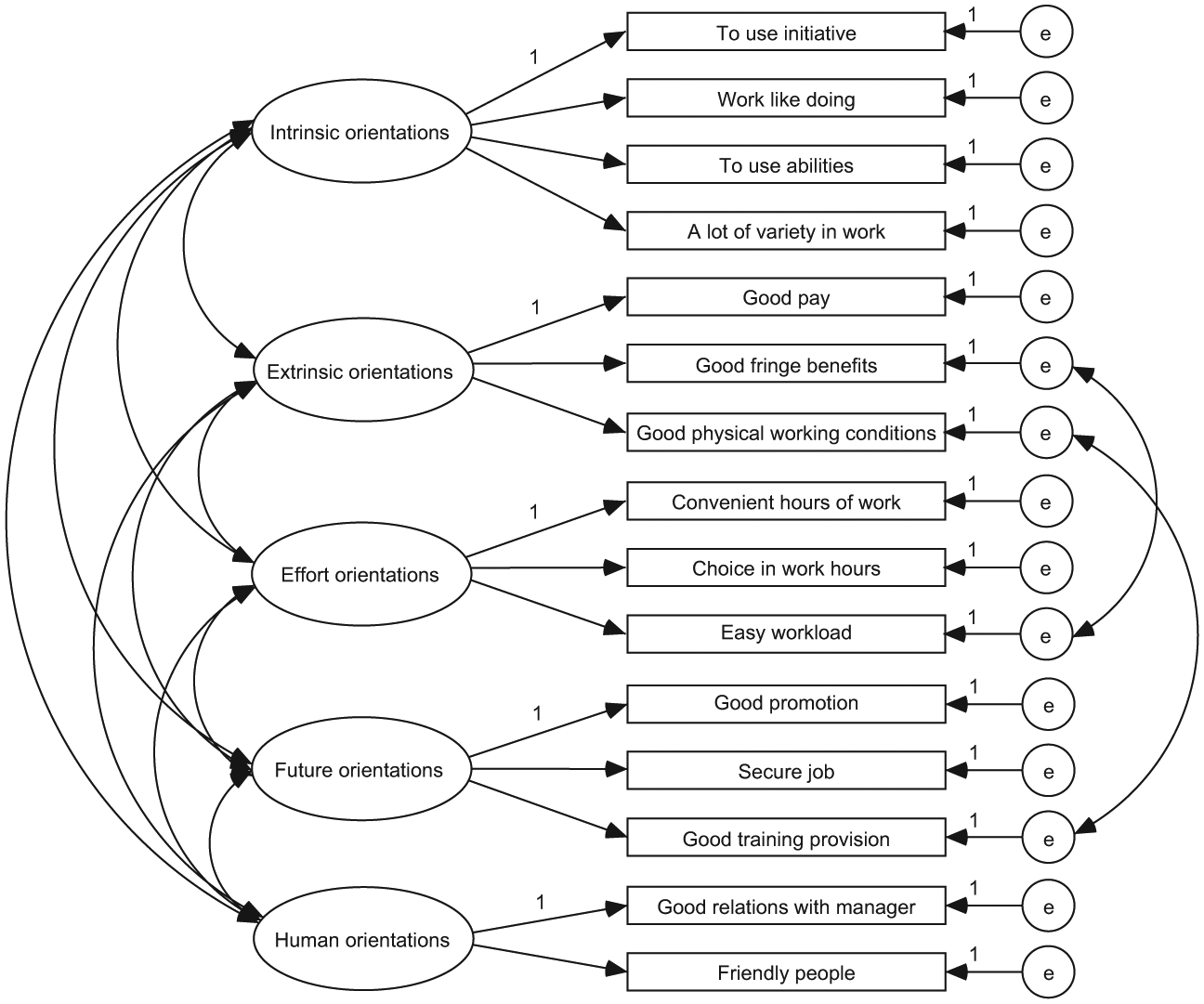
Confirmatory factor analysis: work orientations.
Five latent orientations variables, displayed in the ovals in the Figure, were included in the CFA model: intrinsic, extrinsic, effort, future and human orientations. Intrinsic orientations refer to the importance attached to the inherent interest of the job. Extrinsic orientations focus on the instrumental returns from the job. Effort and future orientations concern exertion and career development aspects of the job. Finally, human orientations are concerned with interpersonal relationships at the workplace. In addition to these five orientations, measurement error that could mediate the correlations between the observed measures and latent variables was also controlled for in the model. Mills (2007) has noted two typical sources of measurement error in CFA which are ‘methodological artifacts’ and ‘common content’. The first error is likely to occur where survey questions are arranged in the same sequence throughout the interviews while the second arises when two items have similar content which cannot be fully explained by the dependence on the same latent variable or the correlation between different latent variables. In order to control for these, error correlations were included when there was a plausible case for the two error sources.
The model fit statistics suggest that this work orientations model fits the data reasonably well. The coefficients of the work orientations CFA model are reported in Table 4. The mean root mean square error approximation (RMSEA) for the CFA model from five imputed datasets is 0.065. Based on these results, five scales of work orientations were constructed by taking the mean of the items pertaining to a dimension for further analysis. 5
Confirmatory factor analysis model: work orientations.
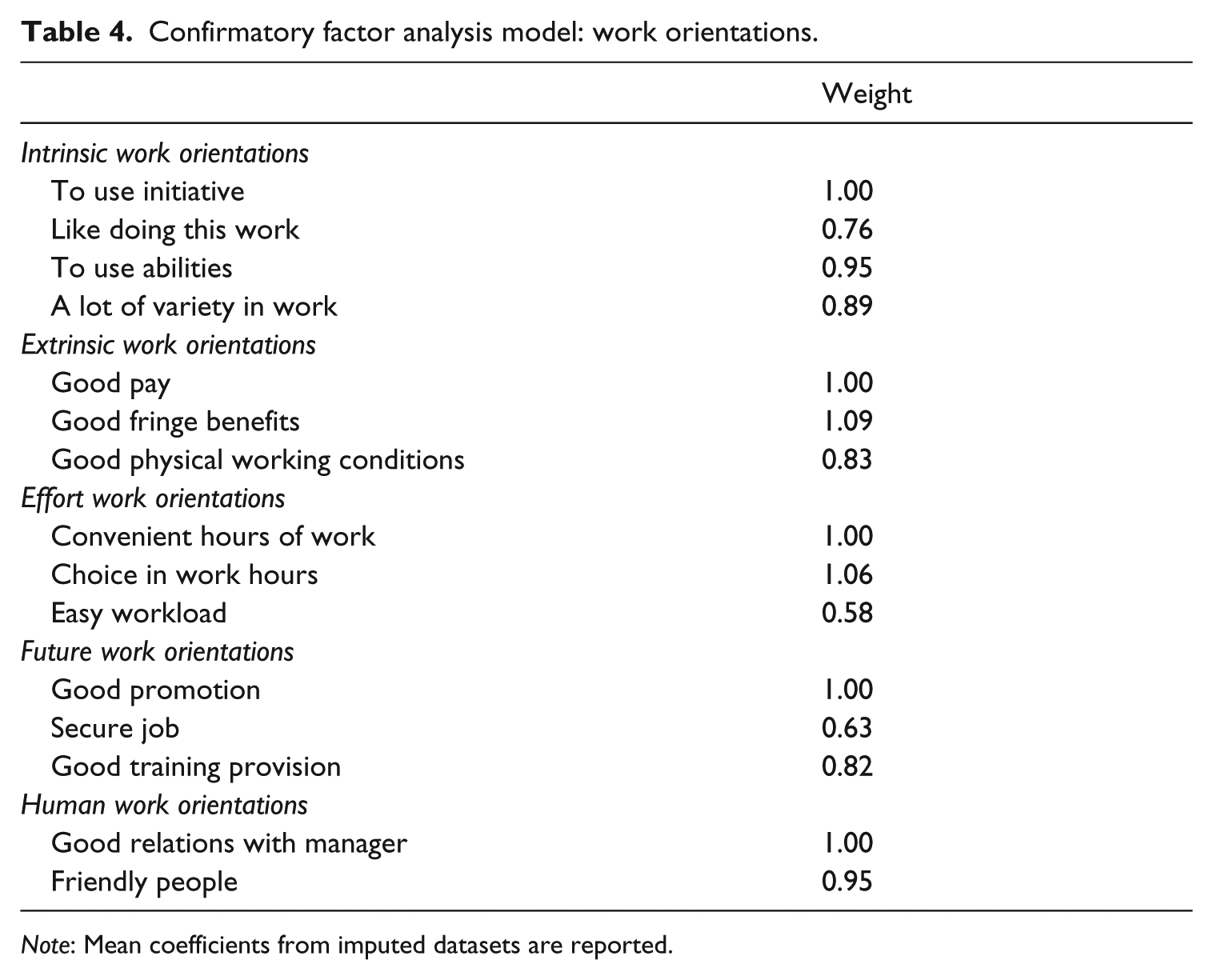
Note: Mean coefficients from imputed datasets are reported.
Control variables
The analysis also included a number of control variables. Clark (1997) suggests that relative income is an important determinant of job satisfaction. 6 In addition, he also finds that there is a U-shaped relationship between age and job satisfaction (Clark, 1997). Meng (1990) suggests that job satisfaction is associated with union status. Bender et al. (2005) find that gender segregation at the workplace also influences how one feels about one’s job. Other potential influences include occupational class, job contract type, marital status (Gorman, 2000), establishment size, industry and sector. Descriptive statistics of the variables used in the models is presented in Table 5.
Descriptive statistics.

Note: Means from the five imputed datasets are reported.
indicates reference category in the ordered probit analysis.
Analytical strategies
In empirical work, job satisfaction is typically analysed by ordered probit models, based on the assumption that the observed satisfaction ratings reflect the intervals where the latent continuous job satisfaction variable falls. This ordered probit job satisfaction model is as follows:


where JS* is unobserved continuous job satisfaction, X is a vector of exogenous variables, JS is observed job satisfaction, k is the number of categories that JS falls into and μ is the estimated intercept term.
The analysis estimated three ordered probit models. Firstly a basic job satisfaction model would be developed with only female employment status dummies (female full-timer and part-timer) and control variables included. Estimating this model would reveal the extent to which women were more satisfied with their jobs than men when personal and organizational characteristics were taken into account. The coefficients of these two female employment status dummies would serve as the baseline for cross-model comparisons by establishing the ‘raw’ gender job satisfaction differential. Work orientations variables would be introduced in the second model. This allowed us to investigate the extent to which the observed gender gap in job satisfaction could be accounted for by work orientations, assuming that the effects of work orientations on overall job satisfaction are constant across men, women full-timers and part-timers. Finally a more flexible model would be fitted to include the interaction effects of work orientations and female employment status. This model allowed effects of work orientations on job satisfaction to vary across these three groups of workers.
Model estimation results
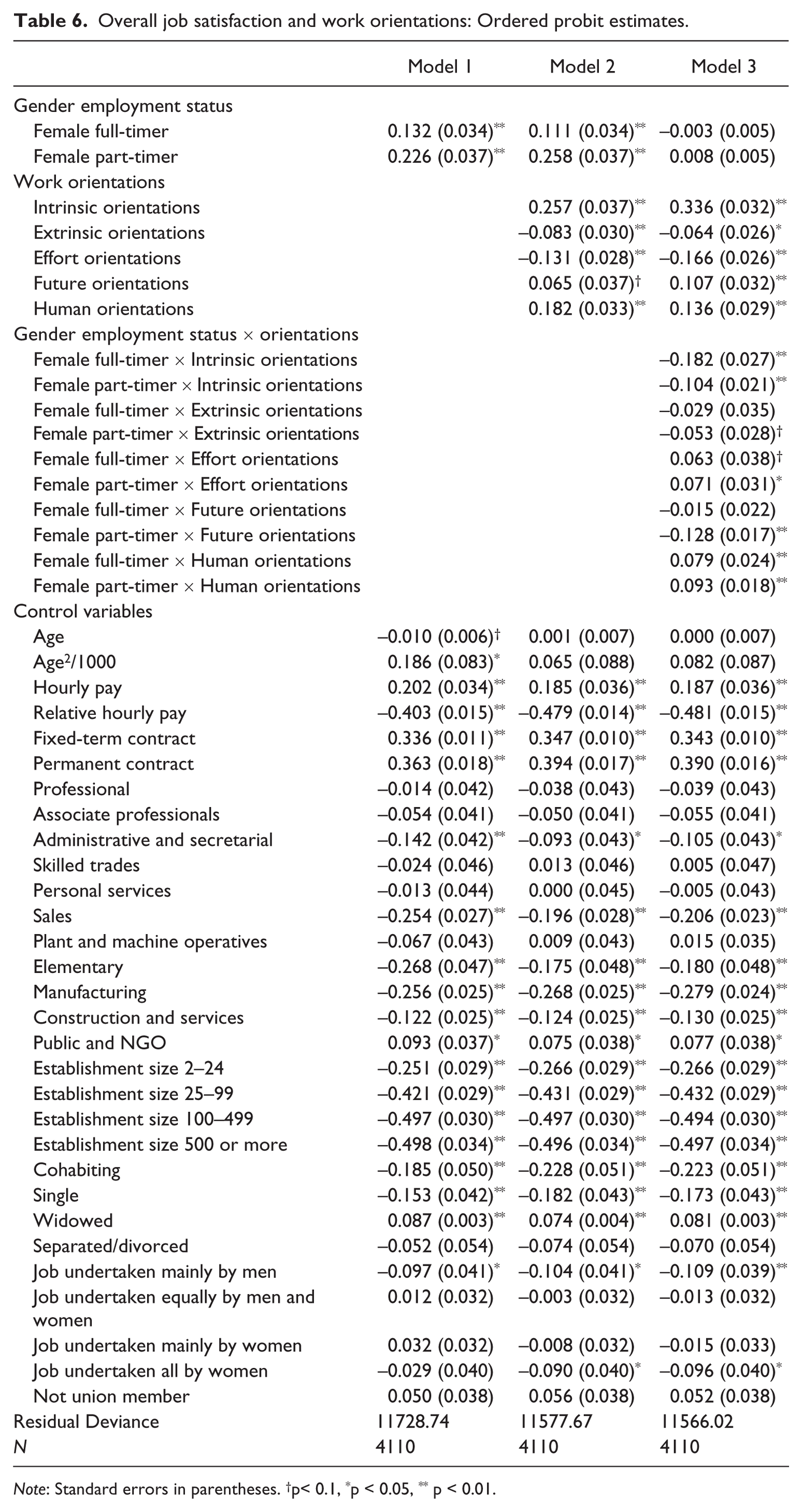
The empirical investigation estimated three ordered probit models. The results are reported in Table 6.
Overall job satisfaction and work orientations: Ordered probit estimates.
Note: Standard errors in parentheses. †p< 0.1, *p < 0.05, ** p < 0.01.
Model 1 shows that compared to men, women, either in full-time or part-time employment, were likely to report higher levels of overall job satisfaction, even after controlling for a wide range of individual and organizational factors. This confirmed the initial findings from the ANOVA analysis that women were more satisfied with their jobs than men. The size of the coefficients of the female employment dummies also confirmed that women part-timers had the highest level of job satisfaction among the three groups. These coefficients would be used as the benchmark against which the results of the following two models would be compared to assess the degree to which work orientations could account for the gender gap in job satisfaction.
Model 2 tests the effects of work orientations on job satisfaction, assuming they are constant across all workers. Five work orientations variables derived from the CFA were included in this model. The results in Table 6 suggest that work orientations were closely associated with job satisfaction. The coefficients of intrinsic, extrinsic, effort and human orientations were significant at the 0.05 level and future orientations at 0.1 level, which seemed to support the argument that individuals tended to engage in jobs where their work related needs were satisfactorily met.
Despite the highly significant effects of work orientations, the gender gap in job satisfaction persisted. The coefficients of the two female employment status dummies were still sizeable and highly significant. Compared to Model 1, there was a small reduction in the difference in job satisfaction between men and women full-timers, whereas the gap had even increased slightly between men and women part-timers. This suggested that although work orientations were strongly associated with job satisfaction, they did not contribute much to explaining the gender gap in job satisfaction when their effects were assumed to be constant across men, women full-timers and part-timers.
The third model allows the effects of work orientations on job satisfaction to vary across the three groups by introducing interaction terms between female employment status and work orientations. As can be seen from Model 3, some of these interactive effects turned out to be highly significant. Women part-timers differed significantly from men in the effects of all work orientations on job satisfaction. The pattern for women full-timers was more similar to that of men. Compared to men, women full-timers did not differ substantially in extrinsic or future orientations and only marginally in effort orientations. They did, however, differ in intrinsic and human orientations. Most importantly, comparing the coefficients of the female employment status dummies to Model 1 shows that the gender difference in job satisfaction was almost eliminated after these interaction effects were included. This is fully in line with the expectation that heterogeneity in work orientations can account for the gender job satisfaction gap.
In addition to accounting for the gender job satisfaction differential, the analysis also reveals that different work orientations varied in the way they influenced job satisfaction. When the effects are assumed to be constant across all workers (Model 2), intrinsic, future and human orientations are positively related to job satisfaction. This suggests that workers who placed stronger emphasis on intrinsic job rewards, future development opportunities and good workplace relations were likely to report higher levels of job satisfaction. By contrast, the influences of extrinsic and effort work orientations on job satisfaction are negative, suggesting that the more workers valued extrinsic or effort aspects of a job, the less likely they would be satisfied with their job. Moreover, the results show that intrinsic orientation is the most powerful predictor of overall job satisfaction among the five orientations variables, which is consistent with the vast body of empirical evidence that job satisfaction is mainly driven by intrinsic job components (Borzaga and Tortia, 2006; Huang and Van de Vliert, 2003).
The final model (Model 3) further indicates that there is significant variation in how orientations influence job satisfaction when their effects are allowed to vary between men and women. Everything else being equal, while holding intrinsic orientations led to positive feelings about one’s job for both men and women, men were likely to report higher job satisfaction than women with similar levels of intrinsic orientations. By contrast, possessing similar levels of human orientations brought more happiness at work to women than it did to men. Extrinsic orientations were similar to human orientations, except that their effects were negative. With regard to effort orientations, while the generally negative effect was observed for all workers, it appeared less strong for women part-timers. Finally, men and women who valued future-related job rewards were likely to report higher job satisfaction, although the effect was less strong for women part-timers. To further illustrate how work orientations affected job satisfaction across different groups of workers, separate OLS models were estimated on men, women full-timer and women part-timer sub-samples to provide more easily interpretable coefficients. The results are summarized in Table 7.
Overall job satisfaction and work orientations by male, female full-timer and female part-timer: OLS estimates.
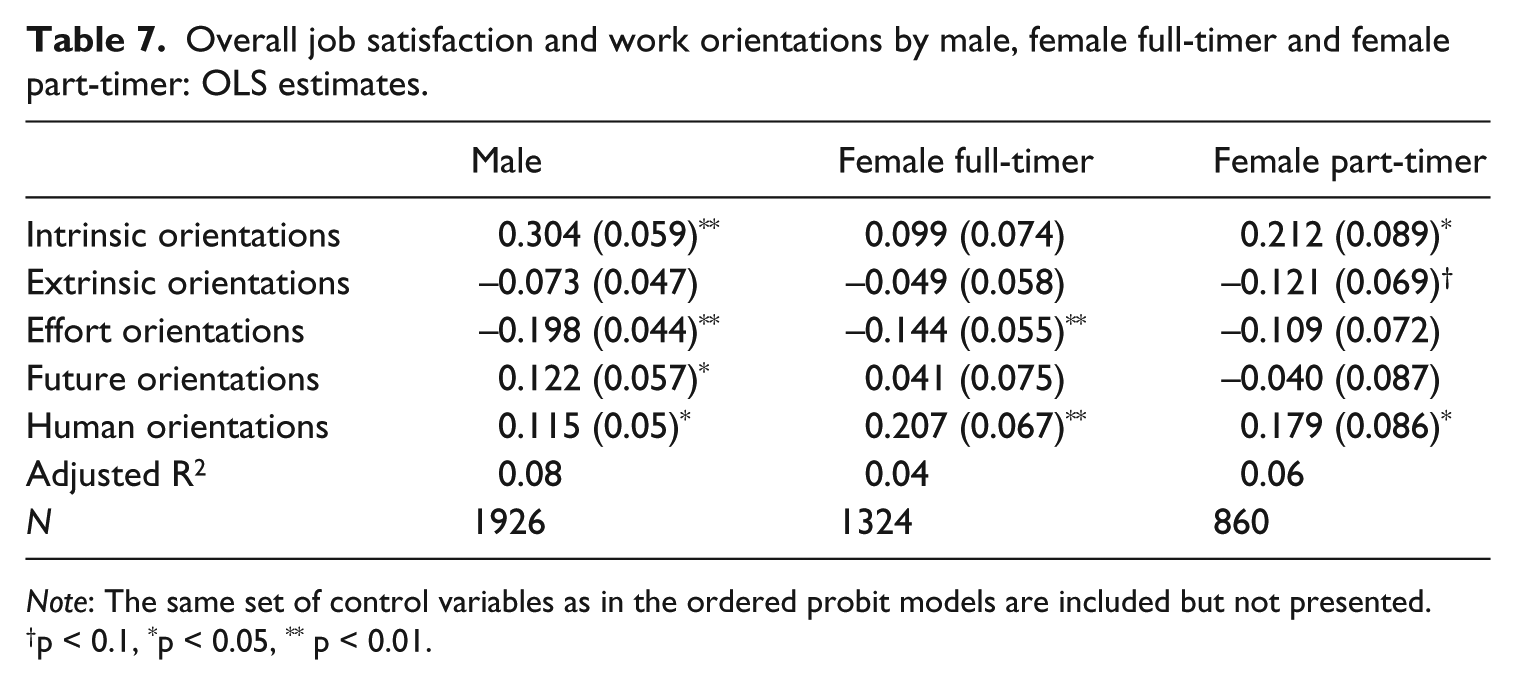
Note: The same set of control variables as in the ordered probit models are included but not presented.
p < 0.1, *p < 0.05, ** p < 0.01.
While the divergence between men and women part-timers may be understood from different life goals (Hakim, 1991, 2000), the reasons why women full-timers differ from men in the way work orientations shape their job satisfaction have been less extensively discussed in the literature. Some further analysis suggests that these may be related to life-cycle and family responsibilities associated with gender role norms. In the sub-sample of men and women full-timers, the smaller effect of intrinsic orientations on job satisfaction was only significant for middle-aged women. This is in line with the work-family conflict literature which suggests that women are more likely to experience declining interests towards work than men due to increased family roles after they enter this stage of life (Frome et al., 2006; Georgellis et al., 2012). Moreover, the additional positive effect of human orientations is found to be particularly strong among those women at prime reproductive ages. It could be that women in full-time jobs place more emphasis on workplace relations in order to facilitate informal support provision from supervisors and colleagues to help cope with conflicts between work and childcare (Behson, 2002; Brunetto et al., 2010).
Conclusions
This article has sought to answer the question of why women are more satisfied with their jobs than men. The central argument of this article has been that men and women differ in what they seek from employment and this could account for the observed gender job satisfaction differential. In other words, the ‘grateful slaves’ paradox arises when we fail to understand women’s orientations to work and arbitrarily assume they look for similar rewards from employment as do most men. To empirically test this hypothesis, the study has drawn on data from the 2006 Skills Survey to analyse the gender gap in job satisfaction from the work orientations perspective.
The analysis started by examining the gender difference in job satisfaction. Similar to many previous studies, the ANOVA analysis found that women, either in full-time or part-time jobs, reported higher levels of satisfaction than men. In addition, the analysis also found that women part-timers had the highest levels of job satisfaction, followed by women full-timers and men.
Despite the divergence on whether work orientations reflect women’s preferences or constrained choices, it has been suggested that women’s distinctive work orientations play a key role in shaping their job satisfaction. The analysis clearly supports the view that work orientations differ significantly between men and women. It was found that men were more likely to value extrinsic and intrinsic job rewards whereas women generally placed more emphasis on social relations and flexible work hours. The analysis also revealed that there was substantial heterogeneity in work orientations within the female workforce. Women full-timers and part-timers differed in almost every aspect except that they attached similar levels of importance to physical working conditions and workplace relationships.
Three ordered probit models were developed to investigate if the heterogeneity in work orientations can explain the gap in job satisfaction between men and women. A baseline job satisfaction model included only control variables. The results of this model confirmed that women, either in full-time or part-time jobs, were indeed more satisfied with their jobs than men. The second model included work orientations to explain job satisfaction, assuming their effects to be constant among men, women full-timers and part-timers. After intrinsic, extrinsic, effort, future and human orientations were entered into this model, all except future orientations turned out to be highly significant, which suggests work orientations were indeed important explanatory variables behind job satisfaction as suggested by prior research. However, the gap between men and women full-timers or part-timers remained largely unexplained. Previous work from economists and sociologists suggests that the effects of work orientations on job satisfaction may vary according to gender and employment status. Holding similar levels of extrinsic orientations, for example, might have a quite different impact on job satisfaction between men and women full-timers or part-timers. To test this, interaction effects between work orientations and female employment status were introduced in the final model and the results suggested that once the effects of orientations were allowed to vary between groups, the gender job satisfaction differential was largely accounted for. Not only did the coefficients of both female employment status dummies become insignificant, their magnitudes shrank dramatically as well.
Regarding how work orientations influence job satisfaction, the analysis suggests that those who valued intrinsic, future or human job rewards were likely to report higher levels of job satisfaction, whereas those who emphasized extrinsic or effort aspects of a job were likely to be less satisfied with their job, everything else being equal. Moreover, the analysis also revealed some evidence that supports Hakim’s female heterogeneity thesis. It was found that women part-timers differed from men in intrinsic, effort, future and human orientations in terms of their effects on job satisfaction whereas women full-timers were more similar to men except where intrinsic and human orientations were concerned.
One issue this article has not fully explored but that deserves further attention is the impact of life-cycle on work orientations and job satisfaction. It is desirable to remedy this because it could be argued that the significant relationship between work orientations and job satisfaction is a consequence of stage of life-cycle, independent of the job itself. Women, for example, may hold ‘dynamic’ work orientations and change jobs due to various constraints over the life-cycle. Preliminary analysis of the data has shown that women in prime reproductive ages were more likely to value workplace relations, which could be interpreted as a means to cope with the conflicts between work and childcare through collegial support.
Although this analysis has shown that the difference in job satisfaction between men and women can be understood from a work orientations perspective, the cross-sectional setting of the analysis will inevitably invite further comments. The nature of the cross-sectional data has restricted the analysis to assessing correlations instead of causations between work orientations and job satisfaction. Also, although this study has explored how work orientations may help account for gender job satisfaction differential, the data does not allow for further exploration of some important questions such as why do women’s orientations differ from those of men – questions that lie at the core of the Hakim debate. These patterns could be due to gender norms such as women valuing workplace relations in order to get collegial support to cope with care responsibilities. It could also be argued that women’s emphasis on human factors might reflect the sex segregation in the labour market. For example, women’s concentration in service sector jobs may lead to the increased importance of human factors in their orientations to work. Finally, the analysis also potentially suffers from unobserved heterogeneity. It cannot be ruled out that the observed gender satisfaction difference is caused by factors that are not measured in the survey. These limitations call for future research to employ panel designs to offer stronger causal evidence on work orientations and their relationships with job satisfaction.
In conclusion, the analysis has confirmed that these men and women differed in their orientations to work and this helps explain the gender pattern in job satisfaction. This in turn lends support to Goldthorpe et al.’s (1968) argument some 40 years ago that it would be helpful for analysis of work attitudes and behaviour to start with workers’ needs and wants in their job rather than with the general assumption that they seek similar rewards from employment. A richer account of how work attitudes and behaviour develop, therefore, can be achieved if analytical frameworks take individuals’ work orientations into consideration.
Footnotes
Acknowledgements
The author would like to thank Colin Mills, Duncan Gallie and three anonymous referees for their constructive feedback on earlier drafts of the article.
Funding
This research received no specific grant from any funding agency in the public, commercial, or not-for-profit sectors.