



Abstract
Academics have long investigated trade union behaviour through the complex interaction of identity, ideology and purpose. At the same time, there have been increasing calls to gain a deeper understanding of the purpose of strategies but the two bodies of literature seldom overlap. The article proposes a framework to help understand the essence of trade unions and to situate strategies (such as organizing) in this broader context and bridge the gap between the literature on union purpose and identity and on strategies for renewal. It is argued that the essence of unions framework can assist with the analysis of both historical and contemporary trade unionism and allows both clarification and consideration of the range of concepts and terms already in use in the industrial relations literature.
Introduction
This article proposes a new framework to understand the essence of trade unions and bridge the gap between the literatures on union purpose and identity and on strategies for renewal. It argues that understanding the essence of unions clarifies and structures a range of concepts and terms already in use in industrial relations literature and thereby assists with the analysis of both historical and contemporary trade unionism.
Understanding trade unionism is a complex issue that has been subject to much academic enquiry. Perlman (1976: x) suggested that the consequence of this has been the formulation of ‘“new” explanations, resulting in a jungle of individual interpretations. The jungle has expanded, and each generation has found itself doing the same or similar tasks over and over again’. The aim of this article is to make sense of this jungle, although complete deforestation is neither possible nor necessary. Instead, attempts are made to create a pathway through the vast array of theories and provide some understanding of the relevance of these approaches for studying unionism today. The extensive works of Richard Hyman provide the main point of departure. The article focuses specifically on trade unionism in the UK although our essence of unions framework could arguably apply to many unions within capitalist societies. Following a period of substantial membership decline, unions have had to pursue renewal strategies for growth and recovery across many Western economies. Writing specifically about the UK, Heery (2005: 92) has suggested that such a response will only occur if ‘there is a prior internal renewal of trade unions to facilitate external change’. Therefore, in order to understand renewal in individual trade unions, there is a need to consider the intention of the union in pursuing that renewal. Arguably the most common strategy for renewal has been organizing and thus organizing is used as an example to help illustrate our framework of union essence.
This article is organized as follows. The next section provides an overview of existing terms used to describe trade unionism, before the third section presents our union essence framework. The penultimate section returns to the debate on union renewal and the final section concludes the article and offers some considerations for future research. However, in order to understand the essence of unions, it is first necessary to revisit the plethora of literature on union purpose.
Existing concepts
Discussions surrounding the fundamental purpose of trade unions have been subject to considerable academic enquiry. However, it should be noted that ‘the attempt to define trade unionism […] involves far more than considerations of semantics’ (Hyman, 1971a: 173). While this historical and theoretical debate is of continued relevance and importance to the study of trade unionism today (Hodder, 2013), this article is concerned with more than issues of definition. Understanding trade unionism has led to numerous concepts being used interchangeably by academics to describe what the authors would term the essence of trade unionism. To speak of the essence of something does not entail the commonly, indeed almost ritualistically, criticized error of essentialism. Sayer (1997) and O’Mahoney (2012) give extensive justification on this point. Terms used to describe types of unionism have included character, function, identity, ideology and purpose. Therefore problems of definition are not new in industrial relations. As noted by Bell, the ‘problem is to endow with exact meanings words which are ordinarily used with little or no attempt at definition’ (1954: 128).
Despite the varied accounts of union purpose within the literature, it cannot be disputed that unions are primarily organizations that exist for the representation of members’ interests, both individual and collective (Allen, 1966: 149). It should be noted here that questions of what unions do routinely (Freeman and Medoff, 1984) and the associated important issues of internal structures, government and strategies, are not being ignored – rather, following the work of both Clegg (1972: 29) and Hoxie (1923: 61), their importance is acknowledged, but these concepts are informed by a more complex notion of purpose. For this reason, the discussion below focuses on the different terms used to explain the essence of trade unionism. Following a thorough review of the literature, it is clear that issues of character, purpose, identity and ideology dominate existing work, but it is argued that the use of these terms is problematic.
Character is one of the most common terms used to describe unions (Blackburn, 1967; Blackburn and Prandy, 1965; Prandy et al., 1974). According to these authors, character is identified through the concept of ‘unionateness’. However unionateness is widely considered to be problematic and a more detailed consideration of unionateness and its various criticisms have been well documented (see Bain et al., 1973; Carter, 1979; Crompton, 1976) and do not need repeating here. Broadly speaking, the term is too loosely defined, the authors providing only ‘a useful rough measure’ of seven characteristics (Blackburn, 1967: 18). The main criticism of unionateness for present purposes is the acceptance by the authors that there is one dominant purpose or ‘ideology of trade unionism’ (Blackburn, 1967: 18) as there are clearly competing notions of trade unionism.
It is important to acknowledge the difference between purpose and function. According to Martin (1989: 4), the two words offer ‘a useful distinction between, on the one hand, an aim, goal, or objective (purpose) and, on the other hand, a method, means, or mode of action (function) intended to fulfil that purpose’. Having made this distinction, however, it is necessary to refer to Hyman and Fryer (1975: 174), who, using function synonymously with purpose, note that ‘debates around trade union functions are typically mediated by ideological frames of reference’, which suggests a distinction between ideology and function/purpose. Hyman and Brough (1975: 6) describe ideology as a ‘frame of reference, a world-picture or Weltanschauung, a set of normative and empirical assumptions which are social-structurally generated’. ‘Function’ was used by Hoxie (1923) in his development of ideal types. However the development of ideal types is subject to criticism due to the problems with their relevance to empirical operationalization, either being viewed as catch-all categories for understanding trade union behaviour or unrealistic in their ability to inform practice (Hyman, 2001: 4; Simms, 2012: 98).
Purpose is a somewhat under-used term although the work of Martin (1989) is a notable exception. Martin (1989) reviewed existing literature and devised five broad, yet distinct, categories which share a number of similarities with Mark Perlman’s (1976) fivefold typology of the ‘basic interpretation’ (Perlman, 1976: x) of trade unionism. While we assessed the considerable literature reviews of Martin (1989) and Perlman (1976) and found them useful for understanding the historical theories of union purpose, their work would have benefited from a consideration of the wider context in which unions pursue their purpose, and therefore suffers from a lack of theorization in connecting union purpose and union strategies, such as partnership with employers or member-led organizing.
Much of the academic discussion has focused on the terms ideology and identity. In deliberating these two terms, Crouch (1996: 93) suggests that their differences are often ‘important and interesting’, before concluding that they are not ‘fundamental’. Gumbrell-McCormick (2013) makes a useful distinction between ideology and identity, suggesting that identity is a more suitable term for this debate. According to her, union ideology ‘may derive from external sources (such as a political party or church) but are internalized within the union or union movement’ whereas union identity ‘can be understood as the relatively stable characteristics and orientations of an organization, tending to persist regardless of changes in personnel, which have both an internal dimension (assuring members, activists and officials what the union is and does) and an external one (proclaiming the nature of the union in the broader industrial relations and public sphere)’ (Gumbrell-McCormick, 2013: 242). The next section considers the interaction between the terms discussed thus far and proposes a framework for analysis to bring together discussions of purpose but also relate these to strategies (such as organizing) and outcomes.
Understanding the essence of unions
Hyman (2001) presents the most systematic and subtle account of union identity – subtle because, analytically, it recognizes at all times the tensions within unions between different objectives and, empirically, it is grounded in a detailed understanding of unions’ histories and practices. However, what an identity is and how it relates to other aspects of unions, emerges in use – much indeed as the Webbs, as Hyman (2001: 16) notes, defined collective bargaining. Thus Hyman refers to ‘purpose and identity’ (2001: ix), ‘identity, ideology and strategy’ (2001: x), a ‘triple polarization of trade union identities’ (2001: 2) and ‘identities and ideologies’ (2001: 4). The fundamental idea is that unions face in three directions, hence ‘triple’ polarization: toward the market; as agencies of class; and in relation to the societies in which they are embedded. In reality, unions are influenced by each of these competing directions and such tensions impact upon the essence of a union.
Elsewhere, Hyman (1994: 131) says that ‘identity relates dialectically to the interconnecting dynamics of interests, democracy, agenda and power’. Does this mean that identity emerges from these other things or in some way affects how they operate? What does ‘relates’ mean? Earlier, Hyman (1994: 119) says that identity is ‘both the point of origin and the end-result of these interconnecting processes’, namely, interests, democracy, agenda and power. Does ‘dialectically’ mean merely ‘affects and is affected by’ or is the word intended to have a wider, Marxian, resonance? Where do concepts like ‘ideology’ and ‘strategy’ come into this? Although it makes sense to say that something is both a cause and a consequence of other things, it is also necessary to consider whether some processes or structures are more fundamental than others. That is, are X and Y mutually reinforcing things that operate at the same empirical level, or is X in some ways more fundamental, such that it can be affected by Y while also being more basic?
There is also a brief discussion of workers’, as distinct from unions’, identities, drawing on the work of Touraine of the 1960s (Hyman, 2001: 33–5). Here, identity ‘represents the categories whereby workers define their individual situation, the groups within which they perceive shared interests’ (2001: 33). As used later by Mann (1973), Touraine’s categories of identity, opposition and totality formed a hierarchy to which a fourth, action, was added. The idea was that to understand class consciousness – that is, something that exists at the level of action – it is necessary to work down through the other layers. The idea has been used by others (Edwards, 2000; Katznelson, 1986), who insist that this hierarchy is not deterministic; the more fundamental levels shape, but do not determine, action.
Here the idea of levels is used to structure the essence of unions framework, in order to work through the tangle of terms around union identity, purpose and ideology. ‘Identity’ means what a union is, its ‘very nature’ (Hyman, 2001: 1). Is it, for example, primarily for the pursuit of wages through market relations, or for the organization of workers to promote class struggle? We would argue that identity is a root structure, with matters of ideology, agendas and so on operating at a less fundamental level. The obvious parallel, suggested by terms like dialectics, is the nature of capitalism as a mode of production. As scholars such as Cohen (1978) argue, the forces of production constitute an economic base on which rise the relations of production. This does not mean that the latter do not affect the former. In Cohen’s homely analogy, the legs of a table form its base which supports the top, but the top then affects the base by adding stability to the structure. The superstructure thus has functions in maintaining a system. As Cohen is at pains to point out, a functional analysis does not entail functionalism – just as essences do not equal essentialism. We say ‘parallel’ rather than analogy because, as writers such as Hyman and others adopting a broadly Marxian view would themselves stress, unions are products of a distinctly capitalist society: they represent a class of wage labourers against a class of capitalists and are fundamentally different from other forms of workers’ associations such as medieval guilds.
Consider in this context the angle of Hyman’s element of polarization labelled ‘society’. It is of course true that, historically, unions are embedded in societies; one cannot understand the fundamental purpose of unions without grasping the distinctive ways in which they emerged in particular social contexts, as Hyman’s historical accounts make very clear. This is not to downplay the role of unions within society. Rather it is acknowledging that their role in societies is distinct. They are not like other collective bodies in civil society because they have particular functions, namely, to represent the class of wage labourers. This distinction may not matter for Hyman’s purpose of historical analysis but it is important for putting some order onto categories. Any union reflects fundamentally a position in the division of labour and has two spheres in which to orient its activity; the economy and the polity. The work of Burawoy (1985) on different production regimes, for example, turns on the linkages between production (or the market and the economy) and the polity. These spheres operate in social contexts, but what they are cannot be understood without considering their fundamental features.
In this framework, the economic and political bases of unions underpin their roles in specific societies. Hyman’s triple polarization of identities then acts as a base for more concrete things. The purpose of a union is to pursue objectives that reflect its identity. Its ideology is the set of values and ideas that inform and give meaning to purpose. Strategies are concrete plans and objectives which arise from the complex interaction between the leadership and the rank and file and lead to specific actions such as campaigns to organize certain groups of workers.
Let us now unpack Hyman’s categories of interests, democracy, agenda and power. In relation to interests, Hyman discusses such issues as whether the interests are pursued for a particular group of workers or for a wider constituency and how interests are framed. He does not deal directly with what these interests are, or how observers can know what they are. Most scholars would want to make some distinction between express wants and deeper interests. We would want to assert that unions have real interests in the sense suggested by Lukes (2005): these are the interests that they would pursue in the absence of power by other parties that prevent them from seeing what these interests are. This point is not justified in detail here (see Edwards, 2006; Kemp, 2012), save to note that this view is consistent with a Marxian interpretation: unions fundamentally aim to advance the interests of the working class and these interests are deeply embedded in the essence of unions. On this view, interests are part of identities; just as Cohen (1978) has a catalogue of parts of the forces of production, we might want to list fundamental aspects of unions and would place interests and identities here.
Hyman’s own discussion of interests merges into an account of how these interests are both defined and represented. Unions ‘can help shape workers’ own definitions of their individual and collective interests’ (1994: 122). This is certainly true, but processes of definition surely build on more fundamental levels of identity. Democracy refers to forms of participation and relations between members and leaders. We of course acknowledge the debate regarding union democracy relating to oligarchy and polyarchy (Crouch, 1982; Hyman, 1971b) and the existence of factions (McIlroy and Daniels, 2009) but take the view that such concrete disputes about the meaning of democracy do not deny that, at root, unions are democratic in the sense that they exist to pursue the collective interests of their members. ‘Agenda’ is defined in terms of the outcome or expression of other forces: ‘the agenda of trade unions may be defined as the expression in action of the interests which they seek to represent and also the outcome of their internal processes of democracy and leadership’ (Hyman, 1994: 125). ‘Power’ embraces the ability to achieve objectives, the establishment of a framework in which unions’ agenda can be pursued and the capacity to influence perceptions so as to create a climate favourable to unions and their roles.
Several different ideas are at work here. The first and third address abilities or capacities while the second is more an outcome of these: a legal framework, for example, reflects and inscribes the uses of power rather than being a form of power directly. As with debates on power and interests, it is also important to distinguish the power to achieve ends against others (‘zero sum’ relations) and the power to secure goals which may not damage others and which may contribute to wider agendas (‘positive sum’ relations). A standard argument is thus: that unions contribute to productive efficiency at the level of the firm, by limiting managerial arbitrariness and pressing managers to improve systems; and at the level of the economy. It therefore makes sense to identify powers that reside in unions and then to consider how these powers are used at the level of action.
We thus have a framework of union essence (see Figure 1). Identity embraces interests and causal powers at a fundamental level. How these are played out affects a union’s location on the market-class dimension. Unions can have different degrees of market and/or class focus. Identity and the degree of market or class orientation then affect ideology. Society comes in as a separate idea, for the distinct national history of a given country reflects processes that are outside the capital-labour relation. The outcome of the interaction of society with market, class and ideology generates the empirical basis of a union. These items establish its purposes and overall objectives. Unions then have two elements, the internal and the external. These elements interact. That is, unions engage in internal (democratic) processes of debate as well as external bargaining with employers and interactions with the state. Both these elements lead to the production of strategies for action. Finally, strategies generate outcomes.
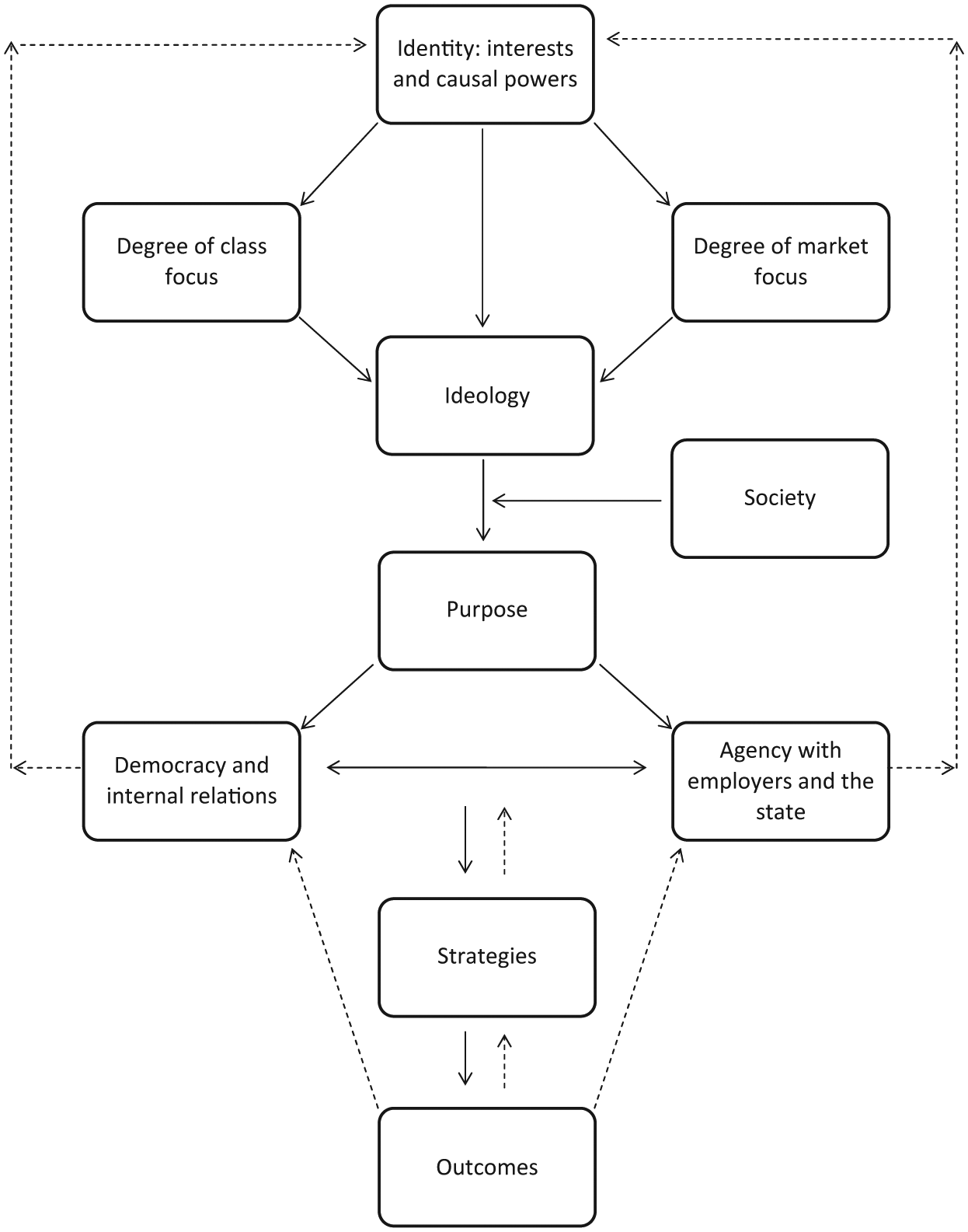
The essence of unions framework.
There are of course feedback loops (identified by dotted lines in Figure 1) as unions develop historically. These are particularly important in understanding union operations today suggesting that unions can benefit from organizational learning (Hyman, 2007: 200–202), as the behaviour and purpose of a union in the early stages of its development ‘can set the “tone” of trade unionism in the future’ (Simms, 2007: 127). We acknowledge the importance of conflict and class struggle in shaping trade unionism at different historical moments in time (Hyman, 1971b; Kelly, 1988) but this is dependent on the degree of market or class focus adopted by a specific union. Specifically, feedback loops occur where both the internal and external elements interact, as this can impact upon a union’s identity.
Of course, the framework is not static and can be subject to change as a result of different actions by the state, capital and unions themselves. Additionally the relationship between purpose and strategies (mediated by democracy and agency) can also be two-way. Strategies may change as a result of internal union relations as well as external agency with both employers and the state. This therefore has an impact upon outcomes. Outcomes (either positive or negative) can clearly have repercussions not just for union strategies, but also for the internal democracy of a union and the way in which a union acts in relation to employers and the state. This process is on-going as unions seek to evaluate both failures and successes and reassess their agendas in order to survive. Additionally, it should be noted that both the purpose and strategies of a union can be multifaceted, reflecting the complex nature of unions. We would argue that such dynamic tensions go beyond the focus of market, class and society and in fact impact upon the essence of unions framework as a whole.
Returning to renewal
We now offer some brief consideration regarding the application of the framework, in relation to contemporary debates regarding union renewal strategies, focusing on union organizing. Despite the acknowledgement that analysis of organizing developments needs to be located in a broader framework to allow consideration of wider theories of trade unionism and the purpose of organizing, neither Martinez Lucio and Stuart (2009) nor Simms and Holgate (2010) suggest ways to do this empirically. Although empirical examples are provided by Simms and Holgate (2010) and Simms et al. (2013), their work is lacking a clear analytical framework to help understand the purpose of organizing.
Debates on organizing and strategies for renewal focus on the tactics and tools to achieve specific outcomes, and debates on purpose or identity are concerned with the somewhat repetitive (and often unhelpful) development of ideal types. A critical and in-depth debate on the organizing model is provided in De Turberville (2004), Carter (2006) and De Turberville again (2007). While it is unnecessary to repeat this debate here, it should be noted that the problems with the organizing model are ‘conceptual as well as practical’ (Fletcher and Hurd, 1998: 52). Part of the problem is that unions have adapted and adopted different aspects of the model for their own ends and ‘part of the answer is rooted in the differences in history, culture, organizational structure, and leadership that influence whether, when, and how each union builds capacity for organizing and moves a comprehensive organizing strategy’ (Bronfenbrenner and Hickey, 2004: 54).
Simms and Holgate (2010: 165) suggest these differences are a result of ‘very different underlying views about the purpose of organizing’ (emphasis in original). Furthermore, they acknowledge that all unions are organizing for membership growth but argue that issues of power and worker self-organization are lacking from the organizing debate. Similarly, Martinez Lucio and Stuart (2009: 36) argue there is ‘a failure by unions […] to connect organizing with a broader political approach and re-invigorated identity’. However Simms (2012) argues that organizing needs to be seen in terms of identities and solidarities, that is as part of a class project; and her final sentence highlights solidarities ‘between workers because they are workers’ (2012: 113, emphasis in original).
Returning to the debate on organizing, then, has touched on issues of purpose and identity, with some scholars endeavouring to root these concepts in a deeper view of unions. The framework developed here aims to develop these efforts. As to how it can be applied, we lack the space to give a detailed example and can only hint at the following. Consider briefly a union which traditionally organizes in a manufacturing industry as opposed to a white-collar union. Remember, we propose that the nature of a union’s organizing efforts is influenced by its deeper purpose and even deeper identity. Thus, a union with a history in manufacturing may utilize a more class-based approach to organizing due to these deeper influences, while a white-collar union may be influenced by a higher degree of market focus for similar reasons. Indeed, these are over-simplified examples which require further exploration but we believe we have provided a useful framework to be tested in future research.
Conclusions
In this article, we have identified a problem of linking union strategies of renewal with broader discussions of union identity, ideology and purpose. Existing work in this area is limited, with little discussion as to how this gap should be bridged theoretically or empirically. Such work warrants an investigation of union strategies in the context of the debates on union purpose and identity. This literature is somewhat confusing as scholars often use ‘words that appear to be the same [but] actually express distinctive meanings’ (Manzella, 2013: 14). It has therefore been argued that a new framework is required in order to amass the current scattered usage of purpose, identity and ideology and show the links between them in relation to union strategy and outcomes.
To be clear, what is being proposed is the adoption of the essence of unions framework to avoid confusion and debate regarding what is meant by the various terms employed. The use of internal dynamics is suggested as part of a more useful way to help identify the links between union identity, purpose, strategies and outcomes. Prescriptive models or methods of measurement have been avoided for two reasons, firstly due to the widespread criticisms of such measures (regarding unionateness) and secondly due to the fact that union essence is designed to bridge existing models and notions of ideal types. While we have briefly used the example of organizing to illustrate our framework, we propose the essence of unions framework could be applied to other renewal strategies.
Thus, we offer the essence of unions framework to be tested by both trade unionists and researchers. Such a framework is important for several reasons. Firstly, it offers some clarity in relation to a number of terms often used by academics interchangeably without a second thought. Our framework shows the linkages between such terms and identifies the importance of each concept in informing trade union behaviour. Secondly, the analysis of unions through our framework would enable a better understanding of the choices made by unions (or different parts of the same union) in relation to strategies and how these relate to broader debates of identity and purpose. Thus, the development of the essence of unions framework can be considered to be a direct response to the calls for the need to understand union strategies in a broader context (Simms and Holgate, 2010; Simms et al., 2013), offering theorization as to how to go about this.
Footnotes
Acknowledgements
Both authors made equal contributions to this article. The authors are grateful to Rob MacKenzie and the three anonymous referees for their helpful comments.
Funding
This research received no specific grant from any funding agency in the public, commercial, or not-for-profit sectors.