



Abstract
This article presents midwives’ views and experiences of flexible working and work–life balance. Both flexible working and work–life balance are important contemporary agendas within midwifery and can have both positive and negative consequences for midwives. Full-time midwives and those without caring commitments feel disadvantaged by flexible working and work–life balance policies as they have to fit when they work around part-time midwives and are increasingly expected to cover extra work. They feel their work–life balance is marginalized and this is fuelling discontent and resentment among midwives and leading to divisions between full- and part-time staff that reinforce flexibility stigma. Although flexible working and work–life balance are important for recruiting and retaining midwives they are part of the ongoing tensions and challenges for midwives and the midwifery profession.
Keywords
Introduction
There has been widespread recent interest and debate over government and employer initiatives to promote flexible working and work–life balance (WLB) (Fleetwood, 2007). Work–life balance discourses range from policies aimed at promoting family friendly practices and increasing gender equality to measures designed to foster greater employee flexibility and control over when, where and how they work to achieve a WLB (Eikhof et al., 2007; Wise et al., 2007). Critical discourses around WLB have highlighted the institutional and structural context in which WLB policies and agendas are adopted, pointing to ongoing gender based divisions of labour in some societies, and a limited take up of WLB initiatives in some contexts (Aybars, 2007; Chandra, 2012; Lewis et al., 2007; Perrons, 1999).
Critics of WLB policies argue that they allow employers to appear employee friendly while meeting business needs and not necessarily ensuring employees achieve a WLB (Roberts, 2007; Sánchez-Vidal et al., 2012; Wise et al., 2007). Hence WLB initiatives may result in tensions and have contradictory effects as some employees benefit while others are disadvantaged and this challenges the premise that WLB is to the mutual benefit of the individual, business and society, as is suggested in some prescriptive takes on this agenda.
One of the problems associated with WLB is a so-called ‘flexibility stigma’, a term that describes employers’ and (often full-time, male) employees’ negative perceptions and treatment of co-workers who want flexible work arrangements (Cech and Blair-Loy, 2014: 105). This flexibility stigma can result in the marginalization of (often part-time, female) employees, who are regarded as less committed to their job and which can lead to employer and co-worker resentment, along with reduced career opportunities and gender inequality for the affected group (Williams, 2000). However, the assumption that it is mainly part-time employees who experience flexibility stigma and marginalization due to WLB policies requires further examination. The midwifery profession provides an interesting context for evaluating this assumption. In the midwifery profession it is full-time working midwives who are the minority. The majority of midwives work part-time and 99.6 per cent of midwives are female (Midwifery 2020 Programme, 2010: 24; Nursing and Midwifery Council (NMC), 2008).
This article aims to contribute to the debate on the effects of flexible working and WLB by presenting midwives’ views and experiences and by exploring the implications for midwifery. The main findings are that flexible working and WLB present midwives and the midwifery profession with a number of challenges and tensions that have not been emphasized in other studies. Tensions and divisions exist between full- and part-time midwives and midwifery managers over the increasing use and effects of flexible working and WLB initiatives. It is full-time midwives who feel marginalized as flexible working is reducing or preventing and, in some cases excluding, them from a WLB. Balancing all the different needs of midwives while trying to provide a 24-hour-a-day service is problematic. Thus the need for flexibility is undermined by the necessity for predictability, as midwives need to know when they will work and this results in inflexibility.
The following sections outline the flexible working and the WLB debates and consider these in relation to midwifery. The approach and methodology, together with the questions used in the study, are then discussed. This is followed by the results, based on a multi-method case study of a large maternity unit. This considers two key questions. First, what are midwives’ experiences and views of flexible working and WLB? Second, what are the implications of flexible working and WLB for midwives and the midwifery profession? The findings are presented under the five key themes identified and this also forms the basis of the final discussion.
Flexible working and work–life balance
In early debates on flexible working, in the 1980s, it was noted how this was primarily an employer centred approach advocated by government, government agencies, employers and voluntary associations, professional bodies and trade unions (Dex and McCulloch, 1997; Fleetwood, 2007). The subsequent WLB agenda has also tended to emphasize employee friendly practices aimed at accommodating the needs of business and working employees (see, for example, Department of Trade and Industry, 2005).
Despite the widespread use of the terms flexible working and WLB their definitions are often unclear and contested. Fleetwood (2007) provides an overview, distinguishing between employee friendly practices (flexitime, term-time working, compressed working week, job-sharing and nine day fortnights) and employer friendly practices (annualized hours, zero-hours and different shift patterns). Increasingly, legislative measures provide a framework in which such practices are considered and implemented. In the United Kingdom legislative measures to promote flexible working and WLB include the right to apply for part-time working after 26 weeks’ continual service and the extension of maternity and paternity leave (Employment Act, Her Majesty’s Stationery Office (HMSO), 2002; Working Families Act, HMSO, 2006; Flexible Working Regulations, 2014 (SI 2014/1398) – The Stationery Office, 2014a). The Children and Families Act (The Stationery Office, 2014b) further extends the right to request changes in flexible working arrangements and allows shared parental leave and pay. The Government stated that: ‘It wishes to move away from the current old-fashioned and inflexible arrangements and create a new, more equal system which allows both parents to keep a strong link to their workplace’ (Department of Business, Innovation & Skills and Department for Education, 2013).
A recent government survey found that 79 per cent of applications from employees with caring responsibilities to change their working arrangements are accepted by employers and the most popular requests are for flexitime, working from home and working part-time (Tipping et al., 2012). The proportion of requests to change working arrangements are similar for both female and male employees (62% and 60% respectively), but males are more likely to have their requests declined (Tipping et al., 2012: 70).
While this, and other, research suggests a relatively wide take up of flexible working and WLB initiatives, deregulatory agendas and the active creation of dual labour market results in some employees being excluded or marginalized from a WLB, or enduring inflexibilities in their working practices (Blyton, 2011; Kretsos and Martinez-Lucio, 2013). For instance, women without childcare commitments are often regarded as employees who can be used by employers to work unsociable hours (Anderson et al., 1994). Moreover critics argue that WLB initiatives and agendas are too narrow and have been conceptualized or targeted towards and applied to, ‘ideal typical family households with dependent children’, who constitute only 22 per cent of UK households (Ransome, 2007: 375).
The rise of part-time employment over the last 50 years has led to increased labour market participation and has enabled some women with family responsibilities to work (Warren, 2004). Women working part-time now constitute 20 per cent of all employees and 72 per cent are working mothers (Office of National Statistics (ONS), 2013). The reasons why women choose to participate in the labour market are complex and contested. Hakim’s (1996: 6) preference theory highlights three orientations that shape participation or non-participation in the labour market. Work–life balance is, under this simplistic view, a choice between staying at home (prioritizing family life and not working), work centred (with no children or family responsibilities) or adaptive (which combines work and family). Hakim (2000) argues that although women have choices, these are influenced by government and employers’ policies designed to encourage flexible working and attract and retain employees who prefer to work part-time. There are a number of fundamental problems with this analysis since women’s preferences are restricted by a range of institutional and structural factors, which are not considered in Hakim’s (2000) work, and this limits the relevance of preference theory (Crompton and Harris, 1998; Crompton and Lyonette, 2007; Ginn et al., 1996; McRae, 2003a, 2003b). The problem for many women still remains the trade-off between work and family roles and negotiation between genders over sharing childcare and domestic responsibilities, and are the same factors cited in international studies (Gregory and Milner, 2009; Kan et al., 2011; Lewis et al., 2007; Lindsay and Maher, 2014). Women are still the major providers of childcare which limits their availability to work full-time and their personal choice (Perrons, 1999: 411). Furthermore, the high cost of childcare and low pay associated with part-time working means that women’s preferences are further constrained by financial factors (Abendroth and Den Dulk, 2011; Horemans and Marx, 2013; Warren et al., 2009).
One consequence of employees choosing to work part-time is the so-called flexibility stigma and resultant marginalization (Cech and Blair-Loy, 2014). Police officers and nurses returning to work part-time report experiencing flexibility stigma as they find that managers and co-workers marginalize them, do not fully utilize their skills and prefer full-time staff (Dick, 2010; Edwards and Robinson, 2004). Similar findings in an Australian study found that full-time co-workers perceive part-time working and part-timers as disruptive (McDonald et al., 2009: 151). Furthermore, females working part-time in professions such as accountancy, law, teaching and medicine experience gender discrimination and social stratification due to being excluded from male networks and are marginalized at work (Bolton and Muzio, 2008; Crompton and Lyonette, 2011). This can result in limited career opportunities, career blockages and lower pay (Smithson and Stokoe, 2005; Walsh, 2013). Whittock et al. (2002: 319) found that in terms of career development and promotion gender plays a role and male part-time nurses are preferentially treated compared to their female counterparts by senior nurse managers.
In contrast, flexibility stigma may be seen from a different perspective by male or full-time groups, such as the accountants in Smithson and Stokoe’s (2005) study who believed that choosing to work flexibly or wanting a WLB would obstruct their career advancement. Similarly the Opportunity Now (2014: 10) survey compared the aspirations of women and men aged 28–40 and noted that 75 per cent of women with no children are concerned about the impact that having a child will have on their career compared to 33 per cent of men. Conversely the increasing feminization of professional occupations raises the issue of whether females will continue to experience flexibility stigma in the future (Crompton, 2002).
Part-time working does not always necessarily result in limiting careers for women, but crucially, this may depend on the occupation. For example, part-time general practitioners still maintain an influence and control over their career and salary due to their professional status (Crompton and Lyonette, 2011). Women in professional careers with valued knowledge and skills are in a relatively more powerful position when compared to females employed in service and manual work (Blyton, 2011: 303; Bolton and Muzio, 2008).
Putnam et al. (2014) propose that an inevitable part of implementing WLB policies is marginalization in the workplace for some groups, due to three tensions: between variable vs fixed arrangements at work; supportive vs unsupportive work climates; and equitable vs inequitable implementation of WLB policies. They further suggest that work culture needs to change to address marginalization and flexibility stigma to ensure WLB is seen as a right for everyone and valued rather than treated as a detriment (Putnam et al., 2014: 429).
Flexible working and WLB in midwifery
Midwifery in the National Health Service offers an interesting context in which to explore these debates. The current shortage of midwives and labour market data predict that just under half of midwives will reach retirement age over the next 10 years and this places the profession under increasing pressure (Midwifery 2020 Programme, 2010: 24; Royal College of Midwives (RCM), 2011). One way this challenge is being addressed is to use flexible working and WLB initiatives, particularly part-time working (Midwifery 2020 Programme, 2010).
Midwifery shortages have been a perennial problem in the NHS, in part due to the inflexible nature of the job, the limited opportunities for flexible working, the lack of WLB and the difficulties of combining shift work with caring commitments (Curtis et al., 2006a). Historically, full-time working was the only form of employment offered to midwives as flexible or part-time working were regarded as incompatible with being a professional midwife (Kirkham, 1996). Consequently the NHS lost experienced midwives as there was little opportunity for flexible working or achieving a WLB. The Opportunity 2000 initiative was intended to increase the quantity and quality of women’s participation in the workforce and encourage employers to help staff balance professional careers with family commitments (Branine, 2003). However, Opportunity 2000 had limited impact and little progress was made with flexible working (Corby and Mathieson, 1997). In recent years, flexible working and WLB have been seen as essential for the delivery of NHS services and to recruit and retain staff (Department of Health (DH), 2010). The introduction of the Improving Working Lives Standards (IWLS) aims to support WLB. The DH stated that a commitment of NHS employers is to: ‘Create well-managed flexible working environments which support staff, promote their welfare and development, and respect the need for a balance between work and their home life’ (DH, 2000: 7).
Ball et al. (2003: 2) explore the reasons why midwives leave the profession and found many would remain in their job if offered increased choice over how they work, more flexible working, varied shift patterns and family friendly practices. The problem of flexibility stigma can occur with offering flexible working and WLB initiatives as line managers and full-time co-workers perceive and categorize part-time workers as uncommitted to their professional careers compared to full-time staff (Curtis et al., 2006b; Edwards and Robinson, 1999; Finlayson and Nazroo, 1998; McDonald et al., 2009; Teasdale, 2013). Conversely a study of full-time and part-time nurses returning to work found no distinction between the two groups on levels of commitment to career or work (Davey et al., 2005). However Rafferty et al. (2011: 8) note that in nursing and midwifery working part-time constrains opportunities for employment advancement. Similar studies found that part-time NHS staff feel exploited, frustrated with their workloads, experience limited opportunity for professional development and are concerned about the lack of respect accorded to them by full-time staff (Branine, 1999, 2003). Nevertheless the disadvantages part-time NHS staff experience with flexible working are ameliorated by the increase in WLB and reduced fatigue.
Atkinson and Hall (2011: 101) note that one of the advantages of flexible working is that it contributes to employee happiness, improves discretionary behaviour and recruitment and retention. The effect of flexible working is positively related to WLB and everyone can potentially benefit, however this can only happen if employers consider well-being at work as an integral part of the organization’s strategy (Galea et al., 2014). The drawbacks for full-time staff are that part-timers are given less responsibility and work fewer hours and in a situation of staff shortages pressure falls on full-timers to take on additional work (Edwards and Robinson, 2004: 180).
The main reason cited by NHS staff for choosing to work part-time is family commitments (Branine, 2003; Rafferty et al., 2011). Thus midwifery managers are experiencing increasing demands from midwives to work part-time and for policies to be introduced that enhance flexible working and WLB (Curtis et al., 2006c). However, midwifery managers find that gaps in shifts are mainly filled by full-time midwives, who are increasingly discontented with covering the service gaps and having to work around part-time midwives’ work preferences (Curtis et al., 2006c). As a result full-time midwives’ antagonism towards flexible working and WLB practices is increasing. Consequently rather than a supportive female dominated nurturing environment that embraces flexible working and WLB, the midwifery profession is encountering potential divisions between midwives (Curtis et al., 2006c). In this context, the remainder of the article seeks to address two key research questions. First, what are midwives’ experiences and views of flexible working and WLB? Second, what are the implications of flexible working and WLB for midwives and the midwifery profession?
Methodology
In midwifery there are approximately 25,571 midwives working in England (Health and Social Care Information Centre, 2014) with the majority employed in the National Health Service. Maternity care is organized around providing a 24-hour service and most midwives work a variety of shift patterns and may be required to be ‘on call’ for births or maternity emergencies (Symonds and Hunt, 1996).
Labour trends indicate there has been a significant change in the ratios between full-time and part-time midwives. In the United Kingdom in 1988, 65 per cent of midwives were employed in a full-time capacity and 34 per cent were part-time (United Kingdom Central Council for Nursing Midwifery and Health Visiting (UKCC), 2001). However, by 2009 53 per cent of midwives worked part-time (Midwifery 2020 Programme, 2010: 24). The professional association for midwifery, the Royal College of Midwives, expects this increase in part-time working to continue for the foreseeable future (Midwifery 2020 Programme, 2010). Table 1 illustrates the profile in 2009 for full-time and part-time midwives.
Midwifery – whole-time/part-time profile by country (1 April 2009).

Source: Midwifery 2020 Programme (2010: 53, Table 5).
The study was conducted in England and the main fieldwork was undertaken in a large NHS maternity unit, situated in a major city. A multi-method approach was used to explore midwives’ views and experiences of work. Initially, the Head of Midwifery was approached and permission obtained to undertake the research and to access midwives working in the maternity unit. A formal research proposal was submitted to the Local Research Ethics Review Committee (LREC) and access agreed.
An introductory letter was sent to all the midwives explaining the research and inviting them to participate, together with a questionnaire and a question and answer sheet outlining the research aims and providing general information. The letter explained what consent and participation involved and that a respondent could withdraw from the research at any point, with a reassurance that their anonymity would be maintained. Midwives who returned their questionnaire and agreed to be interviewed were deemed to have given their consent to be involved in the research. In order to maintain anonymity, those midwives who were willing to be interviewed returned the form with their personal contact details in a separate envelope from the completed questionnaire. The survey findings have been previously reported and will therefore not be discussed in this article (Prowse and Prowse, 2008).
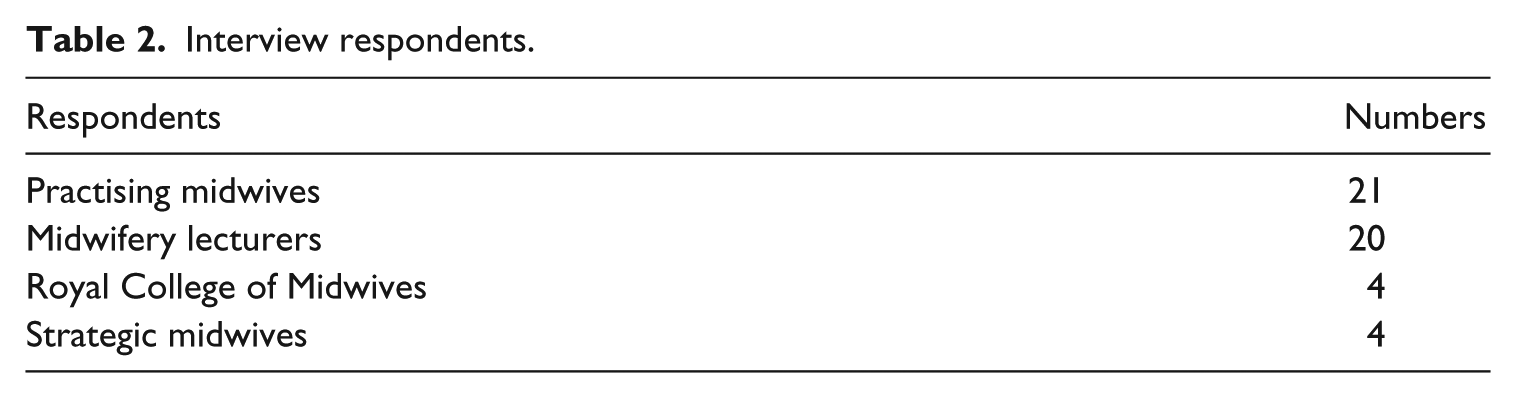
Twenty-one midwives returned their personal contact details and agreed to be interviewed (Table 2). In addition, all the university midwifery lecturers were invited to participate in the research as they worked in both midwifery education and on the maternity unit where the fieldwork took place. The majority of midwifery lecturers agreed to be interviewed (N = 20). In order to gain a strategic viewpoint senior respondents working in midwifery education and policy were interviewed (N = 4). The union perspective was obtained by interviewing three national representatives from the RCM and one regional union officer who covered the maternity unit (N = 4).
Interview respondents.
The interviews were conducted over a six month period and lasted for between one and two hours. An interview guide was used as a prompt to cover issues such as the types of flexible working used across the maternity unit, the advantages and disadvantages of flexible working, and midwives’ views and experiences of flexible working, WLB, part-time and full-time working. All the interviewees agreed to be recorded and a copy of their transcript was sent to them for comments, although none were returned to the researchers.
Analysis of the semi-structured interviews involved sorting and thematically coding the data and identifying the prevalent themes. The major themes were identified using colour coding, then manually sorted and categorized into main headings and sub-categories, with appropriate quotes to support them. These categories were continuously revised to ensure that all the significant issues had been captured. Using these techniques data saturation was achieved (Strauss and Corbin, 1998).
The following discussion presents the findings and is organized around the five themes identified: the advantages of flexible working and WLB; balancing different needs; ‘midwives, they’ve a job to do’; full-time midwives’ resentment of flexible working and WLB initiatives; and ‘the exception, but now the norm’. The themes were interlinked and midwives discussed their views and experiences of flexibility and WLB using examples to illustrate their points.
The advantages of flexible working and WLB
All the respondents identified a number of advantages with flexible working and WLB and cited these as strategies used to recruit and retain midwives. Flexible working was discussed by midwives in terms of the use of part-time or term-time contracts, twilight shifts, job-sharing and flexi-hours. The national RCM representatives agreed that offering flexible working and WLB were important retention strategies that enabled midwives to accommodate caring commitments, continue working and also gave them more control over their working lives. One of the RCM representatives outlined how flexible working was used to manage periods in the maternity units that were difficult to cover: ‘If you’re flexible in the way that you deploy midwives, then actually it’s almost an advantage to have quite a large number of midwives working part-time hours as well.’
Midwives encountered some problems with flexible working and WLB and cited examples of hospital midwives not always receiving the shifts they had to work in sufficient time and this made it difficult to organize caring commitments. This was particularly difficult if paid childcare was used by a midwife as they would be charged for the place even if they did not use it. As a result, some midwives had started to request their shifts and this caused resentment among staff without caring commitments as they were left with limited choice about the shifts they worked and often would have to do the unpopular ones. Despite the right to request flexible working, the RCM union officer observed that midwifery line managers’ attitudes towards flexible working and WLB often determined whether staff were able to work flexibly and suggested: Your biggest problem is your first line manager, because you could have all the policies in place that you want, if that line manager hasn’t had the training and that midwife goes to her line manager and she says, ‘oh no you can’t do that’, that’s the finish of it.
Balancing different needs
One of the difficulties discussed with offering flexible working and WLB was balancing the number of midwives working full-time and part-time to ensure the maternity unit was covered, while at the same time trying to meet the individual needs of midwives. Midwives discussed that ‘balancing these different needs’ was problematic and that flexible working made it hard for midwifery managers to organize work and ensure that all the shifts were covered. As a part-time midwife observed: ‘Flexibility causes lots of problems. I can see from the management point of view, having lots of people doing lots of different shifts is a nightmare, in terms of making sure that everywhere is covered all of the time.’
Midwives recognized that to attract and retain midwives it was important to offer different forms of working, particularly as in some areas of the maternity unit over half the midwives were either part-time or employed on a flexible contract. However, they felt it was important to get the balance and number of staff right. Midwives acknowledged the contradictions with what they were saying but felt this was due to the tension between providing flexible working and WLB with the reality of having to deliver a 24-hour maternity service.
Many midwives suggested that it was possible to accommodate flexible working and WLB practices, providing there were sufficient staff. A midwife argued, ‘It is impossible to fit it together if you’re short staffed.’ One solution offered was that midwives could do caseload working (midwives allocated to work with a specific group of pregnant women and be on call to deliver their babies). However, as a midwifery lecturer pointed out: ‘The problem is that a lot of midwives resisted caseload working because, actually, it’s quite nice knowing when you’re going to go off a shift. It’s quite nice knowing when you start work.’ This presents a dilemma as some midwives wanted flexible working and WLB to accommodate their caring responsibilities, but also needed predictability and to know when they were working in order to manage these commitments. The problem was compounded by the fact that the maternity unit needed to provide continuous cover, yet many midwives did not want to work conventional shifts and a midwife suggested that flexible working was, ‘a big headache to manage’.
‘Midwives, they’ve a job to do’
Midwives’ attitudes to flexible working and WLB were also influenced by their beliefs about what is expected of a ‘professional midwife’ (Symonds and Hunt, 1996). This was discussed in terms of midwives’ commitment to the midwifery profession and ‘the needs of the woman and the maternity unit’. Some midwives believed that flexible working and WLB had reduced midwives’ commitment not only to their job, but to the profession. This resulted in resentment and dissatisfaction among full-time midwives who described part-time staff as, ‘not being committed to their work’, ‘just doing their job’ or ‘letting colleagues down’. Furthermore, they felt WLB was sometimes ‘used and abused’ by midwives. A senior midwife reflected that midwives came into the job knowing that shift work was part of the role and stated, ‘suddenly people just don’t want to do that anymore’. The midwife commented, ‘I just can’t ever remember a day when I was a junior midwife that I would have ever dared do that (phone in because of caring commitments), you know, you were here by hook or by crook.’
Another midwife felt that in some cases midwives’ commitment and attitudes to work had changed as a result of flexible working. She cited examples of midwives who were not working in the same ward area the next day leaving work for other midwives to do and commented, ‘I think midwives just say, I won’t do that because I’m not here tomorrow so that it won’t be me picking up that piece of work tomorrow, it will be somebody else, so it’s OK to leave it.’ There was also evidence that even though midwives pursued a professional career at the same time they also wanted and expected to have a WLB. This sometimes proved incompatible, particularly when the maternity unit was short staffed or very busy. A midwife observed, ‘I think if I’m honest, it’s because midwives expect to have a life out of work.’
Full-time midwives’ resentment of flexible working and WLB initiatives
All the respondents expressed some concern that flexible working and WLB was fragmenting midwifery and fuelling resentment between midwives. Full-time midwives or those without caring commitments felt disadvantaged and marginalized as they had to cover the unpopular shifts or organize when they worked around part-time staff. The consequences of this were outlined by a full-time midwife, ‘I think the people that haven’t got families or choose to work full-time feel that they are propping the whole service up.’ In some cases full-time midwives had opposed flexible working and resented their part-time colleagues. A midwife described the situation, ‘The midwife that is not particularly involved in the term-time contracts actually ends up picking up all the ‘dog ends’, they get very stressed, very resentful and it can harm the working environment.’
These comments illustrate the dilemma of trying to provide flexible working and WLB with staff shortages, increased numbers of part-time staff while at the same time attempting to ensure that maternity services were covered. This results in a tension between full- and part-time midwives over who does the extra work (Edwards and Robinson, 2004). A community midwife outlined the situation encountered: I think if you get the balance wrong, then the traditional shift patterns, which are the ones that underpin everything else, the core, those staff get used and abused and I think they get fed up. I mean it’s like, we’ve got on-call commitments, there’s two of us on full-time contracts, and like we’ve had high sickness, somebody’s got to cover the on-call commitment. None of the part-timers have ever volunteered, and it’s always been the people that have been on three, four, five days, and you think – well hang on a minute! You can get fed up!
The regional RCM union officer agreed there were problems with flexible working and recalled, ‘You get the situation where you get the full-timers saying, “yes it’s all right but it all falls on me”, and the part-timers say, “but I’ve got kids!”.’
The national RCN representatives were aware of full-time midwives’ resentment towards flexible working and WLB, but acknowledged the necessity of having these policies in place to recruit and retain staff. As a national RCM representative stated: Flexibility is a big issue and I have to say it isn’t always management that’s the problem. It’s often midwives’ own colleagues that are the problem, and there seems to be a real backlash going on at the moment about things like Improving Working Lives and a constant moan really from a small, but fairly large, group of full-time midwives without family commitments, who complain constantly about the advantages that all these other people have got. What they do not understand is that if you couldn’t give that flexibility to those midwives, they wouldn’t be there at all! So they wouldn’t be any better off but there seems to be this complete block, which I think is quite sad, in, what is supposed to be a caring profession because (midwives) they don’t care for each other very well.
Despite legislation (Employment Act, HMSO, 2002; Terms and Conditions of Employment: Flexible Working Regulations 2014 (SI 2014/1398), The Stationery Office, 2014a) promoting flexible working and WLB, midwifery managers were reviewing how these policies were being used in the maternity unit due to the perceived inequity between full- and part-time staff and the difficulty with managing flexibility. The reasons for the change were outlined by a midwife: They [midwifery managers] are trying to sort of, not exactly put a stop to it [flexible working], but they are trying to make it more difficult for people to do hours that suit them, so of course that doesn’t go down too well.
‘The exception, but now the norm’
Midwives also discussed that their experiences of flexible working had compromised WLB and led to increased work pressures. This was compounded by high sickness rates and staff shortages, together with the amount of cover on-call midwives had to undertake. In some cases this had led to resentment between colleagues and undermined midwifery teams. As a midwife explained: Nowadays because the hospital are short staffed and are extremely busy, they call you and you may have done a full day’s work, all day, and be on-call, and be called out all night as well, which is horrendous. It got to the point when you are on-call and you count how many deliveries you’ve got; I’ve got three [deliveries] this time, how come she’s only got one?
The need to be flexible to meet the maternity unit’s needs was questioned by some midwives who felt this had been used by managers to enlarge, extend or change their work and that midwives’ ‘goodwill’ was sometimes abused. Arguably by being flexible and accommodating staff shortages and sickness, midwives had gradually taken on more work and this undermined their WLB. Midwives argued that initially this had been seen as a ‘favour’ or a ‘one off’, but this was now expected and in some cases the additional work had become an integral part of a midwife’s role. One midwife commented, ‘I mean if it’s colleagues or patients you will do that “extra bit” and at some stage that “extra bit” becomes part and parcel of your job.’
The evidence indicates that midwives continued to ‘give that extra bit’ and increasingly were going without breaks, doing more shifts, getting off late from work and covering for sickness. A midwife explained, ‘it used to be the exception and you would do it because it was the exception, here it’s become the norm’. As a result, flexible working was not always perceived as a reciprocal relationship between midwives or managers and vice versa. One midwife stated, ‘but you feel like saying what’s in it for me? Apart from the patient and the service what do I benefit from it? I don’t get anything.’ In order to illustrate the tensions between work pressures and a WLB a community midwife recalled a situation in which: They put me on-call on my day off and I thought I don’t want to do on-call on my day off – but there’s nobody else to do it. So I went to my manager and said, ‘well I am having time back’ and she said, ‘oh no – not if you’re not called out’. But I’m on-call for the service on my day off, and I only get paid the minimum, and, you’re saying that even if I’m not called out I won’t get that important time back and it’s about people recognizing that your days off are important.
As a result of incidents similar to this, midwives felt that flexible working had reduced the distinction between home and work, particularly as they were often phoned at home about work related issues. A midwife argued, ‘it’s very hard, because it’s expected, because you have got the title “midwife”, we are expected not to be a person or have a life’.
Discussion and conclusion
Both international and national WLB discourses identify similarities and differences that are prevalent to this study (Aybars, 2007; Sánchez-Vidal et al., 2012). The need for family friendly practices, more control over work and achieving a WLB are all issues identified by midwives (Eikhof et al., 2007; Wise et al., 2007). However midwifery is distinct; it is both a profession and one that is predominantly female, therefore an exploration of midwives’ experiences and views of WLB provides insight into the tensions and contradictions with the WLB agenda from this unique perspective. At the same time, the findings have implications for other professional groups in the NHS who rely on flexible working and WLB initiatives to attract and retain staff. The following discussion considers this with reference to the questions posed earlier in the article.
The first question examines midwives’ experiences and views of flexible working and WLB. Midwives acknowledge the difficulty with trying to balance different needs while attempting to provide flexible working, a WLB and ensuring the maternity unit is covered (Ball et al., 2003). Due to these competing tensions midwives want the proportion of part- and full-time midwives employed reviewed and a ‘return to how it was’, however this is unrealistic due to ongoing midwifery shortages and the increase in flexible working (Midwifery 2020 Programme, 2010). The paradox is that midwives, particularly part-timers, are less flexible as they are trying to balance different needs and exercise their adaptive preference and choice, but also require predictability to manage caring commitments (Hakim, 2000; Purcell et al., 1999).
Tensions are further compounded as both managers and full-time midwives have expectations that to be a professional, midwives have to be committed to the profession and put the needs of the woman and maternity service first (Finlayson and Nazroo, 1998; McDonald et al., 2009). Moreover, wanting flexibility and a WLB are seen as incompatible with being a professional midwife. This perception reinforces flexibility stigma and co-worker resentment (Cech and Blair-Loy, 2014; Edwards and Robinson, 1999) and fails to acknowledge the fact that the majority of midwives do not wish or are unable to work full-time.
The second question asked what the implications of flexible working and WLB are for midwives and the midwifery profession. The research found similar findings to other studies, however an important difference for the flexibility stigma debate is that it is full-time midwives rather than part-timers who are marginalized (Cech and Blair-Loy, 2014; McDonald et al., 2009). It is unclear what the long term implications of this are as potentially flexibility stigma may decline as the majority of the workforce is part-time; alternatively it could increase as the number of full-time midwives further reduces and they become even more marginalized (Crompton, 2002).
The need to offer flexible working and a WLB to attract and retain midwives is acknowledged in the literature and by the midwifery respondents (Midwifery 2020 Programme, 2010; Rafferty et al., 2011). The problem is that increasingly it is full-time midwives who are expected to be flexible, fit around part-timers, work unsocial shifts and are left with little or no choice about when they work (Ball et al., 2003; Edwards and Robinson, 2004; Teasdale, 2013). As a result there is a significant amount of resentment and injustice felt by full-time midwives and those without caring responsibilities who feel they are being disadvantaged by flexible working and not experiencing a WLB (Anderson et al., 1994).
Flexible working is increasing work pressures and encroaching on all midwives as the boundaries between home and work are blurred. Midwives continue to ‘give that extra bit’ in order to provide the care required, resulting in work intensification (Edwards and Robinson, 2004; Prowse and Prowse, 2008). This polarizes midwives as full-timers and those without caring responsibilities feel it is they who take on more work and see part-timers as less committed as they are not as willing to volunteer or undertake additional shifts (Curtis et al., 2006b). These tensions suggest that commitment levels between part-time and full-time midwives are different. However, in contrast to Davey et al. (2005) the study shows that both groups are undoubtedly committed to caring for women, but part-time midwives are unable to commit to extra work due to the trade-off between work and home (Perrons, 1999).
Arguably unless these tensions are addressed the historical supportive, nurturing relationship that exists between midwives is compromised (Curtis et al., 2006c). This illustrates the conflict within midwifery between the majority (part-time midwives) who are using an adaptive preference and contrasts with the minority (full-time midwives) who are work centred (Hakim, 2000). The implications of this for the midwifery profession are significant and will require midwives to adapt to a work culture in which WLB is considered a right (Putnam et al., 2014).
The discussion above highlights that contrary to other studies (see Cech and Blair-Loy, 2014; McDonald et al., 2009; Smithson and Stokoe, 2005; Williams, 2000) the increase in flexible working and part-time midwives is marginalizing full-time midwives and preventing them from having a WLB. While there is growing inequity between full- and part-time midwives, a major challenge for the midwifery profession is to provide and support flexible working and a WLB for all midwives and at the same time ameliorate the antagonism of full-time staff. The concern is that unless these tensions are addressed divisions between midwives and within the profession will intensify.
Footnotes
Acknowledgements
We would like to thank the anonymous reviewers and the editor for their valuable comments.
Funding
This research received no specific grant from any funding agency in the public, commercial or not-for-profit sectors.