




Abstract
The article argues that the long-running debate between organizationally bounded and boundaryless careers has been too narrow and neglects the variety and distinctive characteristics of career boundaries. Drawing on boundary theory, it investigates the main career-relevant domains and boundaries, and the motivations and structural conditions that influence boundary crossing or having a career within a specific domain among a sample of professional pharmacists. The qualitative study shows that careers are enacted within a number of relevant domains and are shaped by a range of boundaries such that boundarylessness and embeddedness are co-existing career dimensions. It also reveals how even within a professional population careers are embedded within diverse social and cultural contexts that impose differing constraints on career mobility. The article therefore provides a fuller, more nuanced understanding of career boundaries and contemporary careers.
Introduction
Two decades have passed since the boundaryless career was proposed as an alternative inter-organizational lens to capture the nature of contemporary careers (Arthur, 1994). The concept has broadened research on careers and career-related topics by identifying how factors such as the interface between work and life (Kossek and Lautsch, 2012), embeddedness within occupations (Arthur and Rousseau, 1996) and subjective views of success (Arthur et al., 2005) help to shape careers and work-related identity. While the boundaryless career concept has generated considerable interest, critics have argued that the idea of boundarylessness presents a number of important conceptual and operational limitations (Cohen and Mallon, 1999; Inkson et al., 2012) and shown that the empirical basis for an increase in inter-organizational career mobility is modest (Rodrigues and Guest, 2010). Part of the problem is that the boundaryless career, like the previously dominant organizational career model, is basically a metaphor aiming to highlight trends in contemporary careers rather than a fully developed theory. While metaphors provide a useful lens to describe and develop insights about social phenomena, they are also incomplete and simplified explanations of reality (Inkson, 2006). To progress careers research we need to go beyond the duality between bounded and boundaryless careers, or traditional intra-organizational career perspectives and the more contemporary inter-organizational lens, and address the complexity of boundaries in contemporary careers.
This article argues that the conceptual and operational limitations of the boundaryless career concept reside, to a significant extent, in the way its proponents envisage the characteristics and the range of career boundaries. Despite calls to bring boundaries to the forefront of the careers debate (Gunz et al., 2007; Inkson et al., 2012), they remain neglected as a focus of empirical research. This article addresses this omission by setting out an initial conceptualization of career boundaries and career domains, identifying a research agenda and reporting a qualitative study investigating career-related boundaries and factors affecting boundary crossing. The discussion is informed by contributions from sociological literature on what has loosely been labelled boundary theory (Hernes, 2004). Boundary theory underpins major streams of sociological research such as social identity theory and systems theory and seeks to explain how boundaries are socially constructed and affect behaviour.
The article is structured as follows. First, using a review of the conceptual strengths and limitations of the boundaryless career concept as a point of departure, and informed by boundary theory, it highlights the potential benefits of investigating boundaries to more fully understand the nature of contemporary careers and identifies a number of key research questions. Second, it explores the main career-relevant domains and boundaries, the motivations to cross or to have a career within a specific boundary domain and the perceived constraints on boundary crossing among a sample of professional pharmacists. The findings indicate that people identify and subjectively construe a wide range of salient career domains and boundaries and that boundarylessness and embeddedness should be viewed as co-existing career dimensions. In addition, the findings show that people seek to manage their careers within multiple boundaries while factors such as family, gender and ethnicity can facilitate but more often constrain boundary crossing and career mobility. The article therefore goes beyond the duality between bounded and boundaryless careers by highlighting motives for boundary crossing but also structural influences on career mobility.
Towards a new understanding of career boundaries
The boundaryless career is broadly defined as one that ‘moves across the boundaries of separate employers’ (Arthur, 1994: 296). The concept was proposed as a contrast to the idea of the organizational career, commonly defined as a ‘sequence of promotions and other upward moves in a work-related hierarchy during the course of the person’s work life’ (Hall, 1976: 2). While the boundaryless career concept has made an important contribution to careers thinking it also presents a number of conceptual issues that limit its utility.
An initial limitation of construing the boundaryless career as the opposite of the organizational career is the assumption that individuals are now free to pursue their careers in a relatively unstructured environment (Inkson, 2006). The traditional career model depicts careers as unfolding mainly within single employment settings and predicates individual career success – defined by promotion, power and income – and organizational outcomes – such as employee loyalty, commitment and citizenship behaviours – on the maintenance of strong organizational boundaries. In contrast, advocates of the boundaryless career argue that boundaries no longer set a ‘division between familiar and hostile territory’ (Arthur and Rousseau, 1996: 372) and should instead be viewed as permeable membranes to be crossed in career behaviour.
The view that boundaries have become weak and permeable suggests that individuals navigate their careers according to their own values and motivations. This ‘manifestation of [a] wider neoliberal discourse’ (Roper et al., 2010: 673) is underpinned by an ideology where careers are essentially viewed as the product of individual agency. This view is also associated with the concept of the ‘protean’ career (Briscoe et al., 2006), which is often described alongside the boundaryless career and which argues that people increasingly manage their own careers and impose their own definitions of career success. Such a view overlooks the contribution of the longstanding sociological research tradition on careers showing how careers are to a large extent shaped by the economic, social and cultural context. For instance, there is strong evidence that career mobility is affected by the economic climate. Voluntary turnover increases during economic expansion and declines during economic contraction (Farber, 2010). There are also variable forms of instability in the labour market which seem to have a differential impact on groups of workers. Kim (2013), for instance, shows that while inter-organizational mobility has generally increased in the USA, inter-occupational mobility has declined among high skilled workers for whom professionalization has better protected against economic instability.
The importance of social structure in shaping careers is also reflected in the presence of more or less clearly defined career scripts (Dany et al., 2011) depicting expected actions, guidelines and career trajectories to follow. For example the careers of academics are often viewed as unfolding across the boundaries of different research projects and universities. However, even these seemingly agency-driven careers are shaped by sets of institutional rules that regulate access to the occupation (e.g. holding a Phd), to jobs in leading institutions (e.g. publishing in top journals) and to promotion (e.g. holding a track record of research funding). Career scripts are particularly strong among professionals for whom possible career trajectories and rules to attain desired career outcomes are broadly shaped from the moment they join a professional body.
Issues of gender, age, ethnicity and family also strongly influence people’s perceptions of and motivations for crossing career boundaries. Elchardus and Smits (2008) reported how preferences for career mobility are shaped by life stage. In their study with nearly 5000 Belgian workers, they found that as people age their preference for career stability, and particularly for a career that unfolds within the boundaries of an occupation or an organization, increases. A vast stream of sociological literature highlights how women and ethnic minorities are often at a disadvantage accessing career opportunities (Kirton, 2009). In a study on the career motivations of female doctors in the Netherlands, Pas et al. (2011) showed that a supportive home–work culture in the workplace and women’s perceptions of motherhood are core mediators explaining gender imbalance in top organizational positions. Interesting cultural nuances have also been highlighted by researchers. For instance, Greenman (2011) showed that US-born Asian American women have higher earnings than women from any other ethnic background, partly because they tend to stay in work after motherhood. Family relationships are another important factor influencing people’s perceptions about the desirability and the feasibility of crossing specific career boundaries. This applies, for example, in the case of familial entrepreneurship which is often passed on from one generation to the next (Bruin and Lewis, 2004), but also in the case of dual-earner couples, where the career of the man is often prioritized (Pixley, 2008).
A further limitation of construing the boundaryless career as ‘the antonym of the “bounded” or “organizational” career’ (Arthur, 1994: 296) is the assumption that careers are mainly constrained or enabled by organizational boundaries (Inkson, 2006). The primacy ascribed to the organizational domain is embedded in Arthur’s (1994) original conceptualization of the boundaryless career and in Briscoe et al.’s (2006) operationalization of the metaphor. In a more recent elaboration of the concept Sullivan and Arthur highlighted the interplay between the objective and subjective aspects of careers, arguing that a boundaryless career is ‘one that involves physical and/or psychological career mobility’ (2006: 22). They also acknowledged that boundarylessness may involve mobility across a range of career-relevant boundaries such as occupation or country. Their contribution, however, raises additional concerns. First, it is not clear how psychological career mobility, which in Sullivan and Arthur’s (2006) view may potentially be coupled with physical career stability, differs from the stereotypical organizational or bounded career. Second, they fail to outline the key domains shaping careers and to discuss the motivations for crossing boundaries within specific domains as well as boundary conditions facilitating or hindering career mobility. These omissions provide the core focus of the qualitative study reported in this article.
An initial task is to clarify the notion of career boundary. Boundaries are ‘physical, temporal, emotional, cognitive, and/or relational limits that define entities as separate from one another’ (Ashforth et al., 2000: 474). These entities exist within domains. Domains therefore comprise sets of homogenous elements which are perceived to belong to a category. For example, organizations constitute a different category or domain to occupations or countries. Setting boundaries through splitting a complex reality into small pieces which are then regrouped in homogenous mental niches is an integral part of the way people make sense of the world (Zerubavel, 1991). In addition to binding elements or entities belonging to a category or domain, boundaries also help us establish differences between entities within each domain (Hernes, 2004). Social systems therefore do not exist without boundaries (Sullivan, 1999).
Building on the broadly accepted definition of a career as ‘the unfolding sequence of a person’s work experience over time’ (Arthur and Rousseau, 1996: 6), Gunz et al. (2007) argue that a ‘career boundary’ separates a work from a non-work domain. While the idea of a single career boundary is potentially useful to analyse careers at a higher level of abstraction, it is of limited value for analysing careers at the individual level. Like all components of social systems, individual careers are embedded in multiple domains. However, career-related boundary crossing mostly occurs across entities within domains reflected, for example, in transitions between different organizations or occupations. Careers then unfold as individuals negotiate within these domains, perhaps crossing boundaries or remaining within boundaries either by choice or because the boundaries are viewed as impermeable or because of the potential impact of boundary crossing on other domains.
Career boundaries can also have different ‘textures’ (Hernes, 2004). Some boundaries are physical (e.g. working within a geographical area) or social (e.g. inclusion or exclusion in occupational communities) and are therefore more tangible. Others are more psychological (e.g. preference for working for organizations known for being socially responsible) and therefore less visible. Boundaries may also differ in terms of their salience, their permeability and their permanence. Therefore, while it may be feasible to cross the boundary between organizations this may be constrained by more salient boundaries in other domains, for example those concerning the impact of work on life outside work. Thus boundary crossing within a domain may be facilitated or constrained by its impact on other salient domains. A challenge in understanding how careers unfold is therefore to identify the most salient domains for individuals and the characteristics of relevant boundaries within these domains. This is also likely to vary according to type of worker. For example, while the occupational domain is likely to be highly salient among professionals it may not significantly affect career mobility for low skilled workers.
While there are potentially a large number of career domains and respective boundaries, the number that in practice are salient for a given occupational group has yet to be established but may be quite small. Socially acknowledged domains such as organization or occupation are likely to attract most attention and the ability to cross boundaries within these can therefore assume particular significance for career outcomes. Aspects of boundary crossing within some of these career-relevant domains, particularly the organization, but also the occupation and the work–non-work interface, have already been addressed in the literature, though often in an isolated rather than an integrated way. There is therefore a need to map out these domains and boundaries and understand how people construe and seek to manage them to pave the way for an integrated perspective on contemporary careers.
The preceding analysis suggests that the way people construe boundaries reflects their own values, preferences and motivations but is also influenced by structural constraints imposed by the broader cultural, social and economic environment; and in understanding the significance of boundaries, the interplay between these needs to be explored. In moving beyond the duality between bounded and boundaryless careers, this article investigates the key domains and boundaries shaping careers, explores the motives underpinning boundary crossing within specific domains and the boundary conditions facilitating or hindering desired patterns of career mobility. These issues are explored in a qualitative study of professional pharmacists in the UK.
Method
Since this is an exploratory study designed to identify the range of career-relevant domains and boundaries and of key boundary crossing motivations and conditions, a decision was taken to use semi-structured interviews as these allow the exploration of a range of pre-defined themes and freedom to cover additional related topics.
Participants
The study utilized in-depth semi-structured interviews with 37 UK pharmacists. Pharmacists provide a highly relevant population for several reasons. First, following five years of education and training, there are a variety of career paths that can be pursued. A majority enter the private retail sector, working either with large chains such as Boots or in medium and small chains. In some cases, they will become self-employed owners of chemist shops. The second largest group enter the national health service (NHS), mainly working in hospitals with a smaller proportion attached to primary care. There are two smaller groups working in academia and industrial organizations and a few employed in various branches of government. It is possible to move across sectors and for many pharmacists there is the potential choice between retaining their primary professional activity or moving into management. Second, until recently, there was a longstanding shortage of pharmacists, potentially affording choice over career path. One consequence is that there is a high level of employment flexibility both in terms of hours worked and type of contract. A study by Guest et al. (2006) found that 46 per cent worked on atypical contracts including 24 per cent who had multiple jobs, often across sectors, 38 per cent who worked part-time and 11 per cent who had temporary contracts. Finally, the pharmacy population has been rapidly changing with an influx of women and ethnic minorities. The pharmacy workforce has been extensively studied by Hassell and colleagues (see, for example, Shann and Hassell, 2006) who confirm this general picture of a highly flexible workforce but also of a workforce in flux. Pharmacists, therefore, provide a useful sample because of the varied choices available within the profession, the labour market circumstances that provide the opportunity to exercise choice of career path, but also the increasing proportion of pharmacists whose careers may be partly shaped by factors such as gender and ethnicity.
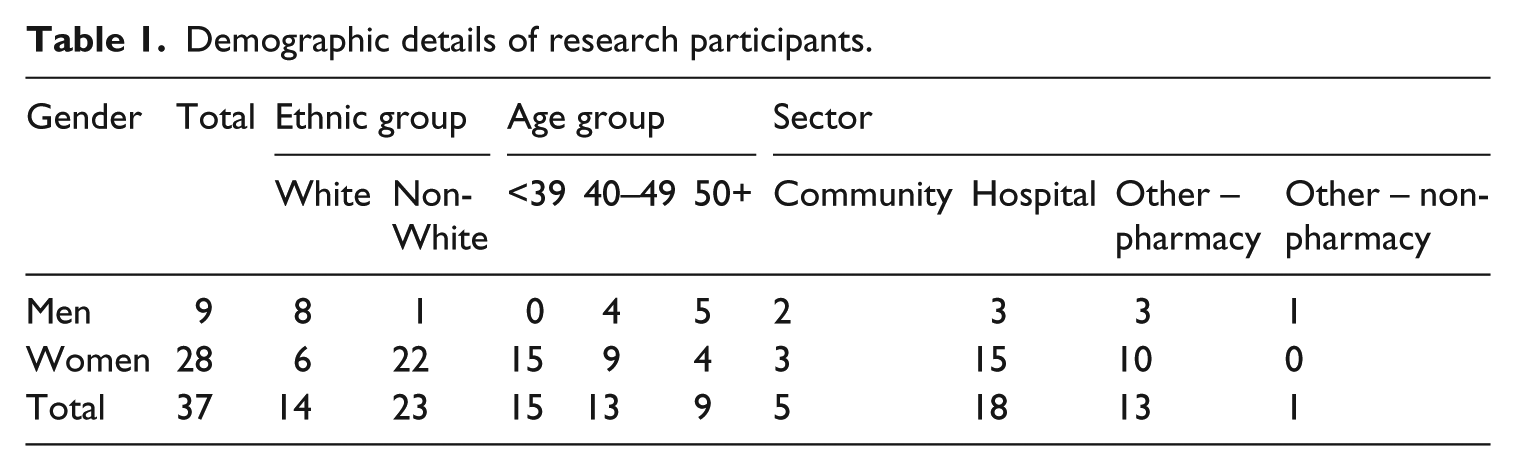
Pharmacists were initially accessed through their professional body which facilitated contacts with subjects across a range of pharmacy sectors and subsequently through a snowball approach. To reflect the changing demographic characteristics of the profession in the UK, the sampling strategy ensured that people from both genders, different ethnic backgrounds, age cohorts and who worked in different sectors were included. The sample for this study reflects the growing diversity in the population even though no claims can be made about representativeness (see Table 1 for information about research participants).
Demographic details of research participants.
Data collection
Interviews were conducted by two authors of this article and focused on two key areas. First, participants were asked about their career history and key career transitions to identify career-relevant boundaries and domains (e.g. what was your first/second/third job?). Second, the interview explored people’s motivation to cross a boundary or to seek a career within a specific domain and factors facilitating or inhibiting career transitions (e.g. what are you looking for in your career? Why did you take this job/change jobs/organization/occupation?). Participants were informed about the study’s aims and were asked to sign a consent form. Confidentiality was assured and interviews were recorded and fully transcribed. Interviews lasted on average 90 minutes. The data were analysed and indexed into relevant themes using the software package NVivo.
Data analysis
The data analysis focused on the two areas described above and followed a thematic analysis approach (Ritchie et al., 2003). First, two authors have jointly identified all the instances in which participants referred to career domains and boundaries. Five categories were inductively identified and considered to represent the key career-bounded domains acknowledged by participants. The excerpts were then independently indexed into each category. Meetings were subsequently held to compare the coding of the data. Where disagreement existed a discussion was held until consensus was reached.
Second, the authors explored motivations to cross or to have a career within each bounded domain identified as well as salient boundary crossing conditions. To assist in this task, two categories – motivations for boundary crossing and motivations for staying within the boundary – were created for each career boundary. An additional category was created for each boundary domain to capture key boundary crossing conditions identified by participants. Both authors began by jointly identifying all the instances in which participants referred to the underlying reasons for crossing a boundary or having a career within the bounded domain. The data were independently indexed into the appropriate category and any disagreements were discussed until consensus was reached.
Findings
The findings are organized around the core issues that form the focus of the study, namely the range of domains and boundaries people identify as relevant career shapers and the motivations for boundary crossing and boundary crossing conditions.
Five clear and consistently mentioned domains and associated boundaries emerged from the data analysis: occupation; non-work; organization; sector; and geography.
Occupational domains and boundaries
All participants identified the occupational domain as a core career shaper and therefore acknowledged a particularly salient boundary between the pharmacy profession and other occupational domains. The motivation to have a career within the occupational domain of pharmacy was associated with two factors. The first was a strong occupational identification. Eighteen participants talked about their motivation to use and develop their specialist skills to a high level of competence and to be viewed as experts in the field. One participant, for instance, described how she was positively influenced by a mentor who inspired her to develop her skills: When I was at [Hospital] I was very inspired by the clinical pharmacist who trained me and my ambition was to do a master’s degree and to be like him and be very involved clinically with the patients and training other pharmacists. (Woman in her 40s)
The second reason was the desire to make a significant contribution to society. Ten participants reported that the pharmacy profession allowed them to serve patients and contribute to the community and emphasized that this was a strong motivator to stay in the profession: ‘I’m patient focused really. What keeps me going, what I love about my job is that I’m helping a patient’ (Woman in her 30s).
Only five participants had, at some point, engaged in inter-occupational career transitions. The motivation to cross the occupational boundary was associated with two factors. The first, mentioned by three participants, was the desire to pursue different career interests. The second, mentioned by two participants, was regret about the decision to enter the pharmacy profession: I decided that I want to retrain in a completely different field […] so I’m studying archaeology and I hope to become a field archaeologist. (Man in his 40s) At a certain point I found out I’m actually not a clinical person. I was working at a hospital and I thought ‘well I can do it but it’s not really me’. (Woman in her 40s)
Most participants acknowledged two relevant factors severely inhibiting occupational boundary crossing. First, 24 participants described how the lengthy investment developing specialist pharmacy knowledge at university had limited their career options and referred to the high costs associated with changing occupations. As one participant explained: ‘I think I will stay [in pharmacy]. I wouldn’t say I love my job but […] you do so much training that it’s not really worth starting from the bottom. I don’t think I could go back to Uni’ (Woman in her 30s).
Second, some participants described how issues of culture, gender and ethnicity influenced their decision to enter and remain in pharmacy. South Asian participants, in particular, reported that being a professional is a longstanding cultural ambition and that their families encouraged them to pursue a career in pharmacy. Asian and Middle Eastern women also talked about how a career in pharmacy is viewed as a suitable profession for a female in their communities, acting as an incentive to remain within the pharmacy occupational domain: I think with Asian people it’s what the community says. They [family] like to say ‘oh my child is an accountant, my child is a pharmacist’. That makes them look good. (Woman in her 40s) It’s encouraged for females in the Middle East to do pharmacy. It’s more of a female oriented occupation. (Woman in her 40s)
Non-work domain and the boundary between work and non-work
The second career boundary identified among pharmacists is the divide between the broad domains of work and non-work. Participants described how career and personal and family lives are often competing domains. While most people sought to maintain a clear boundary between the two domains, in practice the boundary was often highly porous, so that one domain had a significant influence over the other. The constraints imposed by non-work commitments on career choices, and vice versa, seemed to be particularly important when starting a family and having children. These constraints were experienced in different ways by men and women in this study. Men typically reported that having a family and dependent children had either not affected their career commitments or had made them worry more about job security and ensuring a reliable source of income, sometimes forcing them to work longer hours. As one participant stated: Ten years ago I had three young children and my aim was to make sure that I had security for myself and for them. Now my older boy is 17 and the other is 16 and I don’t really worry about that. I’m not that bothered about pay now. (Man in his 50s)
In contrast, after getting married and having children, the majority of women reported experiencing strong career constraints stemming from their family demands. Ten women had crossed the boundary from work to non-work for periods between four months and three years. Eight of these transitions were due to the birth of a child and two women relocated so that their partners could benefit from a career opportunity. Women for whom work and career were viewed as salient priorities sought to minimize the impact of the non-work domain on their career decisions. For example, one participant described how getting pregnant conflicted with her career ambitions and another one emphasized the importance of returning to work as soon as possible after maternity: I got pregnant and miscarried […] and when I got pregnant I thought ‘Oh my goodness what have we done?’ and when I miscarried I had mixed feelings about it. I was sad but equally I was quite relieved because could I really do this job and have a family? I decided not to have a family probably because I had too much to give up. (Woman in her 40s) Career wise having my child I knew I had to get back to work because I went to a talk about what happens to women’s careers when they have children and how the trajectory flattens off. (Woman in her 50s)
In contrast, women who prioritized family over their careers seemed to be more willing to stop working and more concerned with finding work arrangements that fitted with their personal and family lives. These women often moved from full-time to part-time jobs and accepted lower-level positions in their current or in other organizations: I went back after six months, but I couldn’t go back to that role [procurement]. I went back in a different guise. I dropped the on-call, I dropped the hours, etc. (Woman in her 30s) Obviously my priorities had changed, having a baby. I wanted to go back to work [after maternity leave] but I was on quite a high salary at the time. They said ‘if you come back as a basic pharmacist, you lose one week’s annual leave and you would have to slash your salary’. (Woman in her 40s)
Among a number of ethnic minority women in particular, the family and non-work domain took priority over their careers, with some stopping work altogether. One participant from an Asian background described how her partner’s career became the priority after they got married. Another stated that in her group of eight close university friends she was the only woman who continued working after getting married: The reason probably why I haven’t [taken a career opportunity] is because I got married to him here and he can’t [move]. We’re quite tied to London at the moment and his job’s the priority […] if I get pregnant he’s got to earn the money so it’s wherever his job takes us. (Woman in her 40s) From the six girls I am the only one who is still in pharmacy doing something with my career. The two guys are still pharmacists but the girls are not! I used to say ‘why are you wasting the taxpayer’s money?’ (Woman in her 30s)
The organizational domain and boundaries
The organization was the third relevant domain identified by participants in this study. Interviewees had changed organizations on average 4.7 times (between two and eight times) since qualifying as professional pharmacists, suggesting that this is another relatively porous boundary. The analysis identified two main motives for having a career within organizational boundaries. The first was concern about employment security and financial stability. Five participants described how they sought work in organizations that offered long-term employment prospects. The second motive, mentioned by four participants, was identification with the work environment, the values and the culture of an organization: We’re [Organization] in a total state of change but I have a permanent contract so I’m safe from that point of view. (Man in his 40s) I like working in academia doing research but always linked to patients and health care because it’s really great to see that what you do has an impact on services for patient care. That’s why I love it here. (Woman in her 40s)
In contrast, motivation to cross organizational boundaries was associated with preference for variety and challenge at work. Six participants considered that spending a long time with an organization generated undesired routines. Their career preferences often led them to move organizations or seek temporary work assignments. For example, one participant left his organization to become a consultant to benefit from the opportunity of working in challenging projects: I got out, set myself up as a management consultant and the reason to do that was that I felt that I would be able to select the jobs that I wanted. I would be relatively free to move between jobs. (Man in his 50s)
Participants reported that major life events affected the desire to cross the organizational boundaries. Among men, having a family and dependent children raised concerns about ensuring regular income, preventing them from making risky career moves; or it encouraged them to seek better remunerated jobs either with their current employer or in another organization. In contrast, family obligations made women, particularly those from an ethnic minority background, more willing to cross organizational boundaries or to stop working altogether: I think when you are younger and you have a family and a mortgage then you cannot afford to take reckless decisions so up to a point you always have to conform in order to secure the income. (Man in his 50s) I am getting married, at some point I hope to have children, then if I have a career break to have children I may not want to put in the hours that I was doing before. I may find that it’s easier just to become a locum and do my day’s work and go home. (Woman in her 30s)
Sector domains and boundaries
Participants identified two types of sector boundary. The first, between public and private sector organizations, was crossed by 10 participants in this study. Of these, eight left the public sector/NHS for jobs in private organizations, one returned to the NHS after experience in the private sector and another moved into the NHS from a private organization. Participants seeking work in the NHS were motivated by its patient focused culture and job security. Participants seeking work in the private sector highlighted its more dynamic environment: I am an NHS pharmacist. The NHS part is very important to me. The kind of culture in the NHS is that you get a salary but you are not allowed to make a profit because this is not a business. (Woman in her 40s) The remuneration is possibly not as high as you would expect in the private sector but the stability is higher and the NHS stability suits my personality. (Man in his 40s) In the NHS everything moves extremely slowly. Even now 10 or 15 years later they are just implementing these systems [computerized prescribing]. I did an MBA and left the NHS. (Woman in her 40s)
The second type of boundary separates different sectors within pharmacy. The evidence suggested that people working in different pharmacy sectors had different career priorities and sought different work experiences. The main motivations for working in community pharmacy and in primary care were the possibility of balancing work and life outside work and the desire to make a contribution to society. As one participant argued, in community pharmacy ‘you can always get locums so therefore you don’t have to be there as long as you make sure the systems are in place’ (Man in his 60s).
People working in hospital pharmacy performed a wider variety of roles and sought opportunities to develop their specialist skills to a high level of competence. One participant chose to work in hospital pharmacy from the start of his career because ‘the variety there made [him] choose even at that stage that the hospital would be [his] career’ (Man in his 40s). Finally, the main motivation to work in industry was perceived to be the high income. One participant chose this sector at the beginning of her career ‘basically to make a lot of money’ (Woman in her 50s).
Twelve participants have crossed pharmacy sector boundaries at some point in their careers. These people mainly sought opportunities to develop new skills and expand their portfolio of work experiences, revealing that for some pharmacists this is a relatively porous boundary: I don’t actually want to be in this role for much longer. Because I can see myself getting quite comfortable and staying here for the rest of my life. I was thinking I wanted to go into industry, one last sector I haven’t actually gone to. (Man in his 50s)
The findings identified four boundary crossing factors that imposed limitations on sector mobility. The first was differences in specialist skills but also in public policy regulating work and pharmacists’ role in different sectors. The boundary between hospital and community pharmacy was particularly salient. As one participant stated: ‘When you read about the changes in retail or in community pharmacy it’s an awful lot of work to re-train yourself for all that’ (Woman in her 30s).
The second influence on sector crossing was work ethics associated with working in different sectors. In this case, participants highlighted the existence of a boundary separating industry from all other pharmacy sectors. Industry pharmacists were perceived to be working in a context where decisions were made with the view of maximizing profit whereas other pharmacists saw themselves as delivering a valuable service for the community: ‘I don’t agree with a lot of the ethics in industry [pharmacy]. I know it’s inevitable but making money from other people’s health has never been the biggest attraction for me’ (Woman in her 30s).
The salience of specific pharmacy sectors was also influenced by family and issues of gender and ethnicity. Small pharmacy businesses are often passed from generation to generation, shaping decisions to become community pharmacists. One participant reported how having a pharmacy business in the family shaped her career preferences: My parents used to own a [pharmacy] shop. I always liked the retail sector as a result of that. I liked talking to patients and making profits. I think that community was always the way that I was going to go. I knew that from the outset. (Woman in her 40s)
Family pressures to work in community pharmacy were also reported by many female participants, particularly those from an Asian and Middle Eastern background. They described how community pharmacy allowed women in their culture the opportunity to reconcile work with important family commitments: ‘I’ve actually been encouraged [by family] to work in the community. It’s easier for a girl to work in community pharmacy, come home in the evening, and take care of the kids’ (Woman in her 40s).
The final boundary crossing factor was constraints in accessing jobs in specific sectors, especially in industry and hospital pharmacy. This was particularly important after the pre-registration stage: It was quite competitive to get into industry, so I went for hospital. (Woman in her 30s) I tried to get into hospital but it’s very difficult so I did it [pre-registration] in a little independent shop which is good experience but very different to working in hospital. (Woman in her 30s)
Geographical domains and boundaries
The final influential career boundary identified by participants was geography. Eight participants in this study relocated to progress their or their partners’ careers. The motivation to cross geographical boundaries was associated either with career advancement or the desire to live in another location: I came here [from Wales to England] because I wanted to do more research and it was evident that I wouldn’t have time with all the management responsibilities I had. (Woman in her 40s) I sort of changed career pathways because I really wanted to go back to New Zealand so I thought ‘let’s give hospital a try’. (Woman in her 40s)
Two participants reported a strong motivation to have a career within clear geographical boundaries. This largely stemmed from preference for a lifestyle associated with living in a particular area. The first participant applied for a job in a hospital in London because she ‘always wanted to live [t]here’ (Woman in her 30s). The second participant took a career opportunity because she ‘wanted to come back to London and Tooting was home for [her]’ (Woman in her 40s).
The evidence suggested that family constraints were the most salient factor affecting geographical mobility. Participants reported how having children in school or dependent elders narrowed their career opportunities. One participant, for instance, described how his family had limited his ability to pursue career opportunities outside the London area for several years. In contrast, participants who were more geographically boundaryless pointed to the absence of family commitments for their willingness to relocate to pursue career opportunities: I’ve made the choice of where I worked based on where my family is […] when I was very young and I was at [Hospital] my father had recently died and my mother was alone so I didn’t want to move too far away from her even though I had opportunities to work elsewhere. Also when my children got older I couldn’t move them. (Man in his 40s) I’m not married or have children so I’ve been able to not have any ties to a geographical place. I don’t have a problem moving in London or moving outside. (Woman in her 50s)
In summary, the findings have revealed that participants identified five salient domains and associated boundaries shaping the direction of their careers: occupation; the divide between work and personal/family life; organization; sector; and geography. In addition, findings showed that mobility within or across boundaries was associated with people’s career preferences and with their ability to negotiate boundary crossing conditions.
Discussion and conclusion
This article aims to extend the analysis of career boundaries in the belief that this can advance career theory and improve understanding of career behaviour. Hernes (2004) suggests that the study of boundaries has sometimes been neglected in favour of a focus on the domains that they circumscribe. The popular focus on career boundarylessness also implies that boundaries may not be very important. However, Clark (2000) has argued that even if boundaries are becoming more flexible, this does not mean that they are becoming any less salient. Therefore, as a point of departure for this article, some of the critiques of the boundaryless career were revisited and it was argued that its conceptual and operational limitations stem from the way its proponents envisage career boundaries. The focus on inter-organizational career mobility and the view that career boundaries are fading and losing importance not only minimizes the intricacies with which people construe and seek to manage their careers, but also limits the usefulness of the boundaryless career concept for addressing contemporary careers. This article therefore adopts an analytic framework which focuses on career boundaries. It starts from an analysis of relevant career domains and the boundaries within and between them and identifies a range of structural and motivational factors that facilitate or inhibit boundary crossing within relevant domains.
This article supports calls to give boundaries a central role in career inquiry (Gunz et al., 2007; Inkson et al., 2012) by providing one of the first empirical studies exploring the range of career-relevant domains and influences on boundary crossing within these domains. The findings help to progress research beyond the duality between bounded and boundaryless careers in three ways. First, the study shows that careers are shaped by a wide range of domains and that primacy given to one specific domain limits our understanding of the way people construe careers and career opportunities. Among this sample of professional pharmacists five core career domains and associated boundaries were identified with varying degrees of frequency – occupation, work–non-work, organization, sector and geography. Nevertheless, this list is not exhaustive. For example, in a few cases, employment contract boundaries were mentioned, reflecting a preference for permanent or temporary or part-time versus full-time work. Some variation across different populations might also be expected; for example, occupation may be more important for professional workers while in some contexts sector may have limited salience.
Second, the findings indicate that people seek to manage boundaries according to their values and goals and that these motivate them either to cross or remain within career-relevant domain boundaries. This suggests that careers encompass both dimensions of boundarylessness and embeddedness. Future research may attempt to map out these patterns and provide a more fully informed perspective for understanding career decisions and contemporary career patterns. In addition, the findings show that people’s ability to engage in desired patterns of career mobility/stability is dependent on their ability to negotiate boundary crossing conditions. In line with the sociological literature on careers (Greenman, 2011; Kirton, 2009), findings indicate that women, particularly those from an ethnic minority background, reported stronger career constraints that limit boundary crossing. Future research therefore needs to reconcile agency and structure and to bring together the psychological and the sociological research traditions in the study of careers.
Third, the findings contribute to broadening a research agenda on career boundaries. The evidence suggests that people construe career boundaries along dimensions such as strength and permeability. The characteristics of boundaries also seemed to be dynamic, varying according to life and career stage and pressures from various domains, including family and social background. Further research is needed to capture the key characteristics and dimensions under which people construe boundaries as well as the boundary management strategies they use to achieve desired career outcomes. In so doing it is important to take into account that successful boundary management may depend on a favourable social and economic environment. In this respect, professional pharmacists are a relatively privileged group, yet they reported a range of significant structural barriers in pursuing their career goals.
This study has certain limitations. While the choice of professional pharmacists has offered diversity in terms of access to a sample of workers with a variety of career experiences and trajectories, the boundaries identified among this group may not be generalizable to other workers. Further research with other types of workers in different contexts is therefore needed. In addition, the study’s reliance on one-off interviews facilitates the emergence of post-hoc explanations about how people construe career boundaries and make career decisions. Longitudinal research is needed to capture the dynamic nature of boundaries and assess how perceptions of specific boundary characteristics shape the direction of people’s careers.
Overall, this article highlights the usefulness of an analysis focusing on a range of domains and their boundaries to provide new insights about the way people make sense of their careers. This fuller view of career boundaries offers the possibility of progressing careers research beyond the limitations of the debate between bounded and boundaryless careers that has dominated much of the careers literature over the last 20 years and re-emphasizes the importance of recognizing a range of structural constraints on career choices. This is one of the first empirical studies of career boundaries that is, itself, not limited or bounded by a focus on the boundaryless career debate. By exploring the salience of career domains, and the motivation for and constraints on boundary crossing, this study offers a framework for further research with different occupational groups. This in turn may lead to a greater integration of boundary concepts within career thinking and pave the way for a fuller understanding of career boundaries.
Footnotes
Funding
This research received no specific grant from any funding agency in the public, commercial or not-for-profit sectors.