




Abstract
The topic of work safety is a very relevant and multifaceted problem for workers, firms and policy makers. Differing from other narrow-scope studies, this article aims to enrich the understanding of workplace safety as a whole by applying econometric techniques on data from the Italian Labour Force Survey. Findings show poor working conditions are the most significant determinants of accidents and illnesses occurring at work, while having a fixed-term (temporary) contract is not significant. Other significant determinants of work safety are: not being new to the workforce; dissatisfaction with the current job; gender; and a latent proneness observed with occurrence of accident on the way to work. This article also highlights that work related accidents and illnesses are two deeply correlated phenomena and that there is a structural break after three years on the job.
Introduction
Workplace safety is an increasingly important topic around the world. According to estimates by the International Labour Organization, each year across the globe there are 2.4 million deaths from occupational accidents and work related illnesses, in addition to more than 330 million non-fatal serious accidents (ILO, 2012). In 2002 and 2007 the European Union outlined new strategies (European Commission, 2002, 2007) to foster a continual reduction in work related accidents and illnesses. Even though progress has been made in reducing both serious accidents/illnesses and deaths at the workplace, in Europe over the past few years, work related risks have not been reduced in a uniform way leaving some categories of workers, companies and sectors overexposed to workplace risks. Furthermore, the nature of workplace risk is changing due to technological innovation, changes in production organization and important transformations in the labour market (e.g. increasing flexibility, new types of contract, the rising number of women in the workplace, new and large waves of immigrants, etc.) (Blank et al., 1997; Gunderson and Hyatt, 2000; Kalleberg, 2012; Lloyd and James, 2008; Quinlan, 1999). Accidents and illnesses seem to be the result of a process that involves different and multifaceted determinants. This article aims to enrich the literature on workplace safety as a whole by offering a comprehensive view of the phenomenon. In particular, it investigates the key determinants of workplace safety in Italy in an attempt to document the relationships between work related accidents, illnesses and economic, technological, organizational and human factors affecting workplace risk.
Theoretical framework
The issue of work safety can be analysed through various lenses including wages, risks, accidents or employee profile. Exploring the relationship between wages and workplace risk, Hamermesh (1999) demonstrates that increasing wage inequality is accompanied by increasing job disamenities, including the risk of accidents. Viscusi’s (1978) model shows that wages paid to workers are not only dependent on job characteristics but also on occupational risks as perceived by workers. Worrall and Butler (1983) focus on the differences in workplace accident risk between blue-collar union workers and blue-collar non-union workers. Others (Fabiano et al., 2004) focus on the relationship between workplace accident frequency and firm size/type, finding an inverse correlation between the frequency index and firm size. Leombruni et al. (2013) investigate the causal effect of displacement on the job related injury rate, finding that re-employed displaced workers have a higher probability of being injured in their post-displacement period than non-displaced workers. Other analyses, addressing the problem of racial inequality, find that black workers face a higher rate of work related death than white workers (Stout et al., 1996) or no association between race and non-fatal work accidents (Oh and Shin, 2003). Marvasti (2010) finds that both the English language proficiency of foreign-born workers and their cultural differences from native workers play a role in the incidence of work injury. An article by Khanzode et al. (2012) presents a comprehensive review of accident causation theories highlighting three groups of factors affecting injury: individual related factors, which consider personal characteristics; job-related factors, which consider work-site characteristics, including both job and firm features; organization related factors, which include safety climate (Zohar, 1980) and the role of human resources management practices in safety programmes (Shannon et al., 1997; Vredenburgh, 2002).
The relationship between work safety and types of contracts
Labour market deregulation has attracted policy and research attention in recent years and flexibility and security have become crucial issues (Berton et al., 2012). Between 1999 and 2007 the percentage of temporary employees has risen from 11.8 per cent to 14.5 per cent in the European Union (European Union, 2010). This point is very relevant in the analysis of workplace safety because temporary workers have fewer opportunities to receive training at the workplace and their limited experience might also lead them to underestimate the risks associated with a job (Quinlan, 1999).
Moreover, the combination of lower levels of protection and perceived job insecurity might influence the likelihood of accidents and illnesses (Robinson and Smallman, 2006). Quinlan et al. (2001) try both to generalize these results and to conceptualize the association between precarious employment and occupational safety in their review of referred journal articles published since the mid-1980s. Their main finding is that more than 80 per cent of the reviewed studies found a negative association between the various types of precarious employment and occupational health and safety (for the methodological details, see Quinlan et al., 2001: 337–45). On the basis of their analysis, three sets of causes are identified: economic and reward pressures on precarious workers; association of precarious employment with more disorganized work processes or settings; and weakening or bypassing of conventional regulatory regimes (Quinlan et al., 2001: 344).
A part of existing literature focuses directly on the relationship between non-fatal accidents at the workplace and types of worker contracts. Some empirical analyses based on micro-data find different or even contradictory results about work related accidents and fixed-term (temporary) contracts. Results presented by Guadalupe (2003), using data from the 1989–98 period in Spain, are the most relevant in supporting the case of a strong positive effect of fixed-term contracts on work related accidents. However, since a substantial part of the Spanish labour market (31% in 2000, according to Guadalupe, 2003) is composed of temporary workers, her findings may not be generalizable. Blank et al. (1995) found that in the Swedish mining sector accidents happening to contractor workers were more frequent and severe than those occurring to permanent workers. Dupré (2001) established that, in European countries, the risk of accidents for temporary workers who had been employed for less than two years was particularly high in the construction, health and social sectors. Fabiano et al. (2008), using Italian data for the period 2000–2004, show that workers supplied by temporary-help agencies suffer a higher injury frequency index than direct hire employees, due to lack of experience, insufficient specific knowledge and inadequate training.
Medical studies also investigate the issue of workplace safety and fixed-term contracts. A survey (Virtanen et al., 2005) of reports about contracts and health shows that temporary workers may have a higher risk of psychological morbidity and work related injuries as compared to permanent workers. However, Benavides et al. (2006) find that, even though temporary workers seem to have a higher risk for work related injuries than permanent workers, after controlling for the length of employment the probability of accidents is quite similar in both groups.
Other literature seems to confirm that workers with fixed-term or open-ended contracts do not face a different psychosocial work environment (Saloniemi et al., 2004) and they have a similar probability of suffering work related accidents when all the relevant variables are taken into account. For instance, Amuedo-Dorantes (2002), using 1997 Spanish data, found that the higher rate of accidents/illnesses for temporary workers is due to worse working conditions than other workers. Although these findings seem robust, it is worth noting that this study does not control for selection on workers’ ability biases, while the study by Hernanz and Toharia (2006), based on 1999 Spanish and Italian data, shows that the differential of accident rates between temporary and permanent workers vanishes once personal and job characteristics are controlled for. Unfortunately, these results only consider accidents and there is no control for working conditions, which is a key variable for work safety. Finally, García-Serrano et al. (2010), using 2004–2007 Spanish data, find that workers hired through temporary-help agencies have a lower probability of suffering serious accidents and the duration of their absences is shorter than either workers hired with open-ended contracts or direct temporary contracts.
Therefore, the research assumption is that work safety is a complex phenomenon influenced by individual related factors, job related factors, working conditions and organization related factors, which should be analysed comprehensively. The present study is the first to consider accidents and illnesses together with a proxy to control for worker ability and working conditions. Using econometric methods, the Italian labour market is studied; this market is representative of the European labour market with respect to the share of temporary workers. More specifically, a probit regression model is estimated testing the relationship between the likelihood of accidents/illnesses and the types of contracts, working conditions and other determinants. Furthermore, a bivariate probit regression model to jointly analyse the probability of accidents and of illnesses and a probit model for work accidents/illnesses restricted to workers with a maximum tenure of three years are tested.
Data
The micro-data used in this analysis come from the Labour Force Survey carried out by Istat, the Italian National Institute of Statistics, and are entirely comparable to data from other EU countries. The dataset refers to the second quarter of 2007, when an ‘ad hoc’ module devoted to safety and health at work was added to the standard information contained in the Survey. The sample is limited to employees with open-ended or fixed-term contracts, excluding all other types of worker and unemployed individuals. This narrow sample has the advantage of a high degree of homogeneity. Even though several variables are considered, a homogeneous sample reduces the problem of heterogeneity not explained by regressors.
The Italian Labour Force Survey collected the same kinds of information on the key determinants of work-related accidents and illnesses that are identified in the literature (Khanzode et al., 2012), such as job, firm and personal characteristics of workers, but unfortunately it did not consider the organization related factors. In addition, the survey provides data on working conditions and on recent work related accidents and illnesses. The reference period for work related accidents and illnesses is 12 months, which could lead to an undervaluation of job insecurity since the number of accidents reported decreases as the time gap between the interview date and the actual date of the accident increases. Moreover, since fatal work accidents and fatal work diseases are not considered in data used for the analysis, the true extent of the problem of insecurity at the workplace is underestimated. On the other hand, the dataset does not suffer from a systematic underreporting bias since Istat collects the information directly at the household residence which ensures statistical confidentiality.
Following the Istat definition (Istat, 2008), work related accidents can be defined as episodes of injury that occur at work which lead to a disability, total or partial, permanent or temporary, while work related illnesses can be defined as disabilities or other physical or mental problems caused or made worse by working. Two dichotomous variables (work accidents/work illnesses) are used, indicating whether or not the worker had experienced at least one episode during the previous 12 months.
In addition to the type of contract, the determinants of accident/illness probabilities are grouped into three categories: job; firm; and personal characteristics. Within job characteristics, working time (dummy variables: full-time/part-time; overtime hours; and shift work), professional position (grouped into: manager or director; white-collar worker; and blue-collar worker or apprentice) and working conditions (described below) are considered.
A part of the ‘ad hoc’ module includes worker exposure to risk factors for health. These factors are used as a proxy for working conditions considering a set of dichotomous dummy variables. Both physical and psychological risk factors are considered. Included in the physical risk factors are: exposure to dust, fumes, smoke, chemicals; exposure to excessive noise or vibration; bad posture induced by work requirements; movement of heavy loads; and exposure to a general risk of injury. Among the risk factors that may affect the psychological balance of workers there are: excessive workload; phenomena of bullying or discrimination; and exposure to threats or physical violence.
Within firm characteristics, two variables are controlled for: establishment size (dummy variable 10 or fewer/more than 10 workers) and main activity sector of the firm (grouped into: agriculture; industrial excluding construction; construction; retail; and other activities).
The last relevant set of variables is personal characteristics, which include gender, age, number of household members and marital status. These variables help to capture different effects related to how careful different groups of workers are at the workplace. For example, younger workers could be more accident prone than older workers due to their lack of work experience and, at the same time, they could enjoy better immunity from illness than their older colleagues (Robinson and Smallman, 2006). Additionally, the inclusion of variables such as birthplace (Italy or abroad) and geographic area of residence captures specific socio-cultural values otherwise unobserved (Hernanz and Toharia, 2006). Guadalupe (2003) thoroughly explains that the inclusion of accidents on the way to work should control for systematic differences in accident proneness and ‘ability’ of the worker. In accordance with her technique, the analysis also includes a dummy variable for accidents occurring on the way to work which allows us to correct for a possible ability bias in the contract coefficient. Human capital is accounted for in the variables: years of education; months of current job tenure; and two dummy variables for (on the job) recent training activity and an indication for being new to the workforce (first job). Moreover, the variable ‘occupation’ (classified into: executive or intellectual occupation; technical position; office clerk and qualified occupation; and craftsman and operator of industrial machinery) is used to identify the specific kind of job performed by the employee in his/her workplace. Finally, the indication of whether the worker is looking for another job is used to capture job dissatisfaction.
Table A1 in the (online) Appendix provides descriptive statistics for the entire sample and for the workers who experienced accidents or illnesses. Table 1 (in this article) shows the occurrence of work accidents and illnesses by contract type. The raw percentage of workers that had experienced at least one work related accident is similar for both types of contract (2.7% for open-ended contracts and 2.5% for fixed-term contracts), while the rate of work illnesses is greater for open-ended contracts (7.6%) than for fixed-term contracts (5.6%). The aggregate data for accidents (2.7%) is in line with the official data by INAIL, the Workers’ Compensation Authority, while INAIL does not compute the incidence for illnesses (INAIL, 2010).
Incidence (%) of work accidents and illnesses by contract type.

Note: Significance levels (test of proportion) – difference with respect to worker with open-ended contract: * 0.10 ** 0.05 *** 0.01.
Source: 2007 second quarter Istat Labour Force Survey.
These preliminary results are unavoidably raw because they do not take into account all of the variables that could influence the probability of having accidents/illnesses. In the next sections, therefore, exploiting the rich dataset at the researchers’ disposal, different econometric techniques are used in order to produce ceteris paribus results. The main aim is to understand the determinants of work related accidents/illnesses by assessing which variable is significant and should be taken into consideration.
Results
The probability of accidents and illnesses at the workplace
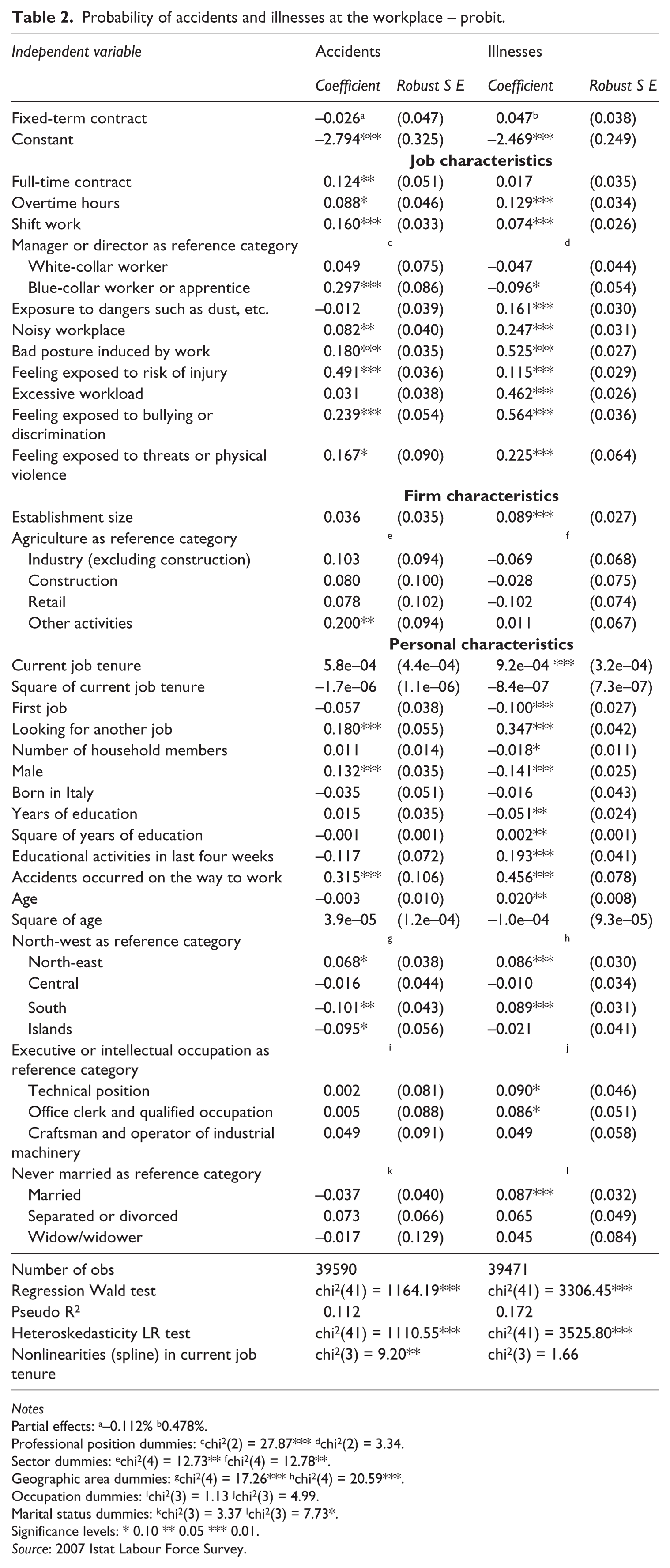
Table 2 shows the results concerning the probability of suffering accidents or illnesses at the workplace, reporting the estimated coefficients and the robust standard errors. As shown by the significant joint Wald tests on the regressions, the models succeed in explaining the probability of the dependent variables. The significant likelihood ratio test on heteroskedasticity is a rationale for using robust standard errors. Whenever Var(ε|x) depends on x, where ε is the error term and x is the vector of dependent variables, ε has non-constant variance or is said to exhibit heteroskedasticity. For all the heteroskedasticity tests in the article maximum-likelihood heteroskedastic probit models are used. They are generalizations of the probit models in which the normal cumulative distribution function no longer has a variance fixed at 1 but can vary as a multiplicative function of the independent variables (Harvey, 1976). The likelihood-ratio test of heteroskedasticity tests the full model with heteroskedasticity against the full model without. In order to obtain robust standard errors, standard errors were adjusted for heteroskedasticity by using the robust or sandwich estimator of variance. This estimator is robust to some types of misspecification so long as the observations are independent (Greene, 2007).
Probability of accidents and illnesses at the workplace – probit.
Notes
Partial effects: a–0.112% b0.478%.
Professional position dummies: cchi2(2) = 27.87*** dchi2(2) = 3.34.
Sector dummies: echi2(4) = 12.73** fchi2(4) = 12.78**.
Geographic area dummies: gchi2(4) = 17.26*** hchi2(4) = 20.59***.
Occupation dummies: ichi2(3) = 1.13 jchi2(3) = 4.99.
Marital status dummies: kchi2(3) = 3.37 lchi2(3) = 7.73*.
Significance levels: * 0.10 ** 0.05 *** 0.01.
Source: 2007 Istat Labour Force Survey.
First, the focus is on work related accidents. An important finding indicates that the type of contract does not seem to affect the likelihood of having accidents. Therefore, the variables that influence safety at work seem to be other than contract term. It is noticeable that job, personal characteristics and, to a lesser extent, firm characteristics can affect the probability of experiencing work related accidents. In the category of job characteristics, as predicted by theory (Khanzode et al., 2012), being a full-time worker as well as doing overtime hours and shift work (as measures of work intensity) increases the probability of having accidents. Clearly, expanding working time, ceteris paribus, increases the chance of accidents. When looking at working conditions, the variables considered in the analysis show positive and statistically significant coefficients. For example, the probability of having accidents is, for the average individual, 0.4 per cent higher if exposed to excessive noise or vibration (partial effects are obtained by computing the variation of predicted probability). The information coming from the professional position dummies confirms the intuition that blue-collar workers are exposed to higher risks (+1.3%) than managers or directors. Firm characteristics seem to slightly affect the probability of injury. On the one hand, the variable for establishment size is not significant. On the other hand, the categorical variable sector of activity presents a positive joint significance but it is not possible to isolate the effect of all single sectors.
When looking at personal characteristics, it emerges that gender affects the probability of having accidents. Males have a 0.6 per cent higher risk of accidents than females. At the end of Table 2 it is possible to see a significant Wald test on the coefficients of a restricted cubic spline approximation (Dupont, 2009) for current job tenure. However, in order to obtain readable results, in the presented probit model a quadratic form is used. As shown in Figure 1, the contribution to the probability of work accidents increases as the current job tenure rises until 167 months (almost 14 years), the point in which it reaches the maximum. After that, the contribution decreases and reaches its minimum for the maximum level of tenure. Figure 1 shows the prediction and the confidence intervals of the probability of accidents for the average individual in the sample for each level of current job tenure.
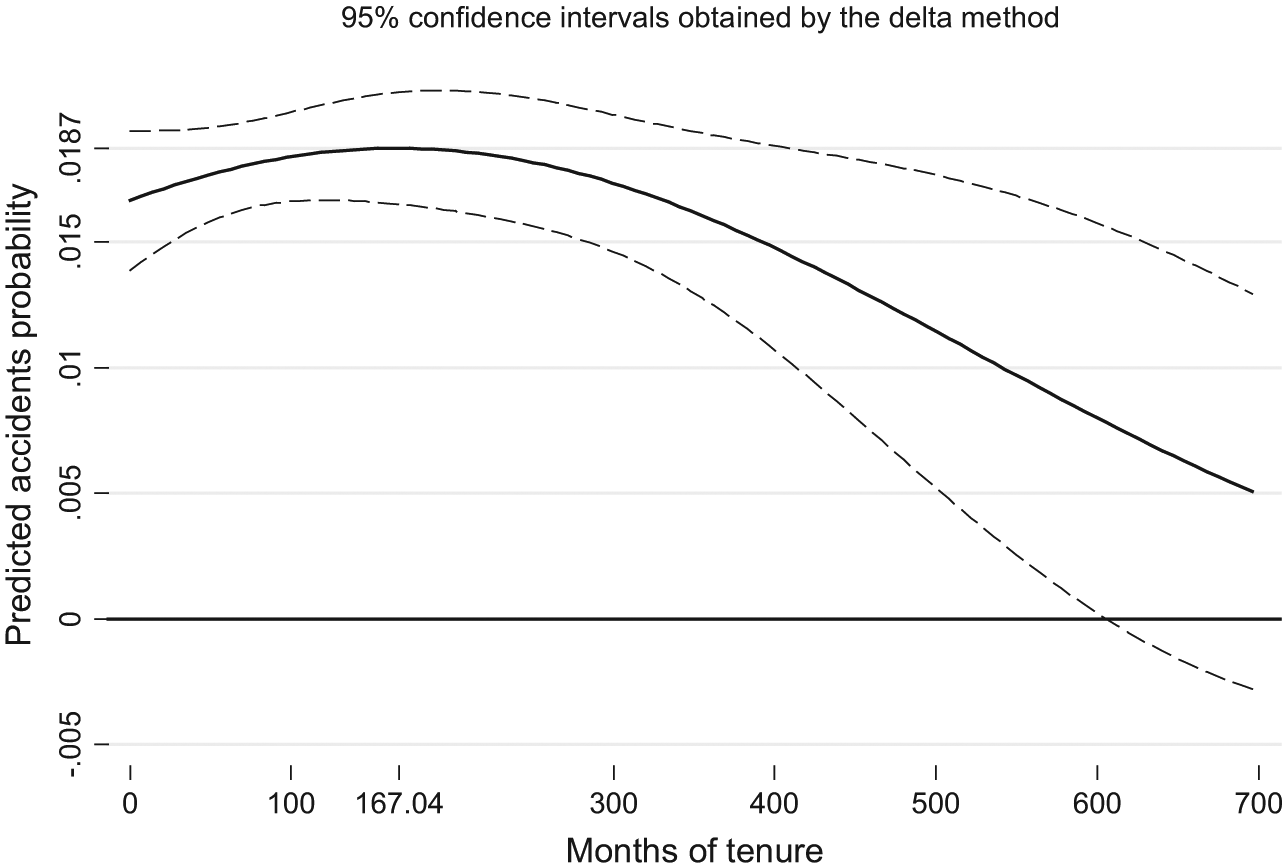
Current job tenure effect on the probability of accidents at the workplace – Table 2.
Workers who are looking for another job seem to have a greater likelihood (+0.9%) of incurring workplace accidents than their colleagues. Indeed, poor motivation, lack of satisfaction and desire for a different job could easily translate into less effort and less care at work. One could argue that people more likely to have accidents and illnesses look for another job. A problem of endogeneity, therefore, might arise. The exogeneity of this variable is checked by means of a bivariate probit model. A dummy variable, indicating whether the worker had ever been in contact with an employment agency, was added as instrument into the equation of looking for another job. Since it is not possible to reject the null hypothesis of no correlation between the residuals based on the result of the Wald test (chi2(1) = 0.05), there is no evidence of endogeneity. Exogeneity is also checked in the model of work related illnesses obtaining a similar result (chi2(1) = 0.44).
Personal characteristics also include the geographical area of residence. The probability of work related injury decreases going from north to south. As already noted, a dummy for the accidents experienced by workers on the way to work is introduced as a proxy for their degree of proneness to accidents: the worker that experiences accidents on the way to work has a greater likelihood (+1.9%) of also having accidents at the workplace. Endogeneity of accidents occurring on the way to work is controlled for by means of a bivariate probit model, as explained above. In this case, the instrument is a variable equal to the total hours worked in the week preceding the interview. Also in this case, the Wald tests (chi2(1) = 0.34, chi2(1) = 0.21) provide no evidence of endogeneity in either model of work related accidents and illnesses. Finally, the worker’s place of birth, years of education and age are not statistically significant.
When focusing on work related illnesses, it is possible to notice a similar result about the type of contract. Change of sign notwithstanding, the estimated coefficient for the dummy variable fixed-term contract is still not significant. This result is robust to different model specifications available from the authors upon request. Once again, job, firm and personal characteristics help explain the likelihood of work illnesses. Among job characteristics, working conditions significantly affect the probability of illnesses; for instance, workers with bad posture induced by work requirements or who are subject to excessive workload endure a 6.8 per cent and 6.1 per cent higher risk of illnesses respectively. Also psychological working conditions prove to be particularly important in determining work illnesses: feeling exposed to bullying or discrimination increases the risk of illnesses by 8.4 per cent. When looking at firm characteristics, employment in larger firms increases the probability of work illnesses. Among personal characteristics, work illnesses are less likely to occur to males (-1.4%). Looking at a worker’s area of residence, the geographic dummies are jointly significant and living in the south leads to a higher probability (about 0.9%) of illnesses as compared to living in the north-west. Moreover, the marital status dummies jointly considered are significant, even if it is not possible to differentiate between all sorts of marital status, but the data show that being married increases the probability of illnesses (+0.9%) in comparison to having never been married.
The joint probability of accidents and illnesses at the workplace
The two elements of work safety were examined in a unified way as a robustness check for the results of the analysis. A bivariate probit regression model was used, therefore, in order to jointly estimate the probability of accidents and of illnesses at the workplace. In this way, covariance in the unobservable of the two equations is allowed. As shown in Table 3, a positive and significant ρ means that there are unobservable factors that positively affect the two probabilities. This finding suggests that there is something similar to an unobserved proneness to having accidents that also positively affects proneness to illnesses, in other words these two phenomena are better studied together.
Joint probability of accidents and illnesses at the workplace – bivariate probit.

Notes
Average partial effects: a-0.151% b0.555%.
Professional position dummies: cchi2(2) = 26.98*** dchi2(2) = 3.29.
Sector dummies: echi2(4) = 12.56** fchi2(4) = 12.66**.
Geographic area dummies: gchi2(4) = 17.29*** hchi2(4) = 20.42***.
Occupation dummies: ichi2(3) = 1.25 jchi2(3) = 4.94.
Marital status dummies: kchi2(3) = 2.90 lchi2(3) = 7.76*.
Significance levels: * 0.10 ** 0.05 *** 0.01.
Source: 2007 Istat Labour Force Survey.
Table 3 reports results that are broadly in line with Table 2. The variable fixed-term contract continues to be non-significant. At the end of Table 3 the average of partial effects for this variable is presented. In contrast to the partial effects quoted in the previous Table, the average partial effect here is obtained by calculating the partial effect for all the observations in the sample and subsequently taking the average of these partial effects (Jones, 2007). The result is less artificial than the partial effect with dummy explanatory variables.
The probability of accidents and illnesses at the workplace within three years of tenure
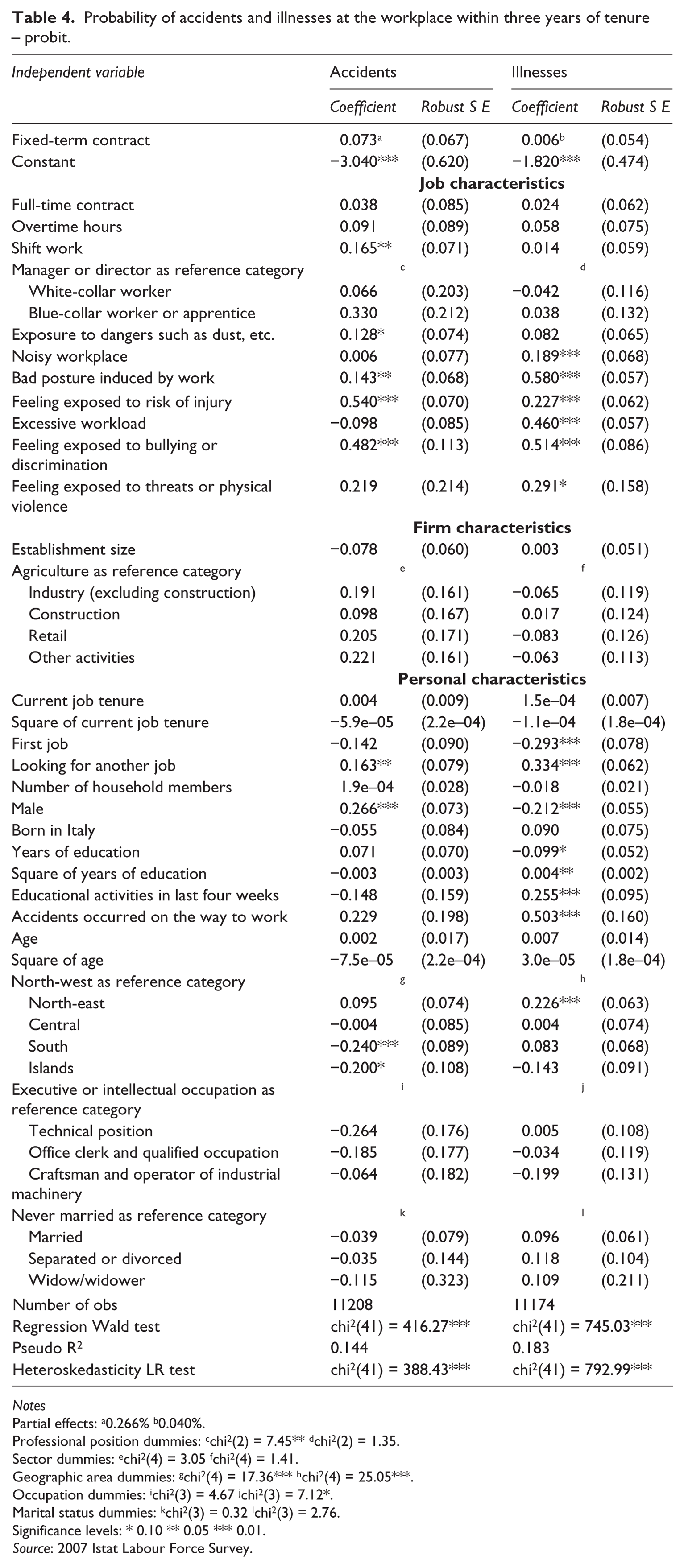
The last robustness check performed comes from a test of misspecification. Both RESET tests on the two models of Table 2 suggest a possible misspecification (chi2(1) = 16.04***, chi2(1) = 26.18***). In Italy the contractual situation changes significantly after three years of tenure in the same firm. Indeed, Legislative Decree n. 368 from 2001, providing the legal framework for fixed-term contracts, states that the total duration of a fixed-term relationship cannot exceed 36 months. Therefore, a poolability test is performed for workers with tenure within and over three years for the two models of Table 2. The results conclusively reject the hypothesis of equal parameters (chi2(42) = 57.45*, chi2(42) = 65.53**). Hence, the analysis is restricted to only one of the two subsets of the dataset. Table 4 presents the results of the probit models for the work related accidents/illnesses, having restricted the dataset to workers with tenure up to three years. This table is very reliable since the RESET tests on the models run on this restricted sample do not find misspecification (chi2(1) = 2.52, chi2(1) = 1.02).
Probability of accidents and illnesses at the workplace within three years of tenure – probit.
Notes
Partial effects: a0.266% b0.040%.
Professional position dummies: cchi2(2) = 7.45** dchi2(2) = 1.35.
Sector dummies: echi2(4) = 3.05 fchi2(4) = 1.41.
Geographic area dummies: gchi2(4) = 17.36*** hchi2(4) = 25.05***.
Occupation dummies: ichi2(3) = 4.67 jchi2(3) = 7.12*.
Marital status dummies: kchi2(3) = 0.32 lchi2(3) = 2.76.
Significance levels: * 0.10 ** 0.05 *** 0.01.
Source: 2007 Istat Labour Force Survey.
When looking for the differences between Tables 2 and 4, the variable fixed-term contract is still not significant in explaining the probability of incurring accidents and the probability of incurring illnesses. Regarding the probability of accidents, the variables full-time contract, overtime hours, noisy workplace, feeling exposed to threats or physical violence, sector dummies and accidents occurred on the way to work are no longer significant. Furthermore, where the probability of illnesses is concerned, the variables overtime hours, shift work, exposure to dangers such as dust, establishment size, sector dummies, current job tenure, number of household members, age and marital status dummies are also no longer significant. In summary, many variables about working conditions and the variables regarding shift work (only for accidents), professional position dummies (only for accidents), first job (only for illnesses), looking for another job, being male, years of education (only for illnesses) and geographic area dummies continue to be significant and have the same sign on the coefficients of Table 2.
Discussion
This article addresses the key determinants of workplace safety in the Italian labour market in 2007, considering accidents and illnesses together with a proxy to control for worker ability and working conditions. The Italian case is relevant because it provides a good representation of the European labour market with respect to temporary employment. The attempt to document workplace risk as a whole is based on the investigation of the relationships among the following factors: work related accidents; illnesses; and selected economic, technological, organizational and human factors. Having a fixed-term contract is not found to significantly affect workplace safety. Rather it is the specific working conditions of any given worker that affect safety.
This clear-cut result leads to several reflections. If some relevant variables are left unconsidered, the variable ‘type of contract’ might contain the effects of associated characteristics since contract type could reflect populations with different levels of workplace risk. On the one hand, there might be a positive association between temporary employment and work accidents/illnesses due to workers’ limited experience of fixed-term contracts and the limited investments in their human capital by employers. On the other hand, it is possible that employers tend to rely on permanent workers for the riskier tasks, while it could even be true that job insecurity pushes temporary workers to take greater care and pay more attention to safety.
Detailed findings show that working conditions significantly affect the probability of accidents and illnesses; for instance, workers with bad posture induced by work requirements or who are subject to excessive workload endure a higher risk of accidents and illnesses. In addition, psychological working conditions prove to be particularly important in determining worker safety: feeling exposed to bullying or discrimination increases the risk of accidents and illnesses. Therefore, since working conditions emerge as the key determinant for safety at the workplace, strengthening health and safety inside firms should be accomplished by improving the actual working conditions for both temporary and permanent workers.
The results of this article contribute to the ongoing debate on workplace safety, providing new evidence to show that working conditions are absolutely relevant and must be analysed. As the debate moves forward, it is important to identify variables able to proxy the organization related factors that affect working conditions and thus work safety, in the analysis. A very rich dataset and thorough estimations notwithstanding, there are still unobservable factors that simultaneously affect the probability of accidents and illnesses. Since there is an unobserved proneness to having accidents that also positively affects proneness to illnesses, it is possible to conclude that these two phenomena should be studied together.
Conclusion
Work safety is a relevant issue at stake in modern political debates. In Europe, there is the widespread conception that the contractual position of the worker is a relevant determinant for work related accidents and illnesses. In order to investigate these ideas, this analysis employs individual level data from the Italian Labour Force Survey and its ‘ad hoc’ module on work safety.
Part of the literature reports a strong connection between temporary work and psychological morbidity (Virtanen et al., 2005). The results of the probit regressions presented, however, seem to be in line with other works (Amuedo-Dorantes, 2002; Hernanz and Toharia, 2006) finding that the type of worker contract does not influence accidents and illnesses at the workplace and that workplace safety is mainly affected by working conditions and, to a lesser extent, by a worker’s personal characteristics. Previous studies finding significant association between labour contract and work safety were probably unable to take into account all the relevant variables. The bivariate probit confirmed these results and found unobservable factors that are positively correlated with the probability of incurring workplace accidents and illnesses. Diagnostic tools and Italian legislation indicated running probit regressions restricted to the sample of workers with up to three years of tenure. Even though some variables lose significance in this last model specification, the findings on the main variables continue to hold.
All the model specifications used reveal the importance of working conditions for non-fatal accidents and non-fatal illnesses at the workplace. Assuming that these findings also hold for fatal accidents and illnesses (not taken into account in this article), the improvement of working conditions should be the priority for new policies on work safety. This would mean noise reduction at the workplace, correct posture requirements, reducing excessive workload and the elimination of behaviour connected to bullying, harassment or discrimination. According to the International Labour Office, ‘decent work must be safe work’; therefore, it is essential to create effective programmes promoting health and safety at the workplace and to create a general awareness of the magnitude and consequences of work related accidents and illnesses as a whole (Stellman, 2008).
Footnotes
Acknowledgements
We are grateful to Alberto Baccini, Lucio Barabesi, Massimiliano Castellani, Pierpaolo Pattitoni, Laura Vici and Lorenzo Zirulia for their useful comments. We would also like to thank three anonymous referees for their comments that have led to an improved version of the article. The usual disclaimers apply.
Funding
This research received no specific grant from any funding agency in the public, commercial, or not-for-profit sectors.
References
Supplementary Material
Please find the following supplemental material available below.
For Open Access articles published under a Creative Commons License, all supplemental material carries the same license as the article it is associated with.
For non-Open Access articles published, all supplemental material carries a non-exclusive license, and permission requests for re-use of supplemental material or any part of supplemental material shall be sent directly to the copyright owner as specified in the copyright notice associated with the article.
