



Abstract
Business process reengineering and lean are increasingly used to restructure public sector work. This article presents a case study of reengineering in a California welfare agency. It finds extensive work intensification and reduced autonomy for the workforce, and deteriorating service for the clientele. Rather than attribute these outcomes as inherent to the business process reengineering model, this article emphasizes how cost cutting and quantitative efficiency were prioritized over worker empowerment and service quality because the organization is a government agency facing severe budgetary pressures under neoliberalism, and the clientele consists of indigent families and individuals who have no choice of an alternative provider.
Keywords
Introduction
With the ascendance of neoliberalism since the 1980s, the public sector has increasingly been managed according to private sector principles. Under labels including new public management, new managerialism or simply restructuring (Harris, 1998; Heffernan, 2006), private sector management principles and practices have been advocated as means to reduce public sector costs, increase public sector accountability and empower service users. These umbrella terms refer to a wide range of practices, from outsourcing (Cunningham and James, 2009; Gill-McLure, 2014), managed competition (Aronson and Neysmith, 2006) and public–private partnerships (Hebson et al., 2003; Rubery et al., 2013) to the use of performance management, quantitative performance metrics, customer orientation and private sector human resource management practices (Bach and Bordogna, 2011). Within this broad international movement, state restructuring increasingly happens by adopting one of two ostensibly coherent and comprehensive operations management systems: business process reengineering and lean.
Reengineering and lean share more in common than not: both claim to be customer-driven management models that use process mapping to improve customer service via rationalized workflow and increased process control. Hammer and Champy (2001: 42, 135), the founders of business process reengineering, ‘define a process as a series of activities that delivers value to a customer’ and emphasize that the ‘goal of redesigning a process is to create one that better meets customer needs’. Womack and Jones (2003: 16, emphasis in original), leading advocates of lean, declare: ‘The critical starting point for lean thinking is value. Value can only be defined by the ultimate customer.’ Both focus on shifts from functionally differentiated tasks and departments to continuous process flows, extensive process standardization and – on paper at least – multi-functional teams empowered to engage in decision making to improve processes (Conti and Warner, 1994). Where reengineering differs from lean is that the former emphasizes the use of information and communication technology to achieve radical change (Hammer and Champy, 2001), whereas lean emphasizes relatively low-tech solutions in order to facilitate continuous, incremental change (Womack and Roos, 2003).
Some critics see reengineering and lean as management models that inherently result in the intensification and degradation of work. Willmott (1994: 40) argues that because reengineering eliminates workers, ‘Those who remain are obliged to work at an ever quickening intensity and pace’ (see also Grey and Mitev, 1995). Stewart et al. (2009: x, 5) argue that ‘lean production demands labour subordination’ and that ‘it seeks to increase stress and work intensification while reducing workers’ collective ability to respond’. Carter et al. (2011: 84, 89) contend that ‘Braverman’s thesis’ of the ‘uniformity of deskilling […] is becoming increasingly relevant to an understanding of the nature of modern management methods in the so-called “information-age office”’.
While this article agrees that reengineering and lean are often used to intensify and degrade work, both theory and evidence suggest that such outcomes are not inherent to these models. Theoretically, there is no reason why processes cannot be redesigned to achieve better flow and control without intensifying work. Empirically, research by critical scholars (Adler and Cole, 1993; Vidal, 2007a) demonstrates there are many forms of non-value added activities that can be identified and eliminated – inefficient layouts and process flows, bottlenecks, slow machine changeovers and so on – without resorting to work intensification. Further, it has been shown in a range of private and public sector contexts (Adler and Cole, 1993; Albizu and Olazaran, 2006; Blair et al., 1998; Kochan et al., 1997; Leverment et al., 1998; Stanton et al., 2014; Vidal, 2007b) that reengineering and lean can be implemented to include true multi-skilling and substantive employee involvement – even if such outcomes are the small minority of cases.
If reengineering and lean can be implemented in different ways with regard to worker outcomes and organizational performance, then it is important to examine the context of implementation. The case presented here is one of reengineering in a California Health and Human Services agency. The three most important contextual factors in this case are that the organization is a government agency, the clientele consists of indigent families and individuals who have no choice of an alternative provider, and the union did not initially put up any resistance to reengineering. First, where market logic dominates state management, funding regimes and budgetary pressures become a primary factor shaping workplace outcomes (Greer et al., 2010). Following the long crisis of Fordism and Keynesianism in the 1970s, the USA (Stoesz and Karger, 1990) and the UK (Carey, 2003) experienced a surge of neoconservatism and neoliberalism, both of which demonized the state, state workers and welfare recipients. In such a context, the likelihood is high that reengineering will be implemented with an overriding emphasis on cost reduction, which, in turn, will likely translate into work intensification.
Second, reengineering is explicitly stated to be customer driven (Hammer and Champy, 2001), but in a context where the clients have no choice of service provider, hence no power to sanction their provider, the customer-orientation is of dubious value (Foster and Hoggett, 1999), again suggesting a likely emphasis on cost cutting over worker empowerment and service quality. Third, countervailing power by workers can also critically shape workplace outcomes, but in this case, the local union bought management’s rhetoric that reengineering would reduce workloads and therefore went along with it during the design and implementation phases. The absence of resistance from a powerful union (or another organ of worker voice, such as a works council) is a third factor suggesting management will prioritize cost cutting over worker empowerment and service quality (Doellgast, 2010).
The article begins with a review of previous findings on reengineering and lean in the public sector. Next, the case is discussed followed by a presentation of the findings. The article concludes with a discussion of the relation between management models, local contextual factors and institutional forms of capitalist competition.
Reengineering and lean in the public sector
Many studies on the public sector find reengineering and lean implemented in ways that overwhelmingly lead to the degradation of work. In a UK Contributions Agency after reengineering, staff reported work intensification and reduced autonomy (Harrington et al., 1998). Across three social service organizations in Australia, New Zealand and Canada, lean was implemented in a way that fragmented case management and reduced staffing so much that the social service workers performed unpaid, volunteer work in order to provide service for their clients (Baines et al., 2014). Similarly, at Her Majesty’s Revenue and Customs in the UK, under lean whole-case working was fragmented, work Taylorized and autonomy reduced (Carter et al., 2011). In the same agency, fatigue, musculoskeletal disorders and stress were positively associated with the volume, pace, intensity and pressure of work, and negatively associated with task variety and control over work (Carter et al., 2013). More broadly, analysis of lean based on a representative sample of the French workforce across industries and occupations finds increased responsibility and standardization each positively associated with stress, physical tiredness and insomnia (Bouville and Alis, 2014).
Baines (2010) argues convincingly that lean (and reengineering) is particularly likely to lead to heavy workloads, skill fragmentation and reduced autonomy in the social services sector, with its limited resourcing and vulnerable clients. Yet, while intensification and deskilling are common findings, the literature shows that these are not uniform outcomes.
In a UK benefits agency under new public management, workers experienced extreme work intensification but, alongside this, multi-functional teams ‘received a positive response and working arrangements improved office identity and conviviality’ (Foster and Hoggett, 1999: 28). After reengineering at a NHS hospital, workers reported a widespread feeling of job intensification, but nursing staff ‘did have a sense of being empowered to do more within the organisation as a whole’ (Leverment et al., 1998: 135). Similarly, under lean in an Australian public hospital, nurses were allowed to reform teams that had previously been disbanded and they reported an increase in resources for the department and improved patient flow (Stanton et al., 2014: 2935). One staff member ‘indicated that the changes improved efficiency without leading to further work intensification’.
In a comparative case study of reengineering in a defence contractor and a public sector service organization, Blair et al. (1998) found some intensification in the former but also that ‘team members were trained to be multi-skilled in order to provide role flexibility’ and that the company invested ‘heavily in training team members’. In the public sector organization, they did not discuss or present any evidence of work intensification (despite emphasizing this in their literature review), suggesting that cost reduction was achieved via process improvement. Finally, two studies of the private sector are relevant regarding the question of work intensification. Among two-thirds of 20 European firms, managers implemented reengineering with close attention to organizational, social and cultural issues, resulting in a ‘more social’ reengineering (Albizu and Olazaran, 2006: 45). Similarly, in nine US supplier factories, workers were frustrated with changed routines and increased responsibilities, but did not report experiencing work intensification (Vidal, 2007a).
Turning from workers to clients, evidence shows that new public management initiatives in the social services sector have not been implemented in ways that increase service quality. Despite the explicit billing of reengineering and lean as customer-driven systems, interviews with 83 Canadian social service workers revealed that the spread of lean did not lead to services being ‘fine-tuned to reflect the demands of a highly diverse population of service users’ (Baines, 2004: 14). Interviews with 66 non-profit social services workers in Australia and Canada find that lean restructuring generated considerable cost savings but ‘increased stress and hardship for service users and workers’ (Baines, 2010: 937). New public management measures to improve accountability in an Australian social services agency were used largely for monitoring and surveillance to improve case processing times, without supporting service workers or improving service quality (Burton and Van den Broek, 2009), while in seven Hong Kong welfare agencies clients were uneasy asserting any power over service-providing agents (Leung, 2008).
In sum, when operating according to a neoliberal logic, and in particular where clients have no ability to change providers, the evidence strongly suggests that cost cutting and quantitative efficiency will be prioritized over worker empowerment and improved service quality.
The case study
In 2005, San Diego County invested $744 million in a computerized case management system to facilitate switching from paper to electronic files as required by state law. In order to ‘align with the new system’ and capitalize on the new technology, the County planned a business process reengineering project, designed in consultation with the UC San Diego Center for Management Science in Health. There are three main programmes that clients access at the San Diego County Family Resource Centers. CalFresh (known nationally as SNAP – Supplemental Nutritional Assistance Programme) provides food stamps. CalWorks (known nationally as TANF – Temporary Assistance for Needy Families) provides cash assistance to indigent families. Medi-Cal, free or low-cost medical coverage for the poor, blind and disabled, is the largest programme in terms of number of recipients.
The present case study is based on a survey of 342 welfare workers (eligibility workers and clerical staff) conducted in spring of 2001, followed by in-depth interviews with 24 of these workers. In addition, the research team reviewed all publicly available documents on the County’s reengineering project produced by management, outside consultants and the federal government, including an internal planning document that was leaked to us; government and advocacy group studies on welfare programme participation in the County, including a previously published study of client experiences (Supportive Parents Information Network, 2010); and observation at various meetings (labour-management, union and County Social Service Advisory Board).
The survey was created based on a review of reports and articles on the San Diego County welfare system and interviews with local advocates. Two focus groups were held with five workers in each to test the questions, which focused on demographic information, health care access, work tasks, training and job satisfaction. Revisions were made based on this testing procedure. To gather feedback on survey results and potential recommendations, a final focus group was conducted with 12 workers. Access to workers for the survey was gained through the employees’ union, the Service Employees International Union (SEIU). Representatives of the union distributed flyers to all workers inviting them to attend closed-door meetings during their lunch break (a regular procedure at their worksites). The flyer announced the survey and offered free lunch sponsored by the research team. Researchers informed attendees of the purpose of the study, risks, benefits, confidentiality and provided researcher contact information. The survey took approximately 20 minutes to complete. After the survey, workers were also asked to inform their co-workers of the opportunity to participate in the study.
As of July 2010, there were 1134 eligibility workers and clerical staff across the 10 locations, 342 of whom participated in the survey, a response rate of 30 per cent for both eligibility workers and clerical staff. Considering that the survey took place at work (during lunch hour) without management approval, this is a reasonably good response rate. Of course, given that it is a non-random sample there is a potential for selection bias, although this could run in either direction. On the one hand, recruiting through the union could introduce some bias towards more disgruntled workers. On the other hand, union members are often more engaged in their workplace and may have been less alienated than other workers. In addition, union stewards told us far more people attended these lunches than at normal meetings, including many who were not union members, perhaps due to the free lunch. Having both union and non-union workers in the sample should increase its representativeness. In any case, the survey does provide evidence of substantial worker dissatisfaction with the reengineered workplace. Additionally, this evidence is supported by triangulation with rich data from in-depth interviews on the reengineered routines and their effects, and supplementary evidence on client outcomes from a study conducted by the Supportive Parents Information Network (2010).
Importantly, 224 respondents were eligibility workers who had been at their jobs for more than three years, prior to the implementation of reengineering, and therefore, had a basis for comparing work conditions before and after its implementation. All statistics presented below on employee assessment of reengineering are restricted to this long-term group of eligibility workers. Demographics of the entire sample and the long-term eligibility workers were almost identical, with females making up about 80 per cent of each group. In terms of race/ethnicity, Latinas constituted between 52 per cent and 55 per cent of each group, whites around 20 per cent of each group, Asians about 15 per cent, blacks around 10 per cent and 2 per cent other.
Following the survey, an interview guide was created for in-depth interviews to delve more deeply into the issues. These interviews lasted about one hour, and were conducted at a site chosen by the worker outside of work hours. Twenty-four in-depth interviews were conducted with a racially diverse group of workers from nine Family Resource Centers and the call centre; as with the survey about 80 per cent of those interviewed were women.
Finally, with regard to the union, the County presented reengineering as a means to reduce workloads and the union went along with this initially. The need to gain union approval was referred to in the leaked management document and such approval was confirmed by the union. However, union leaders present when the research was conducted indicated that the former leadership, present during the initial stages of reengineering, had left the organization. The current union leadership did not have any more information about what concerns had been expressed during the initial stages, if any. After the workforce overwhelmingly reported negative experiences with reengineering, the union negotiated to have a committee that meets every other month to review problems. To date, this group has mainly tackled issues of understaffing, inconsistent implementation and malfunctioning technology.
Findings
Stated goals of the reengineering project
A Health and Human Service Agency document, entitled ‘Eligibility Continuous Improvement (CI)/Business Process Reengineering (BPR) Project’, was leaked to the research team. Reengineering would be guided by identifying a ‘customer-driven objective’. Four goals were specified: ‘maximize use of taxpayer dollars’; ensure ‘that applications are processed timely and accurately’; ‘increase customer satisfaction’; and ‘most significantly […] enhance the performance and job satisfaction of the eligibility and administrative support staff’.
The reengineered processes
The reengineering project consisted of three main components. First was a computerized case management system. Second was a switch from a caseworker system to a ‘task-based’ system. Third was the creation of a call centre, ACCESS, to handle client inquiries. The article now discusses the second two components in more detail.
From a caseworker to a task-based approach
According to the final evaluation report of the UC San Diego Center for Management Science in Health (Fontanesi, 2010), a process mapping exercise identified ‘decisional complexity’ along with ‘rigid staff assignments and variable client demand’ as the central problems. Reengineering focused on transforming the system of ‘single-programme specialty workers’ managing individual caseloads, to a ‘task-based eligibility process’ with ‘multi-programme knowledge workers’ organized in ‘Task Groups’ and ‘managing tasks as a team’. Under the task-based system, each Center had Task Groups in which workers would be assigned to individual tasks (e.g. initial applications, renewals or changes) and be trained to work across all three programmes (food stamps, cash assistance and healthcare).
In practice, according to the interviews with workers, the Task Groups operated differently across the Centers, often in ways that generated a high level of confusion for workers and clients. In some Centers, workers were regularly rotated across tasks, while in others they would typically be responsible for a single programme, only rotating to another programme when the workload required it. As one worker explained: The other day they had us do four CalWorks renewals and it was really hard for me because I haven’t done CalWorks in a while. You have to shift your mind from one programme to another, and think back on all the paperwork, it’s different paperwork.
The problem here stems from the fact that, against stated policy, the workers are not rotated on any sort of regular basis so they are unable to establish and maintain facility in each programme. A second worker similarly noted how the task-based system has increased variability in processes: I get clients on a regular basis that come and say, ‘Well, I didn’t have to do this over there’ or ‘They didn’t ask me for that over there’ or ‘Why is it that I have to do this now?’ There are inconsistencies in so many different areas that it makes the job difficult.
Such variation across Centers goes against the explicit goal of ‘documenting and implementing consistent core processes across all Family Resource Centers by December 31, 2008’ (leaked document, emphasis in original). The interviews did not uncover any evidence that management had in place systems to standardize processes across the Centers or was even concerned with this issue in practice. With regard to inconsistent processes, another worker stated: ‘That all goes back into training … lack of training.’ The article now turns to examine training in more depth.
Technicist and inconsistent training
The leaked document was heavy on rhetoric about training ‘multi-programme knowledge workers’, but workers overwhelmingly reported a system-wide problem of undertraining. The most consistent training given to the workforce was online training, which reflects the overwhelmingly technicist approach of management. One worker explained how the online trainings do not allow for any means of clarification when the content is vague or incomplete: Everything is done more not with an instructor in front of you to ask questions, you’re getting it sent via email or SharePoint [a Microsoft team collaboration tool]. […] I need clarification. Wait a minute. I can interpret it this way, but it could be nowhere near that.
An additional issue with the online training, expressed by many workers, was that workers were expected to complete it without being provided specific time to do so, resulting in widespread ‘clicking through’ training screens, undermining the whole venture and leaving workers less prepared. The following exchange illustrates: Before you would actually sit down in a classroom and your time would be designated just to that, learning that programme or whatever they’re teaching you at the moment. Now they send it through email or you have to go through the LMS system [online Learning Management System] and you have to do it pretty much when you have time to do it, when you’re not with a client, and when are you not with a client? You have to fit it in to your work schedule. And so most people they just go ahead and go through the queue just click, click, click, until they get to the end to say that they completed it and they’re not really training. I think at this point, some workers need actual person-to-person training, not only LMS training. You know, the computer training. … I can push next and yeah, okay, I did it, and kind of just fly through it, but does that mean I’m giving the client the right amount of benefits? Am I treating the case accordingly? Am I over-verifying stuff? Even with the LMS training, like, at the end they give you the little short test. But, if you answer the question wrong, you click back. Go back into it and answer the question right and you still get 100 per cent. So it’s not letting you fail to learn.
Another problem commonly mentioned by workers was that supervisors were not adequately trained. As one worker noted, We all try to work together and help each other out because, especially with our programme, the supervisors don’t know a lot about it. […] So we pretty much have to find the answers ourselves in the programme guide and we rely on each other and our experiences.
Another worker concurred, stating that: Supervisors that they have hired that don’t know the programmes … like food stamps. How do they not know these? So you know they are supervising but they don’t know specifics. No one knows about these things! And they are our supervisors!
The fact that supervisors often did not know details of the programmes reflects a larger issue, namely, that upper management exclusively emphasized quantitative metrics, to which the article now turns.
Exclusively quantitative metrics
The leaked overview document was filled with language about improving customer service and reengineering according to customer-driven objectives. Workers did report consistently hearing managerial rhetoric about customer service in their workplaces but overwhelmingly reported that the metrics management used were exclusively designed for quantitative outcomes. One worker summarized a common sentiment, that under reengineering: They want production. They don’t want quality any more, just production, production. Okay, you’re getting assigned 15 cases, these have to be done by the end of the week, and if not, our ratios go down. We’re more about numbers than actually taking care of the client, at this point. […] They need stats, stats, stats.
This worker suggested that supervisors were under such intense pressure from upper management to focus on quantitative performance metrics that they did not have any time to provide support. When asked for help, according to one worker, supervisors would respond ‘Okay, let me get back to you, because I have to finish these stats that I have to turn in by the end of the day.’ Their primary concern was ‘how many cases we’ve approved’. Another worker stated: ‘My supervisor does not care about personal problems; she just wants to know numbers. It is all very number driven.’
The main metric is cases processed per worker, regardless of whether the cases were processed correctly or not. Thus, another worker noted that she saw a lot of errors in processing cases (eligible clients getting denied, ineligible ones getting accepted) because there was no system to monitor this aspect of service quality: There are just so many errors that are created on a daily basis, and because there’s so much work to do and so many different aspects, it’s not monitored like it should be, so I see a lot of waste in benefits.
The emphasis on quantitative metrics often worked against improving service quality. The call centre was widely criticized because the wait times averaged 30 minutes for the calls that were actually answered, with almost 85 per cent of calls (over 350,000 a month) going to a recording asking the client to call back at a later time (inTelegy, 2012). As a result, time on the phone became the singular focus of management. A red light appeared in the supervisors’ office if a worker spent more than 15 minutes on a call, prompting the supervisor to send an email to the worker or visit the worker’s station.
Three-quarters of call centre workers (74%) believed they were usually or always evaluated based on call volume, while only one-third (32%) felt they are usually or always evaluated based on the quality of their work or ability to resolve cases. The emphasis on volume at the expense of quality undermined the purpose of the call centre – to relieve pressure on the Family Resource Centers – since callers often could not be helped quickly and would end up back at the Centers. Almost half (47%) of the call centre workers responded that they are never or rarely given adequate time between calls to attend to their own needs for such things as using the restroom or getting a drink.
The article now turns to examine outcomes in more depth.
The reengineered outcomes
Reduced worker autonomy and disempowerment
The transition to a task-based system, along with systemic undertraining, led to a widespread experience of reduced autonomy and disempowerment. More than 80 per cent of eligibility workers surveyed felt that since reengineering was instituted they had less autonomy. The following statement well summarizes the majority response of the Resource Center workers to reengineering: It is really bad. I wish I was a case worker. Because everyone is on every case it is really chaotic. […] I want to go back to the way things were done before. I used to be a case worker, and now I am not. Things get lost when everyone is working on it. I had my cases. I knew my cases. Now I don’t. They are not mine. I used to schedule my own work around those cases and now I don’t. I was trained to be a case worker, not a paper pusher.
The call centre workers also felt disempowered due to the managerial obsession with time on the phone. As one stated, ‘I think it is shameful to put a person off to the [Family Resource Center] if I can help them, even if it takes longer than 15 minutes.’ Another described this as ‘vicarious trauma … you are getting these calls over and over and cannot help them’.
Intensified work
The exclusive emphasis of management on quantitative metrics, along with the disempowerment of the workforce, predictably led to work intensification. There was an astounding increase in cases per worker for three reasons. First, following criticism from the media and local activists that San Diego County had the lowest rate of eligible residents receiving food stamps of the nation’s major metropolitan areas, the County launched a campaign to encourage applications. Second, they implemented reengineering with the explicit goal of increasing cases per worker. Third, the 2007–08 financial crisis generated an increase in cases.
Figure 1 shows average new applications per month and average total (new and pending) applications per month for CalWorks and food stamps, alongside the number of employees. While the monthly average of new applications for the two programmes rose 97 per cent and total monthly applications rose 234 per cent over the decade, eligibility workers serving those clients rose by only 1 per cent. Over the same period, there was a 10 per cent decrease in clerical staff at the Center.

CalWorks and Food Stamp Programme applications vs staffing levels, 2001–10.
The tremendous increase in workload was the most salient issue that arose from the survey and interviews. About two-thirds felt pressure not to take legally mandated breaks at least sometimes, and 40 per cent felt this pressure most of the time. As hourly employees, many were working through their lunch hour and performing overtime, even when they were unpaid for these hours. Only 5 per cent of workers thought reengineering decreased the workload, while 82 per cent reported that it had increased.
Increased worker stress
Eighty-two per cent of workers reported that stress levels were worse since the implementation of reengineering; fully two-thirds reported that stress levels were much worse, while only 3 per cent of eligibility workers reported an improvement. One worker told us that in response to increased stress since reengineering, ‘People walk off job, they quit, they are crying in the restrooms.’
Deteriorating service
As Figure 2 shows, the workers surveyed felt strongly that re-engineering deteriorated service for their clients, with 72 to 75 per cent reporting that wait times, service and relationships with clients have all worsened. Analysis of local and state data through the end of 2010, based on cases resolved per total caseload, showed that the County continued to process food stamps applications at a rate far below the state average, with a slight decline even after reengineering was fully implemented (see Figure 3).

How have the following work-related factors changed since business process reengineering?
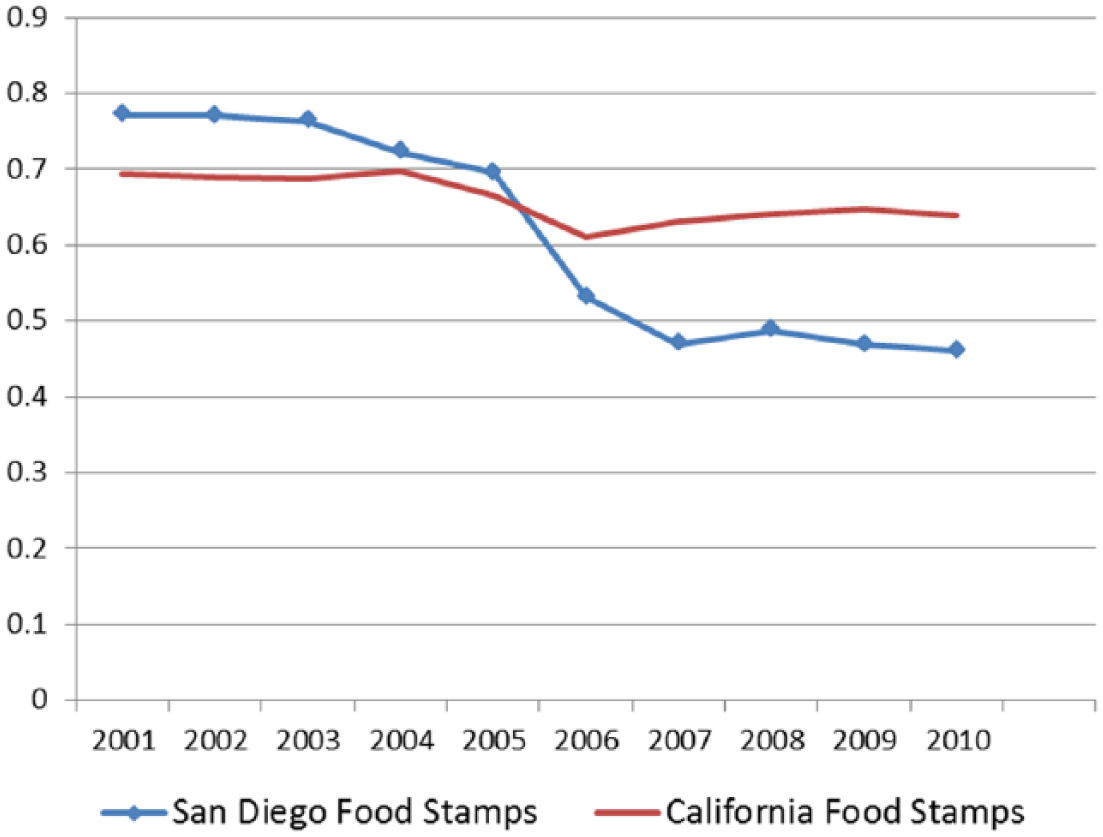
Percentage of food stamps cases resolved out of total cases, monthly averages for San Diego County and the state of California, 2001–10.
A common theme of our interviews was that service quality had deteriorated largely as a result of the shift away from casework. As one worker explained, ‘It’s very impersonal because we don’t have a caseload, we kind of had a relationship with our clients.’ Another stated that: ‘Clients are very frustrated that they don’t have one single person they can call about their case.’ Many workers noted how clients feel lost under the task-based system, as illustrated by the following comment: Some of them have been there seven times and they want to know what’s going on. But like I said, things are getting lost all the time. […] Before I knew my clients. Now I don’t. It’s hard for me. You really don’t know what is going on with the individual clients. You can be sympathetic. But they are not yours. It used to be more personal, now they are just numbers.
Another worker agreed: The quality of the work [has] dropped. Because there’s so many people touching the case that you have pressure, so we don’t have enough time to do a complete and thorough review and process all of the intricate things that need to be handled and stuff gets overlooked, which means people don’t get their benefits.
The deterioration of customer service after reengineering was confirmed by a SPIN (Supportive Parents Information Network, 2010: 58–9) study, which found that: business process re-engineering […] transforms the caseworker staff into a kind of assembly line with no particular caseworker responsible for any particular caseload. […] The removal of the client–caseworker relationship is detrimental to the program goal of fostering economic self-sufficiency. A supportive relationship between the client and caseworker strengthens the client, gets her through hard times and facilitates her re-entry into the competitive mainstream.
The report concludes: ‘SPIN’s experience with people attempting to obtain [benefits] is that these changes have made the application processes for any kind of public benefits […] harder to complete successfully.’
Declaration of unmitigated project success by management
Although the present study has documented deteriorating service for clients and decreased job satisfaction among the workforce, management of the San Diego County Health and Human Services Agency proclaimed the reengineering project to be an unmitigated success. According to the Eligibility Business Process Reengineering Final Evaluation Report (Fontanesi, 2010: 3): The Eligibility Business Process Reengineering project met or exceeded initial goals including: 1. Improving productivity by 39% (original goal was 20–25%) 2. Improving client satisfaction by 22% 3. Reducing unit costs by 18.5% (original goal was 15%) 4. Achieving an adjusted cost-offset of $33,187,262.40 in 2009.
The Final Report is 50 pages long and full of impressive-looking statistical tables, figures and technical language. Yet, this barrage of statistics and jargon belies a fundamental weakness in the reengineering project and its evaluation: a lack of attention to service quality as experienced by the clientele. The report’s evaluation of client and staff satisfaction is highly dubious. The single piece of information provided on method is that ‘data was obtained through direct observation of client intake at four’ Centers (2010: 6). Confusingly, the data are presented in statistical form and labelled ‘Qualitative Data- Satisfaction Surveys’. Out of the 20 tables and figures in the document, there is a single pre/post table for client satisfaction and a single table for staff satisfaction, which only has ‘pre’ data, meaning there was no follow-up measure to look for changes in staff satisfaction. There is no information on how the clients were sampled or how many were surveyed. It is hard to have any confidence in these data given the lack of discussion of sampling procedure and sample size.
For clients, measures are presented on ‘Registration, Time waiting and Staff’ regarding intake. The overall pre score is 2.73 (out of 5) and the overall post score is 3.3. The table is accompanied by a single sentence of text: ‘client satisfaction increased under the new system as reflected in table 20’ (2010: 19). The remainder of the 50 pages and 14 tables and figures are dedicated to showing cost savings. In 2009 alone the report calculated that reengineering effectively saved the County over $33 million in ‘adjusted cost offsets’ by raising the applications per employee ratio.
Despite the County’s trumpeting of how successful its reengineering project was, the constraints to its approach became manifest in 2012, when the County hired a private consultant to evaluate the functioning of the eligibility system. The consultant, who was paid $72,000, found what client advocates and workers had been telling the County for free: it was understaffed and it had too many ‘hand-offs’ (inTelegy, 2012). Much of what the consultant recommended was purchasing more technology, including over 50 additional trunk lines, self-scanning workstations and self-check-in kiosks for every office. However, the consultant also recommended hiring more staff, which the County has followed through with, most likely also in response to union negotiations, bad publicity (including, perhaps, pressure generated by an earlier public report on the present research: Esbenshade et al., 2011) and the Affordable Care Act (and resulting increase in Medi-Cal applicants). The hiring of new staff in the Centers constitutes recognition that the reengineered system – which was hailed as an overwhelming success – could not sustain the efficiency improvements that management claimed. While the new hires will likely decrease work intensification, it remains to be seen whether maintaining the existing reengineered system with a few added technological fixes and some additional workers will solve the underlying problems of a technical/quantity focus and lack of regard for service quality.
Discussion
The case study of business process reengineering in a California public welfare agency presented here finds that the workforce experienced intensification and reduced autonomy while clients experienced deteriorating service quality. These findings are consistent with some studies of business process reengineering, lean and new public management in the public sector (Baines et al., 2014; Carter et al., 2011, 2013; Harrington et al., 1998). Yet, while some critics suggest these management models are inherently detrimental to workers (Carter et al., 2011, 2013; Grey and Mitev, 1995; Stewart et al., 2009; Willmott, 1994), other studies of these models in the public sector find that although workers experience intensification, they also report feeling genuinely empowered by teams and having increased resources due to restructuring (Foster and Hoggett, 1999; Leverment et al., 1998; Stanton et al., 2014). While the case study finds negative outcomes experienced uniformly across the 10 local Centers within the County, the existing literature and theoretical considerations discussed below suggest that management models can be implemented in different ways, depending on the orientations and relative power of management and labour.
On management, Foster and Hoggett (1999) find that district-level managers implementing new public management explicitly encouraged ‘local solutions’ for local contexts. Among three agencies, devolved teams were embraced only in one due to its distinct office culture, a ‘close-knit working community’, which shaped the approach of local managers. Even when senior state managers emphasize quantitative efficiency targets, where lower-level managers and supervisors adhere to a social work or social justice ethos, they can moderate such pressures (Baines et al., 2014). In the California agency studied here, County managers explicitly aimed to implement uniform reengineering across local Centers. Additionally, they hired middle-managers and agency supervisors who were not social workers and who did faithfully implement policies and targets designed by senior management.
To be sure, reengineering as developed by its founders, Hammer and Champy (2001), is deeply problematic insofar as it is heavily technicist, and an emphasis on technical solutions and centralized control in a way that is inconsistent with its claim to empower workers (Grey and Mitev, 1995; Willmott, 1994) was robustly evident in the present case. Yet, academic advocates (Archer and Bowker, 1995; Conti and Warner, 1994) and practitioners (Hutton, 1995; Jackson, 1995) of reengineering have recognized that issues of training, communication, empowerment and cultural change are daunting. These authors and managers appear to be seriously grappling with these problems and the present article is not prepared simply to dismiss them out of hand.
While this article does not see any theoretical or technical reason why workforce issues cannot be managed more progressively if there is sufficient will by management to do so, it does highlight two problems with these models specific to the public sector under neoliberalism. First, to the extent that budgetary pressures and cost reduction are the primary concerns of senior state managers, this is surely an unpropitious environment for a progressive approach to reengineering or lean (though the orientations of lower managers matter nonetheless). Second, where the clients have no choice of provider, they cannot perform the role accorded to them by these models as ultimate arbiter of performance and success (Foster and Hoggett, 1999). If service quality is a genuine goal of senior management, then the absence of customers with the power to sanction must be addressed at the design stage of local implementation.
Rather than dismiss and reject reengineering (or lean) as such, a more effective approach to improving working lives may be for workers, unions and their advocates to use the rhetoric of empowerment and service quality against managers who prioritize cost reduction over all other outcomes. In the present case, this article highlights the universalist and managerialist orientation adopted by management at all levels, in contrast to other cases where senior state managers gave local managers real autonomy to define local priorities (Foster and Hoggett, 1999) and where middle- and lower-level managers adopted a social work orientation (Baines et al., 2014).
On the workforce, strong unions can push the implementation of new management models in more participatory directions (Doellgast, 2012; Vidal, 2007b). However, as Fisher (2004) notes, public sector unions have little experience negotiating and contesting issues around control and skill associated with private sector models. In the case of the San Diego County Family Resource Centers, the union simply did not anticipate that reengineering would be implemented in a way that increased intensification and reduced autonomy.
Regarding outcomes for service users, a few studies of reengineering, lean and new public management find deteriorating service for clients (Baines, 2004, 2010) or at least the absence of a feeling of empowerment by clients (Burton and Van den Broek, 2009; Leung, 2008). Yet, again, other studies find improvements in client service and outcomes (Leverment et al., 1998; Stanton et al., 2014). The reengineering planning document for the San Diego agency explicitly acknowledged the need to achieve a ‘balance between customization and standardization’ and to balance a need to ‘increase customer satisfaction’ and ‘job satisfaction’ with the need to ‘maximize use of taxpayer dollars’. Yet, this study finds strong evidence that quantitative efficiency was prioritized over service quality.
A limitation of the study is that the research team were not able to interview managers to see how they experienced and prioritized these competing pressures for quantitative efficiency versus service quality. Although the quantity/quality and standardization/customization conflict have been widely recognized in the literature (Fisher, 2004; Leidner, 1993; Taylor and Bain, 1999), there remains little understanding of how managers implementing reengineering and lean – explicitly customer-driven models – experience and deal with these conflicting pressures. In the public sector, future research should directly ask managers about service quality and, where service quality has deteriorated, examine how managers explain or rationalize such an outcome. More broadly, the existing literature is largely based on single case studies, and future research could take a more comparative approach (across organizations, sectors and countries) in order to understand how managerial orientations interact with various contextual and institutional factors to produce local outcomes as well as broad trends and patterns (see, for example, Hauptmeier and Vidal, 2014).
Finally, this article notes that average overall work intensification has risen in the vast majority of Organisation for Economic Co-operation and Development (OECD) economies since the 1990s, though not in Austria, Denmark or Portugal (Green, 2006). In the USA at least, intensification has occurred across the entire occupational spectrum (Crowley et al., 2010; Smith, 1997). This article thus understands work intensification as a phenomenon that is not best explained by the diffusion of specific management models but rather by broader institutional forces. While there are strong structural tendencies towards work intensification inherent in the capitalist labour process (Marx, [1867] 1990), their influence is shaped by the forms of competition associated with particular accumulation regimes. Fordist regimes of accumulation significantly moderated these pressures through oligopolistic competition in the private sector and traditional public administration in the public sector. In postFordist regimes, increased competition, financialization and neoliberalism have unleashed pressures for work intensification (Thompson, 2013; Vidal, 2013). Yet, even though neoliberalism is increasingly penetrating Europe welfare states, the extent to which the state is managed according to a neoliberal logic varies across countries (Greer and Symon, 2014). A key issue for future research would be to examine more closely variation in the influence of neoliberalism on local workplace outcomes in the public sector. Finally, a promising line for future research would be to examine and measure the sources of work intensification more directly, in terms of particular practices, in order to tease out the relations between specific practices, general models, local contextual factors and the broader institutionalization of the economy.
Footnotes
Acknowledgements
We would like to thank the following graduate student researchers for their assistance with surveys and interviews: Tim Bolin; Jesse Garber; Amy Guidry; Molly Hansen; Venoosheh Khaksar; Stephanie Laufenberg; Irene Leivas-Howard; Alexa Megna; Joseph Sly; Lauren Tracey; and Ashley Wardle. We also thank Ginny Doellgast, Whyeda Gill-McLure and Ian Greer for providing helpful written feedback on earlier drafts of this article.
Funding
We would like to thank the Department of Sociology at San Diego State University for providing a $1000 grant.