



Abstract
How have the skills of service jobs changed? Have they undergone deskilling, upgrading or some contingent or compensatory development? This study examines these questions as they pertain to frontline sales work in US department stores. It begins by identifying an operational concept of service skill latent across recent debates and then examines it via qualitative comparison of full-line and discount stores in New York City. Based on an evaluative framework akin to that of Blauner, this study’s workplace-level findings suggest that the industry-level succession of full-line stores by discounters has embodied a decline in the complexity and autonomy of salespersons’ emotional labour.
Introduction
The debate over service work has become increasingly dense. Expanding upon the work of Hochschild (1983) and Leidner (1993) who introduced the concepts of emotional labour and the service triangle, service work scholars have developed ever more sophisticated models of service skill (Bolton, 2005; Nickson et al., 2003), interaction dynamics (Jenkins et al., 2010) and institutional constraints (Korczynski, 2002; Lopez, 2006). These contributions have enriched the collective understanding of interpersonal wage work, allowing researchers to identify clearly its distinctive features vis-à-vis manufacturing (Bélanger and Edwards, 2013).
In contrast to the long-running debate over that field of employment, however, service work studies have focused little on change. Some of this is undoubtedly due to scepticism over the ‘technical’ basis of skill (Attewell, 1990; Cockburn, 1983), particularly as it pertains to the production of non-material goods (Hampson and Junor, 2010; Hurell et al., 2013; Vincent, 2011). Just because there is little consensus on the status of skill, however, does not mean occupational requirements cease to change or simply evolve at random. On the contrary, anecdotal (Ritzer, 1993) and recent empirical evidence (Curley and Royle, 2013) support the proposition that interactive services, much like their goods-producing predecessors, are undergoing significant transformations under neoliberal capitalism. The following questions, therefore, remain largely unanswered: how and to what extent are frontline service jobs changing? Are they becoming more skilled, less skilled or simply more differentiated?
This article interrogates these questions as they pertain to the largest frontline service occupation in the USA: retail salespersons. Employing a comparative method akin to that of Blauner (1964), this study considers two contemporary cases of sales work in full-line and discount department stores against a historical backdrop of mid-20th-century sales work. It argues that regardless of the ‘soft skills’ or aesthetic qualities sought by employers in new or potential hires, the trajectory of product knowledge and interpersonal ability – otherwise known as emotional labour – is downward as one moves from mid-20th-century department stores to contemporary full-line stores (e.g. Nordstrom’s, Selfridges, Karstadt) to large-format discounters (e.g. Walmart, Asda, Real). This provides further evidence from a different industry for what Curley and Royle describe as ‘the end of the skilled emotion worker’ (2013: 105).
Services, skills and change
The labour process debate begins from the question of skill change. Contrary to Blauner’s (1964) and Bell’s (1973) hypotheses of upgrading under advanced capitalism, Braverman’s (1974) position is that deskilling is the fundamental tendency. His thesis has been appended (Burawoy, 1979; Edwards, 1979), questioned (Piore and Sabel, 1984), some would say empirically refuted (Attewell, 1987; Penn, 1986) with regard to goods-producing work. However, his basic propositions – that workers’ effort is indeterminate, that its expenditure is negotiated according to material interests and that such negotiation is relatively autonomous from the larger economy – continue to exert strong influence (Bélanger and Edwards, 2013).
A second consequence of Braverman’s intervention has been the questioning of ‘objectivist’ notions of skill. Though himself criticizing government skill measures, Braverman’s realist interpretation upholds the craftsman ideal: individual conception and execution of all tasks necessary to produce a good. Followers such as Littler (1982) and Cockburn (1983) take his scepticism further, identifying social construction and gender as core dimensions of skill attribution, while Attewell (1990) and Wood (1987) call into question the ontological status of the term. Such doubts have only grown in the burgeoning debate over service skills (Bolton, 2009; Grugulis and Vincent, 2009). The tasks at hand are thus (1) to identify what measureable aspects of skill can be posited of interactive service work, and (2) to embed such definition(s) in the three hypotheses of skill change – deskilling, upgrading or contingency.
After hotly debating the definition of skill, labour scholars have reached a working consensus that it consists of task complexity (or variety) and worker autonomy (Spenner, 1983; Vallas, 1990). Cockburn (1983) outlines three repositories of these dimensions: the worker; the occupation; or society’s valuation of the latter. Service work studies, for their part, begin with Hochschild’s (1983) concept of emotional labour as the defining feature of ‘working on people’ rather than things (Leidner, 1993; Wharton, 2009). Defined as ‘labor requir[ing] one to induce or suppress feelings in order to sustain the outward countenance that produces the proper state of mind in others’, emotional labour locates the site of effort expenditure not in the physical or the purely intellectual but in the interpersonal dynamic between worker and recipient (Hochschild, 1983: 7). As such, it defines the terrain upon which debates over service skill have taken place. Some contributors emphasize the third of Cockburn’s repositories – that service jobs are often labelled ‘feminine’ and therefore ‘unskilled’ in patriarchal societies. Others (Bolton, 2005; Frenkel et al., 1999; Hampson and Junor, 2005, 2010) reassert the complexity, variety and autonomy exercised by service workers, with Bolton (2005) developing a four-part typology consisting of ‘pecuniary’, ‘prescriptive’, ‘presentational’ and ‘philanthropic’ emotion work. Hampson and Junor refer to these under-recognized capacities as ‘articulation work’ (2005) and ‘work process skills’ (2010) and Frenkel et al. (1999: 70) as ‘social skills’. These theorists argue that emotional skills are embodied in many service occupations despite society’s (or employers’) denial thereof.
Reactions to such assertions include general sceptics (Lafer, 2004; Lloyd and Payne, 2009) alongside those who posit ‘soft skills’ – ‘non-technical’, largely untrainable abilities (Hurell et al., 2013) such as workers’ appearance, demeanour and flexibility (Nickson et al., 2012; Warhurst and Nickson, 2007). The latter line of thinking focuses on Cockburn’s first repository (the worker) but defines these ‘skills’ as incompatible with ‘human capital’ since they cannot be accumulated. Sceptics of service skill as outlined by Bolton also reinforce this non-accumulative, worker-centred model insofar as they distrust job-centred models that ‘re-label[s] as skills … personal attributes, attitudes, dispositions or behaviours’ (Lloyd and Payne, 2009: 618).
The ‘skills’ of frontline services are thus questioned from all sides. At the societal level they are devalued due to entrenched sex-typing; at the occupational level they are doubted by materialists seeking a more rigorous definition (Brook, 2009); and at the individual level, the ‘soft skills’ sought by many employers function little like ‘skills’ in the classic sense and may provide cover for discrimination (Moss and Tilly, 1996). What can be salvaged of an objective skill concept for frontline service work?
Despite the current lack of consensus, the criticisms of Bolton et al. levelled by Brook, Lafer and others do not deny room for job-specific complexity and autonomy in the application of emotional labour. Rather, these theorists reject the generalized, non-job-specific form posited by Bolton. ‘For Bolton’, Vincent (2011: 1370) summarizes, ‘people’s emotions at work are multi-dimensional and often transcend labour processes’. For materialists such as Brook and Bélanger and Edwards, though human interaction is transcendent, that which occurs between service workers and recipients is subordinate to the employment relationship – a relationship which valorizes only interactions that generate revenue and thereby profit. While Bolton’s concept of ‘emotion management’ may therefore avoid direct measurement as occupational skill, the concept she borrows from Hochschild – ‘emotional labour’ – does not. Skill in interactive service work can thus be understood as the complexity and autonomy of emotional labour required to perform the revenue-generating functions of an occupation – be it selling shirts, serving passengers or placating callers.
This definition, though not resolving the debate over service skill, provides an operational construct that allows for comparison of different service jobs, or the same ones over time. How has the deployment of emotional labour in fact evolved? The suggestive but empirically limited efforts of Ritzer (1993) and Braverman (1974: 248–60) notwithstanding, the debate on change in manufacturing provides greatest theoretical guidance.
Braverman’s (1974: 5) position, that ‘the worker, systematically robbed of a craft heritage, is given little or nothing to take its place’, sees the exploitative nature of capitalist relations as its causal mechanism. Taylorism is depicted as the definitive expression of this drive to increase control over workers through subdivision and routinization of their tasks. Sympathetic theorists emphasize the roles of worker organization in resisting degradation, with Edwards (1979) and Burawoy (1979) identifying alternative managerial strategies such as bureaucratization and fair play. These accounts help to enrich deskilling theory, positing it as a long-term tendency rather than the inexorable process Braverman suggests.
A second group of theorists asserts the opposite of deskilling – upgrading. Proposed mechanisms for this are more heterogeneous: Bell (1973) and Blauner (1964) see technological change as the driver of skill enhancement, Piore and Sabel (1984) favour normative shifts in the structure of industrial relations, while enthusiasts of lean production point to enlightened, ‘participatory’ managements seeking ‘high performance workplaces’ (Whitfield, 2000). Such ‘Toyotism’ and upgrading theory generally exercise strong influence on perceptions of occupational change.
A third group takes issue with the uni-directionality of both proposals. Attewell (1987, 1990) and Wood (1987) question whether degradation can ever be empirically verified while Penn (1986) derives a ‘compensatory theory’ of change – the deskilling of production workers being offset by the upgrading of maintenance and professional workers. Cockburn (1983) challenges the uniquely ‘skilled’ status of craftsmen, arguing that gendered perceptions play a large role in skill designations. These approaches share a common doubt about the objective status of skill and grand narratives of its evolution. They compose a contingency theory since they posit ‘little net change in the skill requirements of work … or offsetting trends in the composition of the occupational structure’ (Spenner, 1983: 825).
Applying the above-derived concept of service skill to these three models of change allows for the identification of three hypotheses about the evolution of service jobs. They are:
H1 (deskilling): Interactive services become simpler and more routinized, with emotional ouput and task flow increasingly determined by managers rather than workers.
H2 (upgrading): Interactive services become more complex and varied, with emotional output and task flow increasingly determined by workers rather than managers.
H3 (contingency): Interactive services become simpler and more heteronomous or more complex and autonomous depending on the market conditions facing particular firms and the responses of key actors (workers and managers) within these.
Before interrogating these claims, it remains to flesh out an adequate method.
Research design
The standard method for investigating conflicting hypotheses is quantitative and longitudinal: ideally, a numeric skill indicator would be measured across a range of service occupations over a meaningful stretch of time. There are, however, serious drawbacks to such an approach. For one, numeric indicators would likely consist of what Spenner (1983: 828) calls ‘indirect’ measures: wage rates, years of schooling and so on. ‘With this […] strategy’, he writes, ‘the nature of skill is still implicit and unclear’ (Spenner, 1983: 828). A second drawback is that casting a wide occupational net may dilute the significance of changes in individual sectors. A third drawback is feasibility: one could design questionnaires to measure skill directly and quantitatively, but fielding such a study on a timescale commensurate with occupational change would take many years. Thus for reasons of validity, specificity and feasibility, the present study employs a qualitative, case-study design. It focuses on the largest occupation within the largest sub-sector of the largest for-profit service industry in the USA: department store salespersons.
Department store retail was chosen not only because of its size, but also because it is a paradigmatic domain of frontline service work (Lichtenstein, 2009). In the USA, general merchandisers compose the largest and fastest-growing portion of retail employment (US Bureau of Labor Statistics, 2014) and the second-largest of retail sales (US Census, 2012a). This sector’s department store sub-subsector accounts for half of general merchandise employment (10 per cent of the retail total) and is itself divided between full-line, full-service stores and discounters (US Census, 2012a). Across general merchandisers, salespersons constitute 34 per cent of non-supervisory employees, cashiers 22 per cent and stock clerks 18 per cent (US Bureau of Labor Statistics, 2014). Salespersons are the primary focus because of their revenue-generating role, but cashiers and stock clerks are also considered as they support the sales process.
In selecting specific cases the goal was to identify firms whose stores could provide proxies for historical phases of sales work. Though less common than the approach of examining one or a few cases over time and relying heavily on documentary evidence, contemporaneous qualitative comparison allows for the use of first-hand worker accounts. It also has considerable precedent in the works of Blauner (1964), Edwards (1979), Smith (2001) and Vallas (2003).
The cases examined here are five stores of two large chains, referred to as ‘Stanley’s’ and ‘Pricebox’ (pseudonyms). Two of Stanley’s New York City stores were chosen to represent the full-line model because they are among the oldest in the firm and have been unionized for several decades. Union presence has been shown to restrict work restructuring elsewhere (Montgomery, 1979: 15–18), so it was thought these workplaces would provide more accurate historical proxies. New York, however, has only recently been colonized by chain discounters and is among the world’s most unequal cities with a highly diverse workforce. These features made it desirable that any comparative case be located in the same place. Pricebox, a large national discounter that is among the fastest growing in the USA and completely non-union, had seven stores in New York at the start of research in 2011. Three of these were chosen to represent the discount model.
The difference between ‘full-line’ and ‘discount’ stores is defined by the North American Industry Classification System as follows: sector 452111, ‘Department Stores (except Discount Department Stores)’ – ‘have separate departments for various merchandise lines […] each with separate cash registers and sales associates’; sector 452112, ‘Discount Department Stores’ – ‘have central customer checkout areas, generally in the front of the store’; and sector 452910, ‘Warehouse Clubs and Supercenters’ – is identical to discount stores except that these also offer ‘a general line of groceries’ (US Census, 2012b). Stanley’s stores fit into the first category; all three Pricebox stores into the third.
As to the relation between full-line and discount stores, the clearest trend is the succession of the former by the latter. Early post-war consumption was served by traditional full-line stores, their suburban branches and rapidly growing full-line chains (Cohen, 2003; Jacoby, 1997). In the early 1960s, however, discount chains purveyed a stripped-down, self-service model with centralized check-out. ‘As late as the mid-1950’s’, state Bluestone et al. (1981: 18), ‘the discount department store posed no threat to the full-service […] department store’; by 1965 discounters ‘surpass[ed] in sales volume all of the conventional mode department stores combined’. The growth of discounters at the expense of full-line stores has only continued since. Whereas in 1992 full-line stores captured 4.8 per cent and discounters and supercentres 7.4 per cent of US retail sales, by 2011 their respective shares were 1.6 and 12.4 per cent (US Census, 2014). Although occupying distinct segments, full-line and discount firms are thus locked in competition that discounters are broadly winning.
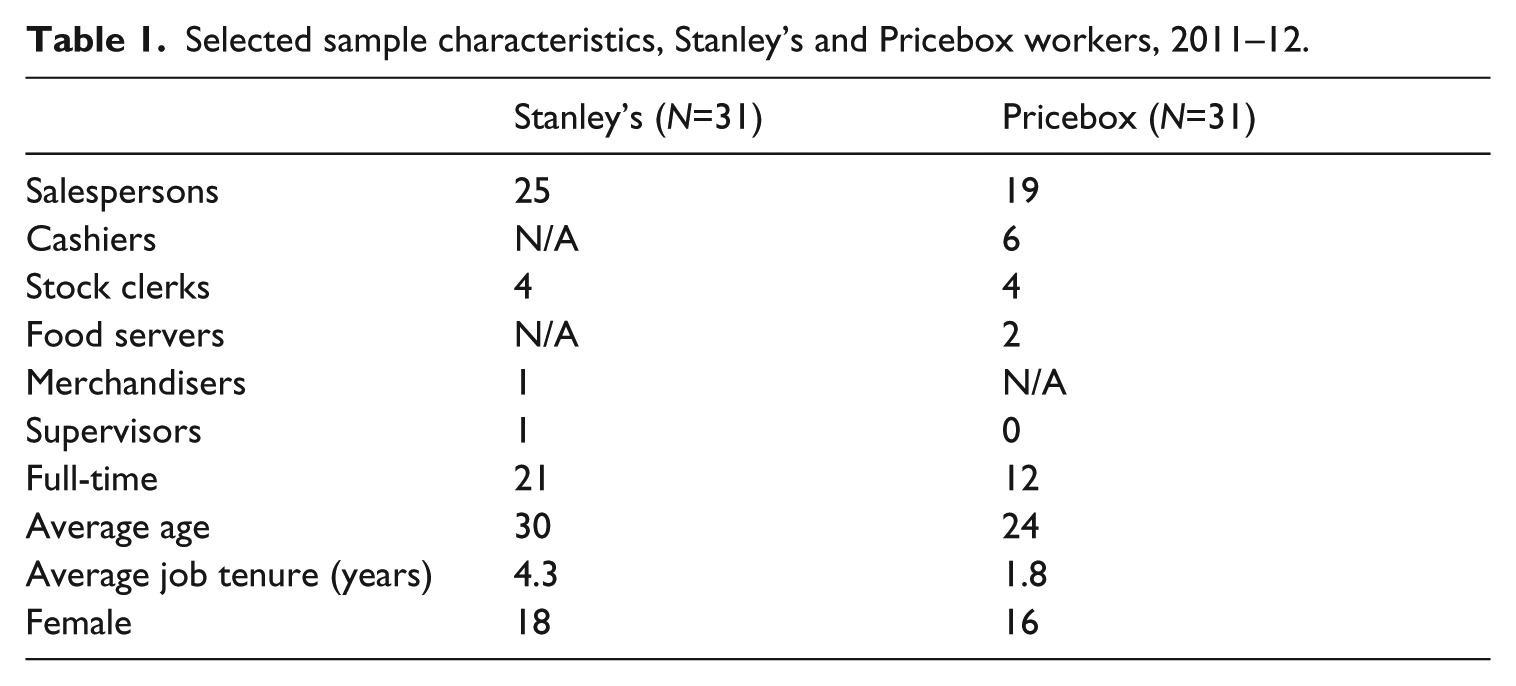
Primary data consist of formal interviews with 31 Pricebox and 31 Stanley’s workers. Management permission was not sought due to the likelihood it would not have been granted and the method of access was therefore as follows. The researcher spent several hundred hours in the five stores observing behaviour and engaging in casual conversations. During these discussions, workers were invited to participate in confidential, off-site interviews for which they were offered a small monetary incentive. Before being interviewed all participants were provided with a full description of the research project, its goals, risks and benefits and guaranteed confidentiality from both employers and the wider public. Sixty-two individuals volunteered and were interviewed by the author between June 2011 and August 2012. All data reported here are from formal, off-site interviews, though informal, on-site observations helped to situate these accounts. Table 1 displays summary characteristics of this sample.
Selected sample characteristics, Stanley’s and Pricebox workers, 2011–12.
Each interview lasted approximately 45 minutes and revolved around a set of open-ended questions pertaining to work routines and rules, customer, co-worker and management interaction, as well as participants’ thoughts and feelings about these dynamics. All interviews were audio-recorded and transcribed. After this, interview texts were analysed and key passages collated according to the following themes: task complexity and variety; task prescription and autonomy; task collectivization; customer interaction; management interaction; co-worker interaction; and pay, job security and benefits. Collated intermediary documents were then used to develop robust depictions of the two firms’ sales processes and salespersons’ required skills. Before presenting these, however, an outline of department store selling before the advent of discounters is provided as a historical baseline.
Skilled selling in the pre-discount era
‘The unique element in department-store labor policy’, writes Benson (1986: 125), ‘was the encouragement of skilled selling: the use of trained salesclerks to increase the size and number of sales transactions through merchandise information and sales psychology.’ Mills (1951: 174), analysing late-1940s department stores, describes a varied set of tasks that allowed ‘salesgirls’ to develop ‘a range of sales personalities’ from the ‘interplay of individual with the store and the flow of customers’. He identifies no fewer than eight types: the Wolf; the Elbower; the Charmer; the Ingénue Salesgirl; the Collegiate; the Drifter; the Social Pretender; and the Old-Timer (Mills, 1951: 174–7). Leach (1993: 159) notes that the ‘NYU School of retailing’ (founded in 1919 at the behest of New York department stores) aimed ‘to teach retailing […] with the overall intention of upgrading saleswork into “skilled labor”’.
In their expansionary innovation phase, department stores created a new occupation – the retail salesclerk – that previously existed only in independent or petty-proprietor forms. Given the industry’s then-dominant upscale orientation, personalized service was a key component of firms’ differentiation and competition strategies. The absence of ubiquitous branding and advertising – ‘absentee selling’ which Mills (1951: 179) saw as ‘centralizing and rationalizing’ frontline sales work – combined with pre-war store layouts that ‘separate[ed] goods from customers’ by keeping them behind counters, required clerks to be ‘skilled workers, whose expertise and training were highly valued’ (Opler, 2007: 81). ‘[W]ithout the salespeople’s knowledge of the stock on hand’, writes Opler (2007: 81), ‘and their ability to provide customers with acceptable merchandise, the stores would immediately cease to operate, since customers could not gain access to goods without the intervention of a salesperson’. Bluestone et al. (1981: 66) contrast full-line stores’ continued ‘dependence upon skilled labor’ with their discount competitors in the 1970s.
The role of the clerk in mid-20th-century department stores was not without circumscription: prices were fixed and no longer open to ‘haggling and bargaining’ (Mills, 1951: 179); each clerk’s sales were monitored by buyers and ‘floorwalkers’, providing cause for reprimand or dismissal if too low (Mills, 1951: 170); and employer-stipulated ‘dress codes enforced “a defined and appropriate ‘class distinction’ between the customer and the assistant [clerk]”’ (Benson, 1986: 140). Employers also sought to elicit worker consent through insurance plans, company unions and leisure facilities (Benson, 1986: 142–6).
Despite these elements of control, however, historical accounts paint pre-discount selling as a form of skilled emotional labour: salespersons, often women, were granted significant autonomy to engage, entice and advise customers in personalized and thus inherently varied ways. Though the societal evaluation and attendant rewards of such jobs were low, evincing the gender bias proposed by Cockburn (1983), occupational demands were high, requiring workers’ time, effort and ingenuity to master.
Semi-skilled selling at Stanley’s
At 21st-century Stanley’s the incipient rationalization observed by Mills (1951) was further advanced. Branding and advertising were ubiquitous while save for very few categories of goods (e.g. jewellery and fragrances) all merchandise was located on the sales floor, not behind counters. Salespersons had less physical and knowledge control over products, but still assessed customers’ moods, advised them individually and closed final purchases, in contrast to their Pricebox peers. Non-negligible emotional complexity and autonomy were thus required for the revenue-generating functions of their jobs, indicating a semi-skilled process.
Division of labour
Stanley’s had no dedicated cashiers. ‘They actually made them salespeople’, stated a saleswoman about changes early in her tenure. A salesman noted, ‘we used to have stock people, now I think there’s one stock person for the whole floor […] you do everything, you are a glorified stock person’. Salespersons were the largest group at Stanley’s. Their interactive tasks had been expanded to replace those of cashiers and their non-interactive tasks to replace those of many stock workers. A different saleswoman described her routine:
We answer the phone, we register the person out, we go back to the floor, look for the item, we retake the item, pack the item, we also have to check the fitting rooms and put the clothes back, we also have to maintain the floors, right? You also have to open up credit [cards], right? […] It’s a lot of multitasking.
Multitasking, however, did not breach department boundaries. A cosmetics saleswoman noted ‘we don’t really associate with people in other departments’, and almost all salespersons reported similar specialization.
Overall, customer interaction was concentrated among salespersons and crowded in by a greater number of maintenance tasks vis-à-vis their post-war counterparts. Despite demanding smaller portions of their effort, however, interaction still required knowledge and improvisation.
Task complexity
A management-promulgated acronym embodied Stanley’s sales method: ‘meet and make a connection … asking questions … give advice … inspire to buy … celebrate the purchase’ (shoe salesman). This open-ended process required salespersons to intuit customer dispositions and deploy product knowledge to guide each toward purchase.
‘I just learned to be real patient and observant with customers’, said one saleswoman, ‘because you can’t come up to every customer the same way – some want to be really attended to, some just want to be left alone.’ Another saleswoman, when asked whether her training as an actress was useful on the job, stated:
Oh definitely, are you kidding? If I have a rude customer that doesn’t want to listen to anything I say and I have to put on a face and be professional, that’s what I do. When the customer doesn’t want to believe what I’m saying – improvising, it’s really part of the job.
Others relied on personal charm. ‘I sort of use [Stanley’s method]’, said a shoe salesman, ‘but really I’m a comedy person, so I try to stand out by my attitude and my luck.’ A third saleswoman found ‘it’s pretty much about being yourself, no one does the same thing’ and another salesman noted ‘I learned how to be customer savvy, because if you don’t get a customer to like you, how are you going to sell?’ Salespersons gauged the moods of shoppers upon initial meeting and responded to them as they thought appropriate, engaging in what Bolton (2005) calls ‘presentational’ emotion work deriving from their ‘basic socialized sel[ves]’ outside the employment relation (Bolton and Boyd, 2003: 297). Variation and complexity, however, did not end there.
Salespersons also had to know their goods. ‘You have to demonstrate your product knowledge because it’s best to learn those things in terms of sales’, said the shoe salesman. A suit salesman found that ‘it took me […] almost a year to confidently express my opinions to customers’ which he then did to the author:
What’s popular right now is two buttons and two slits in the back […] peak lapels are coming back which you would find mostly in the [19]50s and ’60s. [They] look better on the slim suits, in my opinion. And then there are three button suits, that’s not as popular, but still kind of with the Jewish community. Three button suits were more in style 10, 15 years ago.
Even those in lower-priced departments ‘ha[d] to know [the] merchandise, about the brand, about different times and different styles’, remarked a saleswoman in women’s casual wear. Another in the same department stated ‘it’s good to know the jeans so you can inform the customer how the fit is […]. We know our product – we have to.’ Interaction thus involved not only an assessment of wants, but the application of acquired knowledge to satisfy them.
The diversity of wants combined with open-ended, product-specific selling obliged Stanley’s salespersons to ‘induce or suppress feelings to sustain the outward countenance’ that produced sales (Hochschild, 1983: 7). Though the intensity of interaction was likely lower than that of mid-20th-century salespersons, the knowledge and interactive nuance they deployed over extended encounters indicated both complex, learned ability and a partial internalization of their roles – learning about products and developing sales personas. Rather than simply smiling and repeating rote scripts, Stanley’s salespersons utilized personality and knowledge to provide both ‘presentational’ and ‘philanthropic’, alongside ‘pecuniary’, emotion work (Bolton, 2005) and thus perform a degree of improvised ‘deep acting’ (Hochschild, 1983) that could generate sales.
Autonomy
Improvisation required autonomy to perform. Seldom did Stanley’s salespersons complete specific tasks on command; instead, they balanced customer interaction and display maintenance on their own throughout each shift. ‘We do our own thing’, said one saleswoman, ‘they [managers] tell us what to do but if we don’t feel like doing it we don’t really do it’. A different saleswoman affirmed that ‘even when [Stanley’s] doesn’t have a supervisor on our floor we still join together and do what we have to do; we get things done’. A salesman stated that ‘if I see [my manager] for five minutes during a shift, that could be a lot. They generally stay behind closed doors.’ Distance from managers – social and physical – was a recurrent theme. For some, such as the first woman, it motivated resistance; for most, these ‘unmanaged spaces’ allowed them to negotiate interactive and non-interactive tasks (Bolton, 2005: 102). ‘No one has to tell us anything’, said a sales-floor stock clerk, ‘as soon as you can you know what to do’.
Sales output was another matter. All salespersons received daily goals determined by each department’s year-to-date sales plus an incremental increase which was calculated each time they rang up a purchase. Output was also measured in average sales per hour, items sold per transaction and the number of credit card applications submitted. ‘The time you are outside the register’, said one salesman, ‘they [managers] call “unproductive hours” – you are doing something that helps the sale but is called unproductive.’ ‘In my department’, he continued, ‘I have two registers but six persons working, each with a $1000 goal. How could, in the same working hours, six people make the same target?’ A saleswoman found the system competitive and ‘individualistic, it’s a dog-eat-dog kind of world’. Attaining goals yielded a satisfactory scorecard, which determined pay rises and promotions, though not job retention. ‘If you want to go to another department’, said a different saleswoman, ‘the manager is not interested in how well you look or how nice you are, she wants to look at your scorecard’.
With ‘productive hours’ defined as time spent ringing up purchases, Stanley’s displayed a focus on the monetary outcome of salespersons’ emotional labour, or what Bolton (2005) terms the ‘pecuniary’ form of emotion work. Salespersons themselves, however, often valued the holistic service of customer needs – the provision of ‘philanthropic’ emotional gifts (Bolton, 2005). One salesman believed working at Stanley’s ‘doesn’t make you a selfish person, it makes you help people’ and a saleswoman remarked that she had ‘one common goal: satisfying customers. You feel good satisfying customers, when they leave the store knowing they got what they wanted.’
Overall, Stanley’s workers had control over emotional and physical inputs but the goods they sold were provided by management and their sales figures closely monitored. Although Bolton’s typology provides a useful framework for understanding the stages of their interaction and the focus of management, Brook’s (2009) critique – that emotions are hardly the only ‘means of production’ in service workplaces – was supported. Output control incentivized individual performance and placed salespersons in competition with one another, yet simultaneously encouraged their attainment of knowledge, development of personas and of persuasive ability. All of this indicated less emotional complexity and autonomy than their post-war predecessors but more than their Pricebox peers.
Deskilled selling at Pricebox
At Pricebox selling was routinized, mechanized and collectivized. Salespersons’ main tasks were stocking, cleaning and maintenance while their interactions with customers consisted largely of locating items or prices, rather than product advising. Cashiers closed purchases and were judged not on the value of their transactions but on the speed of their processing. Salespersons cooperated on both maintenance and customer service, while replenishment was aided by computerized inventory accessed through stationary and handheld devices. This sales model reduced emotional labour to Bolton’s ‘prescriptive’ and ‘pecuniary’ types or what Hochschild calls ‘surface acting’ – repeating rote scripts and presenting positive external displays.
Division of labour
Pricebox organized stores by product rather than brand and divided labour among these sections and along the in-store supply chain: from receiving and stock to sales floor to the cash registers. Workers, referred to as ‘team members’, rotated among these divisions. ‘They always train you on the sales floor and on the cash register’, said one salesman, ‘because it gets really busy and they sometimes call for back-up.’ A stock worker commented that ‘if it’s busy the manager may ask a team member from the sales floor to help us out’. Emotional labour was performed only by those on the sales floor, at the registers and at the customer service desk.
Selling was beyond the reach of individuals. Stock workers supplied merchandise, salespersons maintained displays and fielded questions, while cashiers closed purchases. All was enabled by just-in-time computerized replenishment: ‘You scan the shelf label’, said a stock worker, ‘and, it’s a system-generated thing – if it’s upstairs they will send it down; if not, the scanner will order it from headquarters.’ Registers also tracked depletion and signalled when new products were needed. Accordingly, store-wide rather than individual sales goals were used; cashiers’ and stock workers’ efforts were measured in speed rather than money; and emotional labour consisted of cashiers’ ‘pecuniary’ conversations with customers about bagging and payment and salespersons’ ‘prescriptive’ locating of items and prices (Bolton, 2005). Persuasive selling was nearly non-existent.
Task complexity
Salespersons performed three basic tasks: re-shop; zoning; and customer service. One salesman described his routine:
You come in and if there is re-shop [misplaced or returned items], you put it where it is supposed to be, you take it to the back. Then you get back to your zone and you zone it, that means you push everything forward and make it look neat and clean, that’s basically what we do. And help customers.
Pricebox’s service motto was ‘Fast, Fun, Friendly’ and its signature sales question ‘Can I help you find something?’ Salespersons were ‘coached’ to ask this of all customers who came within 10 feet of them, interrupting zoning and re-shop tasks to do so. ‘I was working in pets and seasonal’, related a saleswoman, ‘[and] on my way to somewhere else I got stopped by three different guests and had to call backroom for three different items.’ Another saleswoman was less sanguine:
They [managers] literally have us, every five minutes asking every single customer, ‘Can I help you find something?’ Mind you, that customer has probably been asked ‘Can I help you find something?’ 20 times that day, so it’s annoying to the customer and annoying to us because we can’t get done what we have to get done.
Pricebox’s service required little specialized knowledge and thus minimal ‘philanthropic’ gifting (Bolton, 2005). ‘It’s not like you have to think a lot’, remarked one salesman, ‘you don’t have to go in-depth about what you know’. When asked whether he received product training, another replied ‘only electronics does that, if something new is coming out’, and a saleswoman confirmed that ‘in electronics they have to be knowledgeable, but not for me – no knowledge is necessary’. Customer interaction also had lower stakes and fewer ‘pecuniary’ overtones than at Stanley’s, not having to end in a sale to be successful, only in the location of an item or price (Bolton, 2005). Because of this, Pricebox salespersons had little incentive to ‘presentationally’ improvise small talk or interpret customer moods, as their Stanley’s counterparts did (Bolton, 2005).
A further contrast was Pricebox’s use of teamwork. Maintenance tasks were assigned as group objectives and salespersons encouraged to cooperate when helping customers. ‘We call it one team, one dream’, said a saleswoman, repeating a managerial motto. ‘Working together?’ replied a salesman to a question about cooperation, ‘a good 90 per cent of the time’. In the market section, he continued,
If there is any re-shop it is for the whole section so we will put our carts together and get all the re-shop out together. At night there is something we call wave zoning where we zone together: you take this side, I take that side, and we zone each aisle together.
Such teamwork required Pricebox salespersons to cooperate more than their Stanley’s peers which, in turn, called forth interpersonal ‘soft skills’ (Nickson et al., 2003). Though not directly generative of sales (since not directed towards customers), such abilities enabled a smoother completion of tasks.
Salespersons’ interaction rarely involved intuiting dispositions, applying product knowledge or guiding customers towards purchase. Their emotional labour consisted simply of ‘fast’ and ‘friendly’ help locating items or prices and they were aided in these efforts by pre-designed scripts and computer technology. Their performances were thus largely ‘prescriptive’ and ‘pecuniary’, defined by compliance with managerial guidelines and the exchange of money (in the case of cashiers), rather than ‘presentational’ or ‘philanthropic’, involving internalized roles and non-commodified emotional gifts (Bolton, 2005). Pricebox salespersons therefore engaged in ‘surface acting’ distinct from the semi-‘deep acting’ practised at Stanley’s (Hochschild, 1983).
Autonomy
With less complexity and variation required of their efforts, Pricebox salespersons were subject to tighter control. Not only were their maintenance and service tasks routinized and pre-specified, they were also more closely monitored. ‘I pretty much did anything I wanted in [Stanley’s]’, said a Pricebox and former Stanley’s saleswoman, ‘[Pricebox] is a little more strict: they are on you making sure you’re on time, on you for doing your work.’ A salesman stated that ‘the team lead[er]s constantly walk the floor to see if we are on task’, and another saleswoman believed managers ‘use the [in-store] cameras to watch how everybody is working. They would always come out and say, “hey, I see you on the camera doing this or doing that”’.
The Pricebox ‘team’ included supervisors (‘team leaders’) and was reinforced at twice-daily ‘huddles’. Store-wide sales goals and their attainment (or not) were discussed at these meetings, as well as new display or service initiatives. Workers were ‘recognized’ by team leaders for good performance or reprimanded for ‘hitting compliance’ – violating dress code, break-time rules or being tardy. ‘If you hit compliance your name is called’, said a different stock worker, ‘it’s like public embarrassment: they point you out in front of everybody and say “you messed up so you need to fix that”’. The very term ‘compliance’ indicated Pricebox’s ‘prescriptively’ imposed procedures, contrasting with Stanley’s more ‘presentational’ calls to ‘make a connection’ and ‘inspire’ customers (Bolton, 2005).
Managerial scripting also served to determine the parameters of interaction. At Pricebox, salespersons did not sell through improvisation and product advising; they maintained a flow of goods and helped customers navigate this flow. Management told them not only what to say (‘Can I help you find something?’) and how to say it (in a ‘fast, fun, friendly’ way), but also where (within 10 feet of a customer) and when: ‘five minute drills’ were called ‘every half-hour or hour [in which] everybody […] stops whatever they are doing and greets the guests with “Can I help you find something?”’ said a saleswoman. Fulfilling these guidelines was comparatively simple and did not, in most cases, oblige Pricebox salespersons to call forth and transmutate genuine feelings or present significant aspects of their ‘basic socialized sel[ves]’ (Bolton and Boyd, 2003: 297).
The emotional labour of Pricebox salespersons was more clearly predetermined and its performance more closely monitored than that of their Stanley’s peers or of mid-20th-century clerks. While many evinced ‘work process skills’ (Hampson and Junor, 2010) of familiarity with the Pricebox system, these were not the skills of salespersons per se but of institutional adaptation that did not require role internalization and self-presentation, ‘gifting’ of acquired knowledge (Bolton, 2005) or attendant ‘deep acting’ (Hochschild, 1983). Pricebox salespersons instead performed ‘prescriptive’ surface acting as one part of a collectivized sales process in which ‘fixed capital’ – ‘buildings, technical equipment, “back-office” support and codified feeling rules’ – dominated (Brook, 2009: 542).
Summary
The foregoing analysis identified skilled selling in post-war department stores, where salespersons deployed nuanced, ‘philanthropic’ knowledge and ‘presentational’ sales styles; semi-skilled selling in contemporary full-line stores, where salespersons needed less in-depth knowledge yet still ‘presentationally’ intuited customer moods, advised them individually and closed purchases; and deskilled selling at contemporary discounters, where salespersons and cashiers performed brief, ‘prescriptive’ or ‘pecuniary’ interactions involving little to no product knowledge or attendant ‘philanthropic’ gifting (Bolton, 2005). The criteria for skill designations were neither secondary indices (pay or credentials) nor the attributes (verbal or aesthetic) of individual salespersons, but the emotional complexity and autonomy required of them to generate revenue for service employers in environments of their design and control (Bélanger and Edwards, 2013; Brook, 2009).
If the upgrading hypothesis were true, salespersons’ emotional labour should increase in complexity and autonomy from the first to the third case. This is not observed. Mid-20th-century salespersons needed more knowledge and engaged in more varied interaction than those at 21st-century Stanley’s, and those at Pricebox needed even less knowledge in their shorter, pre-scripted interactions. The clearest pattern was thus a downgrading of salespersons’ emotional labour: from autonomous and internalized ‘deep acting’ to heteronomous ‘surface acting’ with a greater role played by non-interactive ‘fixed capital’ (Brook, 2009). Accompanied by mechanization and self-service, this long-run shift may have paved the way for online shopping in which the ‘frontline’ is completely automated and salespersons non-existent.
Could sales deskilling result from conditional forces which, if absent, might have produced upgrading or stabilization? Could downgrading alternatively be offset by growth of marketers and managers, engendering Penn’s (1986) ‘compensatory’ change? While there is evidence (Darr, 2006) that high-skill selling persists in business-to-business markets, indications for US department stores were that full-line firms have rationalized operations while losing market share to even more rationalized discounters. Whether the deskilling of salespersons has been compensated for by an increase in ‘backline’ professionals cannot be assessed with establishment data. Adjudication of contingency must therefore await a firm-level study.
Discussion
The contributions of this study to the ongoing debate over service work are twofold. On the theoretical plane, it uncovers and measures a concept of service skill that appears latent across recent scholarship. This concept excludes Bolton’s (2005) transcendent interpretation of ‘emotion work’ – though not the descriptive utility of her typology – as well as the untrainable attributes embodied in ‘soft skills’ (Nickson et al., 2012). It focuses on the emotional demands of specific occupations needed for their holders to generate revenue in the service workplace. Empirical study of this concept shows that its downgrading involves a reduction of Bolton’s (2005) ‘presentational’ and ‘philanthropic’ to her ‘prescriptive’ and ‘pecuniary’ types of emotion work. This very reduction, however, is simultaneously a reduction in service workers’ complexity and autonomy combined with increasing managerial control and automation, supporting Bélanger and Edwards’ (2013) and Brook’s (2009) positions that although emotional labour is distinct from its ‘mental’ and ‘physical’ counterparts, it is subject to the same basic antagonisms and thus best examined within a labour process framework.
At the same time, measurement of this concept and its change in US department stores allows for limited consideration of the ‘consent, indifference and resistance’ Brook (2009: 544) believes are both ‘ever-present’ and under-theorized in Hochschild’s (1983) formulation. How and why full-line and discount store salespersons consent to and cope with the feeling rules of their respective organizations – or actively resist further simplification and control – are important questions for Brook and Bélanger and Edwards’ project that are beyond the scope of this study.
However, this study’s second contribution does advance that project by providing additional evidence to Curley and Royle’s (2013) that emotional labour can follow a similar trajectory to that long posited of manufacturing and clerical work. The degradation of salespersons’ interaction found here supports Braverman’s (1974) and Ritzer’s (1993) predictions that the tendency of work under capitalism is towards routinization and an erosion of conceptual content. Even if deskilling were compensated for in the aggregate by growth in high-skill jobs (Penn, 1986), frontline jobs would still become more rote, alienating and vulnerable to automation, with all the macro-social consequences this entails. The preconditions for deskilling are large-scale organization and production for mass rather than niche markets, but the fundamental driver appears to be employers’ underlying incentives to control and predictably elicit the revenue-generating efforts of workers, be they emotional, physical or mental. The changes found here in department store selling indicate that some service employers are pursuing these incentives with success, downgrading the skills of frontline service workers in ways that mirror the development of ‘large-scale industry’ more than a century ago (Marx, 1976: 588–636).
Footnotes
Acknowledgements
The author acknowledges the dedicated guidance of Ruth Milkman throughout and beyond his dissertation research, from which this study was drawn. He also acknowledges the helpful input of anthropologist Gerald Sider and former fellow graduate students Sara Martucci, David Monaghan, Melanie Lorek, Calvin Smiley and Kevin Moran. In addition, he thanks the anonymous referees and editor of Work, Employment and Society for their motivation to improve this article continually. Any remaining faults are the author’s own.
Funding
This study was supported by a doctoral research grant of $1075 from The Graduate Center, City University of New York. Funds were used to provide incentives for participants.