



Abstract
A discourse of employability saturates the higher education sector in the UK. Government and employers call on universities to produce employable graduates who are attractive to the labour market and can sustain their future marketability by taking responsibility for protean self-development. While the neoliberal assumptions behind this call have attracted robust critique, the extent to which employers shape graduating students’ subjectivities and sense of worth as (potentially employable) workers has escaped scrutiny. Inspired by Foucauldian analyses of human resource management (HRM) practices, this article examines employers’ graduate careers websites and explores the discursive construction of the ‘employable graduate’. The article contends that these websites function as a mechanism of anticipatory socialization through which HRM practices extend managerial control into the transitional space of pre-recruitment, with the aim of engaging students’ consent to particular norms of employability.
Introduction
‘Employability’ is a discourse which pervades higher education and public policy in the UK. Government and employers call on universities to produce graduates who are attractive to the labour market and who will accept responsibility for their continual self-development, adapting to the exigencies of a knowledge economy in a fast-changing world (Confederation of British Industry/National Union of Students (CBI/NUS), 2011; UK Commission for Employment and Skills (UKCES), 2009). These calls, and the neoliberal assumptions driving them, have attracted a robust critique which sustains important debates about the role of higher education (e.g. Brown and Hesketh, 2004; Molesworth et al., 2009; Morley, 2001; Wilton, 2011). However, an arena which has escaped scrutiny is the transitional space where final-year university students orient themselves towards the demands of graduate employment. It is in this space that employers may seek to shape graduating students’ subjectivities, their sense of worth as (potentially employable) workers, and their expectations of what it means to demonstrate employability once at work. All of this may occur before commencement of formal recruitment and selection processes, and before the disciplining effects of organizational human resource management (HRM) practices have begun to operate (Bergstrom and Knights, 2006; Brannan et al., 2011; Grey, 1994; Legge, 2005; Townley, 1994).
The relative neglect of this transitional space is surprising because leading graduate employers have long engaged in promotional activities at university campuses to advertise themselves as attractive places to work. With the ubiquity of the internet, however, organizations now extend into this online space without physically entering the campus, gaining a much larger audience (High Fliers, 2016). By drawing final-year students into graduate careers websites, sometimes through intermediaries promoting branded rankings (e.g. The Times Top 100 Graduate Employers 1 and GreatPlaceToWork 2 ), organizations can advertise themselves as attractive graduate employers, project a discourse of employability and potentially engage viewers in processes of socialization and disciplining (Foucault, 1994c[1982]; Rose, 1999) which are anticipatory (Scholarios et al., 2003). Seen in this way, and drawing on the terminology of labour process perspectives (Burawoy, 1979; Thompson and Harley, 2007), organizations have the potential to manufacture young adults’ consent to norms of employability before they enter the labour market.
This article examines these propositions by analysing the extent to which – and how – graduate careers websites discursively construct the ‘employable graduate’. The research context was a sample of graduate careers sites of eight leading organizations (from the commercial, public and charity sectors) listed in the 2013 UK edition of The Times Top 100 Graduate Employers. For the purposes of this study, the target audience for these sites is assumed to be students in the final year of their Bachelor’s degree preparing to enter the labour market and begin the recruitment processes entailed. 3 Those students who want to project employability, and provide evidence of it, are likely to proactively seek out materials such as employers’ graduate careers sites to identify the competencies, knowledge and attitudes that employers want (Brown and Hesketh, 2004; Tomlinson, 2008). 4 This article contends that these websites may provide mechanisms through which viewers not only search for information and representational ‘signs’ of employability, but also participate in gamified, interactive technologies which encourage self-assessment against an idealization of the graduate worker, and a subjectification as an ‘employable graduate’.
The study is located conceptually in the literature inspired by Foucault (1980, 1994a[1978], 1994c[1982]) and developed by Rose and Miller (Rose, 1999; Rose and Miller, 1992) concerned with discourse, subjectivity and governmentality. More specifically, it examines how employers can, through their graduate careers websites, extend their capacity to discipline individuals through processes of categorization and representation, and by offering techniques which encourage self-evaluation against constructed norms of employability. The article therefore contributes to research on the socialization and disciplining effects of HRM discourse and practices such as recruitment, selection and appraisal (e.g. Bergstrom and Knights, 2006; Grey, 1994; Townley, 1991, 1994) by examining the anticipatory socialization techniques through which employers can influence the subjectivity of graduating students not yet under an organization’s formal managerial control.
The article proceeds by presenting the conceptual framing for this research, drawing on literatures on governmentality and subjectivity. It then reviews discourses of employability, showing how the locus of responsibility has steadily shifted towards the worker. The research study and critical methodology are then introduced, followed by presentation and discussion of the discursive strategies deployed in the websites. Finally, the implications of this analysis for existing debates within the sociology of work and employment about changing forms of managerial control of workers are discussed.
Becoming the ‘employable graduate’
Governmentality studies, and especially those by Foucault (1980, 1994a[1978], 1994c[1982]), have focused not only on how the state comes to ‘know’, categorize and then manage its population, but also how it shapes the self-knowledge and self-conduct of the individuals within it. In its broadest sense, however, governance processes are not limited to the state. They exist whenever individuals and groups seek to shape their own conduct or that of others; for example, within families, organizations and labour markets (Walters, 2012: 11). The shaping of conduct is theorized to operate through mechanisms such as discourse, techniques and ‘regimes of practices’ (Foucault, 1994b[1978]: 248) which have prescriptive and codifying effects such as constructing categories, cultivating subjects, normalizing particular behaviours, encouraging self-evaluation and disciplining those who transgress those norms or risk doing so. Through these governance processes, abstract ‘categories’ are made concrete in the way that individuals take on or understand others in terms of particular subject positions and the subjectivities associated with them (Hall, 1997; Phillips and Hardy, 2002). Even resistance to subject positions presumes that one knows the categorizations that created them.
A key debate within the governance perspective is how individuals become exposed to, accept or resist subjectivities appropriate to their socio-economic context. In their influential research, Rose and Miller (1992; see also Rose, 1999) examined the emergence of the ‘productive self’ as a subject position associated with a neoliberal capitalist economy, identifying discourses and techniques employed by the ‘psy’ sciences to achieve this. Since then, substantive studies have examined how employable subjects are constructed; for example, the appropriate employee through performance appraisal techniques and practices (Townley, 1994); the competent learner-worker in public commission reports (Williams, 2005); the employable disabled worker through government assessment practices (Connor, 2010); and the employable job-seeker in the advisory job centre and through online job sites (Boland, 2016).
Until recently (e.g. Boland, 2016), however, governmentality studies have tended to overlook the growing dominance of online forms of communication and subjectification. The present article, by examining online careers sites, targeted at final-year students who are engaging with discourses of employability to guide their entry into the labour market, addresses this weakness in the current literature. Moreover, as is demonstrated below, it does so in relation to a topic that itself has been the subject of changing discourses that potentially serve to increase the relevance of such sites to their target population, as well as their influence over it.
Changing meanings of ‘employability’
Discourses of employability have changed historically across time and changing political contexts (Garsten and Jacobsson, 2004; Gazier, 1999; McQuaid and Lindsay, 2005). A key dimension of change is the nature of ideological assumptions about how responsibility for employment is divided between individual and state. Since the 1980s in the UK and other liberal market economies, a discourse of supply-side employment policy, individual choice, flexibility and responsibility has produced a cumulative effect such that employability is now seen as the ‘capacity of individuals to adapt to the demands of employment’ (Garsten and Jacobsson, 2004: 8). This conceptualization brings an implicit emphasis on personal marketability (Vallas and Cummins, 2015), an entrepreneurial approach to self and skills development, and – according to some versions – demonstration of the ‘right’ attitudes such as initiative, flexibility, adaptability and availability (Brown and Hesketh, 2004; Gazier, 1999; McQuaid and Lindsay, 2005). Employability has become a particular skill in its own right, a way of displaying and presenting oneself in a positive way to demonstrate potential (Moore, 2010: 39).
The call for potentiality as a key criterion of employability produces the idealization of employees trapped by demands to be continuously productive yet also forever transforming themselves. Individual competencies are positioned as ‘perishable goods’ (Garsten and Jacobsson, 2004: 1) requiring regular renewal through continuous learning. Having potential is about always striving to be ‘better’ and do ‘more’ (Costea et al., 2012). Seen in this way, employability is not only about capabilities, knowledge and a willingness to be flexible and tractable (see also Gleeson and Keep, 2004), but also about how individuals present themselves and their potential to others in a positive, attractive way. This sense of ‘display’ echoes Goffman’s work about the presentation of self (1990[1959]) because it is the persuasive presentation of potential and willingness to renew oneself that becomes important. This implies a rather different meaning of employability from that of being merely able to perform a job well. Instead, it implies a subject position which consents to the value of being enterprising in one’s self-development in response to market demands. This subjectivity of consent also implies a new psychological contract (Rousseau, 1995) between worker and employer, or what Clarke and Patrickson call the ‘new covenant of employability’ (2008). Their argument is that the wage-effort bargain in the decades after the Secord World War was ‘loyalty for security’, built on assumptions that the welfare state undertook demand-side responsibility for achieving full employment for its citizens. Now, individuals want work arrangements which provide personal development opportunities which sustain their marketability and employability in a precarious labour market (see also Garsten and Jacobsson, 2004; McQuaid and Lindsay, 2005). This implies a subjectivity which is reflexive, autonomous and self-directed.
Such analyses raise questions about how potential employees come to know what employability means, and how they are socialized into this understanding.
Dale (2012: 13) contends that already-employed staff are ‘expected to market themselves as items to be consumed on a corporate menu’ and to actively engage in their own commodification as resources. However, this presumes a knowledge of what employers want, an assumption which is problematic when one considers the position of graduating students. This article posits that, with limited or no work experience, students seeking to understand employment expectations are likely to pay close attention to communications from potential employers in the labour marketplace (see also Boland, 2016). Students may develop particular repertoires for interacting with the sites. Brown and Hesketh (2004) identified ‘players’ and ‘purists’ as analytical ideal-types of the repertoires used by final-year students to understand and manage their employability by scanning the environment, with players characterized by their efforts to ‘decode the winning formula’ (p. 127). Games may be played on either side – by potential employee and potential employer. Organizations can use their recruitment materials to create images of idealized workers, to try to attract only those individuals who ‘fit’ these images or already identify with them (e.g. Brannan et al., 2011; Hurrell and Scholarios, 2011).
Careers sites can consequently be seen to offer representations of a generalized ‘employable graduate’, which can potentially be imitated and reflected back to employers. However, what may seem an instrumental performance – a person’s ability to put on and take off masks/personas at will (Goffman, 1990[1959]) – may be enduring if the person’s subjectivity and sense-of-self are also being moulded by these interactions, and reinforced by circulating discourses of employability.
Methodology
The extent to which – and how – graduate careers websites discursively construct the ‘employable graduate’ was the focus of this study. Claims are not made about how actual viewers responded to the websites, since such claims would require ethnographic research on the social practices in which discourses circulate and are consumed and reproduced (Antaki et al., 2003; Bergstrom and Knights, 2006; Boland, 2016). Instead, this study analysed the careers websites as texts that, as social artefacts, can represent visible traces of opaque discourses such as ‘graduate employability’, while also positioning some beliefs and behaviours as deviant, unattractive or invisible (Rose, 2007). In this way, websites can be seen as public online arenas which open up a discursive space (Woodly, 2015) for the representation, construction and consumption of an element of the employability discourse: the idea of an employable graduate.
‘Graduate careers’ is a lively marketplace. A key decision for the research was how to select employer organizations for analysis. The chosen sampling frame was the Top 100 Graduate Employers 2013, a UK-focused list produced by the market research organization High Fliers (High Fliers, 2016), in collaboration with The Times newspaper. The list is compiled on the basis of the following question posed by High Fliers to UK graduating students: ‘Which employer do you think offers the best opportunities for graduates?’. From the resultant list, the top employers from eight sectors were selected, comprising public and private organizations, profit-oriented as well as charitable organizations (Table 1). The target audience are likely to be final-year students seeking good graduate-level jobs which offer high status and graduate development programmes.
Employers whose graduate careers websites were analysed for this study.
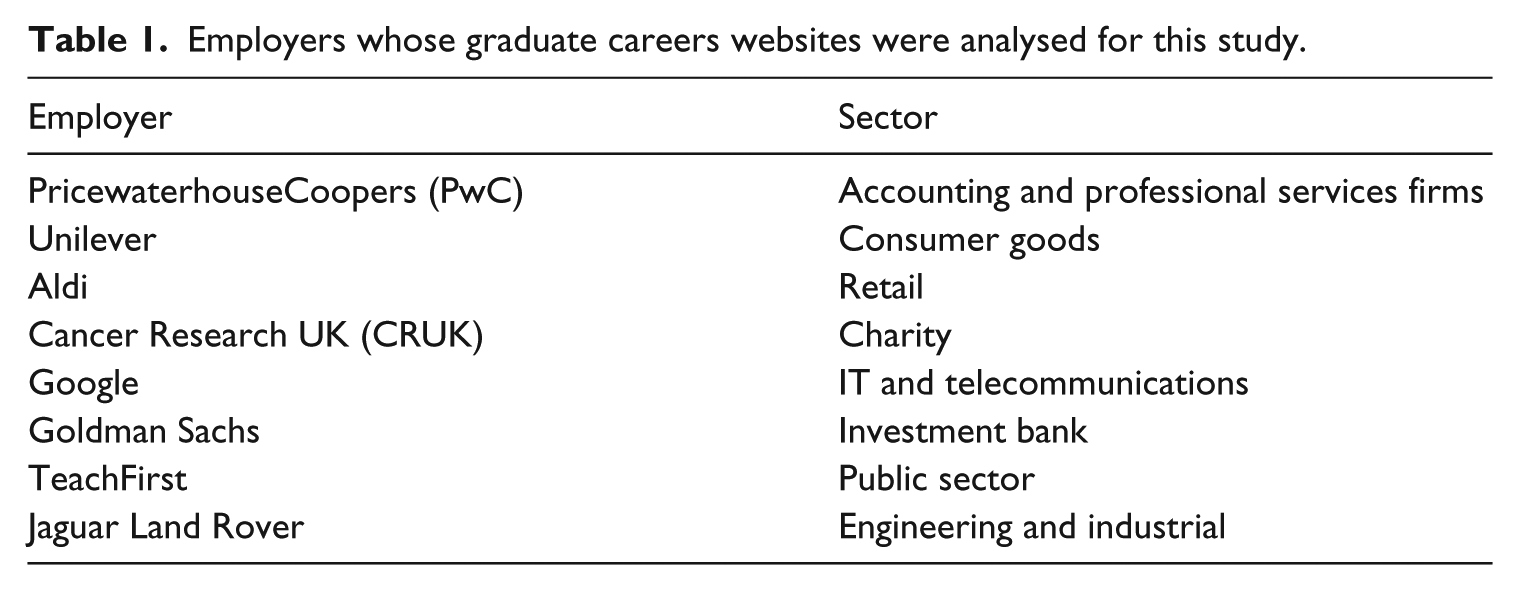
Data collection involved navigating each employer’s graduate website to locate text, images, interactive quizzes, videos, social media gadgets and documents relating to issues of employability. Employability featured in multiple, hyperlinked webpages, typically labelled with titles such as: ‘who are we?’ (i.e. culture); ‘what do we look for?’ (i.e. competencies); recruitment and selection procedures; career paths and roles; ‘what you can expect from us’ (i.e. training and development); and diversity and inclusion. Websites were typically saturated with videos and interactive elements, matching the media maturity of the target audience. To give three examples: Google provided a 30-minute YouTube video of a recruitment ‘hang-out’ discussion between three recruiters; PricewaterhouseCoopers (PwC) provided a 15-minute ‘e-learn’ activity comprising self-test quizzes and formative feedback to guide applicants about the qualities expected of employees; and Cancer Research UK (CRUK) provided a three-minute video with recent graduates giving hints on job application.
Graduate careers websites are rich in terms of their multi-modal communicative complexity. This was especially true of the ‘home’ landing-page located using search terms ‘graduate careers’ or ‘graduate jobs’. Large blocks of text were rare. Instead, words were displayed in shorter sections or were migrated to video formats, and were complemented by imagery, creative page structures, audio-visual materials and social media gadgets. This multi-modal communication required the adoption of an investigative approach that extended beyond methods traditionally used to analyse word-based texts. To this end, methodological insights were drawn from perspectives such as critical discourse analysis (e.g. Fairclough, 2003; Machin and Mayr, 2012), visual and multi-modal methodologies (e.g. Kress, 2010; Rose, 2007), analysis of web materials (e.g. Craig et al., 2001) and governmentality studies (e.g. Boland, 2016). The advice from Rose (2007) was particularly helpful. Rose recommends a multi-layered interpretive process for exploring the rhetorical and discursive organization of texts. This involves an iteration of familiarization (approaching materials with fresh eyes, looking and looking again, reading and re-reading); the use of ‘slightly more systematic methods’ (p. 157) in order to identify key themes and connections; and an interpretation of how words, images and their structure suggest particular meanings and produce ‘effects of truth’ (p. 161). Flexibility is recommended rather than prescriptive procedures (Rose, 2007). As Graham (2011: 5) comments, a decision to eschew prescribing methods in advance does not imply lack of rigour, but reflects a ‘characteristic reticence’ of those doing discourse analysis from a post-structuralist position to assume that precise standardized methodologies necessarily create more objective truth claims.
For this study, a 130-page Word document was created as the data repository. The repository collected content such as online images and text for all relevant webpages – captured using proprietary screen-capture software called Snagit®5 – together with extensive notes on layout, interactivity elements, linkages and summaries of videos. In a first reading of the data, explicit content communicated in pages such as ‘what do we look for?’ was tabulated alongside a list of employability attributes taken from the 2011 report from the UK’s Confederation of British Industry and the National Union of Students (CBI/NUS, 2011). In the second stage of analysis, the material from each employer was analysed to produce a critical summary of messages symbolically communicated across each employer’s website. Then, key cross-employer themes regarding employability were developed. Of particular interest was how the sites constructed the subjects and objects of an employability discourse, and how online interactivity encouraged viewers to participate in self-evaluation activities which can be regarded in a Foucauldian sense as ‘technologies of the self’ (Foucault, 1994c[1982]). Findings from the first, ‘content’ reading are discussed next, followed by analysis from the second more critical reading. For illustrative purposes, longer descriptions are provided of features from the webpages of PwC and CRUK.
Explicit messages about employability
A first reading of the website content – looking for explicit or prominent messages – gave indications of the intended purpose of the communication. Definitions of employability competences were signalled in pages with titles such as ‘what do we look for’. Viewing final-year students were implicitly invited to evaluate themselves against stated core competencies and to self-assess their suitability for continuing with the application process. It was noticeable that the competencies did not align with the generic descriptions in higher education employability discourses. Competencies identified in the CBI/NUS report (2011), such as ‘application of numeracy’, were rarely mentioned by employers, as though taken for granted. The ability to use information technology was not mentioned at all. Instead, employability statements tended to address attitudes or values, using phrases such as ‘passion for the cause’, ‘desire to defy convention’, ‘strong work ethic’, ‘agility and flexibility’.
Three (PwC, Unilever, Jaguar Land Rover) of the eight employers provided competency lists, indicating expected behavioural performance, work values and outcomes. PwC, for example, listed expected interview competencies as: Communicate with impact and empathy; Be curious: learn, share and innovate; Be passionate about client service; Demonstrate courage and integrity; Develop self and others through coaching. Yet, statements requiring applicants to ‘Demonstrate courage and integrity’ and ‘Be curious …’ lacked specificity. One might reasonably wonder – What does it mean to have integrity? What sort of evidence is required? From a corporate marketing perspective, statements about ‘courage and integrity’ might represent an organization’s marketing tactic to portray itself as already embodying these values and seeking individuals who aspire to join. As such, the statements appeal to students’ sense of who they are (their subjectivity), or what they want to become through work.
In the five other careers websites, there were no equivalent competency lists, but expectations about employability were given prominence in other pages such as ‘recruitment and selection’, although there was considerable ambiguity. Employability tended to be articulated across multiple modalities, and through different voices. This complexity was illustrated in the CRUK website. The CRUK graduate scheme webpages carried visual imagery conveying approachability: individuals were in smart-casual dress, smiling and photographed in a variety of settings. The language describing CRUK (e.g. in the ‘what it’s like’ page) included the familiar ‘ambitious’, ‘smart’, ‘passion’, but also the more emotive ‘brave’ and ‘optimistic’. There was a sense of collaboration on an epic journey, with straplines such as ‘united in the fight against cancer’ and ‘our progress is your progress’. One of the few explicit statements of employability was in the ‘graduate programme’ page:
We aim to recruit high potential, high-performing individuals who will provide a high-impact contribution to our strategy and vision. We want bold graduates, unafraid to challenge the status quo and willing to go the extra mile to achieve exceptional results.
Graduate job adverts gave further cues and clues for applicants. For example, the fundraising/marketing trainee should be ‘creative’, ‘driven’ and ‘forward-thinking’. The employability requirements were more pronounced in the embedded video on the ‘how to apply’ page. Here, six CRUK graduate trainees talked of their experiences, gave ‘three words’ to summarize the organization and offered ‘tips to applicants’. Like many of the videos, the conversations and imagery gave symbolic space for employers to convey an idealized graduate. It is plausible that the portrayal of dress, gestures, language and so on would have been carefully scripted and/or edited to convey an appropriate message (Pratt and Rafaeli, 1997; Soenen et al., 2007). Many graduates will be cognisant of this method of symbolic communication and are likely to actively to seek out ‘hints’. In the video, the ‘three words’ describing CRUK gave applicants strong clues about the qualities of the ideal graduate: words such as ‘tenacious, innovative and ambitious’ and ‘pushes the boundaries’. In ‘tips to applicants’, two of the four graduates talked of ‘going the extra mile’, and the final speaker called on aspiring applicants to ‘really prepare, and practise, practise, practise’. Goffman’s ‘presentation of self’ is echoed here in the implication that recruitment is about performance (1990 [1959]).
Implicit messages
A second, more critical reading of the website content and interactivity illuminated how discursive and rhetorical practices seemed designed to function as anticipatory socialization techniques, potentially shaping viewers’ subjectivities and interpretations about how to self-assess themselves against an idealized employable graduate. Three key discursive effects were identified: ‘othering’ student and university life (and values); normalizing consent to particular constructions of employability; and shaping viewers’ self-evaluations through techniques such as quizzes, ‘hints and tips’ pages and (if employed at the organization) continual guidance through coaching, mentoring, buddying and feedback.
The university as ‘other’
Work and employment was positioned as the ‘real world’ in many of the careers websites, in contrast with the ‘other’ world of academia, university life and student identities. A discursive strategy of othering is usually understood as the identification of a category of individuals who are positioned as different or even inferior. De Beauvoir wrote of the patriarchal practices by which women are seen as ‘other’ and subordinate (1997[1953]), and later Hall (1997) highlighted the othering practices of ‘white’ individuals when they referred to black and minority ethnic groups. The websites presented another form of othering which was broader in reach, but just as powerful and potentially deleterious in its effect: that of othering an arena of educational development traditionally symbolized by the university.
Knowledge gained at university was often treated with ambivalence. In the ‘new analyst’ page at Goldman Sachs, an applicant’s knowledge was stated as ‘less important to us than your potential’. Google listed ‘role-related knowledge’ as one of its four minimum requirements, but did not presume a university-derived source for that knowledge. For graduates leaving higher education for professional roles such as accountancy, banking, law or management, a new hurdle was raised which rendered a Bachelor’s degree a mere starting-point: post-graduate professional qualifications. For PwC, such qualifications were the ones needed to ‘open up a world of possibilities’. These qualifications are positioned as demanding in a new way:
Putting in the study time – compared to university, it’s a different ball game. You’ll need to do consolidation and revision outside normal course hours. (PwC, emphasis added)
By othering the university, the websites opened a space for new discursive elements around which a worker identity could be anchored: for example, the collective ‘us’, ‘we’, ‘our culture’ and ‘our firm’ of the organization; the ‘wider cohort’ which graduates employed by PwC would join and build networks with; and the new objects of focus such as the client (e.g. at PwC and Goldman Sachs), the product (at Jaguar Land Rover), the brand (at Unilever), the cause (at CRUK), or the problems of social inequality and educational disadvantage in the case of TeachFirst. These elements are associated with wider discourses about professionalism which applicants may have been familiar with, and which normalize particular behaviours and attitudes. They encourage viewers to imagine themselves as new types of person, subjecting themselves to new norms and priorities, and embedded in new networks of social relations. There is a sense of submitting and belonging to something ‘bigger’.
Normalizing consent to ‘employability’
By othering the world of students and universities, a canvass is opened on which to normalize a different culture of working life which values hard work, joint responsibility and resourcefulness, and which enrols viewers’ consent to an idealized norm of harmonious social (and labour) relations. PwC’s website emphasized the homogeneity of the firm’s culture in the ‘who we are’ video, where the UK chairman talked of ‘… our vision of being one firm … At PwC we have a common set of values and behaviours that define the culture of our organization … we act as one firm’. The accompanying text listed seven features such as ‘working hard’, ‘working together’ and ‘supporting our local communities’, complementing the graduate competency list by elaborating how employees are expected to work. The use of the pronoun ‘we’ indicated that everyone in the firm should be committed to these behaviours – they are a norm to live up to:
… we share the same commitment to quality … we’re always looking for new challenges, want to be the leader in our chosen markets, and are ready to put in the extra effort to succeed. (PwC)
What is important is to fit in, to become one of the team, to take on the values of the organization. The HRM literature has long demonstrated the link between fit, organizational performance and individual satisfaction (Ostroff, 1992). What is relevant here is the manner in which work is positioned as sociable, rewarding and valuable in itself. Strategies to normalize hard work is partly conveyed through visual imagery. For example, Goldman Sachs’s video of life in investment banking rarely portrayed a solitary worker at his or her desk. Instead, workers were shown talking, listening, laughing and in meetings with clients and colleagues. The implication is that work is not just sociable, it is social in the sense that the employable graduate is invited to enter a web of harmonious social relations and therefore needs socializing. In another example, Google’s careers website drew potential employees into an imagined community of hard-working, enterprising, creative ‘Googlers’ – a community they are invited to join on condition they are willing to fit in.
One might wonder – What is the appeal to graduating students of the provocation to not only to accept but also to celebrate such a work ethic? Perhaps an answer is in the aspirational tone of the sites, linking words such as energy/flexibility with outcomes such as success/achievement, and projecting positive imagery in photos and videos of employees who have ‘made it’. This attractive imagery was powerful to the extent that the alternative was disparaged. Viewers were almost ‘dared’ to demonstrate their credentials (as an employable graduate) by firmly distancing themselves from those unable to commit to the demands of a graduate development programme. This self-evaluative dynamic was indicated in TeachFirst’s rhetorical questioning at the start of ‘recruitment and selection’ (‘Are you the kind of person who could make an impact?’) and at the end when the text admits that the job ‘is a big ask’, inviting the viewer to reflect on whether he or she is good enough. Unilever’s introduction page offered another example. The imagery and text depicted an employable graduate who is bold, dynamic and achievement-oriented. However, the text seemed to goad viewers to dare to admit they are not good enough – or, if they want to take up the challenge, to commit whole-heartedly to their new identity:
If you are ambitious, keen to learn, and want to lead, you’ve come to the right place …. It’s learning like you’ve never learned before. It’s challenging, make no mistake. (Unilever, emphasis added)
Use of self-evaluative disciplinary techniques
Beneath the explicit messages about graduate requirements and competencies sat another layer of communication and interactivity, epitomized by the self-test quizzes and hints-and-tips advice. These seemed designed to invite viewers to participate in self-evaluations against an idealized employable graduate. Aldi and PwC provided elaborate self-test online quizzes, while Goldman Sachs offered a bespoke smartphone app – a symbol perhaps of the tech-savvy graduate they sought to attract. PwC’s E-learn quiz, entitled ‘watch, listen and learn’, offered a sophisticated package of interactivity comprising video interviews and multiple-choice questions: the viewer-participant was given the scenario of an interview question followed by three possible interview responses, each with a subsequent piece of feedback. The feedback was formulaic: praise, identification of misjudgement, and suggestions for improvement. Although the interview ‘coach’ assured viewers that PwC wanted candidates to ‘be themselves’, the feedback was normative, shaping viewers’ expectations of the type of organization he or she might be joining.
Similar techniques were evident in the hints-and-tips advice pages. The hints conveyed an informal tone, implying an everyday conversational encounter between potential applicants and recruiters: something friendly and helpful. Nevertheless, the hints are likely to have been closely scripted as text (e.g. Unilever, Goldman Sachs) or video (e.g. Jaguar Land Rover, Google, CRUK). In Jaguar Land Rover’s six-minute video, a coach explained that the organization took a ‘very structured approach’ to their interviews. She outlined the recommended format for interview answers of ‘Context, Action, Results’. This advice can be construed as helpful, but also as a self-disciplining technique for viewers wanting to learn how to behave appropriately. At times, the advice seemed contradictory. Unilever advocated ‘be yourself’, but then told applicants how to manage their emotions with the advice ‘be yourself, be engaging and enthusiastic, and be honest’.
The potential effect of these techniques lies not only in influencing students’ understanding, but also in shaping their subjectivities – their sense of self and their match to an idealized employable graduate. As such, they take on the power of technologies of the self in the Foucauldian sense of being ‘specific techniques that human beings use to understand themselves’ (Foucault, 1994c[1982]: 146).
The discipline of continual coaching and mentoring
Many of the graduate careers websites advertised the availability of regular coaching, mentoring, buddying, training and feedback. In contrast to the hints-and-tips pages which provided advice about application processes, the ubiquitous role of coaching and mentoring support in the future indicated tensions between organizational support on the one hand and expectations that graduates should nevertheless be self-directed and entrepreneurial. The website of Goldman Sachs, for example, explained that analysts are provided with ‘the tools necessary’ for growth and ‘unlimited access’ to training and guidance, but must be proactive and take responsibility for personal development. This positioning was illustrated on PwC’s ‘your development’ page:
To succeed at PwC, you need to take personal responsibility for managing your career. If you do, we’ll provide the support and encouragement you need to succeed. (PwC, emphasis added)
The statement is problematic because acceptance of task responsibility does not ensure a positive outcome. Instead it merely locates the person to blame for failure. However, the resolution is the provision of coaching and other ‘confessional’ support. PwC says that it ‘prides itself’ on giving coaching and feedback early on and ‘continuously’, adding that support is ‘constructive’, using ‘measures’ to turn weaknesses into strengths.
The appealing promise of regular mentoring, coaching, buddying, training and feedback can be seen more insidiously as an expectation that employable graduates should (want to) submit relentlessly to disciplining mechanisms through which they can become aware of ‘weaknesses’ and how to remove them. The existence of such mechanisms in HRM has been acknowledged (e.g. Fogde, 2011; Grey, 1994; Townley, 1994). However, in these websites, viewers were encouraged to accept and welcome these confessional processes as helpful, desirable and ubiquitous, and as a routine element of (future) HRM practice. Viewers should expect to submit to a process of governmentality ‘through which [they would be] rendered amenable to intervention and regulation’ (Townley, 1993: 520).
Discussion
This study’s use of the subjectivity concept and governmentality approach provides a helpful framework to analyse the potential influence on final-year students of the discursive construction of ‘employability’ in graduate careers websites. Employability discourse has dominated higher education and government policy for several decades (e.g. UKCES, 2009), creating a lively debate about the extent of higher education’s responsibility for creating ‘new workers’ (Brown and Hesketh, 2004; Morley, 2001). While policy debates tend to focus on identifying desirable skills and graduate attributes – qualities that universities are tasked with developing and accrediting – the potential effects of the employability discourse on students’ subjectivities is relatively neglected. A contention of this article is that in the liminal space before final-year students enter the labour force, they may be particularly susceptible to employer representations of the ‘employable graduate’, which may shape students’ self-evaluations, subjectivities and later performances during recruitment and at work.
Focusing on eight leading commercial and public sector UK organizations, the study analysed the extent to which – and how – graduate careers websites discursively construct the ‘employable graduate’. A particular focus, inspired by Foucauldian analyses of organizational HRM practices (e.g. Bergstrom and Knights, 2006; Grey, 1994; Townley, 1993, 1994), was on the mechanisms through which these websites shape viewers’ subjectivities such that they buy into and consent to (rather than resist; see Burawoy, 1979) organizational discourses and norms of ‘employability’.
In line with such analyses, it is contended that employers’ graduate careers sites do indeed constitute discursive spaces (Woodly, 2015) that go beyond the provision of a platform for the representation and consumption of a discourse of employability. As the analysis has shown, the interactive media content and gamification elements of contemporary websites create a space in which viewers can actively participate – trying out self-assessment quizzes, doing virtual role-plays as an interviewee, receiving automated feedback, watching alumni give advice about interview preparation, and so on. Final-year students are likely to engage in the websites not just as ‘viewers’, but as participants. Their participation exposes them to processes which may influence, shape and channel their understanding of employability and their self-evaluations and self-categorizations as an employable graduate. As such, there is potential for the shaping of the viewer-participant’s subjectivity as a productive subject and an employable graduate (Foucault, 1980, 1994a[1978], 1994b[1978]; Rose, 1999), while acknowledging possibilities for resistance.
Conceptually, it is argued that graduate careers websites should be seen to be spaces for anticipatory socialization of future workers (Hurrell and Scholarios, 2011; Scholarios et al., 2003). Organizations may use the websites to enrol the consent of viewer-participants to particular representations of employability, and to shape participants’ subjectivity and future performance as workers. In doing so, the processes of anticipatory socialization they support represent a further example of what Thompson and Harley (2007) call ‘the extension of [managerial] controls into new territories’ (p. 154: emphasis in original).
In this case, the ‘new territory’ is temporally situated before formal graduate recruitment has begun, and discursively situated in the virtual medium of the internet. In this virtual space, unhindered by physical constraints, a form of mass anticipatory socialization has the potential to influence cohorts of graduating students who engage with these careers sites. As such, the websites provide a vehicle through which organizations can ‘scale up’ the power effects of their HRM practices. Just as it was the economy of the Panopticon’s gaze which interested Foucault (1977), so it is now the extensive reach of careers websites in an internet age which renders them so potentially powerful as carriers of discourse. HRM practices can extend into pre-recruitment spaces, with scope to effect the anticipatory socialization of graduating students on a scale far greater than achievable through personal recruitment interviews, early induction processes, or performance appraisal (Bergstrom and Knights, 2006; Townley, 1991, 1994).
At the same time, while the explicit and implicit messages conveyed by careers sites may attract some, others may recoil or deselect themselves from applying for a graduate job if anxious about not being a ‘fit’ with the idealization of a graduate worker or the cultural match of the organization (see also Bergstrom and Knights, 2006). As such, the websites potentially function indirectly as filters, attracting some to take the next step of applying for a graduate job, but deterring and discouraging others from applying. In turn, such filtering may thereby act to contradict organizations’ espoused values of equal opportunities and inclusion, or contravene the recruitment and selection policies regulated by institutional equality and diversity legislation. Extending this point further, it might be the case that such filtering effects are an outcome of enacted values which are (perhaps inadvertently) unmeritocratic, acting to discourage applicants without an appropriate outlook and attitude, or who are unwilling to subscribe to a regime of continual mentoring and guided self-improvement. Students from traditionally disadvantaged groups may be more likely to feel they do not ‘match’ the idealized image of employability, compared with those whose cultural capital gives them the confidence of positional advantage (Brown and Hesketh, 2004; Tomlinson, 2008). Although many of the graduate careers sites in this study presented images of employee diversity in terms of gender, ethnicity and (occasionally) sexual orientation, there seemed less scope for variation in expected self-conduct. Indeed, the celebration of category-based diversity seemed to obscure a homogenization of some forms of worker behaviours and values, such as the needs of the client or ‘cause’ superseding those of the firm or the self (see also Mead, 2014).
The ‘othering’ of the institution of higher education, and of the knowledge that students develop at university, meanwhile raises broader concerns. Many of the graduate careers websites re-positioned a university degree as merely a signal of eligibility for graduate jobs. There was a noticeable gap between the websites’ representations of employability, and the employability criteria suggested by institutional bodies such as the Confederation of British Industry and National Union of Students. The latter (e.g. see CBI/NUS, 2011) emphasize generic capabilities and skills such as numeracy, as well as disciplinary knowledge. However, employers’ graduate careers websites construct a rather different notion: ‘employability’ is about students becoming a particular type of person who is passionate, bold, hard-working, committed, flexible and malleable (see also Brown and Hesketh, 2004; Gleeson and Keep, 2004; Hurrell et al., 2013; Morley, 2001). These qualities are inevitably open to subjective interpretation by organizational decision-makers during recruitment and selection processes. Furthermore, the emphasis on personal qualities raises doubts about what higher education can possibly do to enhance the job prospects of their graduating students. If employers see the ‘upper-second’ Bachelor’s degree as a mere signal of eligibility for graduate jobs, almost irrespective of the disciplinary and practical content, the value of higher education as an academic institution and a place of learning is severely diminished, as is its role as a mechanism for enhancing social mobility.
Conclusion
Although employability is a deeply contested concept in the policy arena, the call to become an ‘employable graduate’ is a powerful one for final-year students anxious to get a graduate job. Following an analysis of graduate careers websites, this article argues that such websites provide a discursive space for the representation and consumption of a discourse of employability. Even before formal recruitment processes begin, the websites offer mechanisms of anticipatory socialization, enrolling students’ consent to a vision of employment norms and the attitudinal ‘fit’ expected of them. HRM practices are thus extending into the pre-recruitment arena, influencing students on a scale far greater than traditional face-to-face HRM practices such as recruitment interviews, induction processes and performance appraisal. Echoing the argument that recruitment and selection is the ‘great neglected topic’ (Keep and James, 2010), this article contends that while pre-recruitment HRM practices embedded in organizational graduate careers websites have escaped scrutiny, they have significant potential to filter applicants, and to shape the employability expectations and subjectivities of a new generation of workers. As a result, they offer a means of extending mechanisms of managerial control into the pre-employment domain, thereby making graduate employees more governable.
Footnotes
Acknowledgements
I would like to thank Phil James, Birgit den Outer, Alan Bradley, the three anonymous referees at Work, employment and society and the editor Melanie Simms for their constructive feedback on earlier versions of this article.
Funding
This research received no specific grant from any funding agency in the public, commercial or not-for-profit sectors.