



Abstract
The onset of the ‘Great Recession’ from 2008 was associated with a significant increase in long-term unemployment among young people. Work–welfare cycling has been put forward as a contributory factor. Drawing on a large-scale survey of long-term unemployed young people, this article argues that segmented labour market theory provides a strong explanatory framework for understanding the nature of long-term unemployment among young people, with the literature on work–welfare cycling contributing to an understanding of one of the processes by which precarious employment impacts on employability and labour supply. A second key finding is the heterogeneous nature of the young long-term unemployed, which in turn requires policy responses more customized to the needs of the different groups.
Introduction
The onset of the ‘Great Recession’ in 2008 had significant impacts on youth unemployment. The numbers peaked in the UK between July 2011 and June 2012 at 988,000 or 21.5 per cent of 18–24 year olds (Nomis, 2016). The UK Government, as well as regional and local authorities, developed interventions to help minimize the impact of a ‘lost generation’ of young people. In particular, there has been a growing focus on mitigating the risk of young people becoming long-term unemployed as the consequences of this are more severe (McQuaid, 2015). To be effective, the interventions need to be designed to address the factors behind the current youth unemployment problem.
Analysis of the factors influencing long-term unemployment among young people has mainly focused on declining employment levels during recessions as this poses particular difficulties for those outside the labour market seeking to secure employment (Bell and Blanchflower, 2011; De Lange et al., 2014). From 2008 onwards, the analysis became more concerned with the changing nature of jobs rather than the number of jobs (Bell and Blanchflower, 2011; Sissons and Jones, 2012). It is argued that these structural labour market changes constrain the ability of young people to secure rewarding labour market careers (Bell and Blanchflower, 2011). The emphasis of more recent discussion is therefore more on low pay, low hours of work, temporary and zero-hour contracts, and self-employment (O’Reilly et al., 2015; Sissons and Jones, 2012).
One specific feature of the labour market that is argued to contribute to long-term unemployment among young people is work–welfare cycling. For McCollum (2012b, 2013), work–welfare cycling is the repeated movement of individuals between low paid, low skilled jobs and unemployment. McCollum’s argument is that work–welfare cycling reduces the potential for young people to acquire the job-specific skills and work record needed to progress up the employment ladder and into better quality jobs. Also, when the number of job seekers greatly exceeds the number of vacancies, young work–welfare cyclers are less likely to find favour with employers on account of their irregular work history and so become vulnerable to long-term unemployment. Statistical evidence to support the theory is, however, limited (McCollum, 2013; MacDonald, 2011). This article reviews the employment history data of a cohort of long-term unemployed young people to estimate to what extent they had previously experienced work–welfare cycling.
The article begins with an overview of the different factors driving youth unemployment before specifically considering the concept of work–welfare cycling. In doing so, the article highlights some of the similarities between work–welfare cycling and segmented labour market theory, developed in the late 1960s and early 1970s. The article contributes to the limited quantitative evidence base around the extent of work–welfare cycling by drawing on a study of 705 long-term unemployed 18–24 year olds in Scotland to estimate the levels of work–welfare cycling. The central contribution of the article to theories and concepts in sociology is the importance of integrating work–welfare cycling within the broader conceptual framework provided by segmented labour market theory, taking account in particular of the significant weight given to labour demand factors. The article concludes by considering the implications of the analysis for tackling long-term unemployment among young people.
Factors contributing to youth unemployment
Notwithstanding reductions in youth unemployment as the economy recovered, youth unemployment in the UK continues to be a substantial issue, with over 640,000 (14%) of 18–24 year olds unemployed in June 2016 (Nomis, 2016). Indeed, before the recession, youth unemployment had been steadily increasing during the 2000s despite the buoyancy of the UK labour market and increasing numbers of young people entering further or higher education (Escott, 2012; UK Commission for Employment and Skills (UKCES), 2011). This leads Bivand et al. (2011), De Lange et al. (2014) and UKCES (2011) to argue that there are underlying structural factors contributing to youth unemployment. On the demand side, there has been a ‘hollowing out’ of the labour market with a polarizing of jobs between professional and advanced technical sectors at the top end, and unqualified jobs in the service sector at the lower end (Hamersma et al., 2015; Sissons and Jones, 2012). For the growing numbers of qualified young people, the expansion of jobs in the professional and advanced technical sectors has been beneficial (Furlong et al., 2011), but for many young people the hollowing out of the labour market has left a shortfall in good quality, entry level jobs (De Lange et al., 2014; Hirst et al., 2006; Lee and Wright, 2011). A further structural factor is increased deregulation, which has enabled employers to be more responsive to changes in demand, but has resulted in more insecure forms of employment (Buchanan et al., 2013; De Lange et al., 2014; Ray et al., 2010). However, for young people to secure these and other entry level jobs, they face increasing competition from students seeking part-time work, migrant workers, labour market returners and older workers staying in the labour market beyond retirement age (Bell and Blanchflower, 2011).
Cyclical factors associated with the economic recession have exacerbated youth unemployment. When the economy slows and recruitment levels fall, individuals outside and on the margins of the labour market are most affected (Gangl, 2002). Not only are there fewer job vacancies but employers also place a greater emphasis on recruiting skilled, experienced individuals who are productive from the outset, which disproportionately disadvantages young people and other labour market entrants. The fall in recruitment levels is the main cyclical factor affecting young people but they are also more vulnerable to redundancy. For employers looking to reduce costs, young people are often at most threat as typically there is less cost in making them redundant due to their shorter length of service (Bell and Blanchflower, 2011; Lee and Wright, 2011).
The structural and cyclical factors add further layers to other factors that can make it hard for young people to enter and sustain employment. These include personal attributes which militate against effective job search (Bell and Blanchflower, 2011; Griffiths et al., 2006; Hasluck and Green, 2007; Hirst et al., 2006; UKCES, 2015); negative perceptions of the work readiness of young people reported by some employers (Bivand et al., 2011; Recruitment and Employment Confederation (REC), 2010), but by no means the majority (UKCES, 2015); and the recruitment practices of some employers working against young people (Newton et al., 2005; REC, 2010), and in some circumstances disadvantaging in particular young people with no or low qualifications (MacDonald, 2011; Sissons and Jones, 2012; UKCES, 2011).
Work–welfare cycling and segmented labour market theory
Work–welfare cycling is a concept that helps to illustrate how structural, cyclical, personal and employer factors interact and impact on an individual’s labour market prospects. McCollum (2012b, 2013) describes work–welfare cycling as the repeated movement of individuals into and out of employment. Others have also identified these movements, but applied different labels – the ‘low pay, no pay cycle’ (Goulden, 2010; Shildrick et al., 2010) and the ‘churning trap’ (Escott, 2012).
For McCollum (2012a, 2012b, 2013), work–welfare cycling is brought about through different but inter-related impacts on individuals. There are labour market structures that have created ‘bad jobs’ (McCollum, 2012a: 213), such as increases in flexible working patterns, shorter job tenures and increases in high turnover ‘dead end’ occupations. There are individual factors that include being young, in part-time employment, in poor health, having limited experience or qualifications, and having an already fragmented employment history (McCollum, 2013: 1753). For these individuals, their low employability restricts their employment opportunities to poor quality and precarious jobs (McCollum, 2013: 1754). Finally, there is the local institutional context young people confront that spans the peer influences received from family and friends, the effectiveness and work-first approach of local welfare-to-work services, and the availability of transport and childcare (McCollum, 2012a).
A potential weakness in McCollum’s discussion of the causes of work–welfare cycling is the limited explanation around how these different factors interact and subsequently impact on labour market prospects. To help address this, this article reviews segmented labour market theory that was first developed in the 1960s. Developed primarily to explain the labour market experiences of disadvantaged workers in urban areas (see Harrison, 1972; Piore, 1972), segmented labour market theory arguably offers a broader analytical framework within which to understand how and why individuals experience work–welfare cycling.
Segmented labour market theory argues – in its simplest form – that jobs can be classified into two broad sectors: the primary sector and the secondary sector. The primary sector is characterized by higher skilled, well paid jobs with good training and progression opportunities, which in turn bring employment stability. In contrast, the secondary sector is made up of lower skilled or routine jobs that are characterized by low wages, unstable employment conditions and few training and progression opportunities (Bosanquet and Doeringer, 1973; Harrison, 1972; Harrison and Sum, 1979; Piore, 1972; Wachter, 1974).
Considering the labour market implications of secondary sector jobs, the simple, repetitive work tasks mean that employers have a ready supply of potential workers who can learn and carry out these jobs quickly and effectively (Bosanquet and Doeringer, 1973; Harrison, 1972). While the jobs are often associated with high staff turnover rates, owing to low wages and poor conditions, employers accept this because vacancies can be filled relatively easily from the external labour market (Harrison and Sum, 1979). Indeed, employers can anticipate high turnover and so hire recruits without much prior screening, making entry into these jobs relatively straightforward (Wachter, 1974). In essence, employers in the secondary labour market have an effective and sustainable business model which provides little rationale for investing in the skills of employees, or for offering stable, good quality employment.
For individuals, the absence of significant barriers to job entry means that those with limited work-related skills, experience and qualifications can often find work. Many young people typically begin their working lives in a secondary sector job, while women, low skilled workers and ethnic minorities are also heavily represented (Bosanquet and Doeringer, 1973; Piore, 1972). However, the low wages and undesirable working conditions discourage or inhibit job retention and stability, while at the same time it is relatively easy to move between secondary sector jobs in search of slightly better pay, employment conditions or other factors (Harrison and Sum, 1979). These factors contribute to the high turnover rates within the secondary sector.
While movement within the secondary sector can be widespread, movement upwards into the primary sector is difficult. Individuals can become trapped and spend much or all of their working lives in these jobs (Harrison and Sum, 1979). A key factor is that an employment history with frequent job changes can deter primary employers from recruiting workers from the secondary sector as they fear that the turnover habit will continue and therefore put at risk employer investment in skills that primary sector jobs often require (Harrison and Sum, 1979).
In relation to unemployment, segmented labour market theory helps to explain why unemployment among disadvantaged groups can remain relatively high at all stages of the economic cycle. In buoyant labour markets, individuals might voluntarily choose to leave a secondary sector job believing they can secure another job relatively easily, but experience a short spell of unemployment in the process (Bosanquet and Doeringer, 1973). Such employment options decline in a depressed labour market and individuals may leave jobs involuntarily (e.g. through redundancy or non-renewal of a temporary contract) and not be able to find another job. Indeed, employers are more likely to make secondary sector workers redundant because employers have invested less in their skills and so it makes less sense to hoard these workers (Wachter, 1974). The outcome is that with fewer primary and secondary sector vacancies available, the spells of unemployment experienced by workers in the secondary sector become longer (Harrison and Sum, 1979; Wachter, 1974).
As well as explaining the churn at the lower end of the labour market, segmented labour market theory in its fullest form (see Figure 1) recognizes that the secondary labour market also has close relationships with the irregular economy, government-funded training programmes and the welfare system. The theory also recognizes the intermediary role played by employment services and government-funded training programmes in potentially limiting people’s options to jobs in the secondary labour market. Harrison (1972) states that the employment and skills support the unemployed receive prepares them for the secondary labour market primarily, to the extent that public sector initiatives almost become a recruitment instrument for employers in the secondary labour market.
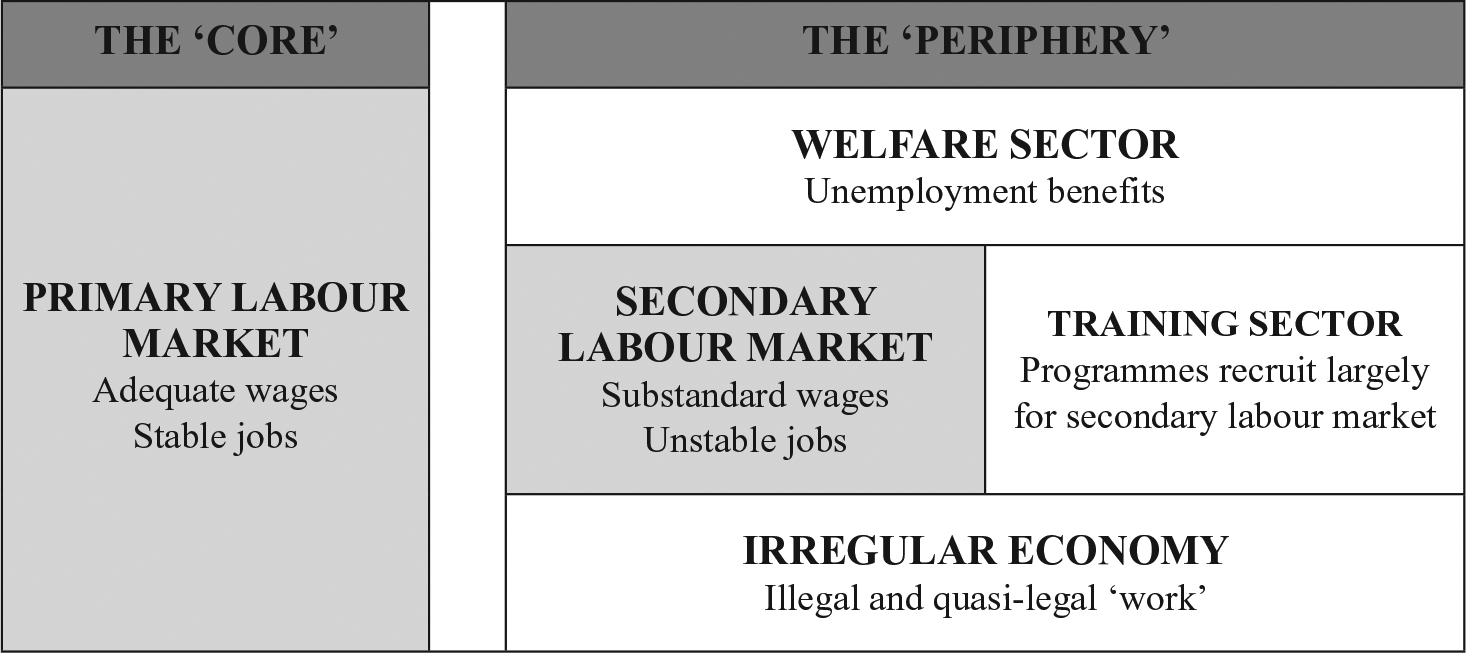
The segmented labour market.
The highlighting of the link between government employment programmes and the welfare system by segmented labour market theorists resonates with current UK employment and welfare policy. Employment programmes and services tend to be focused on a short-termist, work-first approach with an emphasis on placing individuals quickly into jobs, rather than encouraging the effective matching of individuals into long-term, sustainable employment (Escott, 2012; McCollum, 2012b, 2013; Ray et al., 2010). The combination of the work-first approach and the increasingly mandatory nature of employment programmes, backed up by the threat of benefits sanctions, forces some young people to apply for jobs which are low paid and/or of poor quality. In effect, this eases the recruitment problems of employers in the low pay/poor conditions segment of the labour market (Caliendo and Schmidt, 2016; Martin, 2014). Apart from the use of benefit sanctions to back up mandatory employment programmes for the unemployed, the linkage to the welfare system may include the unintended consequences of working tax credits by potentially increasing the effective labour supply to low waged jobs, underpinning the persistence of poorly paid, low quality jobs.
Segmented labour market theory’s main contribution is, however, to challenge the notion that unemployment and low pay are largely supply-side issues, which can be tackled effectively by investment in employability and human capital. Instead it focuses attention on the structure of contemporary labour markets and the quality of jobs, as well as other forces shepherding individuals into the secondary labour market. Highlighting the demand-side issues, between 1979 and 2015, the number of UK jobs in sectors with high proportions of entry level jobs has increased significantly (retail, up 28%; accommodation and hospitality, up 95%; arts and leisure, up 78%) compared with the average increase in employment of 18 per cent (Office for National Statistics (ONS), 2015). Other phenomena include the increase in part-time and temporary jobs, zero hour contracts and self-employment, which predominantly reflect their value for employers rather than employees (Ray et al., 2010). More recently, and in the context of a 4.8 per cent increase in total employment between 2012 and 2015, these types of more precarious jobs have also continued to grow (Nomis, 2016). Between 2012 and 2015 the Annual Population Survey shows that temporary employment grew by 1.3 per cent, part-time employment by 3 per cent and self-employment by 7 per cent (Nomis, 2016). Zero hour contracts have increased by a factor of more than three between 2012 and 2015, although this is self-reported data and respondents may have been affected by the increased media coverage of these contracts (ONS, 2016). These developments on the demand side effectively reinforce the conditions described by segmented labour market theory. Despite these demand-side trends, the welfare system and wider government action remains focused largely on supply-side measures to raise the employability of jobseekers rather than improving the quality of jobs on offer, particularly those at the bottom end of the labour market (McCollum, 2012b; Ray et al., 2010).
In summary, there are many similarities between work–welfare cycling and segmented labour market theory. Both analyse the relationship between low skilled, low paid jobs and more disadvantaged workers. Both help explain the churn at the bottom end of the labour market, including spells of unemployment which can become long-term unemployment when the labour market weakens and there are fewer job opportunities. Both refer to a division in job type, with segmented labour market theory built upon the difference between primary and secondary sector jobs, while work–welfare cycling makes reference to the structural ‘hollowing out’ of the labour market between high skilled, high paid jobs in advanced sectors and low skilled, low paid jobs in retail, hospitality and other service sectors. The greater theoretical power of the segmented labour market theory is that it builds upon a strong demand-side explanation for the nature and persistence of poorly paid and low quality employment, and it explicitly considers the extent to which public policy interventions through the welfare system and employment support services ironically help to maintain this system. This is a powerful explanatory framework which, in addition, carries significant implications for the required policy responses.
For this article, both theories are potentially relevant to the youth unemployment problem as young people can be particularly susceptible to becoming trapped in the cycle of low skilled, low paid jobs, unemployment and government training programmes. To some extent, young people are more inclined to cycle between employment, further education, higher education, training, volunteering and unemployment as they seek and try new work and non-work-related experiences (Furlong et al., 2011; MacDonald, 2011; Pemberton, 2008). The incidence of recurrent spells of employment and unemployment can therefore be expected to be higher among young people, particularly in a buoyant labour market where job opportunities are readily available (McCollum, 2013). However, work–welfare cycling among young people can have long-term impacts in terms of weaker employment prospects (Furlong et al., 2011; Gebel, 2010; Kellard et al., 2007; Worth, 2005), ‘wage scars’ (Ben-Galim et al., 2011) and recurrent poverty (Goulden, 2010; McCollum, 2012a). Shildrick et al. (2010) found that churning labour market careers typical of young adults continued into their thirties and sometimes beyond.
Evidence of work–welfare cycling
While work–welfare cycling is a widely recognized feature of the labour market, statistical evidence of its extent is limited (McCollum, 2013; MacDonald, 2011). The National Audit Office (NAO) (2007), for example, found that of those claiming the standard unemployment benefit for individuals deemed to be close to the labour market – Jobseeker’s Allowance (JSA) – 27 per cent who entered work reclaimed unemployment benefits within 13 weeks and 40 per cent within six months. Over a five-year period, around 50 per cent of benefit claimants had one spell of unemployment, around 20 per cent had two spells, and around 30 per cent had three or more spells (NAO, 2007).
This article draws on a large-scale survey of long-term unemployed young people in Scotland to help understand the extent of work–welfare cycling among young people. The young people, aged 18–24, were all engaged in the UK Government’s Work Programme and had been claiming JSA for at least nine months. These young people were mandated to join the programme, with contractors delivering a range of services to support them into employment. It is important to note that compared to earlier work-first employment programmes, the Work Programme offers more incentives to contractors to achieve sustainable job outcomes for unemployed participants. The survey questionnaire was designed by the authors and administered in January and February 2012 through employment advisors working for the contractors delivering employability services under the programme. The questionnaire was completed by 705 long-term unemployed young people. An analysis of the survey cohort shows that a broadly representative sample of the young long-term unemployed was achieved. Given the elapse of over four years since the survey, if repeated the results would clearly differ to some degree. For example, with the recovery in overall employment levels, long-term unemployment has fallen across all age groups. In terms of the employment histories of the young long-term unemployed, the more buoyant labour market is likely to mean that fewer present with no previous experience of work, and therefore work–welfare cycling is potentially more prevalent.
A challenge encountered in trying to identify work–welfare cycling from the survey data is that there is no established empirical definition (McCollum, 2013). As a working definition, to analyse British Household Panel Survey and Longitudinal Labour Force Survey data, McCollum (2013: 1756) defined a persistent work–welfare cycler as ‘someone who has cycled into and out of employment in at least two consecutive years and/or a third or more of all the years they were present in the survey’. Our survey data cannot be fitted precisely to this definition. The approach adopted here is to define work–welfare cyclers as: individuals who have had three or more short-term jobs and three or more spells of unemployment. The shortcoming of this definition is that it does not define the period of time within which the cycling took place. However, the young people surveyed had been in the labour market for only a relatively limited number of years. As they are 18–24 year olds, their labour market exposure is in the region of two to nine years. As the maximum period of exposure is around nine years, this conforms to McCollum’s (2013) definition of cycling taking place within a third of the years in his dataset.
Findings
Table 1 summarizes the employment history of the 705 young people surveyed. There are three key findings. Firstly, around a third had never worked and are already long-term unemployed. In part, this shows that the recession raised barriers to labour market entry for those outside and trying to secure work from school, college or university. Additionally, it reflects the failure of employment programmes to move a significant percentage of young people into a job. For example, the job outcome rate for the major employment programme which preceded the Work Programme – New Deal for Young People – was around 36 per cent (NAO, 2002). The figure for young people with job outcomes after going through the Work Programme is 28 per cent (Department for Work and Pensions (DWP), 2016). The lower percentage of job outcomes for the Work Programme could be seen as a consequence of the very depressed labour market conditions resulting from a serious recession. Work-first approaches, backed up by mandatory participation and benefit sanctions, clearly do not guarantee that young unemployed people will move into a job. Secondly, however, 68 per cent had previously worked. Clearly the lack of work experience is not the problem for a high percentage of long-term unemployed young people on the evidence assembled here. Thirdly, of those with a previous job, around a half fall into the category which could include work–welfare cycling insofar as they have had three or more jobs.
Number of previous jobs (%).
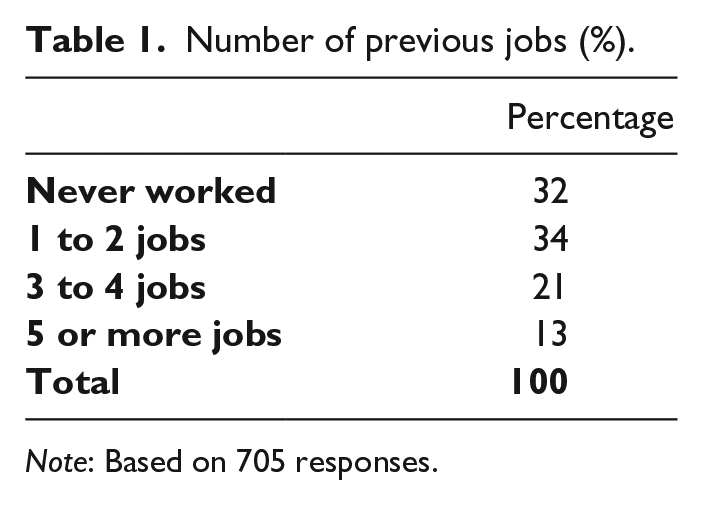
Note: Based on 705 responses.
Table 2 focuses on the young people with a work record and considers the stability of their histories in terms of the longest time in a job. Again there are three findings of note. Firstly, over 40 per cent had held a job for a year or more, showing a high degree of stability for younger workers who subsequently found themselves long-term unemployed. Secondly, nearly 40 per cent did not have a job lasting over 6 months, and these young people are more likely to fit the work–welfare cycling classification. Thirdly, another 18 per cent lie somewhere between the more and less stable ends of the job spectrum.
Longest time in any one job (%).
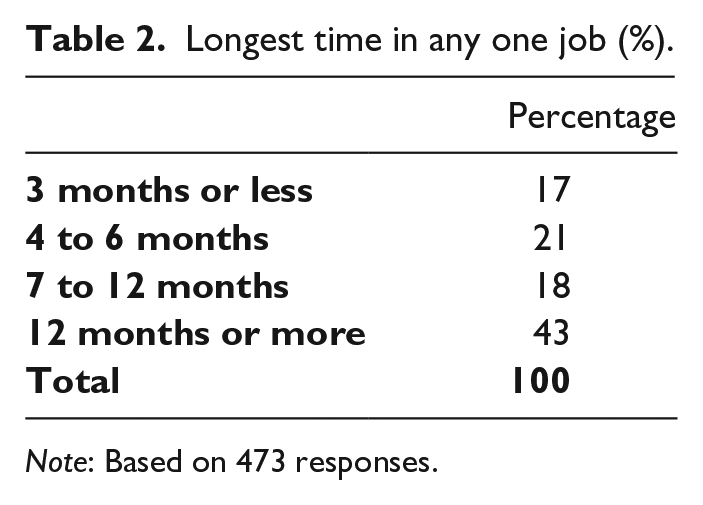
Note: Based on 473 responses.
Having established that a significant proportion of the survey cohort have previously worked, and that the majority of those had never held a job for 12 months or more, the issue is to what extent the previous jobs had been held within a pattern of work–welfare cycling (i.e. recurrent spells of short-term jobs and spells of unemployment)? For those with previous work experience, Table 3 shows the number of previous jobs held against the number of times an individual has been unemployed. On the definition of work–welfare cycling used in this article, namely three jobs and three unemployment spells or more, 33 per cent of the sample of the young long-term unemployed with some work experience fall into this category.
Number of previous jobs and unemployment spells (cell percentages).
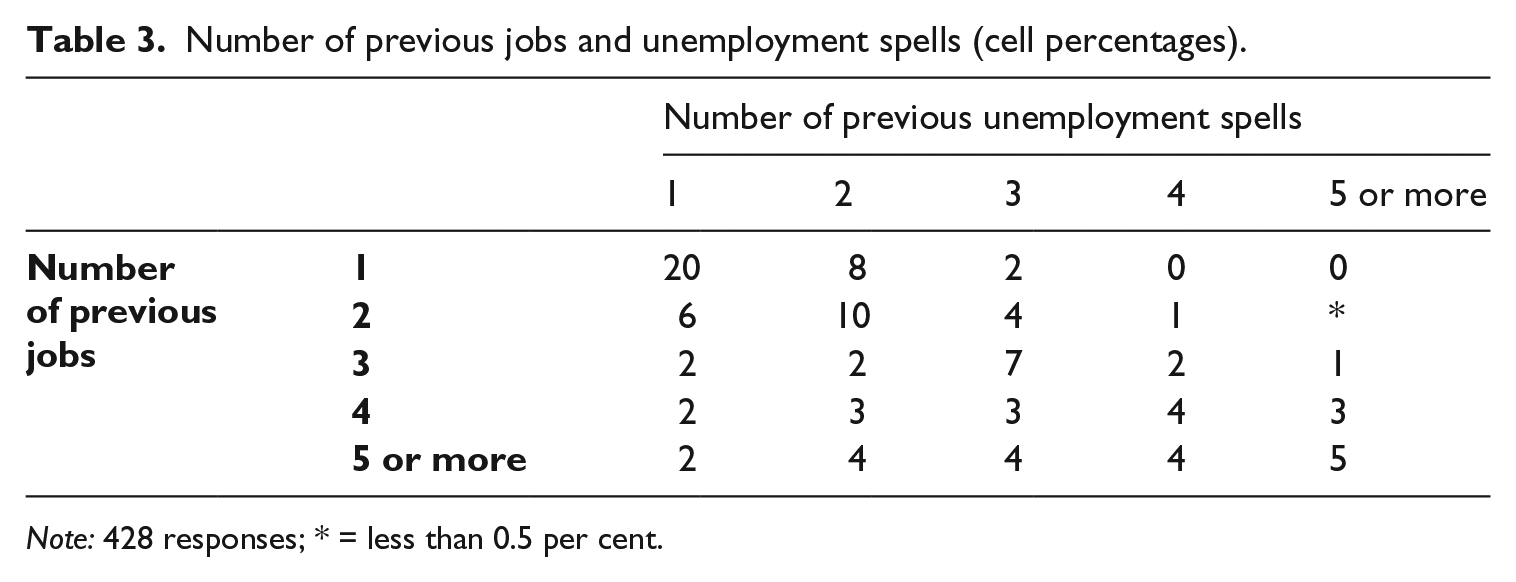
Note: 428 responses; * = less than 0.5 per cent.
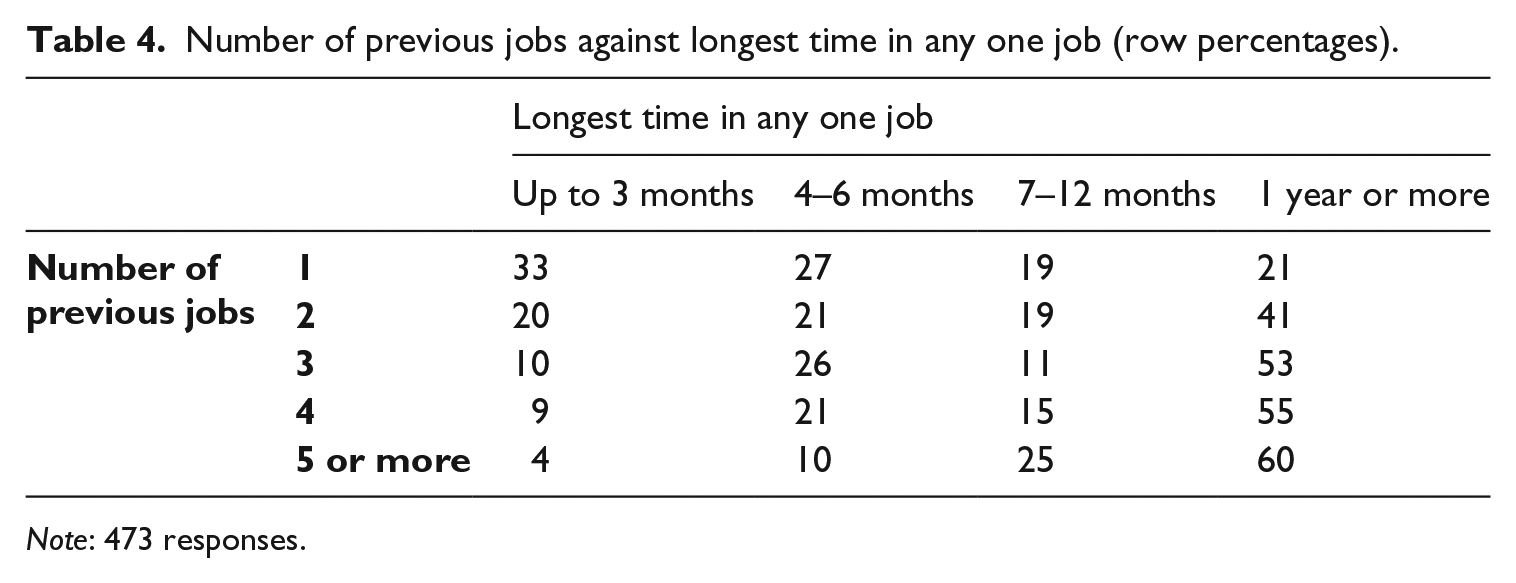
Table 4 considers the relationship between the number of jobs held and the length of the longest job. The picture is quite complex as it is not simply the case that young people with many jobs lack a reasonably lengthy job spell within their employment history. Firstly, for those with three, four, five or more jobs, over half had at some point held a job for at least a year. Information is not available on the sequencing of high and low tenure jobs. In the context of the recession, a plausible scenario would be young people losing a ‘regular’ job through redundancy and then moving through a series of short-term jobs before becoming long-term unemployed. Secondly, for those with only one previous job, short job tenures are the norm, with 60 per cent having held a job that lasted for under six months. These findings illustrate the complexity of employment histories and the need to consider jointly job turnover and job tenure in trying to classify these histories in a meaningful way.
Number of previous jobs against longest time in any one job (row percentages).
Note: 473 responses.
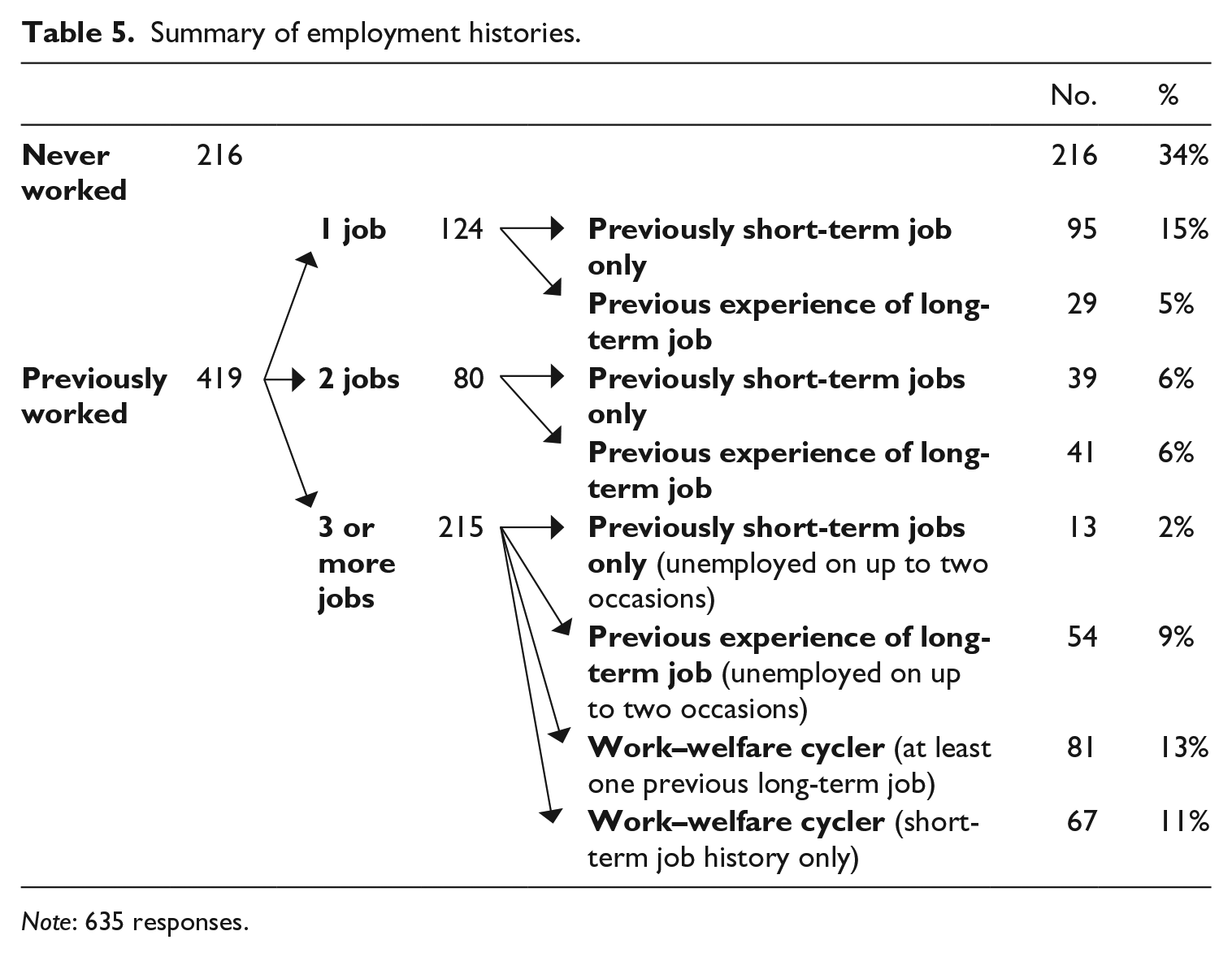
To refine the analysis, the survey data were analysed around four different characteristics of those surveyed: whether they previously worked; the number of jobs they have held; the maximum time they have held any one job (using 12 months as the cut-off point between a short-term versus a long-term job); and the number of times they have been unemployed. By analysing the data in this way a more detailed assessment of the extent of work–welfare cycling can be made by isolating distinctive groups of the young long-term unemployed surveyed. Eight categories of long-term unemployed young people were created, with two falling within the three or more jobs and unemployment spells group used here to identify work–welfare cyclers. This retains a distinction within the work–welfare cycling group between those with only short-term jobs in their employment history relative to those with at least one long-term job. Table 5 presents a summary of the results.
Summary of employment histories.
Note: 635 responses.
The table shows clearly that different types of employment histories can lead to long-term unemployment among young people. Firstly, as noted earlier in the article, around a third of the young people had never worked. This group is at a significant disadvantage as their opportunity to secure employment is low relative to those other young long-term unemployed with employment experience, let alone the competition from already employed people in other parts of the labour market. Secondly, defining work–welfare cycling to include those with three or more jobs and three or more spells of unemployment, around a quarter of the young long-term unemployed were in this category. This is a significant grouping, although smaller than the percentage who have never worked. Thirdly, another sizeable grouping is the 15 per cent who have had only one job but where this has lasted for less than a year. In broad terms, this simple analysis underlines the diversity of employment and unemployment histories that bring young people to the point of long-term unemployment, and demonstrates that work–welfare cycling is a significant phenomenon but far from the norm. The key implication is the need to segment the young long-term unemployed when analysing the problems they confront in trying to re-enter the labour market, and the policies and programmes required to facilitate this re-entry effectively.
Some further statistical analysis was carried out to test whether the broad findings varied by the characteristics of the long-term unemployed young people. Table 6 captures the results of this analysis, broken down by age. Firstly, it is not unexpected to find that the proportion of the young people who have never worked declines steadily from age 18 through to 22, at which point it tends to level out. The disturbing feature is that over a third of 20 year olds surveyed have never worked and at 24 years old the proportion is still nearly one in five, reflecting the corrosive effect of the ‘Great Recession’ and the ineffectiveness of previous employment programmes. Secondly, the largest group of young people in their early to mid-twenties consists of those with a previous job lasting a year or more but who subsequently lost it and find themselves stuck in long-term unemployment.
Age breakdown by employment history (column %).

Age is the only characteristic where there are statistically significant differences in employment histories. Within this, however, it is worth noting that compared to men a higher proportion of women have never worked at any time and a lower proportion fall into the work–welfare cycling category where there is a history of one previous long-term job.
Focusing more specifically on work–welfare cycling, Table 6 shows that it is closely related to age and the risk of falling into this category is greatest in the age group 22 and above. To some extent this could reflect a ‘mechanical’ relationship insofar as the more limited labour market exposure of an 18 year old is unlikely to generate three jobs and three spells of unemployment. It is also important to note the high incidence of employment histories made up only of short-term jobs, which is typically the case for a quarter or more of the 18–21 age band. This type of employment history can convert into work–welfare cycling over time as an unstable work pattern will be unattractive to many employers, except those in the secondary labour market.
Discussion
Unemployment among young people, and particularly long-term unemployment, emerged during the recession as a major economic and social concern. Research evidence typically shows that long-term unemployment imposes significant costs on the individual, the household and society more generally (Lee et al., 2012; Strandh et al., 2015). It is also known that these effects are particularly serious for young people in terms of the impact on their subsequent labour market careers (Gregg and Tominey, 2004; McQuaid, 2015; Schmillen and Umkehrer, 2013). Developing a greater understanding of the nature of long-term unemployment among young people is therefore of considerable importance. This article has shed more light on how the employment histories of young long-term unemployed people might explain the routes into longer-term unemployment.
The principal empirical finding is that the young people’s labour market careers prior to their current spell of long-term unemployment are extremely varied, but fall into four broad categories: those who have never worked; those who have had at least one experience of long-term employment; those with experience of short-term jobs only; and the work–welfare cyclers with more unstable employment/unemployment histories – around 25 per cent of the sample surveyed. This shows that in relation to long-term unemployment, work–welfare cycling is a feature in the employment histories of a significant proportion of young long-term unemployed people, and this is the first attempt to quantify this. However, what are widely accepted as more traditional trajectories into long-term unemployment are more common. Around a third of the young people had never worked before becoming long-term unemployed and around a fifth had held a long-term job but lost this, probably as a consequence of the recession. In effect, failure to find work and difficulty in sustaining work are the classic recessionary consequences for young people trying to find a foothold in the labour market.
The empirical analysis also shows that the experience of work–welfare cycling prior to long-term unemployment is much more common for young people as they move through their early twenties. For example, around 40 per cent of those aged 22 or 23 had a work history characterized by work–welfare cycling. This suggests that in more buoyant pre-recessionary labour markets work–welfare cycling is a sustainable position, but when recruitment falls back significantly this more unstable employment history is not helpful in terms of securing jobs. In the recession, the significant reduction in job opportunities became the dominant influence on youth unemployment and long-term unemployment. The analysis in the article also shows, however, that many of the young long-term unemployed have little or no work experience of any kind. This points to the more traditional explanation of long-term unemployment based on a significant deficit of jobs. Clearly much of the increase in youth unemployment, particularly since 2008, reflects this (Bell and Blanchflower, 2011; Guglielmo and Gil-Alana, 2014; Lee et al., 2012). Additionally, there is a legacy effect associated with the limited positive employment impacts of active labour market programmes for young unemployed people (Bell and Blanchflower, 2011) and the failure of employment programmes to progress 60 per cent or more of their young participants into work of any kind, never mind jobs of good quality and sustainability (DWP, 2016; NAO, 2002).
The central theoretical contribution of the article is to argue that work–welfare cycling (McCollum, 2012b, 2013) is not a new phenomenon as the labour market issues identified are at the heart of the segmented labour market theory developed in the 1960s and 1970s (Gordon, 1972). Segmented labour market theory highlights the situation of individuals trapped in a cycle of secondary labour market jobs, unemployment, government-funded training programmes and the irregular economy. The renewed focus on employment instability and repeated unemployment spells provided by the research on work–welfare cycling is, however, important given that many of the demand-side factors identified in segmented labour market theory are becoming more deeply embedded features of the contemporary labour market (Eichhorst, 2015; Green and Livanos, 2015). Arguably, work–welfare cycling is an empirical outcome and a labour market process which can be explained by and add texture to segmented labour market theory.
Compared to the work–welfare cycling approach, segmented labour market theory offers a more complete theoretical perspective for the analysis of the types of work histories experienced by more disadvantaged groups (such as less well qualified young people) in the contemporary labour market, where negative labour market outcomes are in large part driven by the nature of labour demand. Employers offering vacancies in the secondary labour market place little premium on vocational training and stable employment histories. More disadvantaged individuals are more likely to move into these jobs and thus generate an employment profile which will tend to confine them to the secondary labour market with its poor quality jobs, high labour turnover and limited access to work-based learning. These workers in the secondary labour market are then exposed to a double disadvantage. In relatively buoyant labour market times, they work for low wages on insecure contracts and with little potential to progress due to limited access to work-based learning – as well as an employment history characterized by instability. In more depressed labour markets, they face increased competition for these poor quality jobs as higher skilled workers ‘bump down’ the labour market (Sissons, 2011), which increases their eventual exposure to long-term unemployment. At play here is a dynamic feedback mechanism running from the nature of labour demand in the secondary sector to the labour market characteristics and behaviours of the secondary workforce (Gordon, 1972). This runs counter to the tendency in labour economics to view labour demand and supply as independently determined. In relation to the work–welfare cycling approach discussed earlier in the article (McCollum, 2012a, 2012b, 2013), there is a similar perspective with ‘poor jobs’ being one part of the narrative and ‘poor characteristics’ another part, but without a fully developed articulation of how to some degree the former drives the latter.
Accepting that the nature of employment on offer can influence significantly the characteristics that the long-term unemployed bring to the labour market, in an ongoing cycle of disadvantage, points to the need for a greater understanding of the factors driving and sustaining jobs in the secondary labour market. A key insight of the segmented labour market approach is that the jobs generated in the secondary labour market create and sustain a supply of labour which underpins the business model which dominates that labour market, but which is unattractive to businesses and other organizations operating in the primary labour market. An additional central feature of segmented labour market theory is the role of governmental employment programmes and welfare policies in reinforcing the secondary labour market by helping ensure a greater supply of labour to otherwise relatively unattractive employment opportunities (Harrison, 1972). This perspective appears to be very relevant to the current labour market context in relation to the labour supply impacts of mandatory employment programmes and working tax credits (Caliendo and Schmidt, 2016; Martin, 2014), although the empirical evidence base on the latter is still limited.
Conclusions
The article has generated two principal conclusions. Firstly, the many forms of precarious employment becoming prominent during the recession and which are continuing to grow can be seen as influential in the employment histories of young long-term unemployed people. In other words, a significant proportion of the young, long-term unemployed suffer initially from unstable and precarious employment and then become long-term unemployed. The combination of these two sets of labour market experiences is likely to significantly disadvantage them throughout their labour market careers. Secondly, the literature on segmented labour market theory provides a more effective overarching framework for understanding unstable work histories with its emphasis on how the nature of labour demand influences labour supply behaviours.
A key message is that although government employment programmes typically treat under-25s as a single coherent group of the long-term unemployed, on the basis of the analysis in this article there are significant and distinctive segments, calling for very different types of interventions. The empirical work in this article cannot provide detailed guidance on what these interventions should look like. However, in broad terms, it is possible to say some form of work experience or job creation programme is needed for the sizeable group of young people who have never worked, and a bigger investment in more effective skills development and job matching could help those with relatively unstable work histories.
More generally there are some higher level policy considerations. The analysis of labour market segmentation models places a much heavier emphasis on the need to rebalance the demand side of the labour market. As long as the economy sustains a high proportion of ‘poor jobs’, supply-side measures focused on more disadvantaged labour market groups, such as young people with low qualifications and limited work experience, will fall short of meeting policy objectives. Too much policy development and innovation is currently focused on the individuals who suffer the consequences of an imbalanced labour market, and not enough on policy measures aimed at improving the quality of jobs. Additionally, when designing employment programmes and welfare policies for individuals and families in or close to employment, care needs to be exercised to ensure these policies do not help to sustain or even grow the number of low quality job opportunities in the UK’s labour market.
Footnotes
Funding
The authors received no financial support for the research, authorship and/or publication of this article.