




Abstract
Canada’s public sector has historically provided good jobs, but its increasing reliance on temporary workers has important implications for job quality. We compare temporary and permanent workers in the public sector on three dimensions of job quality (employment security, access to benefits and income trajectories) to assess whether favourable conditions in the public sector are extended to temporary employees, or whether polarization between temporary and permanent workers is the norm. We find provisions related to employment security and access to leave benefits in public sector collective bargains are clearly two-tiered. Drawing on nationally representative panel data, we also find a persistent earnings gap between matched permanent and temporary employees. Further, although temporary public sector workers out-earn their private sector counterparts, the earnings disadvantage relative to matched permanent workers is more pronounced and longer lasting in the public sector. Underlying this difference is greater persistence in temporary employment within the public sector.
Introduction
The public sector has historically provided favourable and equitable employment. Formalized human resource practices, equity policies, high levels of unionization and professionalization and greater public accountability have contributed to well-paying and stable employment, along with smaller gender and racial wage gaps than in the private sector (Fuller, 2005; Hou and Coulombe, 2010; Ilcan et al., 2003, 2007; Johnson, 2002; Lucifora and Meurs, 2006). Recent trends, however, have eroded the benefits of public sector employment, with important implications for inequality. Racial inequalities, for example, have intensified in the US public sector since the implementation of neoliberal reforms (Wilson et al., 2015; Wilson and Roscigno, 2016).
Indeed the public sector in many countries has come under pressure to adopt more market-based employment relations in the name of deficit reduction and flexibility. In a number of countries including Britain (Conley, 2002), Germany (Giesecke and Groß, 2003) and Canada (Stinson, 2010) the public sector has increased its use of temporary positions as part of this trend. In the labour market as a whole, temporary jobs tend to be more precarious than permanent positions, providing fewer benefits, greater job insecurity and lower wages (Booth et al., 2002b; Gash and McGinnity, 2007; Van Jaarsveld et al., 2009; Van Lancker, 2011; Vosko, 2006). In more strongly regulated labour markets these disadvantages tend to persist, with some arguing that temporary employment has become an important basis of labour market segmentation (Garz, 2013). However, is this necessarily the case in the Canadian public sector? Are ‘bad jobs’ still bad in the ‘good sector’?
This article explores temporary employment as an axis of segmentation in Canada’s public sector. The public sector is Canada’s single largest employer. It is also unique in its ability to shape employment relations through legislation. For these reasons, its employment practices matter greatly. We examine two competing arguments. On the one hand, it is possible that this sector’s favourable employment conditions extend to temporary employees, who may also enjoy the benefits associated with unionization and an employment context more explicitly focused on merit and equity. Temporary employment may therefore be less precarious than in the private sector. On the other hand, insofar as temporary employment in the public sector is driven by a desire to avoid the costs of worker protections, differences in job quality between permanent and temporary workers in the public sector may be particularly pronounced. To consider these possibilities, the article proceeds along two lines of investigation and considers three aspects of job quality – employment security, access to leave benefits and earnings.
A content analysis of the 27 collective agreements covering the core federal public administration assesses employment security and access to leave benefits. Because the public sector is highly unionized, collective agreements frame the treatment of permanent and temporary workers. Analysing collective agreements provides fine-grained detail that complements and extends the broader focus of previous research using survey data. To explore differences in employment security, we first compare treatment of temporary and permanent workers on entitlement to special ‘workforce adjustment’ provisions. Such provisions typically include preferential access to jobs or compensation payments to support employees when their positions are eliminated. For temporary workers, such provisions could be applicable when a contract is cancelled prior to its end date. We also assess employment security with respect to severance provisions. Our second dimension of job quality, access to leave benefits, is assessed by comparing maternity/parental leave benefits, sick leave with pay and vacation leave with pay. Collective agreements do not provide direct information about earnings, which are also a key component of job quality. We draw on data from Statistics Canada’s Survey of Labour and Income Dynamics (SLID) to compare five-year earnings trajectories of permanent and temporary employees within the public and private sectors. To assess whether earnings gaps result from remaining in temporary employment over time, we further compare transitions to permanence across sectors.
Background
Temporary employment in the public and private sectors
Canada’s rate of temporary employment is mid-range among Organization for Economic Co-operation and Development (OECD) countries, but higher than other liberal market economies, such as the USA and the UK. In 2005 (the last year with comparable US data), 13% of Canadian workers held temporary jobs, more than twice the rate in the USA (4%) and the UK (5.8%). Between 1997 and 2011, temporary employment grew at a faster pace than permanent employment in both the public and private sectors. However, the increase in temporary jobs in the public sector has been greater (Figure 1).

Share of Canadian employees in temporary jobs by sector.
Temporary employment and segmentation
Employees and employers turn to temporary positions for several reasons. For some workers, they may facilitate the demands of caregiving or other activities (Casey and Alach, 2004). For others, temporary positions may be the best available, with workers hoping that they will eventually lead to permanent employment. Employers’ reasons for using temporary workers likewise vary. The desire to respond to fluctuations in demand or cover for employees on temporary leaves motivate some, while lowering the wage bill and avoidance of employment protections matter for others (Fuller and Vosko, 2008; Gash and McGinnity, 2007; Kalleberg et al., 2000).
While Canadian employment standards do not typically differentiate workers on the basis of permanent or temporary status, many hinge on minimum lengths of service, making them effectively stronger for permanent workers. Although protections for permanent workers are weaker than the OECD average, they do impose costs on employers, and are stronger than in the most typical comparator for Canada, the USA. 1 For example, in contrast to the USA, where the employment ‘at will’ doctrine typically prevails, provincial statutes provide compensation for both termination without cause and/or notice as well as severance payments tied to length of service (Colvin, 2006). These rights are extended in Canadian common law, entitling employees to periods of notice prior to dismissal without cause that are typically longer than statutory minimums (Colvin, 2006). Canadian labour laws that limit flexibility in firing permanent workers might discourage employers from promoting temporary workers to permanent status (and from hiring permanent employees in the first place) (Colvin, 2006; Van Jaarsveld et al., 2009).
Permanent workers are also much more likely to be unionized than their temporary counterparts (Galarneau, 2010). This matters insofar as union contracts contain dismissal provisions that exceed baselines in employment standards and common law. In addition, wages of unionized workers tend to be higher (Anderson et al., 2006; Fang and Verma, 2002). By relying on temporary workers, employers can avoid some of the costs associated with unionization.
The increasing reliance on temporary contracts could lead to a segmented workforce, wherein organizations employ permanent workers for their main activities and less expensive peripheral workers for their secondary tasks (Ilcan et al., 2007; Zeytinoglu and Muteshi, 2000). There is some evidence supporting the emergence of such segmentation in the labour force as a whole. Although there is much heterogeneity in job quality for temporary workers (Peck and Theodore, 1998; Vosko, 2006), on average they tend to earn lower wages, face higher risks of unemployment, labour force exit and repeated spells of temporary employment, and receive fewer fringe benefits (Fuller, 2011; Fuller and Vosko, 2008; Galarneau, 2010; OECD, 2002). Temporary workers employed in casual/on-call positions, who are disproportionately women, are particularly disadvantaged (Fuller and Stecy-Hildebrandt, 2014; Fuller and Vosko, 2008). While in some countries these disadvantages wane over time (Gash and McGinnity, 2007; Gebel, 2010; Heinrich et al., 2005), Canadian research finds considerable persistence (Fuller and Stecy-Hildebrandt, 2014, 2015). For instance, in their sequence analysis of worker trajectories, Fuller and Stecy-Hildebrandt (2015) find that a minority of temporary workers transition to stable and lasting permanent employment, while a sizeable share follow trajectories defined by persistent temporary work, unstable ‘churning’ patterns or labour force exit. Fuller and Stecy-Hildebrandt (2014) find that temporary workers start out with lower incomes than matched permanent counterparts and continue to earn lower incomes over a five-year period, with disadvantage more pronounced for women.
The ‘good’ public sector
Temporary employment in the public sector could thus erode job quality and increase polarization. However, the public sector is insulated from market pressures, potentially reducing the need to cut costs on the backs of temporary workers. Moreover, a focus on highly formalized merit-based hiring, vulnerability to legitimacy pressures to appear ‘fair’ and a high level of unionization might narrow the gap between temporary and permanent workers.
A focus on merit and accountability has translated into resource-intensive and formalized employment procedures (Johnson, 2002). This curbs impulsive firing and encourages investment in the worker (through remuneration, training and job ladders) to facilitate retention and a stable, professional workforce. Both permanent and temporary workers (with the exception of casuals) are subject to this formalized, merit-based hiring process (Public Service Commission of Canada, 2010). While investment in permanent workers is likely greater given their indefinite tenure, decent employment conditions would still be expected for term workers to prevent premature exit and to recruit the most qualified. Further, the cost of bureaucratized hiring could incentivize connecting temporary employees to job ladders leading to permanent positions, creating convergence with permanent workers’ employment outcomes over time.
Public sector organizations also face legitimacy pressures to be perceived as ‘fair’ employers (DiMaggio and Powell, 1983; Fuller, 2005). A more expansive anti-discrimination legal context, public visibility and high rates of unionization motivated the public sector to implement policies such as employment equity (to remove barriers reducing representation of disadvantaged groups) and pay equity (to equalize pay between otherwise similar male- and female-dominated jobs). Both policies are primarily public sector initiatives. While they do not apply systematically to temporary workers, their existence hints at a broader culture and mandate of fairness that gives reason to anticipate a smaller gap in employment outcomes between temporary and permanent workers. Indeed, government policy explicitly notes: ‘term employees should be treated fairly and responsibly’ (Government of Canada, 2011).
The level of unionization also potentially affects differences in outcomes for temporary and permanent workers. Unionized public sector workers enjoy higher than average levels of employment security, pension coverage and benefits (Anderson et al., 2006; Jackson, 2010). Unions have an interest in equalizing pay and benefits as large gaps incentivize the use of temporary workers and put downward pressures on wages. In 2012, 71.4% of employees were unionized in the public sector, compared to just 16.4% in the private sector (Galarneau and Sohn, 2013). This high level of public sector unionization could benefit temporary workers if unions push to extend advantageous working conditions to them.
Neoliberalism and ‘bad jobs’ in the public sector
Although the public sector is a generous context for many workers, neoliberal pressures have weakened the conditions that make it so. For decades, public sectors around the world have come under pressure to operate more like the private sector; that is, like a business (Saint-Martin, 2000; Wilson et al., 2015). Facing demands to rein in spending and reduce deficits, the public sector has moved towards a more market-oriented management style emphasizing cost effectiveness, flexibility, efficiency, outputs and performance, and a client/consumer orientation (Hoggett, 1991; Ilcan et al., 2003, 2007; Saint-Martin, 2000; Wilson et al., 2015). Increasing reliance on non-standard employment contracts has been central to the adoption of neoliberal governance and move towards flexibility (Ilcan et al., 2007).
This might not be concerning if operational flexibility is balanced with fair treatment of term employees, as decreed by government policy (Government of Canada, 2011). However, temporary jobs also enable employers to reduce their commitments to workers as they often fall outside provisions negotiated for permanent workers (Houseman, 2001). In the public sector, only employees with contracts of at least three months’ duration, for example, are covered by Treasury Board guidelines.
‘Bad’ jobs in the ‘good’ sector?
There are several reasons to expect that segmentation will be particularly pronounced in the public sector. Permanent workers are more expensive generally due to greater dismissal costs and likelihood of being unionized. Formalized merit-based hiring, a climate of fairness and a high level of unionization mean public sector permanent workers are highly invested in and better protected than their private sector counterparts. This potentially widens the cost gap between temporary and permanent workers, increasing pressure to balance budgets on the backs of temporary workers.
Further, while unions typically improve workers’ bargaining position, unions have historically structured their collective agreements around the norm of full-time permanent employment, and have therefore seen the interests of non-standard workers as divergent from their own (Fudge and Vosko, 2001; Zeytinoglu and Muteshi, 2000). Unions may not fight equally hard for temporary workers if they are seen as threatening to permanent workers (Casey and Alach, 2004; Ilcan et al., 2007). Casual employees are particularly vulnerable to exclusion because they are not eligible to join federal public sector unions (Townson, 2003). Unions may also confront external challenges to protecting temporary agency workers due to complications arising in triangular employment relationships (Kalleberg, 2000).
In the absence of union coverage, private sector employees are regulated under provincial employment standards, which are typically less stringent than union contracts. This could result in a smaller gap between temporary and permanent workers in the private sector because permanent workers are themselves less costly. Indeed, Giesecke and Groß (2004) find stronger wage penalties for German men in temporary jobs in the public sector.
While stronger protections for public sector permanent workers imply greater segmentation, the consequences would be mitigated if temporary work is an on-ramp to better-quality jobs. In this scenario, the disadvantages associated with temporary employment disappear with a transition to permanency. There is some limited evidence of a stepping-stone scenario in the federal public service among temporary help service workers. The Public Service Commission of Canada (2010) found that within six months of their contracts ending, 12.8% obtained permanent/indeterminate positions in the public service. The commission also identified the long-term use of temporary help contracts, pointing to more of an ‘entrapment’ scenario. Research on France and Germany finds that temporary workers in the public sector are less likely to transition to permanent jobs than their counterparts in the private sector, although findings are mixed for Britain (Booth et al., 2002b; Gash, 2008; Giesecke and Groß, 2004).
To summarize, there are two competing sets of expectations relating to the implications of the heavy reliance on temporary employees in the public sector. The first is that favourable conditions in the public sector will narrow the gap between temporary and permanent workers. These conditions suggest a protective context for temporary workers, who, at minimum, will transition in high numbers to permanent work given the costs associated with their formalized hiring. The alternative scenario is that these advantageous conditions come with increased costs and, in a neoliberal context of cost-cutting, they will widen the gap between temporary and permanent workers, especially relative to the private sector.
Data and methods
To examine how favourable the public sector is for temporary workers, we consider three facets of job quality – employment security, access to leave benefits and earnings. Examining employment security and leave benefits involved comparing coverage under public sector collective agreements (CAs) for workers with temporary and permanent status. These were accessed from the Treasury Board 2 website and cover employees in the core federal public administration.
Using a qualitative content analysis, we analysed the explicit and implicit content of text (Moczaldo, 2015). We categorized CA provisions into a system of codes, established at the beginning based on the material at hand (Hsieh and Shannon, 2005; Mayring, 2014). Six ‘codes’/provisions were compared across CAs: severance pay and workforce adjustment are the measures of employment security, while maternity and parental leave, sick leave with pay and vacation leave with pay index access to leave benefits. Our choice of benefits focused on those related to flexibility/work–life balance (leaves). We see this as particularly important in the public sector as women are over-represented and continue to shoulder the primary responsibility for care. Existing surveys also enumerate access to retirement, dental and medical benefits, so focusing on benefit provisions in collective agreements for which there is a lack of survey data contributes new insights. These provisions were investigated for their ‘equivalence’, ‘inferiority’ and/or ‘unspecified’ status for temporary workers and those with permanent status.
If the provision explicitly outlined a different benefit structure for indeterminate and temporary employees where the section for temporary employees gave less of a benefit the provision was coded as inferior. A provision was also coded as inferior where the benefit was contingent on seniority or continuity of employment. The provision was coded as unspecified if the CA did not have a relevant provision.
In many cases, CAs did not explicitly distinguish between temporary and permanent workers. Instead, most provisions applied to a person designated as an ‘employee’, defined under the Public Service Labour Relations Act 2003 as someone other than a person employed on a casual basis or a person employed on a term basis (unless that term is longer than three months, a typical probationary period). In other words, temporary employees (excluding casual workers) would be considered ‘employees’ as long as their contract exceeded three months. If the CAs failed to distinguish between temporary/determinate and permanent/indeterminate employees and referred only to ‘employees’ throughout, this was interpreted as equivalent treatment. This interpretation was validated by several discussions with union representatives.
The third dimension of job quality is employment earnings, adjusted to 2002 Canadian dollars to ensure comparability across years. We compared five-year earnings trajectories for permanent and temporary workers by sector. This part of the analysis draws on the SLID, a nationally representative longitudinal survey comprised of overlapping panels. We pool data from three panels (covering the periods of 1999–2004; 2002–2007; and 2005–2010) to maximize sample size.
Our sample consisted of all workers in temporary (term, seasonal, casual/on-call and temporary agency) and permanent employment in January of the second wave of each panel. It was restricted to working-age individuals (18–60) who were not primarily students in this year. Thus while the analysis of collective agreements applies to workers in the core federal public administration, the examination of earnings trajectories incorporates a wider definition of the public sector, including provincial and municipal government workers, and those who work in organizations funded and controlled by Canadian governments (such as schools and hospitals). Although this undermines direct comparability, restricting the earnings analysis only to direct federal public sector employees would result in too small a sample to be meaningful. Moreover, the wider scope is helpful for understanding gendered patterns of inequality as the broader public sector is more feminized than the federal public service (which is still majority female). To maximize comparability of permanent and temporary workers within each sector, propensity score matching was employed. This allowed us to compare groups who were similar in terms of the distribution of covariates that could affect the outcome of interest (earnings).
A logit model was used to estimate a propensity score that reflected the probability an individual would be observed in a temporary versus permanent job at the start of the observation period (Caliendo and Kopeinig, 2008). The propensity score model and matching were run separately by sector and for men and women because differences in men and women’s employment experiences result in some important differences in how covariates affect the likelihood of working in a temporary job.
Demographic and job characteristics used as predictors were: age and its square; education; years of actual work experience; racial minority; major income earner in the family; pre-school aged child in the family; marital status; urban/rural residence; job tenure; 3 occupation; industry; full-time/part-time status; covered by a collective bargain; and employer size. Variables were also included measuring circumstances in the previous year: months employed full-time; months unemployed; months out of the labour force; involuntary job-separation (laid off or fired); receipt of unemployment insurance payments (yes/no); and receipt of social assistance payments (yes/no). This controls for factors such as career setbacks that may lead to both temporary positions and lower earnings (Segal and Sullivan, 1997). Permanent workers were excluded who were employed as temporary workers in the previous year. While we have a very rich set of controls to match temporary workers to their permanent counterparts and hence to account for the relationship between selection into temporary work and wages, our approach accounts only for selection on observable covariates. We cannot entirely rule out the possibility of some unobserved confounder that might influence both temporary employment and earnings.
For all workers, age, experience and tenure with an employer were negatively associated with temporary employment, while working part-time increased its likelihood. Unionization reduced the risk of temporary employment in the public sector, but had no significant effect in the private. Education mattered only for the least educated men in the private sector, who were more likely to be in temporary jobs. Being married, the major income earner in the household and a visible minority reduced the likelihood of temporary employment for women in the private sector, as did being the major income earner in the household for men in the public. Having a pre-school aged child reduced the likelihood of temporary employment for all workers.
Female public sector workers in all occupations were more likely to be in temporary jobs than managers, with the biggest difference for those in social and natural sciences and related occupations. Occupation tended not to be a significant predictor of temporary status for men in the public sector, except for occupations associated with primary industry. In the private sector, social science and related occupations increased the risk of temporary jobs for women, as did primary industry and processing and manufacturing occupations. Art, culture, recreation and sport occupations and trades, and primary industry occupations were associated with a higher likelihood of temporary employment for men. Net of occupation, industry tended not to matter, although working in construction increased the risk of temporary jobs for men in the private sector. In the private sector, those in medium-sized workplaces (20–99 employees) had lower risk of temporary employment relative to those in the smallest workplaces.
Workers’ labour force status in the prior year mattered in expected ways: more months out of the labour force increased the risks of temporary jobs, as did being laid off or fired for women. Months unemployed tended to increase the risk of temporary employment (albeit only significantly for private sector workers), as did receiving unemployment insurance (and receiving social assistance for women in the private sector). Months working full-time reduced the risk of temporary employment.
Following the estimation of the propensity score, temporary workers were matched to their permanent counterpart with the most similar propensity score (their ‘nearest neighbour’). Both steps were implemented in STATA using the PSMATCH2 module (Leuven and Sianesi, 2003). To ensure temporary workers were matched as closely as possible a given permanent worker could be used as a match for more than one temporary worker. To further ensure good matches a tolerance level of approximately 20% of the standard deviation of the propensity score restricted the maximum allowable propensity score distance. In our data, this matching procedure performed very well in balancing the distribution of relevant variables.
To produce the earnings trajectories and assess the significance of earnings differences between temporary and permanent workers within each sector, we regressed three-way interactions between temporary employment, dummies for each year and gender on earnings separately for the private and public sector workers. Figures report marginal estimates of mean earnings from these equations.
Results
Employment security and leave benefits
The public sector is considered a ‘good’ employment context largely because of its high level of unionization and corresponding provision of superior employment security and benefits. What remains to be seen is whether provisions are available for all workers, or mainly those who constitute ‘core’ employees.
Overall, the analysis of collective agreements (Table 1) revealed considerable marginalization of temporary workers. This was due both to distinctions made on the basis of employment form (temporary/determinate versus permanent/indeterminate status) and seniority and employment continuity requirements. Indeed, even without explicit distinctions between temporary and permanent statuses, temporary workers would likely be excluded from most of the provisions examined based on their non-continuous and short-term tenures.
Equivalence or inferiority of employment conditions for temporary and permanent workers in collective agreements.

Employment security
Workforce adjustment
Twenty-two of the 27 CAs explicitly laid out regulations for workforce adjustment. These typically mandated that employees receive either a reasonable alternative job offer or compensatory payments. In all cases, these provisions only applied to indeterminate employees. Temporary employees also lacked preferential treatment in terms of placement following the end of their terms (Professional Institute of the Public Service of Canada, 2015).
Severance pay
For all 27 CAs, severance pay provisions were inferior due to their predication on employment continuity and status. Under provisions for severance termination, temporary employees with at least one year of continuous employment were entitled to one week’s pay for each year of continuous employment. However, CAs laid out additional provisions for permanent workers, providing for payments even when they accrued less than one year of continuous employment. For example, one CA states:
[I]ndeterminate employees on date of signing shall be entitled to severance termination benefits equal to […] 1 week’s pay for each complete year of continuous employment and, in the case of a partial year of continuous employment, […] 1 week’s pay multiplied by the number of days of continuous employment divided by […] 365, to a maximum of […] 30 weeks […]. [T]erm employees on date of signing shall be entitled to severance termination benefits equal to […] 1 week’s pay for each complete year of continuous employment, to a maximum of […] 30 weeks. (CA between the Treasury Board and PIPSC, Computer Systems: 53)
Temporary workers who hold their positions for less than one year and whose employment is terminated prior to the conclusion of their contract receive no compensation.
Leave benefits
Paid maternity and parental benefits
All CAs required designated employees to have worked continuously for a minimum of six months to qualify for paid maternity/parental leave (top-up payments to standard benefits provided through Employment Insurance). A typical example reads: ‘[a]n employee who has been granted maternity leave without pay shall be paid a maternity allowance […] provided that she has completed […] 6 months of continuous employment before the commencement of her maternity leave without pay’ (CA between the Treasury Board and CAW, Air Traffic Control: 41). The exclusionary effect of this provision should be eased somewhat by the fact that tenure for temporary workers in the public sector typically exceeds six months. Statistics Canada’s Labour Force Survey (LFS) microdata for the years of this study (1999–2010), revealed that temporary workers in the public sector had a median tenure of 16 months (our calculations). At the same time, 27% of public sector temporary workers reported tenures shorter than six months. A sizeable portion of temporary workers are therefore at risk of not qualifying for maternity/parental leave benefits.
Sick leave with pay
In the 27 CAs, qualifying for paid sick leave usually required working a minimum number of hours or days. These minimums were typically quite low. For instance, most of the CAs required a minimum of 75 working hours per month (18.75 per week) to accrue paid sick leave credits. A minority required 80 hours (20 per week) while another small portion mandated 10 days per month. Typical wording read: ‘[a]n employee shall earn sick leave credits at the rate of […] 9.375 hours for each calendar month for which the employee receives pay for at least […] 75 hours’ (CA between the Treasury Board and PSAC, Programme and Administrative Services: 63). These provisions were coded as ‘equivalent’ because in/determinate status was not a criterion for coverage and designated employees did not have to meet seniority or continuity requirements. Indeed, hours requirements may be less of a concern for temporary workers. Our analysis of LFS microdata revealed temporary workers in the public sector average 29 hours/week (with a median of 35) across the years of our study (1999–2010). Breaking this down by category, seasonal public sector workers reported usual weekly hours of 30.8 per week, compared to 30.5 per week for contract workers. Casual employees reported, on average, the lowest usual hours per week (24), but they are excluded from coverage regardless.
Vacation leave with pay
This provision was coded as equivalent for temporary and permanent workers. As with sick leave credits, the accrual of vacation leave depended upon working a minimum number of hours (usually 75 or 80) or days (10) per month. A particular benefit for temporary workers in all the CAs was that both continuous and discontinuous service counted towards vacation leave. However, across all the CAs, the credits increased with length of service. While all employees earned a basic vacation leave, longer vacations would accrue to permanent workers by virtue of their tenure. Most CAs stipulated an increase after the eighth anniversary of employment. As with the other provisions, casual workers are excluded from accruing vacation leave but they are paid 4% vacation pay on hours worked (Government of Canada, 2015).
Earnings trajectories
Although temporary workers fare more poorly under collective agreements, differences in treatment may be short-lived. It is important therefore to consider indicators of longer-term well-being. Because temporary jobs are time-delimited, their implications for workers’ earnings depend not only on their current characteristics, but also their place in longer-term patterns of mobility.
Figure 2 depicts five-year earnings trajectories for matched workers who were initially observed in permanent or temporary jobs within each sector. Note that both permanent and temporary workers in the public sector out-earned their counterparts in the private. However, it is important to recall that our matching strategy matched temporary and permanent workers within each sector, so the overall level of wages in the two sectors reflects in part differences in human capital (see also Tiagi, 2010).

Earnings trajectories for temporary and permanent men and women in the public and private sectors.
More central to our concerns is the earnings gap between temporary and permanent workers within each sector. Among workers first observed in the public sector, those initially in temporary jobs had significantly lower earnings than their permanent counterparts. Notably, temporary workers failed to catch up to their permanent counterparts even after five years, pointing towards the persistently segmenting effect of temporary employment.
By contrast, in the private sector earnings converged, with the gap no longer statistically significant after the third year. The earnings gap between permanent and temporary workers is thus not only initially larger in the public sector, it is more persistent. This general pattern was true for both men and women.
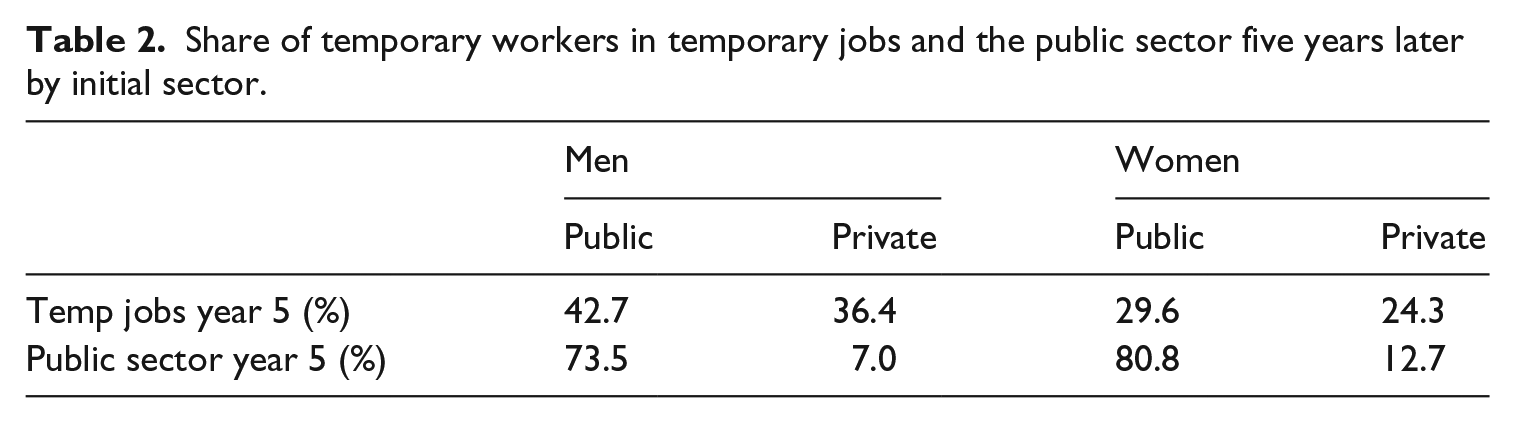
So why no earnings convergence in the public sector? One possibility is that temporary workers persist longer in this status in this sector. Table 2 reveals this is the case. A significantly larger proportion of men (42.7%) and women (29.6%) public sector temporary workers were still in temporary jobs in year five compared to private sector men (36.4%) and women (24.3%). Although the public service has, in the case of those employed by the Treasury Board, specific provisions to encourage transitions to permanent status, these have limitations. For example, the federal public service has policy for appointing term employees within the same department or agency to permanent positions following a cumulative working period of three years, but qualifications exclude many term workers in practice 4 (Government of Canada, 2011). At the same time, the superior employment benefits for permanent workers in the public sector likely motivate temporary workers to persevere in the face of repeated temporary assignments in the hopes of eventual conversion to permanence. In the private sector, temporary workers may be more willing to change employers in search of permanent jobs. Indeed, 73.5% of male temporary workers and 80.8% of female temporary workers in the public sector were still in the public sector five years later.
Share of temporary workers in temporary jobs and the public sector five years later by initial sector.
Discussion
The increasing reliance by Canada’s public sector on temporary employment has far-reaching implications that have not gone unnoticed within the public sector itself. Writing about the subset of temporary agency workers, the Public Service Commission notes they constitute ‘an additional workforce within the public service – one that is not subject to the Public Service Employment Act, and that is used for long-term and continuous work’ (Public Service Commission of Canada, 2010: 3, emphasis added). We also find troubling evidence of segmentation when looking at public sector temporary workers more broadly.
In-depth analysis of public sector collective agreements offered detail about aspects of job quality not observable in public datasets, revealing important distinctions in protections and benefits. We found that advantages associated with public sector collective agreements are primarily available to a core of permanent workers, not only because of exclusions from coverage, but also because of provisions around length of service that effectively disqualify temporary workers. Unionization, often taken as an important bulwark against precaritization (Anderson et al., 2006), is not equally protective. Our findings thus reinforce the need for union renewal to challenge strategies that protect some workers at the expense of the most vulnerable.
Past research has documented how neoliberal restructuring has eroded the public sector’s status as an equitable employer, with particular attention paid to the implications for gender and racial inequalities (e.g. Fuller, 2005; Wilson and Roscigno, 2016). We did not find stronger disadvantage for temporary women within the public sector, though women’s over-representation in this sector means they are disproportionately affected by eroding job quality. Indeed, our analysis reveals that the greater overall permanent/temporary gaps in earnings trajectories found for women by Fuller and Stecy-Hildebrandt (2014) reflect their over-representation in the public sector, where outcomes for temporary workers are worse.
We did not explicitly analyse generational implications of segmentation, and our earnings analysis matched workers by age. However, younger workers are over-represented in temporary jobs, so inequalities between permanent and temporary workers in the public sector contribute to generational divides. Our longitudinal lens is particularly revealing in this respect. Persistent earnings gaps imply that generational inequalities do not simply reflect life-stages but more structural inequalities among cohorts. This may ultimately have implications for unions and the public sector itself. Two-tiered collective agreements potentially undermine young people’s commitment to, and trust in, unions which is critical for their ongoing strength. One of the appeals of public sector employment is the availability of sustained career ladders, yet persistent disadvantage suggests increasingly blocked mobility pathways. Although temporary public sector workers out-earn their private sector counterparts in gross terms, the relative earnings disadvantage of temporary workers is both more pronounced and longer lasting. As younger workers increasingly enter the public sector via temporary jobs, this pattern of ongoing disadvantage is particularly troubling. It may well erode younger workers’ belief in the fairness and promise of the public sector employment context, challenging the public sector’s ability to recruit and retain the next generation of talented workers.
In analysing both collective agreements and earnings trajectories, we sought to provide a comprehensive picture of differences in job quality for temporary and permanent workers in the public sector. However, our analysis did have a number of limitations. First, it is possible that our results represent the conservative case insofar as the analysis of collective agreements applies only to federal public service workers. There is no research to date on the differences in treatment of temporary workers by provincial and federal sector, so it is not immediately obvious what biases may exist. However, the federal public service is regulated by employment protections that do not always apply in provincial jurisdictions. Future research would be helpful to explore variation in outcomes across levels of government.
Second, due to sample size limitations, we were unable to parse differences in outcomes across occupations or between types of temporary workers. Yet important job quality variations exist between high-status, high-paying jobs that are temporary and those which are temporary, but low-status and poorly paid. Similarly, casuals are often particularly disadvantaged by failing to meet minimum hours requirements – affecting their coverage under collective agreements – as well as by exclusion from formalized merit-based hiring and union membership, particularly compared to those in contract positions. More fine-grained analysis of differences among types of temporary workers and occupational groups would be a useful avenue for future research.
Despite the public sector’s concern with fairness and public perceptions, it is unlikely that the strategy of relying on temporary employment is going to wane in the near future. However, policy interventions can mitigate inequalities. These might include facilitating workers’ transitions to permanence, matching temporary and permanent wages and offering provisions to temporary workers on a pro rata basis rather than excluding those who fail to meet minimum contract lengths. Such reforms would matter not only for improving employment relations within the public sector, but also for what they communicate when Canada’s largest employer, which is responsible for crafting the rules around employment, takes segmentation seriously.
Although this article focuses on Canada, our findings carry broader implications for thinking about temporary work in capitalist regimes, highlighting the importance of within-country variation. Like other liberal market economies, Canada has lax regulations around both permanent and temporary employment and lower union density relative to some coordinated market economies (Colvin, 2006). Cross-national research finds higher levels of temporary employment and poorer outcomes for temporary workers where employment protections for permanent workers are greater, as this strengthens divisions between labour market ‘insiders’ and ‘outsiders’ and makes transitions from the former to the latter more difficult (Amuedo-Dorantes, 2000; Bentolila and Dolado, 1994; Booth et al., 2002a; Kahn, 2007; Polavieja, 2005). Yet rates of temporary employment in Canada are high in comparison to other liberal market economies (LMEs), and outcomes are poor. Our analysis suggests that what may be driving Canada’s exceptionalism is the public sector. A high reliance on temporary workers and poor employment outcomes can occur in relatively unregulated LMEs because there is variation within individual countries. Where strongly regulated and protected segments of the economy make extensive use of temporary employees, their overall outcomes will resemble those in economies with stronger insider–outsider labour markets.
Our research is situated in a specific country, but the trends we identify are unlikely to be unique. For example, Wilson and Roscigno (2016) note the shift in the US public sector from ‘classified’ workers with property rights in their jobs to those who are ‘declassified’ who can be easily terminated. Future research would benefit from further exploring cross/within-country variation, an important undertaking as public sectors around the world continue the project of neoliberal reform.
Supplemental Material
Appendix_Table_A – Supplemental material for ‘Bad’ Jobs in a ‘Good’ Sector: Examining the Employment Outcomes of Temporary Work in the Canadian Public Sector
Supplemental material, Appendix_Table_A for ‘Bad’ Jobs in a ‘Good’ Sector: Examining the Employment Outcomes of Temporary Work in the Canadian Public Sector by Natasha Stecy-Hildebrandt, Sylvia Fuller and Alisyn Burns in Work, Employment and Society
Footnotes
Acknowledgements
The analysis presented in this article was conducted at the University of British Columbia branch of the RDC which is part of the Canadian Research Data Centre Network (CRDCN). The services and activities provided by the UBC RDC are made possible by the financial or in-kind support of the SSHRC, the CIHR, the CFI, Statistics Canada and UBC. The views expressed in this article do not necessarily represent the CRDCN’s or that of its partners. We thank Rima Wilkes for helpful comments on an earlier version of the article.
Funding
The authors received financial support for the research from a University of British Columbia Aura grant.
Notes
References
Supplementary Material
Please find the following supplemental material available below.
For Open Access articles published under a Creative Commons License, all supplemental material carries the same license as the article it is associated with.
For non-Open Access articles published, all supplemental material carries a non-exclusive license, and permission requests for re-use of supplemental material or any part of supplemental material shall be sent directly to the copyright owner as specified in the copyright notice associated with the article.
