



Abstract
This article uses Labour Force Survey data to examine why male and female part-time employees in the UK are more likely to be low paid than their full-time counterparts. This ‘low pay penalty’ is found to be just as large, if not larger, for men compared to women. For both men and women, differences in worker characteristics account for a relatively small proportion of the part-time low pay gap. Of greater importance is the unequal distribution of part-time jobs across the labour market, in particular the close relationship between part-time employment and social class. Using a selection model to adjust for the individual’s estimated propensity to be in (full-time) employment adds a modest amount of explanatory power. Particularly for men, a large ‘unexplained’ component is identified, indicating that even with a similar human capital and labour market profile part-time workers are more likely than full-time workers to be low paid.
Introduction
It is widely recognised that ‘part-time work is not just a bit less of the same thing’ (Hakim, 2001: 58), but a form of employment that tends to confer disadvantages or ‘penalties’ (Fagan et al., 2013; OECD, 2010). This article presents a novel contribution in examining the part-time gap in low pay rather than average earnings. It examines why workers who identify as part-time rather than full-time are more likely to receive low pay, defined as earning below two-thirds of the median hourly wage. The distinction between full-time and part-time employment is here based on the respondent’s own assessment of their employment situation. The analysis explores the relative importance of different worker- and job-related characteristics in accounting for the differential risk of low pay faced by full-time and part-time workers. This article also advances the literature by conducting separate analysis for men and women, contributing to a small but growing evidence base on part-time employment for men (Belfield et al., 2017; Gardiner and Gregg, 2017; O’Dorchai et al., 2007).
Why focus on low pay?
Previous literature has focused predominantly on the gap in average hourly earnings between full-time and part-time workers (Bardasi and Gornick, 2008; Hardoy and Schøne, 2006; Jepsen et al., 2001; McGinnity and McManus, 2007; Matteazzi et al., 2014; O’Dorchai et al., 2007; Petrongolo and Manning, 2008). However, ‘focussing on average effects […] [as] has been the dominant approach in the literature, conceals the very different function of part-time employment at the various strata of the wage distribution’ (Tonurist and Pavlopoulos, 2014: 20). Some have posited a dualistic structure for the part-time labour market, polarised between ‘good’ and ‘bad’ part-time jobs (Tilly, 1992). One recent study from Germany (Tonurist and Pavlopoulos, 2014) identifies variation across the earnings distribution in the part-time wage gap: at the top end of the distribution the gap is fully accounted for by differences in the characteristics of full-time and part-time workers; it is primarily at the lower end of the distribution that part-time workers receive lower returns for the same characteristics. One reason to focus on low pay rather than average earnings is therefore that earnings penalties associated with part-time employment may be particularly steep for low earners.
Another reason to hone in on the bottom end of the earnings distribution is the precarious nature of low-paid employment. Low pay has serious consequences for lifetime earnings (Brewer et al., 2012), pension entitlements (Sefton et al., 2011) and vulnerability to financial shocks. ‘Poverty is increasingly a problem of low pay rather than lack of employment’ (Dias et al., 2018: 1). Across Europe, low-paid workers who are the sole or primary earner in the household face high rates of in-work poverty (Marx and Nolan, 2012; Marx and Verbist, 1998), but constitute a fairly small group. Secondary earners employed in a low-paid job are often fairly well protected from poverty, but may well find themselves a sole or primary earner in the future. Low pay is also concerning from the perspective of financial dependency, since it limits the capacity of individuals to form autonomous households.
Working part-time rather than full-time has been recognised as a risk factor for low pay (Lucifora et al., 2005; Lucifora and Salverda, 2012; Simon et al., 2004; Ward and Ozdemir, 2015). This article advances the literature by exploring why this association exists. Rather than being disadvantaged by working part-time, individuals who take up this form of employment may simply have characteristics that predispose them to being low paid. Previous studies find that compared to full-time workers, part-time workers have weaker human capital and therefore lower earning potential (Bardasi and Gornick, 2008; Matteazzi et al., 2014). According to Catherine Hakim (1991, 1995, 2002), part-time workers also have lower work motivation than full-time workers. Hakim’s preference theory (Hakim, 2002) argues that unequal labour market outcomes are a result of part-time workers prioritising home and family life over professional success. Analysing the British Household Panel Survey (BHPS) data, Kan (2007) finds some empirical support for preference theory. Women with work-centric attitudes are more likely to work continuously or predominantly full-time, and for these women the presence of dependent children in the household poses less of a barrier to full-time employment. Preferences in relation to time spent on paid work, family care and other activities are thought to be a major factor contributing to part-time wage differentials (Matteazzi et al., 2014), even if these preferences are shaped by institutional factors (McGinnity and McManus, 2007).
Hakim’s preference theory has been widely criticised for ignoring the malleability of work preferences (Himmelweit and Sigala, 2004), and the degree to which they are shaped by institutional and cultural constraints (Fagan, 2001; Gash, 2008). More generally, there has been push back against the idea that unequal labour market outcomes are driven by the characteristics of part-time workers. Other analysts emphasise the importance of labour market segregation; the fact that part-time jobs are disproportionately located in lower-paying sectors and occupations (Matteazzi et al., 2014; Petrongolo and Manning, 2008). The most appropriate policy response may be rather different if part-time workers experience a higher risk of low pay because they are predominantly young and low skilled, than if they are older, with moderate to high levels of human capital, yet nonetheless are employed in low-paying sectors and occupations. To inform this debate, a central aim of this article is to establish the relative explanatory power of worker- and job-related characteristics. In exploring these relationships, two initial research questions are identified:
How far can we account for the relationship between part-time work and low pay by taking into consideration the characteristics of employees working full-time and part-time?
Of the component attributable to characteristics, what is the relative importance of worker- and job-related characteristics?
Why conduct a gendered analysis?
There is growing recognition that part-time work is an issue with ramifications for men as well as women. A recent report from the Institute for Fiscal Studies highlights a growing correlation between working hours and wages for British men, driven by a fall in the number of hours worked by low-paid men (Belfield et al., 2017). Research from the Resolution Foundation (Gardiner and Gregg, 2017) highlights rapid growth in part-time employment for younger men. Despite this recent flurry of concern, the evidence base on male part-time employment remains under-developed. One comparative study analyses the gap in average hourly earnings for men working full-time and part-time in six European countries (O’Dorchai et al., 2007), identifying a particularly large differential in the UK. Evidence from the Netherlands (Russo and Hassink, 2005) and the USA (Hirsch, 2005) shows that the gap in average hourly wages between full-time and part-time workers is greater for men than for women. Overall, however, the literature on wage penalties associated with part-time employment for men is sparse compared to the corresponding literature for women.
Although part-time employment is increasingly common for British men (Belfield et al., 2017), around three-quarters of part-time employees in the UK are female (OECD, 2016). Men and women also tend to work part-time at different stages of the life cycle, and for different reasons (Eurofound, 2006; Fagan et al., 2013). Women often switch to part-time hours when they have their first child, whereas working hours for men are largely unaffected by household circumstances (Dias et al., 2018). For men, part-time employment often functions as a means of transitioning into or out of the workforce (Fagan and Walthery, 2014). Men are more likely than women to be involuntary part-time workers, that is, to work part-time because they cannot find a full-time job (OECD, 2010). In light of these differences, the nature and implications of working part-time might be expected to differ for men and women, a possibility addressed by the third research question:
3. How does the relationship between part-time employment and low pay differ for men and women?
Data
The analysis draws on the Labour Force Survey (LFS), the largest household panel survey in the UK. The LFS interviews around 41,000 randomly sampled UK households each quarter, with demographic and employment information collected for all individuals in the household. Due to data availability, only interviews relating to the spring quarter (April–June) were analysed. The LFS has a rotating panel design, and each household stays in the survey for five consecutive quarters. Earnings questions are asked at the first and final interviews for each household, but to avoid double counting only observations relating to the final interview for each household were analysed. The most recent five years of data (2012–2016) were pooled to ensure a sufficient sample size for men working part-time. Standard errors were adjusted to account for the clustering of individuals in households and data were weighted to obtain population estimates.
The sample was comprised of employees aged 16 and over, excluding those in full-time education. A small proportion of employees held more than one job (around 4%), but in these instances the analysis related to the main job only. Self-employed workers were not included in the analysis due to difficulties estimating earnings from self-employment. In addition, working part-time may mean something different, or indeed not be meaningful at all, in the context of self-employment. Earnings for apprentices were also taken to be a separate issue, and not included in the analysis. Reflecting the gendered nature of part-time employment, male and female employees were treated as separate samples.
Measurement of key concepts
Low pay is approached in this article as a relative concept, defined as receiving gross hourly earnings below two-thirds of the median. The relative approach is preferred to identifying a fixed proportion of the earnings distribution as low paid because the implications of being in, for instance, the bottom 10% of earners will differ according to the overall level of dispersion in the earnings distribution (Lucifora and Salverda, 2012). Earning substantially below the societal average always has serious implications for economic security, in both the immediate and long term. To avoid outliers having undue influence, relative measures are generally tied to the median rather than the mean. Two-thirds of the median is the cut-off used by Eurostat, the Organisation for Economic Co-operation and Development (OECD) and the majority of academic studies in this area, and is the approach followed here. Although the primary comparison being made is within-gender (e.g. women working part-time compared to women working full-time), the threshold was set according to median earnings for all employees. The variable for gross hourly earnings was constructed based on usual weekly working hours and earnings during the reference week. Paid overtime was included on the basis that overtime payments have a substantial impact on the adequacy of earnings. In response to high and non-random missing data on the earnings variable, multiple imputation was performed (Rubin, 2004). Robustness checks showed that similar results were produced without data imputation, suggesting that this step did not introduce bias into the results.
The focal explanatory variable distinguishes between employees working full-time and part-time. Previous literature on part-time employment is split between those who base the distinction on how workers describe their employment situation (e.g. Bardasi and Gornick, 2008) and those who tie it to a specific hours threshold (e.g. McGinnity and McManus, 2007). The distinction between full-time and part-time employment was in this case based on how respondents described their employment situation. After all, it is relative difference, rather than distance from an arbitrary cut-off, that is likely to have the strongest implications for the individual’s position in the prevailing earnings distribution. Robustness checks showed that using an alternative definition of part-time employment as working fewer than 30 hours a week did not alter the conclusions. The value of operationalising working hours as a dichotomy has been questioned on the grounds that workers in marginal (short hour) part-time jobs may be particularly disadvantaged in relation to full-time workers (Fagan and Rubery, 1996; Warren and Walters, 1998). In this instance, however, there was no difference between workers in marginal and other part-time jobs and no further disaggregation is offered.
Descriptive statistics in Table 1 show that men and women working part-time earned on average a lower hourly wage than those working full-time (for men £12.78 compared to £15.43; for women £10.76 compared to £13.17). They also had a far higher probability of being low paid than full-time workers. For women working part-time, 39.9% were low paid compared to 18.5% of women working full-time. For men the gap was even greater, with 40.9% of part-time workers low paid compared to 12.2% of full-time workers. The statistical analysis that follows seeks to explain this part-time low pay gap, assessing how far it can be attributed to the personal and job characteristics of individuals working full-time and part-time.
Descriptive statistics on earnings for male and female employees working full-time and part-time.
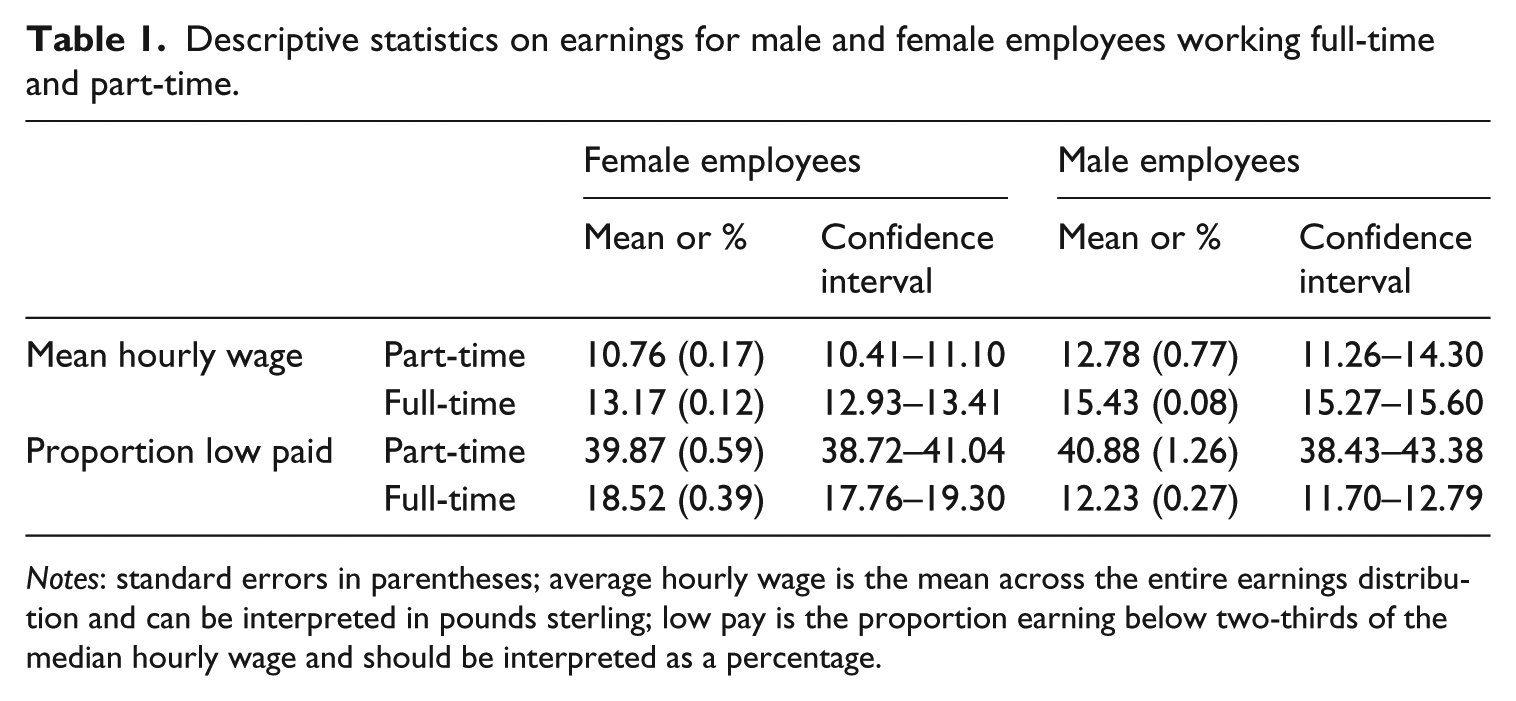
Notes: standard errors in parentheses; average hourly wage is the mean across the entire earnings distribution and can be interpreted in pounds sterling; low pay is the proportion earning below two-thirds of the median hourly wage and should be interpreted as a percentage.
Methodology
The effect of working part-time relative to full-time on the probability of being low paid was estimated using two nested probit regressions. Due to difficulties in interpreting coefficients for binary response models (Mood, 2010), average marginal effects are presented here. It is not possible to completely eliminate the possibility of omitted variable bias and therefore the article does not claim to identify causal relationships. Causal interpretations are also challenging because the direction of causality is ambiguous. The aim of Model 1 is to estimate the raw effect of working part-time relative to full-time, without controlling for covariates. The aim of Model 2 is to control as far as possible for self-selection into full-time and part-time employment, that is, the fact that full-time and part-time workers differ in ways that are related to their earning potential. This includes controlling for job characteristics, since previous literature shows that part-time workers are over-represented in areas of the labour market where low pay is more common 1 (Bardasi and Gornick, 2008; Matteazzi et al., 2014; Petrongolo and Manning, 2008). Demographic characteristics such as age, health (a dummy variable for having a work-limiting health condition) and family structure were included as control variables. Human capital was measured in terms of both formal education (highest educational qualification) and job tenure (in years). Labour market position was captured in relation to social class (NS-SEC coding), contract type (temporary or permanent), industry (SIC ’07 coding), sector (public or private) and employer size.
The inclusion of social class as a covariate reflects the fact that part-time employment in the UK is a classed phenomenon, disproportionately undertaken by women and men from lower socio-economic groups (Warren, 2003). Following Goldthorpe and colleagues (see Erikson et al., 1979; Goldthorpe, 2007), social class was measured according to the labour market position of individuals. This approach has been criticised for downplaying other sources of stratification such as gender, race and wealth, and for ignoring aspects of social class such as class consciousness (Crompton, 2010). Nevertheless, labour market position is clearly an important source of social stratification shaping opportunities and life chances, and the Goldthorpe approach is well validated by prior research (Rose and Harrison, 2009; Rose and Pevalin, 2003). The social class approach differs from occupational measures such as Standard Occupational Classification (SOC) or International Standard Classification of Occupations (ISCO) in taking into account social relationships in the workplace as well as the degree of skill or expertise associated with an occupation. From a social class perspective, low pay is expected to be primarily associated with employment conditions governed by ‘the labour contract’, a basic exchange of money for time, characteristic of occupations in which skill requirements are rudimentary and generic, and output easily monitored (routine and manual occupations). Low pay is expected to be rare in situations where the ‘service relationship’ prevails (managerial and professional occupations), 2 in which employers have incentives to build long-term relationships with employees.
As discussed earlier, differences in attitudes or preferences might have a bearing on the relative risk of low pay for full-time and part-time workers, if, for instance, part-time workers are more willing to accept low-paid work as a means of securing a non-demanding and flexible role. This kind of self-selection into part-time employment is more difficult to control for statistically, since data sets generally do not include variables relating to work attitudes or preferences. Although it was not possible to measure work preferences directly, a selection model was used to adjust for factors such as these that remained unobserved (i.e. were not captured by the covariates in the model). Originally developed by Heckman (1979), selection models have been adapted for non-linear models (Van de Ven and Van Praag, 1981). The first step involves the creation of a latent variable, that is, a variable that is estimated rather than directly observed. In this case, the latent variable (the selection correction term) captured an individual’s propensity to be in (full-time) employment. This was estimated relative to the probability of being non-employed, and therefore the sample for the selection equation included those not currently in employment. The selection correction term reflects all factors contributing to this propensity, including traits such as work preferences that do not feature as explanatory variables. This selection correction term was then included as an explanatory variable in the main regression model.
Previous studies estimate self-selection into full-time and part-time employment using a multinomial logit (Bardasi and Gornick, 2008), ordered probit (Ermisch and Wright, 1993; Matteazzi et al., 2014) or bivariate probit model (Ermisch and Wright, 1993). Following Ermisch and Wright (1993), the selection equation was a bivariate probit jointly estimating: (1) the probability of being in employment (relative to non-employment); and (2) the probability of being employed full-time (relative to non-employment/part-time employment) as a function of age, health and family structure. To function effectively, selection models require at least one variable that predicts selection but is unrelated to the final outcome. If this restriction is not met, selection is identified only though the non-linearity of the correction factor and the model is in danger of suffering from collinearity (Puhani, 2000). For women, two additional variables were included to capture the number of young children in the household. For men, an additional variable identified those who were economically inactive one year ago. It is well known that previous unemployment spells increase the risk of low pay (Stewart and Swaffield, 1999). However, men who were economically inactive one year ago are not necessarily at greater risk of low earnings; this group might include individuals finishing full-time education, re-entering employment after taking early retirement or recovering from a period of ill-health. Robustness checks confirmed that these variables predicted (full-time) employment, but were unrelated to the risk of low pay.
After running the regressions, decomposition analysis was used to understand the relative importance of explanatory factors in contributing to the part-time gap in low pay. The traditional approach to decomposing wage gaps is the Blinder-Oaxaca procedure (Blinder, 1973; Oaxaca, 1973). This method decomposes wage gaps into two components: a part ‘explained’ by differences in characteristics and a part that remains ‘unexplained’ after taking these differences into account. Rather than a traditional Blinder-Oaxaca decomposition, the Karlson, Holm and Breen (KHB) method was used here to eliminate bias from rescaling (Karlson et al., 2012). The KHB method adjusts for the fact that coefficients for nested binary response models are not measured on the same scale, due to changes to the distribution and variance of error terms. In this case, results produced using the KHB and Blinder-Oaxaca methods were closely aligned and the choice of decomposition method did not alter the conclusions. A three-part decomposition was used to identify the explanatory power of: (1) explanatory variables; and (2) the selection correction term, as well as estimating the size of; (3) the ‘unexplained’ component. The selection correction term was treated separately to other explanatory variables because this parameter was estimated rather than directly observed (for a discussion of this issue see Neuman and Oaxaca, 2004).
Results
Average marginal effects (AME) for explanatory variables in Model 1 and Model 2 for the male and female samples are shown in Table 2. For both male and female employees the raw effect of working part-time relative to full-time on the risk of low pay was positive and highly significant in Model 1. In this model, the marginal effect was slightly larger for men (AME = 0.22, p < .001) than for women (AME = 0.21, p < .001). The first research question asks how far we can account for the relationship between part-time work and low pay by taking into consideration the characteristics of full-time and part-time workers. The addition of covariates in Model 2, including the selection correction factor, resulted in a substantial reduction in the marginal effect for working part-time relative to full-time. This suggests that differences in the personal and job characteristics of full-time and part-time workers go some way in accounting for the part-time low pay gap. However, it was not possible to ‘explain away’ this effect. For both the male and female samples the marginal effect for working part-time relative to full-time remained positive and significant in Model 2. The marginal effect of working part-time relative to full-time was once again larger for men (AME = 0.10, p < .001) than for women (AME = .06, p < .001).
Probit estimation of the probability of being low paid for male and female employees; average marginal effects.
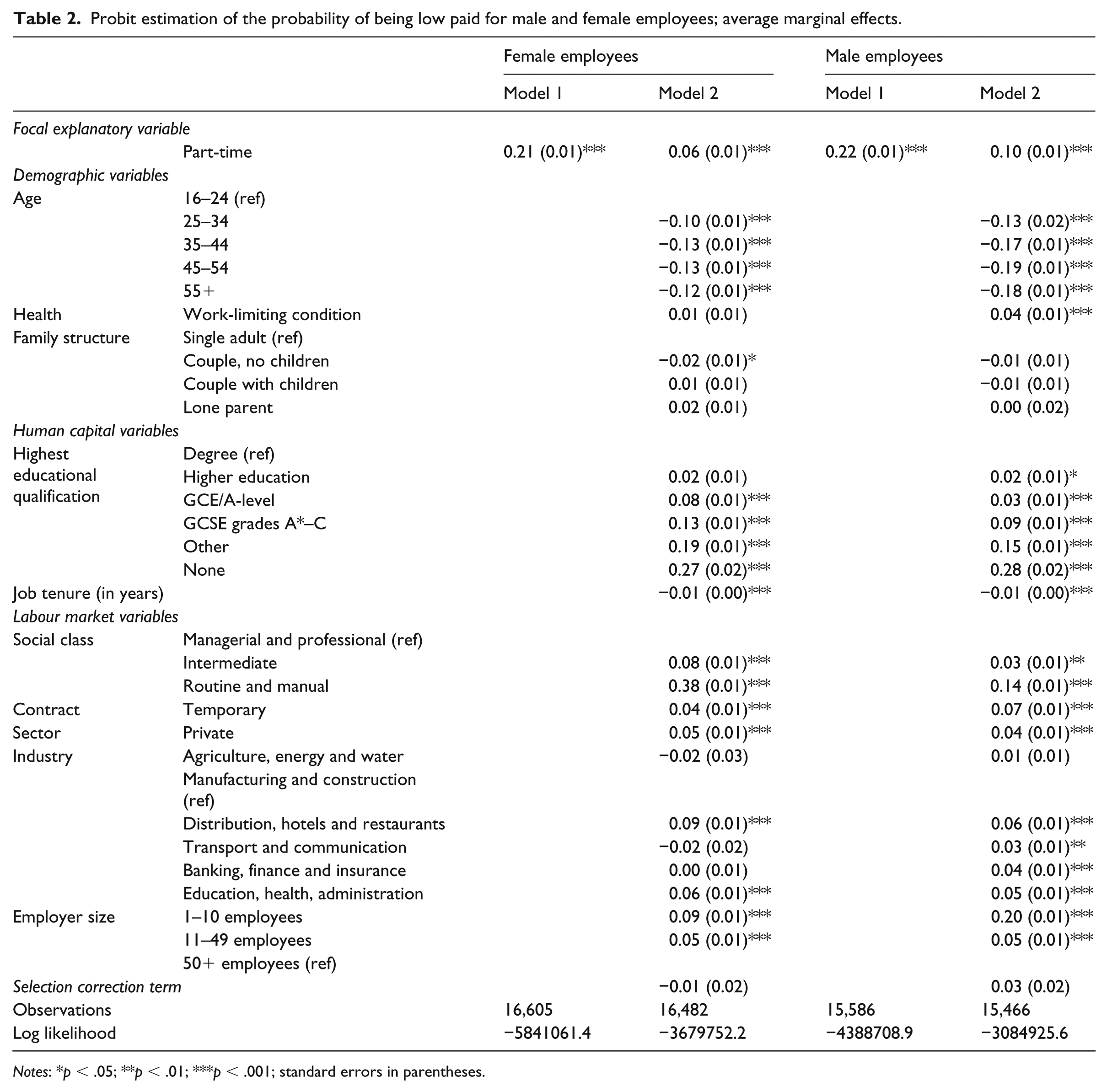
Notes: *p < .05; **p < .01; ***p < .001; standard errors in parentheses.
Results in Table 2 show that low pay was associated with being young, having a work-limiting health condition (for men only), having low educational qualifications and having fewer years of on-the-job experience. In terms of job characteristics, low pay was associated with being employed on a temporary contract, working for a small- or medium-sized employer, working in the private sector and being employed in certain industries such as distribution, hotels and restaurants. Social class was one of the strongest predictors of low pay, with those employed in intermediate occupations as well as routine and manual occupations disadvantaged compared to the professional and managerial classes. For both men and women the selection correction term was non-significant, indicating that modelling low pay without adjusting for selection did not produce biased estimates.
Research question two concerns the relative importance of different worker- and job-related characteristics in accounting for the part-time low pay gap. Decomposition results in Table 3 show that a modest portion of the effect for working part-time relative to full-time on the risk of low pay was attributable to the characteristics of part-time workers, who had on average a lower level of education than full-time workers and for men fewer years of experience in their current role. Differences in the qualifications of full-time and part-time employees accounted for 12.7% of the low pay gap for women and 7.9% for men. Overall, job characteristics were of greater importance than worker characteristics, particularly the unequal distribution of part-time employment across social class groups. For women, the low pay gap would be reduced by 41.5% if the social class positions of full-time and part-time workers were comparable. For men, social class accounted for 16.4% of the gap. The over-representation of part-time workers in small workplaces accounted for 10.4% of the gap for men and 7.3% for women. For both men and women, segregation across sectors and industries had a small or negligible effect. Aside from worker and job characteristics, the selection correction term accounted for 20.1% of the gap for women and 13.1% of the gap for men.
Decomposition of the full-time/part-time gap in low pay risk for male and female employees; mediation percentages.

The third research question asks how the relationship between part-time employment and low pay differs for men and women. Across both models, the marginal effect for working part-time relative to full-time on the risk of low pay was larger for men than for women. The ‘unexplained’ component in the decomposition analysis was larger for men than for women (40.6%, compared to 22.2%), indicating that the full-time/part-time differential is more difficult to explain for men. Comparing effect sizes across non-linear models may be misleading, since the variance of the underlying latent variable is not fixed (Allison, 1999; Mood, 2010). To test whether the effect of working part-time was mediated by gender, Model 2 was re-run with an interaction term. The results showed a significant negative interaction between being female and working part-time, indicating that the positive effect of working part-time relative to full-time (i.e. the extent to which it increases the risk of low pay) is greater for men than for women.
Discussion
Situated in the literature on part-time wage gaps, the distinctiveness of this study is that it focuses on the part-time gap in low pay rather than average earnings. This being so, it is helpful to consider continuities and discontinuities between these results and those of other studies looking at the part-time gap in average hourly wages. In identifying a greater role for job characteristics relative to worker characteristics, the results are aligned with the previous literature on part-time wage gaps (Bardasi and Gornick, 2008; Jepsen et al., 2001; Matteazzi et al., 2014; Petrongolo and Manning, 2008). The study departs from previous literature in the size of the ‘unexplained’ component identified (i.e. the part of the gap that cannot be attributed to differences in characteristics). After controlling for a full set of covariates, previous studies find no effect for working part-time relative to full-time on average hourly wages in the UK (Petrongolo and Manning, 2008; Warren and Lyonette, 2015), Belgium (Jepsen et al., 2001) and Poland and Italy (Matteazzi et al., 2014). In contrast, focusing on low pay rather than average earnings shows that working part-time relative to full-time does exert an effect on the likelihood of being low paid, even after controlling for a rich set of covariates. This was most evident for men, for whom around 40% of the full-time/part-time differential in low pay risk could not be attributed to differences between the two groups of workers.
The question that arises is why the part-time gap in low pay is more difficult to account for than the gap in average earnings. One possible explanation is that discrimination against part-time workers is most pronounced for low-paid workers, and low-paid men in particular. This cannot be established for certain using observational data, since even using a selection model it is not possible to rule out the possibility of differences between full-time and part-time workers not captured by the covariates in the model. Studies utilising experimental designs provide more robust evidence for discrimination against part-time workers in countries such as Germany (Beham et al., 2017) and the USA (Pedulla, 2016; Vandello et al., 2013), and future research might apply similar techniques to the UK context. Aside from discrimination, the ‘unexplained’ component may stem from differences in skills and productivity, or disparities in labour market experience and job conditions such as access to training and networking opportunities. The ‘unexplained’ component may also reflect temporal processes not captured by this kind of cross-sectional analysis. The duration of time working part-time is likely to have an effect above and beyond working part-time at a point in time. Part-time workers may also accrue, or be perceived to accrue, less experience on the job, being passed over for promotions as a result. Research from the Netherlands, for instance, shows that part-time wage gaps grow over the life course due to a lower incidence of promotions for part-time workers (Russo and Hassink, 2005).
In examining the role of self-selection into full-time and part-time employment, this study makes a novel contribution to a long-standing debate in the sociological literature concerning how penalties associated with part-time employment should be understood. Are part-time workers simply a ‘selected’ group whose labour market disadvantage is a product of their skills, abilities and preferences, or do penalties associated with part-time work go beyond this? Only a modest proportion of the differential risk of low pay faced by full-time and part-time workers can be attributed to selection factors of this kind. The selection correction factor, reflecting an individual’s propensity to be in (full-time) employment, is found to be of some importance. However, this should not necessarily be taken as evidence in support of preference theory (Hakim, 2002). This factor may, as preference theory would suggest, reflect differences between full-time and part-time employees in work preferences and motivation. However, these preferences may well be adaptive (Gash, 2008), shaped by institutional and cultural constraints (McGinnity and McManus, 2007). Alongside preferences, the selection correction factor may reflect barriers to full-time employment, for instance childcare responsibilities, health-related factors and cultural pressures. The precise nature of the selection correction term remains opaque, and it is important not to read too much into this component.
Overall, job-related factors were found to be more important than worker characteristics in accounting for the part-time low pay penalty. This finding supports the conclusion drawn elsewhere (Warren and Walters, 1998) that the full-time/part-time dichotomy is more useful in distinguishing between different types of jobs than different types of workers. Labour market segregation is sometimes positioned as part of the ‘fair’ component of part-time wage gaps, in that it can be accounted for with reference to characteristics. However, segregation in the labour market reflects not only different tastes and preferences but also the fact that part-time jobs are not available, or are hard to come by, in certain sectors, occupations and workplaces. Conversely, workers in other areas of the labour market may be forced into part-time employment by a lack of full-time opportunities. From the perspective of part-time employment sometimes being an enforced or constrained ‘choice’ (Gash, 2008), this component may be interpreted differently. Part-time employment may be viewed as limiting the opportunities of these workers to access higher skilled and better paid job opportunities.
In highlighting the magnitude of the part-time low pay gap for UK employees and the importance of job characteristics in accounting for this differential, this study has major implications for policy. The results highlight how crucial it is to address poor quality part-time jobs in the UK, an issue previously highlighted by the Women and Equalities Select Committee (House of Commons, 2016) as well as organisations such as the International Labour Organisation (ILO) (Fagan et al., 2013). The UK already has legislation in place mandating equal treatment of full-time and part-time workers, introduced following the EU Directive on Part-Time Work (1997). However, equal treatment requires a comparable full-time worker (Fagan et al., 2013), and a large part of the issue is that full-time and part-time workers are often located in different jobs. Arguably, more could be done to open up access to ‘good quality’ part-time jobs in the UK. The right to request a change in working hours for parents was introduced in 2003, and this was further expanded in 2014 to apply to all employees who have worked for a minimum of six months in the same role. There may be scope to improve and diversify part-time work opportunities by making flexible working (including part-time employment) available at the point of recruitment (House of Commons, 2016; Rubery, 2017), or placing greater restrictions on the circumstances under which employers can refuse flexible working requests (Anderson, 2003). Improving the ‘quality’ of part-time jobs can only be part of the solution, however, since the results show that even within the same type of jobs part-time workers are more likely than full-time workers to be low paid.
Part-time jobs are disproportionately low-paid jobs, and even within the same type of jobs part-time workers are more likely than full-time workers to be low paid. The impact of this is not felt uniformly across the labour market, but disproportionately affects certain groups. The association between part-time employment and low pay was found to be just as strong, if not stronger, for men compared to women. At the same time, women are disproportionately affected because they work part-time in greater numbers. Patterns of full-time and part-time employment make a major contribution to the gender pay gap (Dias et al., 2018), and may go some way in accounting for the over-representation of women in low-paid work (Gregory, 2012). Part-time employment is a classed as well as gendered phenomenon (Warren, 2003), and this issue disproportionately affects workers from lower socio-economic groups. The study is the first to highlight the major contribution of social class to the gap in low pay between full-time and part-time workers. Another way of looking at this issue is that part-time employment reinforces and perpetuates inequalities according to social class. Given their over-representation in part-time employment, the low pay penalty associated with working part-time rather than full-time falls disproportionately on men and women in routine and manual (working class) occupations.
Conclusion
This article presents a novel contribution in examining why male and female part-time employees in the UK are more likely to be low paid than their full-time counterparts. A major contribution is to show that the part-time low pay gap is just as large, if not larger, for men compared to women, showing how important it is to recognise part-time work as a factor limiting the labour market choices and opportunities of men as well as women. For both men and women, worker characteristics are found to be less important than job characteristics in accounting for the part-time low pay penalty. Controlling for workers’ estimated propensity to work full-time adds explanatory power, but the factors underpinning this propensity remain opaque. The most important explanatory factor in the analysis, particularly for women, is the unequal distribution of part-time workers across social class groups. The results reinforce the need to improve access to ‘good quality’ part-time jobs in managerial and professional occupations. At the same time, a large ‘unexplained’ component indicates that even within the same type of jobs part-time workers are more likely than full-time workers to be low paid.
The results have major implications for policy, and are interpreted in light of the potential for part-time employment to reinforce inequality in low pay according to gender and social class. Future research might consider how part-time employment interacts with other intersectional factors, for instance whether the part-time low pay penalty is particularly steep for part-time workers who have a disability, or those who are from an ethnic minority background. There is also a need for further research to explore how the duration of part-time employment affects the risk of low pay and the probability of progressing onto higher wages. The large ‘unexplained’ component of the part-time low pay penalty for men also warrants further investigation. Several possible explanations are offered, but there are limits to what can be inferred from observational data. Experimental designs could be utilised to establish whether there is a discriminatory element to this component, and qualitative research could add greater insight into how men working part-time are viewed in the workplace.
Footnotes
Acknowledgements
Thanks are owed to Erzsébet Bukodi, Fran Bennett and to three anonymous referees for their constructive feedback on earlier drafts of this article.
Funding
This research was made possible by an ESRC doctoral studentship.
