



Abstract
Higher managerial and professional occupations are now the most incentivized occupational class in Britain. It is not yet known whether the rise in pay for performance (PFP) signifies an erosion or enhancement in the ‘service relationship’ that purportedly characterizes these occupations. Taking an occupational class perspective, this article investigates the implications of the rise in PFP for the employment relationship and conditions of work across the occupational structure using two nationally representative datasets. In fixed-effects estimates, PFP is found to heavily substitute base earnings in non-service class occupations, but not in service class occupations. PFP jobs generally have no worse conditions relative to non-PFP jobs within occupational classes. The article concludes the rise in PFP should be conceptualized more as a form of ‘rent sharing’ for service class occupations, enhancing the service relationship, and as a form of ‘risk sharing’ for non-service class occupations.
Introduction
Narratives of rising ‘marketization’ and ‘financialization’ depict them as quite negative trends for the employment relationship in general (Cushen and Thompson, 2016; Thompson, 2013). Other accounts have been careful to highlight the differential effects across structural locations, focusing on the experience of certain ‘occupational elites’ that are said to have used their advantageous positions (see Cousins et al., 2018) to economically benefit from such trends; for instance, in Piketty’s account of ‘super managers’ (Piketty, 2014). One such trend that is symptomatic of rising marketization and financialization is the growth in pay for performance (PFP). Supporting the perspective of occupational elites, empirical work by sociologists in the United States has indeed shown that the well-known ratcheting up of senior executive pay is almost entirely accounted for by the explosion in performance-related elements of compensation (DiPrete et al., 2010; Kim et al., 2015). Nonetheless, the rise in PFP has penetrated the labour market much more widely than within these narrowly defined elite categories, and so might its effects on employment relationships.
Rising rapidly during the 1990s and early 2000s, about one-third of employees in Europe and two-fifths in the United States now have some element of their pay based on performance (Bryson et al., 2013). What is perhaps less well known, in Britain at least, is that the incidence of PFP is now highest among higher managerial and professional occupations by quite a margin (McGovern et al., 2007; Williams and Zhou, 2016), the vast majority of whom are not senior executives. While the differential effects of the financial crisis and ensuing recession, which can be traced to the incentives of senior executives (Freeman, 2010), on various aspects of the employment relationship, such as pay stagnation, underemployment, and insecurity, have been extensively studied (Gallie et al., 2017; Warren, 2015; Warren and Lyonette, 2018; Williams, 2017b), the differential implications of the growth in PFP for employment relationships across the wider occupational structure have been curiously overlooked.
In this article, we investigate the differential implications of the rise in PFP for the employment relationship from an occupational class perspective. Occupational classes are a technical construct delineating broad groupings of occupations that purportedly share similar employment relations, which in turn delineate broad positions of labour market advantage and disadvantage (Goldthorpe, 2007) and so provide a good analytical tool for this article’s purpose. Proponents of occupational class theory might expect any economic benefits from the rise in PFP to be tilted in favour of higher managerial and professional occupations – the ‘service class’ (Breen, 1997; Goldthorpe, 2007). However, it is far from clear whether the rise in PFP among higher managerial and professional occupations represents an erosion in the privileged ‘service relationship’ typically afforded to employees in this occupational class. On the one hand, it could signify, in part, increasing marketization of a traditionally privileged employment relationship type, shifting a greater degree of income risk onto these workers by substituting base salaries with a contingent component. On the other hand, PFP may act as a way of sharing economic rents, offering a mechanism to boost earnings of those in already privileged occupational positions as is often assumed in topical debates about the PFP among senior executives, ‘super managers’ and ‘elites’, enhancing rather than eroding the service relationship through ‘rent sharing’. But this in turn may still come at the expense of other traditional features of the service relationship and deteriorate working conditions. For non-service class occupations, however, the rise in PFP may mark a further deterioration in an already disadvantaged employment relationship type, incorporating a greater degree of ‘risk sharing’ into the ‘labour contract’. While the growth in pay for performance prior to the financial crisis was found to modestly increase wage inequality across the pay distribution (Bryan and Bryson, 2016), the implications of this trend for occupationally differentiated employment relationships have not been studied in detail. This article aims to fill this gap by examining two nationally representative datasets for Britain conducted in the 1990s and 2010s.
Occupational class and the rise in pay for performance
The Goldthorpe model of occupationally differentiated employment relationships
The influential Goldthorpe (2007) model of occupational class purports that employment relationships emerge from the inherent ‘contractual hazard’ in defining the terms of an employment contract. The possible ‘solutions’ cluster around two polar extremes: a ‘service relationship’ and a ‘labour contract’, with other ‘mixed forms’ in between. Under service relationships, employees are said to provide a ‘service’ to employers in return for a fixed salary and enjoy a greater degree of job (and income) security, promotion (and higher income) prospects to tie employees to the firm and opportunities to develop their skills, since there are mutual gains in doing so. Conversely, labour contracts are more akin to ‘spot contracts’, where tenures are typically shorter in duration and offer fewer opportunities for (income) advancement. Which solution to the contractual hazard is adopted depends on two main characteristics of work: how difficult work is to monitor and the ‘human asset specificity’ required to perform the job. Because differences in these two salient job characteristics vary across occupations, this in turn gives rise to differentiation in employment relationships across broad occupational classes.
This model of occupationally differentiated employment relationships has been repeatedly validated over a number of years and provides the basis for the Office for National Statistics’ Socio-Economic Classification (NS-SEC) schema of occupational classes in Britain for more than a decade (Rose and Pevalin, 2005). Much empirical support has been found for the construct and criterion validity of the resulting broad occupational class categories (Evans and Mills, 1998, 2000; McGovern et al., 2007; Williams, 2017a; Zou, 2015). The basic model, the occupational classes delineated by the NS-SEC version, and example occupations in each class are listed in Table 1.
The NS-SEC schema of occupations and accompanying employment relationship type.
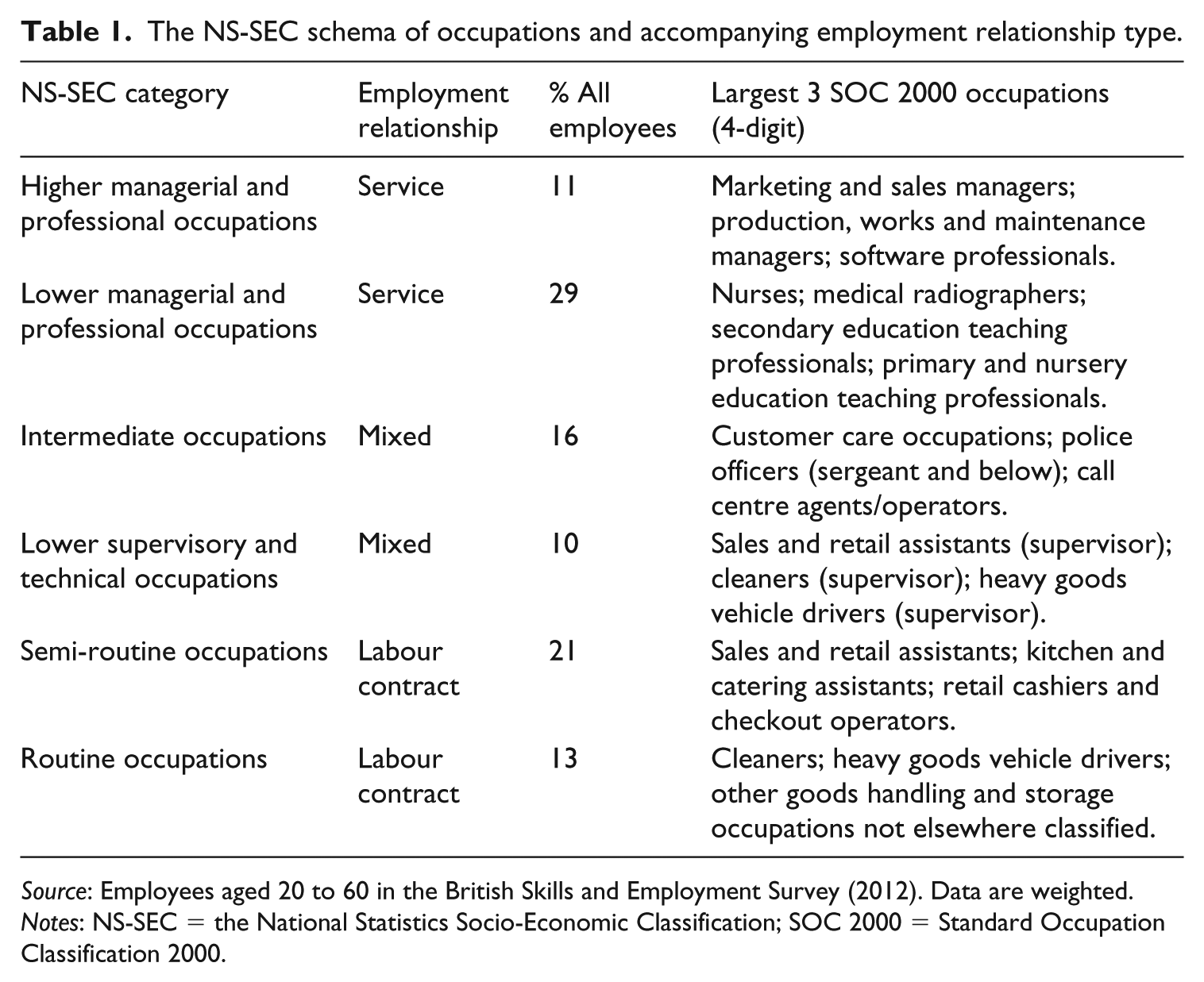
Source: Employees aged 20 to 60 in the British Skills and Employment Survey (2012). Data are weighted.
Notes: NS-SEC = the National Statistics Socio-Economic Classification; SOC 2000 = Standard Occupation Classification 2000.
Nonetheless, the theory is not without controversy, not least due to the constant flux in work organization and the growing marketization restructuring the employment relationship within and across classes over the years (Gallie et al., 1998; McGovern et al., 2007; White et al., 2004; also see Williams, 2017a). Payment systems have traditionally been a fundamental variable in differentiating employment relationship types and occupational classes. Indeed, alternative labels for the main occupational class divide in the Goldthorpe model make explicit reference to payment systems – the ‘salariat’ (salaried) and ‘wage labour’ (hourly paid) occupational classes. One major trend with respect to payment systems over the last two to three decades has been the growth in the incidence of PFP, yet little is known about the implications of this trend for employment relationships in general and its differential impact across the occupational class spectrum in particular. Instead, sociological studies have largely focused on the rise in PFP among senior executives (DiPrete et al., 2010; Kim et al., 2015).
The rise in pay for performance and the service relationship
The theories underlying the Goldthorpe model generally imply greater use of PFP for service class occupations. Principal-agent theory, for instance, states PFP is most appropriate in situations where the monitoring of work effort is costliest, such as in service class occupations, while paying for time is preferred where close supervision of work is easy, such as in semi-routine and routine occupations (Milgrom and Roberts, 1992). Moreover, PFP can act as a way to retain valuable specific human capital as a form of ‘efficiency wage’ (Akerlof, 1982). Empirical research has generally found PFP-use is greatest where work is difficult to monitor and where human asset specificity is high (Williams et al., 2019). Indeed, PFP is often taken as an indicator of the service relationship, while overtime pay is an indicator of the labour contract characterized by discrete amounts of effort for discrete amounts of reward (Evans and Mills, 1998, 2000; Zou, 2015). Whereas the use of overtime pay declined during the last two decades, PFP rose substantially (Bryson et al., 2013).
While a general growth in PFP is expected in narratives of increasing marketization and financialization and in accounts of ‘elites’ and ‘super managers’, what is perhaps less well known is how the diffusion in PFP was much broader but also uneven across occupational classes – although the underlying theory of the Goldthorpe model might predict this, given that contractual hazards are greatest in service class occupations. McGovern et al. (2007: 166–168) found the prevalence of PFP was relatively even across classes in 1992, but by 2000 the higher managerial and professional occupations emerged as the most incentivized occupational class – largely as a result of increasingly being subjected to combinations of individual and group incentives. Growth in organizational PFP (profit-sharing and employee share ownership schemes) did not grow, however. They found that the well-known pay premium to PFP was relatively similar across occupational classes and found no adverse effects of PFP on work demands and work strain. On the surface, these findings imply the rise in PFP in the 1990s neither eroded nor enhanced the service relationship. Nonetheless, the trend towards greater PFP prevalence in higher managerial and professional occupations and associated premium may have come at the expense of other traditional elements of the service relationship, such as opportunities for promotion and job security, but this thesis remains untested.
It is therefore still unclear whether the rise in PFP represents an enhancement or erosion in the service relationship. While empirical research often finds a pay premium for PFP, this does not signify a strengthening per se since much of the premium is often also found to reflect a large degree of unobserved heterogeneity. The PFP pay premium substantially shrinks in panel studies that control for individual fixed-effects (e.g. Bryan and Bryson, 2016; Bryson et al., 2014; Green and Heywood, 2017; Stokes et al., 2017). Moreover, Green and Heywood (2017) in the British Household Panel Survey 1997 to 2008 show that PFP often substantially substitutes for base earnings such that simplistic estimates of the PFP pay premium may therefore overstate the financial benefit of PFP, even when taking unobserved heterogeneity into account.
Various attempts have tried to rationalize trends such as the rise in PFP within a conventional occupational class framework. For instance, Breen (1997) points out that although employers try to offload risk onto their employees where they can, this does not necessarily negate the economic rationale for the service relationship. With respect to PFP, Williams and Zhou (2016), using the 2011 Work Employment and Relations Survey, find that even within workplaces employers seem to be more likely to implement PFP among service class occupations relative to other occupational classes – about twice as likely. If PFP represents a risk insofar as it varies pay according to individual/group performance and/or the financial health of the organization, this risk appears to be overwhelmingly on the shoulders of service class occupations.
Goldthorpe (2007) himself was critical of the view that the rise in new forms of work organization among service class occupations should be taken as an indicator of the decline of the service relationship. Goldthorpe (2007: 122) states two conditions must be met for a compelling argument for a general decline in the service relationship: First, there must be direct evidence that shows elements of the service relationship that were previously typical are discontinued. Second, the change is permanent as opposed to a short-term blip coinciding with economic cycles or management fads. For specifically PFP, to this we add that more exploration on its functioning, its nature, is required. Is PFP added on top of base earnings as we would expect within the service relationship or does it substitute for base earnings as we might expect within the labour contract? Are any possible non-pecuniary benefits (drawbacks) of PFP associated with scaled back (improved) elements of the service relationship elsewhere? For instance, does PFP increasingly substitute for opportunities for promotion or other prospective benefits such as pensions? And for all questions, for whom? Given the logic of the distinction between the service relationship and the labour contract, which are strongly tied to occupational position, the expectation of the sceptical view that new forms of work organization do not negate the economic rationale for the service relationship is that the rise in PFP should have had no effect on the fundamentals of the differentiation in employment contracts, or, if anything, enhances rather than erodes the service relationship.
As topical as PFP has been, especially among certain narrow ‘elite’, ‘super managers’ and senior executive factions of service class occupations engaging in rent extraction through ever higher bonuses (DiPrete et al., 2010), relatively little sociological work exists on interpreting its rise across the wider occupational spectrum (cf. McGovern et al., 2007). The analysis that follows is guided by the following three questions:
Has the rise in PFP among service class occupations, in particular higher managerial and professional occupations, been permanent?
Does PFP complement or substitute base earnings? How does this vary across occupational classes?
Do the data support the notion that PFP is associated with inferior employment relationships or working conditions within occupational classes?
Method
Data
To answer these questions, we turn to two complementary long-running British surveys. The first is the Skills and Employment Surveys (SES) (Felstead et al., 2014). SES has been providing a nationally representative portrait of the British labour market since 1986. The main advantage of SES for our purposes is that it asked identical questions on PFP in 1992, 2001, 2006, and 2012 (the latest wave) – allowing an over time analysis in occupational class and PFP. 1 An advantage of SES is that it questions respondents on different types of PFP. Additionally, SES asked a variety of detailed questions on aspects of employment relationships and job quality, and also includes a rich set of controls. Since our focus is on employees, we exclude the self-employed, yielding an analytical sample of 15,401 cases across the four waves. After excluding cases with missing data, we are left with a final sample of around 14,000 cases.
Although SES contains earnings data, it does not contain information on the size of the PFP component. This makes it difficult to assess the extent to which PFP acts as a substitute or complement to base earnings. Therefore, we also draw upon the Annual Survey of Hours and Earnings (ASHE) 2005 to 2015 (Office for National Statistics (ONS), 2016). ASHE is an employer survey based on a roughly 1% nationally representative sample of the British labour force drawn from tax records. Covered by the Statistics Trade Act, sampled employers must fill out the survey by law. Consequently, response rates are high and item non-response is low. ASHE contains detailed information on components of earnings often unavailable in household surveys, such as shift premiums, overtime rates, etc., and, since 2002, pay from incentive and bonus schemes. An additional advantage of ASHE is that it is a panel dataset by design since national insurance numbers (the sampling unit) are unique to specific individuals and do not change. Employees are therefore followed throughout their working lives, even if they change employer. ASHE was used since 2005 because the way PFP was recorded changed (and improved). We focus on the annual earnings of employees who were with their employer for the full year as bonuses are highly seasonal (Forth et al., 2016). Employees not on the adult rate (i.e. apprentices) and whose earnings were affected by absence are excluded (about 7% of the sample), yielding a final sample of around 950,000 cases.
Measures and analytical strategy
SES asks respondents whether an element of their pay is based on performance in some way and allows respondents to select as many options that apply from a choice of PFP based on individual, team, or organizational performance. ASHE asks employers to report the amount of pay that is based on incentives or bonus schemes, such as profit sharing, productivity, performance and other bonus or incentive pay, piecework, and commission. PFP jobs in ASHE can be identified as jobs where the PFP component is non-zero. 2 These variables and various recodings of them form the main independent variables in our analysis. We deflate all analysis of earnings and PFP amount by the 2015 Consumer Price Index (CPI). Occupational class in both surveys is defined by the NS-SEC schema following the standardized procedures (Rose and Pevalin, 2005) to form the six broad occupational categories in Table 1.
In the SES analysis, control variables fall into two main categories: individual characteristics and workplace characteristics. With respect to the former, we include whether female (dummy), whether ethnic minority (dummy), whether married (dummy), whether has children under 16 (dummy), whether has a degree-level qualification (dummy), years of work experience (five dummies), whether part-time (dummy), hours (logarithm), and whether contract is temporary (dummy). With respect to the workplace factors, we include whether covered by a union (dummy), workplace size (four dummies), industrial sector (four dummies), and region (five dummies). Since ASHE is an employer survey, the available controls are necessarily less complete than SES. In our ASHE analysis, the control variables are whether female (dummy), age (five dummies), tenure (five dummies), whether part-time (dummy), hours (logarithm), whether contract is temporary (dummy), public sector (dummy), industrial sector (four dummies), region (five dummies), and year (dummies).
The analysis proceeds in two main steps. First, descriptive patterns are explored with questions 1 and 2 on the permanency in the rise and nature of PFP across classes in mind. Second, we shift to a multivariate analysis and focus on the predicted differences in the outcome variables between PFP and non-PFP jobs within occupational classes using ordinary least squares if the dependent variable is continuous, or logistic regression if the dependent variable is dichotomous, controlling for the factors mentioned above – which vary according to whether SES or ASHE is used. The purpose of the multivariate analysis is to examine whether the pay of PFP jobs significantly differs from non-PFP jobs within classes in terms of: (1) their overall earnings; (2) the extent to which PFP complements or substitutes base earnings; and, finally (3) differences in broader aspects of employment relationships and working conditions.
While the estimation of (1) and (3) are relatively straightforward, which involves interacting a PFP dummy variable with occupational class categories then calculating the differences between PFP and non-PFP jobs within classes using the first derivatives (in the case of ordinary least squares (OLS) regression models) or average partial effects (in the case of the logistic regression models), (2) requires a little more elaboration. We follow the approach of Green and Heywood (2017) who use the amount of annual PFP (in £) as a key independent variable, and overall annual earnings as the dependent variable (in £). We interact PFP amount with occupational class and obtain the derivatives of PFP on earnings within classes for this analysis. If PFP substitutes for base earnings, this effect within a given class will be less than 1 (i.e. £1 worth of PFP increases overall earnings by an amount less than £1). If PFP is an example of bonus and is simply added on top of earnings, then £1 worth of PFP increases earnings by more than 1.
Since we are interested in differences between PFP and non-PFP jobs within occupational classes, the effects we present are obtained from calculating derivatives/average partial effects from interactions between PFP job/PFP amount and occupational class categories (full underlying results of all analyses available on request). 3 Since the focus in (1) and (2) is on earnings, these analyses are conducted using ASHE, while (3) is conducted on SES using eight separate indicators. The indicators of the service employment relationship are: (1) whether the probability of promotion in the next five years is 50% or greater; (2) whether have an employer pension; (3) whether received training in the last 12 months; and (4) whether there is a likelihood of losing one’s job in the next 12 months. These indicators are chosen as either these items or similar have been used to validate the occupational class schema used here or its predecessors (Evans and Mills, 1998, 2000; McGovern et al., 2007; Williams, 2017a).
The four indicators of wider working conditions are: (1) whether the respondent reports being ‘very closely supervised’ in their job (dummy); (2) an index of task discretion (averaging responses across four items with responses ranging from 0 ‘none at all’ to 3 ‘a great deal’: how much influence the respondent has over how hard they work, what tasks they do, how to do their tasks, and deciding quality standards; Cronbach’s alpha = 0.78); (3) the logarithm of usual hours worked per week including paid and unpaid overtime; and (4) an index of job strain (averaging across three items with responses ranging from 0 ‘never’ to 6 ‘all of the time’: how much the respondent worries about their work, they find it difficult to unwind at the end of the workday, and they feel used up at the end of the workday; Cronbach’s alpha = 0.80). These indicators are chosen as they have been used to reflect key dimensions of job quality in previous analyses of the SES (Felstead et al., 2015; McGovern et al., 2007).
Results
Descriptive patterns
Table 2 reports that the proportion of employees receiving some element of their pay based on performance grew from around 30% in 1992 to around 40% by 2001, then remained at roughly this level for the next decade. Similar trends of growth during the 1990s, followed by broad stability after 2001, can be found with respect to all PFP types, including multiple types of PFP. These descriptive patterns largely reflect those in the earlier analyses of 1992 to 2000 (McGovern et al., 2007). Our updated findings show that the trends have not reversed, nor was there any further growth in PFP generally or in specific PFP types.
The growth in PFP (%).

Source: Employees aged 20 to 60 in the British Skills and Employment Surveys. Data are weighted.
Note: PFP = pay for performance.
Figure 1 breaks down the growth in PFP by PFP type and occupational class. While there was some growth in PFP between 1992 and 2001 in all classes, the growth was most striking among higher managerial and professional occupations. Additionally, most of the growth in PFP among higher managerial and professional occupations was in multiple types of PFP. PFP is lowest in semi-routine and routine occupations, where it has even fallen slightly in more recent years. Overall, not only is PFP greatest in higher managerial and professional occupations, relative differences between this occupational class and others have not reversed. If anything, they slightly widened.
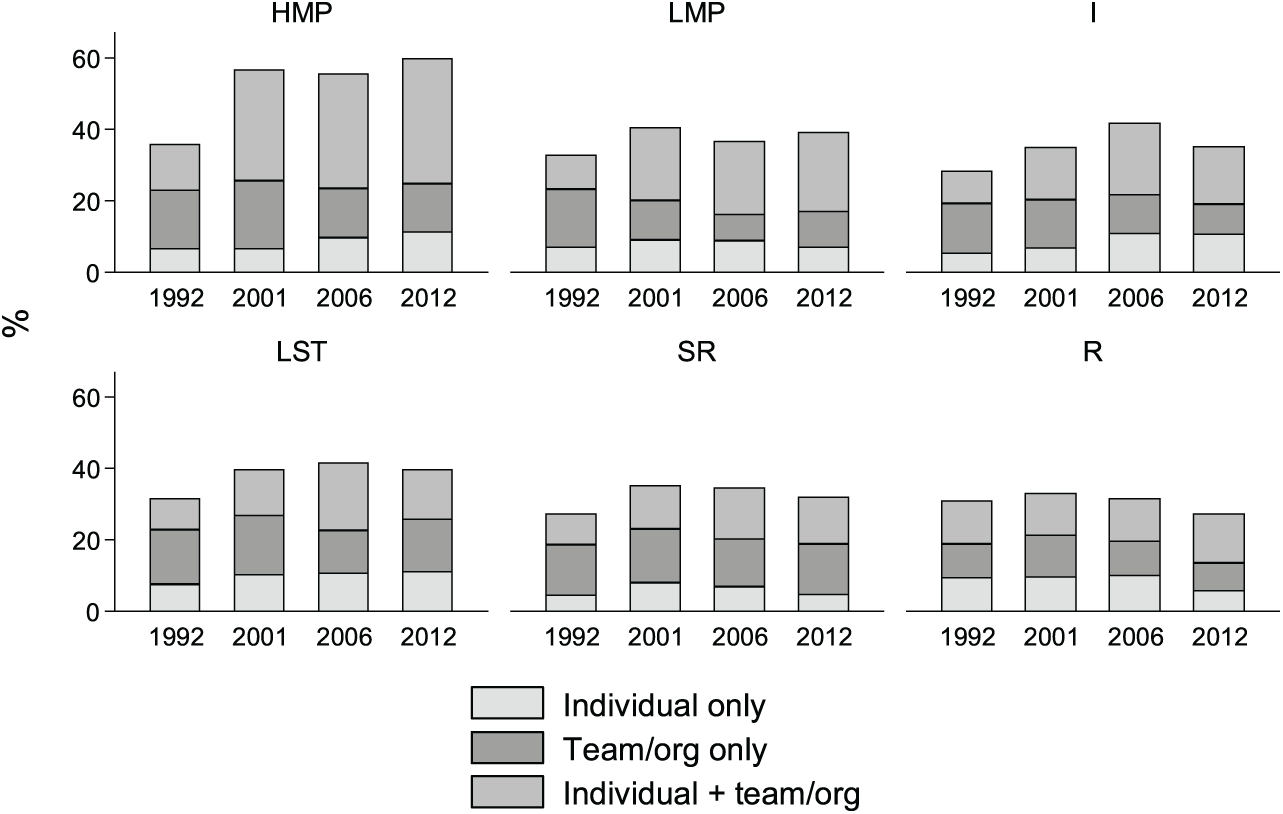
The incidence of PFP combinations by occupational class and year.
An advantage of ASHE is that it breaks down components of earnings into their constituent parts. When examining the average proportion of earnings accounted for by PFP across occupational classes in 2005 to 2015 in Figure 2, it is evident that the proportion of PFP has been falling within all classes over this period. Higher managerial and professional occupations have a higher proportion of overall pay accounted for by PFP than all other classes, whether considering PFP jobs only or all jobs, followed by lower managerial and professional occupations. While there are some signs the overall growth in PFP may have reversed in terms of a fall in the proportion of earnings accounted for by PFP in recent years, overall patterns of class differences have not. Higher managerial and professional occupations are still very much the most incentivized class.

PFP as a proportion of annual earnings by occupational class and year.
Multivariate analysis
Next we turn to the association between PFP and earnings. In Table 3, we present the differences in average predicted effects between PFP and non-PFP jobs within each occupational class obtained from an interaction between occupational class categories and a PFP job dummy. We find a significant and sizeable premium, a reasonably well-known finding in previous research. However, there are substantial differences in the magnitude of the premium across classes. The premium is much larger for higher managerial and professional occupations – about twice as large as most other classes at around 30% (Panel A). The PFP pay differences within classes have remained relatively constant over time. Another finding from previous research which is supported by our occupational class analysis, is that much of the apparent pay premium can be explained by unobserved individual heterogeneity (Bryan and Bryson, 2016; Bryson et al., 2014; Green and Heywood, 2017; Stokes et al., 2017). Controlling for individual-specific fixed-effects in the final column of Table 3, we also find the magnitude of the PFP premium shrinks – by about 50%, and this is roughly constant across classes.
The PFP earnings premium across occupational classes.

Source: Employees aged 20 to 60 in the Annual Survey of Hours and Earnings. Data are weighted.
Notes: Predicted differences in PFP and non-PFP jobs within occupational classes derived from an interaction between occupational class category and a PFP job dummy. All models include a common set of controls (see text), which are omitted to save space. Statistical significance *p < 0.05, **p < 0.01, ***p < 0.001. Robust standard errors in parentheses. OLS = ordinary least squares. FE = fixed-effects.
Although insightful that the pay premium is larger for higher managerial and professional occupations relative to other classes, what is of primary interest to the research questions posed earlier is the extent to which PFP pay complements or substitutes base pay and how this varies across classes. As previously mentioned, to explore this we follow the approach of Green and Heywood (2017) by examining the effect size of PFP amount (in £) on overall earnings, which gives the effect of a £1 increase in PFP on total annual earnings. An effect greater than 1 implies that PFP is acting as a complement to base earnings while an effect less than 1 indicates that as PFP increases, overall pay increases less than the value of PFP, implying base earnings are being substituted by PFP.
In Table 4, we find that the effect is greater than 1 for most years and occupational classes in the cross-sectional analyses. However, as demonstrated in our earlier analysis, much of this is due to unobserved heterogeneity. In the fixed-effects estimates, for higher managerial and professional occupations, a £1 increase in PFP results in a 97p increase to overall earnings (i.e. on average, there is a tiny substitution effect of 3p for every £1 in PFP). The effect is so close to 1 that the substitution effect is not substantively meaningful. The effect for lower managerial and professional occupations is, also, almost 1 (99p), and close to 1 in intermediate occupations too (92p), also implying a very small degree of substitution (1p and 8p for every £1 of PFP, respectively). PFP in all other classes, however, shows a clear and substantively large substitution effect. The substitution effect is particularly substantial for routine occupations, where for every £1 of PFP, earnings increase by only 40p. In other words, for every extra £1 of PFP, base earnings are reduced by 60p.
The substitution or complement effect on earnings of PFP across occupational classes.

Source: Employees aged 20 to 60 in the Annual Survey of Hours and Earnings. Data are weighted.
Notes: See Table 3. Statistical significance *p < 0.05, **p < 0.01, ***p < 0.001. Robust standard errors in parentheses. OLS = ordinary least squares. FE = fixed-effects.
Overall, then, PFP does not come at any meaningful expense to base earnings in service class occupations, while the opposite is the case for all other occupational classes. PFP seems to be acting as a ‘bonus’ added on top of earnings within service class occupations and more consistent with a substitute in other occupational classes, more like a piece rate, exposing PFP jobs to greater earnings risk than non-PFP jobs. In an Online Supplementary Appendix, we report several robustness checks, which lend support to this occupational class-biased interpretation.
Having established that PFP is generally associated with a pay premium that does not meaningfully substitute base earnings for service class occupations (and to a lesser extent intermediate occupations) but does substitute in other occupational classes, we now move on to examine the connection between PFP and broader aspects of the employment relationship and working conditions. The logic for doing so is that perhaps the beneficial effects of PFP jobs for service class occupations might come at the cost elsewhere in other more traditional aspects of the service relationship. Similarly, for PFP jobs in the non-service class occupations, these too could also be accompanied by an even more extreme labour contract in other areas. Are PFP jobs associated with inferior contractual arrangements relative to non-PFP jobs within occupational classes?
Table 5 examines gaps in four employment relationship indicators between PFP and non-PFP jobs within occupational classes, while Table 6 does the same but with four indicators of broader working conditions. These estimates are average partial effects obtained from a model interacting PFP with occupational class controlling for other factors. These analyses are performed by each SES survey wave to examine whether patterns are consistent across years as well as for pooled survey years (and including year dummies for the pooled models). Taking the four employment relations indicators first (Table 5), we find that in general PFP is associated with higher probability of promotion than in non-PFP jobs, but is only statistically significant in some cases. Thus, on the face of it, it seems PFP is not substituting for (or enhancing) prospective promotion opportunities. With respect to pensions, we find that, in general, PFP is accompanied by a higher probability of having an employer pension within classes. For training and job insecurity, we find few statistically significant differences between PFP and non-PFP jobs within classes across waves, but no obvious pattern. Turning to the four indicators of broader working conditions (Table 6), we find little evidence that there are systematic or persistent negative differences between PFP jobs and non-PFP jobs within classes on these indicators. The one exception is for working hours. We find that PFP jobs are associated with longer hours in both higher managerial and professional and routine occupations – about 2 hours extra per week for a standard full-time employee in the former and about 3.5 hours in the latter. Overall, then, PFP jobs seem to have no worse employment relationships or broader conditions of work, with the exception of hours in the two classes that best typify the extremes of employer solutions to the contractual hazard in the employment relationship.
Gaps in employment relationship indicators between PFP versus non-PFP jobs within occupational classes.
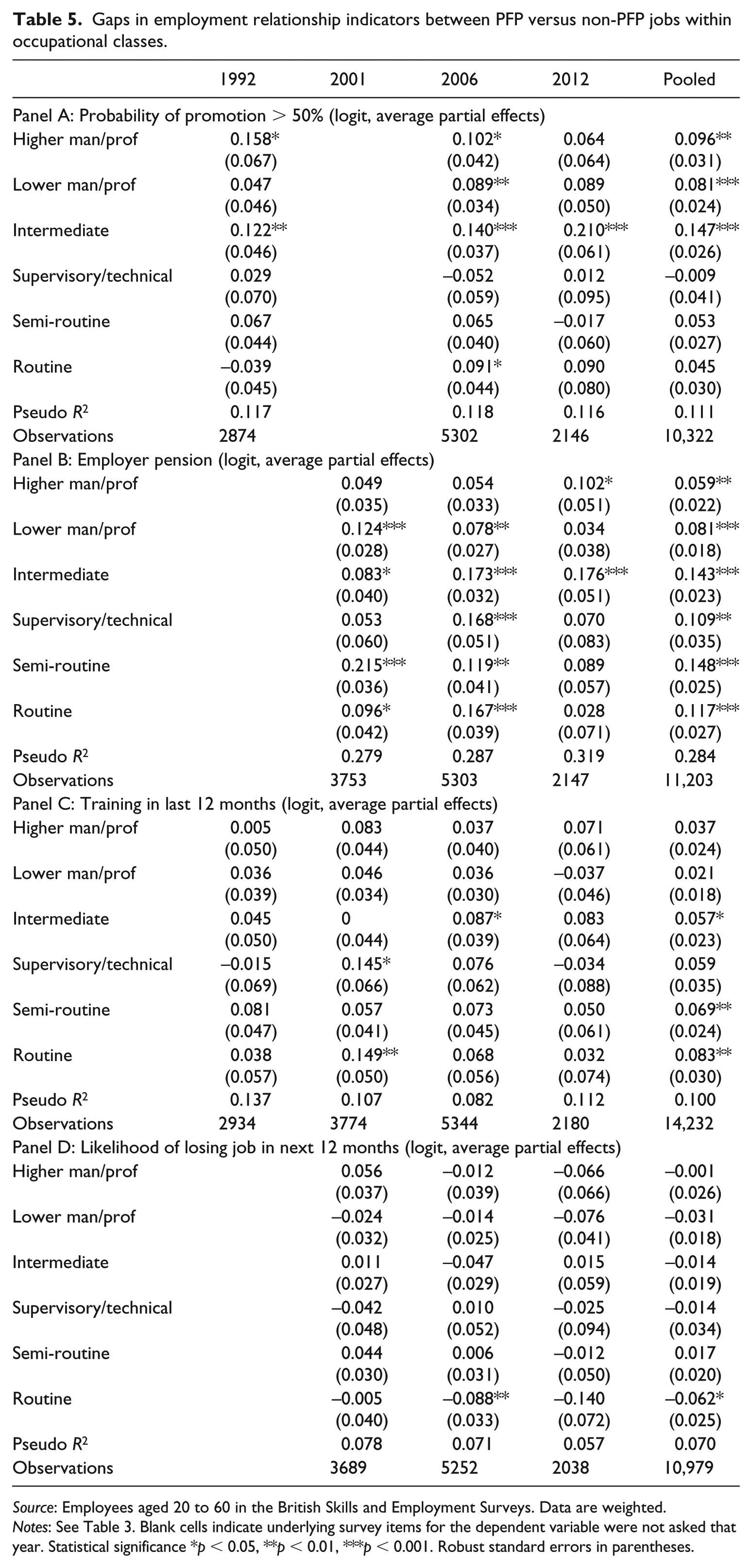
Source: Employees aged 20 to 60 in the British Skills and Employment Surveys. Data are weighted.
Notes: See Table 3. Blank cells indicate underlying survey items for the dependent variable were not asked that year. Statistical significance *p < 0.05, **p < 0.01, ***p < 0.001. Robust standard errors in parentheses.
Gaps in working conditions indicators between PFP versus non-PFP jobs within occupational classes.
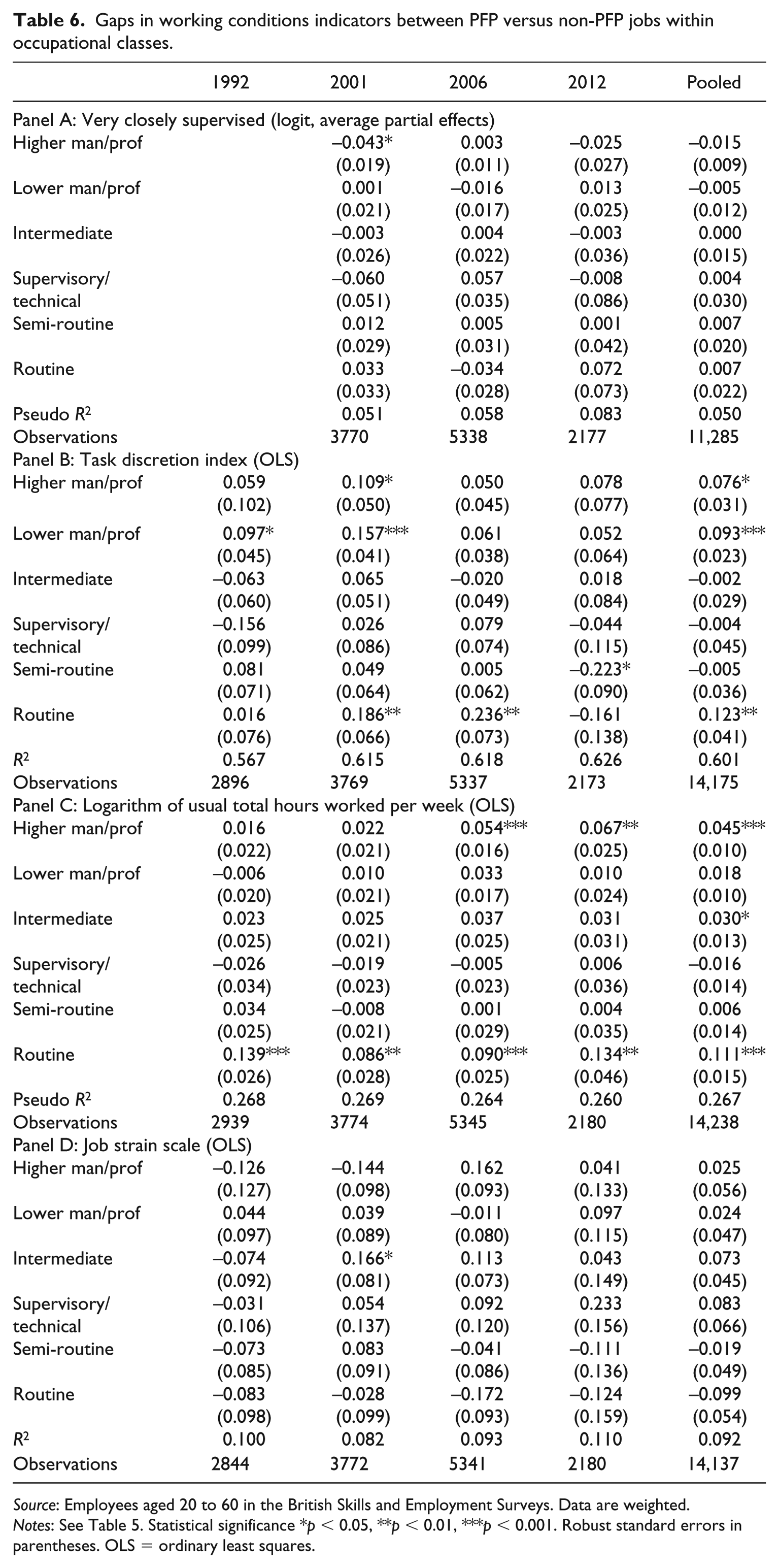
Source: Employees aged 20 to 60 in the British Skills and Employment Surveys. Data are weighted.
Notes: See Table 5. Statistical significance *p < 0.05, **p < 0.01, ***p < 0.001. Robust standard errors in parentheses. OLS = ordinary least squares.
Discussion and conclusions
In this article, we assessed the implications of one symptom of increasing ‘marketization’ and ‘financialization’ for the employment relationship across occupational classes in Britain. While general accounts have tended to depict these trends as having quite negative implications for employment relationships or have instead focused on the economically beneficial effects for senior executive elites, we explored the implications of PFP across the occupational structure, with a particular focus on the experience of the much broader higher managerial and professional occupations where the growth in PFP was sharpest. We find that PFP is still highest among higher managerial and professional occupations, both in incidence and in proportion of overall earnings. Although an earnings premium can be identified for PFP jobs relative to non-PFP jobs within all occupational classes, much of this effect is attributable to unobserved heterogeneity. Importantly, in terms of the nature of PFP, it only meaningfully substitutes base earnings in non-service class occupations. In service class occupations, PFP acts more or less like a bonus added on top of base earnings. Furthermore, PFP does not seem to be accompanied with worse employment relationships or conditions of work, with the exception of longer working hours in PFP jobs for both higher managerial and professional occupations and routine occupations.
Our findings have several theoretical implications. For occupational class theory, while Goldthorpe was critical of the rise in certain management practices signifying an erosion in the economic rationale for occupational class-based employment relationships, and the service relationship in particular, he notes that, in general: ‘employers should try to exploit any changes in the labour market or other economic conditions that might enable them to modify contracts of employment […] in ways that would be to their advantage […] that would reduce their contractual hazard’ (Goldthorpe, 2007: 120, emphasis in original). As our findings demonstrate, the rise in PFP among higher managerial and professional occupations – where contractual hazards are purported the greatest – is consistent with this view. The trend towards greater PFP coverage seems to have been, if anything, broadly beneficial to service class occupations, straightforwardly boosting the earnings of PFP jobs there. Also consistent with our findings is the view that ‘some of the strategies that employers may pursue in search of greater flexibility need have little or no impact on the service relationship per se, and indeed may even help to make this relationship more viable’ (Goldthorpe, 2007: 120, emphasis in original). As we have shown, PFP is associated with longer hours for higher managerial and professional occupations, perhaps indicating that extra demands in certain occupations are being rewarded through PFP schemes. The experience of service class occupations is in sharp contrast to the experience of semi-routine and routine occupations where PFP acts more like a piece rate, heavily substituting base earnings. Although the growth in PFP should not be overemphasized given the declining share of earnings being accounted for by PFP schemes, for service class occupations at least, we find PFP appears to act more like a form of ‘rent sharing’, while it may plausibly be described as a form of ‘risk sharing’ for other occupational classes.
Reflecting on our findings more widely, although the effects of these trends are likely highly moderated by national-level institutional structures, of course (Lallement, 2011; Vidal, 2013), our findings have several theoretical implications on debates concerning the broader narratives of ‘marketization’ and ‘financializaiton’ of employment relationships. First, while narratives of marketization and financialization depict these as negative trends for employment relationships in general, by adopting a more nuanced occupational class perspective, our findings quite clearly demonstrate, in the case of the rise in PFP at least, that the greater risk implied by such schemes really only applies to non-service class occupations. In doing so, we highlight the uneven distributional implications of this trend and that any narrative really needs to highlight that trends are very often polarized according to pre-existing positions of advantage and disadvantage. Second, while existing accounts tend to focus on ‘elites’, ‘super managers’ and senior executives – especially with respect to the rise in PFP – our findings show that the privileged groups are actually much broader. No doubt these narrow occupational groups disproportionally benefited from these wider trends relative to any other; however, our findings highlight perhaps the same processes (though smaller in magnitude) might be at work in service class occupations more broadly, even in the public sector and non-finance sectors (see Online Supplementary Appendix). Instead of ‘super managers’, maybe we should also be talking about the rise of the ‘super service class’. Our final point, then, is that occupational class should feature more as a useful theoretical and empirical tool in sociological understanding regarding the broad distributional effects of such trends for the employment relationship.
Supplemental Material
WES_841552_Online_Appendix – Supplemental material for The Rise in Pay for Performance Among Higher Managerial and Professional Occupations in Britain: Eroding or Enhancing the Service Relationship?
Supplemental material, WES_841552_Online_Appendix for The Rise in Pay for Performance Among Higher Managerial and Professional Occupations in Britain: Eroding or Enhancing the Service Relationship? by Mark Williams, Ying Zhou and Min Zou in Work, Employment and Society
Footnotes
Acknowledgements
We acknowledge the UK Data Service’s Secure Lab based at the University of Essex for granting data access to the Annual Survey of Hours and Earnings (ASHE) and for their support. The data are Crown Copyright and reproduced with the permission of the controller of HMSO and the Queen’s Printer for Scotland. We acknowledge the ONS as the owner and distributor of the ASHE.
The syntax used in our analyses is available on request from the corresponding author.
Funding
The authors received no financial support for the research, authorship, and/or publication of this article.
Notes

References
Supplementary Material
Please find the following supplemental material available below.
For Open Access articles published under a Creative Commons License, all supplemental material carries the same license as the article it is associated with.
For non-Open Access articles published, all supplemental material carries a non-exclusive license, and permission requests for re-use of supplemental material or any part of supplemental material shall be sent directly to the copyright owner as specified in the copyright notice associated with the article.
