



Abstract
In light of the individualisation, dispersal and pervasive monitoring that characterise work in the ‘gig economy’, the development of solidarity among gig workers could be expected to be unlikely. However, numerous recent episodes of gig workers’ mobilisation require reconsideration of these assumptions. This article contributes to the debate about potentials and obstacles for solidarity in the changing world of work by showing the processes through which workplace solidarity among gig workers developed in two cases of mobilisation of food delivery platform couriers in the UK and Italy. Through the framework of labour process theory, the article identifies the sources of antagonism in the app-mediated model of work organisation and the factors that facilitated and hindered the consolidation of active solidarity and the emergence of collective action among gig workers. The article emphasises the centrality of workers’ agential practices in overcoming constraints to solidarity and collective action, and the diversity of forms through which solidarity can be expressed in hostile work contexts.
Keywords
Introduction
The emergence in recent years of the so-called ‘gig economy’ is disrupting established patterns of work organisation and employment relations. The term ‘gig economy’ refers to the parcelled nature of the small tasks or jobs (the ‘gigs’) that individuals are contracted to carry out by companies (often platforms) adopting this model of service provision. Gig economy companies adopt platforms as their operational model, using internet technology to act as de facto intermediaries of labour supply and demand for the provision of services – such as delivery, cleaning, admin and data processing work. Gigs are allocated and managed digitally, often through algorithmic management methods. The number of workers engaged through platforms is growing rapidly. For instance, a survey by Huws et al. (2017) shows that in 2016–2017 between 9% and 22% of workers across seven European countries generated some income from gig work.
The gig economy can be regarded as the latest stage in the development of atypical forms of employment. Its growth has engendered considerable debate about its implications for regulatory and protective institutions (De Stefano, 2016). Gig work threatens established forms of regulation based on collective bargaining, creating legal ‘grey areas’ (Scholz, 2017: 125) where individuals are left without access to social safety nets. Yet, despite recent advancements in theorising the labour process in the gig economy (Gandini, 2019; Veen et al., 2019), understanding of the social relations established between gig workers is still limited. In particular, the potentials, conditions and limits for the emergence of solidarity and of collective action among gig workers are only starting to be explored (cf. Lehdonvirta, 2016; Waters and Woodcock, 2017; Wood et al., 2018). This article aims to develop this understanding and contribute to this nascent stream of literature.
Workers’ solidarity is often conceptualised as the basis from which forms of collective action within and beyond the workplace can develop (Atzeni, 2010; Fantasia, 1988). Studying solidarity and its links to collective action in the gig economy is thus fundamental to understand the labour movement’s prospects in the current phase of transformation of the world of work. The emergence of solidarity and collective action among gig workers might have seemed unlikely, given the atomisation and spatial dispersal characterising their jobs and the imbalanced power relations between workers and platforms. Nonetheless, since 2016, various gig economy platforms – such as the ride-hailing app Uber or the food delivery platforms Deliveroo, UberEats and Foodora – have attracted attention in several countries as epicentres of labour unrest. These episodes force scholars to question existing assumptions about the potential for the emergence of solidarity and, possibly, of collective action in this new frontier of precarious work.
This article tackles this task by developing a comparative analysis of two cases of ‘unlikely’ gig workers’ mobilisation in the food delivery sector which have unfolded since 2016 in two different contexts: the case of Deliveroo riders in England, and the case of Foodora riders in Italy. The study addresses two research questions. First, how does solidarity emerge among gig workers? Second, in which forms does it manifest? The article will argue that despite some obstacles posed by the platform model of work organisation, worker solidarity in the gig economy is possible and rooted in the structural antagonism intrinsic in the labour process. Its development, however, is not mechanistic but shaped by workers’ agential practices and by diverse contextual factors. While the focus is on food delivery platforms, the article offers insights on the potential for and limits to solidarity in the broader gig economy.
Food delivery platforms, employment relations and work organisation in the gig economy
While terms like the ‘platform economy’ or ‘gig economy’ encompass a multitude of platforms, the most effective differentiation is between ‘crowdwork’ and ‘gig work’ platforms (De Stefano, 2016). In the former, job activities are performed remotely through online platforms; in the latter, workers complete physical and location-specific work activities organised through apps (De Stefano, 2016). This article focuses on food delivery platforms, which belong to the location-specific platform model. Food delivery platforms can be described as four-sided platforms (Figure 1), which on the one hand connect clients and restaurants, on the other manage the supply of couriers for restaurants via algorithmic management methods.
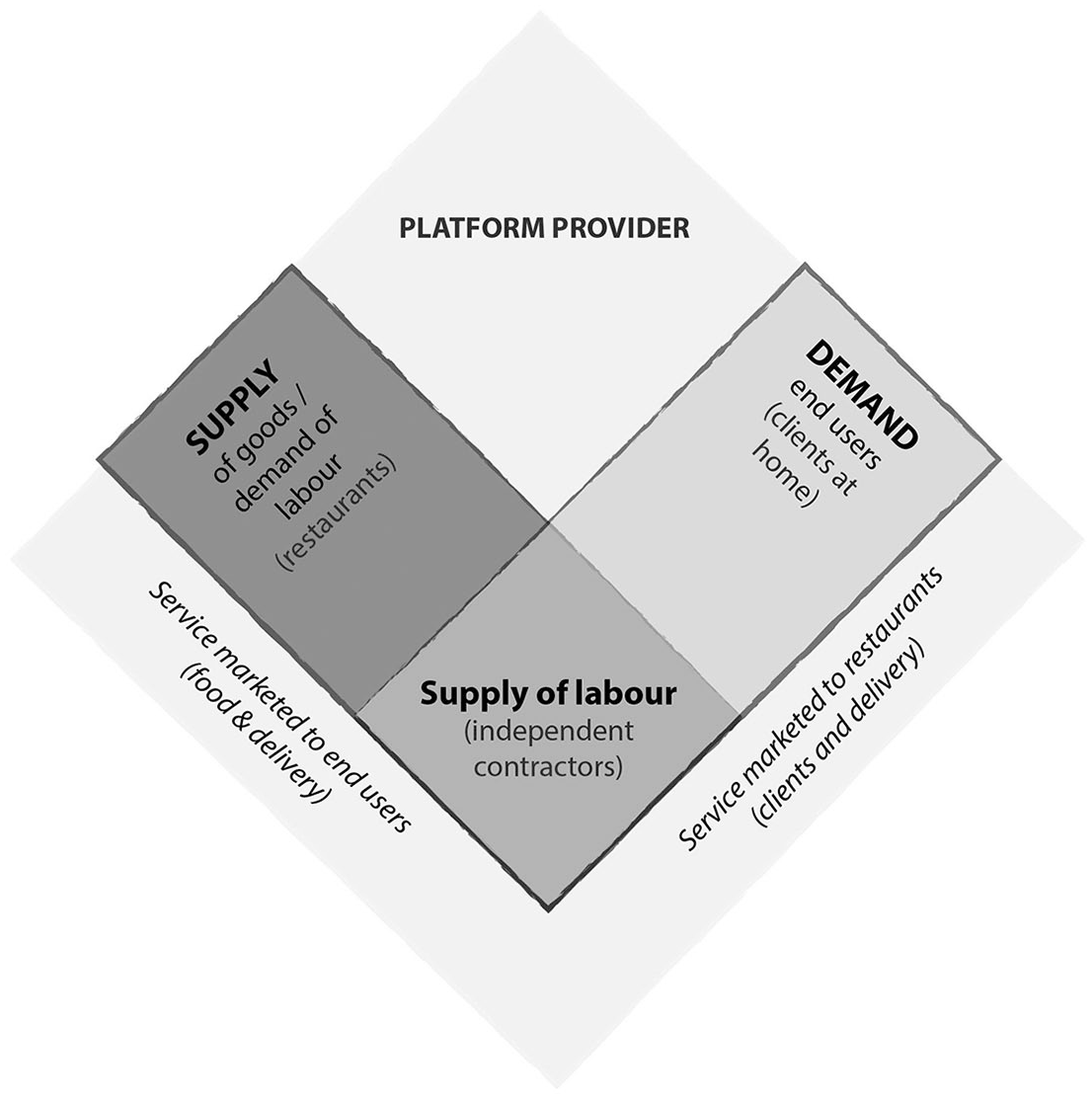
Four-sided model of food delivery platforms (author’s own elaboration).
Workers log onto smartphone apps to receive delivery jobs allocated by location. Workers experience information asymmetry with respect to the platforms, as companies usually maintain secrecy on the mechanism of allocation of deliveries (Shapiro, 2018; Veen et al., 2019). Working time flexibility varies: while platforms promote it as a main advantage, in some cities couriers must sign up for shifts in advance. Using delivery platforms, restaurants can access a flexible labour force without management responsibilities and suppressing costs in low-demand periods. As a low value-added service, suppressing labour costs is a key profitability driver in food delivery. Labour costs are minimised by hiring couriers as independent or para-subordinate contractors, with different contractual models depending on national legislation. As contractors, couriers generally have no right to minimum wage, paid holidays or sick leave. 1 Moreover, this contractual status offers few, if any, protections from dismissal. Furthermore, most food delivery platforms tend to switch from hourly wages to payment-by-delivery over time, shifting enterprise risk on the couriers: if there is no demand, they are not paid, despite being available for work. Finally, couriers use their own bikes and smartphones, hence platforms save on structural costs.
Various types of ‘techno-normative forms of control’ (Gandini, 2019: 1041) ensure control of a geographically dispersed workforce (Shapiro, 2018; Veen et al., 2019). Workers can be monitored through GPS technology (Moore et al., 2017) and data collected used for performance management (Veen et al., 2019). The functioning of the algorithm cannot be scrutinised by workers, making it open to strategic use by the platform (e.g. to reward or disadvantage workers depending on their productivity or acquiescence) (Veen et al., 2019). Consequently, workers could be less inclined to take cohesive collective action against management for fear of retribution.
The operational model poses further potential constraints to the emergence of solidarity among workers. Platforms seek to establish individualised employment relations. Being classified as contractors means that gig workers are normally neither covered by collective bargaining nor entitled to union representation. Work activity is also organised as a non-collective process: on a day-to-day basis, workers interact almost exclusively with the app which allocates delivery jobs. This apparent individualism, coupled with the ‘invisibilisation’ of the managerial figure, may obfuscate the ‘reality of collective participation in the labour process’ (Martinez Lucio and Stewart, 1997: 53), undermining bases for collectivism. The spatial dispersal of work activity may also reduce chances for couriers to build social relations and forge a sense of shared identity.
Different levels of dependence on gig work may also impede consolidation of shared identities. Recent evidence (e.g. Broughton et al., 2018) suggests that gig workers may be segmented in terms of attachment to the job – with a small core relying on gig work as a primary income source, and a larger margin participating sporadically. This segmentation can create divisions in the ‘interests’ of different workforce components regarding remuneration models, contractual forms and attitudes towards ‘flexibility’, as well as in incentives to organise collectively to improve conditions.
Despite these obstacles, since 2016, mobilisations of gig workers across Europe have increased remarkably. Couriers of food delivery platforms have been at the forefront of this ongoing wave of collective action. This offers scholars the opportunity to interrogate theoretically and empirically the processes that underpin the emergence of solidarity ‘against the odds’ in this seemingly hostile context, and the mechanisms that connect the emergence of solidarity to different forms of collective action.
Defining the analytical lens: Solidarity, the labour process and collective action
The conceptualisation of solidarity – within and beyond work – and its links with mobilisation have been extensively debated in the literature, leading to some theoretical ambiguity. D’Art and Turner (2002: 11) define solidarity as a ‘community of interests, feelings and actions’. This understanding implies existence of shared material conditions among members of a group, and realisation that their improvement is best pursued collectively. Collective feelings of reciprocal sympathy and responsibility (Wilde, 2007: 171) expressed through specific forms of action, such as mutual support and preparedness to share resources with others through personal contribution (Stjernø, 2004: 2), are also central to the concept. Solidarity additionally implies that group members recognise their general shared condition and purpose, even when their immediate, individual interests are not fully coincident (Hyman, 1999; Kolers, 2012).
In the context of labour relations, solidarity can be articulated at different levels – such as the workplace, the union or the broader working class (Bild et al., 1997). Working-class solidarity (i.e. solidarity among workers who acquire consciousness as a class for itself overcoming professional, sectoral and even national divisions) has been understood both as the basis of labour militancy (Fantasia, 1988) and as a central power resource for unions. To understand how solidarity can emerge in the specific setting of the gig economy, it is, however, more appropriate to focus on the articulation of solidarity at workplace level. Workplace solidarity is usually described as a group attitude developed in the work context and rooted in workers’ interactions (Fantasia, 1988), shared experiences (Hodson et al., 1993), feelings of mutual dependency (Atzeni, 2010) and collective identity (Bild et al., 1997). As a minimum, solidarity entails group cohesion and collective activities of mutual defence and reciprocal support (Dixon et al., 2004; Hodson et al., 1993), which arise from workers’ recognition of their shared condition and through which they pursue their collective goals at work.
Solidarity at work is hereby defined as a condition where workers develop collective feelings of reciprocity and responsibility towards one another on the basis of an awareness of their ultimately shared interests and purpose – and are prepared to act upon such feelings through solidaristic actions. Atzeni (2010: 28–29) argues that such forms of embryonic solidarity are commonplace at workplace level, where workers develop a sense of collective identity distinct to management (Fantasia, 1988: 108). Embryonic solidarity is thus the basis for the emergence of active solidarity – where the preparedness to act actually translates in collective action (Atzeni, 2010: 28–29).
Following Atzeni (2010), this article argues that the emergence of active solidarity among workers is rooted in the inherent contradictions of the capitalist labour process. At the basis of the labour process perspective (Braverman, 1974) is the idea that managerial action must be understood in the context of capital–labour relations as motivated by employers’ attempts to control and stabilise the ‘unruly’ factor of production (i.e. living labour). This push for the extraction of value from workers through control practices in the labour process necessarily generates contradictions ‘which surface at the point of production as conflicts between workers and management’ (Cohen, 1987: 7). On this basis, the labour process becomes ‘the site where both the opposition of labour to capital and yet its dependence on it are constantly reproduced and solidarity linkages established’ (Atzeni, 2010: 19). The formation of ‘active’ solidarity refers thus to the process whereby workers, by becoming aware of the collective nature of the labour process, develop consciousness of their shared interests and come to act collectively on that sense of unity and mutual dependency, in opposition to management, overcoming the apparent individualisation of their day-to-day work experiences (Martinez Lucio and Stewart, 1997).
The extent to which specific labour process features – such as the collectivism or individualism of work organisation, the type of control and the level of autonomy that workers experience – affect solidarity has been extensively debated (Hodson, 1997; Hodson et al., 1993; Vallas, 1987). In the individualised and dispersed labour process of the gig economy, the ‘material’ foundations for solidarity could be expected to be weaker than in traditional ‘Fordist’ workplaces characterised by workers’ physical compresence, where the ‘collective’ nature of the labour process may be more easily apparent. The internal differentiation of the workforce on the basis of contractual status, labour market attachment and skills, and the associated intensification of intra-class competition in the post-Fordist era also potentially undermine the consolidation of shared workers’ identities (cf. Hyman, 1999; Touraine et al., 1987). The internal segmentation of the gig economy workforce might thus pose an additional obstacle to solidarity.
In line with Fantasia (1988) and Atzeni (2010), however, this article adopts a non-deterministic conceptualisation of the linkages between solidarity, the labour process and the workforce features. This article holds that the bases of worker solidarity lie in the structural contradictions originating from the labour process, which emerge at the point of production and become manifested despite the individualism of platform-mediated work organisation. At the same time, the development of solidarity is conceptualised as a historically specific, evolving process, underpinned by workers’ agential practices, where different context-specific factors can combine to explain its emergence and manifestation (Atzeni, 2010: 32). The analysis of the cases will thus highlight several contextual conditions and mechanisms, internal and external to the labour process, which contributed to facilitating, mediating or hindering the emergence of active solidarity among gig workers beyond the triggers and obstacles posed by features of the labour process. These include the availability of ‘free spaces’ (Polletta, 1999); workers’ framing activity (Hyman, 1999; Simms, 2012); the acquisition of consciousness through action (Fantasia, 1988); management’s counter-mobilisation strategies (Atzeni, 2010; O’Sullivan and Turner, 2013); and unions’ involvement (Dixon et al., 2004).
The last theoretical issue concerns the multiple forms through which active solidarity is expressed. As the definition above highlights, active solidarity implies cohesive action. Collective action – such as strikes and other forms of collective conflict – has been historically focused upon as the main expression of workers’ active solidarity, and the privileged site for its study (cf. Dixon et al., 2004; Fantasia, 1988). This study shares this interest, as it focuses on cases where mobilisations did take place to investigate how within the gig economy embryonic solidarity can be turned into active solidarity. However, forms of solidaristic action other than collective action are possible – including low-key, day-to-day forms of conflict, resistance and mutual support (cf. Hodson, 1997; Mulholland, 2004). Especially in the context of ‘digital’ labour relations, new channels for expressing grievances and taking action acquire importance, such as social media, online forums and messaging apps (Lee and Staples, 2018).
Finally, it is also possible that embryonic solidarity might not be activated at all (Atzeni, 2010), and forms of solidaristic action not manifested. While embryonic solidarity is the conditio sine qua non of any process of collective action in labour relations, solidarity is not sufficient for mobilisation. Hence, the forms through which solidarity is expressed, and the conditions that shape how encompassing and durable these are, must be studied contextually. Building on this theoretical apparatus, this article investigates the processes through which solidarity emerges in the ‘unlikely’ context of the gig economy labour process, and the conditions and agential practices that facilitate, hinder and shape its form of expression and reach in different contexts.
Case selection, methods and data
This study compares two qualitative case studies (Yin, 2013) of gig workers’ mobilisation as sites to investigate the process of solidarity formation: the mobilisation of couriers of the food delivery platform Deliveroo in the cities of London and Brighton in England, and of the food delivery platform Foodora in the city of Turin in Italy. Both cases are empirically salient as they were the first episodes of gig workers’ mobilisation in their respective countries, generating considerable public debate. Theoretically, both cases can be regarded as ‘unlikely’ instances of mobilisation, given the potential constraints to the emergence of active solidarity identified above. Hence, they are well suited for testing prior theoretical expectations regarding the links between the labour process, solidarity and collective action. Case comparison allows the study of the nexus between similar underlying labour processes, different contextual conditions and the forms of solidarity expression; and offers analytical leverage to identify the common, theoretically relevant conditions affecting solidarity activation across distinct contexts.
Data sources include semi-structured in-depth interviews; informal interviews; participant observation of four riders’ meetings; and analysis of documentary and social media sources (see online Appendix 1). The authors conducted 18 qualitative semi-structured interviews (between 30 and 120 minutes long) with 15 gig workers and trade unionists directly involved in various capacities in the mobilisations in Turin, Brighton and London between October 2016 and November 2018 (10 in Italy, eight in the UK); and nine interviews with gig workers and unionists with knowledge of the cases and involved in similar campaigns in the two countries (see online Appendix 1). To guarantee anonymity, interviewees are identified with a code throughout the text.
Participants were recruited through purposive and snowball sampling (Yin, 2013), drawing on the authors’ connections in labour activist networks to facilitate contact with gatekeepers in riders’ groups or unions. The sample is numerically limited and not representative of the whole workforce. As the research aimed to understand the emergence of solidarity in and through action, the authors deliberately recruited interviewees involved in the mobilisations as their perspectives were deemed the most relevant to the research goals. However, participants with diverse involvement levels (courier-organisers, participants in mobilisations, trade union reps) were recruited to compare perspectives. The focus on mobilisation participants and the limited evidence base implies that the findings are partial and cannot shed light on the motivations of non-participating workers. All interviewees bar three were men, reflecting the male-dominated workforce composition; all workers interviewed were cyclists; and only one had a migrant background. While reflective of the profile of participants in mobilisations in the Italian case, the under-sampling of moped drivers and migrant workers represents a shortcoming for the UK case.
The authors were never directly involved in the mobilisations but followed an ‘engaged’ approach to research (Milan, 2014), building a relationship of trust with the interviewees while defining clear boundaries to maintain critical distance. The authors’ ‘partisan’ stance towards the riders’ grievances facilitated connection with informants (see Fantasia, 1988: 247–254). The authors engaged in repeated interactions and informal interviews with some key informants over a two-year period. This ongoing exchange of perspectives facilitated building of trust, allowed for a longitudinal understanding of the cases and increased trustworthiness of findings (Harrison et al., 2001). The authors’ engaged positionality also involved sharing knowledge of the sector with interviewees and contributing to increasing the visibility of their mobilisations to non-academic audiences (see, for example, Tassinari and Maccarrone, 2017a). These activities attempted to ensure relevance of research knowledge for subjects involved (Milan, 2014), and to fulfil ethical commitments to reciprocity (Harrison et al., 2001).
To validate emerging insights, interviews were complemented by the analysis of over 500 documentary sources (newspaper articles, press releases and posts on the riders’ groups’ Facebook pages) and by participant observation of four riders’ assemblies. In these settings, informal interviews (Spradley, 1979) were conducted with several couriers besides those interviewed formally. The authors additionally conducted two expert interviews with researchers who had conducted ethnographic research on the same cases (see online Appendix 1).
Data analysis followed an open-ended inductive approach, based on iterative stages of thematic coding of interviews, field notes and documents in NVivo (Version 11). After the first analysis stage, key emergent themes deemed of theoretical relevance (e.g. sources of antagonism in the labour process; role of ‘free spaces’ and social relations, presence of unions, workforce differentiation and managerial counter-action) were followed up in subsequent interviews.
Evidence: Conflict and protest in Deliveroo and Foodora
The two cases of gig workers’ mobilisation are now introduced in turn. The Deliveroo workforce in London comprises of thousands of riders, divided between cyclists – predominantly young, white and British, and moped drivers – predominantly migrant workers and on average older. The first protest of London Deliveroo workers started in August 2016, following the announcement of a change in payment policy from hourly wage to piecework payment. Around 150 moped drivers gathered outside Deliveroo’s head offices in London demanding the restoration of the hourly wage and were soon joined by many of their cyclist colleagues. The gathering turned into the first ‘unofficial strike’ of Deliveroo workers in the UK. Hundreds of couriers logged out from the app, causing work stoppages that lasted on-and-off for six days. They held mass gatherings outside the company’s offices, flying pickets around the city to raise visibility, and coordinated reputational attacks against Deliveroo’s social media pages.
The protest attracted considerable public attention, and the company eventually agreed not to unilaterally impose the new payment system, instead starting an opt-in trial with one month of guaranteed wages. Attempts at union organising only started after this first mobilisation episode. The IWGB (Independent Workers Union of Great Britain) – a rank-and-file independent union already active in the delivery sector in London – intervened to support the workers during the protests, and then started a longer-term campaign for unionisation. Since August 2016, episodes of strikes and demonstrations of Deliveroo workers have taken place in several other cities – first in Brighton, then across most of the UK – where workers have taken action to denounce low pay, the lack of sufficient work resulting from the excessive size of the workforce, and the lack of coverage for health and safety risks. Organising and mobilisation of food delivery platform workers, supported by rank-and-file unions such as the IWGB or IWW (Industrial Workers of the World), continue across the UK to the present day (May 2019).
In Italy, around 300 couriers worked for Foodora in Turin when the first protest broke out in October 2016. At the time, the couriers, exclusively cyclists, were mostly Italian young people. A group comprising almost three-quarters of the workforce had previously presented a letter with requests to the company, but as in London, it was a change in contractual terms which led to the mobilisation. Indeed, in September 2016, Foodora began hiring riders on a new piecework payment system. When the extension of this pay model to the whole workforce was announced, a group of couriers staged a ‘proto-strike’ in response. The riders ‘unlogged’ from the app en masse; this was combined with flying pickets around the city, a coordinated online campaign targeting the company’s social media pages, and invitations to consumers to boycott the app. Three demands were advanced: a higher hourly rate and an end to piecework payment; a change in contractual terms to be recognised as employees; and an end to the company’s victimisation practices against perceived ‘troublemakers’. The protests were self-organised by the workers with some support from the grass-root union SI-COBAS. Unlike in the UK, no unionisation effort took place subsequently. 2
Following the high media attention, Foodora eventually conceded an increase in the delivery fee and some discount agreements for bike repairs. Yet, the company refused to meet the more substantial demands: the reinstatement of hourly wages and the reclassification of its riders as employees. Furthermore, the contracts of some of the riders most active in the protest were not renewed. A group continued nonetheless to organise – both within Foodora and in other delivery companies – forming a self-organised collective. Subsequent protests and ‘proto-strikes’ were held in the following months, spreading also to the cities of Milan and Bologna, and continue to the present day (May 2019).
As these brief case histories show, the issues triggering the disputes and the ensuing dynamics of mobilisation were similar across the two cases. The main glaring difference relates to unions’ involvement in supporting couriers’ collective action – present in the UK but absent in Italy. The article now proceeds to analyse comparatively the conditions and processes which shaped the emergence of solidarity, its expression and its limits in the two cases, and the salient differences between them.
Solidarity in the gig economy
I’ve been thinking, […] how does the labour movement form when there is no shared space, like, physical space? But as long as there is a shared condition, as long as two people interact at some point and they find some way to communicate with each other, it doesn’t matter if there is no shared factory space, because there is a shared condition. Which is, the job is bullshit. (UK8)
The emergence of collective action suggests that, despite the individualised labour process, solidaristic ties among a section of gig workers consolidated in both contexts. The process of solidarity development in the two cases is now reconstructed by investigating the bases of collective antagonism intrinsic in the contradictions of the app-mediated labour process; the mechanisms and conditions that shaped how solidarity was manifested and consolidated over time; and the limits of its reach.
Sources of antagonism in the labour process
In line with our theoretical expectations, the labour process and work organisation model of app-based delivery work presented several contradictions leading to the emergence of shared grievances among riders and to the manifestation of antagonism towards management.
The shared basis for antagonism was demonstrated by the cross-case similarities in the ‘trigger points’ (O’Sullivan and Turner, 2013) behind the initial protests – a shift to piecework payment or a sudden drop in earnings arising from the excessive workforce size, which provided a focal point for expressing discontent. Besides contesting earnings insecurity, other common grievances were expressed: the absence of safety nets – such as sick pay or adequate injury insurance; excessive work intensification; and perceived dissonance between the rhetoric of ‘flexibility’ promoted by the companies and the reality of the work process – where effective flexibility was limited and mainly experienced as insecurity. In both cases, grievances also included perceived arbitrariness in management methods, targeting the asymmetric distribution of information between the platform and the workers (Shapiro, 2018; Veen et al., 2019). The couriers contested lack of transparency in: the criteria of shifts or delivery allocation; the information they received about incoming orders; whether or not GPS data were used for performance management; and the continuous changes in the functioning of the app’s algorithm: Here nothing is regulated, so things happen like: OK, I like you therefore you get to work; I don’t like you hence you don’t work. We are back in the 19th century, this is effectively a gangmaster system …. (IT1)
The common grievances across the two cases suggest that the underpinning features of the gig economy labour process trump contextual differences in shaping the emergence of antagonism. Furthermore, the fact that these dispersed grievances came to be articulated as common demands posed to the platforms testifies that part of the workforce gained awareness of their shared interests as gig workers, and became willing to act upon them. The analysis has highlighted various mechanisms and conditions that facilitated or obstructed the emergence and consolidation of this active solidarity. These are now discussed in turn.
Facilitating mechanisms for the emergence of solidarity
The analysis identified two key mechanisms, common to both cases, that facilitated the emergence of solidarity: overcoming individualisation and developing consciousness in action. These processes and the contextual factors which prompted them are reconstructed below.
Overcoming individualisation
Developing a sense of collective identity and shared interests has been identified as a key aspect for the emergence of workers’ solidarity (Atzeni, 2010; Fantasia, 1988; Simms and Dean, 2015). In a context of spatial dispersion and individualised interaction with the app, overcoming individualisation was crucial to develop solidarity between couriers. Two central factors enabled this: the availability of ‘free spaces’ and the existence and nurturing of social relations.
The literature identifies ‘free spaces’ as settings – either physical or virtual – partly free from the social control of authorities that allow groups to collectively organise and challenge the status quo by offering opportunities for protected interaction (Polletta, 1999).
The physical spaces where workers encountered each other face-to-face facilitated social identification processes. Workers took advantage of common delivery waiting points (sometimes called ‘zone centres’) in central squares, parks or outside busy restaurants as occasions to consolidate social ties. The digitalisation of managerial functions via the app meant that waiting points were mostly free from the direct managerial gaze. Common day-to-day acts of sharing and mutual support among workers expressed emerging feelings of reciprocity, creating that ‘embryonic solidarity’ which has been identified as the base for active solidarity (Atzeni, 2010). Later on, those same physical spaces facilitated the articulation of shared grievances, allowing riders first to exchange opinions and phone numbers and subsequently to distribute flyers, formulate demands and hold impromptu meetings: When there was that core group of cyclists, I would see the same people time and time again, every day, we would hang out in zone centre, and we would chat and shoot the shit and stuff, waiting for our next delivery … When it’s going tough in the zone it kind of works for itself. Because when there is less drops then people tend to gather. And that’s how the Brighton situation got kicked off because people were spending a lot more time with each other …. (UK7)
Virtual meeting spaces were also key to developing shared consciousness. In both cases, group chats on instant-messaging apps, set up to allocate shifts or discuss operational issues, started being used by workers to voice complaints. These virtual shared spaces provided a channel to start airing grievances and recognising them as shared beyond workers’ individual experiences, solidifying a sense of collectivity which would result in being fundamental for the mobilisation which would follow (cf. Atzeni, 2010). Subsequently, riders started their own WhatsApp groups to share concerns, coordinate and organise meetups, and offer each other support with concrete matters (e.g. punctures, accidents, problems with the app and shift swapping).
The existence and the nurturing of social relations – within and besides ‘free spaces’ – also emerged as a key factor facilitating the overcoming of isolation. In the UK, pre-existing social networks among couriers aided the initial process of consolidating solidarity. For example, the established local community networks of Brazilian moped drivers played a key role in orchestrating the first spontaneous protests and remained central in gathering numbers for following wildcat strikes (UK1, UK3, UK5, UK7; cf. Woodcock, 2016). Maintaining spaces of socialisation where riders could continue seeing each other, to socialise and discuss, was also identified by interviewees as crucial to ensure the sustainability of mobilisation over time. Both the riders’ collective in Turin and the IWGB in London and Brighton tried to facilitate the consolidation of social relations among workers (e.g. by organising public stalls, social events and cycle repair drop-ins where riders would have time to talk and ‘hang out’ with others).
Developing consciousness in action
Beyond the initial collective expression of grievances, interviewees highlighted that a sense of shared identity as gig workers was forged also through the experience of mobilisation itself – as highlighted already by Fantasia (1988). The experience of protesting in large numbers – outside the company’s offices and in the streets – empowered the participating workers, leading to a realisation that taking action was possible and, in some respects, also easy (IT1). This bolstered participants’ confidence and started changing perceptions of the uneven power relations: It was really powerful seeing all these workers together outside the headquarters back in August, all the mopeds and the cyclists there, there was such a buzz. It was fairly exhilarating, as well as very chaotic. I think in that moment we really felt like we could be quite powerful. (UK5)
The experience of taking action together was also identified as having led to a process of social identification among participants that went beyond the confines of the workplace itself: The fight led to the birth of a group of people who continued to be riders also after being fired from Foodora […] they became comrades in fight, who began to talk about lots of stuff, not only about the riders. (IT3)
The consolidation of a collective identity was supported by the frames that the riders adopted in the process of mobilisation (Snow and Benford, 1988). In both cases, couriers involved in the protests engaged in framing activity that sought to consolidate their identity as workers (Hyman, 1999; Simms, 2012), to counter the platforms’ rhetoric that sought to depict couriering as a fun activity done to keep fit or earn ‘beer money’, rather than as ‘real work’. This framing activity involved using their work uniforms and delivery boxes as visible props in protests to reinforce visibility and mutual recognition of couriers’ shared belonging to the same workforce and drawing attention in public communications to the physical risks that delivery work entailed. Interviewees reported that the process of seeing each other and being recognised as a collectivity of workers in public opinion and media representations helped to shape their sense of shared identity, and to consolidate a sense of antagonism against management (IT2, IT3, UK4).
Diversity of organisational forms
Besides these cross-case commonalities, the analysis also highlighted factors which played a facilitating role for the emergence of active solidarity in individual contexts but were not determinant for the development of solidarity across the two cases. The main difference pertains to the role of unions. In the UK, after the first spontaneous protests, the unfolding of the mobilisation was facilitated by the involvement of the rank-and-file union IWGB. In Italy, instead, the workers remained self-organised through an autonomous collective. The resources offered by the local social movement scene also played a different role in specific urban contexts. In Brighton and Turin, being able to access meeting and recreational spaces in established social centres provided valuable organising infrastructures that supported collective action (IT3, UK4). However, the availability of similar infrastructures was not highlighted as equally crucial in London. Overall, these findings suggest that whilst the availability of some organisational structures was important to sustain mobilisation and organising efforts over time, the development of active solidarity was compatible with considerable heterogeneity in organisational forms.
This section has reconstructed how, notwithstanding variation in organisational forms, solidarity among segments of the couriers’ workforce of two different platforms emerged through remarkably similar processes across distinct local contexts. The reach of solidarity and obstacles to its consolidation are discussed next.
The reach of solidarity and obstacles to its consolidation
Although estimates were hindered by the continuous expansions of the workforce, interviewees recognised that the protests only involved between 15% and 25% of the total workforce (UK4, UK5, UK7, IT2, IT10). Yet, these figures are significant in light of the hostile context and the strike trends in comparable sectors. 3 Interviewees highlighted that the profile of participants in collective action reflected the workforce segmentation between a smaller ‘core’ of regular riders and a larger, varying ‘margin’ of occasional riders, with the former being more involved due to stronger reciprocal social ties, greater reliance on earnings from gig work, and hence stronger grievances.
Ethnicity or migrant background also appeared to shape patterns of participation in mobilisation. In the UK, moped drivers of migrant origin – especially Latin American – constituted the backbone of participants in early spontaneous actions (UK3, UK4, UK5). However, those who went on to unionise in the IWGB and continued to mobilise have been primarily, although not exclusively, younger cyclists of British or EU origin (UK5, UK7). In Turin, the large majority of Foodora couriers at the time of the first strike were Italian. Over time, however, the riders’ collective faced difficulties in involving new couriers of migrant origins, seemingly more wary of joining the protests due to their vulnerable status (IT2, IT19). These findings highlight how internal workforce differentiation might shape collective attachments (cf. Touraine et al., 1987) and contribute to hindering workers’ recognition of their general interests besides particularistic circumstances (cf. Hyman, 1999).
However, as our theoretical section emphasised, strike participation is only one possible manifestation of active solidarity, which can otherwise be expressed through multiple types of cohesive action. For example, in Turin, more occasional or ‘newer’ workers often expressed their support through less risky forms of action – such as putting protest flyers inside bags of food delivered to clients or engaging in online ‘shitstorming’ of the company webpages (IT1, IT10). In both cases, some couriers also opted for not logging into the app during wildcat strikes or planned boycotts of the app, without physically joining in pickets or demonstrations.
The research further highlighted some common obstacles to the reach and consolidation of solidarity over time, arising from platforms’ deliberate managerial counter-action strategies and from features of the labour process (Atzeni, 2010). The use of opaque algorithmic management methods (Veen et al., 2019) allegedly allowed the platforms to change the allocation of workload and shifts to punish ‘troublemaking’ riders (IT2, IT3) or dampen discontent by dividing the workforce. In Brighton, interviewees reported that after the first mobilisations Deliveroo started allocating more delivery jobs to moped drivers, who started receiving sufficient income to quieten their low-pay discontent (UK4, UK7). Platforms also sought to create consent through bonuses – often specifically timed to coincide with planned protests – to defuse grievances and incentivise couriers to work (UK6).
As the initial spontaneous mobilisations morphed into longer-term campaigns for unionisation and change in contractual classification, the platforms also adopted communication campaigns to dissuade workers from unionising by depicting the protesters as a small minority of troublemakers (IT2, UK5, UK7). Both platforms spread promotional material alleging that a ‘majority’ of couriers were happy with their self-employed status (e.g. Deliveroo, 2017; Foodora, 2018 quoted in Russo, 2018), and sought to delegitimise demands for more secure contracts by depicting these as threats to riders’ autonomy and ‘self-entrepreneurialism’ – a discourse that seemingly had traction on some workforce segments (UK7, UK10). 4 While awareness of shared interests among couriers on issues of earnings and safety might have been easier to articulate, the issue of contractual status could create potential barriers to the consolidation of encompassing solidarities. The high turnover rate, aggravated by the platforms’ recruitment practices, also posed challenges for long-term organising efforts. As the original core of protesters was diluted, social relations became in some cases harder to sustain, and the companies could more easily apply ‘divide and rule’ tactics between workers who did not know each other well.
However, the longitudinal analysis of the cases over 2016–2019 highlights that obstacles to the reach of solidarity were not insurmountable. In both cases couriers have managed to keep up mobilisation and organising efforts over time. This is evidenced by the several strikes and protests held in Turin over 2017–2019 led by the riders’ collective (now encompassing couriers of several platforms); by the emerging coordination of actions between Deliveroo and UberEats couriers, most recently in the October 2018 fast food strike in London; and by the ongoing legal challenges that the IWGB in London and various former Foodora couriers in Turin have been leveraging against the respective companies, supported by collective fundraising efforts. These findings indicate that while the balance of power between platforms and workers continues to favour the former, managerial counter-action simultaneously reproduces the conditions for new antagonisms, creating a cycle of ongoing contestation (Atzeni, 2010).
Discussion and conclusions
This article contributes to and extends the literature on workplace solidarity through an investigation of how solidarity can emerge and be manifested in the empirically novel context of the gig economy. Figure 2 summarises the processes and conditions which facilitated the emergence of active solidarity in the two cases analysed; the factors which hindered its reach and consolidation; and its varied forms of expressions. The theoretical and empirical implications of the findings are now discussed.
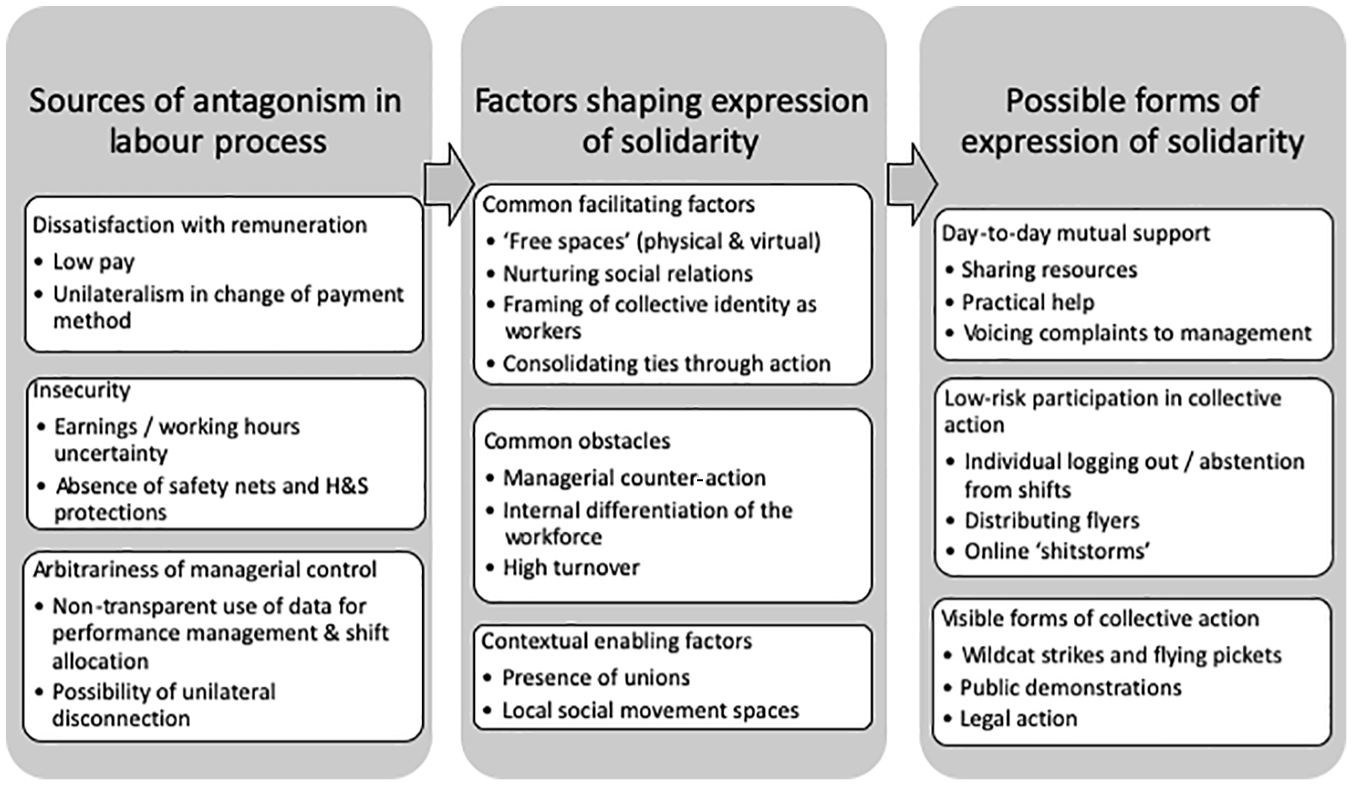
Solidarity in the gig economy: summary of findings.
First, the article demonstrates and advances the analytical value of the labour process perspective both in understanding workers’ solidarity and mobilisation (cf. Atzeni, 2010), and in conceptualising work in the gig economy (cf. Gandini, 2019; Veen et al., 2019). In line with insights by Atzeni (2010), the analysis shows that the emergence of active solidarity is linked to the inherent contradictions of the capitalist labour process. In the gig economy, antagonism against management and active solidarity arise both from the process of valorisation which platforms adopt (manifest in workers’ commonplace dissatisfaction with remuneration and insecurity), and from workers’ experiences of opaque managerial control, intensified by the use of algorithmic management methods (Shapiro, 2018; Veen et al., 2019).
The article further advances our understanding of the labour process in the gig economy, by highlighting the ambiguous and contradictory nature of workforce control (Thompson and van den Broek, 2010) leveraged through technological and contractual means. On the one hand, opaque managerial techniques and information asymmetries between the platforms and the workforce help the companies to maintain control of ‘marginally attached workers who are geographically dispersed’ (Shapiro, 2018; Veen et al., 2019: 14). On the other, the issue of control can become a trigger of mobilisation, while the invisibilisation of the managerial figure (Gandini, 2019) allows workers to socialise and organise in spaces at least partially free from the managerial gaze. Similar contradictions arise from the platforms’ classification of workers as independent contractors. On the one hand, this strengthens platforms’ coercive power, by facilitating dismissal and locking them out of traditional collective voice channels such as collective bargaining. On the other, the use of these contracts reduces the platforms’ formal degree of control over the workforce (Veen et al., 2019) and paradoxically allows workers to bypass restrictive strike regulation which applies to employees in contexts like the UK. These findings demonstrate the ever ambiguous and incomplete nature of employer control over living labour, even in the context of highly unbalanced power relations.
Second, the analysis contributes to advancing an agential understanding of the emergence of workplace solidarity. The findings show that far from being mechanistic, the consolidation of active solidarity is a context-specific process (cf. Atzeni, 2010; Fantasia, 1988), and that agential practices are central in forging collective identity and overcoming the obstacles posed by capitalist work organisation. By showing the diversity of forms through which solidarity can be manifested in the gig economy, the article further contributes to nuancing our conceptualisation of solidaristic action in hostile work contexts (cf. Mulholland, 2004), and reinforces the importance of not equating the absence of overt mobilisation with anomie. Rather than conceiving it as a dichotomy of presence/absence, our analysis suggests that the expression of solidarity, in the gig economy and beyond, is best theorised as a continuum – which can range from day-to-day behaviours of reciprocity embodying the collective nature of the labour process (e.g. mutual help and support among couriers), to individual participation in low-risk acts of resistance and contestation (e.g. abstention from work, online action inflicting reputational damage), to more ‘conventional’ forms of collective labour mobilisation (e.g. protests, wildcat strikes, pickets).
Lastly, the article contributes to shedding light on the connections between workplace solidarity and unionism. Even though the gig economy still largely lies outside the confines of conventional collective bargaining and unionisation patterns, the analysis shows that this does not constitute an insurmountable obstacle to the emergence of solidaristic commitments and collective action among workers. Rather, the consolidation of active solidarity is possible even in the absence of institutionalised collective representation channels, and compatible with considerable heterogeneity in organisational forms, from rank-and-file unions to self-organised workers’ collectives. Without contradicting the insights of the rich literature on the reciprocal links between solidarity and unionism (cf. Dixon et al., 2004; O’Sullivan and Turner, 2013; Simms and Dean, 2015), these findings reinforce the importance of analysing concrete processes of the emergence of workers’ solidarity also beyond the confines of union-organised labour (Atzeni, 2010; Fantasia, 1988). At the same time, the British case shows that unions can be enablers of solidarity in the gig economy, despite the presence of long-standing obstacles to union intervention such as workers’ precariousness and the lack of institutionalised collective bargaining channels. Arguably, unions’ capacity to adapt their strategies and action repertoires to the specific context of the gig economy will be key in determining whether they will be able to act effectively in this difficult terrain.
In terms of limitations, the evidence base did not allow for systematic exploration of the relationships between gig workers’ individual circumstances and characteristics; their differentiated reliance on gig work; the solidaristic attachments they developed; and the solidaristic action they were willing to take. Future research should further investigate these relationships, focusing in particular on the potential for long-term solidarity to extend to those segments of the gig workforce that might perceive stronger benefits from ‘flexibility’ and downplay issues of ‘security’; and to the most vulnerable components. In particular, the extent to which platforms reproduce racialised and gendered hierarchies to leverage control over vulnerable populations (cf. van Doorn, 2017: 908), and how such hierarchies are reflected in the solidaristic ties articulated amongst gig workers, remains to be further explored.
Overall, this study has shown that despite the obstacles posed by some features of the platform model of work organisation, it is possible for workers to counterbalance the power disparities that characterise the gig economy by articulating active solidarity, which gives collective expression to the underlying antagonism of the labour process. Practically, this study raises hopes as well as doubts about the possibility of replicating similar experiences in other segments of the gig economy. Indeed, some elements of the work process that were crucial for the emergence of active solidarity among gig couriers, such as the presence of physical meeting points, pertain only to location-based platforms. Yet, virtual meeting spaces might be able to fulfil similar functions for online platforms (cf. Wood et al., 2018). The capacity of gig workers in the UK and Italy to overcome significant obstacles to the emergence of active solidarity, and the spread of similar mobilisation across several European countries in recent months, offer cause for optimism for the consolidation of workers’ solidarity – even in the ‘brave new world’ of gig work.
Supplemental Material
Supplemental_Material_WES862954 – Supplemental material for Riders on the Storm: Workplace Solidarity among Gig Economy Couriers in Italy and the UK
Supplemental material, Supplemental_Material_WES862954 for Riders on the Storm: Workplace Solidarity among Gig Economy Couriers in Italy and the UK by Arianna Tassinari and Vincenzo Maccarrone in Work, Employment and Society
Footnotes
Acknowledgements
We extend our warmest thanks to all our interviewees and research participants. Previous versions of this article have been presented at the workshop ‘Platform labour in the digital economy’ at the University of Milan (11 May 2017); at the workshop ‘The gig economy: deal or ordeal?’ at King’s College London (5 June 2017); at the 29th SASE conference at the University of Lyon (29 June – 1 July 2017); and at the 14th annual Historical Materialism conference in London (9–12 November 2017). We are grateful to all conference participants, to participants in Warwick Business School’s OHRM Paper Review Network, and to Bethan Bowett Jones, Roland Erne, Enrique Fernandez-Macias, Stefano Gasparri, Craig Gent, Darrah Golden, Daniela Leonardi, Guglielmo Meardi, Mary Naughton and Rebecca Prentice for the valuable comments.
Funding
The authors disclosed receipt of the following financial support for the research, authorship, and/or publication of this article: Arianna Tassinari gratefully acknowledges financial support received by the Economic and Social Research Council [grant number ES/J500203/1]; Vincenzo Maccarrone gratefully acknowledges the financial support provided by the Irish Research Council Government of Ireland Postgraduate Scholarship.
Notes
References
Supplementary Material
Please find the following supplemental material available below.
For Open Access articles published under a Creative Commons License, all supplemental material carries the same license as the article it is associated with.
For non-Open Access articles published, all supplemental material carries a non-exclusive license, and permission requests for re-use of supplemental material or any part of supplemental material shall be sent directly to the copyright owner as specified in the copyright notice associated with the article.
