



Abstract
This article uses data from the Labour Force Survey to examine the effect sexual orientation has on wages in Britain. In doing so it provides the first empirical investigation of the effect being in a same-sex legal partnership has on wages. The results show that gay cohabitees and lesbians face a wage premium compared to their heterosexual counterparts. Decomposition results show that for gay cohabitees this arises due to differences in observable characteristics, while lesbians not only earn significantly more due to differences in their observable characteristics, but they also receive a higher return for these characteristics. In contrast, although no significant difference in earnings is observed for men in a legal partnership, decomposition results suggest that legally partnered gay males should earn more due to differences in their observable characteristics, while there is also evidence that they face barriers to advancement to senior positions, or a glass ceiling.
Introduction
The past decade has witnessed significant changes to the law concerning the rights of homosexuals. Many developed countries have extended their anti-discrimination legislation to include sexual orientation and have changed their marriage laws to recognise same-sex civil unions (and, more recently, same-sex marriage). 1 Despite this, recent data from the British Social Attitudes Survey show that although there has been a dramatic improvement in public opinion towards same-sex relationships, there has not been the same shift in attitudes towards same-sex marriage (Park et al., 2013). 2 In light of this, this article uses data from the Labour Force Survey (LFS) over the period 2010 to 2015 to examine the effect being in a same-sex relationship has on wages and seniority levels in Britain.
Although over the years a body of research has developed that examines the effect being in a same-sex partnership has on earnings, due to the paucity of the data in this area much of this research uses data from the US. Despite this, a common finding of many of these early studies is that cohabiting same-sex males earn significantly less than their married heterosexual counterparts, while partnered lesbians earn significantly more than comparable heterosexuals. See, for example: Allegretto and Arthur (2001); Antecol et al. (2008); and Klawitter and Flatt (1998).
Building on these findings, this article contributes to the literature in this area in several distinct ways. First, it examines the extent to which the findings outlined above hold for Britain. Second, it carries out the first empirical investigation of the effect being in a same-sex legal partnership has on earnings. In doing so, two decomposition techniques are used to decompose the sexual orientation wage gap into a part that can be explained by differences in observable characteristics (e.g. education and labour market experience) and an unexplained component that captures differences in the returns to these characteristics (or differences in the monetary value employers place on these characteristics). The standard Blinder–Oaxaca decomposition is used to evaluate the sexual orientation wage gap at the mean of the wage distribution (see Blinder, 1973; Oaxaca, 1973), while a decomposition proposed by Firpo et al. (2009) is used to explore how the wage gap varies across the distribution of wages. To the best of our knowledge, the literature for Britain contains no attempt to evaluate the size of the sexual orientation wage gap at different points along the wage distribution. This is likely to be an important omission since the size of the gap is likely to vary across the distribution as the composition of the workforce changes.
The wage gap may also be influenced by the extent to which sexual minorities occupy senior positions within organisations, and in the final section this article examines whether sexual orientation acts as a barrier to advancement within a firm. Here empirical research is still scarce, although preliminary findings for Britain suggest that, for men at least, there is evidence of a gay glass ceiling, similar to that commonly faced by women. See, for example, Aksoy et al. (2018b) and Frank (2006). Although insightful, a limitation of these findings is that they fail to account for partnership status, and hence the final section extends the analysis to examine the role that partnership status plays in this setting.
The remainder of the article is as follows. The next section presents an overview of the literature on the effect sexual orientation has on wages. We then introduce the data and provide some preliminary descriptive statistics. The section following this describes the results, while the final section concludes.
Background and literature
Although a large literature exists that explores the effect non-productive characteristics have on earnings, most of these studies focus on the effects of gender and race. In comparison, research on the effect sexual orientation has on earnings, with perhaps the exception of the US, is still relatively scarce.
Much of the initial work in this area has been pioneered by Badgett (1995) who, in the absence of any direct information on sexual orientation, uses data from the US General Social Survey to infer sexual orientation from questions on previous sexual behaviour, such as whether an individual has had more than one same-sex partner in the past. This led to several follow-up studies that extend Badgett’s (1995) analysis to include additional waves of data and alternative measures of same-sex sexual behaviour. See, inter alia: Berg and Lien (2002); Black et al. (2003); Blandford (2003); and Carpenter (2007). These studies confirm Badgett’s initial results for males; that is, behaviourally gay men earn significantly less than their heterosexual counterparts. However, unlike Badgett (1995), who also finds that in some specifications behaviourally lesbian women earn less than their heterosexual counterparts, these later studies find that they earn significantly more.
Though insightful, a potential limitation of much of this early work is that it assumes past sexual behaviour can be used to inform current behaviour. However, one reason why few national surveys include direct questions on sexual orientation arises from concerns about how sexual orientation should be defined (Arabsheibani et al., 2005). 3 Some believe that a homosexual is an individual who self-identifies as homosexual, while others define it in terms of sexual practice. In addition, the potential for sexual orientation to affect earnings also relies on employers being able to distinguish gay males and lesbians from heterosexuals, despite the fact that unlike gender and race, sexual orientation is difficult to observe. Hence, although individuals may be willing to respond to questions about their sexual behaviour in a survey, they may be reluctant to disclose the same information to their employers. As a result, measures such as these may not be appropriate when trying to examine the effect sexual orientation has on wages, especially if this relationship relies on the interaction between employers and employees in the workplace.
In recent years, it has, however, become possible to derive sexual orientation through questions on a household’s living arrangements, which has led to a body of research that looks specifically at the effect being in a same-sex partnership has on earnings. An advantage of this approach is that it focuses on a group of individuals who are likely to be open about their sexual orientation in the workplace. Again, most of these studies originated in the US, where since 1990 it has been possible to identify whether someone is in a same-sex relationship using data from the US Census. See, Allegretto and Arthur (2001); Antecol et al. (2008); Clain and Leppel (2001); and Klawitter and Flatt (1998). Two findings have emerged from this research: cohabiting same-sex males earn significantly less than married heterosexual men, while cohabiting non-heterosexual females earn significantly more than their partnered counterparts.
One potentially relevant theory for explaining these findings is that they arise due to employer discrimination. Becker (1957) first introduced the concept of employer discrimination whereby employers attach a disutility to the employment of certain minority groups. However, this type of discrimination can arise even in the absence of prejudice if being a member of a certain group carries information about a worker’s productivity – a type of discrimination termed statistical discrimination. Here the argument stems from concerns about how easy it is to observe a worker’s true productivity in the workplace (Arrow, 1973; Phelps, 1972). Given this uncertainty, employers may use other characteristics (such as sexual orientation) to predict a potential employee’s productivity.
Another explanation for the effect sexual orientation has on wages, especially among couples, arises from work on household specialisation and the division of labour. In Becker’s (1991[1981]) model of the family, marriage allows one spouse to specialise on labour market activities and the other home production, enabling the former (usually the husband) to accumulate more market-specific human capital and ultimately earn higher wages. It follows from this that since unmarried men, including those who cohabit (since it is often considered less stable than marriage), cannot take advantage of this division of labour, productivity and wages should be lower as a result, providing one explanation for the widely observed male marriage premium. See, inter alia: Bardasi and Taylor (2008); Chun and Lee (2001); and Killewald and Gough (2013). Ribar (2004) provides a detailed review. 4
Building on this, Black et al. (2003) argue that if this specialisation is driven by a biological comparative advantage, with the husband as the ‘breadwinner’, while the wife focuses on work in the home, then for non-heterosexual couples the same division will not arise. Non-heterosexual men would then be expected to invest less intensely in market-orientated human capital than their heterosexual counterparts, while non-heterosexual females should be more market-focused.
However, Blandford (2003) argues that demand-side considerations may also be important. He asserts that if traditional male marriage is seen as a sign of stability and commitment, employers may provide a compensation premium to married men that is not afforded to their unmarried counterparts, while they may penalise marriage in females if they believe that a married woman’s productivity in the workplace will be affected by competing demands in the home. Blandford (2003) argues that if discrimination based on marital status exists, then the rejection of traditional gender norms (manifested as non-participation in heterosexual marriage) should benefit lesbians, while it will work to the detriment of gay males.
To date, there is little consensus in the literature as to the main cause of the sexual orientation wage gap. Badgett (1995) is one of the few studies to conclude that it is solely the result of workplace discrimination, while Black et al. (2003) argue that although their findings are consistent with Becker’s theory of household specialisation and human capital accumulation, they might also arise due to employer discrimination.
Other studies highlight the important role that couple-type plays in explaining the sexual orientation wage gap, although again conclusions are mixed. Antecol et al. (2008), for example, conclude that the observed wage advantage enjoyed by gay men relative to their cohabiting heterosexual counterparts arises due to differences in human capital accumulation, while the wage penalty suffered by gay males relative to their married counterparts remains unexplained. They stress that while discrimination may be responsible for this latter element, without more quantitative evidence they are reluctant to label it as such. Allegretto and Arthur (2001) find similar results, although they argue that the wage penalty experienced by gay men relative to their married counterparts arises due to the male heterosexual marriage premium.
This then raises the question as to whether being in a same-sex legal partnership has the same effect on earnings as it does for married heterosexual males, and the extent to which this is the case is investigated in what follows. To the best of our knowledge, only a handful of UK studies use any kind of decomposition technique to understand the effect sexual orientation has on wages, although they do not look explicitly at the effects of marital status. See, for example, Aksoy et al. (2018a); Arabsheibani et al. (2005); and Bryson (2017). Next, a more detailed overview of the data used in this article is presented, together with some simple summary statistics.
Data and descriptive analysis
Labour Force Survey (LFS)
This article uses data from the LFS over the period 2010 to 2015 to examine the effect sexual orientation has on wages in Britain. The LFS is a household survey, conducted by the Office for National Statistics, which has been carried out in Britain since 1973. Although the format of the survey has changed several times over the years, in 1992 it became a rotating quarterly panel and has continued thereafter in this format. In each quarter, about 40,000 households with approximately 100,000 respondents are interviewed, with each respondent being interviewed for five consecutive quarters. All household members aged 16 and over are included in the survey.
Since the aim of the LFS is to provide a comprehensive overview of the British labour market, the survey provides a rich source of information on each respondent’s demographic characteristics, level of education and details of their economic activity. An advantage of the LFS over other UK data sets is that from spring 1995 it has been possible to identify non-heterosexual couples. Those who are not married, but who are living with at least one other person, are asked whether they are living with someone as a couple, and if so whether they are living as an opposite or same-sex couple. Since 2006, data from the LFS has also allowed the identification of couples in civil unions. 5
To ensure a large enough sample of non-heterosexuals, in the analysis that follows, data were pooled from 2010 (Quarter 1) to 2015 (Quarter 4). Details of the household’s living arrangements were then used to create a sample of adults in employment who were either living with someone (cohabiting) or in a legal partnership (married/civil union). Real hourly wages were calculated by indexing gross hourly wages to 2010 prices. The sample was based on information provided by respondents when they first entered the survey, although they were asked about wages and hours worked the first and last time they were surveyed. This gave a final sample of 77,645 heterosexual legally partnered or cohabiting couples and 1165 non-heterosexual legally partnered or cohabiting couples.
An obvious limitation of this approach is that it was not possible to identify single non-heterosexuals and bisexuals. Although as already mentioned, using data on the former raises questions about how homosexuality should be defined and whether someone who is open about their sexual orientation in a survey discloses the same information to their employer.
Descriptive statistics
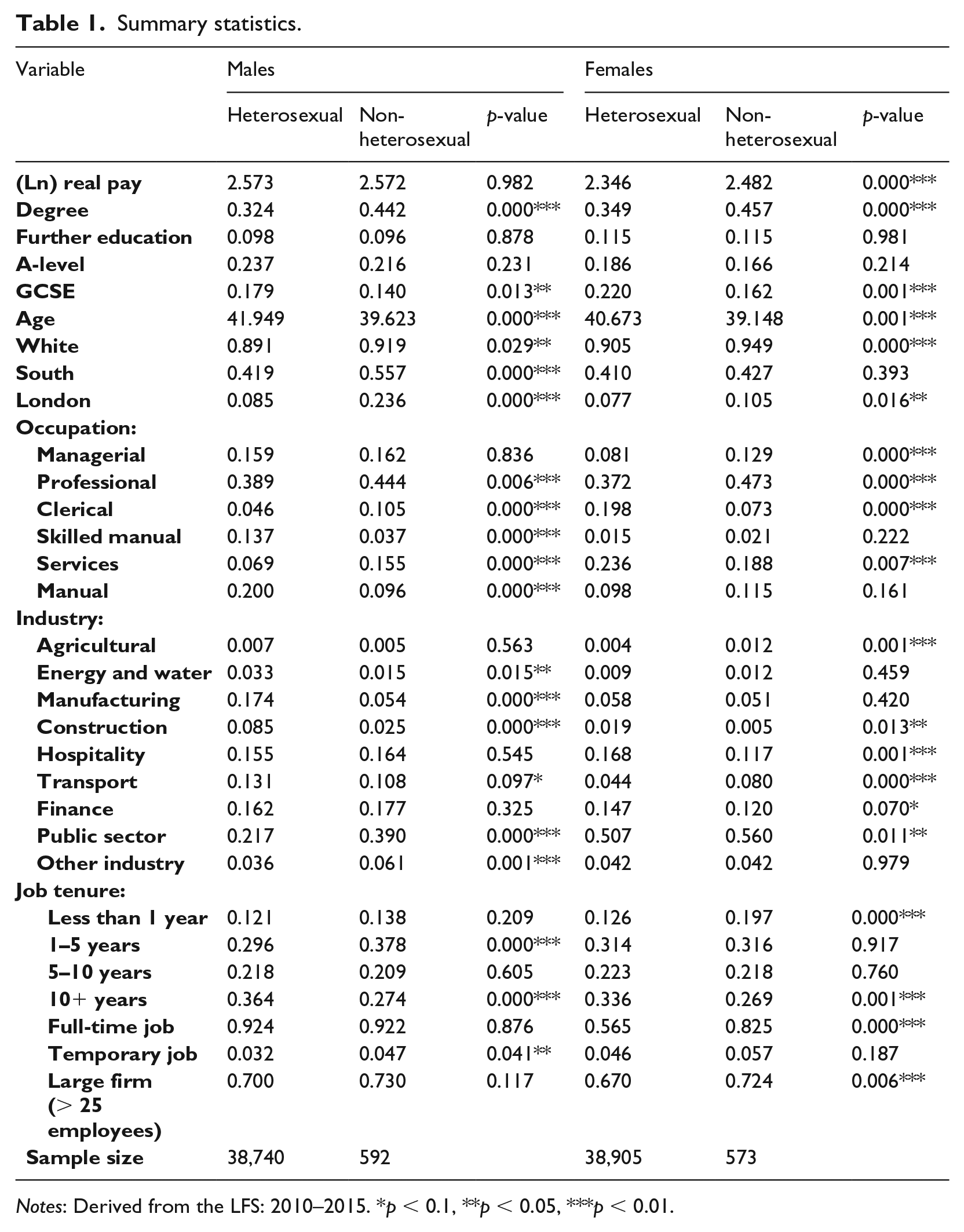
Table 1 provides summary statistics for the key variables of interest, disaggregated by sexual orientation and gender.
Summary statistics.
Notes: Derived from the LFS: 2010–2015. *p < 0.1, **p < 0.05, ***p < 0.01.
It shows that for males, there was no significant difference in wages between heterosexuals and non-heterosexuals, while lesbians earned significantly more than their heterosexual counterparts. Wang et al. (2018) observe a similar pattern for Britain using 2011 Workplace Employment Relations Study (WERS) data, while Arabsheibani et al. (2005) using data over a much earlier period (1996 to 2002) find that gay men and lesbians earn more than their heterosexual counterparts.
In terms of their demographic characteristics, non-heterosexuals were more highly qualified than their heterosexual counterparts; just over half of non-heterosexuals had a degree or some form of further education compared to just 44% of heterosexuals. They were also younger and tended to live in London or the South of England. With regards to their hours worked, female heterosexuals were significantly more likely to work part-time than any other group, which is reflective of the fact that women with children still tend to be responsible for the bulk of any childcare responsibilities within the home.
Differences also emerged in terms of industry and occupation of employment. Regardless of gender, just under half of non-heterosexuals were employed in professional occupations, compared to around one-third of heterosexuals. In contrast, heterosexual males were more likely to be employed in manual jobs in the manufacturing sector, while heterosexual females were more likely to work in the hospitality industry in service or clerical jobs.
Taken together, these initial findings highlight that large differences existed between heterosexuals and non-heterosexuals in terms of their observable characteristics and human capital accumulation. Despite this, for men at least, this did not lead to a significant gap in wages between heterosexuals and non-heterosexuals, and the reasons why this may be the case are investigated next.
Empirical methodology and results
Baseline specification
In order to look in more detail at the effect sexual orientation has on earnings, an ordinary least squares (OLS) regression was estimated, separately by sexual orientation and gender, of the form:

where
Following Blinder (1973) and Oaxaca (1973), the difference in wages between heterosexuals and non-heterosexuals was then decomposed into a part that can be explained by differences in observable characteristics and an unexplained part that arises due to differences in the returns to these characteristics. Although the literature often attributes this latter element to discrimination, it may also reflect differences in unobserved characteristics between the two groups. Another potential limitation of this approach is that the observable characteristics may themselves be the result of discrimination. It is, for example, conceivable that gay men and lesbians may avoid certain jobs if they believe that they will be treated unfavourably because of their sexual orientation. To mitigate this concern, occupation and industry of employment were included in the wage equations at a high level of aggregation (one-digit level).
Decompositions of this kind cannot be carried out without some assumption being made about the wage structure that would exist in the absence of any wage differences between the two groups. Here, it was assumed that the non-discriminatory wage structure could be estimated from an earnings function pooled over the entire sample (Neumark, 1988), and hence the decomposition can now be written as:

where
The parameter estimates from the OLS regression in equation (1) were largely consistent with those from other studies (see Table A1 in the online Appendix). In other words, human capital variables such as education and job tenure were statistically significant with a positive sign, while a pay premium was observed for employment in certain occupations and sectors, notably professional and managerial occupations and the finance sector. In terms of organisational structure, larger firms tended to pay more than smaller firms, while a premium was observed for private sector employment. See, Arabsheibani et al. (2005); Badgett (1995); Blandford (2003); and Wang et al. (2018).
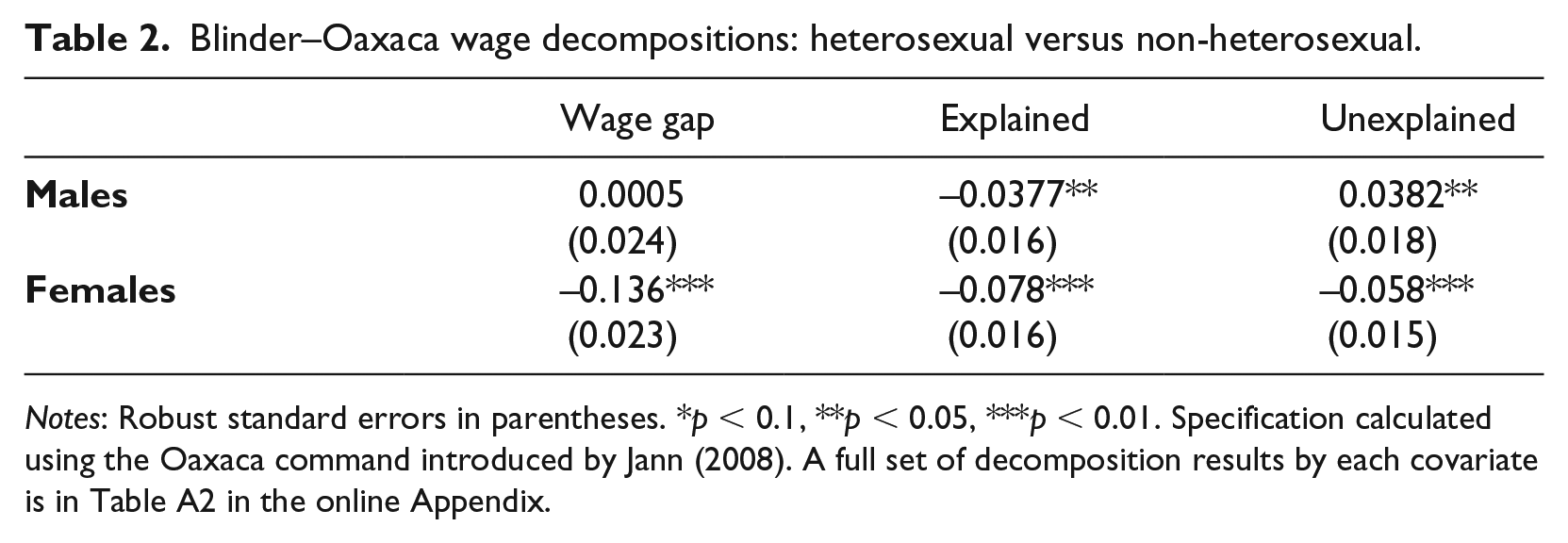
Despite this, the magnitude of the coefficients in the OLS regressions shows that compared to their heterosexual counterparts, gay men received a lower labour market return to certain productive characteristics, while lesbians received a higher return. These differences are confirmed by the Blinder–Oaxaca decompositions in Table 2. Here the aggregate decomposition results are reported for males and females separately, while a full set of results for each covariate separately is in Table A2 in the online Appendix.
Blinder–Oaxaca wage decompositions: heterosexual versus non-heterosexual.
Notes: Robust standard errors in parentheses. *p < 0.1, **p < 0.05, ***p < 0.01. Specification calculated using the Oaxaca command introduced by Jann (2008). A full set of decomposition results by each covariate is in Table A2 in the online Appendix.
For men, the decomposition shows that even though there was no significant wage gap between heterosexuals and non-heterosexuals, this occurred because the explained and unexplained part of the decomposition offset one another. In other words, although the explained part shows that gay males earned significantly more than their heterosexual counterparts due to differences in their observable characteristics, the unexplained part demonstrates that they received a lower return for these characteristics. In contrast, for women, the decomposition shows that lesbians not only earned significantly more than their heterosexual counterparts due to differences in their observable characteristics, but the unexplained part indicates that on average they also received a greater pay-off for these characteristics.
A comparison of these results with those of Arabsheibani et al. (2005) shows that for men, over the past decade, there has been a reduction in the unexplained part of the decomposition, while for women the findings are largely unchanged. If this unexplained part arose due to discrimination, then for males this difference may reflect an improvement in attitudes by employers towards same-sex relationships, while for females the level of positive discrimination remains unchanged.
However, the findings so far fail to account for partnership status. This is likely to be an important omission, especially considering changes to the law to allow a same-sex civil union (and more recently same-sex marriage). The effect being in a legal partnership has on wages is investigated next.
Partnership status: Cohabiting versus legal partnership
As already mentioned, over the years a large literature has developed which finds that married heterosexual men tend to earn more than their unmarried counterparts, while there is also a growing body of research which highlights that working mothers often encounter systematic disadvantages in pay relative to childless females – the motherhood penalty. 6 Despite this, little is known about the effect being in a same-sex legal partnership has on wages. As mentioned earlier, although there has been an improvement in public opinion towards same-sex relationships, there has not been the same change in attitudes towards same-sex marriage.
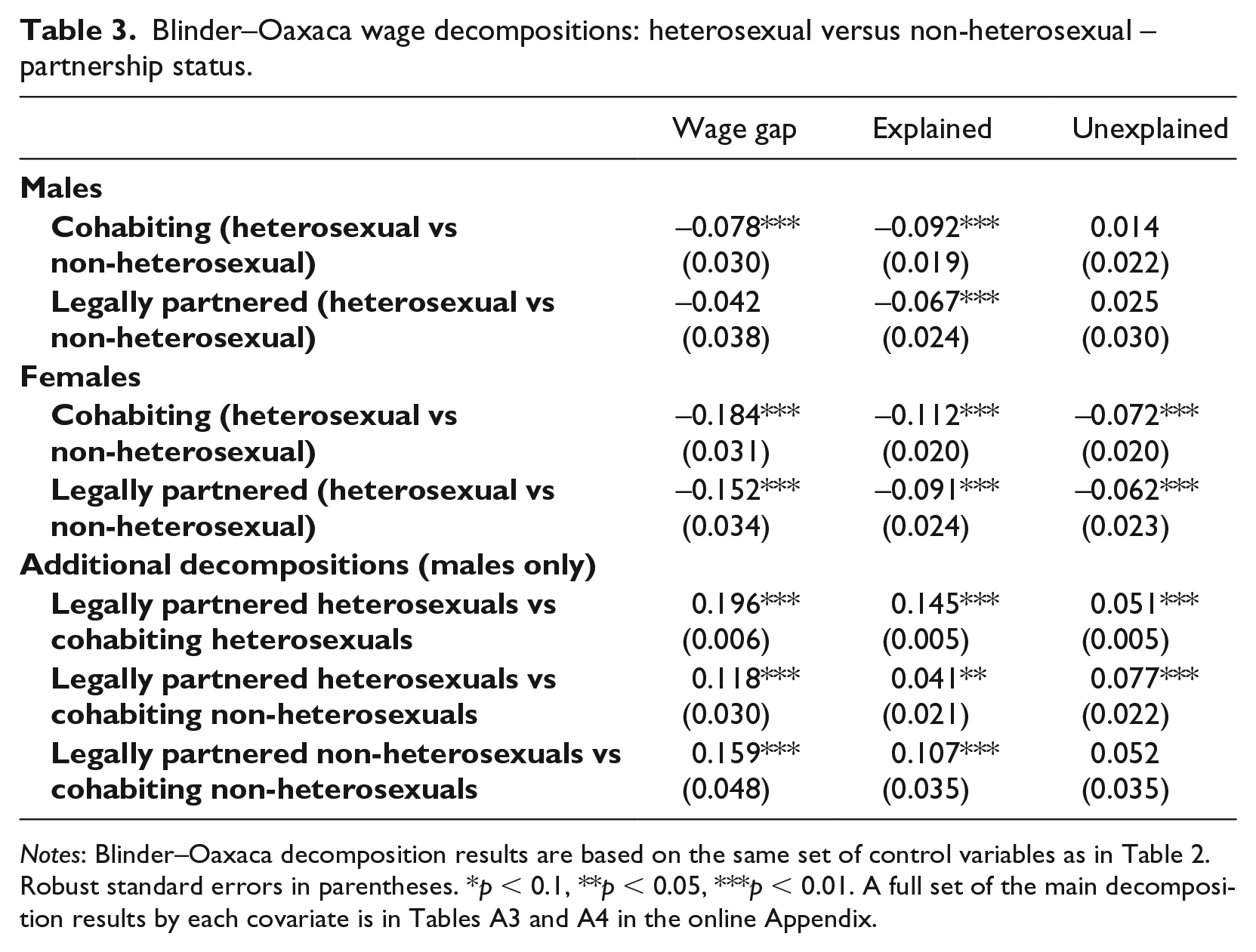
Distinguishing between couples who cohabit and those who are in a legal partnership is therefore likely to be an important contribution to the literature in this area, and the extent to which this is the case is investigated in detail in Table 3. Here the Blinder–Oaxaca decomposition was used to compare the earnings of cohabiting heterosexuals with those of cohabiting non-heterosexuals and the earnings of legally partnered heterosexuals with legally partnered non-heterosexuals. As before, findings are presented separately for males and females. A full set of results by each covariate is in Tables A3 and A4 in the online Appendix.
Blinder–Oaxaca wage decompositions: heterosexual versus non-heterosexual – partnership status.
Notes: Blinder–Oaxaca decomposition results are based on the same set of control variables as in Table 2. Robust standard errors in parentheses. *p < 0.1, **p < 0.05, ***p < 0.01. A full set of the main decomposition results by each covariate is in Tables A3 and A4 in the online Appendix.
For men, there was now evidence of a significant gap in wages between heterosexuals and non-heterosexuals. Gay cohabitees earned significantly more than their heterosexual counterparts due to differences in their observable characteristics. In contrast, for those in a legal partnership, although the size of the non-heterosexual wage premium was positive, it was still statistically insignificant. Despite this, the explained part of the decomposition shows that gay males were paid significantly more than their married counterparts due to differences in their observable characteristics.
However, perhaps of particular note is that after controlling for marital status in both specifications, the unexplained part of the decomposition was now insignificant. Since heterosexuals were more likely to be in a legal partnership than their non-heterosexual counterparts, it could be argued that the analysis in Table 2 essentially compared married men with gay cohabitees. If this was the case, then the unexplained part of the decomposition in Table 2 was capturing the positive returns to heterosexual male marriage, rather than any direct discrimination against gay men. Indeed, further analysis in Table 3 reveals that a significant part of the wage advantage experienced by married heterosexuals relative to those who cohabit (both heterosexuals and non-heterosexuals) remained unexplained, while the wage advantage experienced by legally partnered gay males relative to their cohabiting counterparts was the result of differences in observable characteristics.
For females, partnership status had no effect on the lesbian wage premium nor the size of the unexplained part of the decomposition. The lesbian pay premium and the unexplained part of the decomposition also remained when the sample was split by those with and without children. There was also evidence of a motherhood penalty for heterosexuals, although no such penalty existed for non-heterosexuals, while the results were also robust to restricting the sample to full-time workers. These results are not reported here but are available upon request.
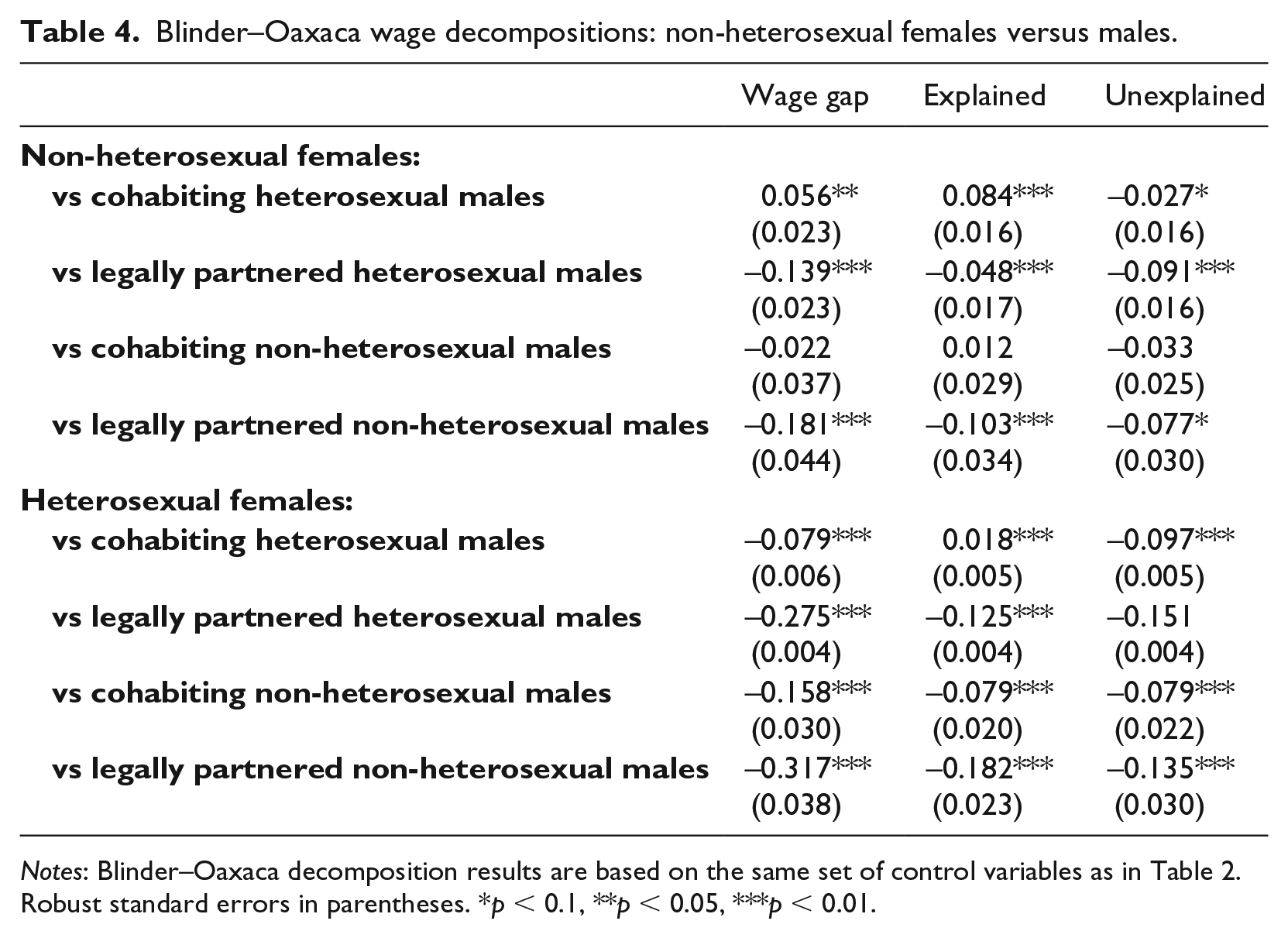
Finally, it should be noted that although lesbians earned significantly more than their heterosexual counterparts, they still faced a pay penalty relative to men. The extent to which this was the case is illustrated in Table 4, which looks at the size of the wage gap between lesbians and different groups of male workers.
Blinder–Oaxaca wage decompositions: non-heterosexual females versus males.
Notes: Blinder–Oaxaca decomposition results are based on the same set of control variables as in Table 2. Robust standard errors in parentheses. *p < 0.1, **p < 0.05, ***p < 0.01.
Table 4 shows that although lesbians earned significantly more than cohabiting heterosexual men, they earned significantly less than legally partnered males, while the wage gap between non-heterosexual women and gay cohabitees was insignificant. These findings arose, at least in part, due to differences in observable characteristics between the two groups, although the decompositions show that regardless of the specification, the unexplained part had a negative effect on female wages, especially when looking at the gap in wages between lesbians and legally partnered men.
Sexual orientation wage gap: Quantile regression
A potential limitation of the results so far is that the Blinder–Oaxaca decomposition restricts the analysis to a comparison of the sexual orientation wage gap at the mean of the wage distribution and ignores the possibility that the size of the sexual orientation wage gap may vary across the wage distribution.
Again, empirical research in this area is scarce, especially for the UK. Antecol et al. (2008), using data for the US, utilise a decomposition developed by DiNardo et al. (1996) to investigate the effect sexual orientation has on earnings across the wage distribution. They show that although on average a wage gap exists between heterosexuals and non-heterosexuals, the differences they observe are much smaller for top-earning men and women. However, a limitation of this approach is that it is computationally demanding, and the results depend on the order in which the decomposition is performed.
To avoid these issues this article employed a decomposition proposed by Firpo et al. (2009), known in the literature as the Recentered Influence Function (RIF) decomposition, to evaluate the sexual orientation wage gap at different points along the wage distribution. This approach makes use of the influence function (IF), which measures the influence of an individual observation on a distributional statistic. For example, for the mean µ = E(

where
Adding back the original statistic to the influence function gives the RIF:

Here, the RIF for the distribution statistic of interest

where, as before, the first term in brackets denotes the part of the wage gap that can be explained by differences in characteristics, while the remainder is the unexplained portion that is commonly attributed to discrimination.
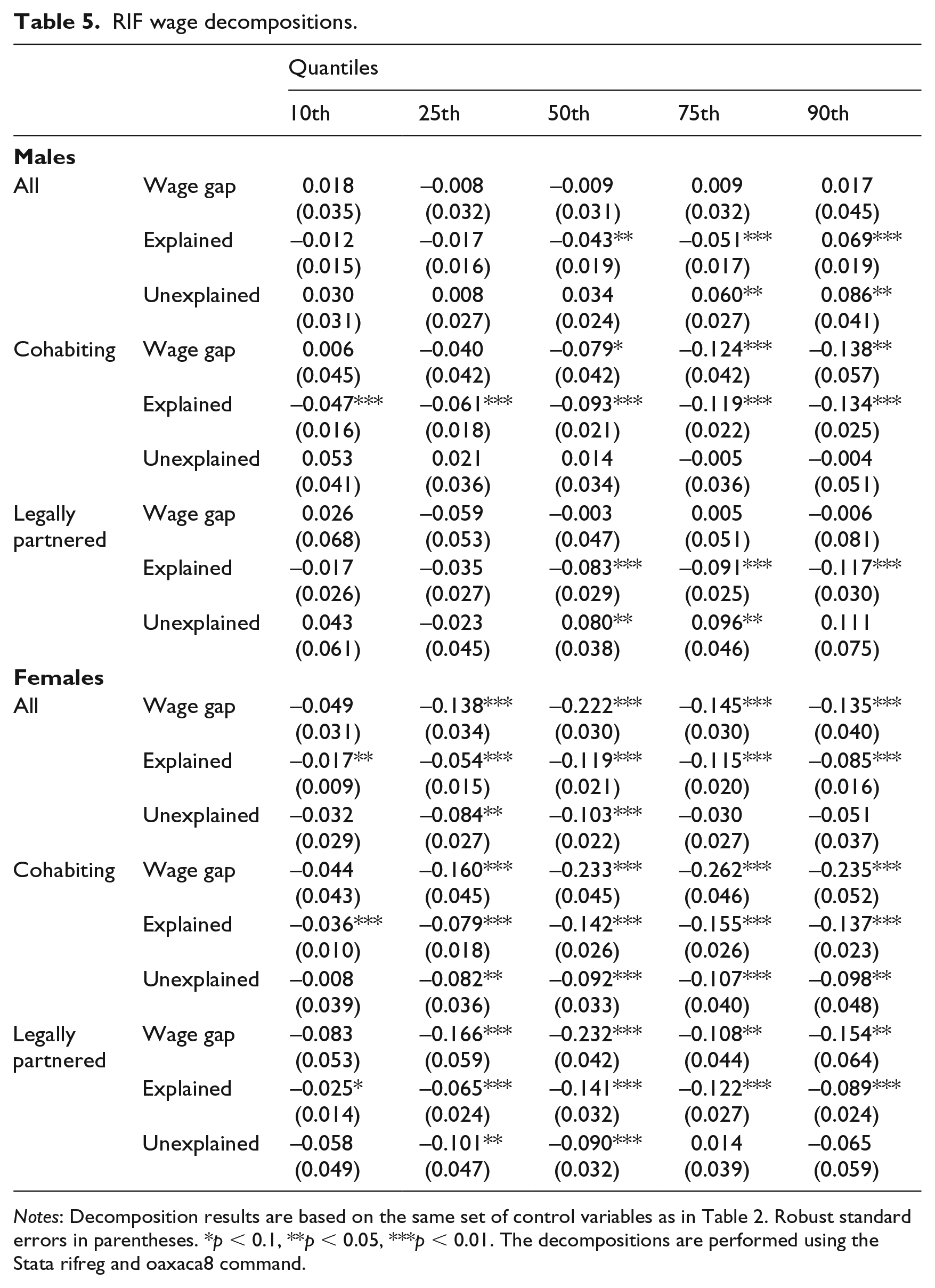
Table 5 presents the decomposition results for the whole sample and then split by partnership status. As before, the findings are presented separately for men and women.
RIF wage decompositions.
Notes: Decomposition results are based on the same set of control variables as in Table 2. Robust standard errors in parentheses. *p < 0.1, **p < 0.05, ***p < 0.01. The decompositions are performed using the Stata rifreg and oaxaca8 command.
For male cohabitees, the findings show that the Blinder–Oaxaca results were driven by workers on median earnings and above. For these workers the wage premium enjoyed by gay cohabitees was at its greatest at the top of the distribution, largely due to a growing gap in observable characteristics between the two groups. In contrast, for those in a legal partnership, although there was no evidence of a significant gap in wages between heterosexuals and non-heterosexuals for those at the 50th percentile and above, this occurred because the explained and unexplained parts of the decomposition offset one another. In other words, the non-heterosexual wage premium that should exist due to differences in observable characteristics was offset by the lower labour market return non-heterosexuals received for these characteristics.
For females, the results for cohabitees were broadly comparable with those from the Blinder–Oaxaca decomposition; while for those in a legal partnership, the lesbian wage premium was lower for high earning women, largely because of a reduction in the unexplained part of the wage gap.
Taken together, these results show that although observable characteristics become more important in determining wages as earnings rise, for certain groups sexual orientation still has a negative effect on wages. This may reflect pay differences within a grade or job-rank, but it may also arise due to barriers to advancement to senior positions within an organisation, and the extent to which this is the case is investigated next.
Sexual orientation: Glass ceiling
Although research in this area is limited, Frank (2006), using data on academic staff, finds that while there is no evidence that sexual minorities suffer any disadvantage in salaries relative to heterosexuals, there is evidence that gay/bisexual men experience a glass ceiling similar to that faced by women. Similarly, Aksoy et al. (2018b) demonstrate that gay males are less likely than their heterosexual counterparts to be in higher-paying managerial positions, while results for lesbians are comparable but notably weaker.
Building on this, this article examines the extent to which sexual orientation acts as a barrier to advancement to senior positions in an organisation, and how this differs across partnership status. In doing so, the probability that individual

where
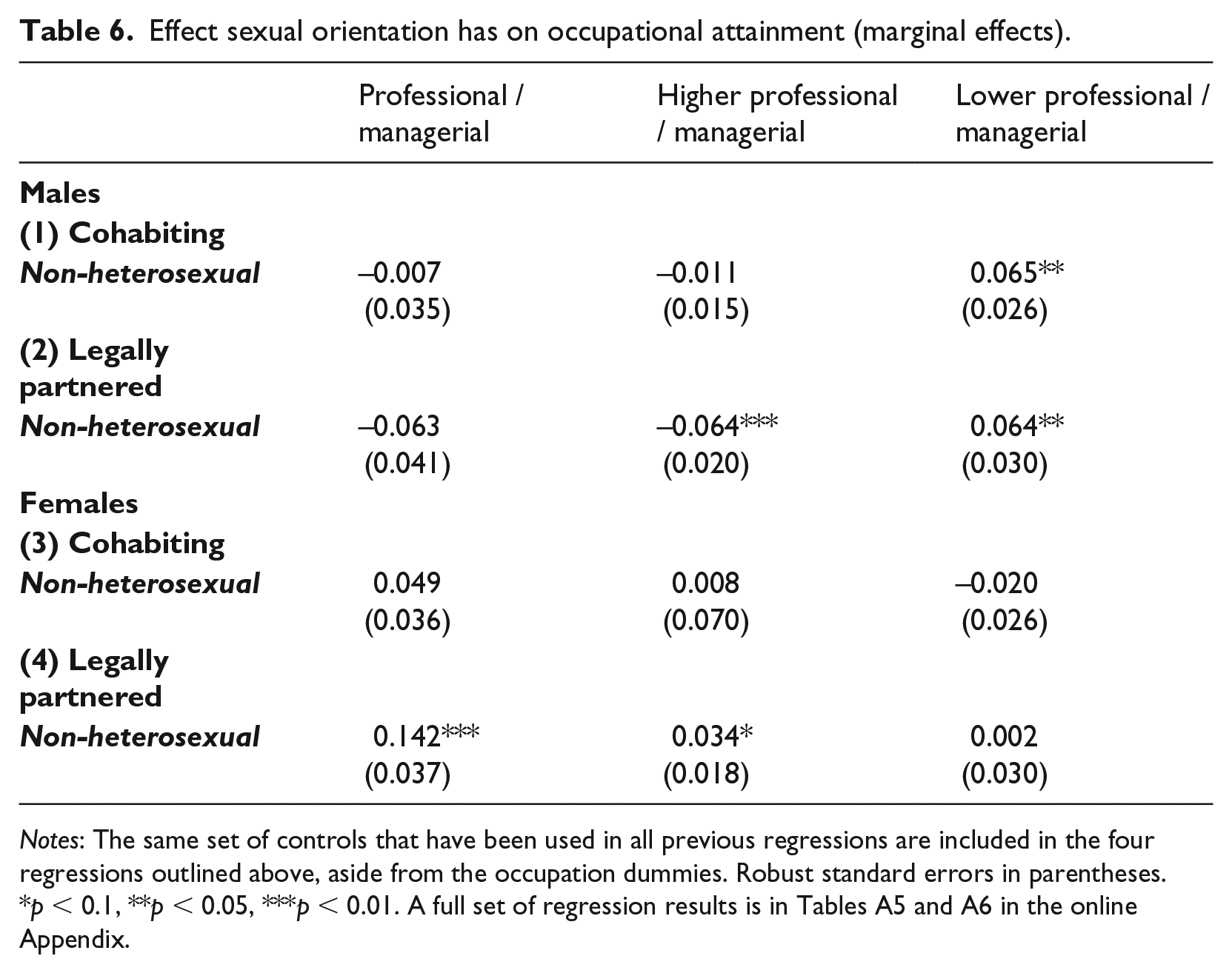
Table 6 presents the main results split by gender and partnership status, while a full set of results is in Tables A5 and A6 in the online Appendix. In column 1, the outcome variable is a dummy variable which takes the value one if the respondent was in a professional/managerial occupation; while in columns 2 and 3 it takes the value one if the respondent was in a higher or lower professional/managerial position, respectively (Aksoy et al. (2018b) adopt a similar approach).
Effect sexual orientation has on occupational attainment (marginal effects).
Notes: The same set of controls that have been used in all previous regressions are included in the four regressions outlined above, aside from the occupation dummies. Robust standard errors in parentheses. *p < 0.1, **p < 0.05, ***p < 0.01. A full set of regression results is in Tables A5 and A6 in the online Appendix.
For males, regardless of partnership status, column 1 shows that sexual orientation had no significant effect on being in a professional/managerial occupation. Despite this, columns 2 and 3 show that when this variable was split into high or low-level managerial/professional positions, legally partnered gay men, despite greater levels of human capital, were more likely to be in lower rather than higher professional/managerial occupations relative to their heterosexual counterparts. This provides tentative evidence of a glass ceiling for this group of gay males.
In contrast, the opposite holds for females. The results show that legally partnered lesbians were more likely than their heterosexual counterparts to occupy higher-level professional/managerial positions, which may be indicative of a preference by employers towards having lesbians in more senior roles. It should, however, be noted that this group of women were still less likely than men to occupy senior positions within an organisation, and hence are still likely to face barriers to advancement as a result of their gender. This latter set of results are not reported here but are available upon request.
Finally, regardless of gender, this pattern only holds for those in a legal partnership. This might be related to the potentially higher visibility of legally partnered sexual minorities, although for men it might once again be capturing the positive returns to heterosexual male marriage.
Conclusion
This article uses data from the LFS to examine the effect sexual orientation has on wages and seniority levels in Britain. In doing so, it provides a much-needed update to the literature in this area, especially in light of changes to the law to allow same-sex legal partnerships.
For males, the results show that although there is no significant gap in wages between heterosexuals and non-heterosexuals, when partnership status is considered a more nuanced story emerges. Now the results show that gay cohabitees, especially those at the top of the wage distribution, earn significantly more than their heterosexual counterparts due to differences in their observable characteristics (notably their level of education). In contrast, for those in a legal partnership, the sexual orientation wage gap is still insignificant, although decomposition results suggest that legally partnered gay males should earn more due to differences in their observable characteristics, while there is also evidence that they face barriers to advancement, or a glass ceiling.
For females, the initial results are similar to those of Arabsheibani et al. (2005) from over a decade ago. The decompositions show that not only do lesbians earn significantly more than their heterosexual counterparts due to differences in their observable characteristics, but the unexplained part shows that they also receive a higher return for these characteristics, although this latter element falls as wages rise. For those in a legal partnership, there is also evidence that lesbians are more likely than their heterosexual counterparts to advance to senior positions within an organisation, which may be indicative of a preference by employers for lesbians in high-level positions. These results are robust to a number of alternative specifications, although it should be noted that regardless of sexual orientation, women still face a pay penalty compared to men, while they are also less likely to occupy senior positions within a firm.
In summary, this article highlights the important role that partnership status plays in explaining the effect sexual orientation has on wages and employment outcomes, particularly for those in same-sex legal partnerships. This may arise because being in a legal partnership makes it easier for employers to observe a person’s sexual orientation, although for men there is tentative evidence that it may be capturing a preference by employers towards heterosexual marriage. Further work is needed, however, to explore these effects further using more detailed data. It should also be noted that this article can only offer inferences on partnered heterosexuals and non-heterosexuals. Since non-cohabiting and single workers are likely to differ in both their observable and unobservable characteristics from their partnered counterparts, additional work is also needed to understand the effect sexual orientation has on the wages and employment outcomes of these two groups.
Supplemental Material
WES873265_Online_Appendix – Supplemental material for Sexual Orientation, Legal Partnerships and Wages in Britain
Supplemental material, WES873265_Online_Appendix for Sexual Orientation, Legal Partnerships and Wages in Britain by Sarah Bridges and Samuel Mann in Work, Employment and Society
Footnotes
Acknowledgements
The authors would like to acknowledge the help of Dr Peter Matthews (Stirling University) for useful comments on an earlier draft.
Funding
The authors received no financial support for the research, authorship and/or publication of this article.
Supplementary material
The supplementary material is available online with the article.
Notes
References
Supplementary Material
Please find the following supplemental material available below.
For Open Access articles published under a Creative Commons License, all supplemental material carries the same license as the article it is associated with.
For non-Open Access articles published, all supplemental material carries a non-exclusive license, and permission requests for re-use of supplemental material or any part of supplemental material shall be sent directly to the copyright owner as specified in the copyright notice associated with the article.
