




Abstract
Unemployment influences life experiences and outcomes, but how it does so may be shaped by gender and parenthood. Because research on unemployment focuses on men’s experiences of unemployment, it presents as universal a process that may be gendered. This article asks: how do college-educated, heterosexual, married mothers experience involuntary unemployment? Drawing on in-depth interviews with unemployed mothers in the US, their husbands, and follow-up interviews, this article finds that the experience of job loss is tempered for mothers as they derive a culturally valued identity from motherhood which also anchors their lives. Husbands’ support emphasises that employment is one of several options mothers can pursue. Couples pivot attention to husbands’ careers as they worry about finances, often resulting in marital tensions. Using mothers’ unemployment as a case, this study demonstrates that unemployment has more divergent implications depending on gender and parenthood than prior theories suggest.
Introduction
Research on unemployment shows that unemployment impacts individuals and their families through economic distress as well as through non-economic factors such as stigma and impact on identity (Buffel et al., 2017; Conger et al., 1990; Jahoda, 1982; Lane, 2011; Newman, 1999; Norris, 2016; Raito and Lahelma, 2015; Young, 2012). Prior studies from Western, industrialised countries, in Europe as well as the US, tend to make conceptual conclusions from data drawn primarily from men’s experiences of unemployment, typically men who are fathers and husbands (Chen, 2015; Chesley, 2011; Demantas and Myers, 2015; Legerski and Cornwall, 2010; Newman, 1999). Research thus presents as universal processes that may be acutely gendered since employment matters differently for masculinity and femininity which men and women are expected to respectively comply with.
Masculinity and femininity are context-specific constructions. In the US, for example, employment is intrinsic to hegemonic masculinity, which can be defined as ‘the pattern of practice (i.e., things done, not just a set of role expectations or an identity) that allowed men’s dominance over women to continue’ (Connell and Messerschmidt, 2005: 832). Dominant conceptions of femininity do not uphold women to expectations of employment. Instead, women in the US continue to be conceptualised as primary caregivers. Liberal economies, such as the US and UK, are characterised by low policy provision of childcare, parental leave, and unemployment insurance (Dotti Sani and Scherer, 2018). There is variation even within the category, with some countries, like the UK, generally being seen as having more generous policy provisions than the US (O’Connor et al., 1999). These policy contexts combine with gender and motherhood ideologies to constrain mothers’ employment. A substantial proportion of US women nonetheless participate in the labour force. In 2017, 71.3% of mothers with children under the age of 18 years were in the labour force, including 63.1% of women with children under 3 years old. Close to two million women in the US (3.7% of the labour force) between the ages of 25 and 54 were unemployed in 2017 (Bureau of Labor Statistics (BLS), 2018). Despite women’s extensive labour force participation, the unemployment literature reflects an empirical gap – women are either excluded or minimally included in studies of unemployment – as well as a theoretical gap resulting from this empirical focus on unemployed men. Given gendered differences vis-à-vis employment, it bears interrogating how unemployment too may matter in a gendered manner.
This article thus focuses on mothers’ involuntary unemployment – the experiences of mothers who have lost their paid jobs and are searching for new ones. I draw on interviews with 23 US, college-educated, heterosexual, involuntarily unemployed mothers, 11 of their husbands, and follow-up interviews with approximately half the sample. This specific sample is conceptually illuminating because as privileged women in the US they expect (and usually experience) continuous employment (Landivar, 2017). They are also very likely to be the primary caregivers for their children (Blair-Loy, 2003; Stone, 2007). Both the professional realm and motherhood are salient for this group. Their experiences of unemployment can illuminate how one of their several social identities becomes more prominent during unemployment and why. This article asks: how do college-educated, heterosexual, married mothers experience involuntary unemployment? The findings here indicate that mothers experience distress at losing a job. However, this is tempered as they spend time at home and derive a culturally valued identity from motherhood. This identity helps structure their time and provides a sense of collective purpose (Jahoda, 1982). Husbands also support unemployed wives by underlining that paid work is only one among several acceptable options. As unemployed mothers and their husbands worry about their family’s economic well-being, the attention pivots to ensuring that husbands’ careers are flourishing.
This article sheds light on the understudied aspect of her unemployment and extends our understandings of gender, unemployment, and the meaning of paid and unpaid work broadly in three key ways. First, this article uses a gendered lens to reveal novel insights about the processes and experience of unemployment, leading to a gender-informed theory of unemployment. Second, this study provides data on how unemployment impacts mothers’ identities, showing that motherhood can become a valuable, primary identity and anchor for social life, at least for some time. Finally, in using data from wives and husbands, these findings more richly demonstrate how couples together uphold the hegemony of the male career (Stone, 2007) even when the material context of the family does not support this. In sum, this study argues for the gendering of our theoretical understanding of unemployment.
Literature review
Toward a gendered theory of unemployment
Unemployment impacts individual, marital, and community well-being through the absence of both manifest (e.g. income) and latent functions of employment (e.g. expanded social contacts, structured time, participation in a collective purpose, status and identity, and mandated regular activity). These latent functions of employment, keenly felt during unemployment, are important for individuals and their sense of social integration (Jahoda, 1982). The type of occupation (Raito and Lahelma, 2015), the kind of job loss (Buffel et al., 2017; Newman, 1999), or use of social media (Feuls et al., 2014) may counter some, or at times all, of these latent functions of employment thereby shaping the responses and coping mechanisms of the unemployed. Latent functions of employment – especially identity and status – matter during unemployment because they shape well-being.
On the issue of status and identity, the Family Stress Model (Conger et al., 1990; Schneider et al., 2016) explains that economic stress could lead to emotional distress for husbands and wives, thereby generating increased marital conflict and decreased marital satisfaction. Beyond economic distress, though, this model additionally identifies that unemployed men may feel as though they are not complying with the male-breadwinner ideal of providing economically for their families. The inability to comply with this powerful cultural expectation – over and above economic concerns due to unemployment – is an important pathway through which marital conflict and satisfaction may be worsened during men’s unemployment according to this model.
Although the Family Stress Model is limited in considering women’s unemployment, Jahoda (1982) takes a gendered approach when she writes that for unemployed women, the most meaningful latent function of employment is the expansion of social contacts. Jahoda explains that women may be able to compensate for the other four functions by activating the ‘traditional role of “housewife”’ (1982: 94) to cope with unemployment. Combined, the latent functions thesis and the Family Stress Model indicate that a deteriorated sense of status and identity during unemployment may adversely impact mental and physical well-being, alcoholism, drug use, and marital relationships, especially for men (Buffel et al., 2017; Conger et al., 1990; Norris, 2016; Schneider et al., 2016). Research subsequent to Jahoda has not fully examined her insight about how the latent functions of employment may matter divergently for men and women; including when it comes to mechanisms leading to marital conflict during unemployment. This is a conceptual limitation because constructs of femininity and masculinity position men and women differently in relation to employment.
Hegemonic ideals of masculinity in the US are deeply intertwined in both the latent and manifest functions of employment. Men who are unable to meet the provider role risk being shut out of institutions such as marriage and parenthood (Killewald, 2016; Townsend, 2002). Additionally, the social norm theory of unemployment explains that the latent functions of employment may be impacted by whether unemployment is expected (e.g. as during widespread economic downturns) or anomalous (Buffel et al., 2017). Men’s unemployment is usually considered more deviant than women’s unemployment given gendered demands of masculinity. According to the social norm theory, unemployed men may be more susceptible to decreased social status and stigma. In contrast, employment is not deeply linked to demands of femininity since women are held to expectations of caregiving (Blair-Loy, 2003). Because employment is often seen as oppositional rather than intrinsic to femininity and motherhood (Hays, 1996), it may not have the same latent functions for women, especially mothers. Their unemployment experience may diverge from our current understandings.
Motherhood, paid work, and unemployment
Despite women’s increased labour force participation in the US over the last few decades, gender ideologies have not moved as progressively within the heterosexual family (Pepin and Cotter, 2018). Men are still viewed as providers, and although women engage in paid work, they are far more likely to combine this with childcare. The division of housework and caregiving are ripe terrain for affirming gender-appropriate masculinity and femininity for men and women (Schneider, 2012). Employed women remain responsible for the bulk of household chores and caregiving, including when they earn more than husbands (Bittman et al., 2003).
Motherhood ideologies are a specific type of child-centred gender ideology. In liberal economies such as Canada, the UK, and particularly in the US, the ideology of intensive motherhood is prevalent (Hays, 1996; Miller, 2005). This ideology demands high standards of emotional and practical caregiving for children and expects mothers to provide this. Although culturally dominant, in the US this is inherently a White and middle-class norm. Drawing on data from a group of racially diverse, professional, and employed mothers, research indicates that intensive motherhood may be giving way to ‘extensive motherhood’ (Christopher, 2012), whereby mothers outsource daily childcare to paid caregivers but remain responsible for organising and monitoring this care. Research from Black middle-class mothers in the US indicates the predominance of an alternative motherhood ideology of ‘integrated motherhood’ (Dow, 2016), where women are expected to combine motherhood with employment, and to share childrearing with kin and community.
Aside from gender and motherhood ideologies, social policies can help or hinder women’s employment. The low policy provision context of the US as a liberal economy is often linked to constraining women’s career pathways (Collins, 2019; O’Connor et al., 1999). In her study of elite professional mothers who left employment, Stone (2007) argues that mothers encounter a choice gap due to a lack of policies or workplace practices that facilitate caregiving. Mothers feel compelled to pick either employment or motherhood. In Stone’s study, many are actively searching for jobs that would enable them to integrate employment and caregiving. In the absence of institutional support, such as policy provisions, couples are more likely to fall into traditional divisions of labour wherein men take on provider roles and women, including when employed, become primary caregivers (Pedulla and Thébaud, 2015). Women, especially mothers in the US, are thus more likely to be in part-time employment than men; but part-time work tends to be of lower quality in terms of pay and benefits (Landivar, 2017). The combination of intensive motherhood with limited policy provisions, means that employed mothers experience constant and acute guilt (Collins, 2019; Stone, 2007).
When it comes to women and employment, research has thus understandably focused on the challenges of combining employment and caregiving, rather than on women’s unemployment (exceptions are Lane, 2011; Norris, 2016). Drawing on in-depth interviews with professionals in the technology sector in Dallas, Texas who lost their jobs during the dotcom burst of the early 2000s, Lane (2011) finds that unemployed women in her sample feel like stigmatised failures. In contrast, through her interviews with unemployed professionals from varying industries, Norris (2016) finds that women highlight their ‘buffer’ (p. 78) identity as mothers as a way to escape the stigma of unemployment. Norris and Lane’s divergent findings can likely be explained by the motherhood status of women in each study. Norris focuses on mothers whereas Lane discusses non-mothers. Additionally, although identity is, of course, an important latent function of employment, by analytically prioritising identity, these studies do not examine how other latent functions, for example structured time or social contacts, may be reshaped due to women’s unemployment.
For men, employment is an anchor for various aspects of their lives. Women, and particularly mothers in liberal economies, often struggle to maintain continued employment as they contend with the demands of caregiving and the absence of policies to facilitate it. The latent functions of employment may thus not matter similarly in terms of organising their lives. As caregivers they may have access to different ways of fulfilling the latent functions of employment such as expanding social contacts (e.g. other mothers), organising time, sense of status and identity, regular activity and collective purpose. Theories of unemployment can thus be revised to more fully incorporate a gendered analysis. Mothers who lose their jobs are a conceptually useful group to begin the endeavour of theorising how unemployment may be gendered.
Methodology
Sample and recruitment criteria
This study draws on in-depth interviews with unemployed mothers in the US, their husbands, and follow-up interviews with participants. The sample included 23 unemployed mothers and 11 of their husbands. It also included follow-up interviews with 13 unemployed mothers and four husbands, for a total of 51 in-depth interviews. This sample was designed to privilege the collection of qualitatively rich data and theoretical processes rather than to identify broad population-level trends (Lareau and Rao, 2016; Roy et al., 2015). I considered reaching theoretical saturation when no distinctly new themes emerged (Small, 2009).
I recruited this non-random sample in a metropolitan area in the north-eastern US, through workshops held by career coaches, job clubs, and parent list servers. I used the following criteria to categorise people as unemployed: lost a job, does not have a job, actively looking for a job, available to work. Except for the first criterion, this is consistent with the definition used by the US Bureau of Labor, the International Labour Organization, and the Organisation for Economic Co-operation and Development to capture unemployed individuals still in the labour force. My inclusion criteria further required unemployed mothers to be heterosexual US citizens, have at least a bachelor-level degree, be in a dual-earner marriage, and have a child aged 22 years or younger.
This sample is privileged in terms of being predominantly White, married, heterosexual, college-educated, and dual-earner. Their advantaged status served an analytical function: it meant that the manifest functions of employment were minimised for this group, rendering the latent functions more visible. As college-educated professionals, this was a sample of mothers for whom employment was most likely to matter to their identity, such that these mothers both expected and had experienced continuous employment, being the least likely to drop out of the labour force due to caregiving obligations (Landivar, 2017). Yet, as heterosexual and married mothers, they were most likely to operate under traditional gender norms typically associated with heterosexual marriage and parenthood, especially in terms of caregiving responsibilities. This may impact how unemployed mothers and their husbands perceived and responded to mothers’ unemployment. This is particularly the case in a context of weak social policies and ideologies of intensive motherhood, as in the US. This sample is thus suited to contribute to theories about gender and unemployment since both employment and motherhood ideologies were especially salient for this group. Despite the conceptual advantages that this sample offers, it has limitations. Intersections of race, gender, and class shape experiences of employment, motherhood ideologies, and how women combine employment and caregiving (Barnes, 2016; Dow, 2019; Glenn, 2002). I offer an analysis of these mothers’ unemployment experiences keeping these limitations in mind.
Data collection
The unemployed mothers in my sample were professionals who had previously worked in occupations and industries such as marketing, media, as lawyers and academics until they lost their jobs. Husbands of 17 of the mothers in this study were college-educated and employed in full-time professional positions. Three of the mothers had husbands who were college-educated but unemployed at my initial interview with mothers. An additional three mothers had husbands who did not have a college education. One of these husbands earned significantly less than his wife, while the other two husbands had annual incomes which fluctuated such that they earned more in some years and less in other years as compared to their wives.
To shield participants’ identities, I have assigned pseudonyms and sometimes conceal participants’ real professions by selecting a comparable one. Original interviews were conducted between 2013 and 2015. Interviews were semi-structured, averaged two hours, and most were conducted face to face, usually in public spaces such as coffee shops. The interview protocol for unemployed mothers and husbands focused on job-searching, financial and emotional repercussions of unemployment, division of housework, and impact on relationship with spouse. The follow-up protocol focused on whether and how these dimensions changed in the intervening time.
To gain insight into individual experiences of marriage (Bernard, 1982), I conducted interviews with unemployed participants and their spouses separately. Qualitative studies drawing on data from both spouses are rare but provide rich insights into how each spouse understands and responds to unemployment (Gush et al., 2015). Husbands’ perspectives were important for illuminating messages about motherhood and caregiving that they shared with their wives, which shaped individual and couple-level responses to mothers’ unemployment. I attempted to conduct interviews with all husbands, ultimately succeeding in conducting interviews with half the husbands.
I conducted follow-up interviews with a subset of participants. Because unemployment is time sensitive, shorter increments of time – months – were meaningful for my participants. I reached out to my sample approximately six months after the first interview. Follow-up interviews averaged an hour, with approximately two-thirds being conducted in person, and the remainder over the phone or via Skype.
Data analysis
Interviews were audio-recorded and transcribed verbatim. I used a modified grounded theory approach (Charmaz, 2006), entering the site with some theoretical knowledge but allowing new themes to emerge inductively from the data. Following grounded theory, I used open and focused coding. My open codes captured broad themes that emerged during the interviews. See Supplemental Appendix 1 for open and focused codes, including sample quotations for each. Focused codes captured fine-grained analyses. This article is based on three main open codes: ‘domesticity’, ‘motherhood’, and ‘responses to job loss’. ‘Domesticity’ and ‘motherhood’ are distinct codes, with some overlaps, as in a Venn diagram. The ‘domesticity’ code captured aspects of the domestic realm such as cooking and cleaning, as well as practical aspects related to parenting (e.g. child-centred chores). The ‘motherhood’ code captured the less tangible aspects of motherhood such as values, beliefs, and identity. Through focused coding, I parsed each into more developed codes, such as ‘slipping into housework’ and ‘fighting the housewife mode’, nested under ‘domesticity’. Finally, I checked for disconfirming evidence, which is included in the findings section. To facilitate coding, I used the qualitative data analysis software Atlas.ti. Selected quotations are representative of the broader sample.
Findings
How mothers initially perceived their job loss
Mothers in this sample had lost their jobs in a variety of ways. Some had been part of large-scale downsizing, others’ positions had been made redundant, and some had been fired. Like men in prior studies, mothers in this study acutely felt the blow of losing their jobs. Doris, a 50-year-old lawyer with two teenage sons, explained how losing her job was difficult, ‘I saw the writing on the wall . . . It was an awful six-month period’. Other mothers confirmed this. Darlene said, ‘Even if you’re prepared [to lose your job], when they tell you, it’s awful’.
Losing a job was often a long, difficult, and drawn-out process, but mothers in my sample explained that quitting was not an option because of how, according to them, that reflected on a person’s character. Julia, an interior designer, stated, ‘I tried. At least for my self-respect I tried’. Julia had an inkling that ‘they were trying to get rid of me’. She added, ‘I never felt like [my manager] and I were really like clicking. There were some instances where she seemed kind of frustrated with me . . . Nothing was ever good enough’. Other times, mothers had chosen not to quit workplaces that were becoming unbearable due to these looming concerns of impending job loss because of more material reasons – such as access to health benefits through their employer. In the low policy provision context of the US, access to quality healthcare was frequently dependent on employer-based health insurance. This was a reason why Anne, a 40-year-old with a PhD, had decided against resigning: I wanted to have another baby and so I didn’t want to leave because you need to work at an agency for a year before you have protected FMLA [Family Medical Leave Act] status . . . so I really couldn’t leave at that point.
Anne’s reasons for needing a higher level of healthcare were clearly gendered and shaped by her country-level policy context.
These women experienced job loss in an economic context where unemployment itself no longer indicated an individual flaw (Lopez and Phillips, 2019), although duration of unemployment did (Sharone, 2013). These mothers’ attachment to the labour market, suggested by these pained responses to losing their jobs, indicated that the latent functions of employment, especially in terms of identity and status, should have been similar to those prior literature, drawing from men’s unemployment experiences, has theorised. However, I found that gender and motherhood shaped their experiences in important ways.
Unemployed workers or stay-at-home mothers?
The latent functions of employment, such as identity and status, organisation of time, and sense of collective purpose, were often mitigated for mothers in this study by motherhood and the time they spent at home. Doris, a lawyer who had formerly earned twice her husband’s salary, emphasised that she foregrounded her identity as a mother, ‘I’m getting a lot of validation in being a mother; from the things my kids are achieving’. Mothers in this sample had frequently experienced deep guilt, feeling pulled by the demands of work and family (Blair-Loy, 2003; Stone, 2007). Most viewed staying at home, even if due to unwanted and painful job loss, as an opportunity to go from being extensive mothers (Christopher, 2012) to embracing the gold standard of intensive motherhood (Hays, 1996). Doris added, One of the things I felt was, ‘Oh good, I can go to these things’ . . . I have more time now. I don’t feel pulled. I don’t feel as though I’m being tortured at work anymore. And I felt I could give more to my kids.
These mothers had not transitioned from working to not working; they had transitioned from doing a mixture of paid and unpaid work to doing more unpaid work. Their unpaid work tended to centre on their children. How mothers parlayed their unemployment into time for children varied with children’s age. Mothers with children aged 11 years or older (n = 11) spent more time on their children. Darlene, a marketing professional with an MBA, was in her early 50s. She had been the primary earner in her family, earning about US$200,000 a year compared to her husband’s US$50,000. Darlene elaborated on how staying at home enabled her to practise intensive motherhood for her 15-year-old son: The moms were doing a fundraiser at my son’s school. So the second week [of my unemployment] I spent a couple of days helping out with this fundraiser, which was great timing because a lot of these moms don’t work. They didn’t ask me ‘What are you doing here at a Tuesday morning at 10 o’clock?’ . . . They’re very welcoming . . . They were like ‘Hey come on, we need your help!’ I felt really happy about it, ’ cause this is a taste of what it is to be a stay-at-home mom. That you can show up at school and hang out there for three hours, working on a fundraiser, and selling doughnuts and Swedish fish to kids to make money for the school.
Two latent functions of employment are organising one’s time and expanding social contacts. When unemployed, Darlene organised her time in these alternative, socially acceptable ways, which also provided her access to a community of mothers. This was facilitated by an upper-class context of intensive motherhood ideology, where mothers routinely participated in their children’s schooling. While this was not time spent with her son, it enabled Darlene to spend her time in a way she found to be meaningful.
Mothers with children younger than 11 (n = 14), spent more time with their children. Kiara, who was in her early 30s, and had two daughters under the age of six, had worked in an educational non-profit. She said: For me there’s good things about being home. I like being able to pick [my daughter] up from school, knowing that when I get home, I’m not going to have to rush to cook dinner. I like knowing that I have created a space for her that when she gets home, we can sit down and do her reading for the day, and we can do her homework . . . She has that space because I’m not frustrated from leaving work and coming home. I know that that’s a good thing for her.
Kiara’s experience, and that of mothers with young children in particular, was shaped by both the policy context of low provisions for childcare and the ideology of intensive motherhood. Motherhood provided Kiara with a way to organise her time and a sense of collective purpose in focusing on raising her daughters. Motherhood in this study thus often accounted for several latent aspects of employment such as organisation of time, identity, and sense of collective purpose.
Yet, there were some important limitations to this overall trend. For four out of the 23 mothers, the domestic realm and immersion in motherhood had not offered a validating experience at any point during unemployment. Instead, these mothers yearned for employment in order to organise their time and affirm their professional identities. Candace, a lawyer in her early 60s, found that her unemployment rendered her without structure: ‘I think I’m so used to having a work structure that it was very hard to be unstructured’. Candace linked her unstructured time to depression: A lot of times I was depressed. I would stay up late and watch television and not get up until really late and I would waste a lot of my day . . . It’s been very hard when I didn’t have a regular place to go to really motivate myself.
Mary Louise, a medical practitioner in her late 50s, had a similar experience: There were a couple of those dreary March rainy days where I’d drop [my son] off at school, I’d come back and I’d think, ‘Let me just lay down for ten minutes’. Ten minutes turned into a half hour, turned into an hour, turned into three hours.
Candace and Mary Louise were among three out of the 23 mothers in this sample who explicitly linked their unemployment to depression. Domesticity and motherhood could have provided both structured time and status, and potentially warded off adverse impacts on mental well-being. Household chores, for example, had fallen entirely on Candace and she had reported, ‘Since I’ve been unemployed, I was doing everything’. But this subsample of mothers did not derive a higher meaning from spending time on housework or childcare. The length of their unemployment was not longer than that of other mothers who had found comfort in motherhood and the domestic realms. Motherhood may not always, or adequately, substitute for the various latent functions of employment.
For other mothers, the sense of status, identity and organisation of time from motherhood during unemployment did not follow a linear trajectory. The mothers I interviewed had been unemployed for various durations at the time of the first interview (see Table 1). There was one key pattern: motherhood alleviated several latent functions of employment especially in the initial months of unemployment. This often waned over time. In this sample, motherhood and the domestic appeared to fulfil the latent functions of employment for about six months. For example, in her follow-up interview, nine months after she lost her job, those same chores that had provided meaning to Darlene in the earlier months of unemployment had become annoying. Several months after her job loss, Darlene had become exasperated with doing chores for her son. In her follow-up interview she said: ‘He’s 15! He needs to be more independent’. Frowning, she had resolutely added, ‘There’s no reason why I should get his breakfast ready, pack his lunch’. Gina, who had initially also expressed sanguine sentiments about the advantages of staying at home, too had experienced ‘a switch’ by her follow-up interview. She said, ‘I’m sort of anxious to be working and to kind of have more of a routine’. The sense of identity from motherhood had waned for Darlene; and the domestic realm had stopped providing a way to help Gina organise her time. This may have been because Gina and Darlene had teenagers who may be keener to demonstrate independence than spend time with parents.
Descriptive data on unemployed mothers and families (N = 23*).
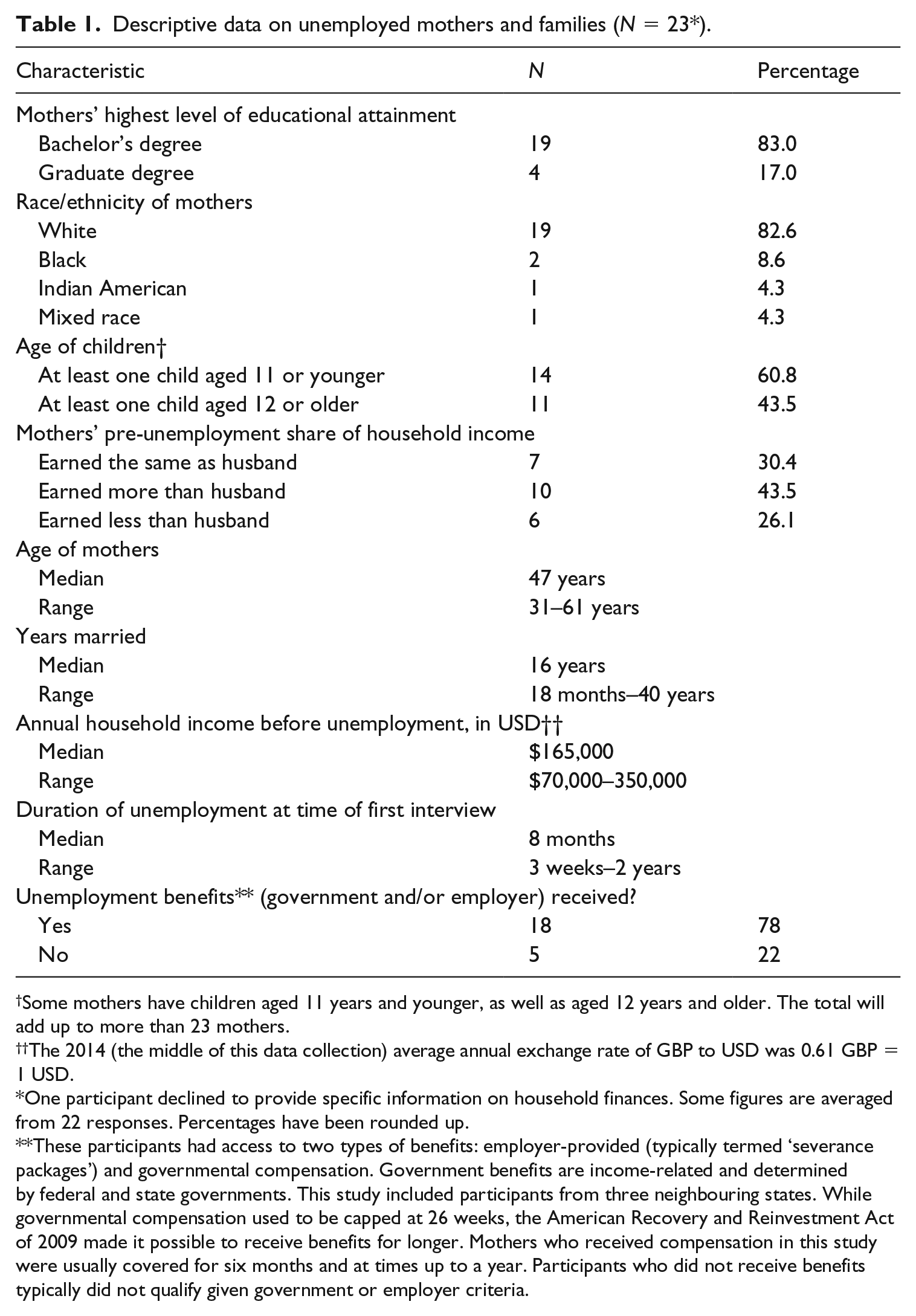
Some mothers have children aged 11 years and younger, as well as aged 12 years and older. The total will add up to more than 23 mothers.
The 2014 (the middle of this data collection) average annual exchange rate of GBP to USD was 0.61 GBP = 1 USD.
One participant declined to provide specific information on household finances. Some figures are averaged from 22 responses. Percentages have been rounded up.
These participants had access to two types of benefits: employer-provided (typically termed ‘severance packages’) and governmental compensation. Government benefits are income-related and determined by federal and state governments. This study included participants from three neighbouring states. While governmental compensation used to be capped at 26 weeks, the American Recovery and Reinvestment Act of 2009 made it possible to receive benefits for longer. Mothers who received compensation in this study were usually covered for six months and at times up to a year. Participants who did not receive benefits typically did not qualify given government or employer criteria.
In contrast, mothers of younger children usually continued to find staying at home fulfilling. Grace, who had earned half of her family’s household income, had decided about a year into her unemployment that she only wanted a job with ‘mommy hours’, which she described as a job from 9 a.m. to 2 p.m., so she could remain involved with her daughters. Because active job-searching was a recruitment criterion in this study, no one in my sample considered dropping out of the labour force. Several mothers of younger children, like Grace above, had focused on searching primarily for jobs that would allow them to do carework more easily. Some nonetheless ended up in full-time positions. Women in Western, industrialised countries are more likely to be in part-time positions than men. In the US, part-time positions tend to be of lower quality in terms of pay and benefits (Landivar, 2017). These mothers experienced a paucity of part-time positions that would balance out the privatised costs of childcare, explaining their entry back into full-time employment.
Husbands reaffirmed legitimacy of staying at home
Men’s unemployment is perceived to be an unsettling event for families and marriages, with marital interactions frequently characterised by tension and urgency around husband re-employment (Rao, 2017). For mothers in this sample, unemployment was generative in a different manner: it opened up an avenue for discussions around mothers’ continued participation in paid work. Marital discussions framed mothers’ re-employment as optional, and husbands often impressed upon their wives that there was no need to view re-employment as urgent.
Out of the 23 unemployed mothers, 18 reported that their husbands were relaxed about their re-employment. Husbands I interviewed too had reported similarly, and had agreed with the idea that wives could consider staying at home for the foreseeable future. Daniel and Nicole were both chemists with PhDs. When Nicole was employed, she and Daniel had earned comparably. They had a three-year-old son. Nicole rued feeling like ‘I’m just a mom right now; I’m not anything else’. Daniel had been supportive, but he explained that his support was designed to accomplish the following: ‘I’m saying, basically, “It’s okay if you don’t get a job. I just want you to be happy”. That’s pretty much what I say’. This was at odds with Nicole’s fear of having a life centred solely around motherhood. Daniel downplayed the manifest function of Nicole’s employment. Neither had he fully acknowledged how the latent functions of employment could impact Nicole. By alleviating the pressure on their wives to find a job quickly, husbands reaffirmed the cultural legitimacy of wives staying at home. The relative privilege of this sample – where husbands too had well-paying and generally stable and standard jobs – may explain husbands’ attitudes to their wives’ employment. This privilege likely enabled these families to follow a gender-traditional route after women’s job loss. Husbands and wives produced a gendered dynamic where husbands took on the responsibility of economic provision, even in families where wives’ income had constituted a substantial portion, at times the majority, of the household income.
When wives prioritised their re-employment, that was perceived to be peculiar. Caroline was a key example of this. Her husband Ben had been irritated when he explained that he told Caroline, ‘No one’s got a gun to your head saying you need to get a job!’ His annoyance was based in his preference that Caroline should focus on motherhood over finding another job. Ben had found Caroline’s focus on re-employment disruptive, and said ‘It’s a big distraction to me, to my kids, and to the house, and to our way of life’. Caroline was aware of Ben’s frustration with her focus on re-employment. She acknowledged, ‘I agree with him, but I don’t like agreeing with him’. Mothers who did not find respite in motherhood, infrequent as that was, were perceived as anomalous. The implicit expectation these couples had was that the latent functions of employment would simply be far less meaningful for women given alternative social roles, especially motherhood, available to them.
In five out of the 23 cases of unemployed mothers, husbands had prioritised their wife’s re-employment. Rayan, a tenured professor in his late 30s whose wife strove for a tenure-track position in academia, had said, ‘That was really just so difficult to see somebody you care about feel really shitty about themselves and feel really low about who they were and about what they did professionally.’ Rayan’s explicit acknowledgement of the latent functions of employment, particularly identity, for his wife were uncommon in this sample.
Although mothers in my sample were interested in re-employment, the ease they felt at home, reinforced by husbands, had made their job-searches less frantic, perhaps explaining broader patterns about why women take a few weeks longer than men to become re-employed (Farber, 2015). Generally, marital dynamics had not pressured mothers to quickly start contributing financially to their families.
Emphasising husbands’ employment
The participants in this study downplayed the manifest function of mothers’ employment and tended to render the latent functions invisible. Surprisingly, marital dynamics become focused on the manifest function of the husband’s employment – specifically that husbands should earn more to compensate for the loss of their wives’ incomes. Gabrielle was a lawyer and the primary breadwinner in her marriage. She explained that once she was unemployed she focused more on her husband’s contracting business, ‘I think also my insecurity around feeling like I’m not doing enough to find a job, so I start to focus on his work and what he’s doing’. Gabrielle’s husband had the opportunity to network with a colleague and Gabrielle pressed him to follow up. Doing so escalated tensions between Gabrielle and her husband. She explained, ‘I start putting pressure: “I just don’t understand why you wouldn’t do that”. And he gets very defensive . . . It just blows out of proportion’.
These mothers were professionals who had typically brought in a large share of the household income. Their employment mattered, especially in its manifest function of earning. Nonetheless, mothers’ unemployment shaped marital dynamics through a heightened imperative for their husbands to provide, instating a male-breadwinner family structure which had not quite been the reality for these couples prior to the mothers’ unemployment. Doris described how she ‘felt as though [my husband] should be earning more money’. This was apparent in her communication with her husband: I’d scream at him: ‘You should be looking for a [better] job! What’s wrong with you!’ You know, really messy stuff. It was awful. It was a big problem. It could have been a huge: it could have been a marriage breaker.
By his follow-up interview, Larry, in his late 50s, married to Darlene (the primary earner in their family), had also lost his administrative job, which he had held for over two decades. At this point, Darlene was 10 months into her own unemployment. Although Darlene was actively trying to find a job, she was deeply concerned about Larry. Larry was comfortable with considering his job loss as an early retirement, and said, ‘I do not want to have a job’. He explained that not working was not an option for him since Darlene expected him to work: ‘A couple of weeks ago, she just finally had an explosion and essentially demanded that . . . I needed to find a job . . . She wants me to get a job immediately’. Darlene had perceived her own unemployment, at least at the start, to be an opportunity to practise intensive motherhood. According to Larry, she had framed his unemployment as morally problematic. This within-couple comparison suggests that latent functions of employment, especially in terms of conferring status, may be more salient for men and less so for women, particularly mothers. Mothers in this context may be more likely to be expected to access a moral status via motherhood.
The manifest and latent functions of employment were deeply bound up in gendered expectations and obligations that participants encountered. Both employment and motherhood were important for these unemployed mothers’ identities. But combining the two was difficult given ideologies of intensive motherhood and a policy context that did not facilitate their employment. When the worker identity was no longer available to unemployed mothers, they emphasised and sought meaning in the socially valued identity of motherhood. This was reinforced by husbands. Emphasising motherhood served, to some extent and for some time, to fulfil the latent functions of employment.
Discussion
Understanding the material and non-material impacts of unemployment has been an important endeavour in sociological research. The concept of latent functions of employment has provided deep insights in this regard (Buffel et al., 2017; Feuls et al., 2014; Jahoda, 1982; Raito and Lahelma, 2015). This article furthers these important conceptualisations to illuminate how unemployment is a deeply gendered process, since employment matters differently as an anchor of social life for men and women given dominant constructions of masculinity and femininity. This is especially the case for workers who are also parents.
For these unemployed mothers, the latent functions of employment often get replaced by motherhood – which occupies their time, provides regular activity, expands social contacts (through other mothers), provides a sense of status and identity as well as a collective purpose (Jahoda, 1982). A context of intensive motherhood ideologies and low policy provisions which produce a practical need for caregiving, enables this (Collins, 2019; Hays, 1996; O’Connor et al., 1999). However, these findings also indicate that over time, and especially for mothers with older children, motherhood becomes a less desirable means of fulfilling these latent functions of employment. Mothers often long to return to employment. Thus, there are exceptions to this general trend. For some mothers, motherhood or the domestic realm never fully substitute for employment, and they yearn for the identity and status, sense of collective purpose, structured time, and regular activity that employment had provided. Husbands are often surprised and disappointed that these mothers prioritise their identities as workers. Since the age of children is associated with how much hands-on childcare they need, this variation may stem from how legitimate and necessary the role of caregiver seems to these mothers. This may explain why women without children experience adverse impacts of unemployment on their well-being, since the status and identity of the caregiver role may not be as readily available to them (Lane, 2011).
These findings support the conjecture that motherhood ameliorates threats to mothers’ sense of self posed by unemployment (Jahoda, 1982; Norris, 2016). This is an important issue because it captures a key tension in the literature: to what extent have norms around employment become gender egalitarian? The present study aligns with Jahoda (1982) in finding that the latent functions of employment continue to be different for mothers. Emphasis on motherhood, rather than on re-employment, is generative in structuring marital dynamics that become more traditional, explicitly placing the responsibility of economic provision onto husbands.
This study may underestimate how strongly motherhood mediates the experience of unemployment, since almost half the mothers in this study had earned more than their husbands. This is considerably larger than the approximately quarter of married women who earn more than their husbands in the US (Cohen, 2018). Thus, these findings can be taken as illuminating how mothers’ employment is perceived to be optional even in cases where their employment constitutes a large share, even the majority, of the household income. Conversely, husbands, even when they earn less than their wives, are deemed to bear responsibility for economic provision of the family. Gendered social norms around employment differently shape how unemployment impacts mothers and their marriages.
These findings diverge from how prior research, based largely on men’s unemployment experiences and encapsulated by theoretical models such as the Family Stress Model and the latent functions of employment model (Conger et al., 1990; Jahoda, 1982; Schneider et al., 2016), conceptualises negative impacts on the unemployed and their marriages. Men’s unemployment is seen to impact marriages adversely partly because hegemonic masculinity requires men to be providers, but also because men’s unemployment puts economic strains on the family. Since many of these mothers had earned a considerable share of the household income, their unemployment could have impacted their marriages and families through financial strain. Husbands could have emphasised that mothers must regain employment due to financial needs, as comparable wives of unemployed men have done (Rao, 2017). Instead, couples emphasise husbands’ careers. Couples may respond as such since husbands are now the sole earners; retaining husbands’ jobs is crucial to the family’s economic well-being. Yet, concern for wives’ and husband’s unemployment is not mutually exclusive, nor does it explain why husbands would insist that wives’ employment is optional.
Within the context of a nation state, mothers’ paid work, and meanings vested therein, are shaped by aspects such as race, social class, and sexual orientation (Barnes, 2016; Dow, 2019; Glenn, 2002). Although the present study has some racial variation, it is not sufficient to extrapolate how mothers’ experiences of unemployment may be raced differently. A significant departure from the findings in this study may thus be for mothers of different races and social classes, whose paid work is often acknowledged as central to the well-being of their families. Black professional mothers see providing economically as intrinsic to their motherhood (Dow, 2016). The latent functions of employment, especially in terms of status and identity, may be more meaningful for them than this study finds. Sexuality too is important since the link between gender and caregiving is loosely coupled for those who are not heterosexual (Weisshaar, 2014). The unemployment experiences of mothers from varied sexual orientations and racial and social class backgrounds deserve separate examination. The homogeneity of this sample is a key limitation. Nevertheless, analysing this privileged sample of heterosexual married parents enables me to illuminate the primacy of traditional gender norms as a prism for interpreting and experiencing mothers’ unemployment in a liberal economy.
This article contributes to theories of unemployment by introducing a gendered lens and showing how the latent functions of unemployment rely on gendered norms of breadwinning and caregiving expectations. We need to better incorporate an analysis of gendered mechanisms into theories of unemployment, such as the latent functions and Family Stress Model (Conger et al., 1990; Jahoda, 1982), in order to fully understand employment – and unemployment – in contemporary economies. By including the voices of unemployed mothers and their spouses, this article provides an account of how individuals and couples navigate unemployment. Couples’ responses may help to explain the social forces that can eventually push mothers out of the labour force, even those with high-earning professional jobs. Unemployment may be an additional mechanism in compelling mothers, especially those with young children, to ‘opt out’ (Stone, 2007).
Supplemental Material
Appendix_Data_Analysis_Table – Supplemental material for From Professionals to Professional Mothers: How College-educated Married Mothers Experience Unemployment in the US
Supplemental material, Appendix_Data_Analysis_Table for From Professionals to Professional Mothers: How College-educated Married Mothers Experience Unemployment in the US by Aliya Hamid Rao in Work, Employment and Society
Footnotes
Acknowledgements
I thank Annette Lareau, Megan Tobias Neely, Priya Fielding-Singh, Kristine Kilanski, Rachel Ellis, Melissa Abad, Rhacel Salazar Parrenas, Yasmin Ortiga and Betsie Garner for their comments on earlier drafts of this article.
Funding
The author disclosed receipt of the following financial support for the research, authorship, and/or publication of this article: The study from which this article is drawn benefitted from a National Science Foundation Doctoral Dissertation Research Improvement Grant #1538951.

Supplementary material
Supplementary material for this article is available online.
References
Supplementary Material
Please find the following supplemental material available below.
For Open Access articles published under a Creative Commons License, all supplemental material carries the same license as the article it is associated with.
For non-Open Access articles published, all supplemental material carries a non-exclusive license, and permission requests for re-use of supplemental material or any part of supplemental material shall be sent directly to the copyright owner as specified in the copyright notice associated with the article.
