




Abstract
This study uses an empowerment theory perspective to examine how a disability quota system affects the decision to disclose one’s disability at work. The study reports on 39 life story interviews with disabled individuals who recently entered or were seeking to enter the labour market in France. The study shows that when considering the disclosure decision, disabled workers reflect on personal attributes, such as their educational level, the visibility of their disability and whether they need workplace adaptations; on the organisational environment, such as the organisation’s commitment to diversity; and on the legal context (underpinned by the biopsychosocial model), in this case, the quota system. These reflections determine whether the disabled workers perceive their disability status as a valuable attribute and whether legal disclosure can be empowering. This study proposes a nuanced perspective by highlighting both the system’s potential for empowerment and for propagating inequality among disabled workers.
Introduction
Disability disclosure, the decision to reveal or conceal one’s disability (Clair et al., 2005), is a dilemma that disabled people face when entering the workforce (Von Schrader et al., 2014). Although previous research on disabled workers has studied the impact of stigma and discrimination on the disclosure decision at work (Santuzzi et al., 2014; Vornholt et al., 2018), little is known about how a disability quota system affects this decision. This is surprising because quota systems aim to stimulate labour demand by committing companies to employing a certain proportion of people with disabilities (Fuchs, 2014) and should thus encourage individuals to legally disclose their disability. The effectiveness of quota systems is difficult to evaluate (Organisation for Economic Co-operation and Development (OECD), 2010). Even in countries that do have a quota system, the employment rate of people with disabilities is still considerably lower than that of non-disabled people (World Health Organization (WHO), 2011). Twenty of the 27 countries of the European Union (EU) have a disability quota system for private and/or public organisations. In France, the quota is 6% and only applies to organisations with more than 20 employees (L.5212-2, French Labour Code).
According to the International Classification of Functioning, Disability and Health (WHO, 2002: 10), which relies on the biopsychosocial model, disability ‘is viewed as outcomes of interactions between health conditions (diseases, disorders and injuries) and contextual factors’. Contextual factors consist of external environmental and internal personal elements. ‘Disability therefore involves dysfunctioning at one or more of these same levels: impairments, activity limitations and participation restrictions’ (WHO, 2002: 10). Disabled workers remain an untapped labour force (Corby et al., 2019; Jones and Wass, 2013). In the EU in 2016, 48.1% of disabled individuals were in employment, compared with 73.9% of non-disabled persons (Grammenos, 2018).
Although the disclosure of a stigmatised attribute at work has received considerable attention from researchers, less attention has been paid to contextual factors that affect the disclosure decision (Hennekam and Ladge, 2017). More specifically, this article argues that legislation, organisational context and individual factors all influence the disclosure decision of disabled workers. This study reports on 39 life story interviews with highly qualified disabled individuals who had recently entered or were seeking to enter the labour market in France. The focus is on highly qualified individuals because French organisations struggle to recruit people of this profile (Perotte, 2013). Disabled workers who enter the labour market need to decide whether they will disclose their disability. It has been argued that disclosing one’s disability is important for two reasons. First, a health condition might be progressive or require medical examinations and therapy that could affect workplace functioning. Second, workplace adaptations can only be implemented if the employer has knowledge of the disability, particularly when support is not already in place in the working environment (Brohan et al., 2012). Indeed, the need for workplace adaptations is the main reason for disclosing one’s disability (Corbière et al., 2014). It is important to highlight that disabled workers face multiple disclosure dilemmas: for example, when sending their CVs, during job interviews and, once in employment, with colleagues, clients or other stakeholders. In France, the official recognition of a disability (legal disclosure) allows disabled workers to be included in the quota, benefit from specific recruitment tools and networks, receive financial support and access accommodations made in the workplace once in employment (Association de Gestion du Fond pour l’Insertion Professionnelle des Personnes Handicapées (AGEFIPH), 2019). This study addresses the following research question: What factors do disabled workers take into account when deciding whether to disclose their disability under a quota system?
This study contributes to the existing research in several ways. First, it answers the call for research on the role of context in the disclosure decision (Jones and King, 2014) by providing a contextual understanding of the factors that influence the decision of whether to reveal or conceal one’s disability when entering the labour market. It identifies factors that influence whether disabled workers perceive their disability as a valuable attribute.
Second, although the disclosure literature reveals that fears of stigmatisation and devaluation are the main drivers that lead individuals to conceal a disability (Clair et al., 2005), this article proposes a strategic view of legal disclosure using an empowerment theory perspective. The findings show that disabled workers do not necessarily have a negative attitude towards quotas as, in some cases, the quotas provide access to employment. The findings suggest that a disability quota system can empower disabled people, helping them to navigate the workplace.
Third, as quota systems are based on the biopsychosocial model (Sargeant et al., 2018), this study makes a contribution by highlighting the limits of this approach. Although a quota system can enhance the inclusion of some disabled individuals, it can also create inequalities among disabled individuals in the form of intragroup discrimination, challenging the principle of inclusion advocated by the biopsychosocial model.
Context: The quota system in France
In France, employers are required to provide reasonable accommodations for disabled workers (L.5213-6, French Labour Code). The duty of reasonable accommodation requires all employers to take appropriate measures to enable disabled workers to obtain or keep a job corresponding to their qualifications (European Council Directive 2000/78). Disabled individuals need to be legally recognised as disabled workers, under legislation known as Reconnaissance de la Qualité de Travailleur Handicapé [Recognition of the Quality of Disabled Workers] (RQTH), in order to be counted in the French quota system. Disabled workers who are registered as such are not, however, obliged to inform their employer of their disability status, even when they have a visible disability (L5213-2-1, French Labour Code). Employers who fail to fulfil their quota must make a financial contribution to a specific fund, which distributes the contributions to promote disabled individuals’ access to employment. Organisations struggle to comply with the disability quotas, with 18.6% of employers not hiring any disabled individuals (Direction de l’Animation de la Recherche, des Etudes et des Statistiques (DARES), 2018) and thus having to make the full financial contribution. Prior to Law 2018-771, 1 half the quota (3%) could be filled by subcontracting goods and services to other organisations that employed disabled workers. However, since January 2020, this will no longer be possible, thus promoting the direct, rather than indirect, employment of disabled individuals. Despite the controversies associated with the principles surrounding quotas, the six countries in Europe with the lowest employment gaps between disabled and non-disabled individuals (Germany, Luxembourg, Austria, Slovenia, Italy and France) have implemented a quota system (Grammenos, 2013).
Literature review
Disability models and the quota system
Different models of disability can explain the variations between countries in terms of legal definitions and employment policies relating to disabled people (Sargeant et al., 2018). The existing scholarship distinguishes three main disability models. The medical model argues that people are disabled because of their impairment or difference from others. This model focuses on removing the impairment and looks at what is ‘wrong’ with an individual, not what an individual needs in order to function fully. In contrast with the medical model, the social model argues that disability is caused by the way society is organised rather than by a person’s impairment (Oliver, 1990). From this perspective, disability is the result of society’s failure to meet the needs of disabled individuals (Oliver, 2013). Disabled people developed the social model because the medical model did not explain their personal experiences and did not lead to greater inclusion in different aspects of life (Barnes and Mercer, 2005). However, the social model has also been criticised (Barnes and Mercer, 2005). It has been accused of writing off the experience of impairment, downgrading the importance of medical treatment and ignoring social differences (Shakespeare and Watson, 2001).
In 2001, the International Classification of Functioning (ICF) introduced the biopsychosocial model, which asserts that the way a person functions arises from the interaction between health conditions and environmental and personal factors (WHO, 2002). This model integrates both the medical and social models of disability (Sargeant et al., 2018) and is seen as a good alternative because it recognises external barriers without ignoring the relevance of impairment (Kazou, 2017).
The French definition of disability relies on the ICF and, therefore, uses the biopsychosocial disability model to define disability and implement employment policies. These policies include a quota system, which, as a compensation tool, is an emblematic feature of the biopsychosocial model of disability (Parkin et al., 2011).
Quotas and disclosure
Although the effects of quota systems on the employment of disabled workers have been examined (Sargeant et al., 2018; Woodhams and Corby, 2007), few studies have investigated their impact on the individuals themselves (Vornholt et al., 2018). This study focuses on how a quota system influences an individual’s disclosure decision and whether and under what circumstances quotas systems can be empowering.
The disclosure decision involves an individual risk–benefit analysis that includes possible positive and negative consequences of (non-)disclosure (Jans et al., 2012). Positive outcomes could, for instance, be social support and work adaptations, which can, in turn, contribute to enhanced performance and well-being (Böhm et al., 2013), whereas negative consequences include stigma or social insecurity, which decreases well-being (Santuzzi et al., 2014). The disclosure decision is not just an interpersonal decision but is embedded in a legal and organisational context. The disclosure of one’s disability involves ‘legal disclosure’ in countries with a quota system. Interpersonal and legal disclosure are independent of one another: interpersonal disclosure mainly concerns invisible disabilities (Chaudoir and Fisher, 2010; Clair et al., 2005), whereas legal disclosure also concerns people with visible disabilities, as disabled workers are not legally obliged to have their condition legally recognised at work.
Quotas or other means of positive discrimination target structural or institutional discrimination, one of the major obstacles to the equalisation of opportunities for disabled people (Degener, 2005). A quota system puts pressure on organisations that, in turn, encourage their employees to disclose their disability; for example, by providing financial incentives (Klarsfeld et al., 2012). Similarly, disabled individuals feel pressured to legally recognise their status in their organisation (Vornholt et al., 2018). Previous research on disclosure places social identity and stigmatisation at the centre of the decision-making process at work (Chaudoir and Fisher, 2010; Clair et al., 2005). However, in the case of disability in a country with a quota system, the disclosure decision has a strategic aspect, as it leads individuals to weigh the advantages and disadvantages of revealing versus concealing a disability to a (future) employer.
Empowerment theory
Empowerment is a process of transitioning from a state of powerlessness to one of relative control over one’s life, destiny or environment. Empowerment theory helps in understanding the process behind attempts to exert control and influence over an individual’s decisions and the consequences of such attempts (Zimmerman, 2000). The concept of empowerment was originally applied to the implementation of laws, specifically affirmative action policies (Kanter, 1977). According to Barnes and Mertens (2008), when applied to disability, empowerment consists of revealing social barriers, changing perceptions of disability and stimulating political action. Empowerment through regulation is called ‘legal empowerment’ (Golub, 2010: 13) and involves legislation and regulations that are designed to empower the disadvantaged (Hepple, 2001). The quota system is one of these forms of affirmative regulation. Legal empowerment is both a process and a goal. The goal is to strengthen disadvantaged populations in terms of their income, assets, health, physical security and freedom (Golub, 2010), and empowerment as a process involves legal reforms and services that improve the bargaining positions of disadvantaged groups. Nevertheless, being in possession of empowering legal rights does not mean that such rights will be enforced or will achieve the desired aims (Oliver and Barnes, 2012). Lawson and Priestley (2016) consider the law as being simultaneously empowering and disabling. Disabled individuals encounter multiple barriers in accessing their legal rights. These barriers exist before taking legal steps (lack of awareness of rights, fear of consequences), during legal proceedings (accessibility) and after taking legal steps (adverse outcomes) (Lawson, 2016). Legal empowerment only occurs when these barriers are overcome. Evidence suggests that effective legal empowerment has led to positive social change for disadvantaged populations, such as increasing legal knowledge and community participation, the resolution of disputes, improvements in health outcomes and changes in institutional policy and practice (Goodwin and Maru, 2017). This article uses the biopsychosocial model to show that the disability quota system in France is a legal empowerment vehicle that can be used by disabled workers to increase their agency by legally disclosing their disability status.
To summarise, by drawing on the biopsychosocial model of disability, this study examines how a disability quota system affects the decision to disclose one’s disability at work and under which circumstances such a decision can be empowering. By adopting the empowerment perspective, this article argues that disabled individuals will assess their personal situation, the organisation for which they (will) work and the legal environment, characterised by the quota system, when reflecting on this decision.
Method
Sample
The sample consists of 39 disabled individuals who recently entered or were seeking to enter the labour market in France. The three selection criteria for inclusion in the study were the following: (a) having a disability, as described in the 2005 French Disability Act; (b) possessing at least short-cycle tertiary education; and (c) recently having entered or seeking to enter the labour market for the first time and thus having to decide whether to legally disclose disability status. The call for participation in the study was sent through a charitable organisation for disabled individuals in France that aims to facilitate their professional integration. A snowball technique was adopted, a sampling method that is commonly used in studies that involve sensitive and hard-to-reach individuals (Hennekam, 2019). The participants’ average age was 25.54 years (ranging from 20 to 42 years), and the sample included 22 men and 17 women; 28% had a sensory disability, another 28% a physical disability, 13% a learning disability, 5% a mental illness, 3% a neurological disability and 23% reported a debilitating condition, such as Crohn’s disease or cystic fibrosis. Half the sample had a visible disability. One participant did not reveal the nature of his disability. Regarding their educational background, 54% had a master’s degree, 28% a bachelor’s degree, 10% a PhD and 8% had received short-cycle tertiary education. As their high level of education makes them attractive to employers, their disclosure decision might have been strategic in nature. Twenty-six participants were employed and 13 were still in a job-seeking situation. Table 1 provides an overview of the demographic characteristics of the sample.
Demographic characteristics of the sample.

Procedures
Life story interviews were used to answer the research question, as they enable researchers to gain a glimpse of the private world of their interlocutors (Atkinson, 2007). Participants were invited to present themselves and tell their stories about the disclosure of their disability. The researcher only intervened when the participant no longer spoke on a topic related to the disclosure decision and used probing to encourage the participants to develop their answers further in order to obtain more information. The life story interviews ranged in length from 45 to 120 minutes. The process of data collection was completed once saturation point was reached (Strauss and Corbin, 1990). All the interviews were recorded and transcribed. The transcripts were then translated into English by two native English-French speakers using parallel back-and-forth translation. The interviewees were informed that participation was voluntary, that they could leave the interview at any time, withdraw consent for information to be used in the study and that pseudonyms would be used to ensure anonymity.
In line with emancipatory disability research (Barnes and Mertens, 2008), this study included the interviewees in the research process. At the end of the data collection, two workshops were organised with the interviewees. The workshops took the form of a debate between the researcher and the participants based on the research results.
Analysis
Data were analysed using thematic analysis, following an inductive approach of open coding. Some codes were based on the existing literature, whereas others emerged naturally from the data. NVivo 12 software was used to analyse the data.
The coding process followed several steps. First, a number of phenomena were coded and a set of approximately 60 codes was established initially. Second, it was decided which codes were important and a process of dynamic construction and deconstruction began in order to generate categories that matched the issues covered in the interviews. The process followed the recommendations of Lincoln and Guba (1985): existing codes were identified and established (filling-in), queried in a new way (extending), others were rebutted (bridging) and new categories were identified (surfacing). This process allowed the final categories and subcategories, as presented in the findings section, to be identified. The last step consisted of linking the categories together to highlight the different dimensions involved in the disclosure decision. Although only one author completed the initial coding (60 codes), the process of construction and deconstruction to reach the final set of categories, as well as the linkage of concepts, was conducted by both authors in order to agree upon the categories. This method allowed the researchers to reach the stage that Kvale (1994) calls ‘dialogic inter-subjectivity’ and to ensure a reliable discussion about a complex phenomenon.
Findings
The findings show that a quota system had an impact on the decision of the disabled workers to reveal their disability to an employer. More specifically, the data reveal that a quota system can empower individuals who then become strategic actors, analysing their personal situation, the work environment and the legal context as part of their disclosure decision. Table 2 provides an overview of the three different levels of analysis in the main findings.
Overview of the main findings.
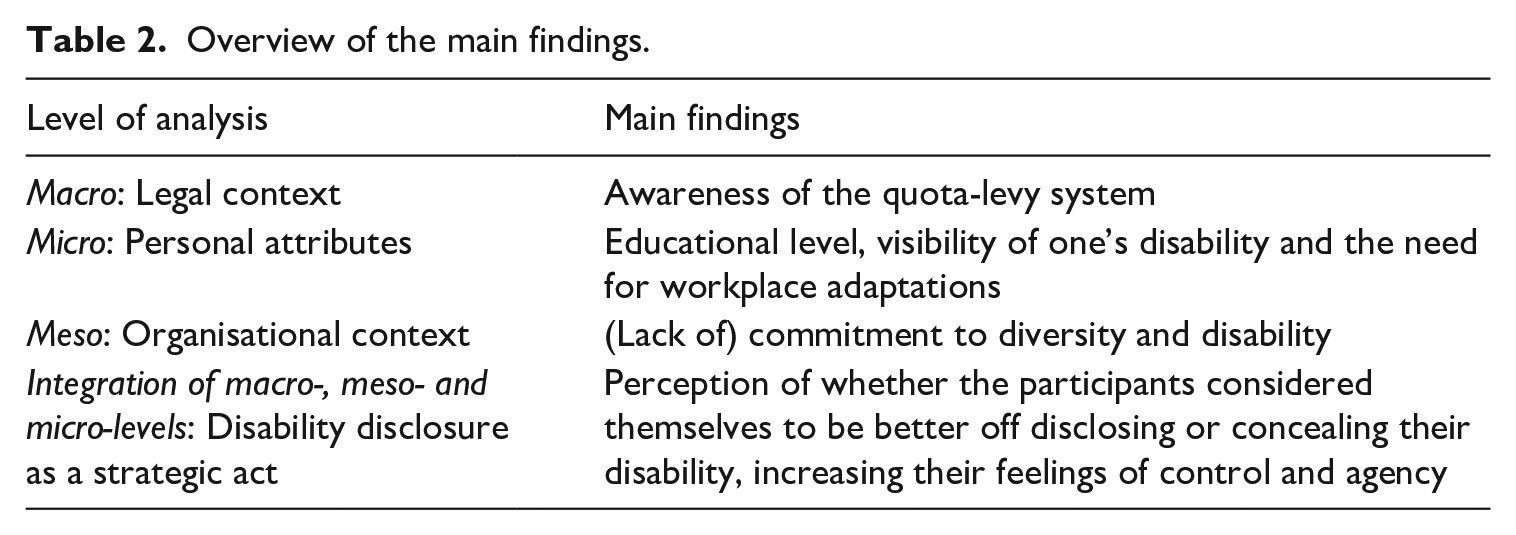
The three levels of analysis that are taken into consideration by disabled individuals in the disclosure decision (macro, micro and meso) are further explained below, followed by a concluding section that integrates the three levels.
The macro-legal context: The quota system
The quota system puts pressure on both organisations and disabled individuals to disclose and have their disability legally recognised. As the participants had recently entered or were seeking to enter the labour market, the topic of disclosure came up frequently. Participants solicited help from their relatives, employment intermediaries and employment experts. Often, external actors pressured disabled workers to initiate legal disclosure by providing information, giving advice, encouraging them or attempting to persuade them to disclose their disability. At the lowest level of pressure, the external actor simply provided the information necessary for the worker to claim the benefits attached to legal disclosure. As a result, newcomers were informed about the support available and the administrative steps to follow as part of their legal disclosure. One participant with a neurological disability reported the following: ‘I got some emails from the person in charge of disability in the organisation’ (Participant 1).
Stronger pressure involved being advised and encouraged to initiate the disclosure process, as indicated by a participant with a physical disability: ‘It was my sister’s husband who explained that if I wanted a job, I better indicate a legally recognised disability status’ (Participant 34).
In certain cases, participants were persuaded by their employer to reveal their disability status: ‘Where I work, they convince everyone to declare it. It’s as if we don’t have a choice’ (Participant 30).
This contributed to the participants’ awareness that their disability can be an asset rather than a liability and made them increasingly aware of the support that exists for disabled workers, such as specific disability job search networks or financial assistance and accommodations. A participant with a physical disability explained as follows: ‘During my interview, they told me I can have a flexible schedule to see a physiotherapist’ (Participant 33).
Overall, the participants reported increasing awareness and understanding of the impact of the quota system in France. Rather than focusing on the potential stigmatising nature of their disability (Santuzzi et al., 2014), they realised that their status could be an advantage in a country with a quota system (Vornholt et al., 2018). As one participant with a physical disability explained: ‘I met someone from a disability charity. We took time to discuss the regulations, and she told me that I could use my disability status’ (Participant 4).
Although most of the participants seemed interested in the support and the disability rights related to legal disclosure at work, some remained sceptical. For example, a participant with a physical and mental disability argued that chronic tiredness cannot be resolved with accommodations and that disclosure is not, therefore, beneficial in such a case: ‘Tiredness is not taken into account. They always ask about material accommodations. Not everything can be resolved with that. I just get tired very quickly’ (Participant 10).
Overall, the quota system had raised the participants’ awareness of their unique position in the French labour market and made them think about the strategic use of their disability status. As one participant with a physical disability explained: ‘I’m a pragmatic person. I dislike the idea of positive discrimination, but if it can help me, why not?’ (Participant 29).
In summary, the quota system and the pressure it puts on employers contributed to participants’ awareness of the advantages and disadvantages in the workplace due to having a disability (Santuzzi et al., 2014). Moreover, it allowed the participants to consider using the quota system strategically, providing agency and empowerment, in order to facilitate their labour market integration.
The micro-level: Reflecting on one’s personal situation
The legal context in the form of a quota system raised the participants’ awareness of the advantages of having their disability legally recognised. However, as every condition is different, the participants engaged in introspection to reflect on their personal attributes and the organisational environment. First to be discussed below is the process of introspection and the different aspects of themselves the participants reflected on as they considered how beneficial it would be for them to disclose (Chaudoir and Fisher, 2010).
First, the visibility of the participants’ disability influenced whether they had a choice in the disclosure decision. Even if disabled workers are not obliged to declare their situation officially, those with visible disabilities are obviously identified as disabled, as one participant with a physical disability commented: ‘I cannot hide it. Whether I say it or not during the interview, the employer is going to know it’ (Participant 38).
By contrast, participants with less visible or invisible disabilities are not systematically identified as disabled and, therefore, have a genuine choice, as mentioned by a participant with a physical and less visible disability: ‘During some interviews, I didn’t tell the human resource manager that I was officially recognised as disabled. It can go unnoticed’ (Participant 33).
Individuals with an invisible or less visible disability may decide to disclose it on one occasion and conceal it on another, depending on the context. However, not providing the ‘Recognition of the Quality of Disabled Workers’ (RQTH) is not practical for someone with a visible disability, as stated by a participant with a physical disability: ‘If I don’t give it [the RQTH], it would look suspicious. The employers wouldn’t understand and would think that I have a problem with my disability’ (Participant 29).
Second, their need for workplace accommodations was also a factor upon which the participants reflected. Participants with disabilities that required significant adaptations at work were forced to reveal their status, as explained by a participant with a sensory disability: ‘They told me that I needed the RQTH to get accommodations. I’m a blind teacher; to manage my classroom, I need an assistant, to act as my eyes’ (Participant 30).
The participants were conscious that the fewer accommodations they needed, the more choice they had in their disclosure decision. They also reported that needing only minor adjustments increased their value in the labour market, as illustrated by a participant with a learning disability: ‘They have a quota to respect. The fact that my disability is not physical is an advantage. The software I need only costs 120 euros; it’s not very expensive’ (Participant 16).
By contrast, participants with impairments requiring extensive accommodations highlighted that they perceived themselves to be less attractive to employers, as mentioned by a participant with a physical disability: ‘I cannot work full time. I get tired easily, which impacts my work. This is obviously an issue for an employer’ (Participant 10).
Participants also thought about their level of education. Highly qualified participants seemed to be aware that many organisations struggle to hire qualified disabled workers in France (Perotte, 2013). They explained that their educational level increased their value and this encouraged them to disclose, as illustrated by the following quotation from a participant with a physical disability: ‘I’m using it and I will use it in the future. I intend to do a master degree. With five years of studies, I have an advantage over other disabled workers. I know that there are not so many disabled people with a master’s degree’ (Participant 4).
Particularly in sectors with low levels of competition, the participants perceived their disability status as a distinctive attribute, as stated by one individual with a learning disability: ‘I put my disability status on my resume, and suddenly several big companies reached out to me’ (Participant 16).
However, in sectors where employment opportunities are scarce, they perceived their disability as an obstacle, as mentioned by a participant with a physical disability: ‘There are very few hiring possibilities. I’m not the only one to struggle to find a position. If they have a position, they will choose somebody with all his physical abilities’ (Participant 34).
To summarise, introspection helped the participants to determine the value of their disability status and made them realise that not all disabled workers are free in their decision to disclose or are equally valuable to potential employers (Clair et al., 2005). Individuals with invisible disabilities, with minor impairments that do not require any accommodations and with a high educational level seem to be more likely to benefit from disclosure under a quota system and might have more employment choices.
The meso-organisational environment: The organisation’s commitment to diversity
Participants also analysed the organisational environment; in particular, attitude and commitment to diversity. Some participants contacted organisations that are part of disability-friendly networks, as reported by one participant with a sensory impairment: ‘In these networks, they already know that we have a disability. The disability aspect of the application is set apart, we can concentrate on competences’ (Participant 35).
Other organisations were less aware of diversity, as illustrated by a participant with a learning disability: ‘A company found my resume on the internet. They didn’t know anything about my disability, they were a little lost’ (Participant 19).
Participants analysed public statements and looked for information and actions that reflected an organisation’s commitment to diversity, as explained by a participant with a sensory disability: ‘I want to know if they have a disability policy, if they have a disability officer, if they really have a disability integration approach’ (Participant 26). Rather than focusing on the disability-friendly image displayed by an organisation, participants instead made an effort to look for ‘proof’ in terms of concrete actions in order to avoid organisations that use diversity as window-dressing, as asserted by a participant with a sensory disability: ‘I had the occasion to see that it was not just words. They even contacted the university’s disability office to implement accommodations. They were curious and open about disability’ (Participant 35).
To be sure that the organisation’s commitment to diversity is shared by everyone in the company, participants also scrutinised social interactions during their job interviews, as explained by a participant with a learning disability: ‘It’s during the interview that I get a feeling for the place. I observe whether individuals want to engage with me or not’ (Participant 19).
In summary, participants adopted a proactive attitude and analysed organisations’ awareness of and commitment to diversity. The organisations that seemed truly committed to diversity issues encouraged participants to be open about their condition (Jones and King, 2014).
Integrating the macro-, meso- and micro-levels: Disability disclosure as a strategic act
Awareness of the quota-levy system, the (lack of) commitment to diversity at an organisational level and participants’ personal attributes, such as educational level, the visibility of their disability and the need for workplace adaptations, influenced whether participants perceived their disability status as empowering. Their analysis of the legal, organisational and personal context influenced whether they considered themselves to be better off disclosing or concealing their disability. Disability disclosure thus becomes a strategic act, increasing the participants’ feeling of control and agency (Zimmerman, 2000).
Participants were aware of the quota employers had to fulfil and, therefore, tended to perceive their disability as a desirable attribute. Some legally declared their disability in the expectation of increasing their employability, as illustrated by a participant with a neurological disability: ‘What I expected is that it helps me to find a job, and it really did help me’ (Participant 1). Similarly, a participant with a physical disability explained that the quota system was a helpful tool to re-establish equity at work: ‘After all, this disability is part of me, if they can use it to obtain the quotas, I don’t mind’ (Participant 9).
The participants also reflected on their need for workplace adaptations and the visibility of their disability. Although some participants perceived their disability to be a disadvantage, this was related to the organisational context, as highlighted by a participant with a physical disability: ‘It can frighten the employer that I have the Recognition of the Quality of Disabled Workers; it means that they have to adjust the workplace’ (Participant 33).
When an organisation was perceived to have a positive attitude towards diversity, the visibility of a participant’s disability and the need for workplace adaptions were no longer a hurdle. In such cases, legal disclosure was perceived to be empowering and a means of being recruited in preference to non-disabled people, as illustrated by a participant with a debilitating condition: ‘If there are two identical resumes, my application will be treated with priority thanks to my disability status’ (Participant 8).
However, the quota system was not always perceived as empowering. A participant who has multiple disabilities and needs major accommodations explained that employers see him as a burden. He does not feel that disclosure has improved his employability: ‘The organisation doesn’t want any constraints. Disability is only used to help the organisation save money’ (Participant 10).
Similarly, some participants perceived that they were recruited only because of their disability, as a participant with a learning disability recounted: ‘It’s a bit humiliating to be recruited just because of one’s disability status. It feels like competences don’t count’ (Participant 16).
Participants with visible disabilities that need workplace adaptations did not have a choice in the disclosure process and, therefore, felt that legal disclosure only benefited the organisation, as mentioned by a participant with a physical disability: ‘Usually, people see that I’m disabled, declaring doesn’t make any difference for me and has only added value for the company’ (Participant 11).
In summary, the disabled individuals interviewed reflected on their personal attributes, such as their educational level, the visibility of their disability and whether they need workplace adaptations, as well as the organisational environment in the form of the organisation’s commitment to diversity. This reflection determined whether they perceived their disability as a valuable attribute and the extent to which legal disclosure would be empowering. However, the findings highlight that disabled workers are unequal in their capacity to make strategic use of the disability quota system, thereby increasing inequalities within this group of workers.
Discussion
Drawing on 39 life story interviews with disabled individuals, this study explored how the disability quota system in France affects the decision to disclose one’s disability in the workplace. The findings reveal that disabled workers in France reflect on their personal attributes, such as their educational level, the visibility of their disability and whether they need workplace adaptations; on the organisational environment, such as the organisation’s commitment to diversity; and on the legal context, in this case, the quota system. This analysis influenced whether they considered themselves to be better off disclosing or concealing their disability. As such, disability disclosure becomes a strategic act. The main contributions of this study are outlined below.
First, legal disclosure allows investigation of the impact of a quota system on the disclosure decision of disabled workers. Although the legal environment has been identified as a key factor in disclosure motivations (Clair et al., 2005), this study adds to the currently small body of knowledge on the influence of state incentives on disclosure behaviour.
Second, the findings show that when disabled workers perceive their disability as something positive, this has an empowering effect. That disability can be conceptualised as something positive, aligns with the affirmative model of disability (Swain and French, 2000). This model provides a non-tragic view of disability that encompasses positive identities for disabled people (Swain and French, 2000). Fear of stigmatisation is considered the core driver of disclosure hesitation (Stenger and Roulet, 2018), but this study shows under which circumstances an individual’s disability can become a valuable attribute at work. The findings show that a quota system can empower disabled workers by making it possible for them to use their disability status as a strategic tool to use to their own advantage in the labour market.
Third, drawing on the biopsychosocial model, this study highlights the unintended negative effects of quota systems in the form of inequalities among disabled workers, as they are not equally empowered under a quota system. Building on previous research that has explored how the accumulation of disadvantages affects an individual’s employment outcomes (Berthoud, 2008), this study shows that multiple disadvantages interact and intersect with one another. More precisely, this study enhances understanding of the complex effects of quota systems that, in some cases, seem to increase rather than decrease discrimination among already-discriminated-against individuals by giving more agency to individuals with minor impairments (Fuchs, 2014).
Theoretical implications
First, this study expands the knowledge of the legal empowerment of disabled workers in an organisational setting. The findings reveal that a disability quota system makes disabled workers more aware of their rights and strengthens their ability to exercise those rights in the form of workplace support that is legally available to them upon legal disclosure. This can help them to overcome their position as stigmatised individuals and improve their chances in the labour market. However, in line with previous research that showed that legal empowerment does not necessarily mean that marginalised groups can benefit from a legal system (Foster, 2007), this study shows how legal empowerment actually plays out in an organisational context. Earlier studies using the empowerment perspective revealed that lack of awareness or assistance was a frequently cited issue in making legal rights truly available to those that need them (Gisselquist, 2019). This study shows that legal empowerment characterised by a quota system enhances disabled workers’ awareness of their rights. However, an organisation’s lack of commitment to diversity and certain personal attributes of disabled workers seem to be important barriers to empowerment.
Second, this study highlights that disabled individuals carefully reflect on how they compare with others in relation to their personal characteristics. Although it has been argued that governments use differences between disabled individuals to cut overall welfare provision with the intention of giving more to those who are severely impaired (Oliver, 2013), the findings of this study show that disabled workers themselves also use such differences to their own advantage.
Third, we provide a more nuanced picture of the biopsychosocial model by highlighting both its potential for empowerment and its limits in the form of unexpected inequalities. As a quota system is underpinned by the biopsychosocial model, we show that a quota system compromises the inclusive aims of this model and that more action is needed to offset these limits. A quota system does not promote general inclusion but further emphasises the differences in disability characteristics. By focusing on disability characteristics, the system is dangerously falling into the trap identified by the critics of the medical model of disability, namely, the tendency to highlight the impairment instead of the person (Lawson and Priestley, 2016).
Practical implications
First, this study shows that although a quota system might help to raise awareness about disability and make disabled workers more aware of their legal rights, it is by no means a measure that necessarily improves their chances of employment. The WHO (2011: 241−242) states that ‘the assumption that quotas correct labour market imperfections to the benefit of persons with disabilities is yet to be documented empirically’. In line with the empty-shell hypothesis (Hoque and Noon, 2004), putting a quota system in place should go hand in hand with other measures and efforts on different levels, such as the creation of an inclusive climate at work, if this employment empowerment measure is to be effective. It remains the case that the lowest employment gaps between disabled and non-disabled workers are found in countries that have a quota system (Grammenos, 2013), so an approach that includes a multitude of tools is likely to lead to the best outcomes.
Second, although it was found that a quota system helps to raise awareness about disability, awareness of and commitment to diversity at the organisational level are paramount. Diversity training, trade union initiatives and affinity networks within organisations can all provide a collective voice for invisible populations in the workplace and help combat discrimination (Colgan and McKearney, 2012).
Third, the findings reveal that personal attributes, such as educational level, the visibility of their disability and the need for workplace adaptations, influenced the participants’ perception of whether their disability status was empowering. The advantage conferred by needing no or little workplace adaptation is not a new finding and can make the difference between job loss and a successful employment experience. It is important to realise that small adaptations are usually sufficient to help disabled workers function optimally at work (MacDonald-Wilson et al., 2002). However, a change in mindset and workplace culture, as indicated above, is more difficult to accomplish.
Policy tends to put all disabled workers on the same level but there seem to be strong differences within this group of workers. Specialised employment agencies, human resource practitioners and managers should, therefore, be aware of this and support disabled individuals by taking their personal attributes into account.
Limitations and future research
First, the findings seem to suggest that a quota system has an impact on the disclosure decision of disabled workers in a workplace setting. However, this study did not include a comparison group (e.g. in the form of workers from a country without a quota system). Further research is thus needed to study other national contexts to examine further the influence of the legal context. Second, there are several factors that differentiate people within the sample and that merit more research, such as gender, the onset of disability and whether someone has been diagnosed. In addition, that the participants were recruited through a disability organisation might have influenced the findings, as those individuals are likely to be aware of the socio-legal context of disability in the workplace. Third, disclosure is not a one-off event. Rather, individuals at work are presented with multiple occasions on which they have to decide whether to reveal or conceal their condition. A longitudinal design or diary study could be particularly interesting in order to capture the dynamic nature of disclosure decisions as one disclosure experience is likely to affect future disclosure decisions.
Footnotes
Funding
The authors received no financial support for the research, authorship, and/or publication of this article.