




Abstract
This article presents Khongelani Hlungwani’s experiences of working as a labour broker worker and his struggle to become a permanent worker in Gauteng, South Africa. His account provides a lens through which to understand the shopfloor divisions between permanent and labour broker workers. These divisions are, as Hlungwani’s account demonstrates, compounded by a trade union movement that largely sidelines the interests of precarious workers in favour of permanent workers. This has led many workers, like Hlungwani, to be distrustful of trade unions. Thus, when new labour rights were introduced in 2015, which provided an impetus for labour broker workers to organise, many, like Hlungwani, chose to do so outside of trade unions. The article demonstrates how it was possible, in the South African context, to utilise the institutional power of new labour rights to build associational power outside of trade unions. The article provides insight into both the strength and the fragility of these forms of organising through an account of the strike that Hlungwani participated in in solidarity with unionised workers at his workplace.
This On the Front Line article presents Khongelani Hlungwani’s biographical account of working as a labour broker worker and his struggle to become a permanent worker. His narrative illuminates the continuities of the internal migrant labour system, which has been a cornerstone of the South African economy since the 19th century. Indeed, as Munck (2013) highlights, while precarity has become, in recent times, a central focus of labour studies, work in the Global South has always been precarious, although it may be becoming increasingly so.
South Africa’s reintegration into the global market economy has borne witness to the accelerated use of casualised and externalised labour, with some estimates suggesting that nearly 40% of the workforce in the formal labour market is currently comprised of workers employed in some form of precarious work (Englert and Runciman, 2019: 88). The South African trade union movement has, as elsewhere in the world, struggled to respond to the changing composition of the workforce. The last membership survey of the Congress of South African Trade Unions (COSATU), the largest trade union federation in South Africa, highlighted that 90% of its membership is comprised of permanent workers, with two-thirds of those members engaged in skilled or supervisory work (Bischoff and Tame, 2017: 66). The traditional blue-collar worker that was, historically, the base of the South African trade union movement, has declined in significance, and very few atypical workers are organised in trade unions.
While COSATU may organise very few atypical workers, it has been vocal in its demand to ban labour broking, the term most commonly applied to those employed in temporary employment services (TES) in South Africa. In response, the government, led by COSATU’s alliance partner the African National Congress (ANC), amended the Labour Relations Act (LRA) in 2015 to afford labour broker, contract and part-time workers greater rights and protections. The amendments came against the backdrop of the Marikana massacre 1 and a rising tide of worker militancy, a not insignificant proportion of which occurred outside of trade unions (Paret and Runciman, 2016: 306).
The amendments restricted labour broking to work of a genuinely temporary nature and required that labour broker workers become permanent workers of the client company after three months. While this was not a ban on labour broking, it was a significant step forward in the rights for labour broker workers. Thousands of workers have since organised to take cases to the Commission for Conciliation, Mediation and Arbitration (CCMA) or the Bargaining Councils in their fight to become permanent. This has largely happened outside of trade unions either independently or with the assistance of advice offices like the Casual Workers Advice Office (CWAO) (Rees, 2019).
Hlungwani’s account details his life as a labour broker and the divisions between the permanents and other workers. His narrative illuminates the deep scepticism towards unions that he, and many other workers, currently have in South Africa (see also Satgar and Southall, 2015). As Pero suggests, the fact that workers embark on organising independently is not the result of ‘an a priori strong ideological indifference to mainstream unions’ (2019: 906), but a direct result of their negative experiences with them. Hlungwani’s narrative provides insight into this through demonstrating how the experience with the Chemical, Energy, Paper, Printing, Wood and Allied Workers Union (CEPPWAWU), which used the labour broker workers to further the demands of the permanent workers, laid the basis of their distrust of unions. This later influenced the attitude of workers towards an offer negotiated by the National Union of Metalworkers of South Africa (NUMSA) and led to workers organising independently, with the assistance of the CWAO.
While there are many similarities to worker centres in North America, advice offices have a distinct history in the South African labour movement (see Ryabchuck and Wilderman, 2018). Worker centres in North America often have a strong orientation towards working with established trade unions (see Fine, 2011); in comparison, the CWAO has orientated towards supporting independent worker organising through workplace committees or forums under the banner of the Simunye Workers Forum.
The response of workers to organise independently, illuminates how, as Pero (2019) has argued, labour mobilisation theory can be extended to consider how workers, under conditions of precarity, are able to build associational power. In this case, when analysed through the lens of the power resources approach (Schmalz et al., 2018), associational power is developed in dynamic interaction with the institutional power the amendments to the LRA afforded labour broker workers. However, this institutional power is a double-edged sword as it draws the workers’ struggle into the institutional terrain, in which employers are able to utilise their structural power to frustrate and delay the demands of workers.
The narrative concludes with a reflection on the strike that both ‘old’ permanent unionised and ‘new’ permanent non-unionised workers embark on, overcoming the divisions of the past. The violence that peaceful strikers are met with is a stark reminder of the continuing legacies of apartheid in South Africa. Furthermore, this account is important in a context in which striking workers are often blamed for violent conduct without any due attention to the conduct of the police or security personnel.
This article is the result of an ongoing research collaboration. This project started with group interviews that included Hlungwani and other workers (Hlungwani and Runciman, 2019). Hlungwani then used his interview as a basis to write up his own life history, supported by Runciman, who assisted with editing and drawing out key details and moments in the narrative. Hlungwani is a first language Xitsonga speaker but he produced the narrative in English so that it may be shared with a wide audience. The editing has been mindful that the text has been produced in an additional language and has sought to retain, as far as possible, the original expression.
Khongelani’s story: Coming to Johannesburg and starting work as a labour broker
In 2008, I completed my secondary education in Mavambe, Limpopo, the village next to my home village of Jimmy Jones. The year after, in May 2009, my girlfriend gave birth to our beautiful baby. I realised that it is now too much for my mother to support me with my family and I decided to come to Johannesburg to look for work. When I got to Johannesburg I was told by relatives that for me to get the job I must go around submitting curriculum vitae at labour brokers’ offices, which I did. I was lucky because after three months of job-hunting I received a phone call from Transman for an interview. The same day they took me to a company called Domino in Pomona in the East Rand, Gauteng. My work was to go around preparing the tent for functions, making sure chairs and tables are in order; I worked there for seven weeks earning ZAR60 per day.
After that job ended, every day I woke up early in the morning to go to Transman because there was always possibilities for those who arrive early to be taken to one of their clients. Every day I was taken to work in different sites. At the end of the week Transman would pay you with different rates depending on how many companies you worked for or placed you at that particular week.
Working in different companies every day had its challenges because I had to make sure I had enough money with me to travel back home from whatever company I was placed in, while never knowing where it would be. The labour broker company would drop me at whatever company they choose, instruct me on what to do and then leave. It would not matter to them what time I would knock off because they would not return to fetch me. It was most difficult not knowing what your pay would be because it fluctuated every month. My expenses and my responsibilities were stressful because my pay changed from time to time. It continued like that until the beginning of the year 2010.
Working at Luxor Paints
It was 5 February 2010, I woke up to go to Transman, as usual. Luxor Paints, a paint manufacturer, was known as an ‘underpaid’ company amongst the workers and it was difficult for Transman to get people to work there for a long period of time. Most workers would only work there a week and then go back to the Transman offices to ask for a different job. When they wanted to place someone at Luxor Paints they would target those who, in their eyes, looked desperate for job. I looked like one of those people. They called me to the office with five other guys and said they were taking us to Luxor Paints.
We arrived around nine o’clock in the morning and immediately we were taken to the supervisor’s office. Among the six of us, four were chosen to work dayshift. The other two, including myself, were to start working a nightshift the same day. The workplace is divided into two – factory and a store. I was working at the factory filling paint, others were mixing, while others labelled tins. No training was given. We were all told that fellow workers will show us how to mix and fill paints even to label tins. It didn’t take me long to learn.
Those who were working at night were only labour brokers. The managers were all white, the supervisors and permanents only worked day shift. Before they knock off, they would make sure they show us what to do for the night and set us a target. If your team fails to reach the target, the following day the managers would give you a warning or you would be told to report back to the Transman offices. Nightshift was known as the best filling team compared to dayshift. I’m sure we were working much harder because we were threatened to be dismissed if we did not reach targets.
When we knock-off at 22:00 there was free transport to take us to our homes. At the time, I was staying at my uncle’s place at Duduza squatter camp in Tembisa Ekurhuleni, Gauteng, but the taxi drivers refused to take me home to the squatter camp at night. They would drop me where the road ended and I walked the rest of the way home, usually arriving at midnight. It wasn’t safe to do that and I had to move. I moved to Winnie Mandela, in Tembisa, paying ZAR300 a month to rent a shack. Moving away from my uncle’s place made things more difficult for me. I struggled to send enough money home because the amount I was paying in rent was almost my weekly salary. On top of this, I now had to buy my own groceries; before my uncle was buying groceries for us.
As labour broker workers, we did the hard work of production, working with dangerous chemicals. To survive as a labour broker was an individual choice to accept victimisation, oppression and the violation of your rights as a worker. Yes, Luxor was worse than the other jobs that I had but what made it better was that it was an on-going contract.
The role of the union
There was a union at the company, CEPPWAWU, for permanent workers. It did not bother to ask us to join them and we were warned by Transman not to join the union or to be seen holding meetings with permanent workers, that would lead to a straight dismissal if they see or heard about it.
The union ignored us for all the time we worked in Luxor until 2012 when the permanent workers wanted to go on strike over better wages. We were so surprised when they ask us to join the strike. They said that they would demand that we were made permanent. In our heart we knew that was a lie, it was just a way to get our support, as the labour broker workers were double the number of permanent workers. Without us the strike would not have an impact. Even though we had our doubts we joined the strike.
The strike took two weeks and the mood was high for both labour broker workers and the permanent workers, we were all happy. There is nothing better than to see labour broker workers and permanent workers unite to fight the bosses. But the permanent workers did not keep their promise. Management made them an offer: they were given a choice between a ZAR200 increase and making 20 labour broker workers permanent a year or a larger wage increase of ZAR900 with no labour broker workers being made permanent. The permanent workers chose to have the larger wage increase.
When we confront them about failing to keep their promise, the union official replied by saying it’s much better the company promise them that we will keep our job and we won’t get punished for joining the strike. 2 It was a painful moment, especially watching them celebrating a huge victory while we are going back empty handed. Our hearts were broken, that was one of the most painful moments at Luxor Paints. But judging by the look of the permanents, you could see that betraying us meant nothing to them. It created a huge hatred amongst ourselves as their action clearly proved that they do not want us to become like them, to become permanents.
Every year the negotiations for an increase would happen. The union would represent the permanent workers and we would be represented by Transman. We never received an increase of more than ZAR300 and we had no say in that matter because according to them they were doing us a favour and we should be grateful and keep quiet.
Organising as labour broker workers
In 2015, after the LRA was amended, we were aware that we had new rights but we didn’t know how to enforce it. We came with an idea of establishing a workplace forum and I was elected to be in a committee of the forum as secretary. By that time, the permanent workers had joined NUMSA. The NUMSA organiser approached us and said that if we join them we could be made permanent under this new amendment. We joined with the hope that union would be able to make us permanent.
The organiser met with management and came back with an offer that we would be made permanent but only receive a ZAR600 a year increase for three years, still half of what permanents were getting and we decided to turn down the offer. 3 To our surprise, the organiser discouraged us from pursuing a better offer. He argued that once we become permanent he would negotiate for better wages. He added by saying that there is no way he can refer a dispute to the CCMA because he don’t even know how to refer it. We could see that the deal NUMSA was defending was daylight robbery and we suspected that it might happen the company brought the organiser to convince us to take the offer because none of us were part of the negotiation. We were not represented – it was him and two permanent workers.
The following week, I was summoned to see the human resources (HR) manager. When I got to the office, she started to mourn, saying that we are making a huge mistake for turning down the offer. She told me how intelligent I am and that she trusts that I can find a way to convince the workers to reconsider rejecting the offer. I was there for an hour, she even made tea for me. I suspected that someone told HR that workers used to come to me for clarity on things, believing that I have a good understanding of the things. I think that’s the reason that management thought that if they could get me on their side that I would be able to convince the other workers. I knew what she was trying to do but I had to act like I’m on her side. I responded by saying I will try to speak to the workers.
When I returned back to the factory floor, workers started asking questions. I shared what happened with those I was working with in my team, but before the end of that day the whole company was talking about my meeting with HR, some were even thinking I might sell the workers out. I decided to call an urgent meeting to explain exactly what my meeting with the HR manager was about. I told them that she sent me to convince them not to reject the offer. Workers believed me and started to say the HR think we are stupid and they thanked me for being honest with them.
Finding CWAO and becoming permanent
After struggling with the offer negotiated by NUMSA, one of us came across the ‘Big New Rights’ pamphlet from the CWAO. We called CWAO and we were told to come to their office – they promise to assist us to get permanent status and equalisation. CWAO help us to refer the case to the CCMA. CWAO did not waste time, they did not even suggest to meet with the company. The only thing they ask from us was to write down all our names and our signatures to refer the case to the CCMA. Every one of us was happy with how CWAO handled our case – we could see that there is a serious business happening there.
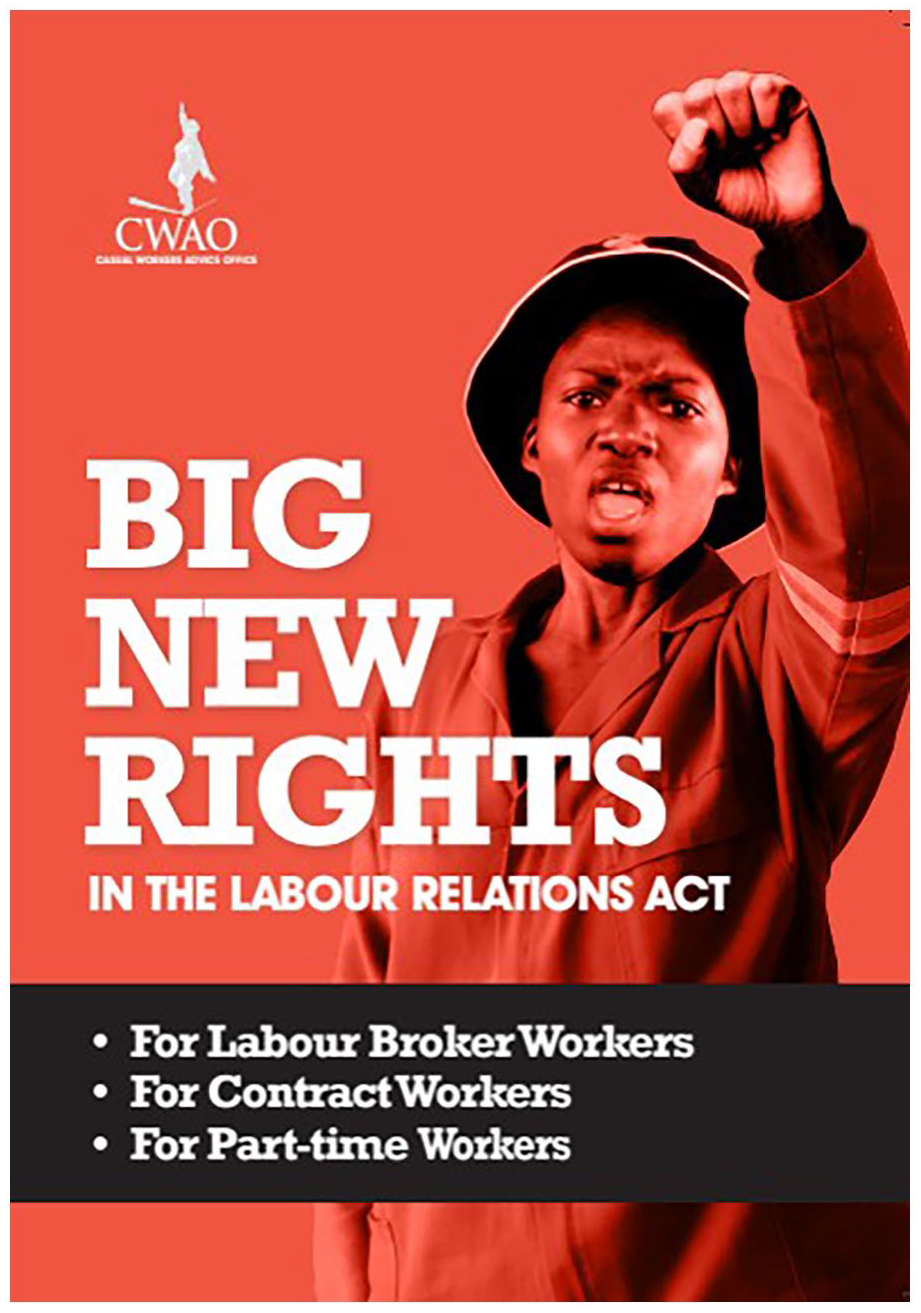
CWAO Big New Rights pamphlet, 2015.
When we get to conciliation, the company stick with the same offer negotiated by NUMSA, so we took the case to arbitration. But the company then registered at the chemical industry bargaining council and successfully argued that the CCMA had no jurisdiction to hear the case. We then had to refer a fresh dispute to the chemical industry bargaining council. At the same time, the management began to target individual workers, especially those it knew were struggling financially, to get them to sign the deal NUMSA had negotiated. Eventually, 21 workers agreed to this deal.
Despite all the bullying from the employer, at the first conciliation at the bargaining council the employer indicated that they were willing to take us permanently and negotiations began. We elected a negotiating team that would liaise with CWAO during the negotiations. After a long time of negotiation, the company agreed to make us permanent and to equalise us with the same conditions as permanents. We also received back pay for what the company should have paid us since 2015; the back pay was staggered over three months. I was so excited being permanent, earning better wages, and the management started to treat us the same as other permanents.
Attempting to build unity
Although the old permanent workers had not supported our struggle, we knew it was important to build unity. Our forum organised several discussions between us and the old permanent workers. The old permanent workers proposed leaving NUMSA, and have all workers join a new union: the General Industrial Workers Union of South Africa (GIWUSA). But the forum members did not want to join a union. For the longest time we had worked with unionised permanent workers who were always complaining about being sold out. Plus, through attending Simunye Workers Forum general meetings and workshops at CWAO, we equipped ourselves to challenge our bosses. We, the forum, were recognised more by the company than the union itself. I say this because every time we had issues with management, they always made time for us to discuss immediately. Whereas unionised workers in the company would struggle to meet management and it would take a long time for their issues to be attended to. We asked ourselves, what benefit joining GIWUSA will bring? We decided to remain loyal to CWAO that assisted us for free and gave full support when the trade unions wanted nothing to do with us.
Striking as unionised and non-unionised permanent workers
In October 2017, GIWUSA called a strike to get a transport allowance, long service allowance and housing allowance. Since we were not union members the strike was called without us, but we decided to go out in solidarity with them. The strike lasted only three days before it was interdicted. We successfully challenged the interdict but then decided to wait until after the Christmas break to go to the strike. In February 2018, we went on strike again.
What I experienced is that bosses hate to see workers being united to fight for the same goal. This scares them a lot, judging from how they responded. From the first day of the strike, the company brought in labour broker workers to replace us. This was to disorganise us as workers. In addition, they deployed a militarised security company with armoured vehicles. It was clear that they were instructed not to show mercy on us. We were so shocked when on the first day of the strike, without warning, they shot us with rubber bullets. It happened again the following week and 19 workers were injured and one worker lost his eye (see Kamanzi, 2018).

Luxor Paints Strike, February 2018.
I will never forget that day, as it was the day that I understood what is the struggle. I recall phoning CWAO to report what had happened. I found myself not able to speak over the phone. When they picked up my call I just broke down in tears, crying like a little baby, until someone came to my rescue and took the phone and spoke with the office. You could see that our hearts were broken, everyone was completely down, some were crying but all that didn’t stop any of us from continuing.
During this time, I experienced the level of the bosses’ arrogance. They dismissed 111 workers for misconduct two days after shooting us. They played the victim, saying we were attacking them. They stopped negotiating with us for almost a month. While we were picketing outside the company’s premises, they acted as if nothing was wrong, they carried on as normal, they showed no remorse. During the strike, they denied us access to water and toilets, even going so far as to stop the nearby garage from giving us water to drink. This is when I realised that bosses do not care about workers, they only care about their profits. The moment you interrupt this, you become like a disease to them.
We started to look at strategies to make the management bargain with us again. We decided to go to the company’s suppliers and clients but instead of supporting us they took our pictures and videos and sent them to the company. The company used these pictures to get a court interdict to prevent us from demonstrating within 500 metres from the company, the clients’ company and their suppliers. We were all disappointed, more especially to see that legal institutions, that are supposed to be fully behind the workers, are now acting against us in support of the bosses who exploit the workers on a daily basis.
Although the strike had been called by GIWUSA, the GIWUSA organiser hardly came to the strike. The original permanent workers started to say that they should have listened to us when we ask them to join our workplace forum. They put it clear that if they return back to work, they will immediately resign from the union and join the forum.
All the workers turned to CWAO for support and we came with a new strategy. We decided to go to where the Luxor Paints owners live and to their local synagogue. We stood outside these places holding big placards saying how bad they treat us as their employees. We shamed them because it attracted a lot of people passing by – vehicles stopped and asked questions, taking photos, some encouraged us to continue with the demonstration. They asked how they could treat their employees like that, questioning how they sleep at night knowing that there are hundreds of workers crying out there? Some even tweeted about it. But, despite all the support we got, there were some who took our photos and sent them to our bosses. After this, we were targeted by the bosses. They made it clear that they no longer trust those who participated on the demonstrations. I was now one of the workers they no longer wanted.
It was my first time being involved in a strike that took a long time, four months in total. Because of the interdict the majority of us started not to come to the picket and the number started to decrease daily. That’s when we decided to call off the strike so that we could continue fighting unfair dismissals. This would also allow the dismissed workers to claim Unemployment Insurance Fund (UIF) to survive. Those who were not dismissed returned back to work, but on their return they faced disciplinary hearings and were charged with derivative misconduct and were also dismissed.
Back to where I started?
It felt like I’d taken two steps backward from where I was with my life. It was hard and disappointing at the same time because all this happened at a time when I had just been promoted and I had just shared the good news with my mother and the rest of the family. Each day she would call to ask: when we are getting back to work? My situation worried my mother because she knew how disappointed I was and, honestly, I was feeling broken because it felt like I was back where I started.
I found myself in a deep hole of debts, which I am still paying to date. As a tenant, I became a burden to my landlord because I could not afford to pay rent. I could see that my landlord was not happy but because I had been his tenant for a long time he allowed me to stay without paying rent. I had to beg for money to buy food from my relatives, watching my kids going to school carrying no cent, this made my heart feel sore as I was helpless; even people around me made me feel less human. My plans were completely crushed.
The dismissal case has been dragging for a year now because we open a case at the bargaining council only to find that the company withdrawn to the bargaining council and they successfully argued that the bargaining council had no jurisdiction to hear the case, forcing us to open a fresh dispute at the CCMA. When we went for arbitration at the CCMA, the company argued that the case must be taken to the labour court but, luckily, that was dismissed by the commissioner. The case is continuing at the CCMA even today.
Although I was dismissed, I personally don’t regret the decision we took for supporting union members. As the struggle slogan says, ‘an injury to one is an injury to all’. I now volunteer as an organiser at CWAO to help other workers.
Footnotes
Funding
The authors received financial support from the National Research Foundation to conduct this research.
