



Abstract
The gender gap in self-employment is one of the most resilient in labour participation. While for some, this gap is the result of women’s lack of opportunities to become self-employed, for others, it reflects women’s preference to stay in paid employment. This article investigates the motivations behind women’s decision (either from opportunity or necessity) to start a business in 17 European countries. Results from the analysis suggest that individual resources are fundamental in explaining women’s motivations to become entrepreneurs. The type of gender regime and the economic situation in their country also play a role in women’s decisions to start a business. Women are more likely to be driven due to opportunity in dual-earner gender regimes than elsewhere, and high levels of unemployment produced by the economic crisis have boosted women’s self-employment from necessity. These findings are discussed in relation to the gender gap in self-employment.
Keywords
Introduction
Despite improvements, the gender gap in labour participation persists and has changed very little in the last few years (OECD, 2017: 21). The most critical is the gender gap in self-employment: whereas the gap among employees is less than 4% in the 28-EU members, it is almost 35% among the self-employed (Eurostat, 2019). The type of businesses women self-employ in also tend to be poorer quality than those of men. Women normally own small enterprises with low possibilities of growing economically; and they tend to earn less than self-employed men (OECD and European Union, 2019).
The existence of a gender gap in self-employment has been addressed from two different points of view. For some (the ‘lack of opportunities view’), the gender gap evidences women’s lack of chances to become entrepreneurs. Since women tend to face strong economic and cultural barriers, among others, when trying to become entrepreneurs, there are fewer self-employed women than men (Guzman and Kacperczyk, 2019). From this point of view, the gender gap is interpreted as a policy problem, and promoting women’s access to self-employment is the key to thriving in a gender-equal economy (European Union: European Commission, 2020). For others (the ‘preference/necessity view’), the fact that some of the largest gender gaps in self-employment are to be found in countries that emphasise female integration into the labour market might be an indication that ‘gender equality policies in the labour market may cause women to prefer employment over self-employment’ (OECD and European Union, 2017: 5). According to this alternative view, even if they had the opportunity, women would prefer to have paid employment. In most cases, this argument explains, women enter self-employment out of necessity, as the only way to access the labour market. Here the gender gap is a simple reflection of women’s and men’s distinct labour preferences, where men are more inclined to seek out entrepreneurship than women. Addressing the gender gap in self-employment from the ‘lack of opportunities view’ has therefore very different implications than addressing it from the ‘preference/necessity view’. We, however, know little about women’s true motives for engaging in self-employment in Europe – either from opportunity or necessity (exceptions include Buchmann et al., 2009; Jafari-Sadeghi, 2020). This study focuses on women’s motivations in being self-employed and the individual and contextual factors that influence entrepreneurial motivations. Hence, it goes beyond the examination of the gender gap as a simple proportion of women and men entrepreneurs, by inquiring into women’s true motivations for self-employment as a potential component of the gender gap. Understanding what motivates women to become self-employed is key to orienting any coherent set of policies aimed at supporting women’s self-employment, either breaking down barriers to women’s access to self-employment or fighting discrimination against women in paid work that eventually pushes them into self-employment (Dawson and Henley, 2012: 699).
Expanding on the push/pull thesis, data from the Global Entrepreneurship Monitor (GEM) are used to test whether and how individual characteristics that have commonly been conceived as push/pull factors do de facto shape women’s entrepreneurial motivations by opportunity/necessity. Moreover, this study makes a rare theoretical attempt to incorporate the context – and particularly the gender regime – as a push/pull factor in the motivations behind women being self-employed. The findings and their implications are discussed in relation to the gender gap in self-employment.
The gender gap in self-employment in Europe
Self-employment and entrepreneurship are not fully equivalent. Whereas self-employment generally refers to the distinction between independent versus dependent workers (e.g. ILO; OECD), there are several definitions of entrepreneurship (Peneder, 2009). The behavioural definition accounts for the characteristics of the entrepreneur, including uncertainty and risk, complementary managerial competence and creative opportunism (Long, 1983). Occupational definitions of entrepreneur are based on the position of the worker in the labour market, either as a salaried employee or as someone who owns an enterprise and/or is self-employed (Verheul et al., 2002). A functional definition looks into the contribution of the entrepreneur to the economy (Wennekers and Thurik, 1999). Different definitions imply different approaches to its measurement. Measures of self-employment (Eurostat) and entrepreneurship (GEM) used in this study are based on the occupational definition. 1 For this reason, and being aware of the limitations of this conceptualisation, self-employment and entrepreneurship are used interchangeably in the text.
As compared to the other regions of the world, Europe is characterised by low levels of entrepreneurship, even if the process of becoming self-employed is smoother than elsewhere (Global Entrepreneurship Research Association, 2018; Pietrobelli et al., 2004). There are however large differences across Europe: in 2019 the percentage of self-employed in the total amount of people employed was 28% in Greece, whereas it was less than 6% in Norway (Eurostat, 2019).
Based on Eurostat 2019 data, Figure 1 shows the percentage of self-employed women out of the total population employed (light grey bars). There was, as can be seen, major variation in the percentage of self-employed women across Europe. Almost matching the country’s self-employment rates, Greece had the largest share of self-employed women in the total population employed (8.9%; Eurostat, 2019), whereas Norway had the smallest in Europe (1.7%; Eurostat, 2019). Figure 1 also shows that there were large cross-country differences in the magnitude of the gender gap in self-employment (calculated as the percentage of self-employed men minus the percentage of self-employed women; dark grey bars in Figure 1). There is more than a 30% difference between the country with the largest gender gap – Romania – and the country with the smallest gender gap – Luxembourg. The size of the gender gap in self-employment in a country was not significantly related to the percentage of self-employed women in that country (r= –.21; n.s.). Increasing numbers of self-employed women does not necessarily entail a better balance between self-employed women and men.
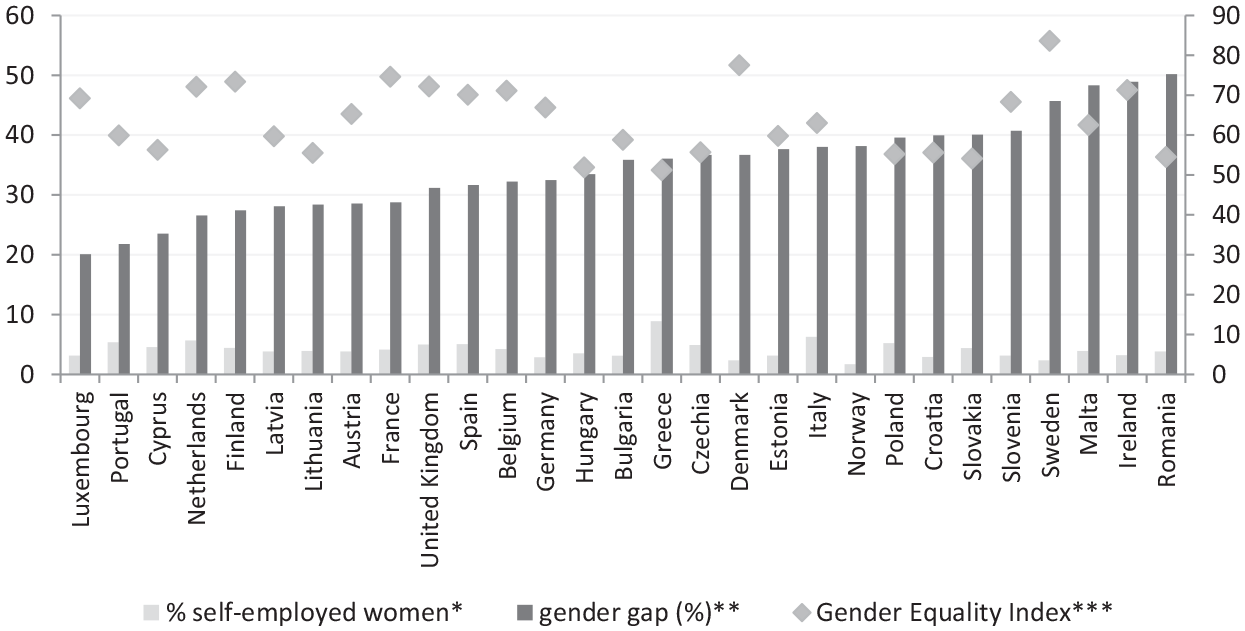
The gender gap in self-employment in Europe, 2019.
According to the ‘lack of opportunities view’, we would expect the gender gap in self-employment to be smaller in countries whose policies favour equality between women and men. In the ‘preference/necessity view’, the gender gap is expected to be smaller in countries less engaged in promoting gender equality. Grey diamonds in Figure 1 (right-hand Y-axis) display the country’s scores on the Gender Equality Index-EIGE 2019. The EIGE index assesses overall gender equality based on indicators from six different domains: work, money, knowledge, time, power and health. Figure 1 shows that neither view is supported by the data: generally, the size of the gap in self-employment is independent of the level of gender equality (r= –.06, n.s.). The question remains, therefore, open with aggregate data: is the gender gap related to women’s lack of opportunity or is it a reflection of women’s stronger preferences to have paid work? In other words, are women’s decisions to be self-employed motivated by opportunity or by necessity and where?
Self-employed women: Opportunity or necessity?
The push/pull factors thesis has commonly been used to assess entrepreneurial motivations (Amit and Muller, 1995; Gilad and Levine, 1986; Schjoedt and Shaver, 2007; Segal et al., 2005; Smeaton, 2003). Push factors generally refer to individual characteristics (for example, a person’s position in the labour market) that force her/him into self-employment whereas pull factors are linked to individual’s expectations, such as autonomy or self-fulfilment, that attract a person to entrepreneurship (Amit and Muller, 1995). The concepts of necessity/opportunity entrepreneurship refer to the motivations underlying entrepreneurship (Reynolds et al., 2001), and can be hypothetically linked to the push/pull factors. Entrepreneurs from necessity decide to start a business because they ‘had no better chance to work’ (Global Entrepreneurship Research Association, 2018: 138; Kelley et al., 2011); they are presumably pushed toward self-employment. On the contrary, entrepreneurs due to opportunity are those who start a business because of a chance to improve their job and life situation (Global Entrepreneurship Research Association, 2018: 138); they are allegedly pulled into entrepreneurship. There is however no exact match between the push/pull factors and individuals’ motivations as necessity or opportunity. For example, factors that are conceived as pull in theory, such as a desire for independence, might in practice motivate entrepreneurship by necessity as a consequence of lack of independence in a previous job (Hughes, 2003). Some studies have in fact found that women and men are pushed/pulled toward self-employment by different sets of factors (Dawson and Henley, 2012; Kariv, 2011; Kirkwood, 2009). Most critically, research has shown that women and men interpret some of the push/pull factors differently (Foley et al., 2018; Hughes, 2003; McClelland et al., 2005). As a consequence, a factor that induces entrepreneurship by opportunity among men might drive entrepreneurship by necessity among women. This article expands on previous research and provides a novel theoretical account of the link between individual and contextual push/pull factors and women’s motivations to become self-employed by necessity/opportunity. It thus advances previous studies by explicitly disentangling entrepreneurship motivations from the factors that influence these motivations; and by introducing both individual and contextual factors to explain women’s motivations to become entrepreneurs.
Individual characteristics: Resources and family status
Push/pull factors typically relate to job dissatisfaction (push) and autonomy and self-accomplishment (pull). Although these two groups of factors are likely to be related to the individual’s resources, the role of human capital as a push/pull factor in self-employment is generally overlooked (but see Block et al., 2015; van der Zwan et al., 2016). Individual resources are however a central driver of self-employment (Simoes et al., 2016), both as educational resources and skills (Bates, 1995; Block et al., 2013) and as psychological resources (Caliendo et al., 2014; Gatewood et al., 1995; Segal et al., 2005). They are also one of the major sources of the gender gap in self-employment. Women’s lower confidence in their entrepreneurial skills and higher risk aversion than men are significantly related to women’s lower involvement in self-employment than men’s (Caliendo et al., 2015; Koellinger et al., 2013; Thébaud, 2010; Verheul et al., 2012).
There is evidence of a U-shaped relationship between education and self-employment: the less educated and the highly educated are the most likely to start a business (Cowling et al., 2019). High skills and risk tolerance relate also to a greater probability to become an entrepreneur than low skills and risk tolerance (Simoes et al., 2016). Different levels of education/skills/risk aversion might therefore imply different entrepreneurial motivations, and act as a push/pull factor for different groups of women. Women with higher resources (such as education, skills or low risk aversion) are better equipped to take advantage of a given occasion, which makes it more probable that they are able to identify a good business and enter self-employment when faced with an opportunity (Tegtmeier et al., 2016). These women are also likely to be moved by the pursuit of autonomy and social responsibility in starting a business (McClelland et al., 2005). Women with less resources, however, tend to be in more precarious labour situations than women with higher resources. Even if they lack the ability to identify a good business, lack entrepreneurial skills and are high risk averse, this group of women might not have a better chance of working than to become self-employed (Montenegro Calderon et al., 2016). High individual resources are thus likely to act as a pull factor and low resources as a push factor.
H1: Women with high/low individual resources are more likely to become self-employed due to opportunity/necessity than women with low/high individual resources.
A person’s family status, and particularly parenthood, is another factor that influences women’s and men’s labour decisions differently: women are more likely to be affected by their family status than men (Baxter et al., 2015; Boden, 1999; Gibb et al., 2013; McManus, 2001). As for entrepreneurship, there is disagreement about whether the family status is a push or pull factor for women. Some scholars consider partnership and (specially) motherhood a pull factor (Budig, 2006; Craig et al., 2012; Jeon and Ostrovsky, 2019; Rønsen, 2014 on motherhood). According to this view, being in a partnership increases financial and other support to become self-employed (Carr, 1996; Thébaud, 2016); and self-employment is perceived by mothers as providing both the independence and flexibility to engage in both childcare and work and do so well (Craig et al., 2012). On the contrary, some argue that women do not in fact enjoy the independence of self-employment but have no better way of staying in the labour market and fulfilling family responsibilities other than becoming self-employed (push factor) (Foley et al., 2018; Kirkwood, 2009; Rønsen, 2014 on partnership), especially among traditional couples (Patrick et al., 2016). Choices of women with family responsibilities might therefore be more constrained than single and childless women’s decisions, who might be better able to pursue a careerist orientation (Budig, 2006). Two alternative hypotheses are hence considered:
H2a-push: Women with no family responsibilities/with family responsibilities are more likely to become self-employed due to opportunity/necessity than women with family responsibilities/no family responsibilities.
H2b-pull: Women with family responsibilities are as likely as women with no family responsibilities to become self-employed due to opportunity.
The context
Individual characteristics that push/pull women into self-employment cannot be considered independently of the context, as it also constitutes a potential push/pull factor (Fuentelsaz et al., 2015). Yet few studies have examined the interaction between individual and contextual push/pull factors, which have generally focused on the economic situation/institutions at the contextual level (Boudreaux and Nikolaev, 2019; Boudreaux et al., 2019; Rapp et al., 2018). One contextual variable has generally been neglected in previous studies that seems crucial in explaining women’s motivations to become self-employed: the gender regime.
A gender regime implies a distinct understanding of how work and care are distributed between women and men (Edlund and Öun, 2016) and a set of norms/values related to the role of women and men in society (Korpi, 2000; Leschke and Jepsen, 2014). The main institutional arrangement in a gender regime is the distribution of work and care. In the traditional male breadwinner system there is a clear distinction of work – left in the hands of men – and care – left in the hands of women. The opposite is the dual-earner model, which presupposes that both women and men are equally in charge of work (and care is taken on by a substitute carer or by both women and men). These two models are related to different types of social policies, which imply different levels of support for women’s engagement in the labour market (Korpi et al., 2013; Lewis et al., 2008; Ray et al., 2010). In other words, different types of gender regimes might push/pull women differently into entrepreneurship.
Although the type of gender regime correlates to women’s levels of participation in the labour market – especially among mothers (Joona, 2016; Rønsen, 2014) – there seems to be no link between the gender regime and the proportion of self-employed women (Baughn et al., 2006; Elam and Terjesen, 2010; see also Figure 1). Whether the gender regime influences women’s reasons in being self-employed, as implied by the ‘opportunities’ and the ‘preference/necessity’ views, is a different question. Scant evidence points in this direction, as women are less likely than men to start a business by necessity in contexts with strong support for women’s childcare (Thébaud, 2015); and women’s decision to become entrepreneurs appears to be less determined by their personal situation in these contexts (Besamusca, 2020; Tonoyan et al., 2010). In a push context, where policies that support women’s employment and childcare are poor, women might not have any better choice when it comes to having a job than to become self-employed, especially if they have few resources or have family obligations. In a pull context, where there is strong support for women’s employment and childcare, women who become entrepreneurs are likely to enter self-employment due to opportunity, independently of their resources or family status.
H3: Women are more likely to become entrepreneurs due to opportunity/necessity in countries characterised by dual-earner support/non-dual-earner support than elsewhere.
H4: The relationship between individual characteristics and women’s reasons to become self-employed is weaker in dual-earner regimes than elsewhere.
The impact of the gender regime on women’s entrepreneurial motivations cannot be assessed independently of the country’s economic situation, especially after the 2008 economic crisis. Levels of unemployment rose dramatically in many European countries after the crisis, especially those of men (Eurostat, 2007–2016), and some of the gender gaps in the labour market even closed up after the crisis, including the gender gap in self-employment (Bettio and Verashchagina, 2014). Bad economic conditions have been found to act as a push factor of self-employment (Conti and Roche, 2018; Fairlie and Fossen, 2018), which is expected also in relation to the 2008 economic crisis. On the one hand, the harsh economic situation is likely to decrease women’s opportunities – already insufficient (Guzman and Kacperczyk, 2019) – to enter self-employment. On the other hand, high levels of unemployment are likely to increase women’s self-employment due to necessity (Paul and Sarma, 2013), considering that women were already holding the most precarious jobs (OECD, 2017; Rubery, 2015; Rubery and Rafferty, 2013). In this context of decline in welfare spending, individual characteristics are more likely to drive women’s reasons for starting a business after the economic crisis (Cueto et al., 2020).
H5: After the economic crisis, the likelihood that women become self-employed due to necessity increases.
H6: The higher the level of unemployment, the higher is the likelihood that women become self-employed due to necessity.
H7: The relationship between individual characteristics and women’s reasons for becoming self-employed is stronger after the economic crisis than before.
Data and method
To test these hypotheses, data from the Global Entrepreneurship Monitor (GEM) are used. The GEM Adult Population Survey is administered to a minimum of 2000 adults in each country and is representative of the population of the self-employed. The study is held once a year, surveying a new sample of individuals in each round (see Appendix A.1). Available data cover the 2005–2015 period and are comprised of 17 European countries, for which data have been collected regularly (see Appendix A.2). The analysis is restricted to working age women (18–67 years old) who are starting a business at the moment of the interview; a total of 8372 women.
Dependent variable
The dependent variable is the motivation to start a business. Respondents can choose one of three responses: 1) to take advantage of a business opportunity; 2) no better choices for work or 3) both. The question is put to all respondents who are starting a business at the time of the interview, and it is therefore expected that respondents’ motivations genuinely reflect the contextual determinants.
Confirming previous studies (Block et al., 2015; Jafari-Sadeghi, 2020), 4% more women than men affirmed they became entrepreneurs due to necessity (differences statistically significant, controlling for individual and contextual variables). Figure 2 shows the percentage of women who started a business due to opportunity, necessity or both, by country. Except in Croatia, the majority of European women who started a business were motivated by opportunity. These data suggest that entrepreneurship is a choice mainly driven by one’s personal preferences, even for women. There are however large differences across Europe. In Norway, 87% of the self-employed women are driven by opportunity. At the opposite end, 42% of the self-employed women in Croatia are driven by necessity.
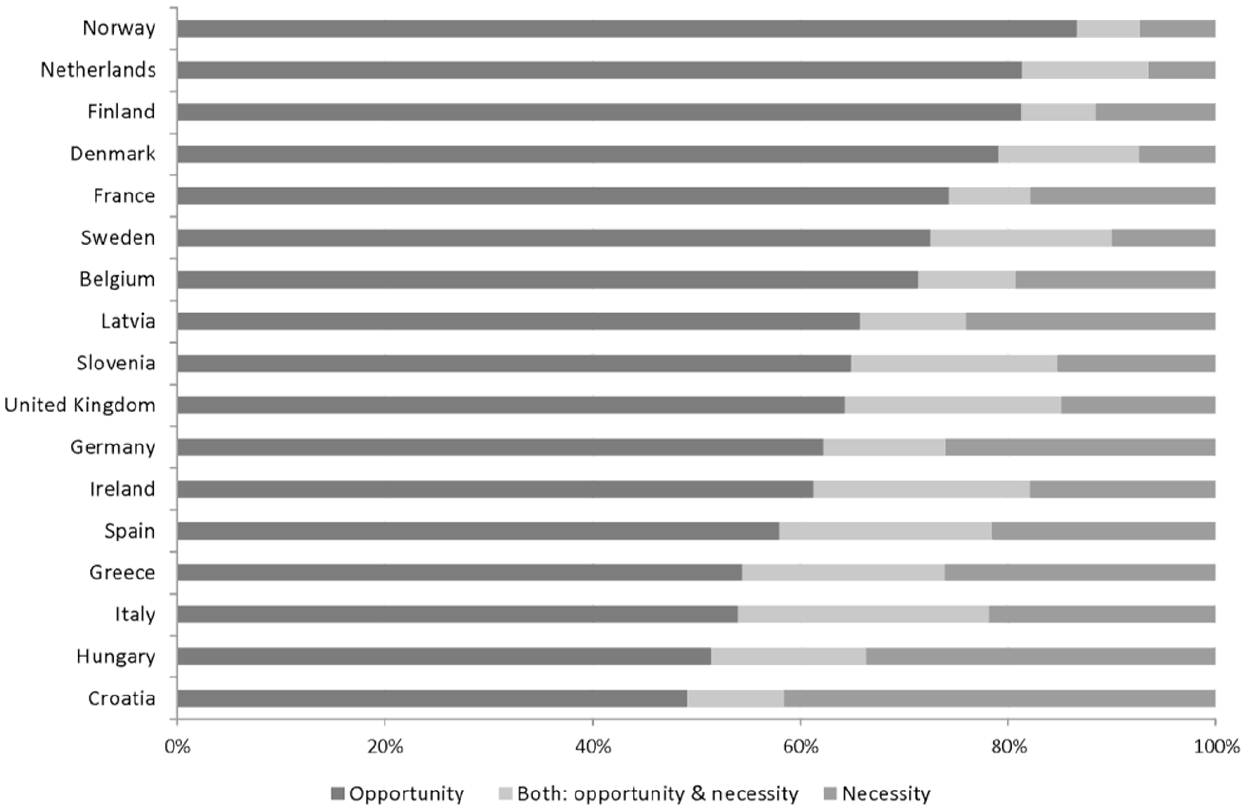
Women’s motivations for becoming self-employed.
Independent variables
At the individual level, three variables are used to operationalise resources (education, skills and risk aversion), and one variable accounts for the family status (household composition). The level of education is operationalised by means of a dichotomous variable that distinguishes between low education (none/primary/secondary education; 0) and high education (tertiary education; 1). Individual skills is a dichotomous variable that differentiates respondents with ‘the knowledge, skills and experience required to start a new business’ (1) from those who lack the skills (0). Finally, a person is coded as risk averse (1) if ‘fear of failure would prevent [her] from starting a business’, whereas she is coded 0 if she answers ‘no’ to the question. The GEM contains one variable that can be used to test the hypothesis related to the family status, only included for the 2009–2015 period. This variable counts the number of people that live in the same household as the respondent and has been recoded as (1) women who live alone (a proxy for single women without children; the reference category); (2) women who live with another person (a proxy for women who live with a partner); and (3) women who live with two or more people (a proxy for women who live with a partner and have children). This variable is problematic as there is no information about the relationship between the people that live in the household and the respondent. However, descriptive data on the number of people aged 18 or older by type of household suggest that this variable proxies reasonably well the three categories (see Appendix A.3). Two additional controls are included in the analyses: the labour situation of the respondent prior to starting a business ((0) unemployed and/or housework, (1) employed and (2) student or retired); and the age.
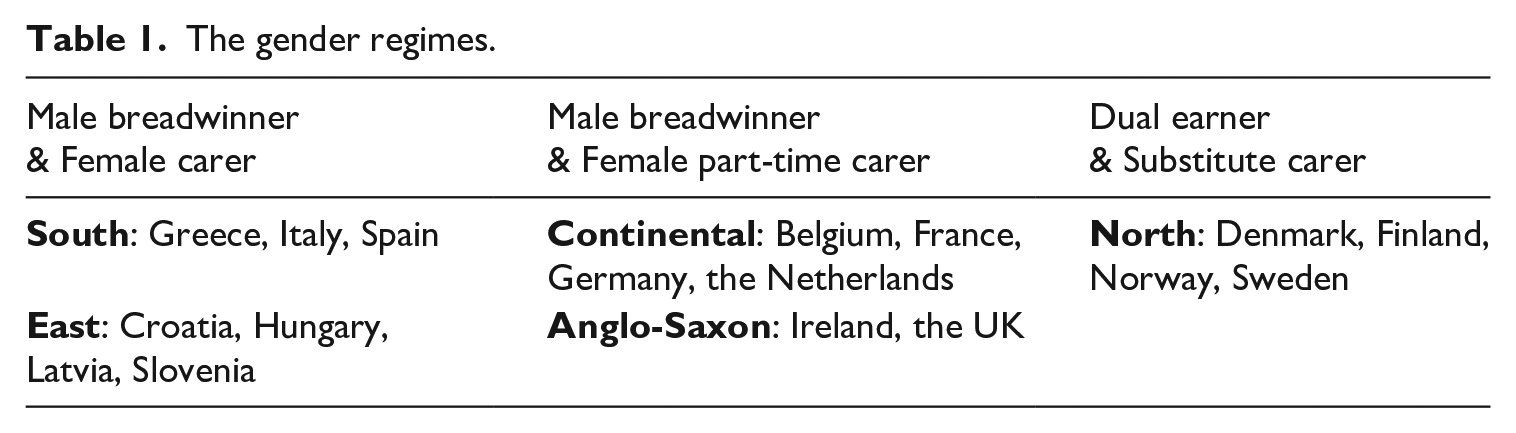
Three variables are used at the context level. To test the effect of the gender regime, a variable classifies the countries according to the prevalent type of gender regime. The variable is composed of five categories: North (the reference category); Anglo-Saxon; Continental; South; and East (see Table 1). The classification draws on the classic distinction between different types of welfare regimes (Esping-Andersen, 1990; Hemerijck, 2012) from a gender perspective (Korpi, 2000; Korpi et al., 2013; Ray et al., 2010).
The gender regimes.
A categorical time variable is used to account for the economic crisis with three outcomes: pre-crisis (2005 to 2008; the reference category), full crisis and recession (2009 to 2013) and recovery (2014 to 2015). In addition, a variable accounting for yearly levels of unemployment for each country is included (see Appendix A.2 for descriptive data).
Method
Because the dependent variable (women’s motivation for becoming self-employed) is nominal, and women are nested in countries of origin, hierarchical multinomial logistic random effects regression is used (Stata package) to test the effect of the independent variables on the outcome variable. Individuals constitute level-1 of analysis and the countries constitute level-2. Time-specific fixed effects are controlled by means of year-dummies when the categorical time variable is not included in the model (see Appendix A.4 for more details on the method). The reference category in all models is ‘business opportunity’.
Results
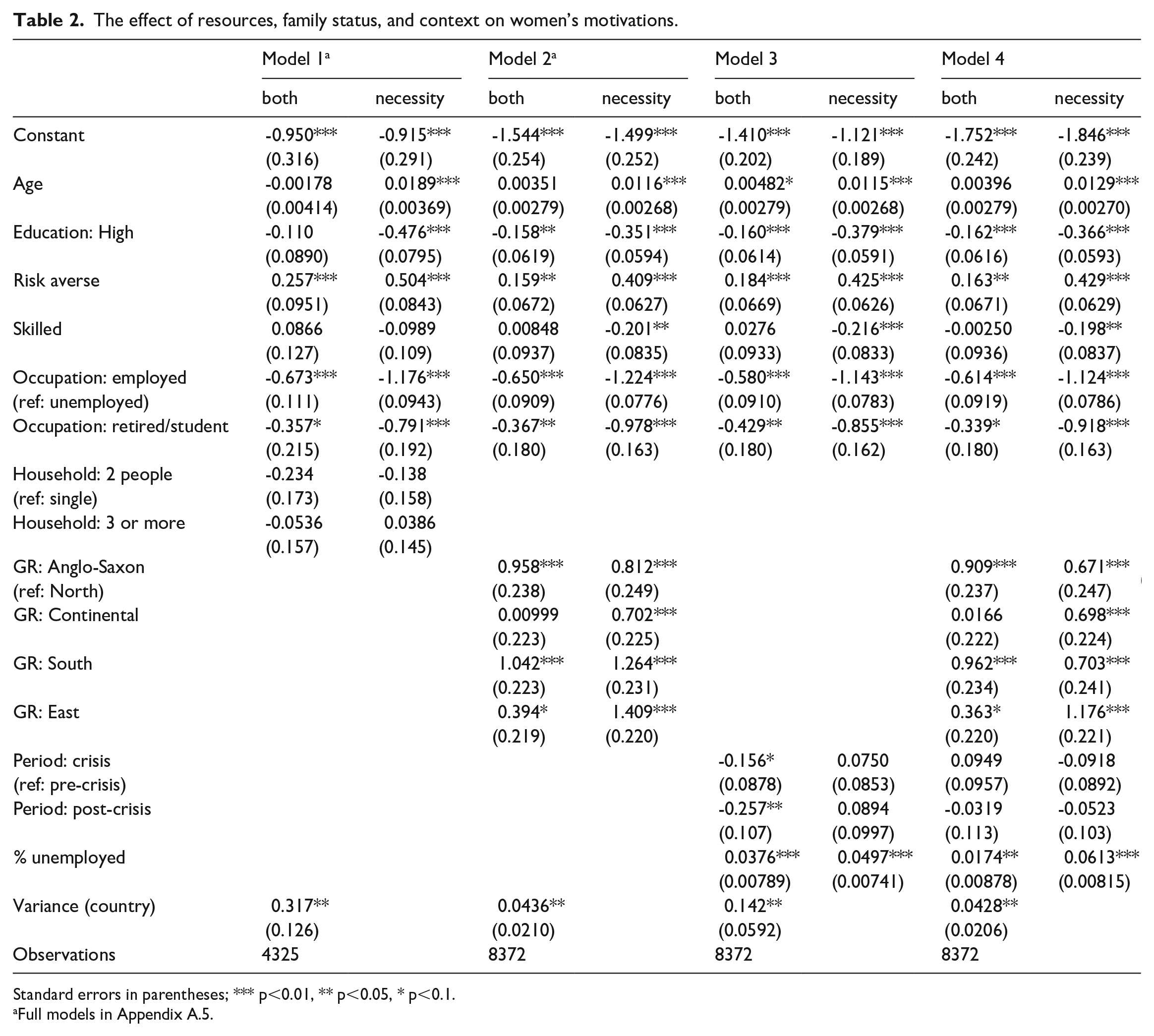
Table 2 presents the results of four multilevel multinomial models: independent variables are introduced step-by-step in the analysis up to Model 4, which includes the full set of variables. Model 1 (columns 2 and 3 in Table 2) introduces the individual characteristics. As hypothesised (H1), different levels of resources are associated with different entrepreneurial motivations. Being highly educated, highly skilled and low risk averse were significantly related to opportunity entrepreneurship. Conversely, less education, less skills and high risk aversion correlated significantly to necessity entrepreneurship. Results are consistent, even after controlling for contextual variables (see Models 2 to 4). In essence, even if previous literature finds evidence that highly educated women might choose self-employment to escape from discrimination in the workplace (Williams, 2012) or to break the ‘glass ceiling’ (Hughes, 2003; Kirkwood, 2009), the results indicate that women with higher resources mainly related self-employment to opportunity.
The effect of resources, family status, and context on women’s motivations.
Standard errors in parentheses; *** p<0.01, ** p<0.05, * p<0.1.
Full models in Appendix A.5.
The findings on the relationship between the family status and women’s reasons for being self-employed were inconclusive: coefficients suggested a negative relationship between partnership and entrepreneurship by necessity, but a positive relationship between motherhood and necessity entrepreneurship, although coefficients are not statistically significant (see also Table A.6 in Appendix A.6). The fact that in our sample 67.1% of women starting a new business lived in a household with three or more people (see Appendix A.2) might indeed be an indication that women tend to choose self-employment to be able to balance work and childcare responsibilities. New entrepreneur women who live with three or more people are particularly abundant in the East and South gender regimes, where family policies are the weakest (see Appendix A.6). Even if the small number of cases prevents from extracting strong conclusions, the data seem also to suggest that partnership and (especially) motherhood differently affect women’s motivations to become entrepreneurs depending on the type of gender regime where they live (see Appendix A.6). In line with H4, motherhood is primarily related to opportunity entrepreneurship in the Nordic countries; to necessity entrepreneurship in the Anglo-Saxon; and to both necessity and opportunity in the South. These exploratory findings point at the relevance of the type of gender regime in moderating the effect of individual characteristics on women’s motivations to be self-employed. Considering the limitations of the household variable both in terms of content and time coverage, this variable is omitted in the rest of the analyses.
Model 2 (columns 4 and 5) in Table 2 confirms H3. Women were significantly more likely to become self-employed due to necessity in all gender regimes than in the Nordic countries. Strong support for women’s employment and childcare prevalent in dual-earner gender regimes seems therefore to be positively related to self-employment due to opportunity. As anticipated above in relation to the family status, the gender regime seems to moderate the impact of the individual level characteristics on women’s motivations to become self-employed (H4). Figure 3 shows the marginal effect of education by gender regime on the probability of becoming an entrepreneur due to opportunity (left-hand quadrant) or due to necessity (right-hand quadrant, based on Appendix A.7). 2 Differences in motivations between the highly and the less educated were not significant in dual-earner contexts, whereas education had a significant influence on women’s reasons for being self-employed in the Anglo-Saxon, the South and Eastern European countries. Contexts that are highly supportive of gender equality are therefore more likely to pull women into self-employment, and to cancel out the influence of women’s individual characteristics, than contexts where the breadwinner model prevails.
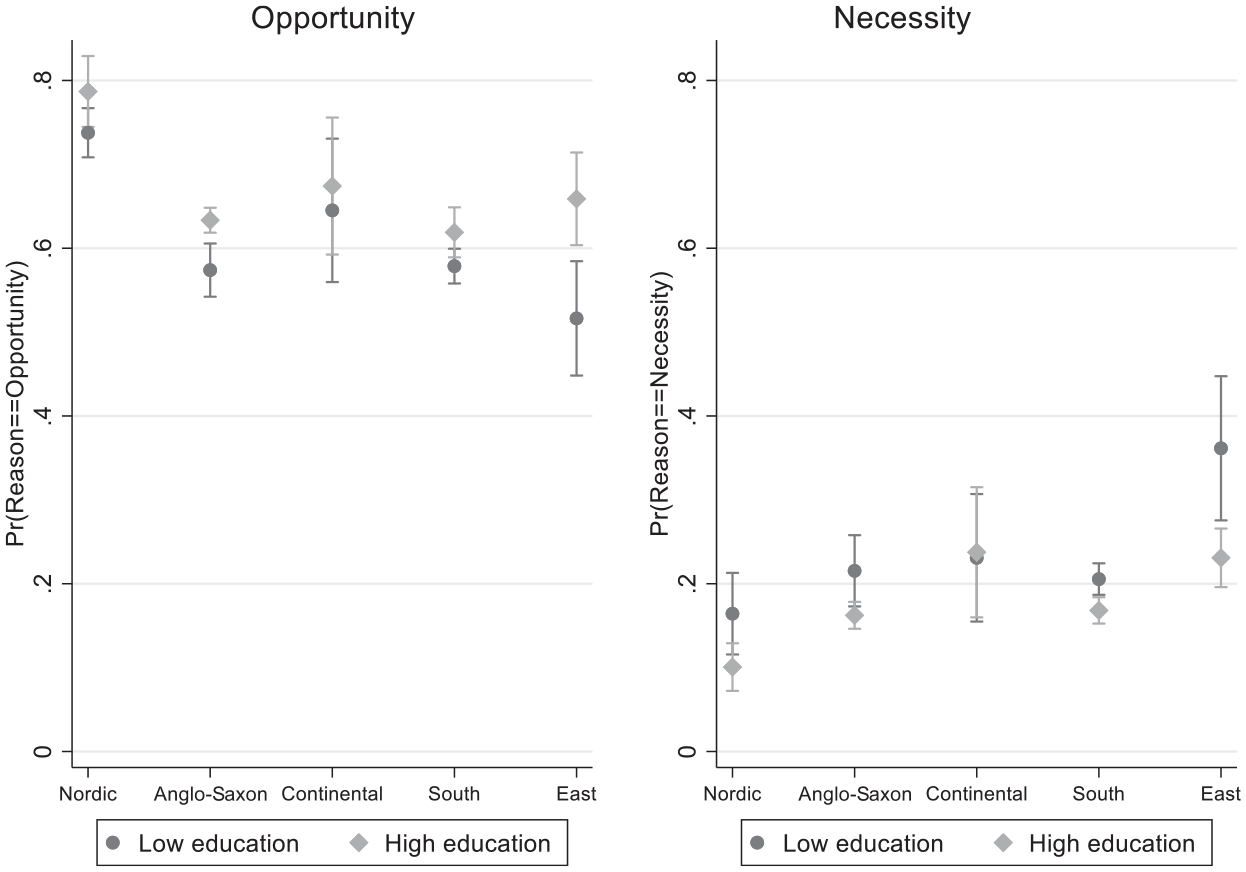
Marginal effect of education across gender regimes.
As for the economic situation, Model 3 in Table 2 (columns 6 and 7) shows that the effect of the crisis is only visible in the countries where levels of unemployment rose the most (H6): the number of women necessity entrepreneurs increased only in the countries most affected by the economic crisis (disconfirming H5). Figure 4 presents the marginal effect of education by period on the probability of becoming an entrepreneur due to opportunity (left-hand quadrant) or due to necessity (right-hand quadrant, based on Appendix A.8). The economic situation moderated the relationship between levels of education and women’s motivation to be self-employed, confirming H7. The gap between the less and the highly educated increased and became statistically significant after the economic crisis started. These findings confirm that less educated women were likely to be the most penalised after the economic crisis and pushed into self-employment.
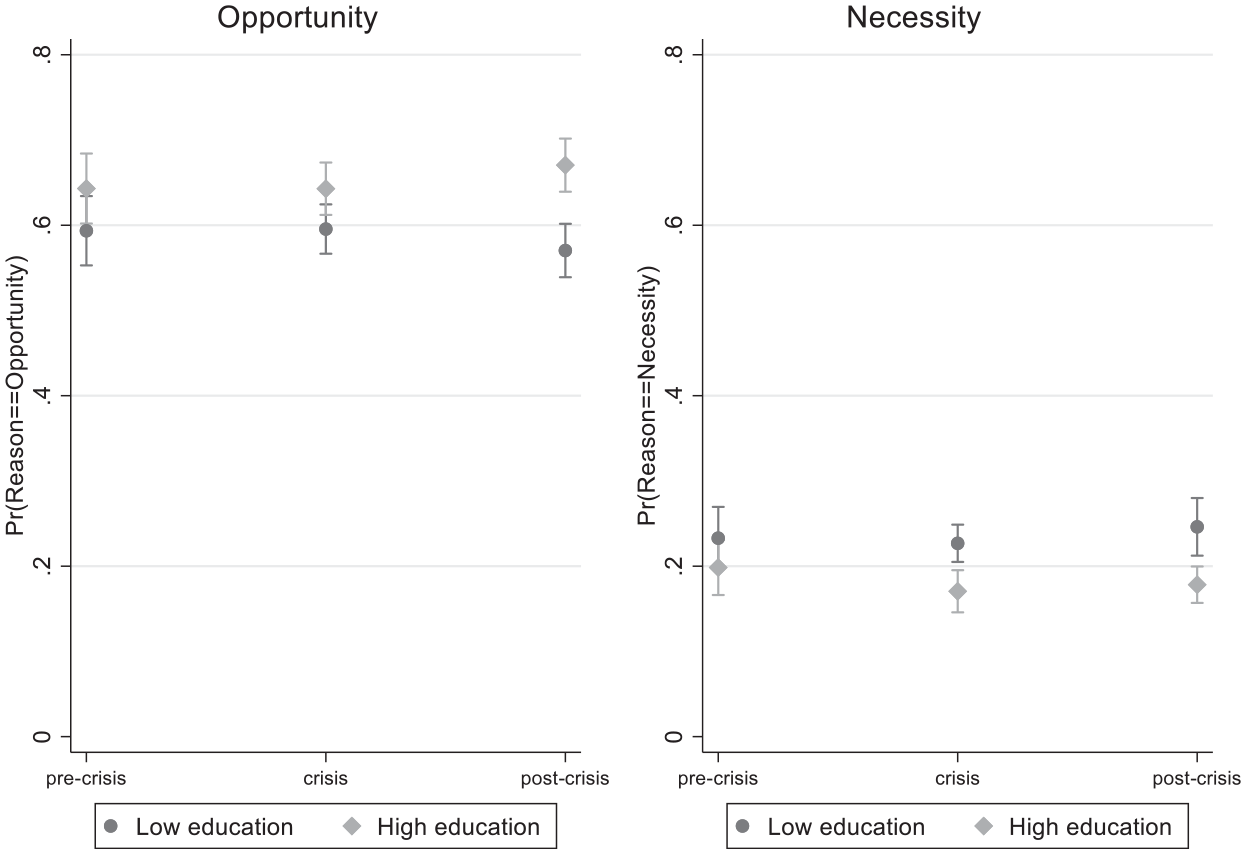
Marginal effect of education across period.
Conclusions
This article contributes to the existing literature on entrepreneurial motivations in two fundamental ways. First, it uses a gender lens to examine the link between the push/pull factors thesis and women’s stated motivations for becoming self-employed by opportunity/necessity. Two factors that are at the source of the gender gap in self-employment are scrutinised: resources and family status. This study does not only allow determining the drivers of necessity/opportunity entrepreneurship but also distinguishing between groups of women that are differently affected by these push/pull factors. Second, this article integrates the context into the theoretical discussion as a push/pull factor of women’s entrepreneurial motivations and provides a systematic comparative assessment of the impact of two contextual factors: the gender regime and the economic situation. Whereas most research until now has focused on the countries’ economic situation/institutions to explain individuals’ propensity to engage in self-employment, this study departs from the distinct position of women in the labour market (still disadvantaged as compared to men, and primarily in charge of unpaid work) to hypothesise on the relationship between the context and their entrepreneurial motivations. As such, besides the economic situation, it incorporates the gender regime as a push/pull factor that drives women’s motives to start a business. It thus adopts a holistic account of how different types of institutions influence women’s entrepreneurial motivations. By introducing the context in the theoretical framework, a set of hypotheses is offered to assess for the moderating effect of the gender regime and the economic situation on the relationship between the individual level push/pull factors and women’s motivations to be self-employed by opportunity/necessity. In this sense, this article goes beyond the push/pull dichotomous explanation to present a gendered framework in which individual and contextual push/pull factors are intertwined.
Empirical results suggest that individual resources are fundamental in explaining women’s motivations for being entrepreneurs: the higher the level of resources, the higher the probability is that a woman becomes an entrepreneur due to opportunity. Also, importantly, both the type of gender regime and the economic situation play a role in women’s decisions to start a business. Women are more likely to be driven due to opportunity in dual-earner gender regimes than elsewhere, and high levels of unemployment produced by the economic crisis have boosted women’s self-employment due to necessity. Even if tentatively, the analyses also endorse the hypotheses that highly gender equal regimes and good economic conditions tend to make women less dependent on their individual resources when deciding to start a business.
How can these findings be interpreted in relation to the two opposite views of the gender gap in self-employment that inspired this article: the ‘lack of opportunities view’ versus the ‘preference/necessity view’. Part of the findings align with the ‘lack of opportunities view’. Most tellingly, the majority of the European women (62% in our sample) become entrepreneurs due to opportunity. Most women choose and prefer to become self-employed, against the ‘preference/necessity view’. The second piece of evidence is that the probability of women being self-employed due to opportunity is significantly greater in contexts that favour gender equality and in times of economic wealth than in less gender equal countries or tough economic times.
Part of the findings, however, align with the ‘preference/necessity view’. Individual resources indeed appear to be an essential component of women’s entrepreneurial motivations. Women with more resources are significantly more likely to be entrepreneurs due to opportunity than women with fewer resources. In addition, differences between highly and less educated women seem to be particularly large in contexts that are much less favourable to women’s self-employment (breadwinner gender regimes and poor economic situations). Considering that entrepreneurship due to necessity is linked to low quality jobs, these findings point to the poor job conditions of this group of women.
Paradoxically, while most women tend to choose self-employment due to opportunity, few women tend to take advantage of these opportunities. It is precisely in the worst contextual conditions (either economic or in terms of gender equality) that self-employment seems to be used as a coping mechanism for keeping a job. Considering past and future economic crises and the spending cuts they imply on policies that affect mainly women, there is a danger that the gender gap in self-employment might be narrowing at the expense of worsening women’s conditions in the workplace.
Regarding the implications of this study, the findings have pointed at the importance of the context (not only the economic one) in moderating individual push/pull factors. Increasing opportunities for women – as in gender equal regimes – are likely to promote self-employment due to opportunity among women, independently of their resources (and family status). However, evidence from the Nordic countries suggests that this might not be enough to eradicate the gender gap. Future research is thus needed to uncover what women’s reasons are for not starting a business and how these relate to individual and contextual factors. From a policy perspective, the findings suggest that policies of opportunities are to be well-targeted. For example, today’s actions focusing on entrepreneurship training and networking (e.g. WEgate of the European Commission) might not reach women who enter self-employment due to necessity, which entails the risk of enlarging the gap between opportunity and necessity women entrepreneurs. Policies aiming at addressing the gender gap in self-employment should therefore not only be limited to increasing the number of women as self-employees but also the quality of self-employment both among highly and less educated women, with a special focus on avoiding bogus self-employment among the latter.
Supplemental Material
sj-pdf-1-wes-10.1177_09500170211035316 – Supplemental material for Self-Employed Women in Europe: Lack of Opportunity or Forced by Necessity?
Supplemental material, sj-pdf-1-wes-10.1177_09500170211035316 for Self–Employed Women in Europe: Lack of Opportunity or Forced by Necessity? by Mónica Ferrín in Work, Employment and Society
Footnotes
Funding
The author received no financial support for the research, authorship, and/or publication of this article.

Supplemental material
Supplemental material for this article is available online.
Notes
References
Supplementary Material
Please find the following supplemental material available below.
For Open Access articles published under a Creative Commons License, all supplemental material carries the same license as the article it is associated with.
For non-Open Access articles published, all supplemental material carries a non-exclusive license, and permission requests for re-use of supplemental material or any part of supplemental material shall be sent directly to the copyright owner as specified in the copyright notice associated with the article.
