



Abstract
This article explores the identity challenges facing teaching-only faculty (TOF), whose occupational self-perceptions are fundamentally contradicted by the way institutional others perceive them. We show how this manifests into a set of stigmatising practices and processes across two dimensions: contact (informal messaging) and contract (formal messaging). The sense of being unjustly stigmatised is amplified because the teaching-only role is generally seen as high-status by outsiders, and the work itself is relatively free from real or metaphorical dirt. Hence, we propose the concept of within-group stigmatisation. Next, we shine light on the implications of this form of occupational stigmatisation through the lens of organisational (dis)identification. In contrast to theoretical expectations, the analysis of our extensive survey and interview data shows that TOF identify with their role but disidentify with the organisation. Finally, we reflect on the importance and broader applicability of our concept of within-group occupational stigmatisation.
Introduction
The concept of stigma has been usefully employed to better understand and address the complex and varied challenges faced by certain occupational groups. A social psychology-oriented branch of occupational stigma research turns to Goffman’s (1963) work, which defines stigma as ‘an attribute that is deeply discrediting’ and which reduces an individual ‘from a whole and usual person to a tainted, discredited one’ (p. 3). A second branch builds on Hughes’ (1951, 1958) ‘dirty work’ thesis. In this tradition, there is a focus on the inter-relation between the physical, moral, or social taint 1 of the tasks performed and an associated sense of occupational stigmatisation derived therefrom (e.g. Ashforth and Kreiner, 1999, 2014; Kreiner et al., 2006). While there is overlap within and between these two branches, in this article, we focus primarily on the latter. A consistent feature in the dirty work occupational stigma literature is the focus – albeit understandable – on groups that perform tasks that are both deeply and broadly tainted. Indeed, while there has been some consideration of what it means for certain work to be lower status and more dirty (e.g. Ashforth and Kreiner, 2014), there is scant attention paid to stigmatised occupations whose work is perceived as generally high-status, less dirty, and not within-group.
Kreiner et al. (2006) highlight this gap and in response develop a classification schema differentiating forms of occupational stigmatisation based on the socially constructed, status-oriented, views of the (high/low) depth and (high/low) breadth of the taintedness of tasks undertaken. Here, depth refers to the ‘intensity of dirtiness and the extent to which a worker is directly involved in the dirt’, whereas breadth refers to the ‘proportion of work that is dirty’ (Kreiner et al., 2006: 621). In this article, we study how an occupational group – namely, teaching-only faculty (TOF) – that performs tasks that are less tainted in terms of depth and breadth, come to experience a sense of stigmatisation. Contributing to the problematisation is that TOF’s role is broadly perceived to be high-status through the eyes of the public (e.g. Chakrabortty and Weale, 2016; Ganzeboom, 2005; Ganzeboom and Treiman, 2003, 2019; Ganzeboom et al., 1992; Smith and Son, 2014).
Employing extensive survey and interview data, we find that TOF at Russell Group 2 business schools in the United Kingdom (UK) experience a contradiction between their inside/outside occupational status. We find that TOF’s occupational stigmatisation manifests across two dimensions, namely formal messaging through ‘contracts’ and informal messaging through intra-organisational ‘contact’ (Behtoui and Neergaard, 2010; Loury, 2002). Thus, this is more than a case of TOF being othered or pushed to the margins of the organisation, whereby the occupational group exists as an outgroup whose self-esteem is constantly under threat (Crocker and Major, 1989). Rather, this is a specific case of occupational stigmatisation from which we derive the concept of ‘within-group stigmatisation’.
Following Kreiner et al. (2006), this article moves on to a consideration of possible organisational dis/identification arising from TOF’s sense of within-group stigmatisation. For clarity, Bhattacharya and Elsbach (2002) define organisational identification as ‘a cognitive connection between a person and an organization’, whereas disidentification refers to ‘a sense of separateness’ (p. 26). Drawing on the work of Elsbach and Bhattacharya (2001) and Kreiner et al., (2006) provides a useful addendum, regarding identification as ‘the definition of self vis-à-vis some group, such as an occupation or organization’, and disidentification as ‘defining self as being not the same as the group’ (p. 622, emphasis in original). We also note that Kreiner et al. (2006) offer a third option: ambivalent identification (or schizo-identification in Elsbach, 1999). 3 This occurs when the individual ‘simultaneously identifies and disidentifies with the group or various facets of the group’ (Elsbach, 1999; Kreiner et al., 2006: 623).
Strikingly, Kreiner et al. (2006) predict that there is ‘unlikely to be a noticeable impact on members’ identification or disidentification’ (p. 630) 4 where those affiliated with that occupational group perform tasks that are deemed to be relatively less tainted (across both breadth and depth). This article examines this proposition and casts doubt over its veracity. Instead, we find that TOF simultaneously identify with their role but strongly disidentify with their organisation. This is interesting for a number of reasons, not least because it is presumed that those who experience occupational stigma will follow a path of organisational disidentification. This is important because there are well-documented deleterious consequences of organisational disidentification that have implications for both the employing organisation and the workers themselves. These include (but are not limited to): a worker’s lack of commitment, goal misalignment between individual and organisation, organisational inaction and dysfunctional decision-making (Ashforth et al., 2008; Bhattacharya and Elsbach, 2002; Elsbach, 1999; Elsbach and Bhattacharya, 2001). This study opens the door to new avenues for research concerning the worker that identifies with their role but disidentifies with their organisation.
We conclude this article with a reflection on the broader applicability of our within-group stigmatisation concept. Alongside this, we stress an urgency to study relatively less tainted workers and workplaces for signs of occupational stigma and organisational disidentification. Thereby, our study answers the call for more ‘research on stigmatisation in organisational . . . settings’ (Paetzold et al., 2008: 186) and addresses the under-representation of ‘the stigmatised person’s viewpoint’ (Yang et al., 2007: 1525) in the management and organisation literature (Brown and Toyoki, 2013; Toyoki and Brown, 2014).
Research setting
Teaching has always been one of the primary duties of academics. However, a standalone TOF pathway has only recently emerged. It is strongest in research-intensive institutions, like those of the Russell Group. It is difficult to put a firm date on when the initial teaching-only positions were granted in the UK, but the first formal counting of TOF (that we are aware of) comes from 1994/1995 (Higher Education Statistics Agency (HESA)). HESA’s (1996) report identifies 11,688 UK-based academics employed on teaching-only contracts (10.2%). Yet, as early as 1991, Westergaard warns of a poorly governed academic pathway system creating problematic tensions between teaching and research. He stresses how the situation requires careful administrative handling. It is unlikely that Westergaard would have envisaged that by 2018/2019 the number of TOF would grow to 66,355 (or 30.5% of the UK-wide university faculty) (Figure 1) 5 (HESA, 2020) and his message be apparently unheeded.
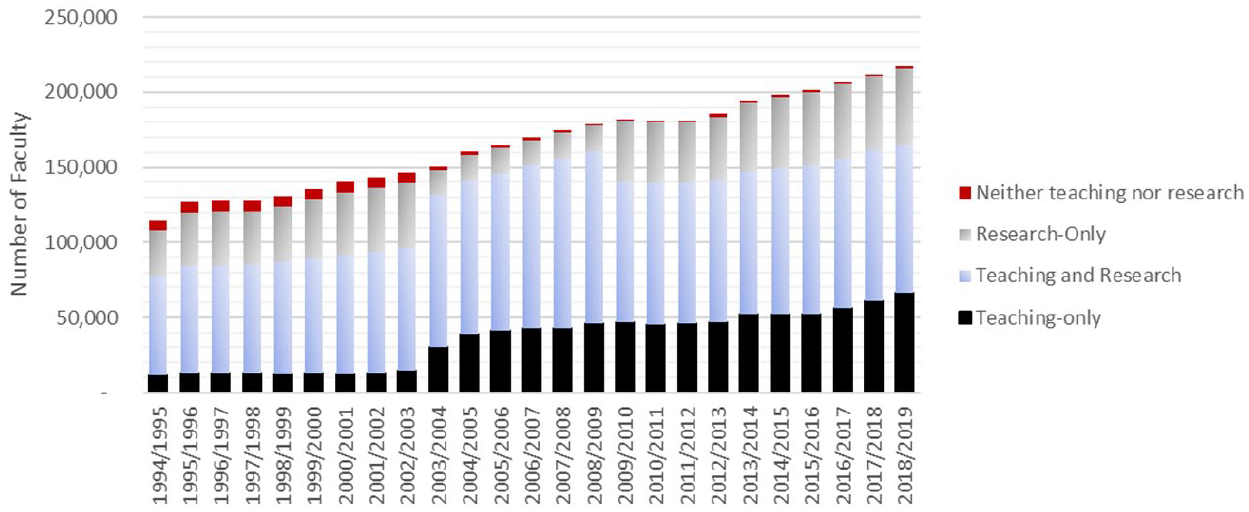
Annual number of faculty employed in the UK, broken down by contract type.
It seems no coincidence that the TOF pathway has expanded as the higher education sector attempts to navigate a successful path to post-massification (Teichler, 1998; Tight, 2019). 6 On the one hand, massification enriches some universities and the higher education sector. On the other hand, in tandem with the emergence of the new political economy of higher education, massification is also responsible for complex policy challenges and choices, not least concerning the allocation of resources (e.g. Schulze-Cleven et al., 2017). In this context, one of the most difficult issues that requires attention is the additional pressure on teaching staff, teaching approaches, the function and format of teaching and teaching resources (e.g. Arvanitakis, 2014; Hornsby and Osman, 2014; Tight, 2019). This challenge is felt acutely in business schools. They benefit from comparatively high(er) levels of international student recruitment (e.g. Bamber, 2014) but consequently this exposes them to a range of time- and resource-related pedagogical challenges, including (but not limited to) large(r) cohorts and classes (e.g. Allais, 2014).
Unsurprisingly, business school deans are uncertain how to satisfy their large, growing and mixed student populations (e.g. Bamber, 2014; Burgess et al., 2018). Likewise, institutional leaders do not seem to know how best to serve the international markets upon which they increasingly rely. The increased(-ing) levels of faculty attention and resources required for teaching-related tasks imply additional pressure on research(ers’) time (Smeby, 2003). Given this, one response is to establish, grow and professionalise the teaching provision through increased TOF recruitment. While this expansion answers several problems, unfortunately it also carries costs and consequences. Occasionally it pits research(ers) against teaching(-ers), and vice versa (Bamber et al., 2017; Westergaard, 1991).
Despite the aforementioned intra-institutional tension, teaching in higher education is viewed extremely positively by the public. It is described as ‘one of the most highly skilled and prestigious professions in Britain’ (Chakrabortty and Weale, 2016: 1). Affirming this, most measurement systems of occupation-based social classifications produce similar results, namely, the status of teaching ranks comparatively highly (e.g. Lambert and Bihagen, 2014). For example, the sub-major group ‘teaching professionals’ (which includes university professors), ranks in the top 20th percentile in the International Socio-Economic Index of occupational status scale and the top decile of the Standard International Occupational Prestige Scale (Ganzeboom, 2005; Ganzeboom and Treiman, 2003, 2019; Ganzeboom et al., 1992). Additionally, Smith and Son’s (2014) most recent occupational prestige survey of 860 professions on behalf of the University of Chicago’s National Opinion Research Center ranks a college or university professor of business administration at 6.9. This puts the business school professor among the top-10 occupations. Thus, given the public perception that teaching in a business school is a high-status career, it seems contradictory that TOF should experience a sense of occupational stigmatisation (Elsbach, 1999; Kreiner et al., 2006).
To this end, prior work suggests that research activities are institutionally favoured and prioritised over teaching (e.g. Bamber et al., 2017). Indeed, in academia, research output drives individual recognition in the higher education system (Knights and Clarke, 2013: 343), whereby a ‘highly successful academic “star” [is] much published’ (Ford et al., 2010: S78). Feelings of failure ensue when an academic does not meet publication expectations (Clarke et al., 2012) because research output is considered crucial for academic career advancement (Clarke and Knights, 2015; Knights and Clarke, 2013).
In the UK, the quality and quantity of an academic’s research output are subject to regular in-depth audits via the Research Excellence Framework (REF) 7 (Clarke and Knights, 2015; Clarke et al., 2012; Knights and Clarke, 2013). Governmental research funding depends on where universities are placed in the REF league table. Beyond that immediate consequence, improved REF outcomes influence other university ranking systems. Among other factors, these ranking systems attract student attention. To this end, in the era of massification, recruiting and retaining more students – especially premium fee-paying students – appears to be a key academic institutional aim. One unintended consequence is that universities employ more TOF during REF periods to allow those on the traditional academic career pathway (i.e. research and teaching faculty (RTF)) to maximise their opportunities for research output (Grove, 2014). We note, however, many universities are less reliant on research for reputation or funding (for instance, they may be teaching-intensive rather than research-intensive), thus, the tension between research and teaching staff and their tasks may be less pronounced at these institutions; even though, this cannot be ruled out.
Stigmatisation of teaching-only faculty members
Goffman (1963) refers to discrediting marks, which single people out as being of questionable moral status whereas Hughes (1951, 1958) refers to the stigmatising taint of ‘dirty’ work. On the one hand, studies use Goffman’s stigma thesis to discuss and describe inherent characteristics and attributes that unfairly mark out individuals for stigmatisation in the workplace, such as gender (Simpson, 2004), sexuality (Stenger and Roulet, 2018), physical and mental health issues (e.g. Almond and Healey, 2003; Fevre et al., 2013), social class (e.g. Ashley and Empson, 2017) and race (e.g. Behtoui and Neergaard, 2010; Nath, 2011). On the other hand, occupational research focuses on the inter-relation between the taintedness of a worker’s tasks and/or workplace and occupational stigmatisation (e.g. Ashforth and Kreiner, 1999, 2014; Deery et al., 2019; Hansen, 1999; Kreiner et al., 2006; Scambler, 2007).
Even though progress has recently been made regarding a ‘theoretically meaningful classification schemata to understand the complex array of stigmatised work’ (Kreiner et al., 2006: 619), neither the limits and implications nor the explanatory power of this scheme has been fully explored. Much of Kreiner and colleagues’ scheme relies on theoretical propositions in the absence of empirical data. Hence, fundamental elements remain unaddressed, including the occupational stigmatisation of relatively low-taint (breadth and depth), high-status work. The importance of this oversight cannot be emphasised enough because it is clear that stigmatised occupational groups – whoever they are and whatever they do – suffer a variety of stress-related effects, including low self-esteem, academic underachievement, poor health (Fevre et al., 2013; Major and O’Brien, 2005; Miller and Kaiser, 2001), role ambiguity, work alienation (Nath, 2011), anxiety and depression (Link and Phelan, 2001).
Kreiner et al. (2006) classify occupational stigma according to the depth and breadth of taint of the tasks undertaken. They claim that there are workers who suffer occupational stigmatisation despite ‘neither the breadth nor depth [of taint being] strong . . . [for example] a salesperson who might occasionally interact with stigmatised individuals (such as the homeless or mentally ill)’ (p. 630). They call for more research concerning these occupational groups. After all, Kreiner et al. (2006) are unable to provide much detail about why these groups suffer occupational stigmatisation or what the implications of this stigmatisation might be. They suggest that a stigmatised occupational group whose tasks are relatively less tainted in terms of depth and breadth is unlikely to engage in group response tactics, such as entitativity. Instead, they formulate two conjectures. First, that ‘the modal defense may be to distance oneself from the tainted task as quickly and efficiently as possible, then return to the non-stigmatised portions of the occupation’ (Kreiner et al., 2006, p. 630). In other words, they believe that TOF will engage in some form of role disidentification. Second, Kreiner et al. (2006) conclude that the stigmatisation of occupations undertaking tasks with low depth/breadth of taint is likely to have ‘little or no impact on identification or disidentification’ (p. 620).
Methods
Data collection
A mixed-methods approach is used to address our research question (Bryman, 2006; Creswell and Creswell, 2017; Plano Clark and Creswell, 2008). 8 This approach provides rich data and opportunities for fresh insights, especially in underexplored areas. Combining methods offers benefits in terms of refining research questions and instruments, triangulating results and enhancing the rigour and robustness of outcomes (Creswell and Creswell, 2017; Deery et al., 2019). Mixed-methods approaches are common (e.g. Bacon-Gerasymenko et al., 2016), even though surprisingly seldom used to study workplace stigmatisation or satisfaction (Deery et al., 2019).
Similar to that of Bacon-Gerasymenko et al. (2016), this study adopts an exploratory sequential design, which enables researchers to ‘use the findings of one methodology to inform the issues to be addressed in the subsequent evaluation’ (Greene et al., 1989: 262). First, a survey of full-time, business school TOF members was conducted, followed by a series of semi-structured interviews. Data collection focused on TOF employed at Russell Group universities, which contract staff according to one of three academic pathways: TOF, RTF and research-only.
A draft survey and interview schedule were developed for a pilot study of six TOF respondents (all Russell Group TOF, and all excluded from the reported data) with the aim of refining survey and interview questions before proceeding to formal data collection. Russell Group business school TOF participants were manually identified via job titles provided on university websites (N = 399).
Incomplete and unusable submissions as well as those from graduate teaching assistants were discarded, leaving 113 usable survey responses (Table 1). Of these, 53% of participants identify as male and 47% as female. In terms of age, four are between 21 and 29 years, 31 are between 30 and 39 years, 38 are between 40 and 49 years, 29 are between 50 and 59 years and the remaining 11 are 60 years or older. The divisions between accounting and finance, economics, management and others are almost equal. Responses were received from TOF at 20 of the 24 Russell Group universities. In terms of experience, 17% had worked as TOF for less than one year, 25% for two to three years, 25% for four to six years, 15% for seven to ten years and the remaining 18% for 11 or more years. Slightly more than half (56%) of the respondents claim to have spent the main part of their careers in higher education, but the vast majority (91%) have also held full-time permanent positions in their field of expertise before becoming TOF – almost half for more than 11 years.
Sample selection and respondents by university.

Note: aZero represents no TOF disclosed/traceable from publicly available information.
Following the survey, 34 semi-structured interviews were conducted (see Table 1 for distribution and Table 2 for demographic information). During the interviews, participants were free to narrate their lived experiences in their own words. To help shape the interviews, the schedule was designed to address core themes: (i) motivations for entering academia and, if relevant, pursuing the teaching-only pathway; (ii) reflections on everyday work-lives and tasks; (iii) individuals’ perceptions of the evolution of their career; and (iv) the status of teaching-only academics more generally. Interviews ranged from 42 to 122 minutes (average 54 minutes). Following research ethics protocol and after relevant permission was gained, each interview was recorded and transcribed. Self-selection bias is a possible drawback for research of this type. In response, we have been careful in the analysis to only include interviewee responses which were representative of the themes, and to exclude comments which were unrepresentative.
Respondent characteristics.
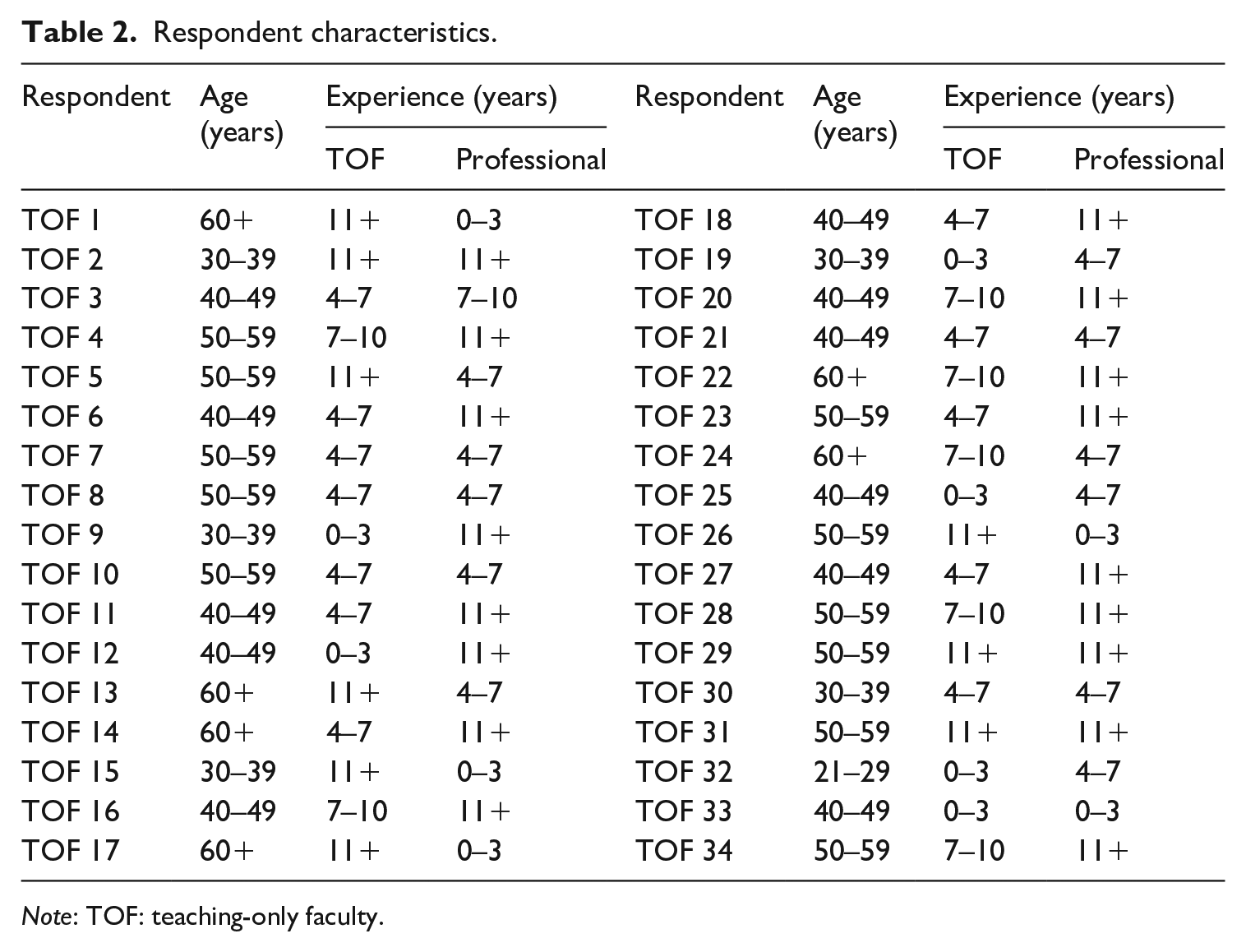
Note: TOF: teaching-only faculty.
Data analysis
Preliminary analysis commenced as soon as the initial data were collected (Miles and Huberman, 2002). First, a detailed interpretation and theory-building phase was conducted, which involved moving back and forth between the literature, the data and theory in an abductive fashion (Mantere, 2008). To make sense of the large quantity of data, the ‘thematic networks’ framework proposed by Attride-Stirling (2001) was followed. The first step of this process involved the simplification of data into several basic themes to avoid misinterpretations arising from code repetition and omission (Attride-Stirling, 2001). Following consultations between members of the research team, basic themes were categorised into a set of ‘organizing themes’ according to their meanings, before eventually arriving at a set of ‘global themes’ (Attride-Stirling, 2001). Key themes and coding practices were substantiated by the authors through intercoder reliability checks.
The final coding framework consisted of two global themes, namely (i) contact and contract issues, and (ii) organisational/role dis/identification. The first global theme was coded under three organising themes: (a) contact: (in)visibility; (b) contact: (dis)creditable work; and (c) contract: inequities and structural barriers. The second global theme was coded under two organising themes: (a) organisational disidentification; and (b) role identification. In the Findings section that follows, we describe and discuss these themes.
Findings
Contact (informal messaging): (In)visibility
Respondents claimed that they were not viewed as ‘full colleagues’ because ‘once you opt to go teaching-only, you close every door possible . . . We always, therefore, suffer, shall we say, a discrimination’ (TOF 26). TOF claim to be made invisible, ‘squeezed into a sort of never-never land where nobody looks at you or talks to you’ (TOF 30). For TOF, this invisibility means RTF colleagues not engaging in everyday interactions with them. We were told that there is very little informal communication between RTF and TOF, but equally worryingly, the invisibility experienced by TOF spills over into formal communication. For example, respondents commented that teaching issues were downplayed during departmental and school-level meetings: ‘Teaching’s just not on [the] agenda . . . In fact, teaching was an administrative item on the departmental meeting agenda, which I just think really undermines our teaching’ (TOF 11). Additionally, several respondents reported being excluded from formal and informal email correspondence, departmental groups and broader decision-making forums. They speculated that this exclusion stems from not being actively involved in discipline-specific research activities.
This invisibility extended to an informal and unofficial discriminatory office accommodation policy. Several respondents stated that they had been moved around the business school, passing from one office to another, often at the whim and/or mercy of their RTF peers. This is an informal process that is either facilitated or ignored by institutional management, and which serves to make TOF physically invisible to their peers. For example, TOF 2 stated: I’ve been here, what, now 14 years, and every time that somebody says they want to sit near somebody they research with, the teaching-only people will be moved out to other offices . . . it’s always kind of like, ‘Oh, you don’t need to sit in the department because you don’t do research. You go and sit in some other building.’
Further, while RTF was given sole occupancy of offices, TOF respondents said they were frequently herded together in mass-occupancy offices, sometimes away from the main business school site.
Contact (informal messaging): Teaching as (dis)creditable work
Respondents commented that ‘good teachers’ were barely acknowledged, whereas ‘good researchers’ were ‘worshipped by everybody’ (TOF 22). This type of language was commonly employed to describe the stark intra-institutional status difference between RTF and TOF. For example, ‘teaching is very much secondary to research’ (TOF 7), and ‘research is king’ (TOF 29). While respondents accepted that research was an institutional priority due to league tables and attracting students, the constant negative messaging not only created TOF identity challenges, it led many to question their institution’s commitment to any form of teaching culture. For example, TOF 15 commented that ‘nobody could give a damn whether I was good or bad [as TOF]’ because ‘beyond research articles, nothing else counts at all . . . We’ve lost any kind of teaching culture really.’
The survey data inform similarly. For example, Table 3 (Panel B) shows that while respondents placed a high value on high-quality teaching (M = 4.75), this contrasts with the value placed on teaching by their institutions (M = 3.32) and departments (M = 3.51). In line with expectations (e.g. Bamber et al., 2017; Clarke and Knights, 2015; Clarke et al., 2012; Ford et al., 2010; Knights and Clarke, 2013), high-quality research was not only perceived as important by TOF (M = 4.09) but was also deemed to be of paramount importance institutionally (M = 4.81) and departmentally (M = 4.75). Thus, the survey indicates an internal hierarchy that measures research and researchers above teaching and teachers.
Survey responses.

Note: Responses were based on a 5-point Likert scale as follows: 1 = strongly disagree; 2 = disagree; 3 = neither agree nor disagree; 4 = agree; 5 = strongly agree; n/a = not known or not applicable.
Contract (formal messaging): Perceived inequities and structural barriers
In terms of a contract, survey respondents indicated a strong belief that high-quality teaching was not appropriately incentivised at either the institutional (M = 2.24) or departmental levels (M = 2.27). By contrast, high-quality research was considered to be highly incentivised at both institutional (M = 4.39) and departmental (M = 4.26) levels. This perceived inequity in contractual terms between TOF and RTF reinforces the notion of an internal hierarchy that prioritises the latter over the former. Yet, outside the gates of the institution, this appears to go unseen.
Reinforcing this sense of inequity, we were told that RTF members who ‘failed’ to publish in accordance with REF targets, were ‘punished’ with extra teaching. For example, ‘I mean the very fact [that] when you fail in research, you’re basically given teaching. Teaching is there for a punishment, a failure’ (TOF 32). Further, when the failure to publish persists, underperforming RTF members were ‘hidden’ from the ‘REF inspection’ by transferring them to the TOF pathway (TOF 7). This captures the nature and extent of the internal research/teaching tension, highlights the difference in intra-institutional status between academic pathways and suggests how TOF come to see their occupation as stigmatised through the eyes of their peers and institutional managers.
While all the human resources documentation available stresses that the academic pathways are ostensibly equivalent, respondents discussed contractual inequities between TOF and RTF. These include progression and promotion ceilings, not getting sabbaticals, but having to cover for RTF colleagues that do, and the relative lack of TOF in senior and professorial positions. For instance, TOF 16 stated: ‘Literally, [my] research colleagues would have to set fire to the vice chancellor’s office . . . not to get progressed . . . They know that they just need to get the research funding and journal papers.’ The perception that there is a substantial status difference between academic pathways and tasks translates into a ‘kind of stigma around the [TOF] pathway’ (TOF 33).
Disidentification with organisation and identification with role
In this section, we explore the implications of TOF’s sense of within-group occupational stigmatisation in terms of organisational dis/identification. Instead of being able to identify themselves ‘vis-a-vis’ the academic group, TOF disidentify because the messaging – contract and contact – defines their occupational ‘self as being not the same as the group’ (Kreiner et al., 2006: 622, emphasis in original). For example, TOF 3 told us that they were not recognised as ‘proper academics’, whereas TOF 7 stated, ‘You’re only regarded as an “academic” . . . if you do research’ (TOF 7). Table 3 (Panel A) indicates that TOF feel they were not viewed as key assets within the Academy (M = 2.24), their institution (M = 2.29), or department (M = 2.60). Indeed, TOF 3 said that their core task – teaching – is viewed intra-institutionally as ‘something that anybody could do’. Speaking about colleagues’ perceptions, TOF 17 stated, ‘It just dismays me that teaching is so poorly valued. You know what I mean?’
We were told that this organisational disidentification carries negative implications for the organisation itself. For example, TOF 23 expressed a commonly held view: ‘Even if you’re good at teaching’, why ‘work all out? [For] no rewards?’ There are deleterious consequences for the individual also. For example, we were told that TOF are ‘not valued at all . . . devalued’ (TOF 15) and that is ‘very disincentivising’ (TOF 7). Thus, TOF describe their inability to identify with the group and showed an inability or unwillingness to acknowledge ‘a cognitive connection between’ themselves and the organisation; instead, they inhabit ‘a sense of separateness’ (Bhattacharya and Elsbach, 2002: 26).
Yet, this organisational disidentification does not preclude a sense of role identification. Table 3 (Panel A) shows that respondents viewed their work as socially and morally important (M = 3.92). The interview data concur. Representative comments included: ‘I really . . . I love teaching’ (TOF 25), and ‘I just think it’s an incredibly rewarding and enjoyable job to do . . . I love it to bits’ (TOF 27).
The bi-modal organisation/role dis/identification is captured in the following statement: I love being with the students, and I make no secret of that, or apology for it. I’m still here. And it’s just for the students . . . I’ve stayed here not for the money, not because [this] university’s a great employer. I stayed because I just love being with the students, and when I leave, I shall miss them terribly. (TOF 2)
In another conversation, we were told that despite ‘no real incentives . . . for doing a good job . . . I really enjoy the interaction with the students and spending time teaching them . . . So, that’s what I love about it and why I do it’ (TOF 8). A recurring sentiment among participants was that the love of teaching was crucial to determining occupational leave or stay choices. TOF 30, for example, reflexively asked, ‘Why do I keep doing it?’ when there are ‘significant barriers’ and ‘I could go back to what I used to do and earn five times as much’. S/he continued: ‘Because I enjoy it’, and it is ‘what I should be doing’. The implication was that the tasks themselves are crucial (role identification), whereas the organisation and/or broader academic group means little or nothing (organisation disidentification).
Discussion and conclusions
First, this research explores and explains how an occupational group – TOF – which is generally perceived as high-status (e.g. Chakrabortty and Weale, 2016; Ganzeboom, 2005; Ganzeboom and Treiman, 2003, 2019; Ganzeboom et al., 1992; Smith and Son, 2014) and which performs tasks that are relatively less tainted (in terms of depth and breadth) (Hughes, 1951, 1958; Kreiner et al., 2006), nonetheless comes to feel a sense of occupational stigmatisation within their professional community group. Little is known about those occupational groups that are relatively less tainted. Yet, this is an important topic given the social, physical and mental health consequences of inhabiting a spoiled identity (e.g. Fevre et al., 2013; Link and Phelan, 2001; Major and O’Brien, 2005; Miller and Kaiser, 2001; Nath, 2011).
We provide empirical evidence that sheds new light on this occupational group, and from this we derive our notion of within-group stigmatisation. Specifically, this study finds that the stigmatisation of TOF stems from inequality across two dimensions: informal messaging (contact) and formal messaging (contract) (Behtoui and Neergaard, 2010; Loury, 2002). Thus, while we find that TOF view their work as important and value-adding – a view shared by stakeholders outside the organisation – they also feel that their role is unfairly deemed, intra-institutionally, of lower status than that of their RTF peers. They are made to feel invisible by colleagues through various processes, such as the enactment of unofficial office de-/re-location policy. TOF also note how RTF appear to be ‘punished’ with more teaching when they fail to meet publication requirements. Ultimately, serial RTF underperformers might find themselves being forcibly transferred to the supposedly lower-status TOF contract, without a review of any meaningful teaching-related performance measures which might suggest that this action is desirable. Hence, we derive the concept of within-group stigmatisation, whereby we mean the sense of occupational stigmatisation felt by high-status, low-taint workers that stems from institutional others within an organisation, which is largely absent from the external public view. This gives rise to questions of potential dysfunctional decision-making. For example, whether these teaching-oriented task specialists might pursue research-oriented activities simply to transfer to the supposedly hierarchically superior pathway. Indeed, many of our respondents hold higher degrees, are contractually compelled to engage in some form of research, and therefore would not consider a transition to RTF as unthinkable. However, TOF have made the conscious decision to become teaching specialists, and a shift to something else would probably be detrimental to the individual and the organisation.
Second, following Kreiner et al. (2006), this research considers organisational dis/identification (e.g. Ashforth et al., 2008; Kreiner et al., 2006). While they regard organisational (dis)identification as one construct, we disaggregate it into two parts, namely: organisation and role. Kreiner et al. (2006) suggest that the stronger the depth and breadth of tainted work, the more likely it is that the occupational group will organisationally disidentify. Conversely, the response from occupations whose tasks are less tainted will be relatively limited. The taint itself, Kreiner et al. (2006) argue, stems from ‘credible authorities and legitimate systems’ being responsible for managing ‘public status hierarchies’ (p. 623). Thus, they assume that an externality is the arbiter of status hierarchies. Strikingly, our findings suggest conflicting views between an external arbiter – in this case, the public, who have deemed the work of TOF as high-status, and an internal arbiter – in this case, institutional others, who seem to hold the opposite view.
We find that Elsbach and Bhattacharya’s (2001) 9 two proposed forms of organisational disidentification are non-mutually exclusive. On the one hand, we find that TOF are proud educators who ‘love’ their work. They perceive their workplace tasks as highly valuable and of high-status, while simultaneously claiming that those outside the organisation hold similar beliefs. On the other hand, TOF experience ‘a negative relational categorisation of [themselves] and the organisation’ (p. 393). Thus, we argue that TOF identify with their role and disidentify with the organisation. This has negative implications for both the individual and the organisation. We find that TOF willingly and happily engage in their primary tasks, but they also seem to mirror the organisation’s apparent lack of concern for them back at the organisation itself. This frequently leads TOF into self-doubt and self-questioning, asking: ‘Why do I keep doing it?’ To this end, it is possible that workers – beyond TOF – suffering within-group stigmatisation share this role identification/organisation disidentification in common. The implications of this might be hugely significant for a large number of workers and workplaces. This is a topic that requires more attention.
We propose that there are sub-group members – even within high-skilled professional occupations – engaged in work that is generally perceived as low-taint and high-status that struggle with a sense of within-group stigmatisation, similar to TOF. For example, it is likely that accountants – a profession traditionally considered high-status and low-taint – would say that the label ‘bean counter’ is a pejorative – possibly stigmatising – label. Our claim is that this labelling is a workplace challenge which comes from outside the organisation. By contrast, we contribute a new dimension to current understandings of workplace stigmatisation through the introduction of the concept of within-group stigma. We suggest that there are sub-groups within these wider occupational groups that face contact- and contract-oriented discriminatory practices and processes from their intra-organisational peers. In other words, they are treated inequitably because their work has been deemed by internal peers and management as hierarchically inferior and of lower status, even if the public view is different. For example, despite all being under the same roof, the work of an auditor might be viewed as lower status than the work of a taxation planner or corporate finance specialist. Urgent work is required, because there is the possibility that this insider form of stigmatisation might cause more hurt and harm than where the stigmatisation comes from outsiders. In the meantime, through internal (e.g. cross-pathway collegiate co-operation and pressure groups) and external (e.g. union campaigns) exercises of will, higher education institutions should be encouraged to shift towards improved formal and informal messaging towards TOF.
Footnotes
Acknowledgements
First and foremost, we would like to thank our teaching pathway colleagues, both for the excellent work they do and for the way they generously engaged with our work. We would also like to thank participants at the British Sociological Association Conference (2018, Northumbria University) and the British Academy of Management (2019, Aston University) who offered comments on an earlier version of this manuscript. We are grateful to the many friends and colleagues who improved this manuscript through their feedback, but special thanks to Jacquelyn Allen-Collinson, Matthäus Tekathen and Emma Parry. Finally, a huge thank you to everyone at Work, Employment and Society, especially the Editor, Associate Editor and Referees who offered invaluable guidance, support and encouragement.
Funding
The authors received no financial support for the research, authorship, and/or publication of this article.
