



Abstract
In many liberal welfare states, market-based reforms aimed at enhancing competition and choice in disability services have necessitated extensive regulatory reforms to ensure quality service provision. This article explores how the changing regulatory environment surrounding an individualised funding scheme is transforming frontline disability work. Drawing on data from a survey of 2341 Australian disability support workers, the article contributes to sociological understandings of market regulation by foregrounding the importance of frontline workers’ labour to the regulation of social service markets. Various regulation-related tasks and duties are identified which, while practically embedded among the client-focused components of care work previously documented, are analytically distinct from them. This category of undertheorised, unrecognised, often unpaid work is referred to as ‘regulatory labour’. The article illuminates the mechanisms through which workers enact and resist regulatory processes and help absorb market risks and failures in ways previously underexplored in theories of marketised social care.
Keywords
Introduction
Introduced in 2013, Australia’s National Disability Insurance Scheme (NDIS) is an historically significant policy reform designed to transform the disability service system through several regulatory changes. At the centre are new funding arrangements aiming to give disabled Australians more choice and control over their support through an individualised, market-based model of disability funding pioneered in the UK and elsewhere (van Toorn, 2020). Under this model, funds to purchase supports deemed ‘reasonable and necessary’ are placed in the hands of eligible people with disability, who choose among service providers, which compete for their custom (Productivity Commission, 2011: 225). The shift from a government-managed system of directly funded services to consumer-focused markets has created the need to enhance regulation of service providers operating under the scheme. In 2017, a national regulator was established to oversee registration of providers and a new quality and safeguards system (Buckmaster and Clark, 2018). The NDIS Quality and Safeguards Commission (NQSC) takes an approach of ‘responsive regulation’ (Ayres and Braithwaite, 1992). Compared with England’s Care Quality Commission, the NQSC makes less use of direct inspection and rating as regulatory mechanisms, instead acting as a meta-regulator which places primary onus on service providers to establish their own systems of harm prevention, risk mitigation and incident reporting (Cortis and van Toorn, 2021). The aim is to lighten the hand of government regulation enough to enable market growth without exposing NDIS participants to unacceptable levels of risk (Department of Social Services (DSS), 2016).
Disability support workers, along with NDIS participants, are at the coalface of this market-oriented regulatory reform process, the viability of which is argued to rest on restructured employment relations (Cortis et al., 2017; Macdonald et al., 2018). In the UK, similar, direct payment schemes have operated since the 1980s, resulting in cost-shifting onto private service providers and frontline workers, including the administrative work involved in invoicing clients, marketing services and managing individual budgets (Young, 2020). Young (2020) found that individualised funding creates new roles and responsibilities for frontline staff supporting people with disability and new forms of risk and accountability for ‘personalising’ services in the most cost-effective ways. Customer-oriented norms and the drive to reduce operating costs detrimentally impact on workers through work intensification and deskilling, job security, working time security and pay (Cunningham, 2016; Macdonald, 2021; Young, 2020). Similar trends are evident in Australia. The NDIS’s market-driven approach, combined with thin employment regulation, has meant paid hours are fragmented and reduced to only essential client-facing tasks while workers are taking on new forms of unpaid work, including travel between clients and new administrative duties that help ‘defray’ general overhead costs (Baines et al., 2019: 25; Cortis and van Toorn, 2021). Studies highlight the ways the viability of the market-based scheme is premised on regulatory arrangements that enable cost efficiencies through poor employment practices and low pay, illuminating the forms of unpaid work on which markets depend (Macdonald and Charlesworth, 2016; Macdonald and Pegg, 2018; Macdonald et al., 2018).
This article advances the literature by theorising the regulation-related tasks and duties that frontline workers perform in marketised social services as a distinct form of labour, different to the client-focused components of care work detailed in existing literature (Baines et al., 2017; Charlesworth, 2012; James, 1992). This form of work is termed ‘regulatory labour’, to denote the administrative roles and responsibilities that constitute the work of regulation in frontline roles, upon which market functioning depends. These include assessing risk, reporting incidents, documenting work and coordinating training and supervision. Regulatory labour occurs alongside, but is substantively different from, the client-oriented roles and tasks performed directly for people receiving support and typically considered to constitute disability support work. Regulatory labour denotes the mostly unfunded, unrecognised and undertheorised activities that workers need to perform to put mandated regulatory processes into effect, to operationalise and correct deficiencies in administrative systems and generally make markets work by mitigating potential risks and threats to service quality. These regulatory roles and responsibilities, it is argued, are more system- than client-focused and are increasingly evident as key components of disability support work under individualised funding schemes. Yet there has been little acknowledgement of regulatory labour as a distinct form of work, both industrially and in the scholarly literature on care work. As regulatory labour has been largely overlooked in theories of marketisation, there is a clear need for research that documents and theorises this form of labour as a structural feature of care work.
Drawing on findings from a survey of Australian disability service workers conducted by the authors in 2020, this article takes a multidimensional approach to analysing market regulation. It adopts an analytical framework that sees market regulation as not having disappeared but rather having moved, transferred downwards from the national level and increasingly shared by a range of public and private stakeholders, as manifest in the regulatory labour of frontline disability support workers (Cunningham and James, 2017; Martínez Lucio and MacKenzie, 2004: 78; Regini, 1994). The approach entails a methodological shift to distinguish between different levels, sites, actors and spaces of regulation, and a theoretical challenge to the market/regulation dichotomy (Peck and Tickell, 2002). In conceptualising regulatory labour as a unique feature of marketised care work, the analysis advances sociological understandings of marketisation and the regulatory role workers play. Empirically, it reveals the types of tasks that frontline workers perform which help employers meet their regulatory compliance requirements within the NDIS safeguarding system. It then considers what, if anything, is distinctive about these tasks and whether they can be said to constitute a unique form of labour. Finally, it specifies the mechanisms through which workers enact regulatory processes and absorb market risks and failures, through their regulatory labour.
The article is structured as follows. First, the significance of regulation is established against the backdrop of claims that neoliberalism entails widespread de-regulation. In this section, the conceptual framework guiding the analysis is outlined. Second, some policy context is provided by discussing the regulatory reconfiguration of disability support work in Australia over the past decade. The third section describes the methodological approach and use of workers’ accounts of the content and structure of their work elicited via a large online survey. Fourth, the findings depict the ways workers enact regulatory labour under themes of gifts of time and self, self-regulation and tolerance and accommodation. The implications of the findings concerning the nature of disability support work are discussed. The concluding section reiterates the article’s key contribution in revealing the unrecognised regulatory role of frontline workers and the role their regulatory labour plays in enabling market functioning.
Marketisation as regulatory reconfiguration
The marketisation of social services has occurred gradually in Australia and internationally through reconfiguring government funding arrangements and enabling entry of for-profit providers (Armstrong, 2013; Meagher and Goodwin, 2015; Phillips and Smith, 2011). Both main political parties have moved to outsource and create quasi-markets for a range of human services, including disability services (van Toorn, 2021). While marketisation is generally associated with neoliberal policies of deregulation and the weakening of traditional forms of direct regulatory control by governments, heterodox political economists reject this ‘myth of neoliberal deregulation’ (Panitch and Konings, 2009). From a critical political economy perspective, ‘regulation is not seen in opposition to the market mechanism . . . [instead] markets [are seen] as depending on state regulation for their stability and growth’ (Aalbers, 2016: 563). Attention centres on the variety of ways in which regulation can facilitate marketisation by establishing the economic and social conditions needed for markets to flourish. This theorisation rests on a distinction between abstract, neoliberal notions of ‘the market’, on the one hand, and ‘actually-existing markets’, on the other, which are seen as always embedded in state institutions and practices (Chester, 2010; Brenner et al. 2010). Yet, while a useful starting point for sociological study of regulation, this theoretical approach neglects the non-state institutions and practices in which actually-existing markets are also embedded. Markets for social services, while created by governments, are maintained by a wider array of regulatory actors operating at different scales of regulatory activity, from the macro-level of the state to the micro-level of frontline service work. This study enriches sociological understandings of how these quasi-markets operate by accounting for workers as regulatory actors. It advances the literature on marketisation by using regulation theory to analyse the NDIS market as a product of regulatory intervention on the part of workers as well as government.
To this end, the analysis draws on a conceptual framework that addresses not only the formal means of regulation, but also the informal, invisible ways regulatory systems are reproduced (MacKenzie and Martínez Lucio, 2005). Within this framework, regulation is defined not by the scale at which it takes place, nor the political status or institutional positioning of the regulatory actors involved. Rather, regulation is defined functionally, capturing those activities which help organise market relations and create conditions for profitable economic activity. It thus encompasses micro-level practices and behaviours as well as formal, institutional processes. Mechanisms of regulation operate through diverse linkages between different regulatory actors and spaces, some formal in nature (e.g. contracts, subsidies, vouchers, collective agreements), and some informal and invisible to outside observers, embedded in social practices and interactions. These informal linkages, MacKenzie and Martínez Lucio suggest, can take the form of ‘complex mechanisms of tolerance and accommodation’ (2005: 509). Tolerance and accommodation occur when ‘one regulatory actor tolerates, and even depends on another regulatory actor’ to help fulfil key regulatory and economic functions (MacKenzie and Martínez Lucio, 2005: 510). These scholars explore tolerance and accommodation in the world of organised crime, in which state officials may tolerate illegal activity due to the ‘basic latent functions’ it serves, or in the case of capital accommodating unions’ demands due to limits on its own regulatory capacities (Beare, 1997: 157, quoted in MacKenzie and Martínez Lucio, 2005: 509).
Despite increasing recognition of the informal, ‘micro-political’ dimensions of regulation (MacKenzie and Martínez Lucio, 2005: 500), theorisation has not fully accounted for the role of frontline workers as de facto regulatory actors in human service systems (Kaine, 2012). This article helps fill the gap by demonstrating the ways regulation occurs not only formally, through state-led processes, but also informally, through everyday practices, norms and behaviours in workplaces and interactions with clients and state bureaucracies. MacKenzie and Martínez Lucio’s insights offer a useful lens for investigating the informal mechanisms through which frontline workers enact, and sometimes resist, regulatory processes. This lens is adopted and adapted to explore regulatory mechanisms at the micro-level of workplace norms and behaviours, including how and why frontline workers tolerate and accommodate regulatory tasks necessary to quasi-market functioning.
In making visible the mechanisms through which workers enact regulatory labour, the article adds a new dimension to understandings of the ways micro-level processes contribute to and shape the overall functioning of social care markets. Conceptualising frontline disability workers’ regulatory labour also extends care work scholarship, which has demonstrated the multiple components and complexities of care in different social service settings (James, 1992). James (1992), for example, distinguished between physical, emotional and organisational labour. Physical labour, the most visible and recognised form of care work, comprises the physical tasks of feeding, hygiene maintenance, assistance with mobility and the activities of daily living (James, 1992). Emotional labour denotes the less visible, innately social-relational aspects of care – specifically, the labour involved in managing one’s own emotional display as well as the emotional needs of the cared-for (Mann, 2005). Organisational labour, James suggests, is the least recognised, yet still ‘vital . . . aspect of the daily labour of care’, conceived as the purposeful deployment of organisational and managerial skills to oversee the coordination of one’s care (1992: 492). These studies highlighted the intensely gendered features of care work, including in the organisational sphere where women perform invisible and undervalued mental labour (Husso and Hirvonen, 2012; James, 1992). Other studies have built on this by highlighting the routine requirements for workers to meet gendered expectations of ‘filling gaps’ in under-resourced service systems through ‘gifting’ (unpaid) time and emotional labour (Baines et al., 2017; Charlesworth, 2012). Baines et al. (2012) suggest that the restructuring of work according to New Public Management principles transformed workers into agents of (self)regulation. As part of this, workers have assumed new system-focused responsibilities in monitoring and documenting their work (Baines et al., 2012). These accounts offer valuable insights into dimensions of care work practices, focused on the ways unpaid aspects of care are outcomes of marketisation. However, they obscure the functional aspects of workers’ regulatory roles and responsibilities, leaving these, and the ways they enable quasi-market functioning, unrecognised and undertheorised. The functional contributions of labour in enabling care markets are more fully illuminated when regulatory labour is treated as a distinct analytical component of care work.
The regulatory reconfiguration of disability support work
Employment in disability services has long been characterised by highly feminised, precarious, low-paid work, with most workers employed in frontline roles offering little upward career mobility (Cunningham et al., 2014; Macdonald and Pegg, 2018). In recent decades, disability support work has become increasingly formalised, moving from domestic provision by families to provision through paid community service employment, although associations with women’s unpaid domestic labour continue to contribute to systemic undervaluation and poor pay (Macdonald, 2021; Macdonald and Pegg, 2018). In Australia, not-for-profit organisations employ the overwhelming majority (over 75%) of disability workers, followed by the public sector (just over 20%) and private, for-profit organisations (6%) (Macdonald and Pegg, 2018). Prior to the NDIS, provider organisations were funded via direct government contracts, to help contain costs and maximise efficiency. Over time, people with disability, carers and industry stakeholders called for more flexible, personalised forms of support delivered through individualised funding arrangements (Productivity Commission, 2011). This cohered with bipartisan political consensus favouring individualised, market-based approaches (van Toorn, 2021).
Over the past decade, new market mechanisms have been introduced, constituting major shifts in the formal regulatory architecture governing Australia’s disability sector. Working conditions and wages remain regulated through national industrial awards, but NDIS funding arrangements strongly incentivise providers to reduce labour and other costs (Baines et al., 2020; Macdonald and Pegg, 2018). Under the NDIS, participants develop plans for which budgets are assigned for various supports (such as assistance with personal care and accessing the community) by the agency responsible for scheme funding and unit pricing, the National Disability Insurance Agency (NDIA) (Cortis et al., 2017). As well as setting resource levels in participants’ budgets, prices set by the NDIA limit what providers can charge for each unit of service (Cortis et al., 2018). Prices are determined on the basis of the ‘Reasonable Cost model’, which the NDIA claims sets prices at levels ‘sufficient to cover the efficient costs of a reasonable quality support provider’ (NDIA, 2014: 2). Prices thereby limit service providers’ capacity to charge rates that cover costs of supplying services at decent standards (Cortis et al., 2018).
As previous research has shown, a range of organisational and employment overheads are not factored into NDIS prices (Macdonald and Charlesworth, 2016), including induction, training and professional development, as well as supervision time, team meetings, incident reporting, logging case notes and other administrative and communication tasks (Cortis et al., 2017). These activities are integral to quality service provision. Yet the insufficient allowance for them under the NDIS represents a major challenge. Service providers must maintain quality standards while remaining competitive and attracting customers, while workers face pressure from employers and clients to maintain standards of care in increasingly insecure and resourced-constrained environments (Cortis and van Toorn, 2020; Cortis et al., 2017; Young, 2020).
New regulations surrounding service quality and safeguarding were introduced in this environment of heightened cost pressures, requiring registered NDIS providers to implement systems to record and self-manage incidents where client safety is threatened, with serious cases referred to the Commission (NQSC, 2019). Providers must inform the Commission of incidents involving death, serious injury, abuse, neglect, or assault of a person with disability, or the unauthorised use of restrictive practices (NQSC, n.d.). While these legal and regulatory requirements apply formally to service providers, the onus of reporting typically falls on frontline workers, many of whom find themselves poorly supported to comply (Cortis and van Toorn, 2020, 2021).
The remainder of the article explores the implications of these regulatory changes for frontline disability workers and shows the ways their regulatory labour shapes the scheme’s viability, including through processes of self-regulation, tolerance and accommodation.
Methodology
The largest Australian disability workforce study, the survey posed closed and open-ended questions about the nature of disability support work, including working time, pay, supervision, training, safety and perceptions of the NDIS (Cortis and van Toorn, 2020). Ethics clearance was obtained from the University of New South Wales in early 2020. As there is no central list or information from which to reliably draw a random sample of disability workers, the methodology followed common practice in care work research by engaging workers via their representative organisations (see, e.g., Baines and Armstrong, 2019; Meagher et al., 2019). Links to the online survey were distributed via the three main unions representing disability workers. Australia has around 100,000 full-time equivalent disability workers (Australian Government, 2019) and union density is around 24% in the wider health care and social assistance industry. In total, 2341 respondents completed the survey over three weeks. Open-ended responses were voluntary and had no word limit. Some participants made short indicative comments, but many contributed lengthy and detailed accounts, providing rich insight into workers’ experiences of their working lives, including their unpaid work.
As workers were recruited via trade unions, perspectives reflect conditions in unionised workplaces, which tend to be better for workers than across the wider industry, due to union-negotiated agreements. Sample characteristics are in Table 1. While there is no central information system against which to assess representativeness, the union sampling strategy means that younger and newer workers, who are less likely to be union members than older workers, are likely under-represented, as are those in smaller workplaces and those employed on a casual basis (Gilfillan and McGann, 2018). A further issue is that disability workers providing services in private homes and in the community are more difficult to engage in online research compared with those in offices or residential facilities. As such, survey responses contain large numbers of workers in group home/supported accommodation settings. Further, the research reflects the experiences and conditions of workers employed by registered providers, although increasing self-management of NDIS plans, as well as growth in gig economy work, is fuelling growth in the use of unregistered providers operating with fewer regulatory requirements (Baines et al., 2020; Macdonald, 2021).
Sample characteristics (%, n = 2341).

Note: aSettings were not mutually exclusive, respondents could select more than one.
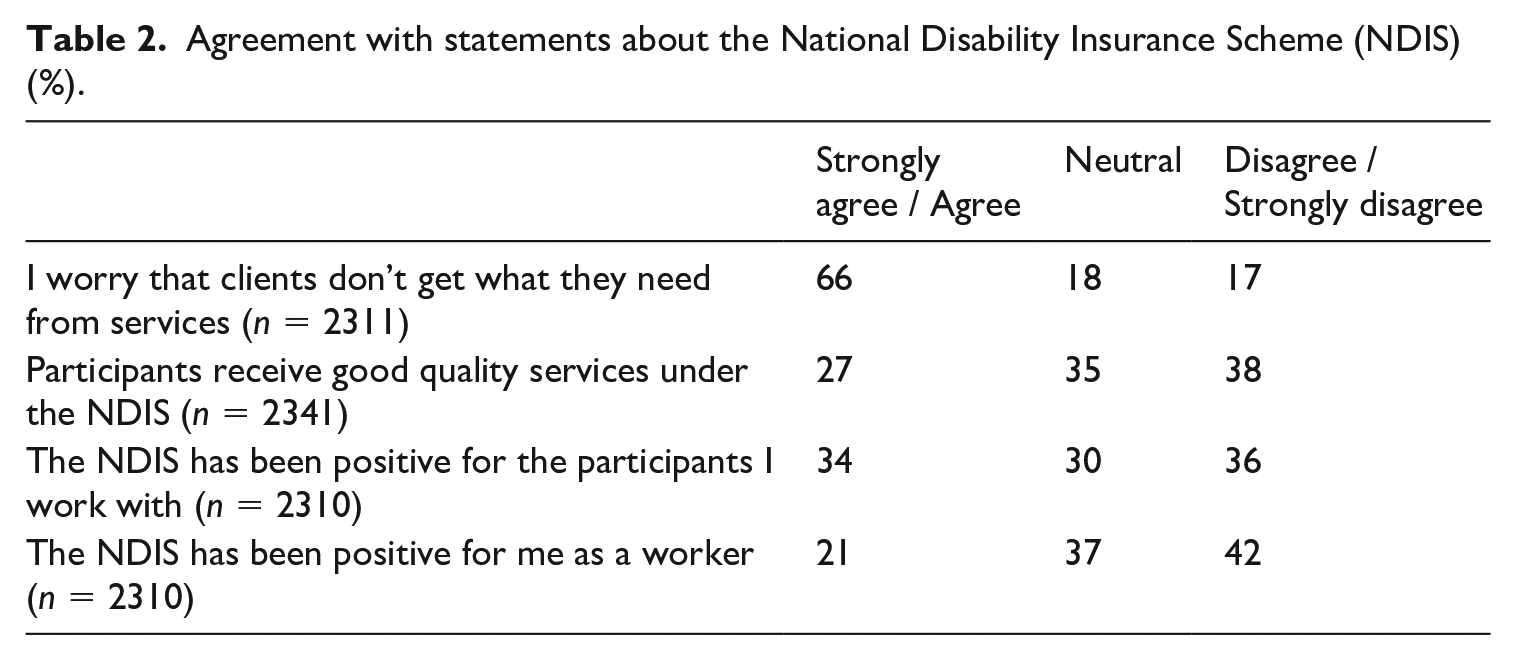
Although sampling means respondents were likely located in workplaces with more comprehensive regulations in place, most workers were concerned about unmet client need, and many expressed concern about poor quality and the detrimental impacts of the NDIS on participants and the workforce (Table 2). These perceptions of systemic deficiencies reflect the emphasis of provider organisations on cost efficiencies and provide a backdrop for understanding the regulation-related tasks and duties workers performed (Table 3 provides a breakdown of tasks performed in unpaid time).
Agreement with statements about the National Disability Insurance Scheme (NDIS) (%).
Tasks performed by workers in unpaid time (%, n = 960).
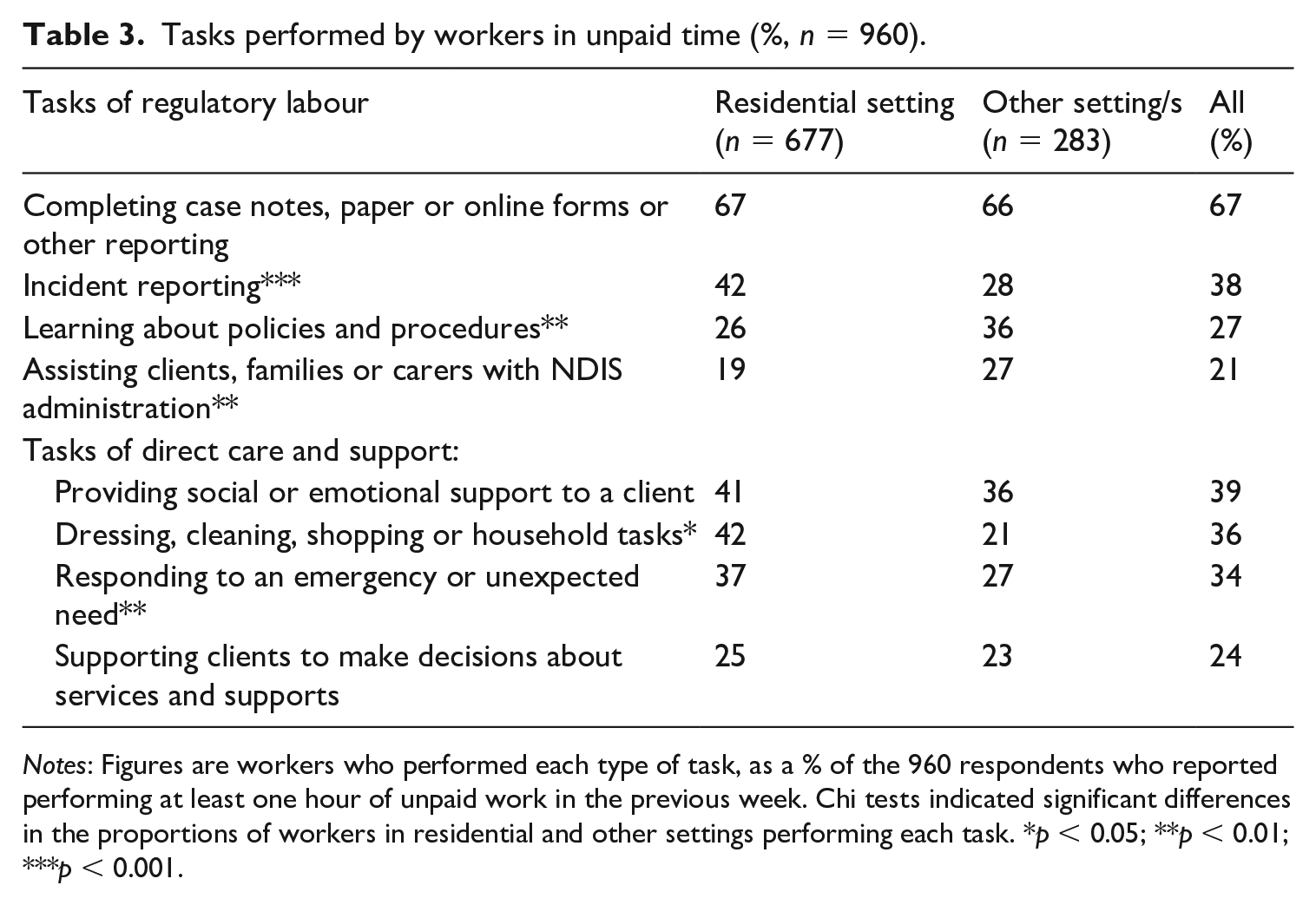
Notes: Figures are workers who performed each type of task, as a % of the 960 respondents who reported performing at least one hour of unpaid work in the previous week. Chi tests indicated significant differences in the proportions of workers in residential and other settings performing each task. *p < 0.05; **p < 0.01; ***p < 0.001.
To understand the regulatory functions performed by disability workers, the analysis drew primarily on open-ended survey comments, pooled from across survey questions to form a dataset. Analysis used a concept-driven coding process (Gibbs, 2007). Author A found through a first reading of the complete dataset that the comments invoked themes from the literature, namely those of self-regulation (Baines et al., 2012) and tolerance and accommodation (MacKenzie and Martínez Lucio, 2005). These themes were combined with others generated through subsequent readings of the comments to form a coding framework, which was then used to code the data in an iterative process resembling Ritchie et al.’s (2013) method of framework analysis. Through this process, and by crosschecking with Author B’s reading of the dataset, the additional themes of gifts of time and self and resistance emerged and were incorporated into the coding frame. In the following section, the findings of the analysis are presented according to these themes, which were employed as the framework for conceptualising how workers contribute to regulating social service markets.
Findings
Gifts of time and self: The devolution of regulatory roles and responsibilities
Workers’ accounts provide insight into the ways in which, under the NDIS, marketisation has entailed a rebalancing of roles and responsibilities between different sites, spaces and actors of regulation (MacKenzie and Martínez Lucio, 2005). They illuminate how NDIS funding arrangements have instigated the devolution of regulatory activity to the local level. While formal decision-making authority rests with national regulators, responsibilities for implementing new regulations, and the problems associated with individualised funding, have been transferred onto service providers and, in turn, onto frontline workers. Administrative tasks that were not required prior to the NDIS or were previously performed by management are increasingly workers’ responsibility, manifest in new administrative systems implemented with few resources. One worker, for example, noted the devolution of responsibility, without financial support: NDIS want organisations to meet their legal obligations but don’t want to provide funding for organisations to achieve this. [. . .] Not enough funding for admin and yet [staff are] expected to put a lot of new systems in place. (Male, non-profit)
Another explained, ‘there is a massively increased demand for excessive documentation in the name of “transparency and accountability” with no corresponding allowance for staff time to complete the necessary paperwork’ (female, government service).
Workers correspondingly noted that despite client-focused framings of the NDIS, administrative tasks and reporting had come to comprise a large part of their job. Corroborating these perceptions, when asked to select from a list of work tasks they performed during unpaid time, tasks of regulatory labour were the most common, performed more often than the client-oriented tasks associated with direct support work (see Table 3). This was the case in both residential and other settings, where two-thirds of workers who performed unpaid work used this time to complete case notes and forms. Other tasks of regulatory labour, however, differed across settings. There were no significant differences found between female and male identifying workers in terms of the proportion performing different types of unpaid regulatory labour, suggesting that at least in this case, unpaid work may be more a product of the work environment than the voluntarism of individual workers or gendered divisions of labour.
Despite the high proportions of workers performing regulatory labour during unpaid time, and the tendency for this work to overshadow their more explicitly client-focused tasks, workers felt it was overlooked and under-supported by employers and government: ‘They need to recognise the amount of work that is done on top of direct support to ensure quality and safer service to clients, like mandatory documents, risk assessments, notes, reporting’ (female, non-profit).
Workers in group homes, in particular, described how the NDIS had increased requirements for reporting, auditing and client risk assessment. For these workers, the shift from a government-managed to a market-based system had created new demands on their time and personal lives. One worker, with over a decade of industry experience, explained: ‘the privatisation of services has increased work-loads dramatically, new [reporting] systems do not always work as they should . . . to get the work done to the prescribed standard relies on staff “giving” time and self’ (female, non-profit).
This excerpt foregrounds the role of frontline workers as regulatory actors, performing regulatory labour. In giving gifts of time and self, workers partook in a range of unpaid activities on which the market depends, in order to maintain and improve service quality and remain viable. These activities span a number of areas, from professional development and training to client handover and incident reporting. Each are integral to quality service delivery within market-based systems, yet are not recognised or remunerated accordingly, nor theorised as components of care work enabling market functioning. On the topic of training, one worker supporting high needs populations with physical disabilities, stated: I would like to get paid for the training I do on my own time, sometimes we do [get paid] but things like first aid we are made to attend on our own time and also pay for most of it. (Male, community-based service)
Another, also working with people with high support needs, explained: There is no extra time allocated to staff to do some essential paperwork especially when it comes to people with complex needs and behaviours. This leads to staff not doing adequate paperwork when needed due to time restraints and having to be hands-on at all times with their clients. (Female, non-profit)
As the survey revealed, workers also intervene in formal, government-led regulatory processes through acts of resistance and subversion. Respondents gave several reasons for resisting regulatory requirements concerning training and incident reporting. Lack of paid time for training as well as reporting – largely a product of the individualised funding model underpinning the NDIS – meant workers routinely traded off their regulatory responsibilities and their own interests; those who refused to perform these duties in their personal time noted the negative consequences for clients. Regarding training, for example, one worker who worked with people with intellectual disabilities remarked ‘online training . . . is becoming more and more the norm. I have declined to do online training when I am not on shift. Consequently, the quality of care provided to residents may be compromised’ (female, non-profit).
Self-regulation
Workers’ accounts illuminate new norms and practices of self-regulation emerging within disability work. Many workers described having engaged in various forms of self-regulation in areas from training and professional development to administration and reporting. Here, self-regulation denotes the role of workers as active, responsibilised participants managing their work lives, behaviours and competencies and those of other staff. There were numerous accounts of workers performing responsibilities well above their classification. Workers described adapting their behaviours to suit altered conditions within the disability sector, where issues of understaffing, under-resourcing, overwork and high staff turnover had intensified under the NDIS market model (Cortis and van Toorn, 2020; Macdonald and Charlesworth, 2016). For example, a worker supporting people with complex needs, remarked: ‘I make decisions and do documentation that are above my pay grade as there has been no team leader to support our team for a long period of time’ (female, non-profit).
Another frontline worker noted her concern about shifts in responsibility for workplace training following the privatisation of disability accommodation and respite services that, prior to the NDIS, had been provided by state government. Her concern was that privatisation had left a vacuum in regulatory oversight of these services, increasing the onus on frontline staff to maintain standards: With [the] privatisation of [the Department’s] residential accommodation services, I have concerns about accredited training like we had in the past . . . Already I have seen this change and had to push to have certain training for medication done as per previously to protect [NDIS] participants and staff. I have a duty of care to ensure the organisation taking over provision of services does as [the Department] did. (Female, non-profit)
Commonly, workers organised training for themselves in the absence of employer provision of training: ‘When it comes to supporting our clients and their families with their [NDIS support] plans . . . we have had to train ourselves and learn on our own’ (female, non-profit).
A similar ethic of self-reliance was evident with regard to supervision. Workers described how they would often perform supervisory roles themselves or organise their own supervision: ‘Supervision in regards to my actual role and supporting clients is non-existent. I trained myself and asked colleagues for support to learn, despite being new in the industry when I became a Support coordinator’ (female, non-profit).
Many workers identified in themselves the capacity for adaptiveness and self-regulation with respect to their role requirements. They modified their behaviour such as ‘learning’ not to ask for support when supervisors lacked the time or desire to fulfil their duties. This respondent from a group home explained: ‘My supervisor does not have a desire to deal with issues, they are simply handballed back to me to solve with little input. Therefore, I have “learnt” not to bring any real concerns to my supervision’ (non-profit).
Owing to understaffing, workers described having limited time and being in situations which required them to ‘work it out on your own’ or source their own support. A home care worker stated: ‘I need to make sure I am getting the time I need for support from colleagues and supervisors. It is not a given and is not organised’ (female, private sector).
Around two-thirds of workers (65%) said they worked with clients with high support needs; many described being unsupported in managing the challenging behaviours of clients and other potential safety risks (Cortis and van Toorn, 2020). In such circumstances, ‘[t]he risks involve lots of self-assessment’ where workers are required to gauge and manage their own exposure to workplace health and safety hazards: Staff are placed in dangerous situations and are expected to be able to handle it without supervisors speaking with staff to make sure they are comfortable and confident enough to be placed in that situation. [Work health and safety] is not monitored. (Female, private sector)
A high degree of personal initiative was required of workers in learning the NDIS rules and regulations to the point where they could implement these effectively. Whereas some resisted these demands, others went beyond what was formally required of them to upskill their knowledge and assist clients. One worker explained: [I] have rang NDIS because the community access funding for one of my customers was a long [time] coming. Four months after we the staff got involved. Now having problems again. Going to an NDIS service provider forum to learn more about the rules. I’m not a services provider, just a caring staff member. (Female, non-profit)
Another, who worked for multiple organisations, remarked: ‘I have had to do ALL of my own personal development and research on [NDIS] matters’.
Accounts of self-regulation were common throughout survey responses, with workers noting activities and behavioural modifications they adopted in response to the changing regulatory environment. A culture of responsibilisation has seemingly developed within disability work, where workers are assuming new roles in managing risk, their own working lives and professional practice and that of other frontline staff. In the next section, the article explores how workers tolerate and accommodate these new roles and responsibilities, and in so doing, play a mediating role in the regulation of markets by government.
Tolerance and accommodation
The analysis revealed some of the problems associated with market-based, fee-for-service models and the ways frontline workers tolerate and accommodate these problems in their day-to-day work. The NDIS makes it challenging for service providers to remain competitive and profitable amid pricing constraints and revenue instability. As shown, the resulting financial pressures are being passed onto workers through various cost-cutting measures that have seen workloads increase alongside administrative/regulatory requirements. Many workers tolerate and accommodate these duties knowing that doing so undermines the quality of services they are able to provide. As one supervisor who worked with high needs clients in a residential setting described: ‘[There are] not enough administration hours in the roster for me to be an effective house supervisor. I’m always cutting corners to get the job done’ (female, private sector).
Another, from a community setting, explained: ‘So much effort and time of the provision of services is centred around NDIS procedure; the paperwork, auditing and administration, it is taking away from supporting clients’ (female, non-profit).
Many workers felt they had little choice but to tolerate the changing conditions in which they worked to implement new regulations. Expectations around incident reporting, in particular, brought these tensions to light: It seems that every time I start a shift the NDIS has introduced a new form for us to fill out. [. . .] I am so tired of being asked to take on responsibility for filling out these forms with no extra time or reward for doing so. For example, an incident report has to be done on the computer but if it relates to restrictive practice now it also has to be filled out on paper and then scanned into the computer and attached to the computer note for the resident. Then I have to print the incident report and attach it to the paper form, then scan and email it to the area manager and the NDIS within one day of the incident. At the same time I am supposed to be supporting the residents. (Male, private sector)
While some workers made accommodations out of fear of losing employment, others did so out of commitment to their job and clients.
Resisting regulatory responsibility
The discussion so far illustrates the extent to which marketised disability support relies on frontline workers performing unrecognised, often unpaid regulatory labour. This should not be taken to signify workers’ passivity or resignation, however. In some cases, workers refused to tolerate and accommodate regulatory process they viewed as onerous, or risking employment repercussions. In resisting formal protocols around reporting, workers considered impacts on their time and employment relationships, and their clients, for example: ‘Incident reports are onerous and require excessive information. [. . .] I have to go through the whole process. Many times I don’t bother. Ain’t nobody got time for that’ (male, private sector): Reporting is difficult and gets the reporter into trouble . . . Unless something was to affect the well-being or health of my client, I would be unwilling to take the risk to report. The after-effects of having reported are too severe to take on. Not worth the risk. (Male, non-profit)
Workers also refused to report due to concerns about the harmful personal effects. One worker, who worked across multiple settings, explained that: ‘So many people, clients and staff suffer extremely traumatising events and cannot go through the further trauma of bureaucratic process. Much is not reported because of this’ (female).
Workers’ accounts of individual and collective resistance highlight their agency as regulatory actors whose labour affects, subverts and reshapes the formal regulatory processes that underpin markets. At times, workers’ tolerance and accommodations supported NDIS regulatory processes; at other times, their accommodations reshaped care according to workers’ own vision of good service provision and decent work.
Discussion
This analysis exposes regulatory labour, a distinctive domain of largely unpaid, unrecognised work that is critically important to the regulation of quality in marketised social service systems. While social service quasi-markets have long been recognised to be premised on expectations of women’s unpaid work and poor wages and conditions (Baines, 2004; Baines and Daly, 2015), the findings of this study point to an additional, hitherto unidentified form of ‘gift’ work specifically related to regulating quality within such systems, which has not been theorised as a component of care work. In disability services delivered within individualised funding schemes, the unpaid work on which quasi-markets depend is comprised not only of the direct care and support labour ‘gifted’ to clients (Baines et al., 2017). These markets are also premised on expectations that workers will perform certain regulatory tasks, often during unpaid time. The tasks of regulatory labour the analysis illuminates are distinct from the forms of labour that have tended to dominate research and thinking about employees’ gifting of unpaid time in social services (Baines, 2004; Baines et al., 2017). Whereas physical, emotional and organisational labour has a ‘client serving’ purpose (James, 1992), regulatory labour is primarily, though incompletely, ‘system serving’, in that, while performed by frontline workers, it primarily responds to systemic (regulatory) requirements rather than the support needs of individual clients. Workers’ accounts show how under the NDIS they perform regulatory tasks and carry responsibilities to supplement an under-resourced, marketised system, which was frequently seen to fail to meet client needs. By empirically substantiating workers’ embeddedness in these micro-processes of regulation, the analysis highlights the need to more fully recognise regulatory labour among the multiple components of care work and to understand the ways it is produced and expropriated in marketised social services, including those organised around individualised funding.
The findings support Martínez Lucio and MacKenzie’s (2004) claim that in recent decades, shifts have occurred in the boundaries of regulation, such that the labour involved in market regulation has been transferred onto new actors and institutions. A key contribution has been to show the significance of frontline workers as undertheorised regulatory actors. The analysis points to several mechanisms facilitating this transfer of regulatory activity from the national, to organisational and individual levels (Martínez Lucio and MacKenzie, 2004). These mechanisms consist of formal rules and obligations (e.g. to report serious incidences of harm). Yet even stronger mechanisms operate informally through workplace norms, tacit understandings and learnt behaviours, which in turn shape, and are shaped by, the external funding environment and power dynamics in marketised service systems.
Previous studies have shown that care workers are sometimes driven by altruism and solidarity with other workers and clients to perform unpaid work (Baines and Daly, 2015). Indeed, these workers were performing regulatory labour in the context of unmet client need and concerns about the negative impacts of individualised funding reforms, which may invoke altruistic donations of labour. However, this study suggests there are other structural factors at play, which are fundamentally linked to the political economy of disability support work. In particular, the NDIS creates structural imperatives for service providers to externalise the regulatory costs and administrative burdens associated with individualised funding arrangements (Carey et al., 2020). Thus, regulatory labour is devolved to frontline workers, replacing client-centred tasks, as individualised funding arrangements instil market logics and compel providers to prioritise financial priorities over quality care. By making this labour visible, the analysis provides empirical support for claims about the myth of self-regulating markets (Aalbers, 2016), suggesting that when governments lighten the hand of regulation, the labour required to make markets work falls to other, non-state regulatory actors – in this case both service providers and frontline workers. This regulatory labour is an important, yet undertheorised, aspect of work in marketised social services.
Conclusion
Drawing and building on sociological theories of regulation, this article has examined how frontline workers contribute to the regulation of marketised social service systems. It has demonstrated the importance of informal workplace norms and practices in mediating the formal regulatory processes which shape and enable care markets, including through workers’ practices of self-regulation, tolerance and accommodation. The disability workforce survey reveals the ways workers assume new roles and responsibilities that support the functioning and viability of social service markets, yet this work is not formally recognised and is largely unpaid. By identifying and distinguishing this work, referred to here as regulatory labour, the article contributes to fuller understandings of care work in marketised social service systems. It calls for improved visibility of regulatory labour in theoretical accounts of marketisation. Practically, the analysis provides a basis for regulatory labour to be recognised and valued among other components of care, while delineating limits to market-based provision by showing how and by whom costs and risks are borne.
Footnotes
Acknowledgements
The article draws on survey research which was funded by the three trade unions representing disability workers in Australia: Health Services Union, Australian Services Union and United Workers Union. We would like to thank these unions for their support in distributing the survey, and the workers who participated. Of course, the views expressed in the article are those of the authors.
Funding
The authors received no financial support for the research, authorship, and/or publication of this article.
