



Abstract
Over the last decade southern European labour markets have been transformed in a common neoliberal direction, as a consequence of the reforms enacted after the 2008 financial crisis. In our research we investigate to what extent these labour market reforms, aimed at promoting a radical decentralisation of collective bargaining, have actually led to such change. For that purpose, we developed a comparative study of Spain and Portugal, using the notions of path dependency and socio-political coalitions developed by historical institutionalism. Our study leads to the conclusion that institutional trajectories resulting from these labour market reforms merge profound changes with significant resilience. The neoliberal transformations of southern European labour markets have not led to the emergence of new bargaining models, nor to an institutional convergence towards the decentralised collective bargaining systems of liberal market economies. Rather, these reforms have triggered a disorganised fragmentation of collective bargaining systems, resulting in a lack of institutional coherence.
Keywords
Introduction
During the Great Recession, the economies of southern Europe faced a deep external debt crisis (2009–2012). This crisis provided an exceptional window of opportunity –a critical juncture– that was used by the European Commission and national governments to promote radical labour market reforms, leading to major institutional changes in these countries. In particular, and with the aim of reducing unit labour costs, we witnessed strong efforts to radically transform collective bargaining systems, in the search for new institutional arrangements and new wage-setting mechanisms.
Labour institutions, and particularly collective bargaining, are not just another institution. They are decisive devices for understanding power relations in modern societies. Collective bargaining is at the very heart of economic and social relations, being decisive in explaining working conditions, the evolution of wages or income distribution. Analysing the changing nature of collective bargaining in Europe, particularly where major reforms have taken place, is therefore of crucial importance for understanding current transformations in the social structure of our societies.
European countries have long been an exception on the international labour scene: approximately two-thirds of all workers fall within the scope of a collective agreement, having higher collective bargaining coverage than anywhere else in the world. The reason for these high coverage rates lies in the traditional importance of sectoral bargaining and extension mechanisms (Marginson, 2015; Van Gyes and Schulten, 2015).
Sectoral bargaining has guaranteed the pay and working conditions of millions of workers in Europe, regardless of the particular power relations existing at company level. Extension mechanisms have allowed collective bargaining to be applied beyond the immediate contracting parties, covering all firms and workers in a certain sector or region. In addition, another form of extension (so-called ultra-activity) has allowed agreements to remain in force until they are replaced by new ones.
These instruments have been particularly important in southern European economies for decades, as collective bargaining at the firm level has been traditionally weak (most companies in these countries are small or very small). And these are precisely the instruments that were deeply reformed in 2010–2012, with the aim of decentralising collective bargaining (Marginson, 2015): the prevalence of sectoral bargaining was eliminated, extension mechanisms were dismantled and the duration of collective agreements was reduced.
However, can we really say that these labour reforms have led to the emergence of new collective bargaining models in southern European countries? Have southern European labour markets been pushed towards institutional convergence with the traditionally decentralised models of liberal market economies? Based on the case studies of Spain and Portugal, and building upon the notions of ‘path dependency’ and ‘socio-political coalition’ developed by historical institutionalism, we investigate to what extent these labour reforms have actually led to radical institutional change, as they intended. Particularly, we analyse the transformations that both collective bargaining systems have undergone during the last decade, the depth of institutional change that has taken place and the causes that explain resilience.
In recent years, numerous studies have reviewed the impact of recent labour market reforms in southern European countries. Much of this research has focused on analysing the changes that have occurred in employment protection and unemployment insurance (Moreira et al., 2015), the dynamics of new labour contracts (Cirillo et al., 2017) and the new forms of labour dualisation derived from these reforms (Cardoso and Branco, 2018).
The sociology of work has also analysed the growing precariousness of work and the re-commodification of labour that has taken place in these economies as a consequence of the reforms adopted (Prosser, 2015), and the literature on industrial relations has addressed the impact of these reforms on the outcomes of collective bargaining (Koukiadaki et al., 2016; López-Andreu, 2019; Távora and González, 2016).
Nevertheless, specialised literature has rarely examined a fundamental point: the elements of institutional continuity and resilience that have occurred in southern European countries despite the radical nature of the labour reforms implemented. To date, academic literature has placed a lot of emphasis on analysing formal changes, but not so much on analysing the adaptation of institutions and actors to these changes.
Our research seeks to fill this gap in the literature, helping to better understand both the real impact of the labour market reforms developed in southern European countries, as well as the mechanisms that explain institutional resilience in collective bargaining. We begin our investigation with three research questions:
First, have the labour reforms that took place during 2010–2012 led to an institutional change as radical as the European authorities intended or, on the contrary, have path dependency forces shaped this change, unfolding relative resilience?
Second, what are the specific determinants that explain this possible institutional resilience?
Third, have these changes resulted in a new coherent and organised model of collective bargaining?
Answering these questions allows us to contribute to a broader debate. The Varieties of Capitalism approach (Hall and Soskice, 2001) categorised the capitalism of different countries into two types –liberal and coordinated market economies– with a ‘hybrid case’ represented by southern European economies. However, later research has opened an inspiring debate in comparative political economy, with some authors (Baccaro and Howell, 2011) insisting on the common trend experienced by advanced capitalist societies towards a neoliberal transformation. According to these authors, today’s societies are characterised not so much by the diversity of their national institutions, but by a set of common pressures that encourage the homogenisation of these institutions, with industrial relations systems being transformed in a shared neoliberal direction. Our article aims to contribute to this debate by clarifying how processes of institutional convergence take place.
In this research we use a comparative study methodology. Comparative-historical studies examine and contrast social structures, institutions and processes across countries to identify general patterns. This allows us to understand institutional complexity, identify causal mechanisms and draw general conclusions. Thus, a comparative study of Spain and Portugal –two cases that present important elements in common, but also relevant differences– sheds light on the specific nature of the mechanisms that explain resilience and institutional convergence.
Our study leads to the conclusion that institutional trajectories resulting from recent labour market reforms merge profound changes and significant resilience, with transformations in collective bargaining being strongly influenced by certain self-reinforcing mechanisms linked to the core elements of the industrial relations system. That is, there are institutional, behavioural and political forces that largely shape the direction and depth of the changes (also in periods of turbulent critical junctures). In this way, even if labour reforms in southern European countries can be explained as an attempt to transform –in a neoliberal direction– the social structure and power relations in these societies, path dependency forces determine the nature of the changes, the resilience of diverse national institutions and the lack of institutional convergence.
The structure of our research is as follows. After this introduction, in section two we present the importance of path dependency forces and socio-political coalitions, in order to understand how institutional transformations are shaped by these influences. In section three we assess, in the field of collective bargaining, the main changes triggered by labour market reforms. In section four, we analyse the outcomes of these labour reforms on coverage, bargaining dynamics and new wage-setting arrangements. In section five, and drawing on the theoretical elements previously introduced, we explain the specific form that institutional resilience adopts in both countries, as well as the determinants that explain such resilience. Finally, in section six we conclude, raising some implications for economic policy.
Path dependency and socio-political coalitions in historical institutionalism
The literature on path dependency –popular in history, political economy and other social sciences– suggests that the functioning of current institutions is largely shaped by past events, framing strategic options for change through self-reinforcing mechanisms (Grabher, 1993; Thelen, 2003). This theoretical framework can be useful for our research, since it presents an analytical tool particularly focused on understanding the forces that determine resilience as well as institutional change during so-called critical junctures.
Self-reinforcing mechanisms push arrangements and institutions towards continuity, due to different types of lock-in processes (Grabher, 1993). Functional lock-in occurs because of the relative efficiency of institutions when performing the functions they have formally been entrusted with. Cognitive lock-in defines the intellectual room for manoeuvre in relation to norms and settlements. And political lock-in refers to the commitment shown by the different collective actors and political coalitions towards maintaining the present arrangements.
In recent years, historical institutionalism has further developed the theory of path dependency, providing a more accurate understanding of the processes of institutional change. First, it has been studied how path dependency processes are compatible with the development of endogenous changes within institutions: institutional embeddedness is important, but deterministic paths should be avoided (Thelen, 2003, 2009). Second, path dependency forces are influential in periods of stability, but it is during periods of change that their role proves crucial, strongly affecting the depth and direction of change (Ebbinghaus, 2005). And third, historical institutionalism has assumed that, to a large extent, institutional change is strongly conditioned by specific distributive struggles, coalitions with conflicting interests and particular political disputes. In fact, Mahoney and Thelen (2010: 8) describe institutions as ‘distributional instruments laden with power implications’.
Ebbinghaus (2005) presents three possible institutional change trajectories within the framework of the path dependency theory. The first type of trajectory, path stability, is characterised by the marginal adaptation of institutions to changes in the environment. There is no alteration in the founding principles of the institutions, and the central arrangements remain unaffected. Self-reinforcing forces lead to ‘lock-in’ and minor adjustments, with institutional inertia inhibiting changes.
The second trajectory conceived by historical institutionalism (Ebbinghaus, 2005; Thelen, 2003), path departure, is particularly interesting for our research. In this case, self-reinforcement mechanisms allow for partial renewal of institutions, behaviours and arrangements, with some reorientation of the model’s core principles.
Path departure can involve different kinds of processes. For example, institutional hybridisation can occur when institutions are reformed to carry out the same tasks in different ways, or to develop new tasks, maintaining functionality. There can also be a trajectory based on long-term gradual changes, which eventually lead to a major reorientation of institutions and to the creation of new paths. But path departure can also take place through fragmentation processes (Teague, 2009): established institutions, behaviours and arrangements lose functionality or become disorganised. In these cases, institutions may apparently remain unchanged, but the function they perform becomes disarranged (Thelen, 2009).
Finally, a third type of trajectory would be that of path cessation. In this case, an intervention (usually external) ends with self-reinforcing mechanisms and institutional change accelerates, with the collapse of previous arrangements. A critical juncture comes into play and acts as a ‘window of opportunity’, allowing a radical transformation and the emergence of new institutions.
The formation of socio-political coalitions is also important in historical institutionalism, in order to explain these possible trajectories of institutional change. In this tradition, socio-political coalitions are understood as alliances between social, business and political actors, with the aim of coordinating their interests and, therefore, with the capacity to mediate institutional change.
The struggles and negotiations of coalitions around different possible reforms are crucial in explaining both the diversity of institutional trajectories and also resilience (Thelen, 2009). In fact, institutions can take on various forms and functions over time, depending on the role played by the coalitions on which these institutions are built. In other words, the specific characteristics of coalitions explain certain socio-economic and political constraints that can strongly condition the outcomes of institutional reforms (Bulfone and Tassinari, 2021; Kornelakis, 2014).
In the following sections we use this theoretical framework to analyse the institutional trajectory shown by the collective bargaining models in Spain and Portugal, in order to answer the three research questions posed in the introduction.
The transformation of collective bargaining systems in Spain and Portugal
In the years immediately following the Great Recession of 2008, a new system of economic governance was established, giving rise to a new European interventionism (Van Gyes and Schulten, 2015). This new interventionism entailed a paradigm shift in the European Union (EU): the European Commission moved from the acceptance of free collective bargaining to direct political intrusion in national industrial relations systems, with the aim of implementing an internal devaluation strategy.
Industrial relations systems in Spain and Portugal before the crisis
Southern European countries have traditionally shared common elements in their industrial relations systems. Portuguese and Spanish systems have been based on the principle of trade union pluralism, with class-oriented unions that have developed politicised strategies grounded on strong partisan links. In both countries the role of law has been of major importance when regulating industrial relations and, unlike in northern Europe, the State has historically played a crucial responsibility in supporting collective bargaining.
Since the 1990s these two systems evolved towards a sort of ‘neo-corporatism’, with labour conflict being channelled through institutions such as social dialogue.
This evolution was more pronounced in the case of Spain, where social dialogue consisted mainly of regular consultations between government, employers and unions at the highest level of representation, in an effort to negotiate fresh legislation as well as salary increases.
In the case of Portugal, tripartite social dialogue also developed in the 2000s, although strong partisan ties between political parties and unions continued to play a key role in the system. While in this period the main Spanish union (Comisiones Obreras, CCOO) weakened its traditional political ties with the leftist parties, the leading Portuguese union (Confederação Geral dos Trabalhadores Portugueses, CGTP) continued to develop strongly politicised strategies.
Both systems also presented a long tradition of collective bargaining at the sectoral level. This preference for sectoral branch agreements was due to the small size of companies (most are micro-size firms), 1 and played a significant role in normalising working conditions and living standards.
Due to this context in which most companies are very small, collective bargaining after the 1980s developed according to the favor laboratoris principle, recognising important extension mechanisms (erga omnes clauses). As explained in the introduction, extension mechanisms allowed collective agreements to be applied to broad sectors or regions of the economy, and not just to some companies. Furthermore, agreements remained in force thanks to after-effect mechanisms until they were replaced by new ones.
Both mechanisms, erga omnes clauses and ultra-activity, proved to be crucial in these two countries vis-a-vis facilitating balanced collective bargaining, leading to high levels of coverage (over 80%) despite the low levels of union density (see Table 1).
Key features in industrial relations systems in Spain and Portugal before the labour market reforms of 2010–2012.
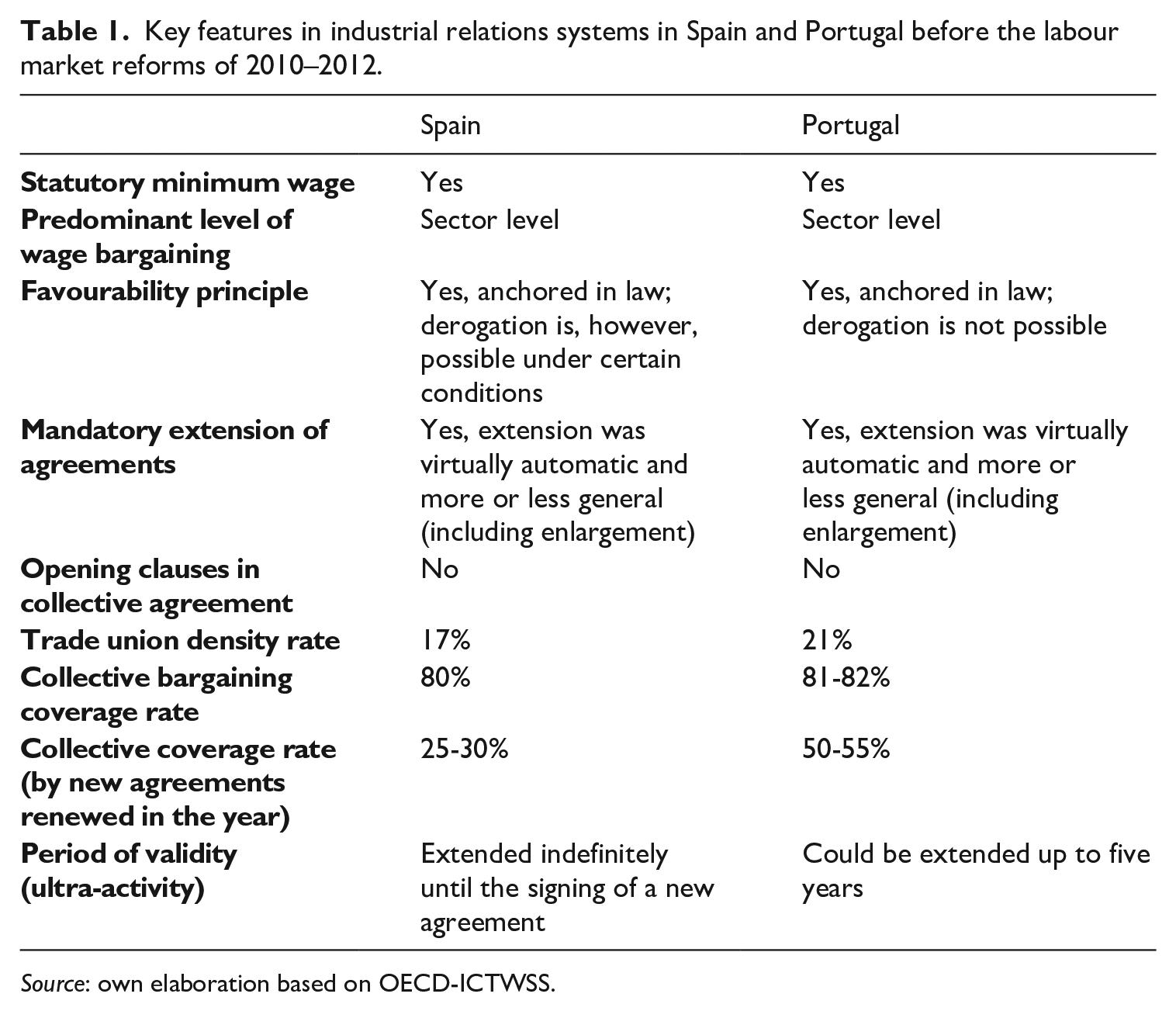
Source: own elaboration based on OECD-ICTWSS.
Main changes in collective bargaining systems
This Iberian model of sectoral level bargaining, with strong extension mechanisms, guaranteed ultra-activity and centrally organised coordination –grounded on tripartite agreements– was deeply reformed during the Eurozone crisis.
Policy strategies in Spain and Portugal during 2010–2012 involved similar elements (Rocha, 2018; Távora and González, 2016): reforms were adopted to decentralise collective bargaining –suspending the preference for sectoral agreements– and measures aimed at restricting the coverage of collective bargaining were also taken –decreasing automatic extension and limiting the duration of ‘after-effects’ mechanisms.
Law 3/2012 in Spain gave preference to company-level agreements over sectoral and provincial agreements in key areas of collective bargaining (wages, working time, work organisation and internal mobility). Favourability was reversed, so that terms at lower bargaining levels started to have priority (see Table 2). Article 41 of the Workers’ Statute was also modified to allow the unilateral modification of wages and working conditions by employers.
Key features in industrial relations systems in Spain and Portugal after the labour market reforms of 2010–2012.
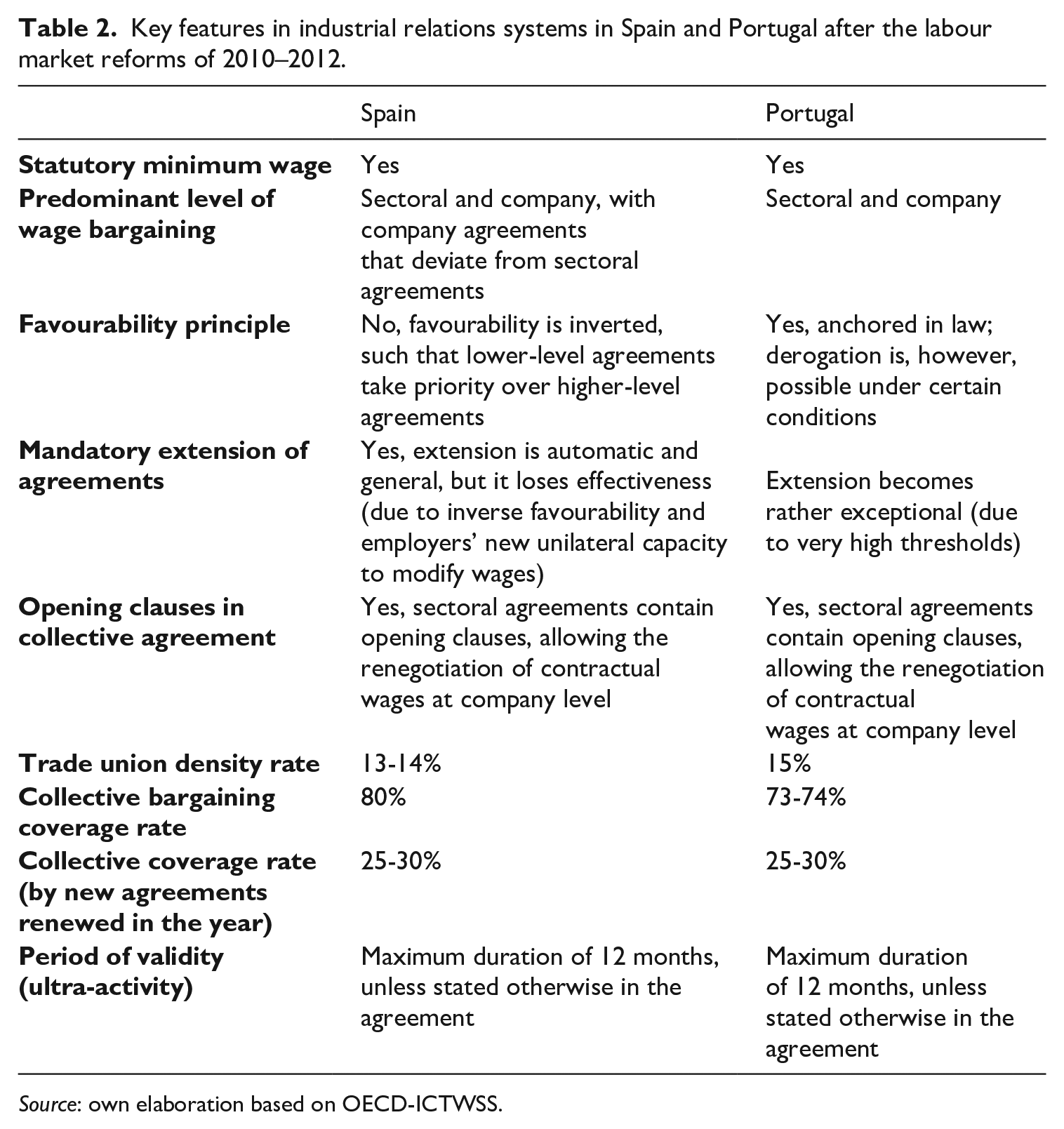
Source: own elaboration based on OECD-ICTWSS.
Reforms in 2011 and 2012 in Portugal likewise sought to extend the scope for decentralised wage setting, creating the possibility for work councils to negotiate remuneration. Portugal’s 2012 reform reduced the company size threshold required for non-union bodies to engage in collective bargaining from 500 to 150 workers and modified the favourability principle by permitting derogation (see Table 2).
Extension and enlargement at the sectoral level were restricted in both countries, especially in Portugal. As of 2012, collective agreements could only be extended to all workers in a sector if the companies signing them employed at least 50% of the workers in that sector. This change led to a significant reduction in the use of administrative extensions (the so-called portarias de extensão).
In the case of Spain, erga omnes clauses were formally maintained, but they lost much of their previous effectiveness due to the new priority of company-level agreements over sectoral ones and the new capacities of employers to unilaterally modify wages (Rocha, 2018). These new regulations eroded the binding nature of sectoral agreements, as well as the effectiveness of extension clauses.
Labour reforms also tried to significantly reduce the duration of agreements, limiting ultra-activity. Spanish regulation prior to 2012 guaranteed an indefinite ‘after-effect’ period of collective agreements, but the 2012 reform drastically changed said norm and allowed a maximum duration of only 12 months once negotiations have proved unsuccessful. In Portugal, ultra-activity was also substantially reduced. Before the crisis, the minimum ‘after-effect’ period was 14 months, a period that could be extended up to five years, but after 2012 ultra-activity was restricted to 12 months. 2
In addition to these reforms in collective bargaining systems, Spain and Portugal also experienced other changes to increase labour market flexibility (Koukiadaki et al., 2016). Layoff costs were reduced and dismissal procedures were made easier for employers. Between 2008 and 2014, the Organization for Economic Cooperation and Development (OECD) Employment Protection Legislation indicator fell from 2.4 to 2.0 in Spain, and from 4.4 to 3.1 in Portugal. Although they did not formally affect the collective bargaining system, these changes have significantly conditioned negotiations between employers and workers, as they reduced the latter’s legal protection against dismissal and thus their bargaining power.
The impact of labour market reforms on collective bargaining in Spain and Portugal
In the years immediately following the reforms, some studies (Naumann, 2014; Van Gyes and Schulten, 2015) argued that Spain and Portugal were undergoing radical transformations in their labour markets. However, when looking at these changes today, with a broader perspective, we certainly have to acknowledge that self-reinforcing mechanisms shaped institutional change, providing resilience and altering the planned course of said reforms.
A path cessation trajectory was avoided and both countries experienced a path departure course: major elements of institutional resilience began to coexist with a series of disorderly changes. More specifically, both collective bargaining systems went through a process of fragmentation (Teague, 2009): a path departure trajectory situated between lock-in inertia and radical change in which established institutions, behaviours and arrangements lose functionality and become disorganised.
We analyse three different institutional dimensions to assess these changes: coverage, decentralisation and agreed wages.
Changes in collective bargaining coverage
The decline in the number of agreements signed was one of the first effects of the reforms.
In Spain, this reduction occurred mainly at the company level, while the number of sector agreements signed remained more stable (see Figure 1). This trend was largely caused by the crisis itself, and by the difficulty that works councils have had in renewing their agreements after automatic temporary extension was abolished (Molina and Miguélez, 2016).

Collective agreements by type and bargaining coverage, Spain, 2008–2019.
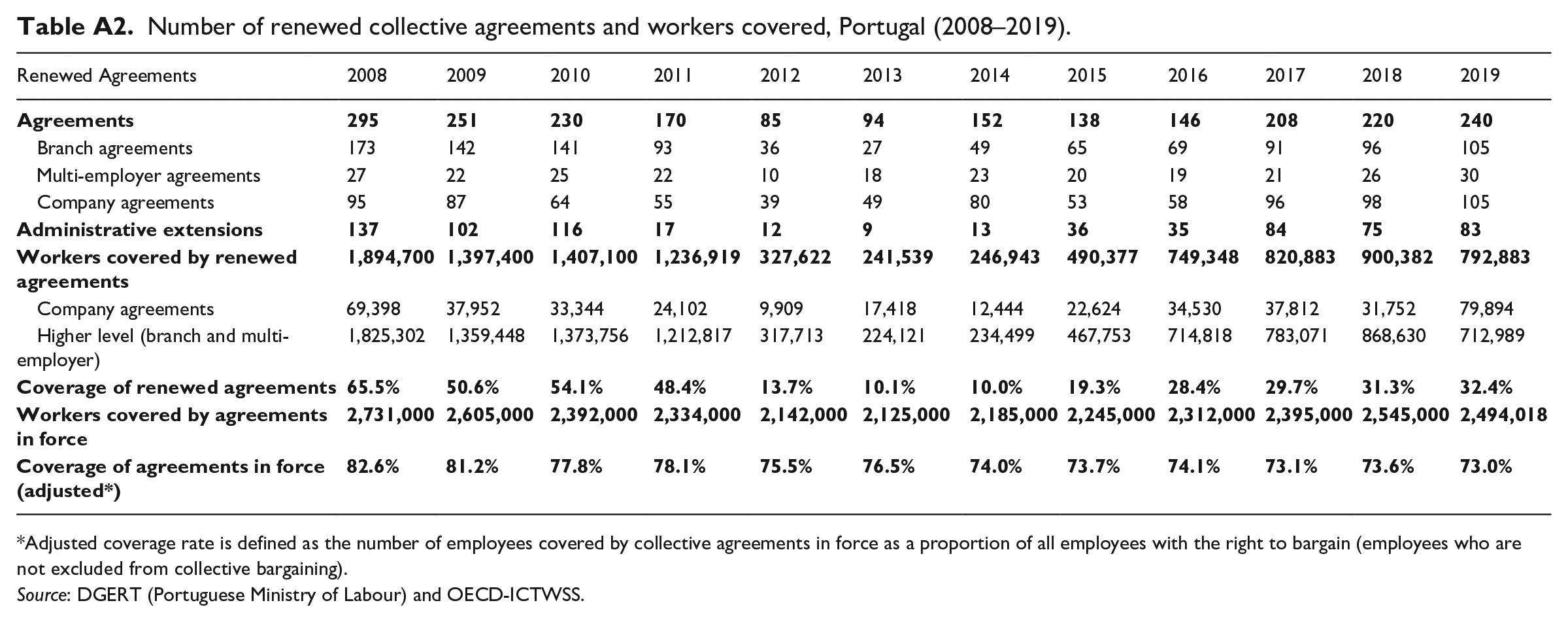
In the case of Portugal, the reduction in the number of collective agreements signed was significantly greater. In 2008, 200 collective agreements were signed at the sector level (branch or multi-employer), while in 2013 the number barely reached 45 (see Figure 2). This dramatic reduction was mainly due to the new –and extremely high– thresholds legislated to allow administrative extensions, as seen in the previous section. In 2008, before the crisis, 137 administrative extensions (portarias de extensão) were implemented in Portugal, while the number fell to just 17 in 2011.

Collective agreements by type and bargaining coverage, Portugal, 2008–2019.
Due to this fall in the number of agreements signed, there was a significant reduction in the coverage of annually renewed agreements, particularly in Portugal (see Tables A1 and A2 in Appendix 1). Nonetheless, overall collective bargaining coverage remained relatively stable in both countries (see Figures 1 and 2). In other words, collective agreements began to be renewed more slowly after the reforms, but they continued to cover the majority of the working population. However, this resilience of collective bargaining coverage masks other important changes.
‘Disorganised decentralisation’ of collective bargaining
Labour reforms in Spain and Portugal did not endorse a process of ‘organised decentralisation’ (Traxler, 1995), namely, increased company-level bargaining, within the framework set by sectoral agreements.
Decentralisation did take place, but not as initially planned. Tables A1 and A2 in Appendix 1 show in detail how in neither of the two countries was there a substantial increase in collective agreements signed at company level, nor in the workers covered by these agreements.
In Spain, company agreements in 2019 reached only 7% of workers covered by collective bargaining, even less than in 2008 (when that figure was 10%). In the case of Portugal, the situation was similar: in the period between 2014 and 2019, only 3–5% of workers were covered by company agreements.
The decentralisation process in both countries did not happen through the use of company agreements, taking advantage of the changes that took place in the favourability principle, instead, decentralisation mechanisms were spurious and mainly based on the erosion of sectoral collective bargaining.
In Spain, the crucial mechanism by which this ‘disorganised decentralisation’ occurred was the new legal capacity of employers to unilaterally modify working conditions, including wages. This mechanism meant that, since 2012, thousands of companies did not apply the formal conditions set out in agreements (Rocha, 2018), leading to an ‘emptying’ of collective bargaining: although sector and company agreements continued to be signed, thus maintaining a strong formal coverage of collective bargaining (see Figure 1), these agreements began to have less actual capacity to enforce wage increases. In Portugal, the withdrawal of the extension mechanisms led to a collapse in the number of sectoral agreements, while company agreements grew very little (see Figure 2).
Evolution of collectively agreed wages and wage-drifts
The moderation of collectively agreed wages resulting from these reforms led to a sustained process of internal devaluation in these economies (see Figures 3 and 4): during these years, and even once the recovery started in 2014, real wages and unit labour costs experienced a very low or even negative growth trend. Collective bargaining in the new post-reform institutional framework has shown remarkable difficulties in maintaining employees’ purchasing power.

Real compensation per employee (annual growth rate) 2008–2019.

Real unit labour costs, (2010 = 100) 2010–2019.
The ‘emptying’ of collective bargaining in these two countries can be seen in Figure 5. Wage drift became negative during the crisis, but also maintained these negative values later during the expansion phase that commenced in 2014. This shows how collective bargaining agreements no longer reflect the real wage dynamics for many workers who, although formally covered by these agreements, experience lower wage increases than those agreed.

Wage drift (annual growth rate, period averages) 2000–2019.
Path dependency in Spain and Portugal: Between radical change and institutional resilience
In this section we explain why the potential capacity of labour reforms to radically transform the institutional framework has not materialised in either of these two countries. We pay special attention to the key role played by some institutional arrangements in each case.
Explaining institutional resilience in Spain and Portugal
As stated in section two, a path-departure trajectory is characterised by the partial renewal of institutions together with a certain reorientation of the model’s core principles. This is indeed the case of Spain and Portugal after the reforms. Nevertheless, in these countries the departure process did not lead to a functional hybridisation of old and new institutions. Rather, a situation arose in which elements of institutional resilience began to coexist with a series of cluttered and noteworthy changes, so that established institutions and arrangements lost functionality and became disorganised.
This fragmentation process begins with the withdrawal of the State’s traditional support for collective bargaining. With the removal of this support, collective bargaining collapsed and social actors initially lost the references which for years had served to guide their behaviour: without a strong favourability principle, extension mechanisms and ultra-activity, unions had great difficulty drawing on other resources to rebalance the importance of sectoral bargaining (Koukiadaki et al., 2016; Molina and Miguélez, 2016).
However, institutional continuity became evident shortly after the reforms, with certain lock-in mechanisms providing resilience. In the case of Spain, the role played by social dialogue proved to be crucial. Tripartite dialogue tradition in Spain was broken by the unilateral reforms implemented by the government: in 2010 the unions called a general strike against the reform implemented by Zapatero’s socialist government, and in 2012 they did so again against a new reform legislated by the conservative government of Rajoy. Nevertheless, Spanish unions set a clear strategy after 2012 by demanding that future governments reverse the labour reforms implemented, while keeping alive social dialogue with employers (moving from tripartite to bipartite dialogue).
In 2013 an important Agreement on Ultra-activity was reached between Spanish unions and employers. In order to avoid major conflicts, it recommended including specific clauses on ultra-activity in signed agreements (Molina and Miguélez, 2016). Furthermore, unions and employers reached two additional National Agreements on Employment and Collective Bargaining for the period 2015–2017, and also for 2018–2020. The first of these agreements contained moderate wage increases, but the second agreement raised the minimum wage to 1,000 euros in 2020 for all workers covered by collective bargaining, and also consolidated the previous ultra-activity arrangements.
In fact, as we can see in Figure 6, the opposite of what was expected occurred in the years following the reforms: there was a rapid increase –from 40% in 2013 to 65% in 2019– in the percentage of collective agreements with clauses extending their duration until the establishment of a new agreement. By contrast, collective agreements in which ultra-activity is restricted to only one year (as intended by the 2012 labour reform) decreased rapidly from 50% in 2013 to 23% in 2019. We thus see how the unilateral government reform of 2012 is to some extent circumvented by the social actors themselves who –through bilateral agreements– partially restore ultra-activity.
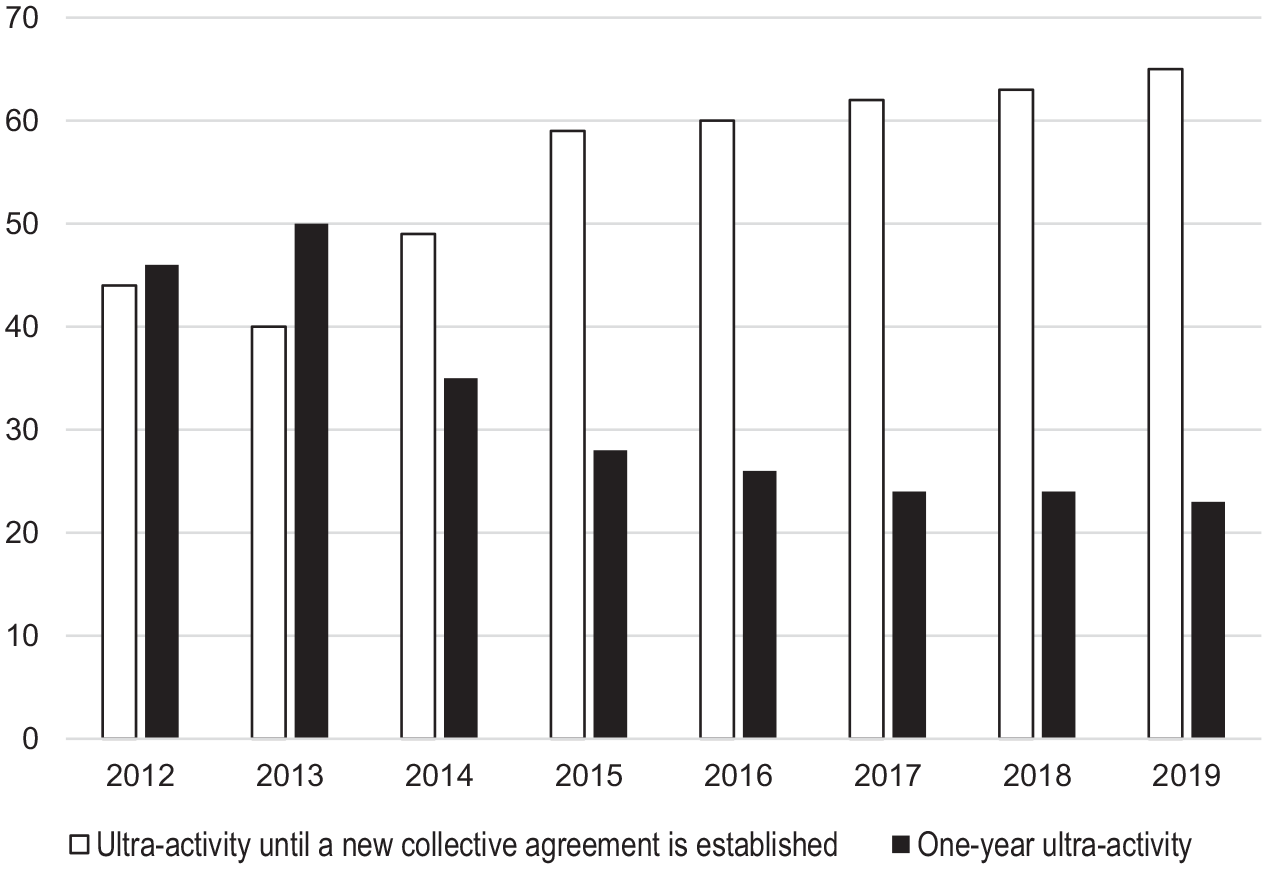
Duration of ultra-activity in collective agreements, Spain, 2012–2019 (percentage of total agreements).
In Portugal, the crisis suffered by collective bargaining immediately after labour reforms was deeper than in Spain. However, important elements of institutional resilience began to appear in 2015. In this case, unlike in Spain, the elements of institutional resilience do not arise from the role played by bipartite social dialogue between unions and employers, but from the guarantor role that the State has historically played in collective bargaining, and from the partisan links between unions and political parties.
As already explained, the element that most eroded collective bargaining in the Portuguese economy was the suppression of the quasi-automatic nature of administrative extensions. Figure 7 shows the sharp decline suffered by these extensions after the reforms, as well as their subsequent recovery.

Administrative extensions, Portugal, 2008–2019.
In January 2015, the government of Pedro Passos Coelho, given the proximity of the elections and the strong salary impact caused by the cessation of administrative extensions, relaxed the criteria of these extensions. The requirements were revised, so that extensions could be issued if at least 30% of the employers’ association signing an agreement were small and medium-sized enterprises (firms with less than 250 employees). This new representativeness clause triggered a modest recovery in the number of extensions issued in 2015 and 2016, as can be seen in Figure 7. In 2017, the new socialist government of Antonio Costa was to totally remove all limitations introduced on administrative extensions.
Two different modes of institutional resilience: Functional and political lock-in
In the case of both Spain and Portugal, institutional resilience is explained by those core elements of the system that have organised collective bargaining in recent decades. As pointed out by Grabher (1993), self-reinforcing mechanisms can cause institutional lock-in processes due to functional, cognitive or political reasons. In Spain, functional lock-in has predominated, whereas political lock-in prevailed in Portugal.
Functional lock-in has occurred in Spain due to the efficacy shown by the bipartite negotiation between unions and employers in recent decades aimed at channelling social conflict and achieving moderate yet constant wage growth. During the 1990s and 2000s, bipartite negotiation ‘from the top’ (at national and sectoral level) allowed collective bargaining to be coordinated at lower levels in a functional manner (Molina and Miguélez, 2016). This explains why this social dialogue has lasted over time –even in a context of institutional turbulence– endowing the whole system with resilience and mitigating some of the most disruptive elements of the 2012 reform.
Both trade unions and employers’ organisations alike have been keen to maintain social dialogue during the post-reform period, as a source of institutional stability. This has been the case with ultra-activity, as seen in Figure 6. Table 3 also shows how during the years immediately after the reforms 80% of companies were still satisfied with sectoral collective bargaining.
Spanish companies with a collective agreement, vis-a-vis the degree to which the agreement adapts to the company’s needs, by type of agreement and company size.
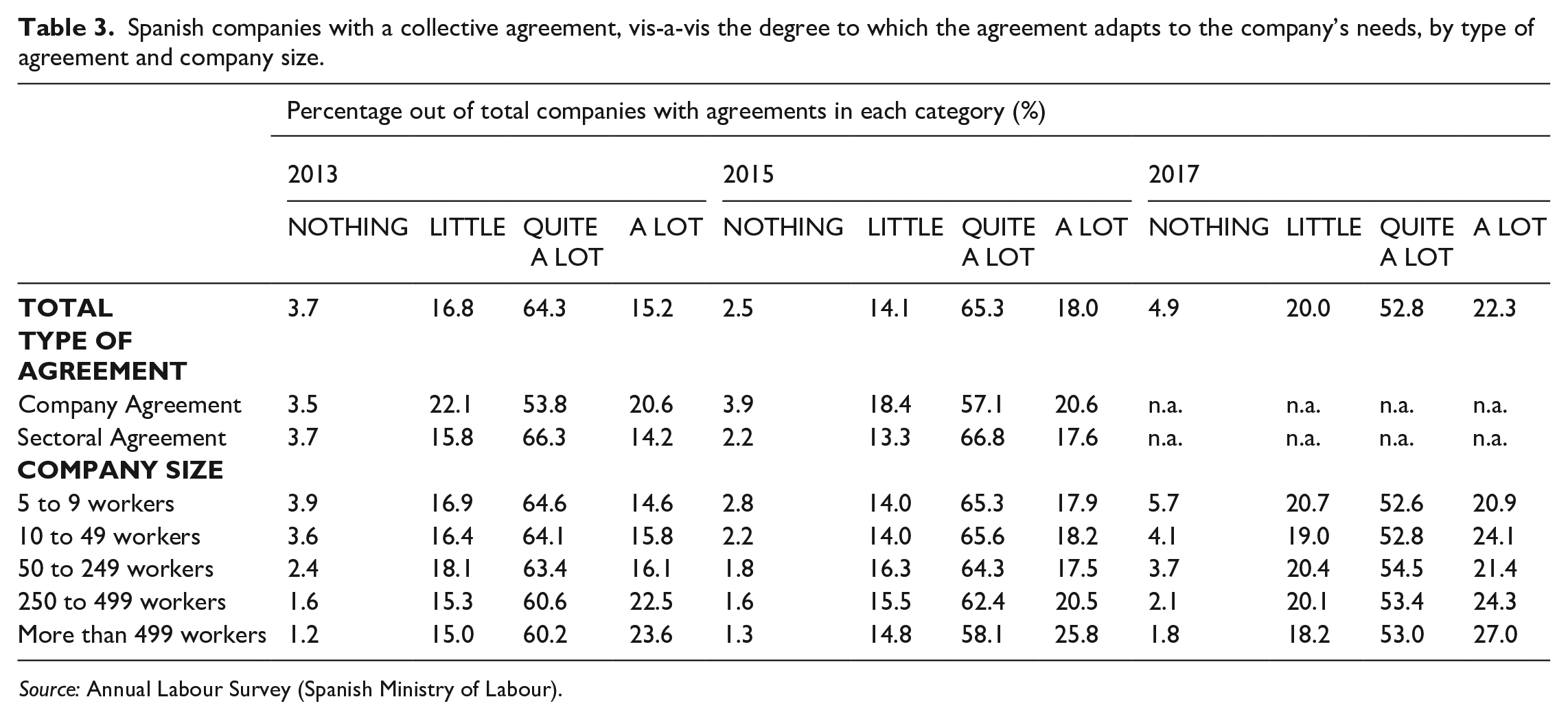
Source: Annual Labour Survey (Spanish Ministry of Labour).
The interest of Spanish employer organisations in keeping collective bargaining alive at the sectoral level, as well as ultra-activity, stems from the very functionality of these institutions. In an economy where most companies are small or very small, bargaining outcomes that ‘come from above’ are seen by firm-level actors as a kind of public good that channels conflict and thus saves negotiation costs. In fact, in July 2018, employers and workers signed the IV National Agreement on Employment and Collective Bargaining, which included the need to ‘promote the renewal and updating of agreements by articulating rules on validity and ultra-activity[. . .]. The signatory parties share the need for collective agreements to remain in force during bargaining periods’ (Ministry of Labour, 2018).
Moreover, at the end of 2018, the Spanish press announced (Alcelay, 2018) a pre-agreement between employers and unions to recover both ultra-activity and the predominant role of sectoral agreements. However, this pre-agreement did not become law since it triggered a major discussion within the socialist government up to January 2020, and thereafter in the Coalition Government between socialists and Podemos (the new anti-austerity party). Finally, at the end of 2021 a labour reform was approved re-establishing tripartite agreements between the government, employers and trade unions, and recovering the ultra-activity and the prevalence of sectoral agreements. In doing so, politics adapted to what the social dialogue had already negotiated a few years earlier.
The strategy of unions and employers in keeping ultra-activity and sectorial bargaining alive has remained in place despite the extensive use that the latter have made of their new capacity to implement unilateral changes in working conditions. As a consequence, we have witnessed the ‘emptying’ of collective bargaining mentioned in section four: the number of sectoral and firm-level agreements signed in 2019 is similar to 2008 (see Table A1 in Appendix 1), although these agreements have been partially void of content (particularly in terms of wage increases and the capacity to enforce such increases).
In Portugal, the lock-in mechanism that has prevailed when explaining institutional resilience is the political lock-in: new governments have reversed those aspects of labour reforms that had proved most damaging to collective bargaining (particularly, the collapse of extension mechanisms). In fact, the evolution of the Portuguese labour market over the last decade is a good example of how institutional change is strongly conditioned by distributive struggles and coalitions with conflicting interests, as historical institutionalism has pointed out (Mahoney and Thelen, 2010).
The protective role that the Portuguese government has historically played with regard to collective bargaining is, in this case, what endows the model with a certain degree of stability and explains the partial return to the pre-2011 situation. This protective role has traditionally been shaped by the confrontation of two distinct socio-economic coalitions, with strong partisan ties (Afonso and Bulfone, 2019). On the one hand, the socio-economic coalition that has ruled the country since the end of the dictatorship in 1974, built around two centrist parties; the Socialist Party (PS), with a social democratic tradition, and the liberal-conservative Social Democratic Party (PSD). Both parties have historically maintained strong links with the country’s second union, the União Geral de Trabalhadores (UGT). On the other hand, we have the socio-economic coalition to the left of the Socialist Party, traditionally led by the Portuguese Communist Party (PCP). This second coalition has historically been excluded from the government but, thanks to the control it has exerted over the country’s main union (CGTP), it has had a major (outsider) influence on the construction of the Portuguese industrial relations system.
The Portuguese sovereign debt crisis in 2011–2014 amplified the traditional tension between the two socio-economic coalitions. In 2011, the PS government of José Socrates requested and signed the financial bailout with the European Commission, which included the aforementioned labour reforms. After Socrates lost the June 2011 elections, the PSD government of Pedro Passos Coelho implemented the Stability Programme, since the PSD was also involved and committed to negotiations with the European Commission. Likewise, the UGT supported the Memorandum of Understanding (MoU) too, focusing its strategy on cushioning the measures imposed by this austerity programme (Távora and González, 2016). In contrast, both the PCP and the CGTP were strongly opposed to the MoU.
The implementation of this reform programme sparked a vehement social and trade union response in Portugal between 2011 and 2014. The external interventionism of the EU, together with the outcomes of austerity and the wage decline caused by labour reforms, brought about increasing politicisation characterised by left-wing polarisation.
In this context, and given the proximity of the approaching general elections as well as pressure from unions, the Passos Coelho government amended its labour policy after the conclusion of the austerity programme (Hayter and Visser, 2018). In July 2014, and with effect from January 2015, the government partially reversed the strict criteria that had ended administrative extensions. The decision was driven by the historical links between UGT and PSD, in an effort by the two organisations to regain social legitimacy after their previous support for the MoU. 3
However, this decision, taken just a few months before the elections, came too late and failed to have any immediate impact on wages. The 2015 elections brought about a full-scale restructuring of the aforementioned socio-economic coalitions, generating a new space for cooperation that had not previously existed in the country. For the first time in Portugal’s history, and due to the accumulated social disaffection, the PS agreed to govern with left-wing parties who had traditionally been excluded from power. Antonio Costa’s victory gave rise to the formation of a PS-led government with the external support of the PCP and the Bloco de Esquerda (radical left), based on the proposal to end fiscal austerity and reverse some of the reforms implemented in previous years (Afonso and Bulfone, 2019).
A convergence in the strategies of the main unions emerged, accompanying the new government. The strong links between political and trade union organisations pushed the Costa government to totally abandon the representativeness criteria of extension mechanisms in 2017. Both de jure and de facto extension mechanisms returned to their pre-2011 period.
The protective role of the State in the Portuguese collective bargaining system, reinforced by the strong partisan ties between political parties and unions, allowed for the reestablishment of extension mechanisms. Said restoration has proven crucial vis-a-vis understanding the recovery of sectoral collective bargaining in the period 2017–2019 (Hayter and Visser, 2018).
Faced with the challenge of institutional change, actors and socio-political coalitions develop different strategies that are largely affected by a history-based logic of path dependence. While Spanish unions prioritised the survival of social dialogue to face the EU reforms, Portuguese unions focused their efforts on socio-political confrontation, trying to influence government action. While Spanish unions favoured unity, Portuguese unions clashed with each other.
As a result, a possible path cessation trajectory –the collapse of previous arrangements and institutions, with the decentralisation of collective bargaining– has not occurred in these countries. But neither has there been a path stability trajectory –a marginal adaptation of institutions through minor reforms, with no changes in the founding principles of institutions. Rather, in both countries we observe a path departure trajectory unfolding in which several changes overlap: company agreements do not replace sectoral agreements but established collective bargaining institutions lose functionality and become disorganised (these institutions are no longer capable, for example, of avoiding negative wage drifts). The restoration that occurs in some institutional arrangements is only partial and incomplete, while coexisting with new loopholes that perforate collective bargaining at the sectoral level. Figure 8 outlines this argument.

Possible institutional trajectories in Spain and Portugal after the labour reforms of the 2010–2012 period.
Conclusions
This article analyses the institutional changes that have taken place in the field of collective bargaining in Spain and Portugal as a consequence of the labour market reforms implemented in 2010–2012.
Throughout the investigation we answer the three research questions posed in the introduction. First, even though the reforms implemented in Spain and Portugal were aimed at promoting a radical change in labour market institutions, the resulting trajectories merge profound changes in some aspects with significant resilience in others. The outcomes of these reforms have been shaped by self-reinforcing mechanisms and path dependency forces, and the full decentralisation of collective bargaining sought by the reforms has been avoided.
Second, the lock-in mechanisms that explain resilience in both cases –albeit differently– are closely linked to certain core elements of each industrial relations system. In Spain, the central element underpinning institutional resilience is given by a functional lock-in: the bipartite social dialogue between employers and unions, which has proved crucial with regard to stabilising ultra-activity and sectoral collective bargaining. The Portuguese experience shows the existence of a strong political lock-in, with a robust partisan link between unions, political parties and government that has allowed administrative extensions and sectoral collective bargaining to be restored.
Third, throughout this research we have also verified how recent labour reforms have not led to the emergence of new, coherent and organised systems of collective bargaining, but rather to the fragmentation of existing models. Both systems have been eroded and perforated, but not replaced.
By answering these three research questions, our research raises a series of contributions to the literature that should be highlighted.
First, our results coincide with those studies that have analysed recent labour reforms in southern European countries (Koukiadaki et al., 2016; Molina and Miguélez, 2016; Távora and González, 2016): the effects of these reforms have been very intense, with very relevant changes in collective bargaining. However, and unlike in this literature, we also identify the mechanisms and determinants that have ensured institutional resilience in collective bargaining systems, this being a novelty in the literature.
A second contribution of our research is to highlight that ‘specificity matters’. Studies that have applied path dependency theory to the analysis of industrial relations have obtained similar results: each country presents different lock-in mechanisms and distinctive socio-political coalitions, which determines the diversity of trajectories of institutional change (Bulfone and Tassinari, 2021; Kornelakis, 2014; Teague, 2009). Even similar collective bargaining systems exposed to similar reforms –as is the case of Spain and Portugal– may trigger different trajectories due to the specificity of the forces at work in each case.
A third contribution of our research, and perhaps the most relevant for the literature, is the evidence we present showing how recent labour reforms in southern European countries have resulted in different forms of institutional fragmentation. Contrary to what some studies (Picot and Tassinari, 2017) have suggested, the labour reforms implemented in southern Europe have not succeeded in decentralising collective bargaining, nor have they significantly reduced coverage, since regulatory changes have been partially blocked by lock-in mechanisms. But even so, the impact of these reforms on wage bargaining has been remarkable, as our research and others in the field (López-Andreu, 2019) have shown.
This is largely explained by the fact that, beyond formal changes in regulation, labour reforms in Spain and Portugal have led to a change in the power relations between actors. Collective bargaining systems in these countries have not been decentralised during the last decade, but have become fragmented, drilled and partially emptied. Bechter and Brandl (2019) come to a similar conclusion in their research into other European countries. According to these authors, the ‘one-size-fits-all’ labour reforms of the last decade have not generated new models of collective bargaining in the EU, but have altered existing power balances, eroding and perforating previous institutional arrangements.
Fourth, our research also allows us to take a step back and draw some more general conclusions. There is an intense academic debate today in comparative political economy on whether societies continue to be characterised by a diversity of national institutions or, in contrast, by common pressures towards the homogenisation of these institutions. Baccaro and Howell (2011) claim that European collective bargaining systems have been transformed in recent decades in a common neoliberal direction. Our research does not contradict this result, but it clarifies that in the case of southern European countries, this common trend has not led to a convergence with decentralised collective bargaining models of liberal market economies, but towards a disorderly and fragmented evolution of these systems. Neoliberal transformations of national collective bargaining systems do not necessarily trigger institutional convergence towards pre-established coherent models, nor do they replace previous institutional arrangements. Rather, they may produce, as has been the case in Spain and Portugal, dynamics of fragmentation and lack of institutional coherence.
Certainly, these institutional changes have strong implications for the social structure of these countries: the corrosion of sectoral agreements and extension mechanisms has led to a weakening of trade union power to establish common standards enforceable at company level for all workers.
Finally, we point out the fifth contribution of our research to the literature, in this case with important implications for policy-makers: reforms that are imposed without dialogue with the main socio-political coalitions are more likely to fail.
In this sense, it would probably be valuable to compare in detail the case of southern and northern European countries. In the first case, the reforms of the last decade have been imposed from abroad and without the involvement of the main socio-political coalitions of the system. Meanwhile, in northern European countries, endogenous changes carried out by the actors of collective bargaining have predominated (Teague, 2009; Thelen, 2009). The results appear to be very different in each case: in northern European countries we observe gradual processes of layering and hybridisation (Bechter and Brandl, 2019), with institutions modifying their performance and undergoing functional displacements, but not corroding. However, labour reforms imposed exogenously and without negotiation seem to lead to processes of disorganised fragmentation of collective bargaining.
This last issue would require further investigation. In any case, from our research it can be concluded that in those countries where social dialogue is important, or where there are strongly influential actors in the field of industrial relations, the complicity and involvement of unions and employers is crucial for the success of reforms. This is a result consistent with the historical institutionalism approach that, as Thelen (2003, 2009) points out, considers that institutions survive as long as they are legitimised by socio-political coalitions.
Footnotes
Appendix 1
Number of renewed collective agreements and workers covered, Portugal (2008–2019).
| Renewed Agreements | 2008 | 2009 | 2010 | 2011 | 2012 | 2013 | 2014 | 2015 | 2016 | 2017 | 2018 | 2019 |
|---|---|---|---|---|---|---|---|---|---|---|---|---|
|
|
|
|
|
|
|
|
|
|
|
|
|
|
| Branch agreements | 173 | 142 | 141 | 93 | 36 | 27 | 49 | 65 | 69 | 91 | 96 | 105 |
| Multi-employer agreements | 27 | 22 | 25 | 22 | 10 | 18 | 23 | 20 | 19 | 21 | 26 | 30 |
| Company agreements | 95 | 87 | 64 | 55 | 39 | 49 | 80 | 53 | 58 | 96 | 98 | 105 |
|
|
|
|
|
|
|
|
|
|
|
|
|
|
|
|
|
|
|
|
|
|
|
|
|
|
|
|
| Company agreements | 69,398 | 37,952 | 33,344 | 24,102 | 9,909 | 17,418 | 12,444 | 22,624 | 34,530 | 37,812 | 31,752 | 79,894 |
| Higher level (branch and multi-employer) | 1,825,302 | 1,359,448 | 1,373,756 | 1,212,817 | 317,713 | 224,121 | 234,499 | 467,753 | 714,818 | 783,071 | 868,630 | 712,989 |
|
|
|
|
|
|
|
|
|
|
|
|
|
|
|
|
|
|
|
|
|
|
|
|
|
|
|
|
|
|
|
|
|
|
|
|
|
|
|
|
|
|
Adjusted coverage rate is defined as the number of employees covered by collective agreements in force as a proportion of all employees with the right to bargain (employees who are not excluded from collective bargaining).
Source: DGERT (Portuguese Ministry of Labour) and OECD-ICTWSS.
Funding
The authors received no financial support for the research, authorship, and/or publication of this article.
