




Abstract
This conceptual article develops a framework based on the ‘total social organization of labour’ for analysing the implications precarious work in the public sphere has for the reorganization of the private domestic sphere. The core proposition is that a ‘grey zone’ of unpaid labour exists which needs to be negotiated – or at least tolerated – within a household to engage in precarious paid work. A ‘grey zone’ is theorized as a necessary transition space under conditions of precarious work requiring temporal and spatial adaptations within the family household. The article explains how adaptations in ‘time’ and ‘space’ within a ‘grey zone’ context in the private domestic sphere entail new forms of unpaid labour. Employers have increasingly divested themselves of responsibilities to provide security through the wage relation; families and their pre-existing socio-economic position have adapted to support the unpaid labour necessary to access and survive under precarious work conditions.
Introduction
‘[Agency worker] Rüdiger Jablonski could afford a life in a leafy suburb. But he never knew for how much longer. While his permanent colleagues were able to make plans, while some of them moved into larger apartments or even built their own houses, Jablonski hardly dared even to book a vacation. And whenever a perspective, a long-term commitment was required, he was at a loss: “Try getting a loan as a contract worker”, he said. Rüdiger Jablonski’s wife says that at some point, family life started following the beat set by VW. Her husband became more and more nervous, more and more irritable, and her youngest daughter quieter and quieter. At some point, her birthday wish-list contained the following: “A permanent contract for my Dad”’ (translated from Lobenstein, 2021: 33).
This quote is illustrative of the extent to which precarious work, even relatively well-paid agency work, can impinge on family life. Yet, as Choonara (2020: 427) points out, the ‘precarious concept of precarity’ did not appear in the Oxford English Dictionary until 2018. Over the last few years, the term has become ubiquitous, used to describe not just forms of paid employment but wider social effects on individuals and families. Even so, most discussions of ‘precarity’ focus on the uncertainty and insecurity of work that impacts on income, employment rights, benefits and time management, and neglect to examine the social foundations of precarious work in terms of the way in which households and individuals adapt to the process of accessing precarious work and living with its uncertainties.
This article highlights the interdependencies between work in the public sphere and work in and around the family and household. We draw from the arguments of Miriam Glucksmann (1995, 2005) and others (e.g. Hardill and Baines, 2011; Pettinger et al., 2005; Taylor, 2004, 2005) about the interconnection between the social reproduction of labour within the family, characterized by unpaid, gendered labour, and the appearance of labour power on the market as a particular bundle of skills, capacities and capabilities available to employers. Glucksmann’s notion of the total social organization of labour (TSOL) indicates the importance of ‘thinking through and separating out different forms of interconnection between work activities’ (Glucksmann 2005: 19), including work, both paid and unpaid, in the public and the private sphere. She argues that ‘each work activity has to be analysed in relation to each other’ (Glucksmann, 2005: 24–25). Glucksmann builds on the concept of social reproduction with its emphasis on the work necessarily undertaken within the private sphere to produce and sustain labour through and across generations. She emphasizes that historically these relationships change over time as new forms of work organization and business strategy emerge and as relations within the private sphere are altered by demography, the changing nature of the household structure, new technologies and the development of new aspirations. This article discusses how that linkage has evolved as the labour process becomes more precarious and workers are faced with more uncertainties and risks in relation to maintaining secure employment.
In this respect, the article builds on a number of notable and important contributions which have framed precarious work as a social process that requires focus not just on the individual’s employment position but also on how this form of labour is socially produced (e.g. Alberti et al., 2018; Bá, 2019; Choonara, 2019). As the TSOL approach emphasizes, this requires an appreciation of unpaid work performed both in the private (domestic) sphere but also in the public sphere as a form of unpaid work which may be voluntary (Taylor, 2004) and which is nevertheless necessary to access paid work under conditions of precarity. This unpaid work has to be supported economically ‘whether directly through a person’s paid employment or through family wealth’ (Taylor, 2005: 135). This article therefore asks how precarious work necessitates changes in the social reproduction of labour. As Glucksmann suggests, ‘changes in the distribution of work cannot readily be explained from within work but may be better appreciated by reference to their wider context, that is, the changing pattern of interconnectedness that results from re/structuring of the overall process and of the different stages of work activities’ (2005: 25).
The article develops the idea of a third sphere which interfaces the public sphere of paid employment and the private sphere of unpaid domestic labour. While this third sphere has been explored from a variety of perspectives in previous literature and gained such labels as the ‘informal economy’, the ‘shadow economy’ (see e.g. ILO, 2002 discussions of informal economy), this article defines this third sphere more explicitly in relation to the emergence of precarious work under the specific contextual conditions of neoliberal economic governance resulting from employers’ pursuit of new employment strategies and changing state policies (Baccaro and Howell, 2017). The article thus presupposes a change from Fordist forms of work, welfare and family which gave rise to the Standard Employment Relationship (SER) in the post-1945 period to the early 1980s and to a particular pattern of social reproduction described in the article. While the shift to precarious work varies across sectors, labour markets and countries, there are certain commonalities described in this article – related to the emergence of all sorts of work activities that are predominantly unpaid, unsupervised and unorganized but public, visible and necessary in order to access precarious paid work. The article describes this as a ‘grey zone’ at the interface of work and home. The article’s contribution lies in its theorizing the particular nature of adaptations (in ‘time’ and ‘space’) which arise when individuals and households find themselves engaged in precarious work. Whereas work is key in both the private domestic sphere and the ‘grey zone’, what happens in the ‘grey zone’ concerns how a precarious worker prepares for work, while what happens in the domestic sphere relates to how a household adapts to the insecurities and uncertainties manifested in the ‘grey zone’. As the protections associated with an SER and its innate social security are withdrawn, precarious workers increasingly lack the ability to control, first, their own ‘time’ (resulting in uncertain incomes as well as the loss of certain employment rights) and, second, the location (‘space’) of their work (resulting in further pressure on time and income and on relationships within the household space). These insecurities impact on the social organization of the ‘time’ and ‘space’ dimensions as already examined in the TSOL, and upon which we build. They require private domestic labour in the household to adapt to these new circumstances. The article uses the concept of ‘scaffolding’ by Beckman and Mazmanian (2020) to develop the idea that ‘patterns emerge in how families distribute and manage this work, which correspond to different structures of support. Each structure relies on various forms and combinations of invisible work to keep a household running’ (Beckman and Mazmanian, 2020: 132). Those with resources and fungible assets are able to build supports that sustain family members in precarious work; those without such resources and structures become increasingly impoverished and pressurized as they seek to deal with the insecurities facing them. The article concludes by suggesting the importance of research on precarious work that traces its effects back into the ‘grey zone’ and into the impact on unpaid work in the private sphere of families.
Social reproduction, labour power and precarious work
The necessary connection between the capitalist labour process and the private sphere of the family in terms of social reproduction has been examined from a variety of perspectives. This section draws on Polanyi’s idea that labour is a ‘fictitious commodity’ (Polanyi, 2001[1944]). One of those fictions is that it constitutes a ‘commodity’ with finite boundaries and qualities that can be traded in market contexts like any other commodity. However, labour breaks the bounds of this definition for two reasons. First, it has to be created outside the market within the family sphere. Its appearance as a commodity is based on the unpaid labour provided within the family, a role primarily undertaken by women. Second, labour power has to be turned into actual labour within the workplace where the effort bargain is constantly adjusted between employers and employees in the light of their respective powers in markets and in the state. As Polanyi points out, the history of capitalism can be read in terms of a dual movement between markets as self-regulating and markets as socially embedded in various forms of institutions (Polanyi, 2001[1944]). Where employers are strong, they treat labour as a commodity subject solely to market conditions: when and for how long labour is required, what is expected of a worker and how much he is paid are determined by the employer. Unless employed, labour has no source of support for social reproduction other than what it can eke out through family, friendship and the informal economy. As the history of industrialization in the advanced industrial societies of the North shows, this meant high levels of uncertainty for employees both in terms of their stability of employment and their wages and in terms of broader conditions of social reproduction such as education, health, housing and provision for old age.
Throughout the 19th and early 20th centuries, extreme commodification of labour was tempered in various countries as employees organized into trade unions and secured some form of legal powers to engage in collective action, seeking to embed the market into society and to de-commodify labour. Crucial to this, however, was the development of a particular ideology of the domestic sphere and the family, associated with a clear distinction between the ‘male breadwinner’ and the female provider of unpaid labour in the household. This created a coalition of middle-class reformers, male trade unionists and Christians of various sorts, for whom the ‘protection of women’ (and children) could act as a justification for both keeping women in the home and therefore out of competing with men for jobs, while at the same time justifying wage campaigns based on the need to pay men as the main providers of money for the social reproduction of the family. The degree to which this was achieved in the industrialized economies prior to the era of welfare state Keynesianism varied across countries, though as the 1930s depression revealed, it was still possible for mass unemployment and deep levels of poverty to emerge and impact on the survival of families and individuals. Large numbers of families could be left to go hungry, homeless, uneducated and diseased when employment ceased or when employers held wages down by coercion and their power over labour markets. Reproduction of the family under processes of industrialization could never be taken for granted; employment instability remained high and the domestic sphere adapted in various ways to survive (Skinner, 2011).
The situation began to change with the growth of income and employment security (labelled as the Standard Employment Relationship – SER) in the developed economies as a result of trade union and social democratic action during the 1950s and 1960s. Under the SER, labour de-commodification was embedded in collective institutions of wage bargaining and employment rights, which sought to minimize the focus on the specific characteristics of individual workers. A stable set of collective bargaining rules entrenched certain rights and responsibilities for employers, including relative security of employment and rewards essential to allowing the growth of personal consumption supported by Keynesian demand management and the expansion of credit facilities (Dörre, 2014). Wages circulated into households, supplementing the domestic (unpaid) labour of women and enabling adjustments in domestic labour as new technologies and new forms of consumption emerged. The income security of the SER emerged as a common feature based on full-time and relatively permanent male employment with stable reward systems deemed to constitute the ‘family wage’ (Land, 1980), albeit controlled by the man in the household. Women generally entered the labour force in a part-time or temporary capacity, whereby women’s work was not seen as necessary for the family wage but as so-called ‘pin money’ (Zelizer, 2017), reflecting the substantial pay gap between women and men. State welfare benefits were generally secured through male full-time employment, reinforcing male power within a household and leaving women who exited (with their children) a male-dominated household reliant on low-paid temporary work or means-tested benefits supplemented by charity.
This traditional and male-dominated set-up became increasingly challenged from the 1970s onwards, as women’s full-time and part-time employment across a range of occupations increased (particularly in the expanding state sector). This led to demands for equal pay and a gradual undermining of the ‘family wage’ discourse in favour of ‘equal pay’. This was paralleled by debates relating to employment flexibility and domestic duties (e.g. the rise of the Wages for Housework campaign; e.g. Federici, 1975). Authors such as Crompton asked: ‘How may sets of institutions, moulded to the contours of the “male breadwinner” arrangement, be reconstructed [. . .] to new realities? How do families adjust to these changing circumstances [. . .]?’ (Crompton, 2006: 3). The urgency of this question grew as neoliberal policies in terms of labour market deregulation were established. While the details of the policies and the extent to which they undermined the power of labour varied, their impact was to increase employer discretion over employment conditions (Baccaro and Howell, 2017) and return the employment relationship in some sectors back to a more 19th-century model of insecurity and uncertainty. Employers succeeded in re-commodifying labour, first through a tight focus on employing workers only when and where there was market demand, and second through offloading aspects of their responsibilities for social reproduction back onto the individual and the family (e.g. by withdrawing from the provision of certain employment rights by changing a worker’s status to freelancer or subcontractor and by forcing workers to bear the cost of certain key aspects of equipping themselves for paid labour; e.g. Kalleberg, 2009, 2018; Rubery et al., 2018). Such strategies were massively extended, for example, by the adoption of new digital technologies equipping employers with data to plan when they needed labour but also providing them with the ability, via algorithms rather than direct face-to-face contact, to allocate work as and when it arose to workers whose performance was constantly monitored and evaluated by the algorithms. Security of income, employment benefits and work locations were taken away from those seeking work, with their access to paid employment instead becoming precarious. The following section examines these processes in more detail, showing how they have led to a restructuring of the private sphere and the emergence of a ‘grey zone’.
Precarious work and the context to ‘grey zone’
The ‘grey zone’ refers to where unpaid (de-commodified) work is performed by a person in order to access work that brings an income, no matter how insecure or uncertain. Some of this work reflects the shift of ‘unproductive time out of the remit of paid labour’ (Moore and Newsome, 2018: 475). It also reflects the emergence of new forms of work organization based on the matching of demand for labour with supply of labour by technology as, for example, described above. For employers this represents a significant gain as wage bills can be kept down. By contrast, the burden and risk of coping with lower wages, insecure rights and responsibilities and unstable employment is shifted onto the worker and the household (Standing, 1999).
The risks for labour in precarious work involve significant fluctuations or interruptions in income and benefits deriving from paid work, but also the emergence of significant unplannable activities that individuals have to shoulder themselves (and/or their families) in order to even gain access to work. Such activities can include the need to have several jobs just to make ends meet, in turn producing disruptive effects on the care of children and the elderly, as well as on the running of the household that sustains individuals’ ability to work (Smith and McBride, 2021). What is therefore being created as a result of the rise of precarious work is a reconfiguration of the TSOL and the interdependencies between productive paid work (undertaken within the public sphere) and reproductive unpaid work (within the private domestic sphere) together with work in the ‘grey zone’. As neoliberal economic governance imposes on workers a ‘duty to work’ (Supiot, 2001: 32), making claims on welfare benefits dependent on proof of a willingness to work whatever the terms of that paid labour, workers are required to accept bad-quality and low-protected jobs at low (or no) set rates, with no set hours and in some cases with no set location (leaving the worker to find a work-space for themselves). These insecurities mean that precarious workers find themselves in a situation of having to continuously re-negotiate with household members and alike (Brannen, 2005) on two fronts. First, they negotiate how a range of tasks associated both with social reproduction per se (such as how to look after children and old people, how to manage maternity times, how to cope with illness, how to house the family adequately) can be managed given conditions of precarity and associated uncertainties with time (e.g. flexible schedules) and location (Wood, 2020). Second, they negotiate how they can survive in terms of being ready and available for precarious work when employers provide it; this involves financial support for periods when paid work is unavailable as well as for providing funding for equipment, space and training that are necessary to undertake certain forms of precarious work.
The analytical framework of ‘grey zone’
As discussed above, the ‘grey zone’ is a transition space under conditions of precarious work, where people’s unpaid labour becomes necessary to access paid work. Unpaid work in the ‘grey zone’ is unremunerated (yet, productive) work outside the home. The individual is forced to engage in the ‘grey zone’ where activities are unpaid and therefore needs to be financially and materially supported at the household level (Taylor, 2016). The ‘grey zone’ is structured around two inter-connected dimensions that shape the sort of unpaid labour which is undertaken there and which impacts on the private sphere of the household. These dimensions relate to temporality and spatiality – how, when and where the precarious worker has to undertake tasks in the grey zone (Table 1).
‘Grey zone’, unpaid labour and precarious work.
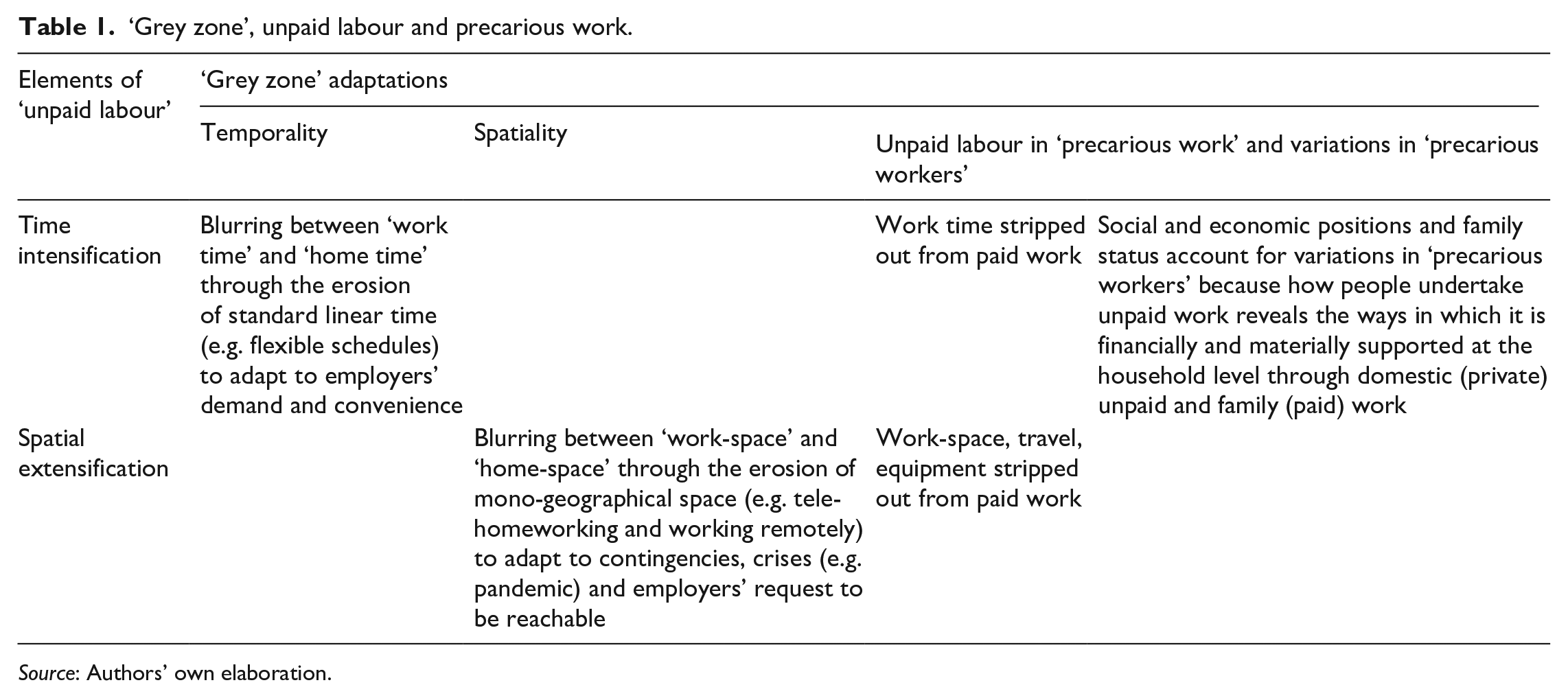
Source: Authors’ own elaboration.
Temporality
Under the diversification and fragmentation of non-standard work arrangements, workers have little or no control over their ‘work time’ and ‘home time’. This is more likely the case for occupations where work schedules are fixed by employers with little input from trade unions or collective bargaining (Lott and Chung, 2016). Under these circumstances, workers may experience ‘extended temporalities’ (Smith and McBride, 2021: 258), as employers match consumer demand more exactly to requirements for labour supply. To respond to market fluctuations, for example, fashion retailers engage staff on zero-hour contracts (Gasparri et al., 2019). In so doing, companies create new organizational forms to fissure workplaces through agency work and outsourcing, and food delivery platforms call up workers in peak hours (Cant, 2020; Weil, 2014). Such ‘on-demand’ relationships mean no guaranteed and predictable working hours (Kessler, 2018). Likewise, platform workers are exposed to ‘client colonization’ (Gold and Mustafa, 2013) as they need to adapt their working time to comply with clients’ erratic and last-minute demands. Although platform workers may reject gigs requested by rude or untrustworthy clients, for example, they are the ones complaining the most about long and unpaid waiting times (Pulignano and Mará, 2021) for job acceptance or ‘prize money’ (Gerber, 2021). Similarly, under casual and flexible work arrangements with no guaranteed minimum number of working hours in nursing homes, carers have a tendency to work longer hours in order to maintain eligibility for access to in-work benefits and to receive good references when seeking subsequent employment (Rubery et al., 2015). These references are key to building and sustaining the networks upon which carers, particularly those with temporary contracts, are greatly dependent for accessing future work (Lewchuk et al., 2015). Aside from these activities, carers tend ‘to do more with less’ (Davies, 2011) as employers regularly leverage their sense of a moral responsibility towards clients and their profession, resulting in forms of ‘self-exploitation’ or working in paid employment but without receiving pay for these extra hours and efforts. Carers may spend many hours travelling between the locations of their clients, compounding the length of their working day as they also spend more time on visits to meet the human sides of caring than is allowed for in their allocated work hours. Similar conditions exist in the creative sector, where ‘art for art’s sake’ enables event organizers, promoters and intermediaries to ‘routinely exploit freelance musicians by flexible and longer unpaid hours’ (Greer et al., 2018). The time spent on working both long and unsocial hours (Statham and Mooney, 2003), ‘juggling jobs’ (Taylor, 2004), maintaining networks, and therefore sustaining the production and selling of commodities (Terranova, 2000) is intensive and unpaid, and in some sense ‘voluntary’; yet, it is productive labour that serves the interests of the business employing the precarious worker. This unpaid labour is a necessity for the individual in order to gain opportunities to access paid work and earn a living. Workers are forced to inhabit this ‘grey zone’ of unpaid labour in order to be ready for the opportunity of paid work in the public sphere.
What does this mean for the domestic sphere? First, it takes individuals out of the domestic sphere and makes them unavailable for tasks of social reproduction. This ‘removal’ has been the case since the decline of cottage industries in the 19th century (though some sectors have retained or rebuilt this system: Hammer and Plugor, 2016). What is different under conditions of precarious work is that much of this time is spent in non-remunerated activities such as waiting for work or working beyond paid for hours. Second, the financial return which emerges from precarious work is irregular and uncertain, which impacts on the ability of the household and the individual to manage finances, particularly in terms of eligibility for long-term debts (i.e. mortgages) or for saving in the long term for pensions. It also has more short-term effects. For example, Glucksmann (2005) reports how the irregularity of hours can lead to a dependence on takeaway food, often more expensive than home-cooked meals. Third, providing unpaid care work for children and elderly relatives is made more difficult as long or irregular or unsocial hours in the ‘grey zone’ disrupt time management. Wealthier households with the necessary financial resources and suitable structures and status (e.g. married vis-a-vis single status and intergenerational families) may be able to manage by creating a ‘scaffold’ of support (often paid), such as a single parent in a well-paid job who hires in cleaners, babysitters or pays for nursery care or long-term elderly care, etc. or a dual-earner with a primary breadwinner and a relatively more present or stay at home parent (Beckman and Mazmanian, 2020). As the availability of financial resources and cultural capital decreases, such solutions may not be available and there may have to be a trade-off between career and family. If, however, the person supported fails to find work over a long period, this puts pressure on the financial and household maintenance tasks undertaken by other household members (Pugh, 2015). Individuals within the family may have to subsidize each other in various ways, often through inter-generational support systems. Many young adults indulge in ‘boomerang mobility’ (Olofsson et al., 2020), returning to live (rent-free) with their parents for much longer than previously as they are unable to afford their own accommodation when they are in precarious work (Thompson, 2015). Where households involve working class members who have fewer economic resources, workers and their families can be pushed into dependence on state benefits or on food banks and charities. Managing household finances under these conditions leads to multiple potential disruptions to domestic arrangements, to be borne by those (often women) mostly engaged with social reproduction in the households (Taylor, 2004). This can lead to unsustainable tensions and conflicts, resulting in individuals either exiting from employment or staying but facing the consequences of career paths which may be uncertain and risky for themselves and their partners (Siebert and Wilson, 2013).
Spatiality
Spatiality exists in the form of the spatial extensification of work; that is, the undermining of the separation between ‘work-space’ and ‘home-space’ with the risk of a continuous ‘overflowing’ of work into wider spaces of social (domestic or private) life (Pratt and Jarvis, 2006). The increased expectation from people to work from home has imposed a burden of adjustment on the domestic sphere. For example, during the Covid lockdown, managing the division of labour in a newly crowded household of different generations fell mainly on women (Felstead and Reuschke, 2020) and reflected gender differences in psychological distress over the period (Xue and McMunn, 2021). Likewise, digital technologies have reduced for the employer the fixed costs related to the ‘work-space’ (i.e. property, furniture, heating) and transferred this onto workers. Reorganizing their ‘home-space’ for work means competing for the available space within the household. For those without a dedicated ‘work-space’ in the domestic sphere, there are two options. First, workers with means can rent ‘work-space’ in a commercial co-working space (or possibly resort to a cafe for the price of several cups of coffee) (Merkel, 2019). Second, workers probably can ‘juggle’ with available space; for example, setting up shop in the bedroom or working on the kitchen table while other household members are in another room or away at work or school. However, presentism, instant availability requirements and digital surveillance turn the purpose of the home and the way relationships within it are managed into an experience different from a ‘sanctuary’ from work (Manokha, 2020).
Spatiality is also relevant in terms of the amount of travelling outside the household. As high housing costs drive less well-off families away from city centres where much precarious work is located, the time required to travel to work increases. Whereas this is not a problem for well-paid SER employees, for low-paid non-SER workers, the compound effect of high housing and commuting costs makes it increasingly hard for them to make ends meet, in turn forcing them to become ‘job-jugglers’ between multiple low-paid jobs (Smith and McBride, 2021). Tying in with the temporality dimension, the existence of multiple ‘work-spaces’ forces those affected to sacrifice a lot of (unpaid) time commuting between them. In many cases, the unavailability or impracticability of public transport, especially when working hours are irregular or outside normal working hours, will dictate the need to run a car, with all the associated costs.
Increasingly it is the family and household which has to offer resources and scope for covering the costs resulting from the ‘(un)productive’ space elements stripped out of paid work and shifted onto them. Hence, much is reliant on having sufficient economic and moral support from family members and beyond in the form of monetary transfers, but also on gaining social and cultural capital through providing housing and physical infrastructure so that one can sustain one’s employability. Whereas those with resources can provide more de-commodified unpaid labour to facilitating the presence of the precarious worker in the ‘grey zone’ where employers select their employees, those with fewer resources find it more difficult to support the sort of spatial flexibility required. Under precarious work, the ‘home-space’ has become colonized by activities that previously existed in the ‘work-space’. New forms of unpaid domestic work need to be undertaken to adjust in ways which allow the precarious worker the space to carry out the activities necessary to be available for work and to engage in work itself. Care of children, the elderly, maintenance of the conditions of social reproduction in terms of leisure time, etc. need to be renegotiated within the family, invariably creating tensions and difficulties. Depending on social and economic circumstances, the impact of precarious work and the ‘grey zone’ on families is bound to vary. The degree to which mitigations and scaffolding can be built depends on whether there are funds available to buttress instabilities and uncertainties in terms of income, to pay for childcare and for care of elderly relatives, to maintain the health, vitality and well-being of the range of family members. Friendship and extended family networks may be brought into play to help with these and to aid in overcoming tensions over the use of space when all members of the household occupy a small, domestic house, but this is not available to all.
Discussion and conclusion
Precarious work results from ‘the erosion in the older modes of social integration and the social organization of work’ (Glucksmann, 2005: 34) based on clearly defined hours of work and rest and clearly defined spaces of paid work and the unpaid of social reproduction. These changes have been produced by a complex set of political, socio-economic and technological processes. Neoliberal reforms have re-asserted a ‘market-based’ policy framework, with flexible and irregular schedules, contingent arrangements and multiple job-holdings. The digital revolution has enabled communicative availability unbound by location (Rosa, 2015). These changes have involved temporal and spatial shifts, and in turn they have produced knock-on effects on families and households (Glucksmann, 1995, 2005; Taylor, 2005). This article has provided a framework for explaining the driving forces of these processes and the consequent adaptations which underpin the growing importance of the ‘grey zone’ of unpaid work at the interface of work and home resulting from precarious work.
Individuals need to engage in an increasing amount of unpaid labour to access precarious paid work. Individuals with unstable income, with variable work schedules, with requirements to qualify themselves for work by possessing their own equipment and work-space are rarely able to mitigate the financial and material consequences of unpaid labour alone. Such mitigation is managed within households, where efforts to erect ‘scaffolding’ (Beckman and Mazmanian, 2020) to cope with these uncertainties reflect the different socio-economic positions of the household and the family. Hence, how people undertake unpaid work reveals how it is financially and materially supported at household level through domestic (private) unpaid and family (paid) work. The adaptations required refer to the blurring between ‘work time’ and ‘home time’ and between ‘work-space’ and ‘home-space’. The former indicates the erosion of the standard linear time, with the introduction of flexible time schedules and arrangements (‘flexi-time’) adapting labour market supply to employers’ mapping of demand and convenience. Conversely, the blurring between ‘work-space’ and ‘home-space’ indicates the erosion of a mono-geographical space (‘flexi-space’ through teleworking). Workers need to be reachable and available for work instantly when called up by an employer, regardless of whether this involves travelling between sites or having office space available at home or in a co-working space. Employers have restructured activities to become more flexible and profitable, often by shifting many of these activities onto workers and their families with no recompense, creating new dependencies within and between the sphere of work and home. People in precarious work increasingly rely on family support because they do not know whether they will be able to reap the reward of their ‘active’ unpaid investments in the ‘time’ and ‘space’ necessary to access paid work and to earn a living capable of giving them financial independence.
Hence, the ‘grey zone’ perspective opens up new theoretical, empirical and policy challenges, with important implications for research into domestic labour, ideologies and legitimations of precarious work and intersectional division of labour, and the implications for gender and family inequalities based on socio-economic features. First, there is scope to extend the study of precarious work to the question of how workers prepare themselves to access this work and manage the demands on their time and space. This requires a focus on the internal dynamics of families and households and the impact which managing precarious work has on the conditions under which people undertake that work (see ‘precariousness’ in Isabelle, 2015). The SER, with its focus on employment stability, the provision of health and unemployment and pension rights, used to provide the conditions under which families and households could engage in domestic labour and social reproduction as a separate but connected sphere of life. The nature of this connection to inequalities of wealth and income through the labour market and inheritance (including ‘capital’; Bourdieu, 1986), however, means that families manage their resources differently depending on their socio-economic position and status. Whereas in the heyday of the SER there was a stable planning horizon for families in terms of a steady income, a fixed set of working hours, days, weeks and even years, and a temporal and spatial firewall between home and work, under conditions of precarious work this has disappeared. Instead, the temporality and spatiality shifts identified in the article have generated unpaid labour within the ‘grey zone’. The result is that precarity now extends to the domestic area of home and social reproduction.
Second, there is the need to consider how processes of precarious work are legitimated by employers, governments and workers on the one hand, and on the other to shed light on the tensions insofar as these processes reveal the contradictions of the neoliberal emphasis on individualism and markets. Neoliberalism justifies current transformations as an extension of people’s freedom to organize their lives. In reality, however, the result in many occupations and sectors is leading to instability, uncertainty and precarious work. While the ‘risk shift’ presupposes that a family has the resources to manage this instability, increasing numbers of families do not, because the social and economic positions of their members is such that they are themselves trapped in precarious work. Middle-class families with sufficient resources may be able to supply this support, but overall this process deepens inequalities. Cooper argues ‘neoliberalism and social conservatism agreed [. . .] that the private family (rather than the state) should serve as the primary source of economic security’ (Cooper, 2017: 69). Brown states that the agendas of social conservatives and neoliberals ‘came together in policies through which the “natural obligations” and “altruism” of families replace the welfare state, operating as both “a primitive mutual insurance contract and [. . .] a necessary counterweight to market freedoms”’ (Brown, 2019: 92). Labour is becoming recommodified, meaning that, while pure market relations may provide a degree of freedom and autonomy that previous more bureaucratic forms of management and control did not, ultimately the worker has fewer security guarantees and higher levels of control exercised even if such controls remain hidden within ‘algorithmic’ forms of work allocation (Rosa, 2015). However, demands to extend workers’ freedom by facilitating a variety of forms of employment (in terms of when and where to work) come up against material realities where the economic and social position of precarious workers finds them excluded from the traditional features of autonomy, such as home ownership, and instead dependent on renegotiating responsibilities within family and household relationships.
Finally, unpaid labour impacts gendered (and often ethnic) inequality by enhancing the costs of domestic (reproductive) labour through making family members more reliant on care and other consumable goods. This derives from the need to underwrite new economic and moral duties and responsibilities at individual and family level – and even including social networks and communities (see Williams, 2011) – in line with levels and degrees of individuals’ needs (i.e. childcare or eldercare). Thus, those likely to be found performing unpaid work in a ‘grey zone’ may have to accept lower standards of wage income while having less capacity to mitigate the impact through the use of home-based resources, as all household members may be in relatively precarious employment or dependent on state benefits and thus little able to help each other in fulfilling the adaptations in time and space within a ‘grey zone’. One possible way to deal with this situation is a reassertion of hegemonic structures of male dominance, reinforcing old gender-based disparities within the household in new ways; for example, by continuing to expose women to occupational segregation in flexible, devalued and unpaid (or low-paid) jobs because the sphere of family work (and the domestic activities undertaken by women) is re-expanding to cope with the increasingly precarious work situations of other family members. Undertaking care responsibilities risks limiting the capacity of individuals and family members – particularly women – to take advantage of the new freedoms promised by neoliberalism (Berg, 2019). This is particularly the case during societal and economic disruptions and crises, such as Covid, where men and women are facing different realities in terms of health (frontline workers in care), social (unpaid care, housework and household violence) and economic hardship and risks.
To conclude, this understanding of the temporal and spatial shifts underpinning the adaptations entailed by precarious work within the context of the ‘grey zone’ has implications for theory, policy and practice. This article has illustrated the need to transcend the conventional assumption that precarious work is limited to the paid work within a non-standard employment relationship. Instead, it reveals that an investigatory focus on the various effects of precarious work on the development of a ‘grey zone’ is needed. As Glucksmann’s TSOL model suggests, this involves examining the whole range of related adjustments and changes in household and family arrangements as individuals and families become trapped in precarious work situations. In such situations, unpaid labour in the private sphere and in the ‘grey zone’ is expanded in order to provide more intensively re-commodified labour to employers. Such adjustments in time and space are manageable where families have access to sufficiently fungible assets (cash, home ownership, creditworthiness) to cover the associated costs. Where such assets are not available, a wide range of responses may emerge; for example, with individuals taking on multiple precarious jobs while other family members concentrate on child- and eldercare, supported by a ‘do-it-yourself economy’ for many aspects of everyday living. Alternatively, such families may turn to the state to support them in times of crisis. However, this may lead not only to the disciplinary and stigmatizing processes associated with state benefits (Tyler, 2020) but also to more direct control over the family, its behaviour and its whole way of life – all of which may put further pressure on the cohesion of families already finding it difficult to adequately perform the tasks of social reproduction due to a lack of money, steady work and an adequate welfare system. One possible result will be the increasing disintegration of families which characterized the poor in 19th-century industrial societies, in turn reviving long-forgotten social pathologies such as crime, addiction, family breakdown, domestic violence, ill health and ultimately leading to political instability. Although research is still needed on how different welfare institutional settings may cushion the social effects of the adjustments in ‘time’ and ‘space’ within the ‘grey zone’ of unpaid labour, this article has indicated that there are important policy implications and political recommendations which need raising about how to lift workers out of the ‘grey zone’ by re-dignifying and re-humanizing work and the worker.
Footnotes
Acknowledgements
The authors would like to express their thanks to the editor and the three referees for their insightful and constructive comments and feedback. We also thank Jill Rubery and Arne Kalleberg for their comments on a previous version of this article and Richard Lomax for his contribution to the input on which this article is based.
Funding
The authors disclosed receipt of the following financial support for the research, authorship, and/or publication of this article: This research received funding from the European Research Council (ERC) under the European Union’s Horizon 2020 research and innovation programme (grant agreement no. 833577) – ResPecTMe project ‘Resolving Precariousness: Advancing the Theory and Measurement of Precariousness across the paid/unpaid work continuum’ and the Flemish Research Council (FWO), grant/award number: G073919N.
