



Abstract
Variable work hours are an understudied source of work-to-family conflict (WFC). We examine the relationships between the magnitude and direction of work hour variability and WFC and whether work hour control and schedule predictability moderate these relationships. We estimate a series of linear regressions using the 2016 US General Social Survey, examining women and men workers separately and together. Findings indicate that as the magnitude of work hour variability increases, so does WFC, controlling for the usual number of hours worked. Work hour control helps to protect workers, especially women, from WFC when work hour variability is high and hours surge. Although schedule predictability tempers the relationship between work hour variability and WFC, its potency diminishes as variability increases. Our study emphasizes the potential benefit to workers and families of government policies and employer practices that promote work hour stability, schedule predictability, and equity in employee work hour control.
Keywords
Introduction
Fluctuating work hours are a marker of the growing precariousness of employment in many nations. Fluctuating hours can make it difficult for workers to arrange and fulfill personal responsibilities, such as securing childcare, working another job, and attending school. The level of work-to-family conflict (WFC) fueled by work hour variability is likely to depend, though, on its magnitude and direction. Work hours that vary greatly from week to week will likely generate more conflict than minor week-to-week variations. Work hour shortfalls may free up time for family responsibilities whereas work hour surges may exacerbate time constraints. Moreover, the consequences of work hour variability for WFC are likely to depend on the extent to which workers can control or at least predict their work schedules. Previous research hints at but does not systematically examine such nuances. In this article, we conceptualize and estimate how variability in weekly work hours – both its magnitude and direction – contributes to WFC beyond the sheer number of hours worked, and in the context of work hour control and schedule predictability.
Although research on work hour variability has centered on its adverse effects on economic security (Adams et al., 2019; Lambert et al., 2019), a recent study of US service workers found that workers who experience problematic scheduling practices, including schedule instability and unpredictability, are at increased risk of psychological distress, poor sleep, and unhappiness (Schneider and Harknett, 2019). Notably, WFC emerged as a strong mediator of these relationships. In this study, we investigate the association between work hour variability and WFC specifically, attending to subtleties not previously investigated.
We focus our examination on the United States (US) for both practical and conceptual reasons. Practically, to our knowledge, the 2016 General Social Survey, a nationally representative survey of US residents, is the only survey that includes questions addressing key concepts of interest: the magnitude and direction of work hour variability, employee control over the number of work hours, schedule predictability, and WFC. Conceptually, the US provides a rich setting in which to examine the ramifications of work hour variability for WFC due to the institutional contexts that shape both work and family domains. On the work side, the institutional configuration of working time in the US is characterized as a regime of unilateral employer control, which gives employers ample autonomy to vary hours (Berg et al., 2014; Fugiel and Lambert, 2019). To illustrate, over 80% of US workers in the wage and salary workforce (which constitutes over 90% of all workers) report week-to-week hour fluctuations that average about 13 hours of work (Lambert et al., 2014, 2019). On the family side, the US lacks institutional supports to assist workers in dealing with family responsibilities. There is no federal paid medical and family leave and annual public spending on early childhood (ages 0–3) care averages a meager US$500 per child (Davis and Sojourner, 2021). As American sociologist Jessica Calarco is credited with saying, ‘Other countries have social safety nets. The US has women’ (see Petersen, 2020).
The lack of public investment by the US in resources for working families holds different ramifications for women and men given that women in the US take on more family responsibilities than men, as is the case in most other OECD nations (Craig and Mullan, 2010). Gendered differences occur on the work side as well through occupational gender segregation and discrimination in the US labour market (Zhavoronkova et al., 2022).
In the context of little public investment in children and families, US workers must rely on household and work-based resources to navigate the demands of work hour variability. In this article, we examine how the work-based resources of work hour control and schedule predictability may mitigate observed associations between work hour variability and WFC, controlling for household resources. Considering pervasive gendered inequalities in both work and family spheres, we examine how associations vary by gender.
The magnitude and direction of work hour variability
In many surveys, work hour variability is captured by asking respondents to indicate the type of schedule they work, ranging from a regular 9-to-5 weekday schedule to an ‘hours vary’ response (e.g. US Current Population Survey, European Working Conditions Survey). Even when working a 9-to-5 type of schedule, workers incur varying degrees of variability (LaBriola and Schneider, 2020; Lambert and Fugiel, 2023) and variability can result from surges beyond or shortfalls below usual hours (Lambert et al., 2014, 2019).
We extend Greenhaus and Beutell’s (1985) classic conceptualization of sources of conflict between work and family roles by introducing work hour variability as a pressure in the work domain that can fuel time-based work–family conflict. Steeped in traditions of role theory common in the early literature on the social psychology of organizations (Katz and Kahn, 1978), Greenhaus and Beutell (1985) frame work–family conflict as a form of interrole conflict in which role pressures in one life sphere (e.g. work) are incompatible with the fulfillment of role expectations in another sphere (e.g. family). Time pressures are viewed as a key source of work–family conflict in both work and family domains. In their original explication, work-based time pressures result from long hours, inflexible schedules, or shiftwork. In this earlier era of theory development, such qualities of working time were viewed as stable properties of jobs, and items in most national surveys were designed to smooth variability; for example, by asking only about ‘usual’ hours and times (Fugiel and Lambert, 2019).
Greenhaus and Beutell’s (1985) original model does not incorporate work hour variability as a time-based source of WFC; however, their delineation of the two pathways through which time pressures at work may interfere with fulfillment of family responsibilities suggests specific hypotheses of how work hour variability in general, and its magnitude and direction in particular, are likely related to WFC. One source of time-based work–family conflict occurs when ‘time pressures from one role make it physically impossible to comply with expectations arising from another role’ (Greenhaus and Beutell, 1985: 78). This proposition has served as the basis for extensive research on how long work hours create time-based WFC: the more hours worked in paid employment, the fewer hours available to fulfill family roles (Byron, 2005).
We posit that work hour variability may also create time-based WFC, distinct from the WFC generated by the number of hours worked. Regardless of the number of hours usually worked, fluctuating work hours create time pressures that interfere with workers’ family and personal roles by, for example, directly interfering with caregiving and family routines such as monitoring homework and family meals (Harknett et al., 2020; Henly et al., 2006; Smith and McBride, 2021). Variable work hours can also interfere with nonwork responsibilities more broadly, for example, by impeding working students’ class attendance (Ben-Ishai, 2014; Boyd et al., 2016). We anticipate that the greater the magnitude of work hour variability, the more likely hours worked will directly impinge on the fulfillment of nonwork roles. Following a similar logic, surges above usual hours will also increase the likelihood of work hours impinging directly on family life, fueling WFC in much the same way as working long hours. Shortfalls in work hours, on the other hand, should free up time to fulfill family roles and thus be negatively associated with WFC. To substantiate the unique contribution of work hour variability as a source of time-based WFC, we examine associations between measures of work hour variability and WFC net of usual hours worked.
Another source of time-based WFC postulated by Greenhaus and Beutell (1985: 78) occurs when the demands in one role ‘create a preoccupation even when one is physically attempting to meet the demands of another role,’ a process also depicted in theories of work–family spillover (Lambert, 1990). We theorize that work hour variability can engender preoccupation with work through the uncertainty it introduces into workers’ lives, in turn fueling WFC as workers devote additional time to planning nonwork responsibilities. Like direct time-based WFC, this logic suggests that both the magnitude of work hour variability and work hour surges will be positively associated with WFC. Although the uncertainty introduced by hour shortfalls may also prompt preoccupation with work roles, by unleashing time available for both planning and performing family responsibilities, we still anticipate that hour shortfalls will be negatively associated with WFC.
Moderating resources: Work hour control and schedule predictability
Employee control over the number of work hours
The impact of work hour variability on WFC may depend on whether hour fluctuations are determined by the employer or the employee. 1 When employers set and alter the number of hours that employees work, variable work hours are likely a cause of instability, generating WFC (Henly et al., 2006; Wood, 2018). Under employee control, variations in work hours may reflect flexibility rather than instability, as employees alter hours to accommodate family roles. Nevertheless, work hour variability that is under employee control may still complicate work and family life.
Karasek’s (1979) classic Job Demand-Control (JD-C) model identifies worker control over job conditions as a work-based resource that can mitigate the effect of high job demands on worker well-being. By conceptualizing work hour variability as a job demand, we extend research from the JD-C tradition, which has typically focused on other types of job demands and employed a categorical approach to designating ‘high job demands’ (see review by Häusser et al., 2010). Consistent with the JD-C model, we anticipate that control will be most effective when job demands are high. Our continuous measure of work hour variability enables us to go beyond categorical approaches by identifying the level of variability at which control achieves or loses effectiveness in tempering WFC. In addition, because research suggests that worker control is most effective at mitigating the deleterious effects of high job demands when the type of control corresponds to the type of demands (Van der Doef and Maes, 1999), our focus is on worker control over the number of work hours specifically.
We hypothesize that work hour control will temper the WFC induced by work hour variability and that its mitigating effects will be stronger as variability increases. Similarly, to the extent that hour surges exacerbate WFC, worker control over the number of weekly work hours should be a mitigating force. We also anticipate that work hour control will enhance the alleviating effect of hour shortfalls for WFC as control should enable workers to put extra time to good use.
4a. Work hour control mitigates the positive association between work hour variability and WFC.
4b. Work hour control mitigates (magnifies) the positive (negative) association between hour surges (shortfalls) and WFC.
Schedule predictability
A theoretical refinement to the JD-C model posits that resources beyond control may mitigate the relationship between high job demands and well-being, reframing the original model as Job Demand-Resource (JD-R) (Bakker and Demerouti, 2007). We view schedule predictability as a resource that, akin to control, may temper the relationship between work hour variability and WFC. Schedule predictability is defined as the ability of workers to anticipate the number and timing of their work hours (Henly and Lambert, 2014). Studies have shown that employer practices that generate schedule unpredictability, such as posting schedules with little lead time and making last-minute adjustments, undermine workers’ ability to negotiate work and life demands (Clawson and Gerstel, 2014). Schedule predictability facilitates workers’ ability to manage personal and family responsibilities even when work hours vary greatly (Eurofound, 2017; Harknett et al., 2020).
We conceptualize schedule predictability and work hour variability as distinct dimensions of working time, even though they may be empirically correlated since working a similar number of hours each week adds an element of predictability to work hours. Even with a consistent number of weekly work hours, work hours still can be unpredictable if the timing of shifts varies across weeks. Conversely, variable work hours can be predictable if workers know ahead of time how their hours will vary. Confirmatory factor analyses substantiate that work hour variability and schedule predictability are empirically distinguishable (Lambert and Fugiel, 2023), which we also establish in our data. 2
We hypothesize that schedule predictability tempers the relationship between the magnitude of work hour variability and WFC by improving the ability of workers to anticipate, and thus plan, both their work and their nonwork time. We expect that the mitigating role of schedule predictability will increase in concert with the magnitude of work hour variability as advance knowledge of working time should be most important in the context of highly fluctuating hours as well as work hour surges. We also posit that schedule predictability will magnify the possible negative association between hour shortfalls and WFC by enabling workers to use reduced hours to fulfill family responsibilities.
5a. Schedule predictability mitigates the positive association between the magnitude of work hour variability and WFC.
5b. Schedule predictability mitigates (magnifies) the positive (negative) association between work hour surges (shortfalls) and WFC.
Comparisons by gender
The association between work hour variability and WFC is likely stronger among women than men. According to Greenhaus and Beutell (1985), workers who face simultaneous pressures from both work and family domains are most susceptible to WFC, especially if both domains are highly salient. We posit that working women, especially those working full-time, are more likely than working men to face simultaneous pressures from work and family domains and to experience both domains as important. If there are gender disparities in salience, the literature suggests that they are greater on the family side than the work side. On the work side, although on average men may rate work as more important to their sense of self than do women (Cinamon and Rich, 2002), this does not mean that work is inconsequential to working women and their families. In 2017, 41% of US mothers earned at least half of their household’s income (Glynn, 2019), and the share of US women working full-time increased 60% between 1970 and 2020 (U.S. Bureau of Labor Statistics, 2022). The dramatic growth in women’s participation in paid employment has not been accompanied by as dramatic an increase in men’s participation in unpaid family work. Women still perform the majority of caregiving and housework in heterosexual couples, even among couples who share an egalitarian gender ideology (McMunn et al., 2019) and in which the woman out-earns the man (Syrda, 2022). We posit that work hour variability places working women at greater risk of WFC than working men as navigating fluctuating work hours is more challenging when shouldering primary responsibility for family obligations.
Given that women perform more family responsibilities than men, the resources of work hour control and schedule predictability may play a larger role in helping women fulfill family responsibilities in the context of work hour variability (Kim et al., 2020). Gender differences are likely to be especially pronounced for work hour control as research suggests that women are more likely than men to use schedule control to fulfill family demands, whereas men are more likely to use control to work more hours (Lott and Chung, 2016).
6a. The associations between work hour variability (magnitude, surges, shortfalls) and WFC are stronger among women than men.
6b. Work hour control and schedule predictability moderate associations between work hour variability (magnitude, surges, shortfalls) and WFC more strongly among women than men.
Because women, even those highly committed to work, are more likely than men to reduce work when employment interferes with caregiving and other family responsibilities (Young et al., 2023), cross-sectional analyses of women currently working may mask the gendered association between work hour variability and WFC. We take several steps to address this issue in our analyses but emphasize that the cross-sectional data we employ are not ideal for investigating variations by gender.
Methods
Data and sample
The General Social Survey (GSS) is a nationally representative, repeated cross-sectional survey of English and Spanish-speaking non-institutionalized adults (aged 18 and over) in the US that has been fielded since 1972 (Smith et al., 2019). The survey addresses diverse topics and includes demographic and employment information. In 2016, respondents were randomly assigned to one of three ballots, which each contained distinct modules. Our analysis is based on the sample of wage and salary workers who received the Work Flexibility Module (Ballot C) and who provided information on WFC and our focal measures, a total of 501 respondents. 3 Mean imputation was used to fill in missing values on two control variables with over 5% missing data (household income, 25 cases; low - pay status, 70 cases). Listwise deletion was then used in all analyses, resulting in a final sample size of 486.
The sample reflects the diversity of the wage and salary workforce in the US, which constitutes 90% of all paid employment (see online Appendix B). The majority were hourly paid (64%). All respondents were 18 or older: 32.3% between 18 and 35; 44% between 36 and 55, and 23.7% older than 55. Over half (53.7%) were women and the majority held at most a high school degree (56.6%). More than half (57.4%) lived with a spouse or partner and a third lived with a child aged 18 or younger. The bottom quartile of workers lived in a household with an income of less than $35,000 and the top quartile in a household with at least $110,000 in income. Office and administrative workers (30.0%) and workers in service industries (27.6%) comprised the majority of the sample, with professional workers (24.7%) and workers in industrial settings (17.7%) constituting the rest of the sample.
We included part-time workers in our analyses, employing the full sample to protect its representativeness. When comparing gender subgroups, we narrowed our analytic sample to those working full-time (i.e. usual work hours of 35 or more a week per common definitions in the US). Focusing on full-time workers reduces the impact of potential selection bias on gender comparisons, given women’s disproportionate likelihood of choosing part-time work and using schedule control to reduce working hours to accommodate family demands. By concentrating on gender comparisons among full-time workers, we also aim to enhance comparability in terms of work role salience between men and women. Full-time workers constituted the majority of the sample: 75% of women, 90% of men, and 81.7% of the combined sample.
Measures
WFC, our primary dependent variable, was measured by the following question: ‘How often do you feel that the demands of your job interfere with your family life?’ Response options range from 1 (never) to 5 (always), with higher scores indicating greater conflict. We treated WFC as an ordinal approximation of a continuous variable. 4 We recognize that a single-item variable does not capture the richness of the concept of WFC and echo the frustration of other researchers who also rely on a single-item dependent variable due to data availability constraints (Coron and Schmidt, 2021; Nawakitphaitoon and Tang, 2021).
Usual work hours is the number of hours respondents reported usually working each week at all jobs.
Magnitude of hour variability is the total variation in weekly work hours during the past month, conditioned on usual work hours. Following Lambert et al. (2019), this measure was derived from three items: usual hours worked, most hours worked in a week in past month (including overtime and work at home), and least hours worked in a week in past month (excluding weeks when ill or on holiday). By norming the absolute difference between most and least hours by usual hours, the magnitude of variability is akin to a coefficient-of-variation (CV), calculated by: [most – least] ÷ usual hours. CVs are commonly used in studies of income instability to account for the fact that the marginal utility of additional earnings depends on base income (Bania and Leete, 2009). Similarly, a five-hour difference in weekly work hours may create different demands depending on whether one usually works 20 hours or 50 hours a week. Other research has adopted this CV approach to gauging the magnitude of volatility but over different periods, such as a year (McCrate et al., 2019) or multiple months (LaBriola and Schneider, 2020).
Hour surge is a dichotomous variable that is coded 1 if the respondent worked at least eight hours more than usual in a month, and 0 otherwise. We chose the absolute cut-off of eight hours as indicating a meaningful surge because this is the convention of a full day of work in the US.
Hour shortfall is a dichotomous variable that is coded 1 if the respondent worked at least eight hours less than usual over the month, and 0 otherwise. This measure is based on the same logic as hour surge.
Work hour control is a dichotomous variable that differentiates the employee- versus employer-driven schedule control. To assess the effect of having strong employee-centered control over work hours, we coded the variable 1 for respondents who indicated they ‘can decide the number of hours they work within certain limits’ or are ‘entirely free to decide.’ Those who indicated the number of hours they work are ‘decided by my employer but with my input,’ ‘decided by my employer with little or no input from me,’ or ‘outside of my control and employer’s control’ were coded as 0. We additionally analyzed a three-category variable that differentiates workers who can decide their hours, have some input, or have little or no input.
Schedule predictability is a categorical variable based on the question, ‘How far in advance of the workweek do you usually know when you will need to work?’ Responses should not be interpreted as explicitly capturing how far in advance schedules are posted as not all US workers receive a written schedule. Response categories included: one day or less; two to three days; four to seven days; between one and two weeks; between three and four weeks; more than four weeks; and ‘my schedule never changes.’ Based on the distribution of responses and prior research indicating negative associations with worker well-being with a week or less advance notice (Schneider and Harknett, 2019), we created a dichotomous variable differentiating workers who reported more than a week of schedule predictability (coded 1) from those with less predictability (coded 0). We also created a three-category variable to examine the moderating effect of different levels of schedule predictability: a week or less; between one and two or three and four weeks; and more than four weeks or the schedule never changes.
We controlled for worker characteristics of age (and age squared), gender, race, and education because prior research indicates that they are related to work hours, employment arrangements, and experiences of WFC (Byron, 2005; Reynolds, 2005). We controlled for family-based demands that research shows can impact work hours and WFC by controlling for the presence of a young child under 6 years old and the number of children in the household (Byron, 2005). To account for household resources that might be used to mitigate the demands of work hour variability on WFC, such as financial resources to outsource care responsibilities (Baxter et al., 2009), we controlled for household income, cohabitation status, cohabitant spouse’s/partner’s work status, and number of adults in the household. We also controlled for low-pay status by identifying workers in the bottom third of the earnings distribution to take into account personal resources. Additionally, our analysis controlled for additional work demands that may be associated with both work hours and WFC, multiple job holding over the past year, type of employment arrangement (salary or hourly), and occupation. Definitions of control variables are available in online Appendix C.
Analytic approach
We estimated a series of linear regressions that assess the relationship between WFC and our measures of work hour variability, work hour control, and schedule predictability, controlling for the factors noted above. We estimated models for the full sample and separately for women and men full-time worker subsamples. Unstandardized beta coefficients are reported. Across models, none of the control variables and work schedule indicators were sufficiently correlated to raise concerns of multicollinearity (see online Appendix D).
Results
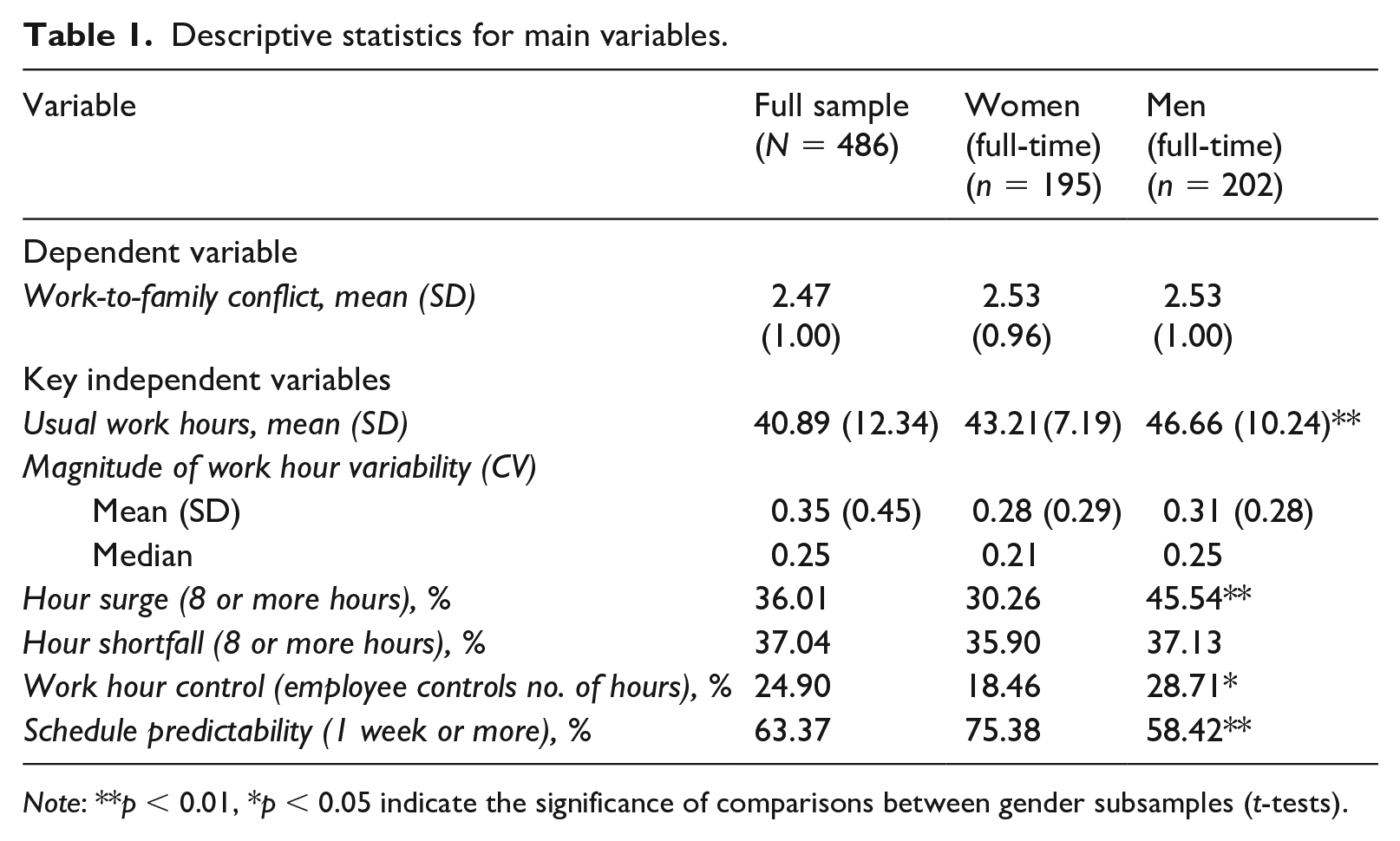
Table 1 presents descriptive statistics for all main variables. Workers averaged 40.89 hours per week. The magnitude of variability in weekly hours in the past month averaged 35% (median 25%) of respondents’ usual hours. Over a third of workers (36.01%) reported a surge of eight hours or more and over a third (37.04%) reported a shortfall of at least eight hours. Only one-quarter (24.90%) of workers said that they decide the number of hours they work either within certain limits or on their own, whereas almost two-thirds (63.37%) reported that they know when they will need to work more than a week in advance.
Descriptive statistics for main variables.
Note: **p < 0.01, *p < 0.05 indicate the significance of comparisons between gender subsamples (t-tests).
The prevalence of work hour demands and job resources significantly varied by gender among men and women working full-time. Consistent with prior literature, men reported working longer hours than women on average (46.66 versus 43.21 hours, p < 0.01). The average magnitude of work hour variability did not vary significantly between women (28% of usual hours) and men (31% of usual hours). A larger proportion of men (45.54%) than women (30.26%) reported a work hour surge (p < 0.01), reinforcing the caution we discussed earlier that cross-sectional analyses may not adequately capture gender variations in the association between work hours and WFC, since women are more likely than men to limit their work hours to accommodate family demands. Although a larger proportion of men (28.71%) than women (18.46%) reported having work hour control (p < 0.05), a smaller proportion of men (58.42%) than women (75.38%) reported that they could predict when they would need to work more than a week in advance (p < 0.01).
Work hour variability and WFC
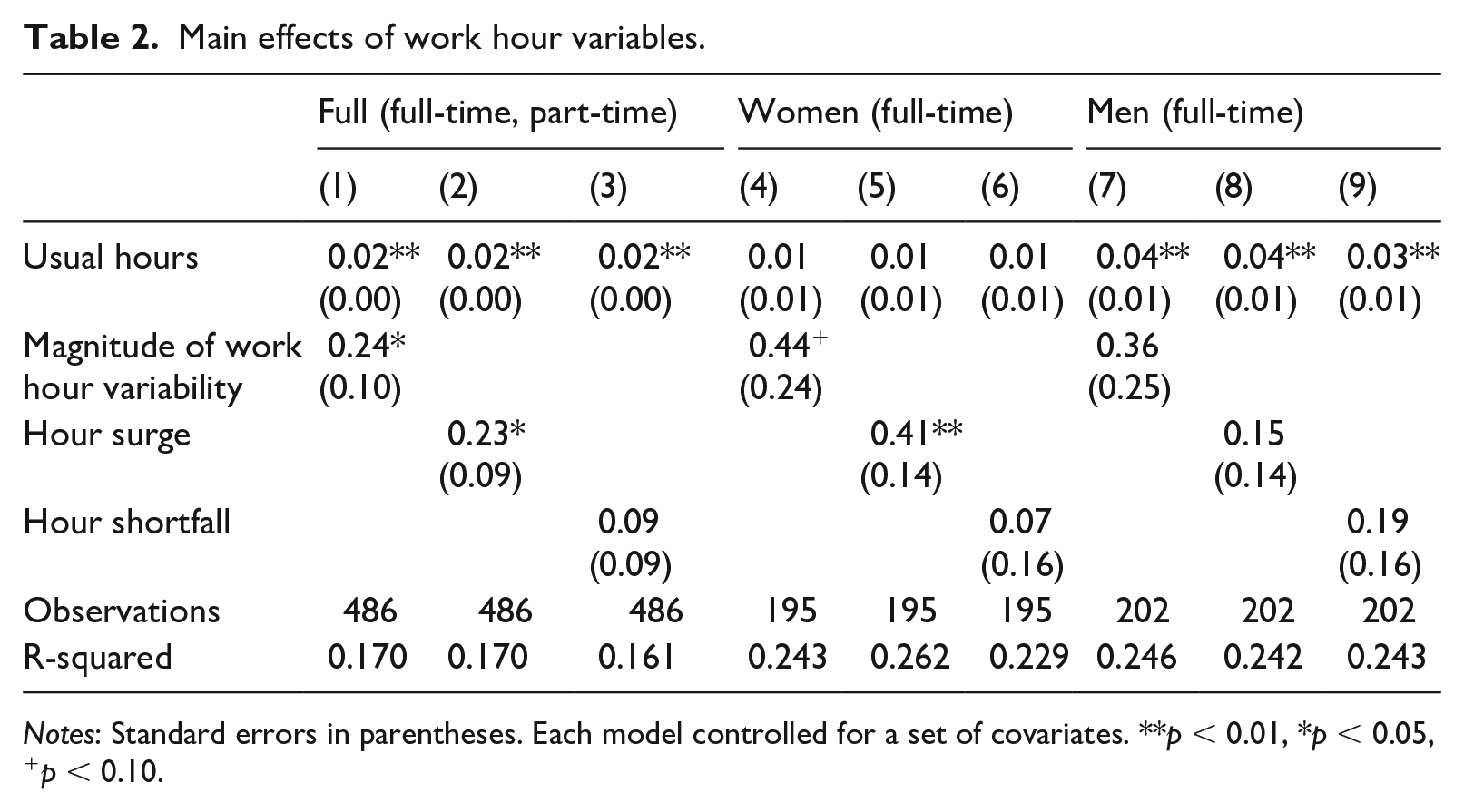
Table 2 reports the results of regression analyses that estimated the association between key work hour variables and WFC for both the full sample and the men and women subsamples. The full regression results with control variables are reported in online Appendix E.
Main effects of work hour variables.
Notes: Standard errors in parentheses. Each model controlled for a set of covariates. **p < 0.01, *p < 0.05, +p < 0.10.
Model 1 in Table 2 reports the associations between the magnitude of work hour variability and WFC in the full sample. The results support Hypothesis 1 that work hour variability contributes to WFC beyond the usual number of hours worked. Although the positive association between work hour variability and WFC was only significant among women (Model 4) and not men (Model 7), the coefficients were not significantly different (not shown in table), counter to what the theory would suggest (Hypothesis 6a). Post hoc power analyses indicated that the difference between coefficients would have been statistically significant with approximately 750 cases in each subsample, about three times the current subsample size. We advise caution in concluding that work hour variability plays the same role in explaining WFC among men and women, unless replicated by additional research with a larger sample.
Models 2, 5, and 8 present the relationship between work hour surges and WFC in the full and gender subsamples. In support of Hypothesis 2, workers who experienced a surge of more than eight hours above usual hours reported significantly greater WFC than their counterparts, controlling for the number of hours worked. This association was statistically significant among women but not among men in subsample analyses, although the difference between the size of the men and women coefficients was not statistically significant (not shown in the table). As noted above, the size of gender subsamples warrants caution in drawing firm conclusions that women and men experience work hour variability similarly.
Models 3, 6, and 9 summarize the relationship between work hour shortfalls and WFC. Hour shortfalls were not significantly associated with WFC for the full sample or the gender subsamples. 5
Moderating the role of work hour control and schedule predictability
Table 3 presents regression results analyzing the moderating effect of work hour control on the relationship between work hour variability and WFC. Models 1, 3, and 5 report the main effect, and Models 2, 4, and 6 report its moderating effects in the full sample. The results suggest that work hour control operated as a work-based resource directly associated with lower WFC (main effect in Model 1), and also buffered the disruptive aspects of work hour variability for WFC (Model 2), supporting Hypothesis 4a. As illustrated in Figure 1, the positive association between the magnitude of work hour variability and WFC was significantly weaker among workers who have more control over their work hours than among those who have less control. Contrary to expectations (Hypothesis 4b), work hour control did not mitigate the relationship between hour surges and WFC, or facilitate the usefulness of shortfalls in limiting WFC, in the full sample.
Interactions of main work hour variables and work hour control.

Notes: Standard errors in parentheses. Each model controlled for a set of covariates. **p < 0.01, *p < 0.05, +p < 0.10.
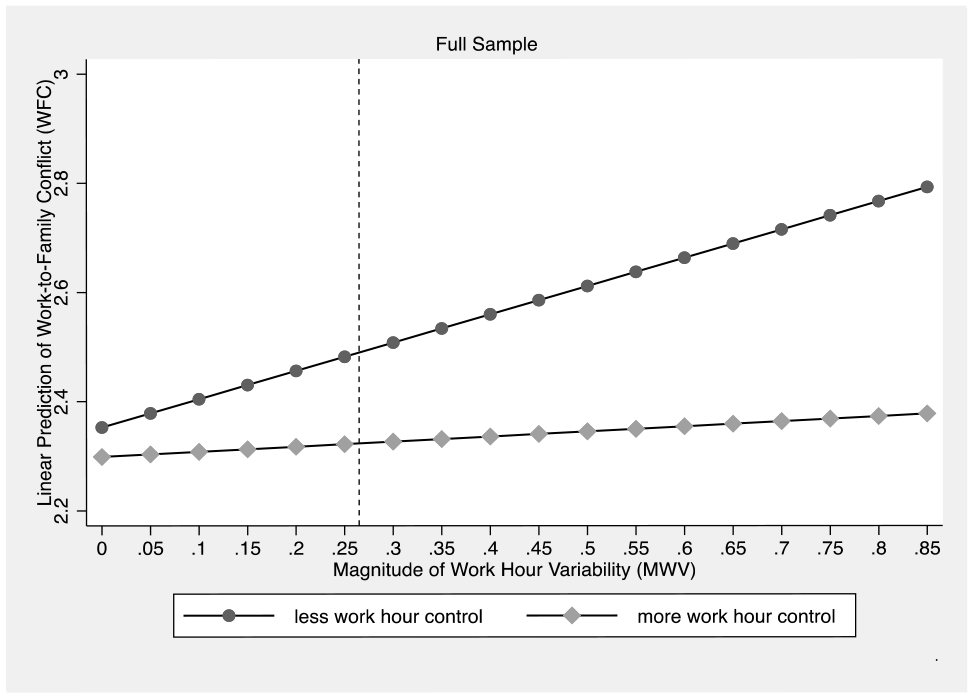
Full sample: interaction of magnitude of variability and work hour control.
Models 7 to 18 present a nuanced picture of the main and moderating effects of work hour control when comparing gender subgroups. Although the main negative association between work hour control and WFC was significant among men (Models 13, 15, and 17) but not women (Models 7, 9, and 11), work hour control significantly moderated the relationship between WFC and the magnitude of work hour variability (Hypothesis 4a) and hour surges (Hypothesis 4b) among women (Models 8 and 10) but not among men (Models 14 and 16). As illustrated in Figures 2 and 3, women with more work hour control reported significantly lower WFC than women with less control when work hours varied to a large extent and when hours surged. In contrast, among men, work hour control had a main effect that reduced WFC regardless of the magnitude of work hour variability. Viewed one way, the results are consistent with Hypothesis 6b that work hour control is a more important resource for women than men when it comes to buffering the potentially deleterious effects of high work hour variability on WFC. Viewed another way, the results suggest that men benefit from work hour control more consistently than do women. 6

Gender comparison: interaction of magnitude of variability and work hour control.
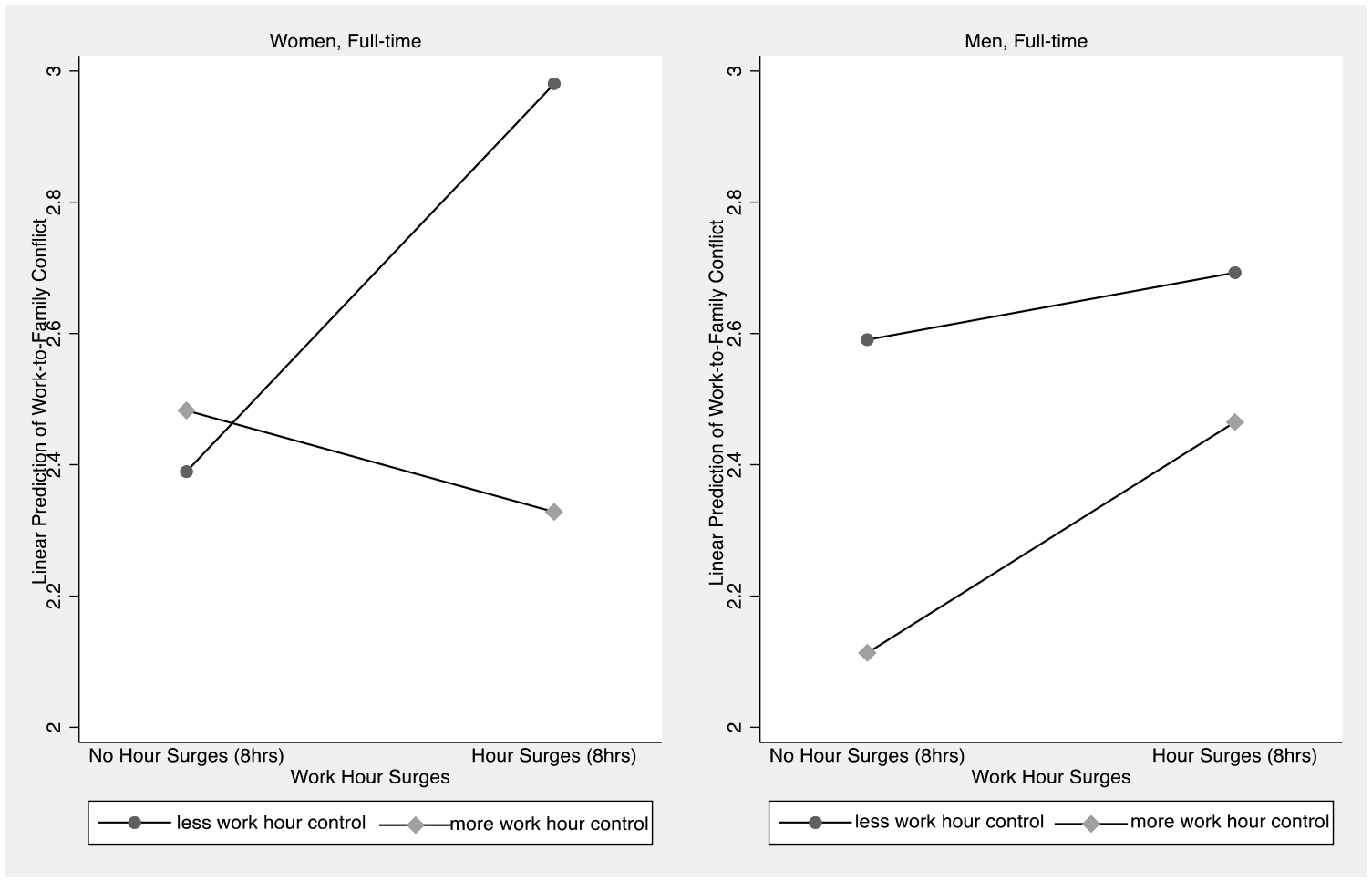
Gender comparison: interaction of hour surges and work hour control.
Figure 4 shows the results of additional analyses using a three-category variable of work hour control. Having some input into the number of hours worked was not enough to mitigate WFC among women experiencing high work hour variability. Specifically, the pattern of association between work hour variability and WFC among women who reported at least some input tracked closely the pattern among women with little or no control. Among men, the findings still demonstrate a main effect of work hour control on WFC, though the highest levels of WFC were reported by men with some input.

Gender comparison: interaction of magnitude of variability and work hour control (three-category).
Models 6, 12, and 18 in Table 3 report the interaction between work hour control and work hour shortfalls in explaining WFC for the full sample and gender subsamples. We found no evidence to support Hypothesis 4b that work hour control helps workers take advantage of hour shortfalls to reduce WFC.
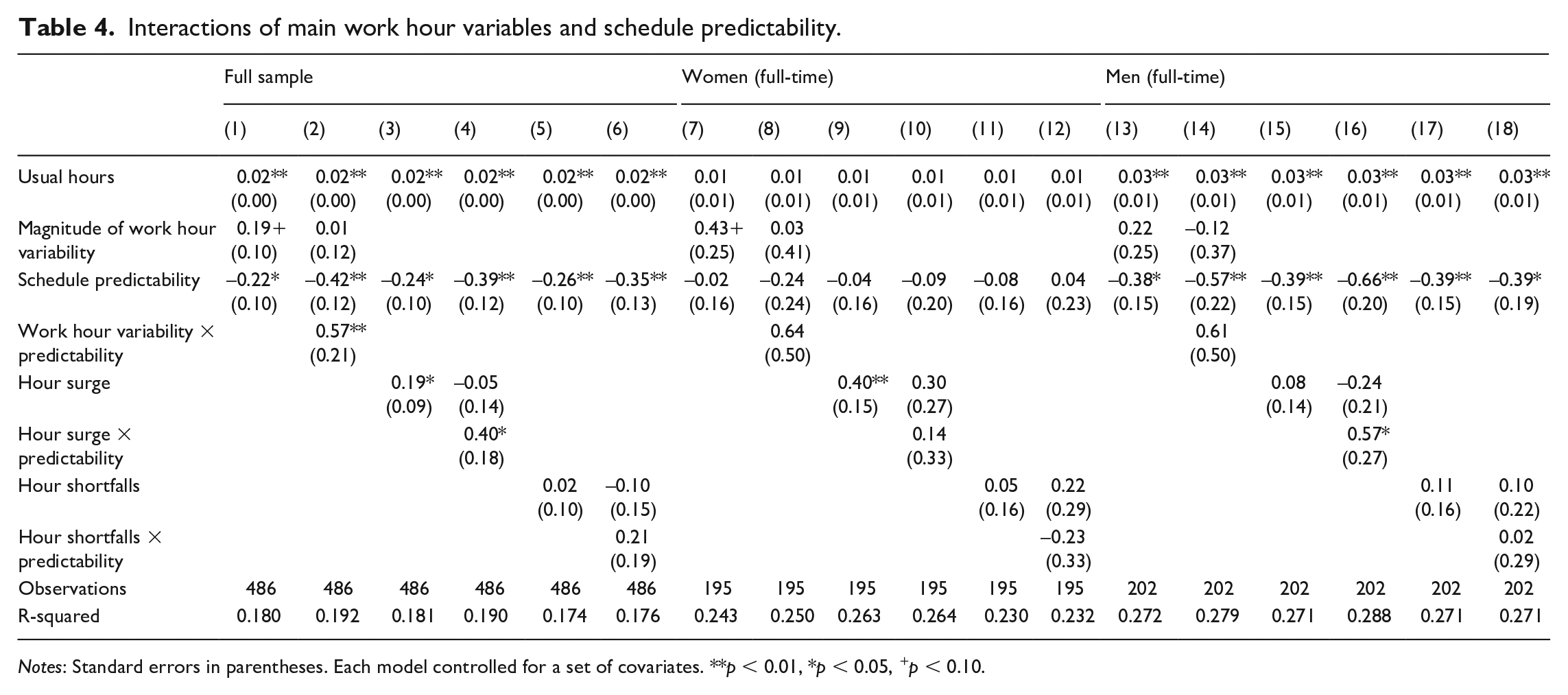
Models 1, 3, and 5 in Table 4 report the main associations between schedule predictability and WFC for the full sample. The results show that workers who know when they will need to work more than a week in advance reported lower WFC than those with a week or less predictability, highlighting the importance of schedule predictability as a resource to reduce WFC.
Interactions of main work hour variables and schedule predictability.
Notes: Standard errors in parentheses. Each model controlled for a set of covariates. **p < 0.01, *p < 0.05, +p < 0.10.
Schedule predictability also interacted with work hour variability in explaining WFC, but the relationship is complex. Figure 5 displays the results from Model 2 that examined the moderating effect of schedule predictability on the association between the magnitude of work hour variability and WFC for the full sample. Although workers with more than a week of schedule predictability experienced less WFC compared with those with shorter schedule predictability, contrary to Hypothesis 5a, the benefits of schedule predictability decreased as work hour variability increased, and beyond a certain point, the difference in WFC between those with more or less schedule predictability lost statistical significance. We observed a similar finding in Model 4, which examined the interaction between work hour surges and schedule predictability in explaining WFC (Hypothesis 5b) (Figure 6).

Full sample: interaction of magnitude of variability and schedule predictability.
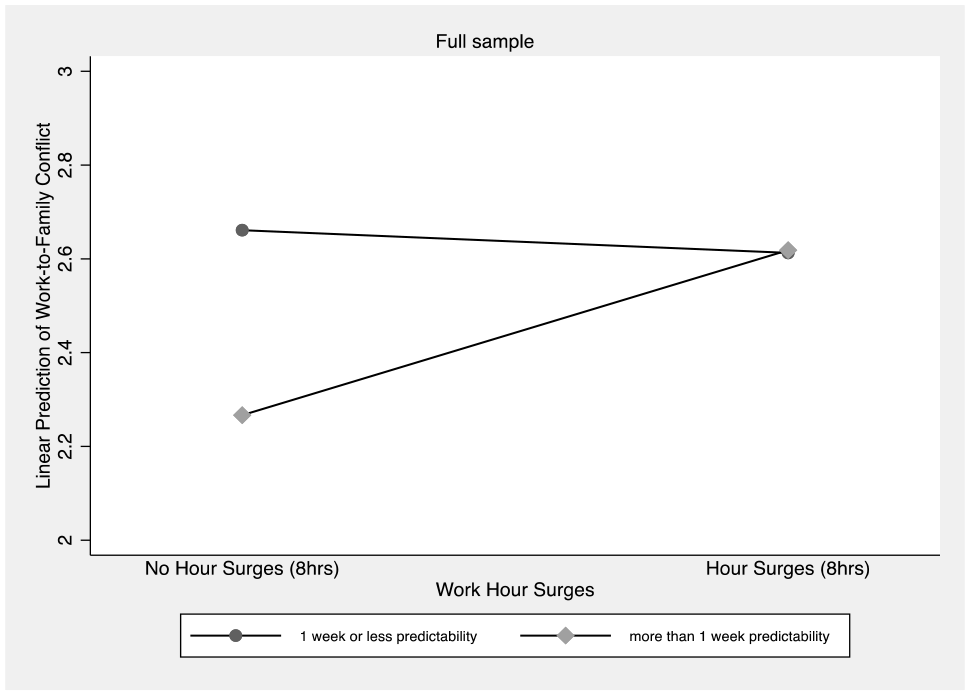
Full sample: interaction of work hour surges and schedule predictability.
To explore whether longer schedule predictability is needed to mitigate WFC at higher levels of work hour variability, we used a three-category measure of schedule predictability: a week or less; one to two, or three to four weeks; and more than four weeks. The results of the interaction model, as illustrated in Figure 7, suggest that greater schedule predictability helped temper WFC at higher levels of work hour variability, as WFC was lowest among workers with more than four weeks of predictability at all levels of work hour variability. Nevertheless, we still observed a diminishing benefit of schedule predictability as work hour variability increased. These findings suggest that schedule predictability can be a useful resource, but it may not be enough to overcome the challenges high levels of work hour variability create for fulfilling work and family roles.

Full sample: interaction of magnitude of variability and schedule predictability (three-category).
Models 7 to 18 present the results of gender subgroup analyses, which replicated the pattern of moderation observed for the full sample in Figures 5 and 6. For both men and women, the benefits of schedule predictability faded as the magnitude of work hour variability increased and hours surged above usual hours worked.
Across all samples, our findings did not support Hypothesis 5b on work hour shortfalls, which posited that schedule predictability facilitates the ability of workers to take advantage of hour shortfalls to reduce WFC (Models 6, 12, and 18).
Variations by household resources and demands
We conducted supplemental analyses to explore how the relationship between work hour variability and WFC may vary with household resources (household income) and demands (presence of children in household) (see online Appendix F). The results suggest that limited resources for outsourcing care or other family responsibilities place workers in low-income households at heightened risk of WFC when work hours vary greatly or surge. For both men and women, the association between work hour variability and WFC was stronger among workers in lower-income than in higher-income households. Moreover, a shortfall in hours, which can reduce earnings, was positively associated with WFC among men in low-income households, providing further support that household resources such as income may moderate the relationship between work hour variability and WFC.
Supplemental analyses for household demands revealed no significant interaction effects between work hour variability and the presence of children in explaining WFC for men or women. Instead, children in the household had a main effect on WFC for both, whereby workers with children reported higher WFC than those without children, regardless of the magnitude of work hour variability.
Discussion
Jobs and employment arrangements have become increasingly precarious, with fluctuations in weekly work hours being commonplace and substantial in many countries (O’Sullivan et al., 2019; Piasna, 2019). To guide our examination of the ramifications of fluctuating hours for WFC, we incorporate work hour variability into Greenhaus and Beutell’s (1985) framework of work–family role conflict as a time-based source of WFC. Our refined conceptualization of work hour variability differentiates the magnitude and direction of variable hours, enabling us to explicate the qualities of fluctuating work hours that place workers at increased risk of WFC. Building on the JD-R model, we conceptualize work hour control and schedule predictability as work-based resources that may mitigate the demands created by varying work hours, allowing us to identify possible avenues for easing WFC in the context of work hour variability.
Our findings demonstrate the usefulness of considering both the magnitude and the direction of work hour variability for understanding its relationship to work–family conflict. WFC increased in concert with the magnitude of work hour variability, exposing an incremental pattern obscured by measures that treat variability as a ‘yes or no’ event or type of schedule. Surges above usual work hours emerged as especially demanding, especially for women. Despite a larger proportion of men than women reporting hour surges, surges were positively associated with WFC only among women; among men, usual work hours were positively associated with WFC. These patterns suggest that long work hours make reconciling work and family roles difficult, but that the relationship may take different forms among women and men. The conventional emphasis on usual work hours seems more helpful for capturing work demands that make it more difficult for men than women to manage work and family roles, at least when studying full-time workers.
Our findings related to work hour control and schedule predictability add new insights into how work-based resources can benefit women and men in fulfilling family roles in the face of high work hour demands. Although a smaller proportion of women than men reported control over the number of hours they work, it is women who benefitted most from work hour control in the context of variable work hours, particularly surges above usual hours. That said, to successfully shield women from experiencing WFC in the context of work hour variability, our findings suggest that they must have access to substantial control over their hours. Simply providing input to management on the number of weekly work hours was not enough. Men with work hour control reported lower WFC regardless of the magnitude of variability or whether they experienced a surge in hours. These findings suggest that control over the number of hours worked can be a useful resource for men as well as women, even if some men use their control to work more hours than they would otherwise and, key to our focus, regardless of how much their work hours vary.
Compared with work hour control, schedule predictability is a more readily available resource in the US. A larger proportion of women than men know when they will need to work more than a week in advance. Our findings suggest that although schedule predictability can reduce WFC, it cannot completely compensate for the work–family demands created by highly variable work hours. Among both women and men, the benefit of schedule predictability faded as the magnitude of work hour variability increased. It became inconsequential when workers incurred a surge in hours. Our results should not be interpreted as indicating that schedule predictability is an ineffective work-based resource for negotiating work hour demands. Post hoc analyses suggest that longer schedule predictability (i.e. more than four weeks) can mitigate WFC at higher levels of work hour variability. Although the inclusion of advance schedule notice is a crucial provision in ‘fair workweek laws’ in the US (Wolfe et al., 2018) and in the recently amended directives on Transparent and Predictable Working Conditions in the European Union (Georgiou, 2022), research is needed to assess whether the length of schedule predictability being required is adequate to enable workers to fulfill work and family roles when working variable hours. Our findings suggest that more than four weeks of schedule predictability, and more than just schedule input, are needed to meaningfully temper WFC in the face of highly fluctuating hours.
Even with these substantive contributions, the low predictive accuracy of our analytic models (see online Appendix E) prompts reflection on the usefulness of our conceptual model for guiding future research (Sarstedt and Danks, 2022). Both work and family have changed enormously since the theories on which we build were originally developed. For example, the centrality of work for women has grown since Greenhaus and Beutell (1985) incorporated the concept of role salience into their model of WFC, and the increasing precarity in work arrangements may have introduced new predictors of WFC and altered patterns of relationships between work hour arrangements and WFC. Future research might benefit from a predictive modeling approach with the goal of revealing new patterns and pathways linking work hour variability and WFC, improving explanatory models, and sparking theory development (Shmueli, 2010; Valizade et al., 2022).
Our study has additional limitations. First, our measure of WFC is based on a single survey question because that is all that is available in the 2016 GSS containing the Work Flexibility Module. As a result, we could not evaluate the two pathways that Greenhaus and Beutell (1985) posit create time-based WFC (i.e. direct interference and preoccupation). Second, our sample size is of concern, particularly for gender subgroup analyses. We could not increase our sample by stacking data from prior waves as is common with GSS data because the 2016 wave is the only one to include the necessary data to test our models. Third, the cross-sectional nature of our data cannot account for the unobserved heterogeneity associated with both work hour variability and WFC, potentially biasing our estimates. The time-constant characteristics of workers, such as personality traits or abilities, that may be linked to workers’ experiences of both work hour variability and WFC, are better addressed with longitudinal data. As noted earlier, our cross-sectional data also cannot account for the selection of workers who may have adjusted their hours due to work hour or family demands, perhaps tempering associations between work hour variability and WFC, especially among women.
Although our study is based on a national survey of workers in the US, the findings hold implications for other countries where working time is increasing in precarity as new forms of nonstandard employment weaken the employer–employee contract (O’Sullivan et al., 2019; Piasna, 2019). We focused on work-based resources that may temper the demands of work hour variability in explaining WFC because public resources in the US to support workers and families are scarce. Future research could add useful insight by examining how public resources may also mitigate the relationship between work hour variability and WFC. Our supplemental analyses indicating that work hour variability mattered more for WFC among workers in lower-income than higher-income households suggest that the associations between work hour variability and WFC, and comparisons between men and women, may look different in countries with greater public investment in work–family infrastructure (Boye, 2011). For example, it could be that in more generous welfare states, workers are able to take advantage of hour shortfalls to fulfill family roles as hour shortfalls may matter less for workers’ ability to access and fund childcare and healthcare.
Across countries, policy efforts to reduce conflict between paid work and personal life have focused on reducing work hours (Fagnani and Letablier, 2004; Gornick and Heron, 2006), and more recently, work schedule unpredictability (Lambert, 2020). Our study underscores the need for more explicit and concerted effort to increase work hour stability as well as work hour control. Research has shown that access to work schedule control is highly stratified, with women and marginalized workers being disproportionately excluded (Kossek and Lautsch, 2018; Lyness et al., 2012). In conclusion, policies can play a crucial role in establishing labour standards that promote high-quality work schedules. Our study emphasizes the need to prioritize strategies that promote stable work hours, equitable access to work hour control, and meaningful schedule predictability.
Supplemental Material
sj-docx-1-wes-10.1177_09500170231218191 – Supplemental material for How Work Hour Variability Matters for Work-to-Family Conflict
Supplemental material, sj-docx-1-wes-10.1177_09500170231218191 for How Work Hour Variability Matters for Work-to-Family Conflict by Hyojin Cho, Susan J Lambert, Emily Ellis and Julia R Henly in Work, Employment and Society
Footnotes
Acknowledgements
The authors would like to extend their gratitude to the Editor and three anonymous reviewers for their constructive and insightful feedback.
Funding
The authors received no financial support for the research, authorship, and/or publication of this article.

Supplementary material
The supplementary material is available online with the article.
Notes
References
Supplementary Material
Please find the following supplemental material available below.
For Open Access articles published under a Creative Commons License, all supplemental material carries the same license as the article it is associated with.
For non-Open Access articles published, all supplemental material carries a non-exclusive license, and permission requests for re-use of supplemental material or any part of supplemental material shall be sent directly to the copyright owner as specified in the copyright notice associated with the article.
