




Abstract

Carol Wolkowitz, whose name will be familiar to many readers of this journal, died in March 2025. She was a lifelong feminist and sociologist of work who is best remembered for her book Bodies at Work (2006). As well as her conceptualisation of work as embodied practice, she will also be remembered for her research on homeworking, initially with Sheila Allen at Bradford and later with Annie Phizacklea in the Department of Sociology at the University of Warwick where she spent most of her professional life. Other significant aspects of Carol’s work involved visual methodologies, an interest in the women associated with the Manhattan Project, and, post-retirement, research into animals’ work, which she and I carried out together. Indeed, we were putting the finishing touches to an article that combined her interests in body work and visual methodologies at the time of her death.
Carol was born in Oak Ridge, Tennessee, where her father had been seconded to the Manhattan Project which developed the atom bomb. Her early education was in the US where she completed her first degree at Smith College, Massachusetts, before crossing the pond to become a post-graduate student at Sussex University. Her PhD, awarded in 1982, explored women politicians’ careers in India and pre-dates her interest in the sociology of work. At that time, she was influenced by feminist anthropologists and economists rather than industrial sociology and this shaped her later interest in challenging the way work was conceptualised. I knew of Carol’s work because she and I had chapters published in a collection edited by Feminist Review in 1986 and I had also read and admired her co-edited book, Of Marriage and the Market (1985). Although our trajectories and research interests were similar, including serving as members of the Work, Employment and Society editorial board, I didn’t meet Carol until I joined the Department of Sociology at Warwick. At that time, the beginning of 2005, Carol was working on Bodies at Work (2006) and we subsequently became close friends as well as colleagues, teaching and, latterly, researching and presenting articles at various conferences, including WES, together.
Carol’s intellectual attention turned to work with her first academic job which was with Sheila Allen in Bradford. She was employed as a researcher on a project investigating homeworking and articles and a book resulted from this collaboration. She retained her interest in homeworking when she moved to Warwick where she and Annie Phizacklea explored the gender, race and class dimensions of homeworking and published Homeworking Women: Gender, Racism and Class at Work (1995). This book was one of the first to look in detail at the complex patterning of women’s homeworking in the UK, taking seriously class and ethnic differences in both women’s experiences and the organisation of their work. Many of her most fruitful collaborations were with colleagues at Warwick whom she knew well and felt comfortable with, including Rachel Cohen, Phil Mizen, me and some of her PhD students.
The legacy of her father’s work as part of the Manhattan Project influenced her research. She was fascinated and horrified by her closeness to the creation of the atom bomb and this led her to explore how the women who were connected to the project understood their own involvement. This resulted in two fascinating chapters, ‘Nuclear Families: Women’s Narratives of the Making of the Atomic Bomb’ and ‘“Papa’s Bomb”: The Local and the Global in Women’s Manhattan Project Narratives’ (both published in 2000), which analyse women’s written accounts of their time associated with the Manhattan Project. The inspiration for this work was a family album that Carol’s mother had put together of her life in Oak Ridge, and these chapters show how it, and the women’s narratives, had the effect of domesticating the ‘birth’ of the atom bomb.
The work that Carol is best known for, however, is her book Bodies at Work (2006) and the development of her concept of ‘body work’. She first explored the concept of ‘body work’ in a 2002 article, ‘The Social Relations of Body Work’, published in WES, where, in the context of the massive expansion of interactive service work, she challenged both the sociology of work to take the body seriously and the sociology of the body to incorporate work into understandings of the body. In Bodies at Work, she explored bodies as central to working life. She was particularly interested in work that was done on the bodies of others, and it is in her exploration of prostitution, sex work and work such as care work, dentistry and hairdressing that her argument is at its most innovative. Her insistence on the centrality of the body to work is indebted to feminists’ attention to corporeality, their claim that embodiment is the basis of knowledge, and the wider corporeal turn of the 1990s, which meant that bodies and embodiment became an acceptable area of sociological research. Like many feminists, she was committed to challenging boundaries, and this meant that she brought these feminist insights into conversation with the sociology of work. This transformed how we conceptualise work: no longer could work be seen as a disembodied process where the body was an ‘absent presence’ but was instead conceptualised as profoundly embodied. She approached work as a material, corporeal activity where bodies both worked and were worked upon. Her approach is not only indebted to feminist theory but also to more ‘classic’ scholars, including Foucault, Marx and Bourdieu, whose ideas about disciplinary bodies and the production and reproduction of bodies within and through work helped her to conceptualise the corporeality of work.
Carol’s concept of body work was also a corrective to the over-emphasis on feeling in ‘emotional labour’ scholarship and the lack of inter-corporeality in ‘aesthetic labour’ scholarship. In contrast, body work put inter-corporeality centre stage. It generated further research, to which Carol was central, and resulted in two edited publications that brought together analysis of body work across occupations: Body Work in Health and Social Care (2011), edited with Julia Twigg, Rachel Cohen and Sarah Nettleton, and Sex/Body/Work: Intimate, Sexualized and Embodied Labour (2013), edited with Rachel Cohen, Teela Sanders and Kate Hardy. These volumes came out of an ESRC-funded seminar series exploring the relationship between embodiment and the labour process in health and social care. Carol was also interested in the way body work can be seen as demeaning because it necessitates contact with bodies and bodily fluids; this led her to explore the ways in which body work is ‘dirty work’ and how that relates to its gendering and racialisation. She also developed her interest in touch and the materiality of body work with two articles: ‘The Feminisation of Body Work’ (2018), with Rachel Cohen, which developed the concept of body work through an exploration of hairdressing and care work, and ‘“Basically He’s a Pet, Not a Working Dog”: Theorising What Therapy Dogs Do in the Workplace’ (WES, 2023) with me, which explores animal touch as therapeutic encounter. Her conceptualisation of body work led to a plethora of invitations to co-author and to present at conferences, which is testament to how ground-breaking this concept was, and, in 2008, she published, again in WES, an autobiographical account of her intellectual engagement with the sociology of work, ‘Challenging Boundaries’. Here, she shows how her intellectual home in feminism and gender studies enabled her to develop her understanding of body work.
Carol also had a longstanding interest in visual methods, possibly piqued by her mother’s family album of their time in Oak Ridge and the impossibility of talking to her about it because of her early death. This interest led to an under-graduate course on visual methods, which she taught with Phil Mizen. She also published a book chapter in 2001, ‘The Working Body as Sign: Historical Snapshots’, and a similar approach to analysing images of women and men at work is integrated into Bodies at Work. She explores how photographic images create particular understandings of work steeped in gendered and racialised assumptions. She includes two of the official images of work created as part of the Manhattan Project, commenting on how adherence to photographic conventions has the effect of normalising the work that was being carried out, a normalisation that is also evident in the women’s narratives she had already explored. Her interest in visual methods also inspired later research into the body work economy in Florida, which is the basis of her 2012 article ‘Flesh and Stone Revisited: The Body Work Landscape of South Florida’. I remember her presenting this research at a departmental seminar at Warwick, where her photographic images were central, as they are in the published article. She took these photographs over a number of years when on holiday visiting her step-mother, thereby illustrating her disregard for the boundaries separating work from ‘life’. Her most recent work also used visual methods as part of an ethnographic study of therapy dog visits to a university. In the spirit of her conviction that the visual is essential to understanding social relations, I include an image showing Carol at work among the dogs, students and staff who participated in the study (Figure 1).
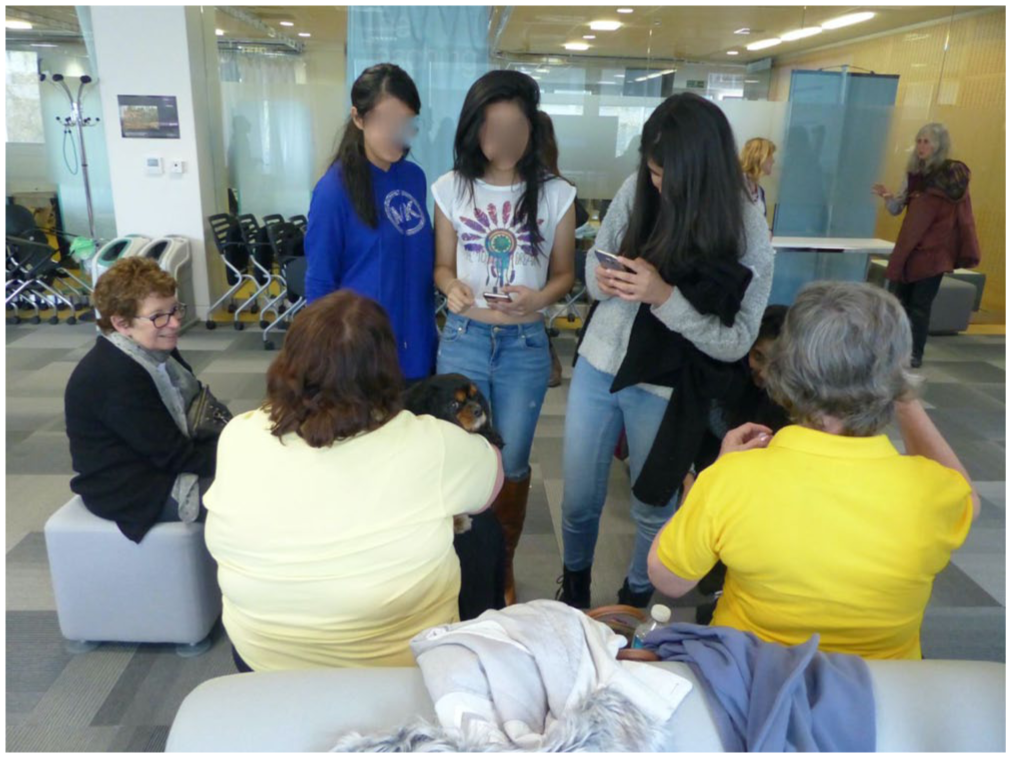
The ethnographer at work (far left).
Carol’s feminism led to her involvement in the Centre for the Study of Women and Gender at Warwick from its inception in 1993 and her collaboration with Terry Lovell and Sonya Andermarh on A Glossary of Feminist Theory (1993), which ran to a second edition in 2000. She continued her commitment to the Centre post-retirement, becoming a valued member of the Centre Collective and contributing to seminars in her usual insightful and supportive way. Indeed, Carol was a hugely supportive teacher, at both under- and post-graduate level, providing voluminous feedback in sprawling handwriting to very appreciative students. In turn, students provided her with inspiration and contributed to her intellectual development.
Over the years, Carol contributed in significant ways to WES. As well as publishing articles in the journal and presenting articles at WES conferences, she was the reviews editor from 1996 to 1998, a member of the editorial board from 2015 to 2021 and a non-board reviewer from 2022 to 2024. She reviewed more than 105 articles for WES authors and was highly regarded for the quality of her reviews by all the editorial teams; in turn, she found many of the articles exciting and intellectually challenging. She enjoyed the reviewing process, taking it seriously and always providing extremely constructive feedback, which had a hugely positive effect on many members of the community. She was on the organising committee of the 2013 WES conference that took place at Warwick and participated in many WES conferences, enjoying the intellectual stimulation and the conviviality of conversation over a glass of wine. Carol was clearly important to WES and her continuing involvement with the journal was very important to her, giving her validation and a focus when her health was failing. Work was a central part of her life, both as something she did and as something she researched, and her fascination with body work never left her. Even when she was in hospital during treatment for cancer she was not only a patient but a participant observer, commenting on and analysing the body work that she saw all around her and was experiencing herself.
Carol is survived by her husband, Martyn, her son, Tim, and her two grandchildren, Emily and Benjy.
Carol Wolkowitz, 19 November 1947 – 4 March 2025
