




Abstract
Research into migrant workers suggests noncitizens are subject to tensions between their inclusion for labour and their exclusion as the ethnic ‘other’. These tensions are held in balance by a stable configuration of state and social actors. However, a security crisis provides an opportunity for actors to shift the balance towards their interests and is likely to strengthen the exclusionary logic. We analyse the labour market in Israel/Palestine following the extreme crisis of October 2023, to show how actors shift the inclusionary/exclusionary balance and how this impacts the entry and employment terms of noncitizen workers. We find that while crisis enables actors to challenge the status quo, key logics underpinning that status quo are resilient, and neoliberal inclusionary pressures persist even during extreme security crises. We thus reveal the structural constraints that market economies place on ethnonational projects, including ethnocracies with a powerful ethnonational ethos expressed in populist racist politics.
Keywords
Introduction
While the ‘import’ of migrant labour fulfils certain economic interests (most obviously, employers’ desire for cheap labour or scarce skills), it runs contrary to nationalist desires to exclude noncitizens, especially those considered to be of a different ‘ethnic’ or religious background to the dominant group. Relevant across many developed economies, this tension – between the exploitative, inclusionary ‘imperative’ and the nationalist exclusionary ‘imperative’ – is likely to be of greater importance in ethnocracies or ethnic democracies, where ethnonational hierarchies are central to national identity and the distribution of (material) resources (Preminger and Bondy, 2023; Yiftachel, 2000).
Globalisation and associated ‘labour mobility’ have increased scholarly interest in how the tensions between inclusionary and exclusionary imperatives affect noncitizen workers (e.g. Connolly et al., 2019). Accordingly, emerging scholarship has shown how these imperatives are a useful framing to explain the behaviours of social actors and their impact on noncitizen workers and the labour market (Fedyuk and Stewart, 2018; Preminger and Bondy, 2023; Wotherspoon, 2018). However, this scholarship accepts the balance between the imperatives as a given context within which actors work to promote their interests and agendas. While the balance can change, and some studies trace such change over time (e.g. Rosenhek, 2003), current research tells us little about how this change occurs, or how social actors, pursuing their interests, cause the dominance of one imperative over the other. Therefore, this article analyses how the balance of forces between the two imperatives changes, asking: How does one or the other become more dominant? What is the role of actors in enabling or ensuring this dominance? And what is the impact of these changes on noncitizen workers?
The balance between the inclusion and exclusion of noncitizen workers is a product of power relations between various actors pursuing their interests. We assert that crisis makes these power relations visible while opening space for actors to challenge them, and to change their ‘stances’ – their position regarding the inclusion or exclusion of various worker groups. By shifting actors’ stances and power, crisis allows actors to construct a different balance between the imperatives, and subsequently impact the policies that shape the entry, employment conditions and rights of noncitizen workers.
The war that began in Israel/Palestine on 7 October 2023 constitutes an example of crisis. Alongside extreme devastation, it led to the outright expulsion of noncitizen Palestinian workers from Israel, to attempts to ‘import’ tens of thousands of labour migrants, and to changes in migrant workers’ main sector of employment – the construction sector. It thus offers an opportunity to observe the changing power relations between actors adopting exclusionary and inclusionary stances and their impact on the balance between the imperatives. Therefore, in this article, we investigate the entry and employment of noncitizen workers to Israel from October 2023 onwards. We analyse key market actors and their relationship to state actors – the security establishment and government – claiming that the crisis represents another phase in the struggle over the logic that governs the labour market of noncitizens (Palestinians and migrant workers) in this ethnocratic context.
We find that the crisis weakened professional state actors, who often adopt an inclusionary stance to support a liberalised, open labour market; similarly, unions and civil-society organisations (CSOs) operating in the field of workers’ rights found their position significantly undermined. The security establishment, which has always had a dual role (partially oppressive and exclusionary but also facilitating the entry of Palestinian workers), found its position severely challenged and curtailed, leading to the roll-back of its inclusionary agenda. On the other hand, extreme right-wing politicians, strengthened by their veto position in government and the war-related emergency, used their reinforced position not only to promote their exclusionary agenda towards Palestinian workers but also to enable the massive import of migrant workers while eroding established protections of their rights. This acquiescence in the erosion of protections functioned as compensation to employers, whose access to cheap (Palestinian) labour was undermined by the crisis, and therefore gained their support.
We therefore conclude that in the context of market economies the inclusionary imperative persists, even during extreme crisis and the reinforcement of the exclusionary ethnonationalist ethos: to varying degrees of success, inclusionary actors draw on existing logics and political alliances to ensure that shifts in the balance do not undermine key interests. Crisis, then, led to the conversion (Mahoney and Thelen, 2010) of migrant labour frameworks, such that inclusionary interests are safeguarded through alternative routes: in this case, the worker group included was changed, and the nature of inclusion was transformed to increase exploitation and vulnerability and reduce workers’ rights. We thus demonstrate how social actors, pursuing their interests and promoting their agendas, can shift the balance between the imperatives while highlighting the constraints imposed by the context of a liberal market economy, profoundly impacting the rights and lives of noncitizen workers. Finally, we assert that understanding such shifts – as a reflection of struggles between actors – is essential to understanding labour migration trends.
Inclusion and exclusion: Noncitizen workers in an ethnocracy
In modern nation-states, immigration controls embody compromises between the ‘desire’ to exclude noncitizens and the ‘need’ to include noncitizen workers, or the nationalist urge to exclude the ‘other’ and economic pressures to include cheap labour (Anderson, 2010; Könönen, 2019; Maletzky de García, 2021). Thus, rules governing migrants’ entry into sovereign territory are often intended to ensure exclusion from certain spheres, especially those associated with social and political citizenship and its benefits: migrant workers may be eligible to claim workplace rights but are often excluded from certain social rights and more so from political rights. Furthermore, migrant workers’ claim to economic rights is also subject to various limitations (e.g. geographic or sectoral), excluding them from basic labour market mobility rights (see Ruhs, 2013), and from various protections and representation (Meardi et al., 2012; Wagner, 2015).
Thus, inclusion and exclusion are not dichotomic categories and the move from exclusion to inclusion is not necessarily linear; rather, inclusion is multifaceted, covering basic inclusion in the labour market, human and labour rights, access to representation and membership in trade unions (Connolly et al., 2019). Ruhs (2013), for example, shows how basic (economic) inclusion of migrant workers has increased but constraints on their social (and political) inclusion proliferate. Similarly, recent scholarship on borders notes that migration rules are no longer embodied only at the point of entry into a given sovereign space: bordering practices dog migrants even after entry, further limiting their rights and policing their claims-making – and shaping the configuration of their inclusion (Medien, 2022; Shachar, 2020). Compromises between inclusionary and exclusionary pressures thus have material consequences for workers; they also often result in ethno-national divisions of labour (Bonacich, 1972; Sa’di, 1995). These tensions are further accentuated in states with a strong ethnonational ethos or histories of colonialism, where formal citizenship is just one differentiator, working with other crucial factors – such as ethnonational belonging – to determine levels of inclusion (e.g. Stead et al., 2022; Yiftachel, 2000, 2006).
Preminger and Bondy (2023) theorise this dynamic in terms of an exclusionary ethnonational ‘imperative’ and an inclusionary neoliberal ‘imperative’, as a heuristic lens to explain the behaviours and decisions of social actors who are subject to (sometimes conflicting) pressures stemming from these imperatives. Moreover, they show the concrete implications of ‘neoliberalisation’: the discourse of rights and a logic of equality at an individual level can open space for workers’ claims in the workplace (see also Haddad, 2016; Preminger, 2017). Preminger and Bondy’s (2023) study also highlights how the coevolution of these ‘imperatives’ reinforces mutual dependency between the dominant and the dominated, based on both economic and political interests (see also Hackl, 2022; Mundlak, 1999).
While such scholarship has highlighted important dynamics with tangible implications for those caught within the tensions, it takes the exclusionary and inclusionary pressures as a static, given context. Within this context, state institutions and nonstate social actors are understood to work according to different logics in keeping with perceived interests and attempts to promote certain agendas. The implicit assumption is that key employment actors are subject to, but do not explicitly impact, this balance. The balance can change, but this scholarship tells us little of how actors lead to this change, except at a very high level of analysis: Fedyuk and Stewart (2018), for example, survey tensions between neoliberal open borders in Europe and political regimes more wary of migrant workers, analysing attempts to settle these tensions through state-level policies and employment frameworks. Wotherspoon (2018) explores similar tensions embodied in border regimes, which create hierarchies of citizenship and inclusion, but focuses essentially on migrants coping with a given set of inclusionary/exclusionary institutions. In the Israeli/Palestinian context, Rosenhek (2003) analyses how the incorporation of noncitizen workers was shaped by the state’s changing agenda vis-a-vis the Palestinians and its efforts to manage the national conflict. Similarly, Hilal (2015) analyses the impacts of Israel’s changing approaches to managing the occupied territories on Palestinians.
At a lower level of analysis, scholars have focused on specific actor groups to understand how nonstate actors shape migration policies (Menz, 2009). For example, studies of trade union strategies demonstrate how unions use their ‘institutional power’ to influence labour migration in certain sectors (Boräng et al., 2020; Marino et al., 2017), and research on employers’ associations shows their influence on labour migration through lobbying and political coalitions (Freeman, 1995; Menz and Caviedes, 2010). CSOs have also been shown to influence migration governance through advocacy and participation in international forums (Baglioni et al., 2022; Collini, 2022), as well as through grassroots activism (Youkhana and Sutter, 2017). Nevertheless, such scholarship highlights actors’ behaviours to incrementally adjust policies in their interests within a given configuration of power relations and overall policy objectives. What is lacking is a perspective that combines top-level analysis of political forces with a broader focus on the role of a wide range of both state and social actors (and their interactions) in reconfiguring these forces – and the resultant impact on the inclusion of noncitizen workers.
This perspective should acknowledge that these social actors do not hold permanently inclusionary or exclusionary positions but rather adopt ‘stances’ that can change depending on context, timing and the specific migrant groups in question. For example, while unions may advocate equal rights for migrant workers during periods of economic growth with full employment, they may adopt more exclusionary stances during economic crises (to protect existing membership) (Marino et al., 2017). Similarly, employers may support inclusion of certain categories of migrants while advocating for the exclusion of others, according to their economic interests (Menz, 2010; Sandos and Santi, 2019). Finally, state agencies also reflect this fluidity, simultaneously pursuing exclusionary border controls and facilitating inclusionary policies for economic purposes (Anderson, 2010; Berda, 2017; Maletzky de García, 2021). Relatedly, it is worth emphasising that while goals and strategies often differ between state and nonstate actors, such differences are also common among different state actors (Garritzmann and Siderius, 2024). This fluidity suggests that rather than categorising actors as inherently inclusive or exclusionary, we must examine the stances they adopt under different conditions to understand how changes in power relations lead them to pursue change in the overall balance between imperatives.
Adopting this approach, we could expect state actors with a market, globalising orientation, such as officials from the Ministry of Finance, to push for increased economic inclusion of noncitizens (to satisfy employers’ demands for cheap labour) in times of full employment; conversely, they may push for their exclusion as unemployment rises, or in the face of rising ethnonationalism promoted by nationalist politicians. For example, as Preminger and Bondy (2023) show, in an ethnonational context, labour market liberalisation may enhance the economic inclusion of noncitizen workers (their access to work), but incrementally also their social inclusion (their representation by social institutions and their improved access to rights). This process reflects the increasing power of market-oriented state actors, at the expense of exclusionary, ethnonational state and nonstate actors. Thus, though liberalisation may threaten local workers whose representative institutions are weakened, it also holds promise for noncitizen workers as the ethnonational imperative is eroded, facilitating their gradual inclusion.
However, we would expect crisis (such as a state of emergency, radical political transformation or mass social mobilisation; see Hay, 1999) to transform the power relations between different actors, leading them to challenge the balance between the inclusionary and exclusionary imperatives. Crises are particularly important for understanding institutional and inter-actor dynamics because they often disrupt established arrangements and create opportunities for institutional change (Saurugger and Terpan, 2016; Tommasi, 2004). However, the relationship between crisis and institutional transformation is complex and contested. While some scholars argue that crises create ‘critical junctures’ that enable rapid institutional change (e.g. Capoccia, 2015), others emphasise how institutions can be remarkably resilient, even during severe disruptions (Thelen, 2004). The scholarship of gradual institutional change suggests various mechanisms that express its different possible forms (Mahoney and Thelen, 2010): ‘layering’ (the addition of new elements leading to incremental change); ‘drift’ (the transformation of an institution due to changing circumstances and nonstrategic minor deviations); or ‘conversion’ (the transformation of an institution’s core functions, while maintaining its external form). Crises can accelerate these gradual processes by shifting power resources between actors, creating legitimacy for previously marginalised stances and undermining the credibility of existing ones, thus creating spaces for alternative policies.
Our actor-centred approach suggests that change would be the outcome of both the nature of a crisis and its impact on actors’ relative power, which allows actors to take advantage of the crisis to challenge the status quo ante through various mechanisms of institutional change (e.g. Conley, 2012). Economic crises, destabilising the market, are likely to reinforce those actors holding market-oriented stances with an interest in increasing the number of migrant workers, as we witnessed after the global financial crisis of 2008 (e.g. Abella and Ducanes, 2009). However, forms of crises perceived to threaten the safety of the state are likely to strengthen exclusionary state actors, thus reinforcing the ethnonational ethos of key political groups (e.g. Kemp and Raijman, 2008; Norberg and Norberg, 2024), as seen in the UK and the USA in recent years, and more generally in the EU’s hardening stance towards migrant entry (e.g. Raineri and Strazzari, 2021; Sahin-Mencutek et al., 2022).
We thus build on existing literature to propose a more dynamic understanding of how inclusionary and exclusionary imperatives interact. Rather than viewing these as stable pressures that actors simply respond to, we conceptualise them as contested domains wherein actors’ power and strategies can shift. By examining both the fluidity of actors’ positions and the institutional contexts that shape their capacity to influence politics, our approach enables an understanding of the ways inclusion and exclusion are reconfigured during transformative periods, thus revealing how crisis enables some actors to strengthen exclusionary stances while weakening others’ capacities to maintain inclusive policies, and the concrete implications this has for noncitizen workers.
The extreme security crisis sparked by Hamas’ attack and the following war in Gaza allows us to investigate these potential changes. We expect these critical events to weaken market-oriented state actors and other inclusionary social actors, such as trade unions or CSOs, while strengthening actors’ exclusionary stances and the latter’s relative power. In the face of a (real or perceived) security threat, power relations in society change, leading to the marginalisation of actors holding inclusionary stances, and the rise of exclusionary actors, promoting suppressive policies towards the ‘other’. For some workers (and employers), these policies are likely to halt and even reverse previous liberalisation, limiting their access to work and rolling back the inclusive institutions that safeguarded their labour rights. Furthermore, this transformation is likely to shrink the space for workers’ (or employers’) agency while undermining the roles of social actors in the regulation of the market, thus reinforcing the ‘ethnonational imperative’ (Preminger and Bondy, 2023) and its exclusionary ethos.
Methods
Our study is based on a close sociopolitical reading of the rapidly shifting situation in Israel following the Hamas attack on 7 October 2023. To understand the balance between the two ‘imperatives’ as theorised by Preminger and Bondy (2023), we focused on the inclusion/exclusion of noncitizen Palestinians working for Israeli employers as the epitome of Israel’s ‘ethnic other’. Given that, from the official Israeli perspective, the crisis was triggered by a Palestinian attack (as opposed to just Hamas), we wanted to understand whether any shift in actors’ power would impact only Palestinians’ inclusion/exclusion or would result in a more general rejection of the ethnonational ‘other’. Therefore, we also compared policies regarding Palestinians with those regarding migrant workers, who are also subject to the conflicting logics of inclusion and exclusion (Gil and Dahan, 2006).
To understand how actors’ power resources changed and resulted in a changed balance between the two imperatives, as well as its impact on noncitizen workers, we explored the actions and approaches of key actors relevant to the employment of Palestinians and migrant workers. Chief among these were the traditional social partners – state (and government) actors, employers and their associations, and trade unions – as key actors impacting the ‘import’ and employment of noncitizens. We also considered the role of the security establishment (the General Security Services – ‘Shabak’, the military, and its various bureaucratic arms, including the Civil Administration) as the most important actor implementing Israel’s policies towards the Palestinians. In addition, we considered the position taken by workers’ rights CSOs, most prominently the Workers’ Hotline, since such organisations have been crucial in shaping the employment of noncitizens and impacting the level of their inclusion.
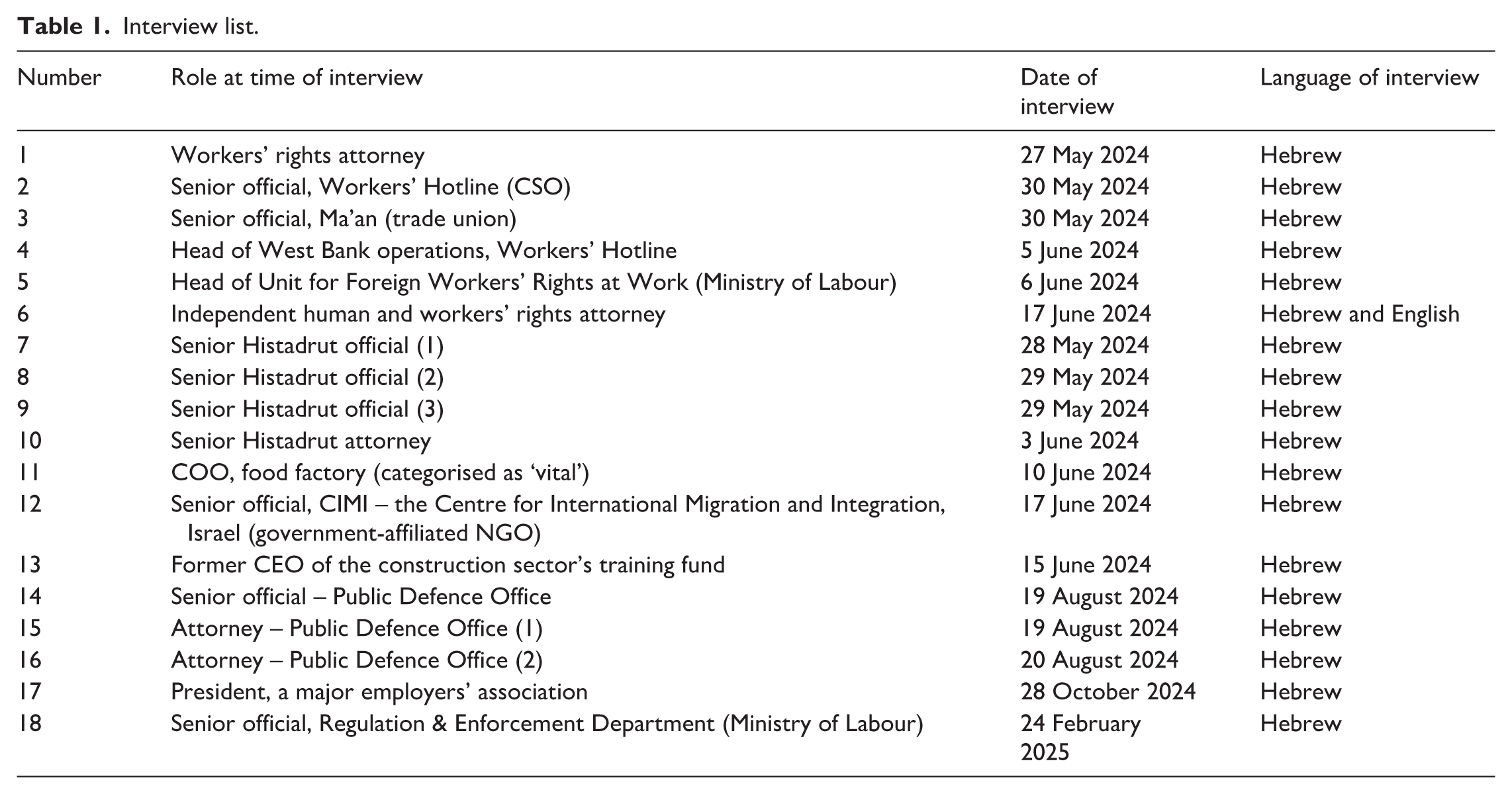
For understanding the broad picture and changing state policies, as well as the perspectives of key state and political actors, we relied on media coverage (including TheMarker, Calcalist, Ynet and Ma’ariv) and the published minutes of Knesset committees debates, specifically the Subcommittee on Foreign Workers and the Economic Affairs Committee. 1 We also studied legal petitions and judicial processes regarding the import of migrant workers to Israel, 2 and the press releases and reports of key organisations, including trade unions, employer organisations and CSOs working in the field of human and worker rights, published by the organisations themselves. In these documents, we looked for evidence of actors’ relative power (expressed in their ability to promote their interests in official policies), for expressions of actors’ stances (inclusive/exclusive) and for formal policies (e.g. the right to work in Israel, quotas of noncitizen workers). Finally, we complemented this information with 18 semi-structured interviews with key social actors, including government officials, senior officials in CSOs dealing with workers’ rights and in trade unions, and lawyers in the private and public sectors, based on the relevance of their role in the inclusion/exclusion of noncitizen workers (detailed in Table 1). Interviews focused on interviewees’ perspectives on past, present and future policies regarding the employment of noncitizen workers in Israel; the relative power of the actor they represent, before and after 7 October 2023; and the stance they adopt towards noncitizen workers. Most interviews were recorded, while some were written. All interviews were manually coded to identify similar themes regarding actors’ power, stance and position vis-a-vis existing policies.
Interview list.
Background: Noncitizen workers in the Israeli labour market
Following the 1967 war and the subsequent occupation of Palestinian territories, Palestinian workers were (economically) integrated into the Israeli labour market as cheap workers. Access to work in Israel was supported and managed by the security establishment as a way of pacifying Palestinian resistance to the Israeli occupation (Arnon, 2007) and by pro-market state actors intending to reduce labour costs in Israel and undermine organised labour (Shalev, 1992). Thus, noncitizen Palestinians rapidly became an important group within the Israeli labour market, emerging as the dominant group in both the construction and the agriculture sectors (Farsakh, 2005). Nonetheless, their inclusion was curtailed during the late 1980s and the 1990s, and they were gradually excluded and replaced by temporary migrant workers (Kemp and Raijman, 2008).
This displacement created social tension, born of the uncontrolled number of migrant workers in Israel in the early 2000s (Kemp and Raijman, 2008). This social tension, together with harsh and ‘successful’ repression of Palestinian resistance to Israeli rule, led to the reemergence of an inclusive approach towards noncitizen Palestinians, expressed in a gradual increase in their entrance to work in Israel from the mid-2000s onwards, and by improved regulation of migrant workers’ recruitment and working conditions, to ensure their rights as well as their compliance with Israel’s migration policies (e.g. Livnat and Shamir, 2022). By the eve of the October War, over 100,000 Palestinians worked officially (with a permit) inside Israel, with a further 40,000–60,000 working ‘illegally’ and 30,000–40,000 working in special industrial zones and West Bank settlements (Adnan and Etkes, 2023). During this period, some 100,000 migrant workers were employed in Israel, working mostly in agriculture, care and construction, arriving through highly regulated bilateral labour agreements (CIMI, 2023).
As the state hollowed out institutions that had constrained and administered the economic inclusion of Palestinian workers, the gap was filled by social actors with inclusive agendas (Bondy and Preminger, 2022; Preminger, 2017): employers and their associations (who advocated for increasing the number of workers allowed entry); the unions (which, after years of excluding Palestinian workers, now supported their access to rights); and CSOs that campaigned for the expansion of workers’ rights. This trend shows that despite the political imperative to exclude Palestinians, market liberalisation reinforced the social actors’ relative power, supporting their inclusive stances towards noncitizen (and mainly Palestinian) workers, essentially for exploitation but increasingly also as bearers of rights (Preminger and Bondy, 2023).
Exclusion: The security crisis and the ban on Palestinian workers
Despite plans for institutionalising apartheid or transferring Palestinians from the West Bank, following its election in December 2022, Israel’s extreme right-wing government focused mainly on internal conflict (over democratic institutions) (see Bondy, 2025), and the balance that facilitated gradual inclusion of noncitizen workers, mainly Palestinians (Preminger and Bondy, 2023), seemed stable. However, this balance collapsed on 7 October 2023, with Hamas’ brutal attack. While violent eruptions had been common in recent years, this time was different: Israel declared all-out war on Hamas and to some extent on the entire Palestinian people, establishing a full blockade on the Gaza Strip (illegal according to international law). 3 This was accompanied by an immediate ban on the entry of Palestinian workers into ‘Israel proper’ 4 – officially to ensure security (Bank of Israel [BOI], 2024). Most actors expressed strong anti-Palestinian discourse and policies: Israeli politicians voiced repeated statements of a genocidal nature, with PM Netanyahu and Defence Minister Gallant portraying them as ‘Amalek’ (the Biblical nemesis of the Jews), stating that ‘there are no innocent [people] in Gaza’ while declaring that Palestinian workers would never return to work in Israel. 5 At the same time, arrest operations against Palestinian workers illegally present in Israel were increased (HCJ 7637/23; Ganon, 2023), and under the far-right National Security Minister Itamar Ben Gvir, the police policies towards them toughened (Interviews 14, 15, 16). 6
However, as the war intensified, the security establishment – including the defence minister – spoke out in favour of permitting Palestinians to work in Israel, viewing their employment as vital to maintaining peace and preventing an escalation of violence in the West Bank (Lis, 2023). Before the war, this professional position was respected and considered a key directive in strategic planning (e.g. Berda, 2017), but now it was severely criticised by leading political actors from the government, especially its extreme right-wing factions, now in control of the Ministry of Finance and police as well as central parts of the Ministry of Defence (see coalitional accords between the Likud, Religious Zionism and Jewish Power parties). 7 Demands for the inclusion of Palestinian workers also came from employers, who saw their businesses grind to a halt without access to cheap labour (Gamas, 2024). Both security- and economy-based demands were rejected by the government, intent on unilaterally controlling the economy, and framed as part of the ‘conceptzia’ (the now discredited security doctrine) that had led to the 7 October massacre. Finance Minister Bezalel Smotrich emphasised that ‘[work] permits don’t buy us peace’, suggesting that the Palestinians would ‘murder us’ regardless (quoted in Braski, 2023).
Meanwhile, the military continued to renew entry- and work-permits, which are under its administrative control, indicating its intention to reinclude Palestinians in workplaces inside ‘Israel proper’. Yet political actors were loudly critical of the military’s permit renewal policy, which led to an official freeze of work permits (Channel 7, 2024). This political pressure on the military’s professional position initially raised concern and led to some public criticism against government policy, on both economic and political grounds (Avriel, 2024), but as the war continued, such criticism disappeared. A senior lawyer noted, ‘since 7 October, no one [in government or parliament] is talking about Palestinian workers’ (interview 1). Other state professionals, such as officials in the Ministry of Labour and Ministry of Justice, traditionally responsible for inclusionary policies, were also bluntly marginalised from substantial discussion on this (interview 5).
Thus, with the change of power relations between the government and the social actors following 7 October, the former’s exclusionary stance was (almost) completely uncontested. However, while security actors had limited influence in debates inside Israel, in the occupied Palestinian territory (OPT) they had full authority to act according to their own professional evaluations and allow Palestinian workers to enter Jewish settlements (e.g. Ben-Kimon, 2024). Though the most vocal opponents of the security establishment were politicians living in the settlements, they effectively consented to its inclusionary policy that allowed 25,000 workers (c. 50% of the workforce prior to the October War) to resume their work in the settlements and seam-line industrial zones, 8 supporting the government’s main political project – bolstering the illegal occupation of the OPT.
The terrible impact of exclusion
Exclusion led rapidly to severe economic hardship for Palestinians: families lost their income overnight and the Palestinian economy was starved of funds (interviews 4, 6). 9 With economic stress mounting, workers started to illegally cross the border and informally access work, with the encouragement of (at least some) employers who desperately needed workers (Yehoshua, 2024). While this was common before the war (see Adnan and Etkes, 2023), after 7 October enforcement against infiltrators became much more severe, with more frequent police raids on cars and workplaces and increasingly harsh treatment of infiltrators and anyone assisting them, raising the personal cost of ‘illegality’ (interviews 4, 14, 15). 10 Indeed, where previously ‘illegal’ workers had risked deportation or a night in jail, they now risked up to three months in prison (for a first offence), as well as their lives, with reports of soldiers shooting infiltrators without warning (interview 4). 11 Nevertheless, military forces often continue to ignore these illegal crossings (interviews 14, 15, 16).
According to some interviewees, the erosion of Palestinians’ economic inclusion also dramatically impacted their social inclusion and the severely curtailed access to work undermined Palestinians’ ability to raise grievances or challenge violations of labour rights (interviews 3, 4, 6). ‘Things are much better controlled these days . . . but workers are much more afraid . . . [that] if they complain, their employer will just throw them out’, said a Workers’ Hotline official (interview 4). Additionally, as OPT unemployment rates rose above 50%, the excluded Palestinian workers also lost their social rights, accumulated by Israeli employers or insurance agencies (seen as a violation of ILO Convention 95). 12
Furthermore, despite being responsible for ‘the biggest massacre of Jews since the holocaust’ (as commonly claimed by Israeli opposition leaders) and being accused of numerous war crimes and crimes against humanity in Gaza, the extreme right-wing government reinforced its position within Israel’s economy and society, further promoting its exclusionary stance. This has meant a dramatic change in the position and strategies of other social actors – unions, CSOs and even entrepreneurial lawyers. In fact, without basic economic inclusion (which these social actors consider to be beyond their control), their ability to promote Palestinians’ social inclusion was curtailed (interviews 2, 6). One independent lawyer said his activities assisting Palestinians to access work in Israel had ‘completely shut down . . . it’s currently impossible for us to help them’ (interview 6). While they were present in many official deliberations in parliamentary committees regarding noncitizen Palestinian workers, these actors seldom presented any position regarding the economic inclusion of Palestinian workers. 13 A senior official of the major union federation (the Histadrut) confirmed his personal support for their reinstatement, but noted he ‘would never say it out loud or lead any active pressure for it . . . I will not take the responsibility now’ (interview 7). Similarly, a senior official in a key CSO said he feared public reaction if his organisation were to advocate for Palestinians’ right to work in Israel (interview 2). Complementing this overall silence, the right-wing trade union, the National Histadrut, distributed a professional opinion calling for the ‘need’ and ‘justified right’ to exclude Palestinian workers. 14
Inclusion: The switch to migrant labour
With 60–70% of the manual workforce in the construction sector excluded, work stopped in sites throughout the country, raising serious concerns among professional actors about the sustainability of the sector and future financial risk (Moyal, 2024a). 15 As Israeli citizens were not perceived as a potential workforce in construction, employers demanded the import of migrant labour in massive quantities to replace Palestinians. 16 Though strengthened relative to other social actors, in the face of employers’ pressures, government and state actors turned their attention to the reformulation of inclusive policies for migrant workers (interviews 5, 12).
Politicians, keen to compensate employers for the loss of access to cheap (Palestinian) labour and concerned about the crisis in the construction sector, were now quick to support employers’ demands for rapid government action to increase migrant labour. A government official who regularly attended the Knesset Special Committee for Foreign Workers said, ‘there seemed to be no request [from employers] the committee members won’t approve’ (interview 5). However, the current labour ‘market’ was very different from the market imagined (or desired) by employers: national and international regulations have a far greater role than they had 20 years ago, and labour migration has become more regulated (Livnat and Shamir, 2022; Shamir, 2021). 17 Many bilateral labour agreements (BLAs) had been reached with ‘sending countries’ to oversee recruitment processes and reduce the exploitation of migrant workers; and professional governmental agencies were established to monitor stakeholders in the field of labour migration, such as the Ministry of Labour’s Unit for Foreign Workers’ Rights at Work and the National Anti-Trafficking Unit in the Ministry of Justice. 18
While employers had broadly accepted this regulated market, the war created what one interviewee called ‘a great opportunity’ to change long-accepted norms (interview 5). Indeed, in public debates that followed 7 October, political actors started to portray the regulatory landscape as unfit for current challenges in sectors that relied on noncitizen Palestinian workers, criticising regulatory barriers that prevented the rapid recruitment and import of workers.
Employers actively promoted this ‘regulation-lite’ labour import situation, as it ensured a docile and cheap workforce and revenue for agencies, not merely to sectors that relied on Palestinian workers, but also to those sectors experiencing labour shortages during the war (and its massive military operations). 19 ‘With all due respect for regulations,’ an employer association official said, ‘the government should understand we are in an emergency situation’ (interview 17). Additionally, the head of the Knesset Special Committee on Foreign Workers critiqued attempts to sign BLAs as slow and ineffective (5 March 2024), and regulators were pressured to circumvent the tested and agreed-upon mechanisms that had protected workers’ rights while holding Israel to its international obligations (interviews 1, 2, 5). Such pressure caused concern among the ‘professional class’ in state institutions such as the Population, Immigration and Border Authority (PIBA), the Ministry of Labour and the National Anti-Trafficking Unit: they feared deregulation and further liberalisation of labour migration would lead to local and international critique, which could cause Israel’s rating to be downgraded by international bodies, harming its economy and ultimately halting labour migration (interview 5).
Despite the opposition of such state officials, their weakened position since 7 October led to their marginalisation in official debates, which according to one interviewee became increasingly ‘political, really anti-professional and populist’ (interview 5). Subsequently, the government decided to increase quotas of migrant workers in construction, including ‘private’ import – outside BLA channels 20 – and significantly increase the numbers of migrant workers permitted to work in Israel overall (as well as the sectors in which they can work), without any complementary regulation.
Inclusion contested
A professional government official stated: ‘These new policies are an irresponsible acceptance of employers’ demands . . . while undermining all protective mechanisms that supported workers’ rights’ (interview 5; also interview 12). 21 Yet professional criticism was largely futile, leading some social actors – mainly CSOs – to use other tools to challenge the government. Despite initial restraint (interviews 1, 2, 6), as it became apparent that the new policy was likely to severely erode workers’ rights, CSOs contested it in court. 22 During court deliberations, the government partially backtracked on its decision to expand ‘private’ (unregulated) import of migrant workers and agreed to reinforce professional inspection of labour migration. The revised decision emphasised the obligation to prioritise official, highly regulated routes for migrant labour, while creating some ‘regulatory buffers’ to improve conditions in unregulated routes. 23 Nevertheless, despite a significant increase in the numbers of enforcement agents, state officials and NGOs have suggested this will be ineffective, as ‘existing manpower cannot meet current needs . . . [Additionally,] we struggle to fill existing posts [of labour inspectors], so you can imagine what will happen with these new posts’ (interview 18, state official; similar observations were shared by interviewees 5 and 12).
Various interviewees noted that this was recreating the ‘wild west’ situation of the early 2000s (interviews 1, 2, 4, 6, 12), while both employers and politicians called for excluding migrant workers from certain labour rights (e.g. social security, pension rights and minimum wage). 24 Indeed, initial evidence shows that the pressure from employers for a rapid and unregulated import of workers has caused the return of past abuses such as high recruitment fees and violations of rights such as minimum wage (interviews 1, 2, 3, 5).
Importantly, despite their weakened position, CSOs continued to challenge the government, while unions were completely absent from this policymaking process. Though union officials were present in the main parliamentary committee debates, their contribution is questionable: the main trade union in the sector – the Histadrut – seemed to have had no effective agenda on the issue, and silently acquiesced in employers’ demands, prioritising the return of the sector to full production capacity (interview 8). 25 A senior Histadrut official said, ‘the situation has changed and we must accommodate it . . . so we turn to [the] employment of migrants’ (interview 9), while the second union called for the import of skilled migrant workers ‘without erecting regulatory barriers’. 26 Raising concerns for Israeli workers in various sectors previously ‘protected’ from labour migration, Histadrut officials tried to resist the dramatic policy change and its potential impact for Israeli workers, while saying almost nothing about migrants’ rights (interviews 8, 9). Nevertheless, their weakened position within policymaking since 7 October undermined most Histadrut efforts to limit labour migration, as noted by interviewee 8 (‘[the government] just does not listen to us . . . We need other means’), leading the union to give up on its concerns for its newly exposed local constituencies. At the same time, in the construction sector, the marginalisation of the union has led to its development of new strategies for collective regulation of migrants’ working conditions, mainly through company-level partnerships with employers (interviews 8, 9, 10). Nevertheless, with their position weakened, this collective regulation mainly expressed employers’ interests, without substantial, enforceable provisions above the legal minimum. 27
Discussion
The October War represents an exogenous shock to what appeared to be a stable configuration of institutions managing the employment of noncitizens in Israel according to widely accepted norms. As we have shown, this crisis transformed power relations in this field and was an opportunity for social actors to recalibrate this configuration, promoting specific agendas and interests with a profound impact on the entry and employment conditions of noncitizen workers. Given that the Hamas attack of 7 October was perceived by Israel as a profound security threat, we expected the dominance of actors with market-oriented, inclusionary stances to be severely undermined, as actors holding exclusionary ethnonationalist stances gained the upper hand. Our findings support these expectations to a certain extent, seen in the partial change of the overall balance between the imperatives and the rapid and massive exclusion of Palestinian workers. While the inclusionary agenda still dominated debates on employment relations in construction, its subjects changed – from Palestinians to migrants – expressing a new balance between the inclusive and exclusionary imperatives.
A key actor is the trade unions. Like elsewhere (e.g. Lillie and Greer, 2007), the dominant unions in Israel are not necessarily inclusionary actors, but rather subject to exclusionary pressures as organisations firmly embedded within the dominant ethnonational group. Nonetheless, these unions have made significant progress towards an inclusionary stance and we expected them, as ‘inclusionary actors’, to be weakened by the crisis. However, we found that instead of stepping aside, unions shifted their focus towards migrant workers and, as in the past, accepted employers’ dictates (see also Bondy and Preminger, 2022). For the Histadrut, then, this was not exactly a weakening, but more a recalibration of its partnership, though clearly at the expense of the worker group (the Palestinians), which had been increasingly – if slowly – included. Thus, trade unions’ increasingly inclusionary stance towards noncitizens, evidenced in many countries (Boräng et al., 2020; Marino et al., 2017), can be fragile and unstable within the context of ethnocracy, and even powerful unions may find themselves needing to rein in their inclusionary stance when the dominant ethnos is under (perceived) threat.
Though an increasingly important actor in Israeli industrial relations (Mundlak, 2007), CSOs were extremely weakened in the crisis. Despite past successes in enhancing levels of inclusion (i.e. extent of rights) for those granted entry, in the current crisis they had only limited success in maintaining protective institutions and safeguarding workers’ rights. Professional state actors too found their power weakened as they struggled to maintain the standards demanded of a liberalised labour market plugged into the global economy. The ‘space’ for promoting this agenda narrowed, as extreme right-wing politicians succeeded in increasing opposition to inclusive politics towards ‘the other’, while attacking CSOs for their historic role in promoting multidimensional inclusion. This marks the clearest weakening of inclusionary stances and thus most closely conforms to our research expectations.
These findings contribute to the growing literature on the configuration of migrant labour rights (Anderson, 2010; Connolly et al., 2019; Könönen, 2019; Ruhs, 2013) by highlighting the political pressures that shape policies and levels of inclusion: going beyond long-term trends and the work of specific social actors lobbying for reforms that suit their interests (Menz, 2009), we emphasise political struggle between actors of conflicting stances, including within government. While we have not analysed the shift in parliamentary politics towards a more exclusionary ethnonationalism (we take this as a given; see e.g. Schneider, 2024 for such an analysis), our material does highlight the discrepancies between the political and professional arms of the state and shows how crisis undermines the ostensibly stable power balance between them. The security services are the most prominent example. In our case, they have always played a dual role: the main executors of government-sponsored oppression and violence, but also administering the permit system that enables Palestinian employment in Israel. In this crisis, this inclusionary stance was greatly weakened, while its exclusionary roles were augmented, from the sealing of the borders of ‘Israel proper’ to violent oppression of Palestinians in the West Bank, ethnic cleansing and tacit support for the most extreme ethnonationalist elements of the Israeli settler movement (ACRI, 2024; Levy, 2023, PHR, 2025).
Similarly to the security services, law enforcement agents have been both partners in the settler-colonial project and guardians of Palestinian rights; moreover, they were formerly somewhat lax about enforcing the exclusion of Palestinian workers. Now, however, they made great effort to guard the boundaries of the ethnonational entity as redefined by the government. Thus, their de facto inclusionary stances, however limited they may previously have been, are increasingly overpowered by exclusionary demands. The ‘state’, then, does not only regulate to balance between interests, but its various branches are key participants within these struggles.
While the exclusion of Palestinian workers from ‘Israel proper’ suggests an extreme shift in the balance between inclusionary and exclusionary imperatives, a powerful actor with a strong inclusionary stance countered this trend: employers were able to shift their demands for the inclusion of cheap labour away from one group of noncitizen workers and towards another, receiving support from the same exclusionary actors that now sought to compensate those (local actors) losing from this exclusion. This illustrates that the strengthening of the exclusionary ethnonational imperative is not monolithic: the balance between exclusion and inclusion shifts between the different groups of ethnic ‘others’, so that the inclusionary imperative – at least for now – remains powerful, promoted by a powerful market actor.
However, this is a different kind of inclusion, and the implications for the included – the migrant workers – are only beginning to show. While Palestinian economic inclusion led (perhaps inadvertently) to incrementally increasing inclusion also in terms of social rights and representation (Bondy and Preminger, 2022; Preminger and Bondy, 2023), the economic inclusion of additional migrant workers in great numbers is currently devoid of other forms of inclusion: their entry into Israel is supported by few additional rights and by weaker protective institutions.
This case clearly shows how the manoeuvring of social actors does not just take place within a given balance of inclusionary and exclusionary forces, but impacts this balance, especially during times of crisis – and that the shift in balance has serious implications for noncitizen workers. Crisis reveals power dynamics typically obscured during periods of institutional stability, as it undermines previous consensus and exposes the contested nature of seemingly stable compromises between inclusionary and exclusionary imperatives. Nonetheless, the subsequent reinforcement of the ethnonational stances as a result of crisis does not necessarily mean the de-liberalisation of labour market institutions, but rather a potential conversion (Mahoney and Thelen, 2010) in its nature (the inclusive dimensions) and subjects (the included worker group). To be precise, while liberalisation continues, without powerful actors holding a developed inclusive stance, the extent of its ability to include the ‘other’ within the ethnocratic context is highly limited – from a reasonable level of economic and social rights to inclusion based predominantly on economic factors with few safeguards for rights.
Furthermore, much critical scholarship on Israel/Palestine accepts a settler-colonial framing and perhaps inadvertently assumes a monolithic colonial and exclusionary state stance. While we accept the usefulness of this framing, we emphasise that some state actors at a given time are inclusionary and promote an agenda of liberalisation and openness, while at other times are exclusionary and ethnonational – and some even have contradictory roles. Our material offers a more nuanced understanding of the dynamic between actors and their (changing) stances, which does not place ‘the state’ above other actors, but rather shows the links between state actors and other actors, especially those who impact the terms, conditions and regulations in the labour market. This perspective also highlights the links between key industrial relations actors and actors operating in the sphere of parliamentary politics, crucial for the balance between the ethnonational exclusionary imperative and the (neo)liberal inclusionary imperative.
Our central finding is that while crisis is indeed an opportunity for actors to challenge the status quo ante and transform the power balance between them (Capoccia, 2015; Conley, 2012; Mahoney and Thelen, 2010; Saurugger and Terpan, 2016), key logics underpinning that status quo are resilient. While the war augmented the political exclusionary imperative, the fundamental element of actors’ position within the neoliberal ethnocratic context – namely, the need for cheap labour and the mutual dependency that had developed between noncitizen workers and the state that ‘imported’ them (Preminger and Bondy, 2023) – maintained its centrality. 28 This suggests that even institutional change and ostensibly sweeping policy shifts may recreate the conditions required to meet the same key political-economic interests. Crucially, the persistence of neoliberal inclusionary pressures, even during an extreme security crisis, reveals the structural constraints that market economies place on ethnonational projects. While actors of the dominant ethnic group can redirect these pressures towards different populations, they cannot (or are unwilling to) eliminate the fundamental demand for flexible, cheap labour that drives inclusion. In a globalised, market economy, the rising dominance of ethnonationalism might successfully eliminate rights for noncitizen workers, reversing trends of liberalisation and individualisation of rights, but cannot exclude these workers completely. Thus, our analysis points to the limits of what can be contested within a market-oriented state, even when this state is an ethnocracy with an increasingly powerful ethnonational ethos expressed in populist racist politics.
Conclusion
We have developed previous framings (Preminger and Bondy, 2023) to show not just that the balance between inclusionary and exclusionary imperatives is a useful heuristic lens to explain behaviours, but also how institutional balance can change, impacted by, and having an impact on the behaviours of, social actors. Crisis widens the ‘space’ for action, giving social actors that promote either the inclusionary or the exclusionary imperative an opportunity to try to shift the balance between them in line with their interests.
The extreme supremacy of the ethnonational ethos, triggered by crisis, compromises other political-economic interests (e.g. in production and growth) formerly supported by the dominant inclusionary imperative that in turn allowed access to cheap labour. Yet the resultant reduction in economic activities and the harm to a powerful and vocal lobby threaten the legitimacy of exclusionary ethnonational policies. In previous eras, a solution might have been state investment in training (for workers) and subsidies (for employers) to support the inclusion of local workers; in the neoliberal era, however, the solution often materialises through market-based alternatives: the import of workers less threatening to the ethnonational ethos. Thus, the ‘imperatives’ are shaped by the agendas and interests promoted by social and political actors – but crucially, they are constrained by the logics of the market economy underpinning these interests. The result is the inclusion of different noncitizen workers with reduced protections for their rights.
More broadly, our analysis shows how insights from policy studies can help us understand industrial relations by embracing a wider set of actors, not as ‘new labour actors’ (e.g. Bondy, 2021; Heery et al., 2012), but as the full configuration of actors who impact policy through their efforts to advance interests not always directly related to the employment relationship – including the range of state actors with often contradictory agendas.
Footnotes
Acknowledgements
With thanks to Michael Shalev for his encouraging comments and feedback on a previous draft, and to the anonymous reviewers for their comments and insights.
Funding
The authors received no financial support for the research, authorship, and/or publication of this article.
Ethics statement
The research was part of a larger project, which was approved by the Ethics Committee of Cardiff Business School at Cardiff University, reference no. 688. Participants who requested anonymity were assured of this, and the option of withdrawing from the study at any time was explained to them.
