




Abstract
This article focuses on co-development technology transfer models. It offers an empirical analysis of a pioneer model applied in Italy: the proof-of-concept network (PoCN) applied by AREA Science Park in Trieste. Starting with a review of the literature, the authors identify the drivers that facilitate collaboration between the industrial and research systems in the embryonic phase of technology development. Then, discussing the PoCN model, the article analyzes and explores an emerging phenomenon that is as yet poorly understood. The application of a model for co-development, in fact, highlights many advantages for both firms and the research system and improves the efficiency of matching between these distant and heterogeneous sectors. The authors report a single case study which, while appearing to be a limitation of the article, offers elements of originality because it concerns the first applied co-development model in Italy. There are many practical implications, not only for firms and research institutions but also for policymakers who seek to implement public policies to support innovation and technology transfer.
The innovation ecosystem at national and international levels is characterized by a research system that each year produces a substantial portfolio of scientific results and patents (ASTP-Proton, 2015; Netval, 2016). However, these results often remain far from industrial application and commercial exploitation and do not generate the expected revenues. Companies, for their part, may find it difficult to evaluate the applicability of such research outcomes and to understand their potential, because the stage of their development is embryonic or because their performance or repeatability has not been sufficiently tested (Perkmann et al., 2013).
Customers’ needs have become increasingly complex, and industry is expected to develop useful products and processes based on frontier technologies. At the same time, researchers are expected to address the practical needs of society. Thus, the traditional technology-push and demand-pull models (Dosi, 1982) are becoming obsolete in a highly dynamic and complex society. The challenge is to foster the transformation of scientific results into real processes or products for the market and to help firms tap into research systems to acquire specialized skills and develop successful innovation by applying cutting-edge technology (Cattapan et al., 2012; Chesbrough, 2003; Hallonsten and Christensson, 2017; Peris-Ortiz et al., 2016; Perkmann et al., 2013).
Among practitioners, new technology transfer models are emerging (Passarelli, 2016); these are co-development models, in which the research and industrial sectors work together to validate (proof) scientific results (concept) from the very early stages of the innovation process by taking into account multiple and heterogeneous actors. In the United States, for example, a variety of proof-of-concept centres (PoCCs) have emerged. Among these, the Deshpande Center at MIT in Boston and the Von Liebig Center at the University of California at San Diego stand out. They were created from the desire of industrial and research partners to accelerate the transformation of research findings into industrial applications. For several years now, the European Union (within the 7th Framework Programme or Horizon 2020) has offered incentives to PoC projects through grants for researchers who wish to enhance the potential of their research results.
The literature on technology transfer includes many contributions, concerning the technology-push and demand-pull models (Di Stefano et al., 2012; Dosi, 1982; Hyundo, 2017; Namgyoo, 2012; Siegel, 2006). However, few empirical analyses in scientific studies have investigated the real applications along with the motivations underlying the co-development activity of new technology transfer models (Munari et al., 2017; Steinthorsson et al., 2017).
This lack of analysis represents a significant gap in the literature on technology transfer. In this context, this article aims to enrich the literature on co-development technology transfer models through the analysis of a case study of a proof-of-concept network (PoCN), the first experience of a co-development technology transfer process in Italy. It was proposed by the prestigious ‘innovation brokerage organization’, AREA Science Park, and was financed by the Italian Government.
We use a ‘theory-building’ research approach (Dul and Hak, 2007), following the method proposed by Bank et al. (2017). We also agree with Flyvbjerg (2006: 242) ; he argues that a discipline without a large number of thoroughly executed case studies is a discipline without systematic production of exemplars, and that a discipline without exemplars is an ineffective one. In social science, a greater number of good case studies could help remedy this situation.
The article is organized as follows. Following a review of the literature on co-developing models of technology transfer, we discuss the methodology used and the data collection. We then present our results and formulate propositions in the light of them. In the final section, we summarize our conclusions, discuss the implications and set out the limitations of the study.
Literature review: Towards a perspective on co-development
There have been numerous studies of demand-pull and technology-push models for technology transfer, while the literature on PoC models is still in the development stage and relevant papers are, therefore, relatively sparse. From Thursby et al. (2001) onward, a few studies have focused on the topic. Gulbranson and Audretsch (2008: 250) define the PoCC as ‘an institution devoted towards facilitating the spillover and commercialization of university research’. Leyden and Link (2015: 84) quote Gulbranson and Audretsch and add that ‘PoCCs seem to be taking aim at improving the transfer and development of technologies derived from public R&D funding, especially from universities and public laboratories’. According to Rasmussen and Sorheim (2012: 671), ‘PoCs are models that reduce the technological uncertainty of the projects at an early stage by supporting technology verification’. Bradley et al. (2013: 3) define the PoCC as a collection of services to improve the dissemination and commercialization of new knowledge from universities in order to spur economic development and job growth. A more narrow perspective might simply view PoCCs as an investment by a university or universities for improved technology transfer. an organization working within or in association with the university, to provide funding, mentoring, and education, in a customizable support to PoC activities in TC, i.e. the development and verification of a commercial concept, the identification of an appropriate target market, and the development of additional required protectable IP. a collection of services to improve the dissemination and commercialization of new knowledge from universities to industry. PoCCs seek to address many of the challenges associated with commercializing university technology, including lack of access to resources, services, and networks that support the development of university start ups.
So, an analysis of recent literature on technology transfer and international managerial practice indicates that the PoC model (belonging to the typology of co-development models) aims to bring together research and industrial partners from the very early stages of research through to the marketing phase in order to generate a process of collaboration between technological skills and market expertise. The challenge is to accelerate the transformation of research results into successful industrial application by directing research towards the real needs of the market. The PoC model, in fact, aims to promote the matching of the needs of the research system and firms to facilitate the fulfilment of both simultaneously.
The novelty of the PoC model in relation to the traditional technology-push and demand-pull models lies in the timing of the matching process and in the flow of knowledge between the research and business partners. If we consider the innovation process, the phases are the following: basic research, applied research, development, engineering and launch in the market. Technology-push and demand-pull models are characterized by matching between the research and industrial systems in the more advanced stages of the innovation process (mainly development and engineering). In these models, the researcher proposes a well-defined technology (e.g. a prototype or patent), while firms ask for a very specific innovation need to be satisfied in a very short time. The matching should be rapid, with no opportunity to modify or adapt the predefined technology. Knowledge sharing is unidirectional, from the research system to the industrial system.
In co-development models, the matching between research and industrial systems occurs in the early stages of the innovation process (mainly basic and applied research). In these models, the researcher proposes a concept or a research result, while firms ask for a very specific innovation need to be satisfied in a highly customized way. The development process is based on a multidirectional flow of knowledge among the partners that creates a kind of leverage knowledge effect. The researchers offer technological and scientific knowledge, while the industrial partners offer marketing knowledge and strategic knowledge to orient the development of frontier technologies towards real customer needs (Figure 1).

Technology transfer models. Source: Authors’ elaboration.
The aim of this study is to explore the main drivers that facilitate the collaboration of researchers and industrial partners from those early stages of the innovation process.
Empirical analysis
Method and data
We focus on an exploratory case study (although almost exclusively descriptive) in order to obtain a better understanding of the object of study: the co-development technology transfer process. This is a phenomenon recently observed and still poorly understood (Yin, 2003).
As already noted, the PoCN is the first experience of a co-development technology transfer process in Italy. It is also the first co-development programme to be financed by the Italian Government and is in line with the key objectives of Europe 2020. In this context, we should be able to identify important issues in co-development, even through the study of a single case (Eisenhardt, 1989; Yin, 2003). The theory-building approach was used to highlight such issues on the basis of evidence drawn from observation of instances of the object of study (Dul and Hak, 2007). We use the case study method, in fact, because we wish to explore new areas with a limited theoretical background and to answer ‘how’ questions (Kohn, 1997). We are aware of the potential shortcomings of using a single case study, but it is important to note that this methodological approach is common in social science. Our research design followed the steps recommended by Yin (2003). Qualitative data were collected during September and December 2015, using semi-structured interviews followed by a complementary literature review addressing the co-development ecosystem.
Specifically, the phases of the case study development were as follows: We started by identifying the phenomenon to be investigated, that is, the co-development model of technology transfer. We then focused on the Italian innovation ecosystem, identifying potential cases of co-development. Starting from a series of interviews and contacts with experts in the Italian innovation and technology transfer system (e.g. Netval, university technology transfer offices, policymakers), we chose as our unit of analysis the PoCN implemented by AREA Science Park. After selecting the PoCN, we prepared a data set for the classification and analysis of data. Then, we moved to the actual data collection. The data collected were both primary and secondary. The primary data were collected by consulting the documents made available by AREA (including, e.g. technology description worksheets, assessment scorecards filled out by experts, publications and patents) and via a semi-structured survey. In total, 51 semi-structured interviews were carried out, 23 with the managers of the firms involved in the project, 23 with the research leaders, 2 with the project manager of the PoCN, 1 with the Director of AREA Science Park and 2 with a technology transfer expert. The interviews lasted between 60 min and 120 min and included questions about the motivations of the partners, applied research activities, patent activities, closeness among the partners and assessment activities
1
(this article includes a small selection of quotations from the interviews). The secondary data on firms (size, core business, localization) were extracted from the ORBIS database provided by Bureau van Dijk; all information about researchers and patents was gathered by consulting specialized websites (Scopus, Thomson Reuters, GoogleScholar, Ministry of University and Education (MIUR), Espacenet). All data collected were stored in a case study database in line with Yin (2003) and were analysed using descriptive variables (means and frequencies).
The case of the PoCN: Actors, phases and co-development
The PoCN is a ‘rewarding project’ (set up in 2013), financially supported by the MIUR, which has recognized the high impact of the project on the industrial and scientific systems.
The project aims to introduce, in the Italian economic context, a new model of technology transfer which is designed to support and enhance the commercial exploitation of research findings in conjunction with the business sector. This target is achieved through the implementation of methodologies and operational tools that allow for the integration of the skills and expertise of researchers with the skills and resources of companies to transform research results into product and process prototypes that are aligned with the specifications and needs expressed by the companies. The main objective of the PoCN is to transform, through original methods and programmes, the validation of research results in industrial contexts into a stable, long-lasting and cost-effective process. The PoCN offers an innovative technology transfer model that, starting from consolidated methodologies and tools drawn up by AREA, supports the implementation of development activities which are defined as ‘industrial validations of research findings’ – namely, co-development programmes between universities and public research institutions and firms.
The lead partner in the PoCN project is AREA Science Park, a top-level public research institution located in Trieste 2 whose main activities are technology transfer support and the exploitation of research results. Other partners are located throughout Italy and belong either to the industrial or the research system: Netval (the Network for the Promotion of University Research), Confindustria, the National Research Council (CNR), Elettra Synchrotron Trieste SCpA, Politecnico di Torino, the University of Calabria, the University of Padua, the University of Trieste and the University of Udine. Governance of the project is the responsibility of the PoCN’s scientific and operating committees. Public research institutions and universities (through their technology transfer offices) deal, at the local level, with scouting activities and the assessment of research finding exploitation proposals. Scouting and assessment activities are also carried out by local technology transfer offices, which support the matching of firms and research by building a consolidated network of relationships on the ground and through their knowledge of regional domestic demand. Confindustria has also participated. Two prestigious business schools, CUOA and MIB, have offered support for the assessment phase. Netval 3 has also contributed by providing expertise for the organization and training of people involved in technology transfer.
The PoCN programme starts with a training program on the topic of market analysis, technology validation and intellectual property rights; it is are provided by a team of experts, to the technology transfer employees, working in the technology transfer offices of universities research centres and regional organizations.
The second step is scouting at local and national levels. Local scouting is carried out by local units (research centres and universities) that have joined the project under the supervision of the AREA. Specifically, they promote the project in the research departments of universities and institutes and, later, organize interviews with research teams in order to identify technologies with industrial potential. Each local unit then supports academic researchers in the formulation of proposals for exploiting research results. When this stage has been completed, a set of proposals is selected by a team of technology transfer experts.
At the national level, scouting is done through three successive calls launched by AREA. The research groups that have already been mapped and selected by the local units, and supported by a scientific advisor, submit a formal proposal in response to one of AREA’s three National Calls. In their application, the scientific advisors provide information concerning their careers (including references, role, patents, publications and collaborations with industry) and the characteristics of the technology.
In the period under study (2015), 94 proposals were received via the three calls, most coming from the University of Udine and the CNR. Regarding the field of application, every scientific advisor was asked to indicate the business units as well as the segments of the business 4 in which the technology could be applied. On the basis of the information provided by the scientific advisors, 5 the thematic area of medical technologies accounted for the largest proportion of the technology candidates for co-development (approximately 20%), while new materials technologies were less popular (about 7%).
Once the candidates had been selected, the technology and market assessment phase was initiated. AREA set up an internal working group, composed of 66 analysts who, on the basis of a set of default parameters, evaluated the proposals and produced an assessment report. To carry out the assessments, the group used technology foresight and business intelligence tools. Specifically, for each technology, two dimensions were evaluated: intellectual property and market potential. Regarding intellectual property, the technologies were differentiated according to whether they were patented or non-patented. For non-patented technologies, the experts assessed their eligibility for patent application, technical feasibility, novelty and freedom to operate. For patented technologies, they assessed the legal status of the patent (e.g. filed, filed with search report, granted), geographical coverage, the state of the art of any procedure under review, technical viability and freedom to operate. Each technology was labelled with a synthetic indicator ranging from 1 to 100, in which values from 1 to 30 indicated ‘low potential’, 31 to 70 ‘medium potential’ and 71 to 100 ‘high potential’. In assessing the potential of the technology, the analysis focused on the size of the market, its structure and trends, entry barriers, competitive benefits, the potential applications, time to market and, therefore, the feasibility. Again, a synthetic indicator was used ranging from 1 to 100, in which the values from 1 to 30 indicated ‘low market potential’, 31 to 70 ‘medium market potential’ and 71 to 100 ‘high market potential’. Then, all the research proposals were submitted to a further evaluation step, carried out by a panel of experts with high international profiles (identified by AREA in collaboration with Confindustria).
The assessment process resulted in 90 proposals to be communicated to a panel of companies. At this stage, the CUOA Foundation located in Altavilla Vicentina (VI), the MIB School of Management of Trieste and Confindustria required a network of entrepreneurs, managers and technicians to provide qualitative and quantitative evaluations of the research results and to suggest potential firms or clusters of firms available for co-development activities. This panel of experts then selected a panel of companies that might be interested in developing the technologies already selected in the previous phase.
The following activities were carried out with regard to the promotion and presentation of proposals to firms: Door-to-door activity, with a customized approach. Sectoral roadshows were organized in different Italian regions, where the selected proposals were presented to potential partners. In addition, details from the assessment phase were made available to all stakeholders in different languages through a dedicated Web platform, which is available on the AREA website and the websites of other regional organizations involved in the project.
Companies (both Italian and foreign) could express their interest in one or more of the proposals by completing a form available on the Web platform. Sixty-seven companies expressed an interest, of which 33% were located in Friuli Venezia Giulia, 11% were foreign companies and the rest were firms distributed throughout the ‘boot’ (but most were in Lombardy and Veneto). Of these 67, 79% were small or medium-sized enterprises.
After receiving the expressions of interest, AREA’s experts, using advanced rating system tools (provided by Bureau van Dijk), verified the financial strength of each company interested in co-development. Only those companies with a financial strength rated as ‘sufficient’ were considered eligible to sign a letter of intent with a group of researchers.
By matching the values assigned to different technologies and the ratings assigned to companies, the experts created a ranking in which the technologies were classified as ‘adequate’ and ‘adequate and fundable’. A technology was considered ‘adequate’, if it received expressions of interest from at least one company whose financial situation was labelled as strong (only 47 were considered adequate technologies). A technology was also ‘eligible for financing’, if the total score given by the panel of industry experts was greater than 50. According to the criteria of appropriateness and eligibility, only 23 technologies in the PoCN project were admitted to be financed by AREA. 6
At this point, for each technology, a co-development project was drawn up. Key elements were a working plan (which included a definition of the activity and the time needed to validate the research findings according to the specifications provided by the companies involved), an agreement on intellectual property and the financial plan. Every co-development project also required a letter of intent between the research team and the company. Individual validation programmes were tested and approved by the AREA experts, who also defined the amount of financing, and a project champion was assigned to each validation programme.
For each co-development project, AREA signed an agreement with the legal entities (departments/institutes) to which every scientific referent of the projects belonged. This agreement marked the formal start of the validation programme which consisted of two steps:
Implementation of experimental activities. During 6–12 months, researchers and companies carried out activities relevant to the industrial validation of the research findings. Each project champion followed a single co-development programme, supporting the relationships between researchers and firms and ensuring the full compliance of the activities with the working plan.
Industrial validation. Each co-development programme ended with the implementation of a PoC – an industrial prototype – after a development process shared between researchers and companies that lasted up to 9 months.
Analysis and discussion
The empirical analysis focuses on the 23 co-development cases that joined the PoCN project; through our qualitative analysis, we contribute to the literature on technology transfer by identifying drivers of the co-development process from both the primary and secondary data.
The first driver is scientific reputation. This is considered to be crucial in the co-development process. For the purposes of this study, we take as a benchmark value the average number of citations of the most cited paper of the person leading the scientific team (the average value is 346, while the median is 94, with a minimum value of 20 and a maximum of 3). This evidence is supported by analysis of the h-index of the journal in which the most cited paper was published. The analysis showed that seven people (30%) had published their most cited article in a scientific journal among the top 100 in the Google Scholar ranking. We also analysed the publications relating to the specific technology in the co-development project and for which at least a co-author was a member of the co-development team. It emerged that 19 of the 23 technologies had already been the subject of published work in a total of 80 scientific publications (with an average of 3.5 publications for every person leading the team). Going through these 80 publications, we found that they had generated about 1620 citations (with a mean of 70 for every technology). The quality of academic research and the reputation of technology through scientific publication seem to hold an important value for companies looking for scientific partners (Fabrizio and Di Minin, 2008; Lissoni, 2010). In fact, according to the literature, the international visibility of researchers and their reputation have a signalling value for industry in relation to the possibility of identifying research findings to be exploited.
Another important factor is the total number of patents (applied and granted). From the empirical analysis, the total number of patents (filed and granted) was 164, of which the 23 team coordinators were inventors (a mean of 6.4 and a median of 2). In all 23 cases, the coordinator was the inventor of at least two patents, and 16 scientific coordinators held about 5 patents each. From this, we can infer that companies prefer to start a co-development innovation project with research groups that have a significant propensity for applied research. So, the applied research propensity of proponents–inventors is also considered a driver of success.
The perceived industrial applicability of a specific technology also emerged as a driver for co-development. This factor is a kind of perceived incremental diversification. The greater the number of applicable business units in which the technology is classified by each research team, the greater the level of incremental diversification. The empirical results show that, for most of the technologies (19), the research teams perceived a very low level of incremental diversification, with 16 believing that their technology was applicable to only one business unit and a single segment, 2 envisaging a possible application in two business units and a single segment and only 1 team indicating three business units and a single segment.
An analysis of the NACE codes (the European industry standard classification system) of the participating firms and the potential new applications identified by the research teams suggests that most firms joined the PoCN to diversify, penetrate new market segments or explore new commercial sectors. This is true for all companies, independent of their size. According to a PoCN project manager: Firms are interested in the proof of concept that will be achieved, if it is supposed to satisfy interests related to internationalization or diversification processes. Firms are mainly interested in fulfilling emerging and latent market needs and seek in the technology the key to success.
With regard to the analysis of the market feasibility of the technology, we examined the scores assigned by industry experts, including chief executive officers, product managers and marketing managers working for corporations in areas relevant to the new technologies examined. Although the scientific coordinators had perceived a low level of incremental diversification (identifying predominantly one application area), the analysis by external experts identified high scalability for each technology (in terms of market size, potential competitive advantages, time to market and economic viability). This means that the researchers, because of their low level of market knowledge of developed technologies, were not able to understand all the market needs and accommodate all the market trends. Similarly, in assessing intellectual property rights, although there were no patents for six technologies (neither deposits nor concessions), the technologies had very high potential in terms of novelty and feasibility. The expert analysts, in fact, assigned different satisfaction values (17 technologies of 23, in fact, showed values between 70 and 100).
Closeness among partners can also be an important issue in a co-development process. Our data show that the physical distance was on average 304 km. This figure indicates that, alongside the regional dimension of technology transfer (short networks), there is the additional dimension of long networks. The picture that emerges shows that small firms tend to prefer short networks, while medium-sized and large companies are involved in long networks and leverage, instead of relying on cultural and relational closeness. The empirical analysis showed that 17 of the 23 technologies had been shared with industry (for technology development, testing or future commercial developments) before participation in the PoCN. In particular, we note that 11 companies had already collaborated with the research group with which they embarked on the co-development project. Of these 11 companies, 25% were micro enterprises, 43% were small and medium-sized and 32% were large companies. Furthermore, we can conclude that large enterprises tend to ignore territorial proximity and start co-development projects with research groups with which there is an existing relationship. The concept of relational proximity, characterized by the exchange of tacit knowledge and personal interactions, may arise here. Rules, codes, common ways of thinking and idea-generation processes can be shared between geographically distant subjects. Tacit knowledge is continually transformed into codified knowledge because new tacit knowledge that needs to be made explicit is constantly developed (Foray and Lundvall, 1996). Micro, small and medium-sized firms appear, on the other hand, to be more attracted by territorial proximity because it allows face-to-face contact and the establishment of specific channels of communication between the research community and the business world. As for the age of the companies that had relational proximity with research groups, we found an average of 36 years, while the average age of those companies that had no previous collaboration with research groups was about 16 years. We found no specificity with regard to sector.
From the interviews with researchers and representatives from industry, it emerged that the ability to absorb and develop external technologies is also a crucial element in the co-development process. Since this ability involves multidirectional skills in a process of continuous growth of the stock of knowledge between partners, we must analyse either the absorptive capacity of scientific coordinators or the capacity of firms. For the former, the proxy is the number of patents developed jointly with at least one company. Some of the coordinators, belonging to the research groups examined, showed a high propensity to develop patents with industry and thus exhibited a high level of absorptive capacity (meaning the capacity of the research system to assimilate, revise, enhance and develop external knowledge). The analysis of the 23 coordinators showed that the total number of patents for which at least one co-applicant was a company was 76 (with an average of 3 patents for each coordinator). Specifically, 12 scientific coordinators had developed at least one patent with a company; moreover, for 4 of them, the patents had been developed completely in collaboration with at least one company. Regarding firms’ absorptive capacity, if we look at the number of patents of companies whose co-applicant was a research institution, only 5 firms (of which 1 was a spin-off) of the 23 had a university or research institution as a co-applicant.
Key drivers in the co-development process: Discussion and theory building
The above case study contributes in several ways to the literature on co-development technology transfer models, as demonstrated in this section. Following Flyvbjerg (2006), we add a new empirical experience to the field of co-development models. Then, stemming from the empirical results, we propose a theoretical categorization of the factors identified above and attempt to explain the main drivers that encourage the co-development process. Finally, we analyse the measurement proxies.
A first group of factors is related to the knowledge and skills of the R&D team. Excellent academic research stimulates the interest of firms, and the related driver is the scientific reputation of researchers, which depends in large part on the number and quality of papers they have published. The reputational success of a scientist or team is considered to be reflected by the prestige of the journals in which their papers have been published (measured by the h-index). Another reputational factor is the rate of citation: the more a scientist’s paper is cited, the greater is the reputation of the study and consequently of the scientist. Thus, the literature suggests that the phenomenon of co-development grows when researchers work on applied research topics, thereby increasing the opportunities for synergy between academia and industry. The proxies that can be used to measure the scientific reputation are: the number of citations and the h-index (Bozeman and Gaughan, 2011; Lissoni, 2010).
The second group of factors concerns the complementary assets of the research team. The related drivers that enable co-development are the propensity of researchers to perform applied research and the industrial applicability of the technology, as perceived by the research team.
The first driver could be measured by the number of patents (filed and granted), of which the researcher is the inventor. This consideration indicates that companies’ interest in the process of technology transfer from academia depends on their having the opportunity to take part upstream and in a cogent way in setting the targets of scientific research (Arora and Gambardella, 2010; Teece, 1996). Moreover, the ability of the research system to attract firms is also connected to co-developed patents (Baldini et al., 2007), and the scientific quality of the researcher–inventor influences co-development projects between academia and industry. Researchers may engage in research to test specific industrial applications, while companies may be interested in research carried out by a professor. In the matching activity, it is reasonable to assume that the interest of firms will be greater, if the research is in a development phase, so that they have an opportunity to help steer it towards the real needs of the market.
The second driver is the perceived industrial applicability, measured by the number of potential applications identified by the scientific researchers; this indicates the degree of market scalability perceived by the research team. This is a proxy of incremental diversification, which refers to the application of a technology in several segments of the same sector (Corsino and Passarelli, 2009). If a technology is applicable in multiple segments within a sector, it can meet the needs of a greater number of industries (Dosi, 1982) by exploiting economies of scope and providing larger market potential; thereby it increases the value of technology itself.
The third group of factors concerns technology potentiality. In this context, the first driver to be considered is the proximity of technology to market/technology maturity (i.e. the stage of development of results eligible for co-development) (Till, 2016). This can be measured by the TRL index, as has been described. This index is based on a scale from 1 to 9, where 1 indicates that the level of technology maturity is far from the market and 9 indicates that the technology has already been transformed into a useful product for the market. TRL analysis shows whether firms are likely to take part at the beginning or at least at the intermediate stage of technology development (TRL = 3–4) or in more advanced phases. If companies prefer technologies with a TRL value less than 5, they are more likely to influence the direction of research development as well as the technological trajectory (Dosi, 1982).
Dutta et al. (1999) show that strong market orientation is a winning strategy; therefore, market needs must be at the heart of the innovation process from the very beginning of idea generation. Especially in high-tech sectors, the key factors in market success are the ability to constantly generate research with high technological potential and to develop such research into products that respond to real market needs. Consequently, the second driver is the level of market and sector feasibility (Grant, 2006). The proxies can be different: size of the market, level of competitive advantage, time to market and economic feasibility.
The third driver is the intellectual property value; proxies are the level of protection of the invention, the level of novelty and the level of feasibility of the technology subject to co-development. The literature is rich of contributions supporting this idea. Song et al. (2016) show a positive correlation between the value assigned to patents and the likelihood of beginning projects with external partners. Moreover, Geum et al. (2013) state that, in a context of open innovation, the value assigned to patents is one of the most considered factors in the choice of partners.
The fourth group of factors is knowledge sharing. The main drivers suggested by the empirical analysis are types of proximity among the different actors (Aharonson and Schilling, 2016) – geographical and relational. According to D’Este and Iammarino (2010), the less the distance between universities and firms, the more interactions between them. Geographical proximity can help to improve overall technology performance as a generator of territorial innovation (Laursen et al., 2011) because it is an intermediation factor between context-related learning processes based mainly on tacit knowledge. This is coherent with Lundvall (1992), who highlights the positive relationship between physical proximity and radical innovation (whose main factor is tacit knowledge). Tacit knowledge is, therefore, linked to geographical context and to personal interactions between partners. The coding process of implicit knowledge can be compared to a spiral movement, in which tacit knowledge is continuously transformed into codified knowledge because new tacit knowledge, which needs to be made explicit, is created over and over again (Foray and Lundvall, 1996). As a proxy of physical proximity, the distance between partners measured in kilometres can be used.
With regard to relational proximity, as Breschi and Lissoni (2009) note, social and cognitive proximity among agents may be as important as geographical concentration. Also, Costabile (2000) highlights that relational closeness, based on the interconnection of relationships between heterogeneous stakeholders, is a vehicle for the generation and dissemination of innovation. To develop innovation, firms, research centres, universities and other institutions work together to form an open network. The more the different partners have convergent targets, values and visions, the stronger their relationships will be and the more their relational proximity will grow, and so the co-development of innovation is enhanced. Cultural and relational proximity among the partners can be measured by the number of previous and/or ongoing industrial collaborations.
Since the fundamental issue is the ability of the co-development partners to recognize new external knowledge and to assimilate, rearrange and develop it for commercial purposes, the fifth group of factors relates to absorptive capacity. Cohen and Levinthal (1990: 128) define a firm’s absorptive capacity as its ‘ability to recognize the value of new information, assimilate it, and apply it to commercial ends’. The easier it is to learn knowledge from the outside, the easier it is to capitalize on technological opportunities. Zahra and George (2002: 186), reviewing the foundational work of Cohen and Levinthal, define absorptive capacity as ‘a set of organizational routines and processes by which firms acquire, assimilate, transform, and exploit knowledge to produce a dynamic organizational capability’. Therefore, the interaction between partners plays an important role and influences the level of absorptive capacity, in terms either of the assimilation of knowledge, as Zahra and George (2002) propose, or of the ability to identify new external knowledge and exploit it internally. We identify absorptive capacity as a critical feature of partners involved in the co-development process. As a proxy to measure it, the number of patents of the scientific agent whose co-applicant is at least one firm can be used.
Table 1 summarizes the contribution of the case study to various streams of the literature.
Links between the literature and the study results.
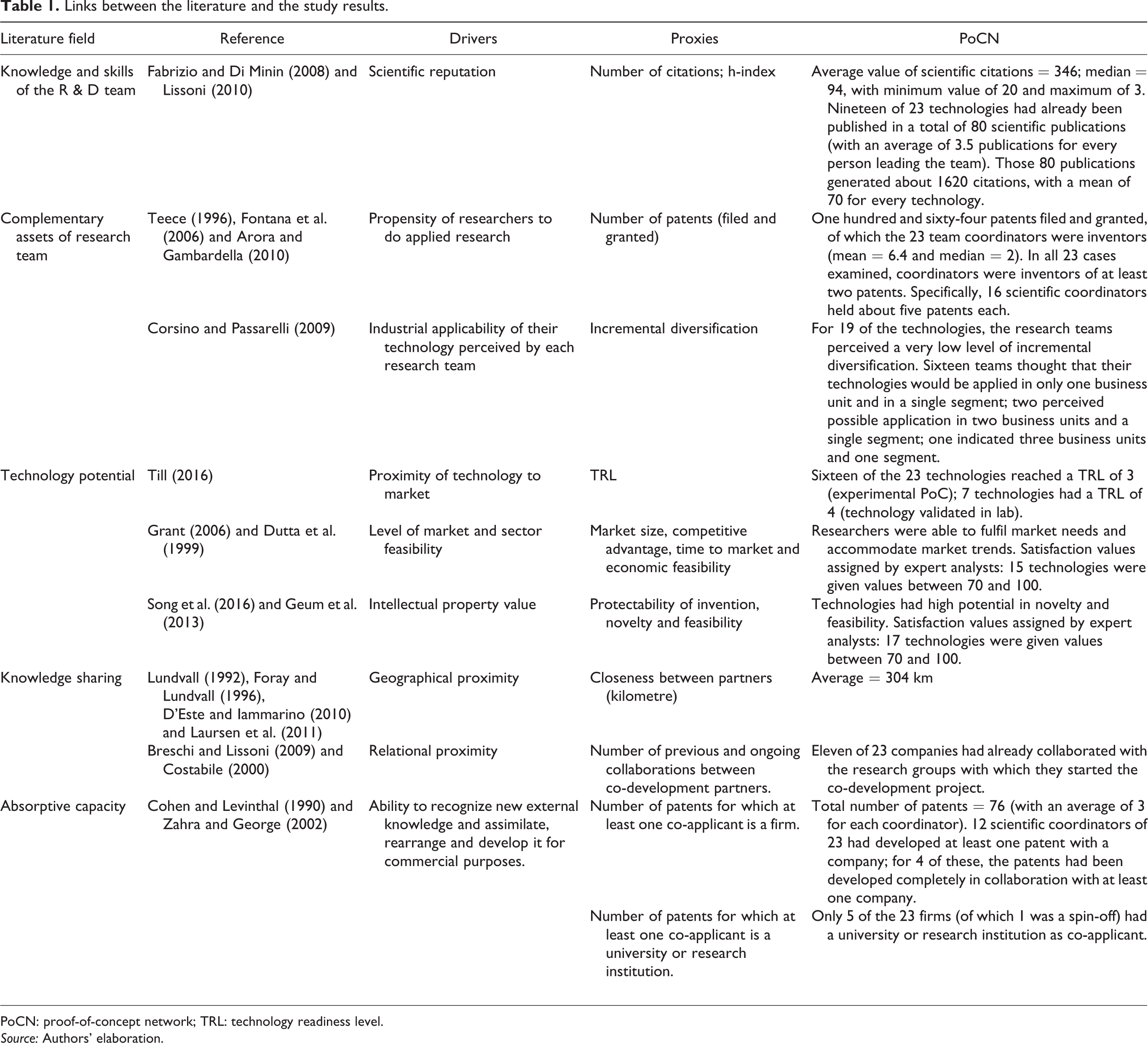
PoCN: proof-of-concept network; TRL: technology readiness level.
Source: Authors’ elaboration.
Theory-building methodology offers an opportunity to build a dedicated framework. Our analysis suggests the following propositions: The scientific reputation of a researcher influences his or her probability of creating a match with industry to co-develop an innovation project. A propensity for applied research increases the probability that the researcher will create a match with industry to co-develop an innovation project. A low TRL for the technology proposed by the researcher increases the probability of a match with industry to co-develop an innovation project. A high level of market and sector feasibility for the technology proposed by the researcher increases the probability of a match with industry to co-develop an innovation project. A high level of intellectual property efficiency for the technology proposed by the researcher increases the probability of a match with industry to co-develop an innovation project. Proximity between the research system and the industrial system increases the probability of creating a match. Geographical proximity increases the probability of a matching between a small medium enterprise (SME) and the research system. Relational proximity increases the probability of a match between a large firm and the research system.
Conclusions and implications
The success of co-development programmes has enabled universities and public research institutions to develop and enhance their experimental results in accordance with an industrial and commercial perspective and companies to innovate their products and processes by identifying, designing and prototyping solutions developed according to their specific needs. The interaction between the research and the industrial systems at the embryonic technology development stage offers a range of benefits to all involved. In particular, companies can enter national and international networks and access a range of cutting-edge scientific findings. According to the project manager of PoCN, Companies have the opportunity to develop new products and processes by making the most of specialized teams with a high degree of scientific reputation, not available within corporate boundaries. Thus, there is a growing level of innovativeness and companies are able to offer the best features for new products or improve the existing ones. Having a preliminary evaluation of the research findings by market and sector experts can steer future research directions, with obvious savings in terms of time and cost; testing in-progress technologies, generating learning-by-doing processes, helps to reduce failure rates and costs; joining a national and international network of firms facilitates the visibility of research findings for industry.
This article, then, contributes to the literature on technology transfer, offering examples and empirical evidence in relation to a very young field of study. The empirical exploratory analysis is intended to improve the understanding of the co-development phenomenon, recently developed and still poorly understood (not least in Italy).
The analysis has also various implications for innovation and technology transfer policies in that co-development models offer potential for economic development. The implementation of the PoCN model has afforded great opportunities to the enterprises, researchers, universities and research centers that have joined the project. In summary, companies that have joined the programme have experienced the following advantages: engagement in national and international networks offering a range of results from frontier research; the prospect of developing new products and processes through cooperation with experts with strong scientific reputations, offering specialized skills that are not available internally (this applies especially to SMEs); the opportunity to offer customers the best features for new products or to improve existing ones; the establishment of an enduring collaboration with the research system; the opportunity to initiate a multidirectional knowledge exchange process with scientific partners; engagement in national and international networks that increase the visibility of the firm’s products and its potential for technological innovation; and the guarantee that new technologies will be tested on product attributes that really meet the needs of the market, so saving money and time.
For their part, researchers, universities and EPRs that have joined the PoCN programme have experienced the following advantages: early feedback on research results by sectoral and market experts, which can help to guide future research, with clear savings in time and cost; the opportunity to test technologies in progress, generating learning-by-doing processes that reduce costs and time for final product testing in the market; the possibility to become part of national and international networks that increase the visibility of research results to industry; saving time by identifying market needs while developing new frontier technologies; and an increase in commercial exploitation of public research results (patents, spin-offs, prototypes, etc.).
The empirical analysis also indicates appropriate policies for technology transfer offices and science parks with regard to implementing activities to promote technology transfer.
Co-development models of technology transfer have implications too for public policies concerning applied research. Italy’s regional governments, for example, might keep such models in mind when establishing Regional Operational Programs dedicated to research and innovation; co-development models might act as the benchmark for designing effective calls for research exploitation and technology transfer. The implementation of effective and efficient public policies, designed for specific regional contexts, is a crucial element in stimulating an improvement in technology transfer and so in increasing the competitiveness of firms for local development.
Limitations and further research
This research is limited to a single case study and questions might be raised about the generalizability of the results. However, according to Flyvbjerg’s (2006) approach, such an analysis could be extended to other cases at the European level, thus enriching the growing literature in the field. Moreover, starting from this work, future research will develop an econometric analysis for a sample of co-development projects across countries to test the propositions.
Footnotes
Declaration of conflicting interests
The author(s) declared no potential conflicts of interest with respect to the research, authorship, and/or publication of this article.
Funding
The author(s) received no financial support for the research, authorship, and/or publication of this article.