



Abstract
The globalization of higher business education supported by the growth of transnational educational institutions is now a feature of the developing countries of the Caribbean region. This article examines the situation of Guyana, where the recent discovery of hydrocarbon resources has created expectations of an economic transformation that will generate a demand for trained personnel to manage the transition: Master of Business Administration (MBA) graduates are expected to contribute significantly in this regard. In the higher education system in Guyana, MBA graduates are produced mainly by the regional university and an Australian transnational institution. This study gathered information on the guiding factors in the choice of MBA through a survey of current students and recent graduates of the two institutions. A comparative analysis of the competing programmes was also undertaken to provide greater insights into their capacities for generating the human resource output necessary for the contemplated transformation.
Keywords
The Master of Business Administration (MBA), developed in the United States and Western Europe, has become the most accepted graduate business degree in the world and is considered the main qualification for creating managers, the primary mission of business schools (Almog-Bareket, 2011; Bubna-Litic and Benn, 2003). The subsequent phenomenon of the globalization of higher business education was triggered by the maturing of the market in the United States and the United Kingdom and the internationalization of curricula and the use of standard learning materials (Altbach, 2004; Bevelander, 2012). In this environment, the MBA gained popularity in the developing world, including in the Caribbean region where both local universities and foreign transnational education (TNE) institutions offer the degree. It is against this background that two specific questions were considered for investigation in this article: Q1: Will the MBA programmes offered in the Caribbean country of Guyana meet the requirement of producing graduates with an adequate level of expertise and ability to assume the challenge of managing the various institutions in the private and public sectors of Guyana? Q2: What was the key motivation of the respective students for their particular choice of MBA programme offered in Guyana?
The first question is particularly relevant to the specific case of Guyana, where the requirement is for the management of the economic development processes that will flow from the imminent production of oil and gas resources. This question is important in view of the contention that the MBA has become the most standardized university programme in terms of curriculum, course content and teaching materials (Altbach, 2004). Further, it has been argued that these aspects of MBA programmes are based on US thinking that has foregrounded consumerism, individualism and competitiveness and led to convergence in education (Wee Pin, 2009). Such priorities were considered questionable in developing-country situations in which there is a need to incorporate sustainability into the MBA curriculum (Bubna-Litic and Benn, 2003).
MBA education has been around for 80 years but has been embraced by universities as a valid area of academic study only in the last 25 years (Cameron, 2017). There is a growing body of literature on MBA studies with an emphasis on curriculum issues, pedagogy, types of MBA, and the ranking of business schools. While the coverage of the literature on MBA curricula and teaching is considerable, there has been little research on the individual institutions that offer business degrees and their operating environments and strategies (AACSB, 2011). The picture is fragmented, with some MBA offerings compressed into 9-month degrees, greater specialization provided by some than by others, the growth of multiple-university degrees and joint-degree programmes (Gupta et al., 2007; Heslop and Nadeau, 2010). In an international survey of alumni of MBA programmes at 71 universities in 16 locations, respondents, with a combination of excellent and outstanding scores, ranked the MBA types as follows: full-time 2-year MBA (82%); full-time 1-year MBA (74%); part-time/flexible MBA (66%); executive MBA (EMBA; 75%); and online MBA (70%) (GMAC, 2015). Students, therefore, have a menu of options from which to choose in their pursuit of an MBA. Such options are, however, limited in developing-country situations where resources and choice are often largely determined by affordability – an issue that is addressed in this article.
There is also a vast gap in the documentation of the experience of MBA programmes in small states (Mehtap-Smadi and Hashemipour, 2011), which this study will contribute to filling. The only published study to examine MBA choices in the Caribbean compared the programmes offered by the regional University of the West Indies (UWI)–Arthur Lok Jack Graduate School of Business (ALJGSB), with those offered by two UK universities and the Australian Institute of Business (AIB) operating in Trinidad and Tobago through franchise arrangements with private local educational institutions (Allahar, 2015). This article also helps to fill the gap in research on MBA studies in the Caribbean and highlights the case of the developing country of Guyana, for which no past published research exists.
The MBA qualification has become an international product that is exported by leading business schools from the United States, the United Kingdom, Canada and Australia, as noted by Mehtap-Smadi and Hashemipour (2011). These authors attribute Australia’s success in exporting education to the creation of a clear national policy and international marketing of higher education programmes. The concept of TNE has attracted considerable attention among a growing body of researchers who pursue the related concepts of globalization and internationalization. In the area of business education, there is a proliferation of labels, such as ‘cross-border’, ‘offshore’ and ‘borderless’ (Knight, 2015, 2016; Whitsed and Green, 2014). MBAs earned through TNE institutions constitute an established growth industry, which is the subject of this article.
The literature on transnational MBA studies invariably focuses on the larger developing countries, such as Brazil, which introduced a ‘science without borders’ policy to stimulate the transnationalization of higher education (Nery, 2017), and, particularly, China, in which 22 international branch campuses from the United States, the United Kingdom, France, Russia and Australia have been established (He and Wilkins, 2017). In the English-speaking Caribbean, the dominant TNE institutions offering business degrees are from England, Scotland and Canada, but, more recently, the AIB has successfully entered the market. The literature acknowledges that research on the delivery and results of such TNE exported by Australian institutions is sparse (Soontiens and Pedigo, 2013). Furthermore, Kosmützky and Putty (2016) assess the literature on the internationalization of higher education as lacking in clarity about concepts and themes, and they identify a trend of attempting to legitimize transnational academic mobility while contending with issues of quality assurance and institutional positions. Kosmützky and Putty (2016) also comment that most of the academic output has been by authors not based in the country under study or affiliated to institutions participating in transnational educational initiatives. This article, by contrast, is based on the active involvement of the authors in MBA education in the developing Caribbean region.
The specific areas of focus of the study were (a) an assessment of the two main MBAs offered in Guyana, the ALJGSB’s international MBA (IMBA) and the AIB’s general MBA; and (b) obtaining students’ views on their choice from these programmes. The methodology of comparing the programme structure, content and pedagogical approaches of the two alternative MBA programmes provided the data for gauging their relevance to the management of the development processes in Guyana (Q1). The examination of motivations for programme choice (Q2) was based on the execution of a short, focused survey of students on various programmes.
The study is significant for prospective MBA students, policymakers and tertiary educational institutions in the Caribbean, because MBA graduates are expected to play a defining role in the economic and institutional development of developing countries seeking to improve the quality of life for their citizens. In this context, Thomas (2007: 13) argues that business schools have to rise to the challenge of producing graduates who possess ‘the skills, flexibility and training to compete in the new economy defined by globalisation and technological change’. This point is especially applicable to Guyana, a country on the cusp of accelerated development as the result of major oil discoveries in its territorial waters by ExxonMobil (Bitto, 2017). These discoveries will create a demand for a human resource pool with the appropriate management aptitude, competencies and skills to oversee the economic boom projected to start in 2020 (Bitto, 2017).
The aim of this article is to present a clearer insight into the concept of the globalization of MBA studies and various entry strategies employed by TNE institutions for delivery of MBA qualifications in developing countries, to provide an analytical basis for student choice of the options offered. The study is unique for Guyana’s business and education environment, and the discussion of the issues raised contributes to the literature by highlighting the implications for prospective MBA students, governmental policy officials and the higher business education system. The remainder of the article follows a logical sequence that begins with a description of the theoretical perspectives and conceptual management framework underpinning the study and then proceeds to an account of the research methodology, an overview of the relevant literature, a country profile of Guyana and its MBA options, the findings of the MBA survey, a comparison of the key features of the MBAs, the implications of the findings for key stakeholders and, finally, our conclusions.
Theoretical perspectives and conceptual management framework
The theoretical underpinnings of the study are based on perspectives on the globalization of education (Blass, 2009; Spring, 2008) and a conceptual framework for management development that is relevant to the study context (Thomas, 2007). At the theoretical level, the globalization of higher education is viewed from four perspectives: neo-institutionalist, post-colonial, world systems and cultural theorist. In the neo-institutionalist view, there is a worldwide culture that adopts a Western model of mass schooling, with a multicultural curriculum driven by market demands in an unregulated environment. The post-colonial view is concerned with economic and political issues and is credited with the rise of the knowledge economy in developed countries. From the world systems perspective, the world is an integrated system comprising a central Western zone and a peripheral zone, both of which operate in a competitive, global education environment. The world systems perspective is also associated with the export of MBA qualifications to developing countries. The cultural theorist perspective emphasizes cultural and knowledge exchange systems that provide the means of creating favourable economic and democratic conditions globally and is attributed to the collaboration between Western universities and institutions in developing countries (Blass, 2009; Spring, 2008).
The conceptual framework adopted identifies the key drivers of management development as demographic forces, globalization, information and communication technology (ICT), the entrepreneurial enterprise and competition (Thomas, 2007). With regard to demographic forces, the dominant factor is the need to cater for older and more experienced people pursuing higher business education through greater use of projects and teamwork, a more flexible curriculum and shorter and more affordable degree programmes. Globalization has led to growth in customized executive programmes, global delivery of management education, the formation of strategic alliances and partnerships and increased diversity and cross-cultural content. ICT enables greater use of Internet technology, self-study programmes, technological tools for teachers and access to electronic databases. Entrepreneurial enterprise in management education includes entrepreneurship studies, small business, business start-up projects and university-based business incubators. Competition among management education providers raises issues of competitive pricing, inter-university collaboration, a focus on core competences and relevant niches and a greater stakeholder orientation.
The analyses of MBA programmes in this article are linked to the world systems and cultural theorist perspectives and the following specific drivers in the management development framework: flexibility of curricula, shorter degree programmes, an increase in self-study (especially Internet-supported), an increase in customized MBAs, an entrepreneurship focus, business incubators and competitive pricing.
Research methodology
A mixed methods approach was adopted in the collection of qualitative and quantitative data. Published data on the main themes of the globalization of MBA studies and the operations of TNE institutions were sourced from the leading digital full-text aggregator journal databases of ABI/INFORM® and EBSCOhost®. Relevant studies and reports by international research institutions were downloaded from the Internet. A thematic analysis was conducted of the data obtained from these published sources to identify patterns across the research data and to identify the critical issues through a process of data familiarization, coding and sub-theme development (Braun and Clarke, 2006). The critical issues that emerged from the analysis relating to MBA studies and TNE institutions are explored in the literature review.
Data on the characteristics and structure of the MBA programmes offered in Guyana were obtained from desktop research of the institutions’ websites and promotional programme material and the downloading of programme prospectuses. For the purpose of comparative analysis, a matrix table was constructed comprising the key features of the two main programmes, and the details were checked for accuracy by the programme coordinator of the ALJGSB-IMBA and the official site of the AIB in Guyana.
A short questionnaire, comprising seven questions that elicited yes/no responses with the option to provide reasons for the response, was used as the survey instrument. The main aim of the questionnaire was to obtain responses from participants in both the ALJGSB-IMBA and the AIB-MBA programmes regarding the reasons for their choice of MBA programme. The questionnaire was deliberately kept short in light of the authors’ previous experience of the difficulty of obtaining student responses to similar questionnaires. The process was facilitated by the programme coordinator of the ALJGSB-IMBA and a lecturer in the AIB Guyana programme, both of whom issued the questionnaire to current students and recent graduates by email, received the responses and transmitted them to the authors. The survey data were entered on an Excel spreadsheet so that statistical analyses could be undertaken: the results of these analyses are discussed in the section below on survey findings.
Overview of relevant literature
The published literature on MBA studies and TNE is wide ranging and growing. This overview focuses on those studies that are applicable to, and have lessons for developing countries with limited experience in higher business education, with specific regard to the globalization of MBA studies and the entry of TNE institutions into the Caribbean market.
Globalization of MBA studies
The terms ‘globalization’ and ‘internationalization’ are linked and are sometimes used interchangeably in the literature on the commercialization of higher education. Internationalization is generally considered to be the response to globalizing activities (Knight, 2015; Whitsed and Green, 2014). More particularly, globalization is viewed as ‘the broad economic, technological, political, cultural, and scientific trends that affect higher education’, while internationalization deals with ‘the specific policies and programs undertaken by governments, academic systems and institutions, to cope with or exploit globalization’ (Altbach, 2004: 6). These interpretations imply a developing business environment with globalization acting as a process of change in which educational institutions seek to export their services to foreign locations to foster an understanding of the dynamics of business operations (AACSB, 2011) that is consistent with the world systems theoretical perspective. In this regard, Merey and Alkan (2015) suggest that globalization is an economic phenomenon that emphasizes the integration of national economies, while internationalization focuses on international trade and commerce. In this context, global education is required in an increasingly competitive world, and the tasks of business schools are to achieve a sense of mission or professional obligation, networking to build connectivity with other schools, brand-building, satisfying demand, generating revenues and self-transformation (AACSB, 2011). Interestingly, the globalization and internationalization of business education have not earned much attention in academic journal publications, with fewer than 4% of the top journals addressing the subject (AACSB, 2011).
Further, the globalization of higher business education is unsurprisingly concentrated in developing countries and dominated by large Western universities (Altbach, 2004). Concern has been expressed in the literature about whether MBA programmes are adequately preparing managers and business leaders for the future through the updating of curricula (Minh Ly, 2015). This is considered particularly relevant for developing countries where, as in the case of Vietnam examined by Minh Ly (2015), there is a need for the localization and tailoring of offshore MBA curricula to ensure the effective transfer of content. In addition, business schools need to rethink many of their most cherished assumptions if they are to remain relevant, because there are significant unmet needs such areas as leadership development; critical, creative and integrative thinking skills; the capability to understand modern organizational realities; and the imperative of balancing analytical problem-solving skills with the need to embrace social responsibility and accountability (Datar et al., 2010; Schlegelmilch and Thomas, 2011; Thomas, 2017). The globalization of higher business education has also failed to provide the sharing of best practices in management education with indigenous business schools in emerging markets (AACSB, 2011). The relevance of the MBA curriculum offered in Guyana to the future economic and business development demands of the country is integral to this study.
MBA programmes represent a competitive industry in which business schools compete for students and are impacted by rankings by Business Week, The Wall Street Journal, US News, World Report and the Financial Times (Wee Pin, 2009). The literature indicates that the preferred programmes offer a challenging workload, cover functional areas, address strategic decision making, focus on teamwork skills and network development, emphasize leadership and communication skills, embrace innovation and cover both theory and practice (Heslop and Nadeau, 2010). These findings are consistent with those of an MBA survey indicating that students preferred programmes that improved career prospects, involved critical thinking, provided links to business and industry, offered value for money and allowed for flexible study (Carringtoncrisp et al., 2013). Further confirmation is provided by an AACSB (2011) study of the globalization of management education, and the findings of the MBA survey set out in this article. With the observed trends in the globalization of business education, there is evidence of the ‘emergence of a global system of management education’, which is defined by the level of interaction among institutions and individuals in a global network (AACSB, 2011: 210).
Transnational institutions and MBA education
The focus on the internationalization of education started in the mid-1990s. Most of the research has looked at trends in student mobility, the policies and strategies adopted by organizations including internationalization modes, critiques of the results and unintended consequences, curriculum internationalization, franchising and the recruitment of foreign staff (Bennett and Kane, 2011; Tamtik and Kirss, 2016; Youssef et al., 2012). An influential study identifies three generic models: the classic one, which reflects the development of multiple activities and partners at home and abroad and involves a broad spectrum of intercultural and international academic, research, service and management initiatives; the satellite model, which uses off-campus research centres, international branches and offices for alumni relations; and the co-founder model, which is the most recent approach and involves independent institutions co-developed by international partners (Knight, 2015).
The co-founder model has evolved into different forms, from the initial twinning programmes with a host-country institution to joint or double degree programmes (the legitimacy of which have been questioned by some researchers – see Wilkins and Huisman, 2012; Kuder et al., cited by Knight, 2016); the establishment of new universities co-developed by two or more universities from different countries; new approaches to distance education with support from host countries; and franchise universities based on arrangements with a host-country institution to offer franchised programmes (Knight, 2016). Taking these models, Knight (2016) has devised a framework that categorizes TNE institutions as independent or collaborative providers. Independent providers are defined as foreign institutions that set up operations in a host country without input into course design or delivery from local institutions. The collaborative approach involves foreign institutions forming agreements with local educational institutions or private business organizations for delivery of MBA programmes. The franchise agreement is one of the most common collaborative approaches used in TNE as an entry strategy into developing-country educational markets. The implementation of this strategy has been successful in the Caribbean over the past two decades and has created a competitive arena that makes the sustainability of the model a challenge.
Although the curricula of most MBA programmes have similar content, all MBA degrees are not created equal. The differences lie in the stability and validity of the educational institution delivering the programme, the quality of the instructors, the relevance of the curriculum and teaching methods to the local situation, the academic sophistication of the assignments and the overall rigour of the studies in terms of the depth and breadth of topics covered. The delivery of MBA degrees through business schools raises issues and challenges with regard to ‘governance models, intercultural partnerships, accreditation, awarding of qualifications, staffing, language, host country regulations, and sustainability’ (Knight, 2015: 117), all of which issues impact on the case presented in this article.
Guyana country profile and MBA options
Profile
Guyana is located on the South American continent but is politically part of the Caribbean community of anglophone countries. The latest population estimate is 750,000, with a tertiary education student body of 69,283 (Guyana Bureau of Statistics, 2018). The country is considered the third poorest in South America and the Caribbean (Bitto, 2017), with per capita gross domestic product at US$4.5 million in 2016, projected to grow to US$4.8 million in 2018 (IMF, 2017). The economy is based on extractive industries comprising gold, diamonds and bauxite, which accounted for a modest expansion of economic activity by 3.3% in 2016 (IMF, 2017). The macroeconomic outlook for the medium term is positive, based on projected increases in public investment, the expansion of the extractive industries and increased rice production (IMF, 2017). However, as noted above, in the longer term, the economy of Guyana is expected to be transformed because oil production is anticipated to reach 100,000 barrels per day in 2020, rising subsequently to 400,000 (Bryan, 2017). However, the country is expected to face challenges with regard to the ‘resource curse’, territorial issues with Venezuela in a disputed area of oil production, environmental protection, wealth management and social impacts (Bitto, 2017; Bryan, 2017). The challenge that is particularly relevant to this article is the creation of a pool of skilled people to manage the revenues from the oil boom in the interest of the future economic and social development of the country.
MBA options
There are three options for obtaining an MBA qualification in Guyana: the Commonwealth MBA (CMBA) offered by the University of Guyana under licence from the Commonwealth of Learning, United Kingdom; the IMBA through the UWI-ALJGSB; and the general MBA from the AIB offered under a franchise agreement with a local company (at time of writing, the TNE institution is registered with the Guyana National Accreditation Council but has not reached the stage of accreditation). The reputation of business schools drives the demand for their MBAs and the CMBA, despite its 10-year life, has suffered in this respect in the Guyanese market, as confirmed by the MBA survey findings. The main competitors are the UWI-ALJGSB and the AIB, whose products are significantly differentiated but are established in the market and hence the focus of this article. The ALJGSB, based in Trinidad and Tobago, is an integral part of the UWI system and contributes to the development of Trinidad and Tobago and the wider Caribbean region through its academic and executive education programmes. The business school was established in 1989 as a strategic alliance between the private sector and the UWI, St Augustine Campus – the latter providing the approval of programmes and the awarding of degrees. The business school aims to facilitate competitiveness and innovation in Trinidad and Tobago and the Caribbean region. The ALJGSB ventured into the Guyana market in 2010, offering first the EMBA and later the IMBA, which, since 2014, became the school’s main programme offering in Guyana.
Australia has emerged as an active player in the business of TNE, and by 2004, all major Australian public universities had established a presence in offshore locations (Soontiens and Pedigo, 2013). According to Soontiens and Pedigo (2013), Australia assigned importance to TNE as an export industry, initially focusing on South East Asia. Entry into the Caribbean region was led by the Adelaide-based AIB which was launched in 2011 as a private company, the outcome of the rationalization of the training activities of a management consulting firm. Trinidad and Tobago is the main centre for the AIB in the Caribbean, based on franchise arrangements with three private higher education institutions, and offering a general MBA with an option of five specializations in the Trinidad and Tobago market. The AIB also offers its general MBA in Ghana, the Maldives and Guyana through franchise agreements with three teaching centres (AIB, n.d.). The AIB promotes its MBA as fully accredited by the relevant Australian government agency and provides an adult-centred, affordable, flexible and accelerated qualification under the rubric of the practical business school focused on applied learning for the workplace (Skinner, 2015). However, it has been noted that research on the delivery mechanisms and standards and the quality levels of such schools has been sparse, even though the industry is characterized by great competitiveness (Soontiens and Pedigo, 2013). Competition among TNE institutions has been intensified in 2018 by the arrival of the UK-based University of Bedfordshire, which has entered into new franchise arrangements with the previous AIB franchisee to offer its generic MBA and specialized MBA in oil and gas management. Guyanese students have the alternative option of continuing directly with the AIB on a 100% online basis.
Survey of Guyana’s MBA students – Findings
Primary research was conducted to obtain basic data on the motivation of MBA students in Guyana regarding their particular choice of institution and the type of MBA degree they pursued. As already noted, data were obtained by means of a short questionnaire emailed to students of the MBA programmes offered by the ALJGSB-IMBA and AIB-MBA. The questionnaire sought responses to the motivation for pursuing an MBA; the reasons for the choice of institution; attitudes to the UG-CMBA; familiarity with the AIB’s offering and target market; and whether the two programmes addressed the realities of Guyana’s businesses and society. The questions all called for yes-or-no answers for qualitative analysis of the results, while open comments on each question were also invited to obtain qualitative views for analysis.
The questionnaires were distributed on 15 February 2018 and a cut-off date of 26 February was established by the authors based on past experience with students’ responses to questionnaires. Sixty students of the IMBA were contacted directly, but only 11 responses (18%) were received, reflecting a disappointingly low rate of participation. Fifty students of the AIB were issued with questionnaires and the 21 responses received indicated a reasonable response rate of 42%. Because of the small data set, Excel software was used to conduct a statistical analysis of the data, the key results of which are identified below: The main motivating factors for pursuing an MBA, irrespective of programme choice, were career advancement followed by higher income. The overwhelming reasons for the choice of the ALJGSB-IMBA were shared between the reputation of the business school and the international Association of MBAs (AMBA) accreditation, while affordability was the dominant reason for the choice of the AIB, followed by the flexibility of weekend classes, which was convenient for working adults. The ALJGSB’s participants viewed their programme as more rigorous and preferred the ‘authentic learning’ approach to the compact weekend programme offered by the AIB. The UG-CMBA was not attractive to Guyanese students because of doubts about its international recognition and a poor assessment of the UG’s facilities, faculty strength and programme management. There was a view that this programme was more of an EMBA, geared towards public sector managers in Guyana. Interestingly, 100% of the ALJGSB’s students were aware of the AIB’s programme, but 35% of the AIB’s students were not familiar with the ALJGSB-IMBA. The question on whether the AIB targeted a lower managerial segment of the MBA market was supported by 44% of the ALJGSB’s students and 40% of the AIBs respondents. A question on the students’ assessment of the relevance of the two programmes to the business and social realities of Guyana generated a 27% positive response from ALJGSB students, but 90% from the AIB’s students. However, it was noted that the AIB’s programme was being replaced by the University of Bedfordshire’s MBA, with its concentration on oil and gas management which was viewed by some students as adding relevance. The ALJGSB’s students were asked whether they considered the programme offered by the AIB to be a threat to the ALJGSB programme in Guyana, but only 23% found this to be the case. Perhaps, the threat to the ALJGSB-IMBA may be heightened with the introduction of the University of Bedfordshire’s programme, which specifically addresses the current and future needs of Guyana’s developing hydrocarbon sector. The ALJGSB offers an MBA in Sustainable Energy Management at its Trinidad and Tobago campus and should explore the feasibility of offering this option in Guyana.
Comparative international data were obtained from a survey of 1,200 prospective MBA students’ from 69 countries conducted by Carringtoncrisp, the Association of Business Schools and the European Foundation for Management Development. The survey focused on the reasons for choosing a business school, and the main student motivational factors linked to the choice of specific programme (Carringtoncrisp et al., 2013). The survey results confirmed that the main reasons for choosing a business school were (a) the improvement of career prospects and the integration of theory and real-world application (over 50%) and (b) it challenged students to think differently, supplied new skills and contained strong practical content (over 40%). The choice of business school and programme was influenced by a mix of the school’s international and academic reputations (over 50%), the quality of the teaching faculty, the record of enhancing career prospects and combining theory with work application (over 50%), the fostering of links with business and industry, value for money, allowing flexible study and providing international study options (Carringtoncrisp et al., 2013).
Comparison of main MBA programmes in Guyana
Based on the research on the globalization of MBA studies, certain programme components were identified as critical to this study context: the mandate of the business schools; entry requirements; programme structure; curriculum design, content and duration of study; teaching approach and faculty; assessment methods; programme fees and costs; and accreditation. These components formed the core of a comparative analysis of the two MBA programmes in this study (Table 1). The analysis was linked to the theoretical perspectives of world systems theory, which addresses the centre and periphery view of competitive global education, and cultural theory, which deals with knowledge exchange through collaboration between foreign and local educational institutions for the delivery of MBA qualifications (Blass, 2009; Spring, 2008). Further, the concepts detailed in the management education analytical framework espoused by Thomas (2007) were also applied in the comparative analysis as the basis for reaching conclusions regarding relevance to the Guyana situation.
Comparison of the ALJGSB and AIB-MBA models in Guyana.
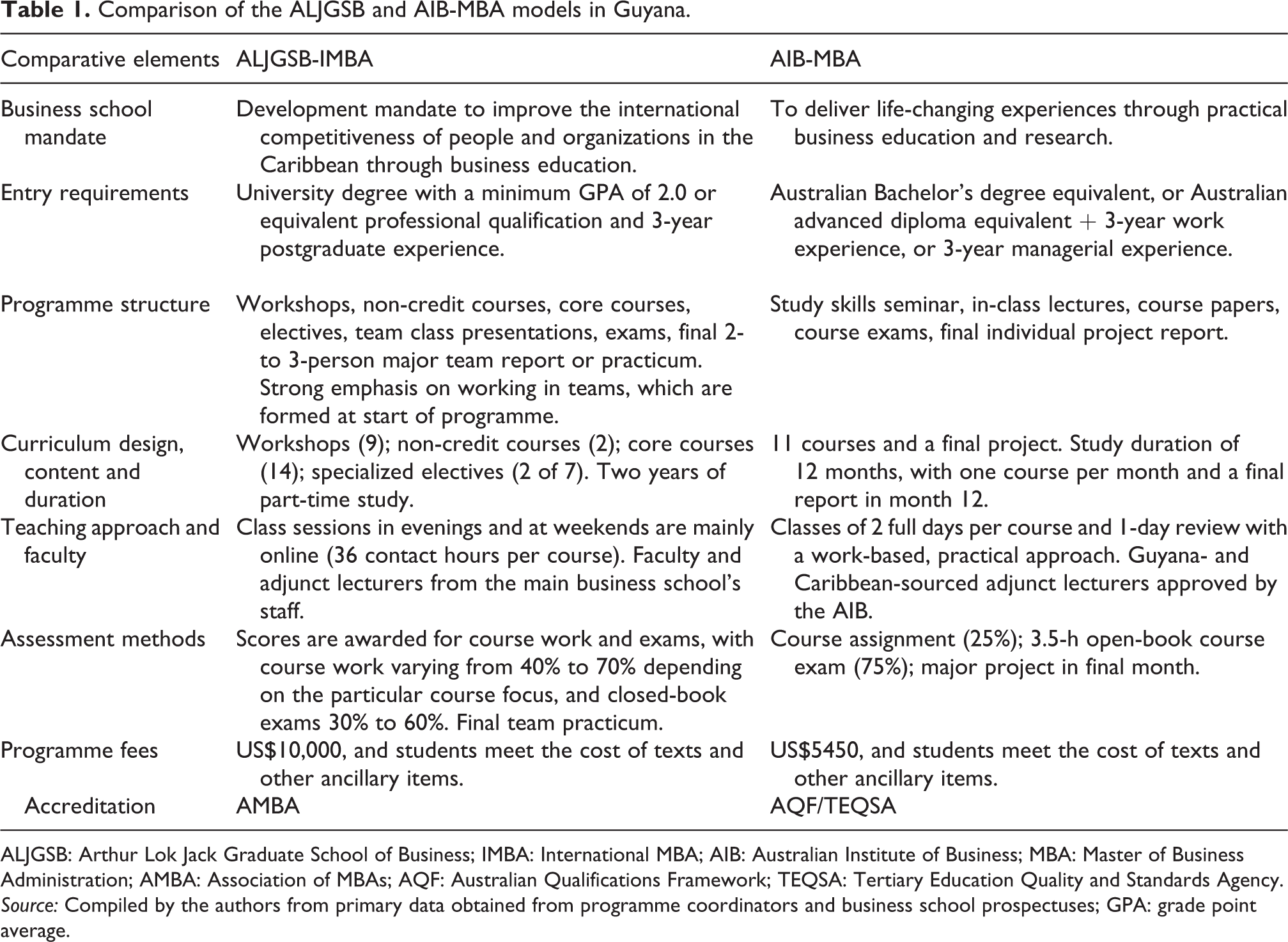
ALJGSB: Arthur Lok Jack Graduate School of Business; IMBA: International MBA; AIB: Australian Institute of Business; MBA: Master of Business Administration; AMBA: Association of MBAs; AQF: Australian Qualifications Framework; TEQSA: Tertiary Education Quality and Standards Agency.
Source: Compiled by the authors from primary data obtained from programme coordinators and business school prospectuses; GPA: grade point average.
Mandate of the business schools
The ALJGSB has a developmental mandate which is directed at improving the international competitiveness of Caribbean people and organizations through business education, training, consulting and research. However, the AIB’s mandate is oriented towards the practical application of its training in the workplace. These mandates thus differ in scope and purpose, with the ALJGSB adopting a Caribbean-wide focus, consistent with the conceptual position of the entrepreneurial enterprise as a driving force of development (Thomas, 2007). The AIB is more concerned with equipping students for the world of work and employability under the rubric of the ‘practical school’, which relates to the competitive forces perspective of Thomas (2007). This distinction introduces the consideration of whether a business school is a business or a school, if the former is characterized by a focus on market share, international opportunities, competing for students, generating profits and stressing efficient operating processes, and the latter by an emphasis on education and training with the aim of meeting student needs and addressing urgent global issues (Rayment and Smith, 2013).
Entry requirements
The ALJGSB aims to provide ‘practical experience for business professionals who are on the path to middle management and further specialization’ with the intention of broadening world views, critical thinking and problem-solving (UWI-ALJGSB, 2017). It requires entrants to have a Bachelor’s degree or equivalent professional qualification and 3 years of post-graduation work experience. The AIB requires an Australian Bachelor’s degree equivalent, an Australian advanced diploma equivalent plus 3 years of work experience or 3 years of managerial experience. These three options expand the potential market for the AIB because they accommodate a mix of people from different educational backgrounds and with varying business experience.
Programme structure
The respective programmes are comprised of core courses and concentrations or specializations, but differ significantly in design. The ALJGSB follows a trimester system over 24 months and an approach that aims to prepare students for senior management positions in public and private sector organizations. This programme includes workshops, non-credit courses, core courses, electives, team class presentations, exams and a final two- or three-person major team report or practicum. The AIB’s programme is designed for working adults who are seeking to obtain a graduate qualification for employment or to climb the managerial ranks in the private and public sectors; hence a compact package of courses is delivered on a monthly modular sequence. This programme includes a study skills seminar, in-class lectures focused on clarification of the content provided in course manuals, preparation of course papers, exams and a final individual project report. The AIB’s programme is consistent with the demographic trend towards shorter and more affordable programmes (Thomas, 2007).
Curriculum design, content and duration
The ALJGSB’s MBA is designed along the lines of the authentic learning process that requires class attendance for live lectures, participating as a team member for group assignments and course projects, individual written exams and a supervised team practicum. The programme is aligned to those of the leading business schools in the United States and the United Kingdom, involving 14 core courses supplemented by workshops, non-credit courses and electives. The core courses and electives are delivered in a trimester of 36 contact hours of class and online time per course, team-based course projects and the culminating practicum – which is consistent with the trend towards project and teamwork (Thomas, 2007). The workshops are conducted at the beginning of the trimesters along with selected core courses. The AIB’s programme has a compact, functional design comprising a total of 11 courses delivered on a modular monthly sequence requiring 3 days of class attendance per course and a final course report on a relevant business issue as the output. There are significant differences in the approaches of the two business schools in that the ALJGSB emphasizes teamwork as the core of its model, while the AIB programme is oriented towards individual study.
There is a considerable difference in the duration of the respective programmes, with the ALJGSB-IMBA being twice as long as the AIB. This is partly a reflection of the trimester system adopted by the ALJGSB, which has a greater number of courses of longer duration and a 6-month practicum, as opposed to the continuous flow method of the AIB that mimics the online learning approach. The AIB’s model involves three contact days per course with two weekend days of classes and 1 day of revision followed by a written course exam. The final month is allocated to the completion of a major project focusing on a significant business issue related to the programme content. This model provides for staged certification, with students earning a graduate certificate after 4 months and four courses, a graduate diploma after 8 months and eight courses and the MBA after 12 months. A further differentiation between the two programmes is the ALJGSB’s requirement for the completion of the practicum – this exercise involves the preparation of a business plan for a new opportunity or the conduct of an organization study to diagnose business problems, identify solutions and implement at least one of those solutions, as the timeframe permits. The business plan is presented to an independent panel for feedback and grading, while the organization study is presented over three stages to the host company, with each presentation graded by the supervisor.
Teaching approach and faculty
The ALJGSB-IMBA programme requires significantly more class time, student participation, teamwork and research. The AIB’s class time is limited and the programme is student-driven, with mastery of one text as the knowledge instrument. The ALJGSB’s faculty is more broad-based and diverse than that of AIB because it has access to a larger pool of expertise. Significantly, the ALJGSB’s staff are empowered to modify course outlines to ensure ongoing relevance in content and context and/or customization. In this regard, the AIB’s approach raises issues about the depth of understanding and learning provided in such compact programmes, which do not allow flexibility to innovate the curriculum, consistent with most franchise arrangements in which content is dictated by the franchisor.
Assessment methods
The main differences in the assessment methods employed by the two business schools are in the greater course-grading flexibility of the ALJGSB and the requirement for submission of the final practicum report of up to 20,000 words, which is scored with marks awarded for the written report (60%), panel presentations (30%) and a reflective journal (10%) in which students track their experiences during the practicum. Further, the ALJGSB’s coursework assignments are team-based, but final exams are individually assessed, while the AIB’s system is individual-oriented and assignments follow a template contained in its course manual, and marks are awarded for course assignments (25%) and exams (75%).
Programme fees
The ALJGSB’s programme fees of US$10,000 are approximately twice those of the AIB. This is to be expected because the programme is 24 months compared to the AIB’s 12, has greater contact hours and is much more demanding of resources with the requirements for maintaining international accreditation. The nature of the AIB model entails a much lower cost for the programme, and this is a significant influencing factor in markets such as Guyana (costs were highlighted in the survey feedback). An important cost-saving component is the AIB’s strategy of using local lecturers, while the ALJGSB recruits a mix of local and foreign faculty. This AIB strategy is consistent with the driving forces framework that points to competitive pricing and shorter programmes (Thomas, 2007) and accords with the position that a low-cost degree is more important than a high-quality qualification in some circumstances because the quality model is geared more to executives who are targeting corporations (Lorange, 2012).
Accreditation
The MBA programme of the UWI-ALJGSB was accredited by the UK-based AMBA in 2003 and has maintained that accreditation to the present. The school has also benefited since 2012 from local accreditation by the Accreditation Council of Trinidad and Tobago. The AIB is accredited by the Tertiary Education Quality and Standards Agency in the Australian Qualifications Framework to award higher education qualifications and degrees but carries only ‘approved’ status with the National Accreditation Council of Guyana. Because of the international recognition of the AMBA accreditation, the ALJGSB is perceived as having a higher-level accreditation, as was borne out in the responses to the MBA survey. However, the Australian accreditation carried by the AIB is a valid one and has an acceptable recognition level shared by leading Australian universities.
Summary
The overall conclusion from this comparative analysis of the two programmes is that both programmes have relevance for the Guyanese market, but the ALJGSB-IMBA, with its greater rigour and more broad-based scope of study, is more relevant to the higher management requirements for the future economic development of the country under the projected conditions of new wealth.
Implications for key stakeholders
The results of this study have implications for various stakeholders, as follows: Current Guyanese policy prioritizes increasing learning achievements at all levels and decreasing mismatches in the learning outcomes of students in coastal and hinterland schools (Ministry of Education, Guyana, 2014). At the MBA level, the state-owned University of Guyana-CMBA is the government’s only involvement in graduate business education, and the programme is not well regarded by students, as is reflected in our survey results. Further, Guyanese educational authorities do not assess the curricula of TNE institutions for relevance. Guyanese officials need to formulate a clear governmental policy towards higher business education in support of the creation of a managerial cadre to manage the new wealth and a transformed economy. The role and contribution of TNE institutions in the delivery of MBA qualifications should be assessed by the education authorities in Guyana and those in the wider Caribbean. The National Accreditation Council of Guyana was incorporated in 2004 with a three-stage process of registration, approval and full accreditation, but the current status is that only one institution, in the engineering field, has achieved full accreditation. This Council needs to become more active in completing the process of granting accreditation status. The ALJGSB’s policy regarding the design and delivery of MBA qualifications in the Caribbean and a strategy for competing with TNE institutions in the Caribbean market are critical. The ALJGSB will need to rethink its MBA offering in Guyana so that it can better cater for its market’s needs and to confront further competition from TNE institutions (Datar et al., 2010; Petit, 2011). Such a rethinking exercise should include consideration of the desirability and feasibility of offering its specialized MBA in Sustainable Energy Management in the Guyana market, or including it as an adjunct to the IMBA, to counter the impact of the new TNE, the University of Bedfordshire, which offers a similar programme. Appropriate higher business education models must be formulated by Caribbean universities and business schools if effective business leaders are to be produced (Thomas, 2017) and academic, personal and social values are to be imparted to students, executives and alumni through the knowledge and skills such models will develop (Bevelander, 2012). Private Guyanese companies in the market for managerial personnel at all levels must be taken into the confidence of the MBA providers in tailoring their offerings to corporate needs at all tiers of management. Such collaboration between the public and private sectors will greatly assist in avoiding the potential flight of candidates and the ‘brain drain’ of qualified MBAs through offers of scholarships. A key contribution of this article is that it can serve as a document to familiarize prospective MBA students in Guyana to the options available and as a guide to selecting an appropriate MBA.
Conclusions
This article examines the phenomenon of the globalization of higher business education and the growth of TNE institutions that are seen as responsible for the internationalization of MBA studies. The specific aim has been to assess the relevance of the MBAs on offer in Guyana to the development of the country in the context of an impending economic boom based on recent discoveries of oil and natural gas. A major conclusion is that the MBA qualification is established in the Guyanese market as a prized higher education attainment that can make a significant contribution to advancing the development status of the country. However, the timeframe is tight, because additions to the managerial and skilled human resource pool to drive development will be required by 2020, when oil production will commence. The managerial pool is expected to be sourced from graduates of the MBA programmes provided by the ALJGSB and the AIB. However, the entry of the University of Bedfordshire, offering an MBA in oil and gas management in Guyana as a replacement for the AIB’s general MBA, will reinforce the involvement of TNE in the market. The potential contribution of the graduates of the University of Bedfordshire to satisfying the demand for local expertise in oil and gas management is a subject for future research. The responses to our survey of MBA students and graduates, as a first-time undertaking, highlight the need for a review of higher business education policy and the formulation of a strategy to ensure that MBA programme graduates are aligned with the development requirements of an economy in transition to new wealth.
The assessment of the competing MBAs is based on a comparative analysis of the details of the programmes offered in Guyana. The overriding conclusion is that both the IMBA from the ALJGSB and the general MBA from the AIB are relevant to Guyana because, in the view of the authors, the programmes are designed for different market levels in the economy. The IMBA is designed to supply middle- to upper-level executives for private corporations and senior governmental administrative management positions and is a vehicle for pursuing further studies, such as the DBA offered by the ALJGSB. The AIB’s MBA is geared towards providing entry-level professionals who will fill the lower managerial ranks with the prospect of climbing up the corporate ladder. Therefore, the educational institutions differentiate their offerings by targeting specific market segments and tailoring the curricula, delivery mode, duration, costs and intensity to meet the different market needs and circumstances of participants. These are the bases on which the TNE institutions have acquired market share in Guyana and the Caribbean through the negotiation of franchise arrangements with local private organizations for the delivery of MBA qualifications at what amounts to half the cost and half the duration of the ALJGSB’s programme.
Footnotes
Acknowledgements
The authors acknowledge the assistance with the MBA survey of Brandon Hamid, Coordinator of the ALJGSB-IMBA, and Kamla Rampersad de Silva, lecturer, ALJGSB and AIB.
Declaration of conflicting interests
The author(s) declared no potential conflicts of interest with respect to the research, authorship, and/or publication of this article.
Funding
The author(s) received no financial support for the research, authorship, and/or publication of this article.