



Abstract
During the course of the past 30 years, a challenge made to entrepreneurship educators has gone unaddressed. While acknowledging that there has never been a more exciting time to be an enterprise educator, we suggest that there has also never been a more challenging time. On the one hand, the changing nature of employment landscapes globally is forcing a freelancer world on us all. In this new world, our students must increasingly be capable of developing an enterprising career, regardless of any additional start-up aspirations. Conversely, the legitimacy of our teaching practice remains challenged at a level slightly above the student–educator interface. These concerns tend to question our collective purpose and relevance. This article seeks to offer a holistic framework through which enterprise and entrepreneurship educators can act in greater unison. In doing so, it also aims to move us collectively on from the current focus of our scholarly writings to analyse more deeply how we promote and define our purpose and relevance as enterprise and entrepreneurship educators. Our observations inform us that the greater challenge lies not in finding a starting point for new ideas in enterprise education, but rather in engaging all key stakeholders and developing an inclusive scholarship of teaching. At a time when higher education stands accused of failing graduates, we offer leadership on addressing long-running challenges in our field of education.
Increasing attention is being given to notions of entrepreneurship education, enterprise education, entrepreneurial education, entrepreneurship training and entrepreneurial learning. While the activity that surrounds such scholarship is admired in our corner of the education universe, it may be confusing to others who operate without our nuanced appreciation of what separates and unites these areas of focus. At the same time, the challenge implicit in the warning of Vesper and Gartner (1997: 420) that ‘if university entrepreneurship educators do not step forward to assume leadership of our own field, others will surely come to the forefront to determine the rules of the game’ remains largely unaddressed. This article ambitiously attempts to reorient our discussion of enterprise and entrepreneurship education to enable real progress to be made in relation to the challenge of Vesper and Gartner. This entails deliberately moving on (for a moment) from many of the key areas of discussion present in our growing literature. It is very clear that the practice of enterprise education is broad both in the context of origin/place and in terms of learning approaches. We risk being overwhelmed by our own honest efforts to catalogue our collective practice. We believe that deeper questions related to our collective purpose and relevance must now take precedence.
In line with the recently revised guide of the United Kingdom’s Quality Assurance Agency (QAA, 2018: 9), we view enterprise education as the process of developing students in a manner that provides them with an enhanced capacity to generate ideas, and the behaviours, attributes, and competencies to make them happen. It extends beyond knowledge acquisition to a wide range of emotional, intellectual, social, cultural and practical behaviours, attributes and competences, and is appropriate to all students. aims to build upon the enterprising competencies of students who are capable of identifying opportunities and developing ventures, through becoming self-employed, setting up new businesses or developing and growing part of an existing venture. It focuses on the application of enterprising competencies and extends the learning environment into realistic risk environments that may include legal issues, funding issues, start-up and growth strategies. (QAA, 2018: 9)
Locating the nature of enterprise education
The symmetry of our ideas is captured in Figure 1. Our collective conversations tend to be dominated by competing perspectives that shift in relative importance based on a range of factors, not the least of which are our personal teaching philosophies and institutional contexts. We see established enterprise and entrepreneurship zones that, despite their legitimate development, are too often seen as competing views, or as misinterpretations of one another. Note, when we use ‘EE’ hereafter, we are referring to both enterprise and entrepreneurship education. We are heartened by the adoption of both zones in the QAA guide for EE (QAA, 2018: 16). This represents a growing recognition by policymakers that EE perform different roles. For example, where enterprise education offers a safe zone for students to discover aspects of the developing inner world, entrepreneurship education, as we see it, is designed for more purposeful student action. As such, we acknowledge different modes of thinking related to passion and process. The base of the triangle in Figure 1 represents the potential broad application of enterprise thinking whereas the top of the triangle signifies the small student group that seeks to take purposeful action via the curriculum. A common aim of EE is the development of a capacity for self-negotiated action, be that for personal development or venture/value creation. Therefore, we see entrepreneurship education as being for the relative few, in contrast to enterprise education, which is increasingly made available to many students.
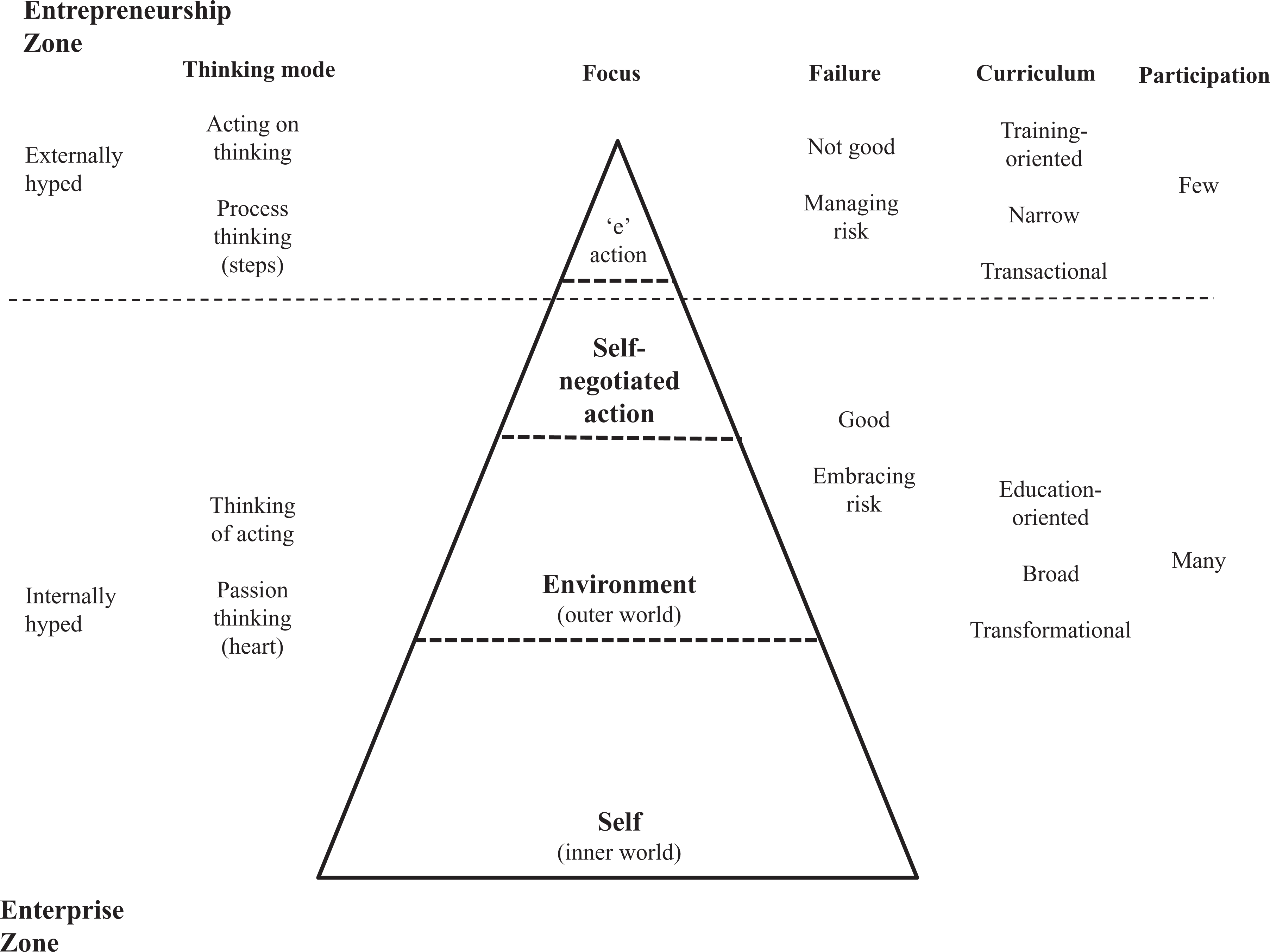
The enterprise–entrepreneurship triangle.
In developing the enterprise–entrepreneurship triangle, we aim to visually communicate several propositions about entrepreneurship education and enterprise education. We believe that it is important to discuss these propositions. They provide different points for future debate. For example, in the absence of such a process of reorienting our collective discussions, we expect that we shall continue to see calls for different approaches to ensure the development of self-efficacy (Piperopoulos and Dimov, 2015), but we shall perhaps still remain collectively ignorant of the true importance of context. We aim to address context in a fine-grained and yet universal manner, from which even the long-held scepticism of David Birch (Aronsson, 2004) can be overcome. We question the idea that our students await activation through further development of their sense-making skills (Johannisson, 2016), for this ignores the greatest virtues our students possess: their own curiosity and latent aspirations. The process of entrepreneurship is far too individually complex and linked to stochastic events to be simply ‘switched on’. To demonstrate this, let us begin with an explanation of the logic of the enterprise–entrepreneurship triangle.
Proposition 1
Enterprise education, through its natural design, addresses the personal developmental needs of more students than does entrepreneurship education, in which the primary focus is on new venture/value creation. To conflate the two forms of education potentially reduces education to training. Consider for a moment the idea that we may be comfortable with our teenage children receiving sex education, but we would be uncomfortable if they were also offered sex training (Rickman, 2004). There is a difference between education and training, and such differences need to be understood in the context of EE. Supporting the development of entrepreneurial behaviours and related mindsets is not the same as trying to work out how to start a business. Therefore, numerically speaking, enterprise education is and should always be of more importance in the overall education of each student throughout his or her learning journey.
Proposition 2
With regard to those students who make it to the top of our triangle (we estimate this to be around 10–20% of higher education students studying EE – see Jones, 2011), they need to learn specific steps, such as Aulet’s (2013) 24 steps to navigate the start-up world, depending on the complexity of their planned venture. Conversely, at the lower levels of the triangle, the students’ hearts and imaginations can facilitate numerous adventures towards unknown personal development. While the high road is accompanied by much external hype, the low road is dominated by internal hype based on curiosity and temporary notions of self.
Proposition 3
In the context of enterprise education, embracing failure is good and creating multiple opportunities for students to reflect on failing is essential. Conversely, failing is not good when students are taking authentic new venture creation action at the top of the triangle; therefore, they need to understand how to manage risk when their personal stakes are high. It is thus essential to think of failure in very different ways when discussing EE.
Proposition 4
As noted by Jones (2016), enterprise education should be transformational education, allowing students to transcend concepts and ideas through personal experience (Hart, 2001). Further it is transformational in the sense that each individual student can tackle his or her life dilemmas (Harmeling, 2011; Nielsen and Gartner, 2017), transforming meaning perspectives in the process (Mezirow, 1978). Conversely, entrepreneurship education is transactional in nature; it is about acquiring and efficiently using (likely) scarce or valuable resources to create a viable venture. Put another way, it is about simultaneously creating and capturing new value.
Uniting EE
The challenge in accepting these four propositions is made easier by acknowledging the grey areas of overlap that separate the extreme characterizations of each. In reality, there can be no neat line dividing enterprise education from entrepreneurship education: they simply relate to each other based on factors associated with student activities and levels (or depth) of education, educators’ and institutional aims and other factors beyond curriculum control. Nevertheless, we must attempt to separate both forms of education so that we can speak of EE in a more informed and holistic manner. The development of our enterprise–entrepreneurship triangle is motivated by our mutual desire to see the field move on from claims of impact when we have yet fully to describe the actual nature of the treatments assumed to be producing such specific impacts. Sadly, too much research has already been published that purports to demonstrate the impact of EE without having even described in rudimentary detail the nature of the EE treatment the students have been exposed to.
There remain many interesting topics; for example, exploring the influence of heterogeneity on EE (Jones and Matlay, 2011), the place of self-determined learning in EE (Jones et al., 2014; Refai and Higgins, 2017), the development of competency-based assessment in EE (Morris et al., 2013) and further understanding what it means to deliver authentic EE (McGuigan, 2016). We argue that what is missing is an overarching framework within which to discuss such EE-specific topics. In the absence of such a framework, we face the prospect of reduced transferability of our collective ideas, as we cannot understand the contexts from which other new ideas originate. Further, it is hard to contemplate the system-wide implications that arise from importing and/or developing new ideas in our own curricula. In the next section, we draw on activity theory to propose an approach for understanding EE as a series of activities.
Activity theory as an organizing framework for EE
Activity theory provides a holistic way for all manner of EE activities to be viewed through one lens. At present, EE educators and researchers are separated in terms of approaches and forms of communication. We see the application of activity theory as a form of meta-theory within which all practice and research can coexist. Developed from the early Russian/Soviet psychology of the 1920s and 1930s, and the seminal thinking of Vygotsky (1978), activity theory (Engeström, 1987) is used to illustrate the multiple factors that work together to influence an activity. The key idea is that, in order to achieve outcomes (such as knowledge or capabilities), we must use human activities and tools. The activities occur in particular contexts, such as institutions or, more broadly, communities. Communities in turn are associated with rules that influence the nature of how activities occur. In total, six interrelated components (tools, rules, roles, subjects, outcomes and culture of relations) of the model are identifiable (see Figure 2.).

Activity system model.
When we return to the four propositions discussed above we can acknowledge the difficulty of modelling such diverse outcomes common to EE. We are challenged by the presence of specific entrepreneurship and enterprise zones, the delivery of pure education and/or timely training and the varied needs within our student cohorts. Therefore, before proceeding with a discussion of how the model’s components inform us of EE activity, we need to be mindful of the likely presence of ‘networks of activity systems’ (Kaptelinin and Nardi, 2012: 35). We can envisage several layers of interrelated triangles representing the local domain of the educator and that of the university more generally. We can also contemplate systems occurring alongside each other to represent the different activity systems used to support learning outcomes associated with entrepreneurship education and enterprise education. The key issue is that all activity can be reduced to a constantly evolving system that can be analysed for improvement by understanding the six fundamental components directly related to the specific activity.
Activity theory has previously been applied to education, with the recent work of Barnes (2012) providing an insightful example. Noting that it is less a tool for designing educational systems, and more a tool for evaluating and improving such systems, Barnes describes the six key components of activity theory in the following manner. First, we are concerned with the subjects – in our context, students, educators and support staff and those who observe and/or influence the subjects’ behaviour. Second, with regard to tasks and outcomes, we can view these simplistically as generic learning outcomes (Kennewell, 2010), but more realistically we need to factor in the ideas from the enterprise–entrepreneurship triangle which indicates the varied forms of outcome associated with EE. In this way, we can see the development of a network of activity systems that avoid being all things to all people. Logically, this network of systems will provide greater opportunities to align specific EE initiatives with specific desirable outcomes that can then be better measured. Third, we need to consider the tools used within the activity. Broadly speaking, we have a curriculum and the various processes and strategies we use to foster and encourage learning. These can include internal tools, largely controlled by the educator, tools introduced from the local community, such as problem contexts and external contributors, and also tools introduced by students that are related to their own project-specific focus. Fourth, we have communities and organizational structures. This is a complex area in which boundaries between networks of activity systems are formed. Clearly, we can have very localized communities, national communities and increasing international communities. For example, in the context of EE, we can contemplate different communities at the level of the student’s individual focus, given the freedom typically afforded to students to pursue projects related to their own aspirations. As a consequence, we need to be mindful not only to view our communities from micro, meso and macro perspectives (Barnes, 2012), but also within each of those three levels. Fifth, the idea of roles, or the division of labour, is complicated in the context of EE. While there remain many pedagogically-driven EE programmes, many others are now more aligned with notions of heutagogy and andragogy (Jones et al., 2014). As a result, the roles performed within the activities of EE are many and varied. Again, as noted by Barnes (2012), this introduces important questions not merely about the roles performed, but also about the transfer of power related to those roles. Sixth, the final component of the model is the rules employed in relation to the activities performed. Rightly or wrongly, EE has developed a reputation as a rule-breaking form of education, with student-centred learning approaches very common in the domain. As a result, the rules, as perceived by students, educators and other administrators, can be quite contested.
Barnes (2012) also outlines Engeström’s (2001) five key principles that control the use of activity theory. First, the primary unit of analysis is the activity setting itself. Second, multiple voices are sought to enrol multiple perspectives, interests and traditions associated with the activity to surface contradictions through which transformation and innovative change are possible. Third, the idea of historicity is used to ensure that the processes of change within the system over time are comprehended as much as possible. Fourth, the search for contradictions in the activity system identifies the tensions through which system transformations are logically possible. Fifth, the principle of expansive learning dictates that only through embracing the identified contradictions can we truly and honestly contemplate the nature of change required to improve the activity system. After all, viewed from the perspective of activity theory, it is the system that is prioritized over the six individual components.
EE as an activity system
Thus far we have argued that, in order to move our collective discussions of EE to a more productive level of discourse, we need to locate the purpose and related practices of EE. Further, we argue that the propositions we identify in our enterprise–entrepreneurship triangle need to be considered against the constant backdrop of the ever-increasing diversity of activities associated with EE. To this end, we have drawn on activity theory to offer what we believe is a very useful model to comprehend and improve EE. In essence, we are proposing that EE be viewed as various activities contained within a single system, or occurring alongside interrelated systems. The remainder of this article will demonstrate the value of activity theory as a tool to conceive and improve EE as activity. To illustrate our thinking, we draw attention to Engeström’s (1981, 2007) view that activity systems are constantly evolving and improving through the resolution of contradictions. Let us first consider Proposition 1 in some detail.
Proposition 1
We view EE as designed to achieve different outcomes, regardless of the nature of overlap that occurs between them. We highlight this proposition in terms of contrasting education and training and siding with enterprise education as being of broader value to society. There are four levels at which we can use activity theory to seek to isolate contradictions in this proposition. ‘First-level contradictions are inner contradictions of each of the components of an activity system’ (Kaptelinin and Nardi, 2012: 35). Here we are concerned with the individual choices made by the subjects – for example, the suitability of EE for enrolled students in terms of personal development or new venture creation. Our collective experience informs us that a common failing in EE is the contradictory (often implicit) assumption that all students can benefit equally from EE. We therefore see similar contradictions in the tools we use, which are not always fit for purpose when the diversity of our students’ aspirations is eventually known. It is not difficult to find first-level contradictions in all six components, but we will proceed to consideration of second-level contradictions.
Second-level contradictions occur between components of the activity system: for example, in the assumption that the rules of an educational institution will align and be supportive of the preferred roles educators and students desire in the context of EE; or, that the developed tools will enable all students to achieve their desired outcomes. The inclusion of choice in EE curricula (Jones, 2011) illustrates the response to such contradictions, although this response does not always ensure that the challenges related to Proposition 1 will be overcome. ‘Third-level contradictions describe potential problems emerging in the relationship between the existing forms of the activity system and its potential, more advanced’ form (Kaptelinin and Nardi, 2012: 35). Consider the example of importing ideas to refresh the tools used facilitate higher-level activities. It is not difficult to imagine some degree of pushback occurring on the part of the students (subjects), as they might be expected to perform different roles. Finally, fourth-level contradictions are those that arise within a network of activity systems. For example, one educator–student (subject-led) activity system may be prevented from developing new tools, rules and roles by the presence of rules operating at a higher institutional level. We shall now consider the other three propositions, but in slightly less detail.
Proposition 2
We see alternative purposes coexisting in EE. With reference to Figure 1, a few students need to know specific (new value creation) steps to satisfy their immediate needs (Tyler, 1949). Alternatively, a great many more students need to learn about themselves and their potential to think creatively and create ideas of potential value (Penaluna and Penaluna, 2009). The enduring ideas of Tyler underpin the constructive alignment approach of Biggs (1999) that is increasingly popular in EE. We can use constructive alignment to identify the general and specific needs of individual students. In doing so, level-one contradictions can be expected in the nature of the tools chosen for EE. Level-two contradictions are obvious between the needs of students (subjects) and the tools they use during EE. Level-three contractions could obviously occur through the introduction of start-up-oriented tools that students (subjects) remain reticent to engage with due to their personal development preferences. Finally, fourth-level contradictions could emerge due to the rules related to external accreditation of the institution preventing specific local rules from being appropriate at the level of the educator–student (subjects).
Proposition 3
Failure is not universally a good thing in EE. We need to educate for tolerance of failure and then eventually train the ability to mitigate and manage risk. In this instance, level-one contradictions can be expected in the nature of the outcomes associated with EE. Level-two contradictions could be expected between the ways in which specific tools are developed to support engagement with the community. Level-three contradictions could occur between the roles developed for students (subjects) and the tools that support failure and/or risk mitigation. The most obvious fourth-level contradiction could be the outcomes of EE in one activity system and the needs of the community in another – for example, students (subjects) failing to develop broad enterprise skills that are in increasing demand in global workplaces (Penaluna and Penaluna, 2015) due to an overemphasis on the start-up process.
Proposition 4
EE comprises transformational learning processes aimed at altering the ways students view both themselves and their immediate surroundings. However, it also serves the purpose of assisting students to simultaneously create and capture new value. Again, level-one contradictions can be expected in the nature of the outcomes associated with EE. Level-two contradictions could be expected between the ways in which specific tools are developed for specific roles the students (subjects) are expected to perform. Level-three contractions may occur if the tools developed for students (subjects) are too limited to facilitate the preferred outcomes of the students (subjects). Finally, fourth-level contradictions could exist between the desired institutional outcomes of EE and the needs of the students and educators (subjects): for example, an institution may have key performance indicators (KPIs) related to student start-up outcomes but no KPIs for transformational student learning outcomes.
Conclusion
The above consideration of the application of activity theory to EE illustrates the inherent tensions in our everyday teaching practices, which can be viewed as contradictions awaiting our attention. Our aim is to offer an alternative focus for EE scholars. We remain no less curious about the abundance of teaching and learning practices occurring in EE globally. However, we sense that we risk being overwhelmed by our honest efforts to catalogue such practice. We have argued that deeper questions related to our collective purpose and relevance wait impatiently for our attention. The logic of the enterprise–entrepreneurship triangle is simple and should present little controversy. In short, there is a valued place for all educators in EE. However, we do ourselves a disservice by not rising to Vesper and Gartner’s (1997) long-standing challenge to demonstrate leadership of our domain of education. We argue that no amount of well-intended sharing of individual practice and/or claims of impact in poorly-illustrated contexts will constitute the leadership our domain requires.
To make a start on this leadership journey, we have addressed our collective purpose and relevance as germane to our students and the broader society. To this end, we offer two ideas designed to shine light on our individual and collective purpose and relevance. First, the enterprise–entrepreneurship triangle moves us beyond definitions of what is enterprise education as opposed to entrepreneurship education (QAA, 2018). It offers a schema with which to sharpen our collective thinking about the purpose of our own piece of the EE puzzle in both local and broader contexts. For example, we can ask what are the logical outcomes that should be assessed at each level of the triangle. Further, we can consider the appropriateness and form of community involvement at each level of the triangle as it pertains to our intersecting desire to both educate and train our students.
The second idea we have introduced into our field of EE is the process of activity theory. This approach has been used previously in other educational contexts (see Barnes, 2012; Kaptelinin and Nardi, 2012) and we believe it has the potential to increase the relevance of our own teaching practices. Viewing EE as an activity system in which specific subjects (students, educators and administrators) use various pedagogical, heutagogical and andragogical approaches aimed at producing specific outcomes dilutes our focus on the educator as the key player in this process. We can contemplate worlds where, regardless of the individual educator’s brilliance, cohort outcomes may be suboptimal due to the influence of conflicting rules, poorly-defined and/or contested roles or lack of community integration. Activity theory offers a pathway for transforming EE in local contexts by enabling key stakeholders who support its development to identify contradictions and seek their resolution. Doing so will inevitably increase the relevance of EE more than the parading of snippets of individual practice in a manner that withholds important contextual information related to the components of such activity systems.
In conclusion, we offer a positive way to work with our collective challenges at local levels. We do so while not wishing to suppress the desire to shout from the rooftops about our successes. Increasingly, we see exciting research that explores the myriad contexts related to EE – such as enterprise education in initial teacher training (Tiernan, 2016), enterprise learning out of school (Gilje and Erstad, 2016), the use of educator networking in developing practice (Ruskovaara et al., 2015) and enterprise education in unorthodox contexts (Refai and Klapper, 2016), to mention but a few. What is missing is a framework to accommodate our different contexts, approaches and applications of EE. However, we envisage a world where EE has developed sufficient cognitive legitimacy (Aldrich and Martinez, 2001) for different perspectives to be considered not as islands of work but rather as pieces of one jigsaw puzzle. In developing our enterprise–entrepreneurship triangle, we believe we have created the parameters of the puzzle so that greater clarity can be developed about the purpose and relevance of our individual and collective practice. Further, we argue that activity theory provides a robust lens through which to view all forms of EE in ways that can be explained through a common language. Doing so will enable us finally to address Vesper and Gartner’s (1997) challenge to define the basis on which EE is organized and developed in higher education. We therefore offer a constructive and holistic pathway towards defining the fields of EE in our collective terms.
Footnotes
Declaration of conflicting interests
The author(s) declared no potential conflicts of interest with respect to the research, authorship and/or publication of this article.
Funding
The author(s) received no financial support for the research, authorship and/or publication of this article.