



Abstract
In the field of entrepreneurship education (EE), researchers, educators and policymakers have long attempted to determine whether EE has an effect on students, and many studies have provided anecdotal evidence measuring the impacts of EE endeavours. There is a particular lack of understanding in relation to affective learning outcomes – that is, the beliefs, attitudes, impressions, desires, feelings, values, preferences and interests of students – and of the related indicators. In response to this lack of understanding, this study aims to identify students’ affective learning outcomes in EE based on a taxonomy of such outcomes and to investigate and understand in depth their nature. The study draws empirically on the learning reflections of university students enrolled on a bachelor’s level course on corporate entrepreneurship, which are qualitatively examined through thematic content analyses. The study identifies various external and internal affective learning outcomes based on the levels of expertise of students and contributes to the existing EE literature by providing a more fine-grained understanding of these complex outcomes. For educators, the study makes affective learning visible in EE and provides insightful information for programme development.
Entrepreneurship education (EE) has grown rapidly in recent decades. Higher education institutions have assumed an important role in educating students to become more entrepreneurial to promote economic growth and well-being after graduation (Kuratko, 2005; Nabi et al., 2017; Rae et al., 2012). Entrepreneurship scholars have acknowledged the importance of supporting entrepreneurial behaviour in established organizations – that is, corporate entrepreneurship (CE) – in addition to starting businesses (Kuratko et al., 2014; Kuratko and Morris, 2018). Although new business creation and CE obviously occur in different contexts, they share the foundations of entrepreneurship as a scholarly domain: entrepreneurial behaviour, entrepreneurial process and the emergence of something new (see Gartner, 1988). Given their similarities, entrepreneurship and CE programmes can both be considered as EE interventions aiming to enhance entrepreneurial behaviour among students. The impact or outcomes of EE have generated interest among entrepreneurship scholars (Blenker et al., 2014; Vesper and Gartner, 1997). Furthermore, policymakers and educators willing to support and expand EE are eager to find relevant metrics for evaluating the outcomes of EE (Kozlinska, 2016).
The impact and outcomes of EE have been studied from various angles (see e.g. Nabi et al., 2017; Pittaway and Cope, 2007). However, entrepreneurship scholars acknowledge the lack of rigorous research on the topic (e.g. Fayolle and Gailly, 2008; Galloway et al., 2015; Honig, 2004; Nabi et al., 2017), particularly on affective and related outcomes (Mets et al., 2017; Nabi et al., 2017). These outcomes concern the beliefs, attitudes, impressions, desires, feelings, values, preferences and interests of students (Allen and Friedman, 2010; Friedman, 2008). In EE, where the aim is not only to spread knowledge about entrepreneurship but also to educate students to behave entrepreneurially in life (e.g. Fayolle and Gailly, 2008; Hytti and O’Gorman, 2004), affective outcomes are especially important. In particular, beliefs, attitudes and perceptions play a key role in enhancing entrepreneurial behaviour and related intentions (Krueger and Carsrud, 1993).
Three main domains of learning have been presented in the literature: cognitive, affective and psychomotor 1 (Anderson and Krathwohl, 2001; Bloom et al., 1956; Krathwohl, 2002), of which the affective domain of learning is arguably the most complex. Cognitive outcomes, which describe students’ actual knowledge and their ability to remember, understand, apply, analyze and evaluate knowledge and create new knowledge (Anderson and Krathwohl, 2001; Bloom et al., 1956; Krathwohl, 2002), are relatively straightforward for researchers to assess and study (Shephard, 2008). The psychomotor domain of learning focuses on the mastery of certain skills and is highly relevant in areas such as laboratory sciences, health sciences or music, where coordination of the brain and muscular activity is especially important (Bloom et al., 1956; Kennedy, 2006). Psychomotor outcomes are also relatively easy to assess.
The complexity in assessing and understanding affective outcomes arises from the fact that the affective domain permeates the other learning domains (Pierre and Oughton, 2007). In addition, the affective domain is often considered as a highly individualized, ‘personal’ aspect of learning, and it is thus relatively difficult to measure (Allen and Friedman, 2010). Educators rarely openly develop or assess the attainment of entrepreneurial values and attitudes, even though their important role has been recognized, particularly in the field of EE (Nabi et al., 2017). Furthermore, affective outcomes are important in all learning domains due to their intertwined role in meaningful learning (Piaget, 1952; Wight, 1971). Still, these important outcomes are often developed quietly, without explicit goals or measures of achievement. In EE, scholars have opened the avenue for research on affective learning outcomes. The scarce and fragmented studies to date have focused mainly on unique and disparate learning outcomes (see e.g. Nabi et al., 2017), but this has not led to the development of a more nuanced understanding of the type and nature of affective outcomes that can be obtained in EE.
In response, the aim of this study is to identify students’ affective learning outcomes in EE based on a taxonomy of such outcomes (Krathwohl et al., 1964) and to investigate and understand in depth their nature. Empirically, the study draws on the learning reflections of university students enrolled on a bachelor’s level course on CE. The findings demonstrate that EE can generate various affective learning outcomes that refer not only to the content of learning but also to its nature – how deeply learning manages to penetrate students’ thinking and behaviour. By applying the taxonomy of affective learning outcomes, it is possible to identify external and internal affective learning outcomes based on students’ levels of expertise and to suggest that only the internal affective learning outcomes can be considered as affective outcomes in EE. The study contributes to the existing EE literature by providing a fine-grained understanding of the complex affective learning outcomes in EE as well as their development during an EE intervention.
The article proceeds as follows. First, affective learning outcomes are discussed in the EE context. Next, the research context and the methodology are presented and then the affective learning outcomes of students are analysed. This is followed by a discussion and, finally, our conclusions are set out, together with the limitations and implications of the study for research and practitioners.
Measuring affective learning outcomes
Researchers and practitioners have long attempted to determine whether EE affects students, and many studies have provided anecdotal evidence measuring the impacts of EE endeavours. The most widely cited outcomes are self-efficacy, entrepreneurial intentions and number of start-ups (Nabi et al., 2017; Pittaway and Cope, 2007). Nabi et al. (2017) identify several types of outcome and impact indicators in EE impact studies: changes in attitude, changes in skills and knowledge, feasibility, entrepreneurial intention, business start-up, performance and socioeconomic impact and other impacts. Elaborated from the categorization of Nabi et al. (2017), in Table 1, we classify the types of outcome, providing examples of related indicators and their applicability based on the existing EE literature (Table 1).
EE learning outcomes and indicators.
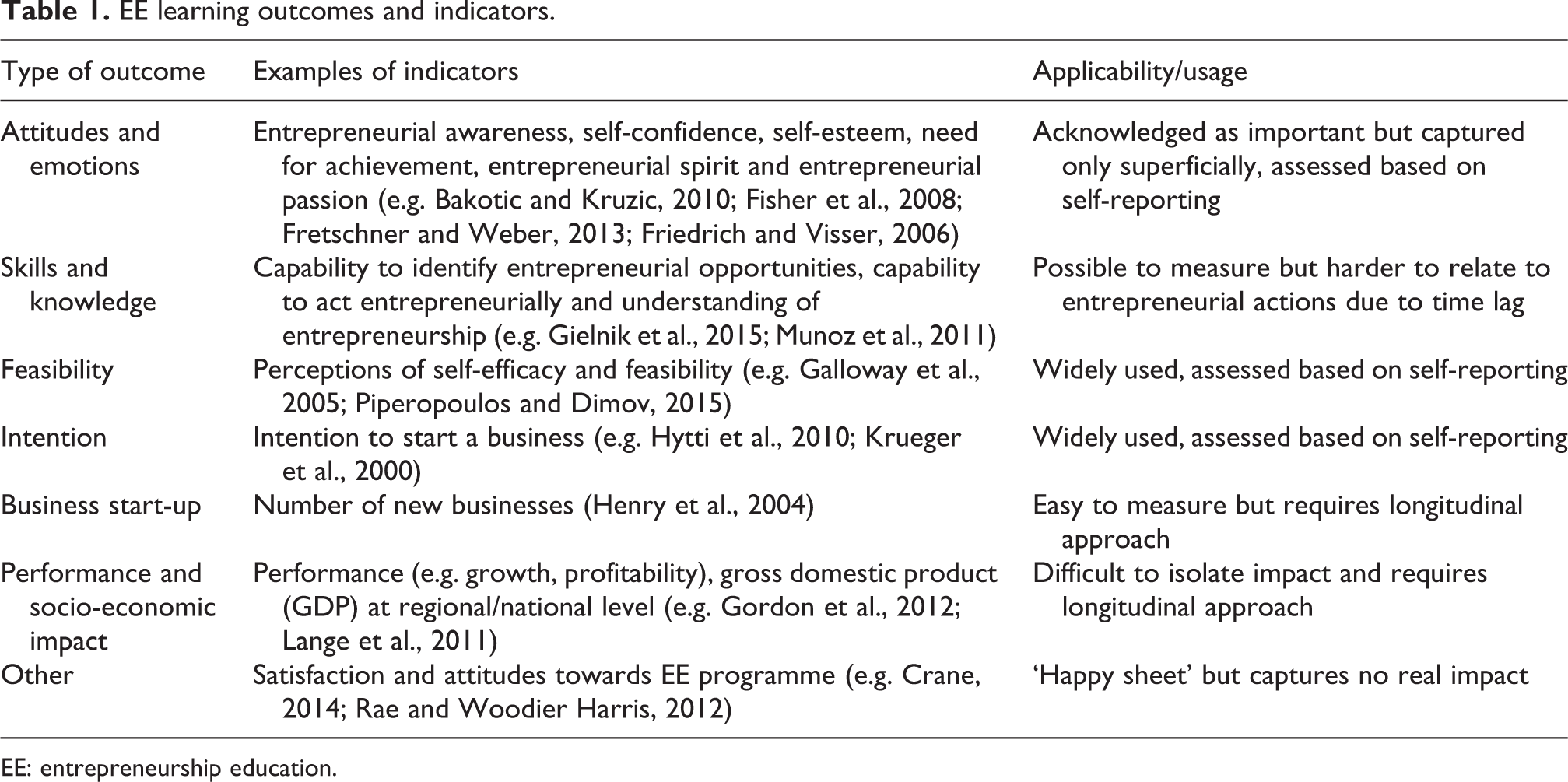
EE: entrepreneurship education.
Despite the multitude of studies on EE outcomes, Mets et al. (2017) and Nabi et al. (2017) argue that there is a lack of research addressing affect or emotion and, particularly, the related learning outcomes in EE. Complex affective learning permeates other domains of learning (e.g. Kyrö et al., 2011) and plays a key role in changing the mindset and behaviour of individuals (Brown et al., 2001). Nabi et al. (2018) and Souitaris et al. (2007) argue that emotional aspects can override rationality in the development of entrepreneurial outcomes. Moreover, Lackéus (2014) highlights the importance of emotional events in the formation of entrepreneurial competencies in EE. The few studies on affective learning outcomes examining the beliefs, attitudes, impressions, desires, feelings, values, preferences and interests of students capture the attitudinal rather than the emotional domain (Nabi et al., 2017). Even so, the number of studies attempting to address attitudinal changes is limited. In general, cross-sectional, quantitative studies on entrepreneurial attitudes have focused on the extent to which participation in an educational activity influences the level of a certain attitude. Entrepreneurship researchers have identified some affective learning outcomes that can be facilitated through EE to create more entrepreneurially acting students. For instance, entrepreneurial spirit, entrepreneurial passion, self-efficacy for entrepreneurship, commitment to business ventures and entrepreneurial identity are considered affective outcomes (Fisher et al., 2008; Krueger, 2005; Markman et al., 2005; Sánchez, 2011). Intention towards entrepreneurship could also be considered as an affective learning outcome, but in this study, we follow Ajzen (1991) and Krueger and Carsrud (1993) and presume that entrepreneurial intentions are not affective outcomes but rather are predicted by them. Overall, previous studies on affective learning in EE have called for better knowledge of affective learning outcomes.
In the field of education, where there is a long tradition of research on learning outcomes, researchers have developed frameworks that address and classify learning activity in terms of levels of mastered expertise. The most traditional and widely adopted classification is Bloom’s taxonomy of educational objectives, which, as noted above, consists of three domains of learning: cognitive, affective and psychomotor (Anderson and Krathwohl, 2001; Bloom et al., 1956; Krathwohl et al., 1964). Krathwohl et al. (1964) propose that the achievement of affective learning goals can be measured by five levels of achieved expertise. In the taxonomy, the lower levels of expertise include students’ willingness to minimally receive and respond to studied information, while the higher levels consist of the modification and organization of attitudes, beliefs and values in such a way that students perceive their world differently (Krathwohl et al., 1964). The first level of the taxonomy is receiving, which refers to the student’s willingness to participate in the educational activity and to learn about the topic. The second level is responding, which is characterized by a demonstration of interest in the topic. The third level is valuing, which refers to the internalization of an appreciation for values. The fourth level is organization: at this level, a student starts to compare diverse values and to resolve possible conflicts between them to form an internally consistent value system. The fifth level is characterization by values, which refers to the adoption of a long-lasting value system that is pervasive, consistent and predictable.
Like many seminal works, Bloom’s taxonomy of education objectives and its premises have been widely challenged (see e.g. Addison, 2014; Furst, 1994; Hussey and Smith, 2008; Murtonen et al., 2017; Ormell, 1974; Postlethwaite, 1994; Pring, 1971). Criticism has often been targeted at the most famous part of Bloom’s work: the taxonomy of cognitive learning outcomes (Anderson and Krathwohl, 2001; Bloom et al., 1956). Broadly, though, the major criticism of the taxonomy is related to the clarity of categories and its hierarchical structure. Clarity issues include the contention that the distinction between the levels may be blurred and rater-dependent (Postlethwaite, 1994). With its various levels, the taxonomy could be taken to suggest that learning is sequential. However, it is important to note that learning is not always linear, and the linkages between levels are not straightforward or automatic (Buissink Smith et al., 2011; Postlethwaite, 1994). The classification and separation of different levels might therefore give too simplistic a picture of learning and conceal its ‘messiness’ – behaviours are not isolated, as the taxonomy suggests (Pring, 1971). Despite these deficiencies, the taxonomy is regarded as one of the most influential works in the field of education. Since the main criticism focuses on its design rather than its content, we acknowledge that this criticism is also relevant to the taxonomy of affective learning outcomes. However, even though learning might not occur in as straightforward and easily measurable a way as the taxonomy suggests, the approach can help towards a richer understanding of the affective component of learning (Kennedy, 2006) by serving as a framework within which to capture related outcomes. To the best of our knowledge, and despite its potential, such a taxonomy of affective learning outcomes has not yet been used in measuring the development of expertise in the field of EE. We consider the taxonomy especially valuable for areas in which research on outcomes is still in its infancy – including for the study of the previously identified affective learning outcomes in EE. To gain more nuanced understanding on affective learning outcomes in our empirical study, we thus refer to the taxonomy in Krathwohl et al. (1964) and ask the central research question: what kind of affective learning outcomes do students report in relation to the bachelor’s level course on CE?
Research context: A university-level CE course
This study reports the learning outcomes of university students in a compulsory bachelor’s level course on CE in the business faculty of a Finnish multidisciplinary university. The course, ‘Corporate Entrepreneurship and Creating Entrepreneurial Mindsets’, focused on entrepreneurial behaviour in existing organizations (for CE as entrepreneurial behaviour in existing organizations, see e.g. Antoncic and Hisrich, 2003; Åmo and Kolvereid, 2018) and developing entrepreneurial mindset in students. During the course, the students were expected to learn the concept of CE and its potential benefits and drawbacks for employees and organizations. Learning goals also included understanding the antecedents of CE and what it takes to create an entrepreneurial mindset and organization, as well as personal assessment as an entrepreneurial actor.
The course consisted of four 4-h interactive sessions, which encompassed different themes of CE and the entrepreneurial mindset. Learning in the classroom followed flipped classroom principles (see Bergmann and Sams, 2014). Before each session, the students were required to read two to three scientific articles and to prepare a reaction paper on their learning reflections from the previous session and from reading the articles. The content and lessons learned from the articles were processed with the use of different pedagogical methods, such as group work, guided discussions and various types of exercises including role play. Before the course, students submitted a pre-assignment on entrepreneurial individuals, organizations and themselves as entrepreneurial actors. After the course, a similar post-assignment was conducted to identify the students’ learning for both themselves and the teachers. The students used and discussed these assignments in their learning diaries, in which they demonstrated their learning and the learning outcomes of the course.
In their learning diaries, the students were encouraged to raise issues they found interesting and relevant to demonstrate their learning of CE and the entrepreneurial mindset. They were asked to focus especially on reaching the learning goals set for the course. During the course, their learning was assessed mainly through their learning diaries but also on the basis of their assignments and active participation during the sessions. We acknowledge that the course assessment affected the content of the learning diaries, as students may have attempted to write out learning that they considered to be valuable from the teacher’s perspective. It is impossible to assess whether or not they made false descriptions of their learning in the hope of achieving a better grade. Still, the written diaries are reflections of what the students think and hope that they have learnt on the course.
Methodology
The study focuses empirically on two student cohorts, with a total of 74 students who completed the course in 2015 and 2017. Most had passed the elementary first-year course on entrepreneurship when they attended the bachelor’s level course on CE. The students were primarily from business disciplines, although a small number were engineering students minoring in entrepreneurship and some were exchange students with multicultural backgrounds. With regard to gender, 57% were female and 43% were male.
The measurement of affective outcomes is typically done using different types of self-reporting instruments (Rubin and Martell, 2009). As already noted, this study also relies on students’ self-reporting, as we used their reflective learning diaries (10–15 pages each) as research material when exploring the learning outcomes. The diaries are valuable sources of information because they provide rich data on students’ learning processes and outcomes. As an ethical procedure, all participants were informed of the research during the first course session, and all gave permission for the anonymous use of the data collected for research purposes.
The analysis of the research material was carried out in stages, drawing on the steps of thematic analysis set out by Braun and Clarke (2006). First, the learning diaries were read through, and the learning outcomes (i.e. sentences in which students discussed their learning) were collected into the node learning outcomes in NVIVO 11 for Windows, QSR International. Second, this node was read multiple times, and its content was further classified into three child nodes: cognitive learning outcomes (n = 328), psychomotor learning outcomes (n = 64) and affective learning outcomes (n = 88) based on Bloom et al. (1956), Krathwohl et al. (1964) and Krathwohl (2002). Third, the focus was placed on the child node affective learning outcomes, the content of which was further categorized into different levels of expertise based on Krathwohl et al. (1964). We excluded the lowest level of the taxonomy, ‘receiving’, as we considered it to have been achieved through course participation. Fourth, to understand the content of the affective learning outcomes from the perspective of EE, we further categorized the research material based on learning outcomes identified in the EE literature (Table 1). The sentences in each level were classified based on the identified indicator of EE outcomes. Some sentences (e.g. those describing the nature of CE) did not fit the existing indicators but remained data-driven learning outcomes. Finally, the affective learning outcomes identified in the study were labelled and are discussed in the analysis section. Appendix 1 demonstrates the analytical process through examples based on the research material.
By means of this analytical process, we were able to identify and classify the affective learning outcomes of the students as described in their learning diaries. To gain a more in-depth understanding of the nature of affective learning outcomes and the individual context in which they were achieved, we focused on the diaries of two students: Ann and John. These two diaries were selected on the basis of the thematic content analysis of the research material. First, we identified four learning diaries with more frequent quotations about affective learning outcomes and reviewed them thoroughly. Second, given the aim of the study, we decided to focus on learning diaries that richly captured the higher levels of affective learning outcomes in CE. At this stage, two learning diaries were excluded from the analysis because they did not focus on CE, but rather on business start-ups and/or lower levels of affective learning outcomes. The diaries of Ann and John contained their individual reflections on CE, particularly from the point of view of their own relationship to it, indicating higher levels of affective learning, and therefore these two were analysed in greater depth. The content analysis focused holistically on Ann’s and John’s learning reflections during the course, rather than looking at the text containing affective learning outcomes only. This was done to understand the nature of the higher level affective learning outcomes in context. Both authors conducted in-depth analyses of these diaries individually, and then the analyses were compared to reach a consensus regarding the core findings.
In the following two sections, presenting the findings of the thematic analysis, selected quotations from the research material are included to demonstrate students’ reflections on and interpretations of their learning: ‘(S[number])’ denotes the student who is quoted. The names Ann and John are pseudonyms to maintain the anonymity of the two students whose learning diaries were analysed in depth.
Analysis
CE as a topic
In their learning diaries, all the students discussed the course topics, summarized the given articles and connected the knowledge gained to their previous understanding of entrepreneurship in general and CE in particular. The diaries included accurate descriptions of the course content, the different types of activities in the course sessions and the ways the exercises had pushed them to reflect on entrepreneurial characteristics and entrepreneurial behaviour. I believe being entrepreneurial is not something you just learn at once, but it is a lifelong process of learning from mistakes and experiences. (S3) We had to complete a task in which we had to draw an entrepreneurial person, showing his characteristics, skills, social and economic status, education, industry, sex, nationality, skills, hobbies, interest, style and values with his interests and characteristics. We were divided into groups in a random order, and it was a sort of opportunity for us to share our ideas and discuss how we feel differently about an entrepreneurial person, their characteristics and lifestyle. It was quite an interesting task. (S32)
Overall, the students discussed and reflected on the concept and phenomenon of CE without taking any clear stance for or against the topic or on its benefits or drawbacks. Their participation in the course demonstrated their willingness to learn about CE and thus reflected the achievement of level 1, the willingness to receive new knowledge, with regard to the taxonomy of affective learning outcomes. By writing and submitting a learning diary and seeking new information and perspectives on CE, they responded and showed genuine interest in the course topic, reaching level 2 of the taxonomy. Given that the students were expected to write learning diaries discussing the course content and activities, the first and second levels of expertise had to be reached to pass the course.
Problematizing CE
Fewer than half of the students described and pondered on the nature of CE by focusing on their feelings and beliefs about it. CE was portrayed as a multifaceted, complex and contextual phenomenon characterized by an entrepreneurial spirit: I believe strongly that, like becoming a good leader, becoming more entrepreneurial, there is a path that people can actually learn and grow. (S41) You can be entrepreneurial with almost everything. (S13) The guest speaker also inspired me because he showed that you don’t have to be an A-student or go to university to succeed in working life. If you have passion to do something, you will succeed even though it means making mistakes. (S35) In reality, you face number of barriers and challenges when trying to take entrepreneurial initiatives. (S32) Also, what came up strongly in the story was that being entrepreneurial is difficult. (S35) An individual who has strong competence in entrepreneurship can organize something so great, but on the other hand the example showed how managers and bad organization strategy can destroy the entrepreneurial activities in an organization. (S49) I thought the main reason is that they were afraid to change. Changing means that people have to face the challenges and invest their money and time in order to get good or bad unknown results. People love a stable life, and the fear of change will restrict them from discovering new things. (S46)
Own relationship to CE
About a third of the students wrote about their relationship to CE and entrepreneurial actions in more depth. Enhanced entrepreneurial spirit was widely discussed. This was demonstrated in multiple levels in the diaries: their own entrepreneurial spirit, how to enhance entrepreneurial spirit among employees and its value for an individual and an organization. The students perceived entrepreneurial spirit as an asset in different types of position and organization and claimed that they had learned how to exploit it in different settings. An enhanced entrepreneurial spirit was also connected to self-efficacy: I have learnt about how to act as an entrepreneurial person and what one with such a mindset should actually do. (S13) What I have gained from this course will be an advantage for me, as I now have a better idea about how to act as an entrepreneur in an organization and also how to create and nurture a corporate entrepreneurship mindset if I have my own business or hold management positions. (S17) I would be extremely happy to work in a company where corporate entrepreneurship is supported, but I don’t think I would enjoy the possible pressure that would come with it. (S29) I understand that I do not have to be a superhero to survive as entrepreneur. I can stretch this way of thinking on entrepreneurship and how I am acting in my current workplace. (S4) The most important thing I will be taking with me from the course is a whole lot of confidence and courage to pursue my dreams. (S26)
Internalizing CE as one’s own mode of work
A minority of the learning diaries showed some slight revision of judgements and a willingness to change behaviour due to new knowledge and experiences gained during the course. In these diaries, the students discussed their need for achievement, as the course setting had triggered a desire for accomplishment and the mastery of important skills and qualities which were seen as being important for future endeavours. The course made some students think about and change their perceptions of entrepreneurial careers. It also provided a better understanding of the qualities that are important to entrepreneurship, and so motivated them develop those qualities: I would like to be an entrepreneur and those three characteristics, as far as I’m concerned, I don’t have them yet. Therefore, I will now be able to try to develop them in order to fulfil as many of the characteristics as possible to be a good entrepreneur. (S1) I am motivated when it comes to things that I am interested in, but if I have to do something that I do not really like, it is hard for me to find motivation to do those things. This is something I need to work on, and keep in mind that you cannot learn how to swim unless you get wet first. (S13) The interesting guest lecturers [name1] and [name2] inspired me to take more bold actions inside the organization I am working in and also to examine my own choices. (S4) During the course I understood that my nature is definitely not an entrepreneurial one since I do not have such a quality as being self-appointed to tasks. Also, intrapreneurs are people who are self-determined goal-setters that often take the initiative to do things no one has asked them to do. Intrapreneurs also tend to be confident with their skills and to be action-oriented. And that definitely does not apply to me. (S5)
Higher level affective learning outcomes
As noted earlier, to understand the nature of the higher level affective learning outcomes two learning diaries were analysed in greater depth. Ann’s learning diary demonstrates how she constructed her relationship to CE during the course. She named her learning diary ‘The story of four weeks of self-awareness’, and it reflects the content and schedule of the course by discussing its core themes – what, how and why – and then it ends with a wrap-up. In the introduction, Ann states that the course was ‘truly a turning point’ for her, as she realized that entrepreneurship is not only about being a business owner; it is also possible to act like an entrepreneur in an existing organization. Ann insightfully discusses the various exercises given during the sessions and emphasizes the element of surprise (i.e. being faced with activities and tasks she did not expect to take place during the lessons). Her learning diary demonstrates her reflective learning, and she focuses on studying the theoretical concepts, experiencing some of these in the activities and learning through practical examples, such as those presented by the visiting entrepreneurs as well as joint discussions in student groups. In particular, she relates to a visiting entrepreneur’s story that helped her to understand that it is up to her to decide whether she wants to succeed and enjoy her work: One is his efforts to go from an introvert to an extrovert. It is definitely not easy. I am an introvert, and I feel like only if I was born once again that I could adjust myself from introvert to extrovert. The next point is his simple definition of success: have a good day…Only when the motivation to work is from inside can we make our day a good day. She [peer student] also saw in me some entrepreneurial actions, which gave me more confidence in my entrepreneurial potential.
John’s learning diary demonstrates how he internalized CE as his own mode of work during the course. The title of his diary, ‘Should I become an entrepreneur?’, reflects his pondering and learning. In the introduction, he sums up his learning during the course, mentioning a very vague prior understanding of CE, an overview of the course highlights, including the visiting entrepreneurs and the role play, and finally the structure and approach of his diary with a focus on his own reflections: I will utilise the findings \and consider whether I should take more actions to become an entrepreneur and what kind of actions could make it happen. I am wondering if my own actions are entrepreneurial or not…I might have only tried to improve the normal daily routines by combining them with something old, but not really tried to expand the limits of how the organization acted currently…I do not think that I have yet taken actions that are significantly separate from normal routines. I will make sure that the people working under my supervision will have the courage to try something completely new for the company to succeed in the future.
Discussion
By building on the taxonomy of affective learning outcomes (Krathwohl et al., 1964) and the related levels of expertise, we were able to identify four types of affective learning outcomes on CE to which the students referred in their learning diaries: CE as a topic, problematizing CE, own relationship to CE and internalizing CE as one’s own mode of work. Figure 1 summarizes the affective learning outcomes of CE, as identified in the study. Moving from levels 1 to 4 deepens the level of expertise gained. The original taxonomy of affective learning outcomes is also depicted in the figure to demonstrate the correspondence between the categorizations.

Affective learning outcomes of CE. CE: corporate entrepreneurship.
The study reveals that the external learning outcomes (CE as a topic; problematizing CE) are relatively easy to achieve. The way the course was organized and assessed required all the students to reach at least the first level (being able to demonstrate an interest in discussing the course topic). The second level of expertise, problematizing, was less common among the students, although some did consider the nature of CE by discussing their related feelings and beliefs. These external learning outcomes do not imply a consideration of one’s own stance towards CE and entrepreneurial behaviour.
Students’ reflections on their learning outcomes for the most part remained external to themselves, without any clear references to their own beliefs, attitudes, impressions, desires, feelings, values or preferences, which constitute the affective domain (Allen and Friedman, 2010; Friedman, 2008) and which are acknowledged to play a crucial role in entrepreneurial behaviour (Krueger and Carsrud, 1993). Therefore, one may question whether these two levels of expertise, CE as a topic and problematizing CE, can be considered as affective learning outcomes of EE, since they appear rather to be cognitive learning outcomes.
The other internal learning outcomes (own relationship to CE and internalizing CE as one’s own mode of work) are harder to achieve, as they require taking a personal stance towards CE or even concrete entrepreneurial actions. Interestingly, some students reached these levels of expertise and reported affective learning outcomes, even though the course was not specifically designed to elicit such behaviour. The internal, higher level affective learning outcomes identified are very personal. This is understandable because entrepreneurial behaviour is intrinsically personal, and so related values, attitudes and perceptions differ among individuals (see e.g. Iakovleva et al., 2011). This implies that motivations prompting entrepreneurial behaviour depend on the individual’s personal values (see e.g. Jaén and Liñán, 2013; Moriano et al., 2007), which can be addressed through an educational intervention, as this study suggests.
These students with internal affective learning experiences were, however, the exceptions in the group. The study also shows that cognitive learning outcomes lay the groundwork for achieving affective learning outcomes; it is easier to reflect on one’s own relationship to CE, or even internalize it as one’s mode of work, if one knows what it is all about. New knowledge, therefore, may enhance motivation for personal reflection and entrepreneurial behaviour. Better self-awareness and self-efficacy are also likely to increase one’s motivation to change behaviour, as Ann’s learning experiences demonstrated. Furthermore, reaching the highest level of affective learning outcomes in CE was very rare, as it seems to require an ability to test and reflect on one’s entrepreneurial behaviour at work, something that John was exceptionally able to do at his workplace.
The idea of internal and external learning outcomes resonates with the different learning approaches of students discussed in educational studies. According to Biggs (1999), students following a surface approach to learning accept new facts and ideas without criticism and attempt to store them as isolated, unconnected items. This seems closer to the external learning identified in this study, when students gained new understanding about the topic. Although the students also problematized the challenges and opportunities related to CE, they did not consider their own stance towards it. Those following a deep approach to learning examine new facts and ideas critically and try to integrate them into existing cognitive structures by making numerous links (Biggs, 1999). In this study, students’ internal learning outcomes, based on their attempts to form an internally consistent value system for entrepreneurship and CE, as well as to consider and test CE from their personal perspective, resonate with the deep approach to learning. Although the divide between external and internal learning outcomes or between surface and deep learning approaches is not clearly defined, it suggests that learning, and particularly affective learning, is not only about the content of learning but also about its nature – how deeply it manages to affect students’ thinking and behaviour.
This study demonstrates that understanding affective learning outcomes within the framework of the taxonomy of affective outcomes is ambiguous. As suggested above, it seems that affective learning outcomes cannot be considered solely based on their content, such as self-confidence or entrepreneurial spirit, but rather on the nature of those outcomes, which determine the level of expertise in the taxonomy. Let us take entrepreneurial spirit as an example. A student understanding the importance of entrepreneurial spirit in making things happen has reached the level of problematizing, as he or she has internalized the related values to his or her thinking. By pondering various ways to create and exploit entrepreneurial spirit in his or her work and the related implications, a student demonstrates his or her own positioning in relation to entrepreneurship and the achievement of the level of own relationship to CE. Furthermore, being able and willing to behave differently and to adopt an entrepreneurial spirit in everyday actions over the long term demonstrates a student’s incorporation of an entrepreneurial spirit into his or her own behaviour and the achievement of the highest level of affecting learning outcomes, internalizing CE as one’s own mode of work. All of these are illustrations of entrepreneurial spirit, but they characterize different levels of expertise in the taxonomy.
Furthermore, our findings suggest that only internal affective outcomes are truly meaningful in EE. For instance, a strong need for achievement in an individual will require energetic and innovative activities that entail planning for the future and the acceptance of responsibility for the outcomes (McClelland, 1961). Such individuals must therefore understand the rationale behind those energetic and innovative activities and must be willing to engage in them. In the taxonomy, this requires more than valuing; it requires the organization or characterization of expertise, which both denote internal affective learning in this study.
Conclusion, limitations and implications
The starting point for this study was a clear need for research on the affective domain of entrepreneurship and the related affective learning outcomes. On the basis of our findings, we argue that EE can generate various affective learning outcomes related not only to the content of learning but also to its nature. Building on the taxonomy of affective learning outcomes, it was possible to identify external and internal affective learning outcomes according to different levels of expertise. In light of the results, we question whether only the internal affective learning outcomes can be considered as affective learning outcomes in EE, as they relate the individual’s own beliefs, attitudes and emotions. Finally, our results shed light on the development of affective learning outcomes in the personal contexts studied and thus highlight the subjective and personal nature of affective outcomes in EE, as suggested previously (see Shephard, 2008). We conclude that a course organized in a classroom setting may not be sufficient to achieve the highest level of affective learning outcomes (internalizing CE as one’s own mode of action), which requires the potential for reflection in a real-world setting (i.e. in working life). However, our findings suggest that a course may still trigger and enhance the achievement of the higher level affective outcomes. By applying the taxonomy of affective learning outcomes, the study provides a more fine-grained understanding of the complex affective outcomes in EE.
The study also has its limitations. First, the findings are derived from a course on CE. This is justified, given the similarities in entrepreneurial processes and behaviours found in both new business start-ups and existing organizations. Still, we acknowledge that it would be interesting to study affective learning outcomes in relation to a start-up environment. Second, the students were not instructed or guided on how to report their affective learning outcomes per se, but they were encouraged to share any experiences indicative of their learning with regard to CE. We acknowledge that students have their personal writing styles and that some are more willing than others to share their experiences. It would be interesting to examine whether more explicit instructions in this regard would produce a more nuanced understanding of the affective domain and the related outcomes. Finally, the development of affective learning outcomes requires a longer period than the duration of one course, and so it is important to conduct longitudinal analyses to gain a clearer picture of their development.
Our study has clear implications for educators, as it is important for them to understand the complexity of the affective domain and the related learning outcomes of EE. This is particularly the case in a university setting, where the most desirable outcomes are complex and relatively difficult to achieve. Educators should be aware of the challenges involved in the achievement of internal affective learning outcomes in a classroom setting where there is no opportunity to test and reflect on one’s learning in a real work environment (see also e.g. Buissink Smith et al., 2011). Our study supports the previous suggestion (see e.g. Shephard, 2008) that providing role models and interactive learning methods, such as role playing, discussions and debate, may support students to achieve affective learning outcomes in EE. Furthermore, it is worth noting that cognitive outcomes probably help students to reach affective outcomes. We hope that this study encourages educators and researchers to further test and investigate various EE endeavours.
Footnotes
Declaration of conflicting interests
The author(s) declared no potential conflicts of interest with respect to the research, authorship, and/or publication of this article.
Funding
The author(s) disclosed receipt of the following financial support for the research, authorship, and/or publication of this article: Sanna Ilonen received financial support from The Foundation for Economic Education (Finland) and TOP-säätiö (Finland).
Note
Appendix 1. Analysis of the research material
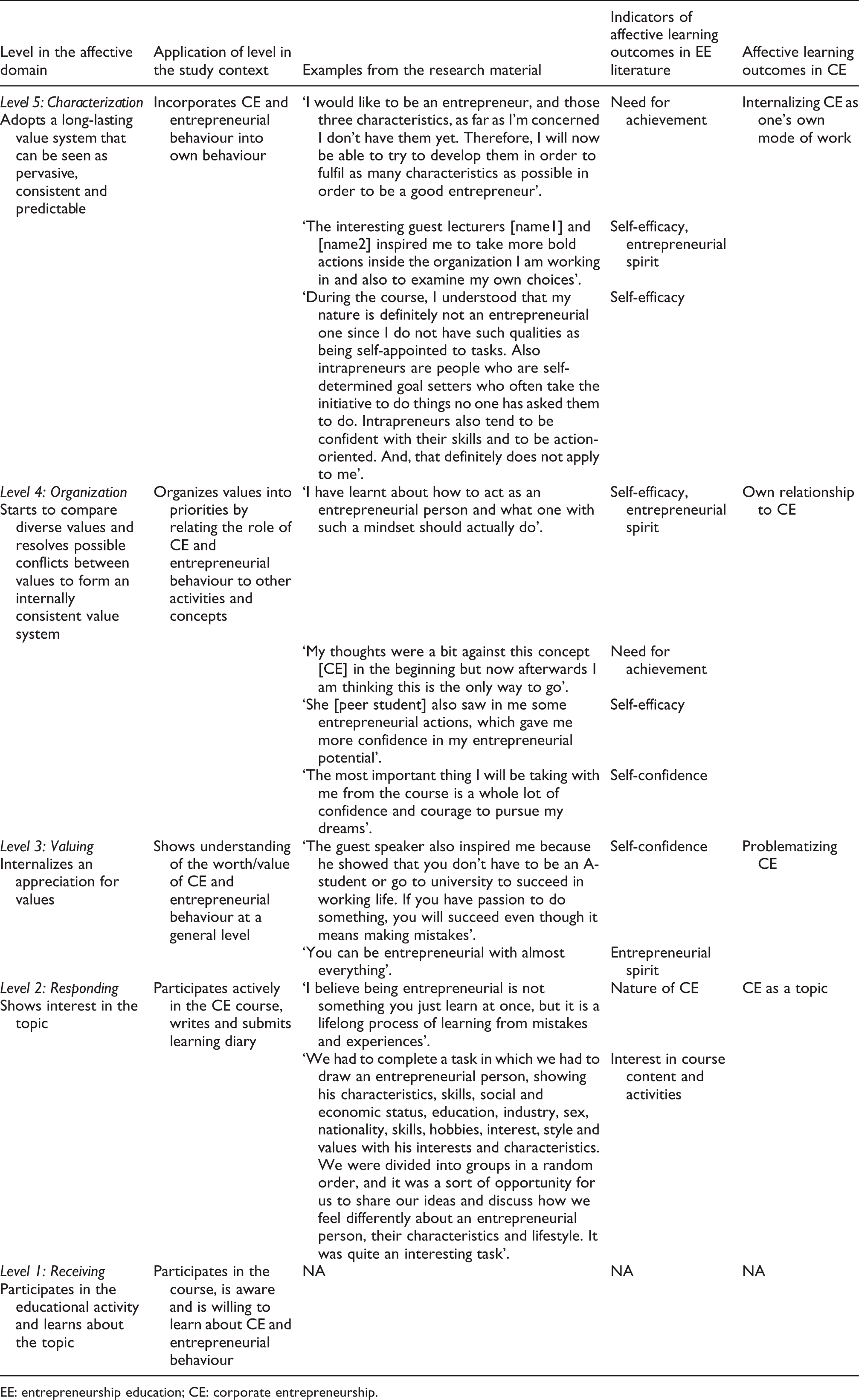
| Level in the affective domain | Application of level in the study context | Examples from the research material | Indicators of affective learning outcomes in EE literature | Affective learning outcomes in CE |
|---|---|---|---|---|
| Level 5: Characterization Adopts a long-lasting value system that can be seen as pervasive, consistent and predictable |
Incorporates CE and entrepreneurial behaviour into own behaviour | ‘I would like to be an entrepreneur, and those three characteristics, as far as I’m concerned I don’t have them yet. Therefore, I will now be able to try to develop them in order to fulfil as many characteristics as possible in order to be a good entrepreneur’. | Need for achievement | Internalizing CE as one’s own mode of work |
| ‘The interesting guest lecturers [name1] and [name2] inspired me to take more bold actions inside the organization I am working in and also to examine my own choices’. | Self-efficacy, entrepreneurial spirit | |||
| ‘During the course, I understood that my nature is definitely not an entrepreneurial one since I do not have such qualities as being self-appointed to tasks. Also intrapreneurs are people who are self-determined goal setters who often take the initiative to do things no one has asked them to do. Intrapreneurs also tend to be confident with their skills and to be action-oriented. And, that definitely does not apply to me’. | Self-efficacy | |||
| Level 4: Organization |
Organizes values into priorities by relating the role of CE and entrepreneurial behaviour to other activities and concepts | ‘I have learnt about how to act as an entrepreneurial person and what one with such a mindset should actually do’. | Self-efficacy, entrepreneurial spirit | Own relationship to CE |
| ‘My thoughts were a bit against this concept [CE] in the beginning but now afterwards I am thinking this is the only way to go’. | Need for achievement | |||
| ‘She [peer student] also saw in me some entrepreneurial actions, which gave me more confidence in my entrepreneurial potential’. | Self-efficacy | |||
| ‘The most important thing I will be taking with me from the course is a whole lot of confidence and courage to pursue my dreams’. | Self-confidence | |||
| Level 3: Valuing |
Shows understanding of the worth/value of CE and entrepreneurial behaviour at a general level | ‘The guest speaker also inspired me because he showed that you don’t have to be an A-student or go to university to succeed in working life. If you have passion to do something, you will succeed even though it means making mistakes’. | Self-confidence | Problematizing CE |
| ‘You can be entrepreneurial with almost everything’. | Entrepreneurial spirit | |||
| Level 2: Responding |
Participates actively in the CE course, writes and submits learning diary | ‘I believe being entrepreneurial is not something you just learn at once, but it is a lifelong process of learning from mistakes and experiences’. | Nature of CE | CE as a topic |
| ‘We had to complete a task in which we had to draw an entrepreneurial person, showing his characteristics, skills, social and economic status, education, industry, sex, nationality, skills, hobbies, interest, style and values with his interests and characteristics. We were divided into groups in a random order, and it was a sort of opportunity for us to share our ideas and discuss how we feel differently about an entrepreneurial person, their characteristics and lifestyle. It was quite an interesting task’. | Interest in course content and activities | |||
| Level 1: Receiving |
Participates in the course, is aware and is willing to learn about CE and entrepreneurial behaviour | NA | NA | NA |
EE: entrepreneurship education; CE: corporate entrepreneurship.