



Abstract
This study applies a systematic literature review and qualitative content analysis to identify and synthesize key factors that enable collaborative innovation between industry and universities. Using a keyword search in the Web of Science database, the review identified 40 papers that were frequently cited on the topic. Results were summarized into seven main themes or central factors stimulating collaborative innovation: resources, university organization, boundary-spanning functions, collaborative experience, culture, status centrality and environmental context. This article elaborates on these ‘enabling factors’ and uses them to summarize a number of results from the reviewed studies regarding facilitators of collaborative innovation. The discussion focuses on how these factors relate and the extent to which they are amenable to policy intervention.
Academic entrepreneurship, outreach, the third mission and university–industry collaboration are key concepts at the centre of an emerging research specialization in science, technology and innovation policy studies. Unlike traditional innovation/industrial policy, where the expectation is that the private sector alone will drive innovation, the new focus is on the role of universities and their extended networks in transforming research into products and services. Classical studies on collaborative and networked innovation processes (e.g. Powell et al., 1996) have been extended to include conditions for university–industry partnerships. Furthermore, theoretical approaches such as Mode 2, the Triple Helix and post-academic science have been suggested to help explain circumstances that affect such partnerships (Etzkowitz and Leydesdorff, 2000; Gibbons et al., 1994; Ziman, 1996).
Previous attempts to order this research are characterized by at least one of two shortcomings. First, meta-studies tend to gloss over the details of the main variables at play, in essence listing factors affecting collaboration rather than providing detailed analysis of their content. Second, factors affecting collaborative innovation and its outcomes are not always conceptualized causally, which makes it difficult to theorize about key relationships (e.g. Geuna and Muscio, 2009; Rothaermel et al., 2007). This study draws on a systematic literature review and a qualitative content analysis to describe and analyse actions and conditions that promote the co-production of innovation. We discuss the results in relation to open-ended hypotheses or ‘hypothetical imperatives’ about the relationships between those actions and conditions. We suggest that this approach can serve as a guide for future empirical inquiry, as well as a mechanism to construct a programme theory for policy instruments aimed at the co-production of innovation.
The study deals with a subset of university outreach that focuses on innovation. While other types of outreach – including the commissioning of practitioner teaching, curricula alignment, student placements, social networking, public understanding of science, involvement in social and cultural life and participation in policymaking – may result from collaborative innovation, or may support aspects of it, they are not the focus of this study. Instead, we analyse innovation-related collaboration that focuses on research and development (R&D) activities, such as formal research consulting work, joint R&D projects and programmes, patenting and spin-off creation (Fuentes and Dutrénit, 2012; Ramos-Vielba and Fernandez-Esquinas, 2012) or purchase of prototypes developed at universities, and exchange of facilities and equipment between universities and firms (Schartinger et al., 2002). Throughout the article, the following terms refer to this type of outreach: collaboration, outreach, collaborative innovation, co-production, technology transfer and research collaboration. This article proceeds as follows. In the next section, the systematic literature review is outlined in terms of sampling, collection and analysis. The subsequent section presents the main categories of collaborative activities and conditions, going into detail regarding the underlying research results. In the fourth and final section, we discuss the results and conclude the study by proposing a number of relationships in which the enabling factors identified in the review are related to the challenges of collaborative innovation.
Approach
Data collection and analysis
The material for this study was collected using a systematic literature review, coupled with a qualitative content analysis of the studies reviewed. The aim of the literature review was to collect studies, which were representative, empirically-based and peer-reviewed, on the topic of the co-production of innovation using explicit search criteria (Petticrew and Roberts, 2006). To elicit and select relevant studies, the authors undertook a keyword search in the Web of Science database using the publication type (‘English language journal’) and the keywords ‘innovation’ and ‘empirical.’ These were combined with each of the following keywords and phrases in separate searches: academic entrepreneurship, mode 2, outreach, third mission, third stream activity, third task, triple helix, university–industry interaction/collaboration/cooperation, university–industry, PPP, co-production, technology transfer. The lower cut-off point for inclusion in the sample was 20 citations. A manual selection was conducted to ensure that the studies were indeed empirically-based journal articles addressing academic–industry cooperation and innovation. A selection of the 40 highest cited articles was retained for analysis (see Appendix 1).
The authors cross-read the articles and documented each study according to the empirical sample, the type of actors involved, the type of collaboration, the factors/activities identified as stimulating collaboration and the outcomes. These protocols were then subject to a qualitative content analysis (Kuckartz, 2014) in which common results were identified, specifically with regard to activities and factors stimulating collaborative innovation and outcomes. These results were clustered into categories applying a concept mapping approach and were then ordered according to basic, identifiable patterns (Rosas and Kane, 2012).
This procedure produced seven basic enabling factors: resources, university organization, boundary-spanning functions, collaborative experience, culture, status centrality and environmental context. We have arranged the factors below according to our assessment of their amenability to change by means of intervention, for example, through management or government policy (see the ‘Results’ and ‘Discussion and conclusions’ sections for details). For example, some factors require only resource distribution and managerial action (e.g. adding new resources, changing the formal organizational structure by adding a liaison officer). Increasing or creating actual collaborative experience is an outcome that requires more time and is subject to more uncertainty. Finally, affecting the status of an institution, and developing a collaborative culture, or creating geographical proximity between actors, requires an even longer time horizon and is subject to even more outcome uncertainty. Even so, and as will be discussed below in the section ‘Discussion and conclusions’, it is important to point out that the ordering of the results into such a hierarchy is a highly hypothetical exercise in a study of this size. Nevertheless, it is an interesting one in terms of methodological and analytical illustration and as a stepping stone for further elaboration. We have attempted to support this analytical step by carefully elaborating the content of the respective result themes (see under ‘Results’), as well as potential linkages in terms of how one outcome might lead to another outcome (see under ‘Discussion and conclusions’) (see also Cooksy et al., 2001).
Results
The factors found to affect the likelihood of university–industry collaborative innovation are presented below, arranged according to their hypothesized amenability to intervention and/or change (Table 1).
Factors enabling university–industry collaboration on innovation.
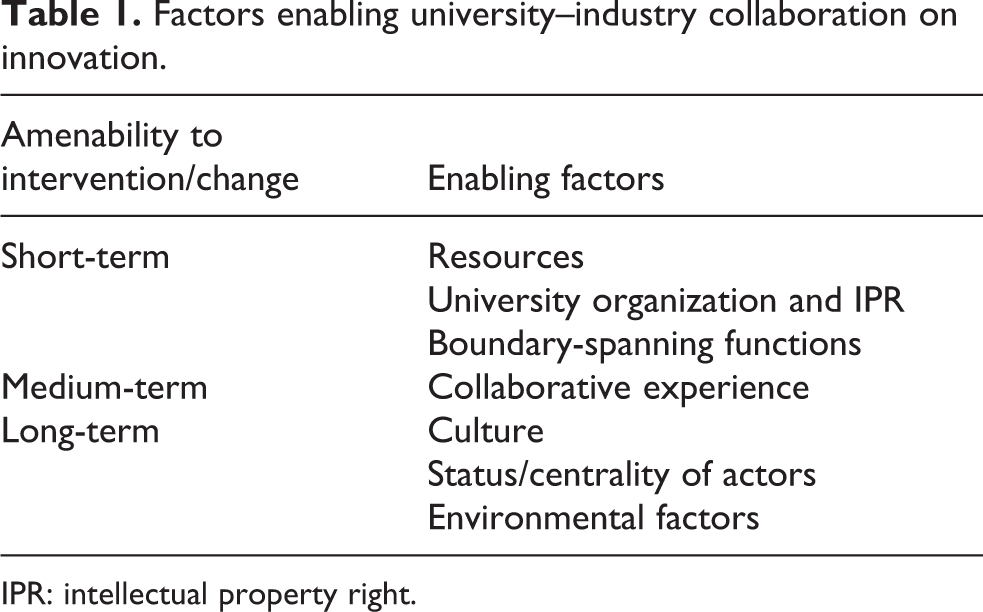
IPR: intellectual property right.
Resources
The first enabling factor is the provision or existence of organizational resources for pursuing collaboration, that is, the need for additional funds to pursue research among academics, where this need is not fully satisfied by available research funds (D’Este and Perkmann, 2011; Franco and Haase, 2015; Tartari and Breschi, 2012). While the literature emphasizes the importance of resources, our sample of studies does not specify how resources should be distributed to achieve desired effects. The blanket descriptor for this is simply available resources to cooperate (Tartari and Breschi, 2012). The literature identifies two resource types: local seed-funding, which pertains specifically to the creation of spin-off firms (Debackere and Veugelers, 2005), and non-public funding – that is, resources distributed via non-governmental channels (Azagra-Caro et al., 2006; D’Este and Patel, 2007; D’Este and Perkmann, 2011). We therefore conclude that the availability of local, non-governmental funding may be a key enabler of collaboration.
An additional enabling resource is time availability (Locket et al., 2008). Time is connected to how financial means are transformed into time available for collaboration: developing and maintaining mutual engagement and interest requires time (Gertner et al., 2011). This overlaps partially with the organizational factor below, where a researcher’s time must also allow for company requests of a more immediate nature (Locket et al., 2008).
University organization and intellectual property rights
Organizational-level resources are connected to organizational capacities for collaboration in various ways. The most immediate is the provision of incentives to collaborate among actors. Some actors perceive the monetary and non-monetary rewards for engaging in technology transfer as insufficient (Siegel et al., 2003). Incentives must be built into systems that offset the risks of commercializing, for example, through substantial royalties (Debackere and Veugelers, 2005). Many papers point to the importance of a support infrastructure for collaboration, with some authors distinguishing between a ‘passive’ support structure (enabling organizational form) and an ‘active’ support structure (dedicated functions for supporting collaboration). A passive structure may be balanced or adapted to foster the co-existence of entrepreneurial and scientific work through, for example, cross-cutting, interdisciplinary divisions (Van Looy et al., 2004) or may include a decentralized management structure in which research groups are given autonomy in managing their industry relations (Debackere and Veugelers, 2005). In general, both researchers and managers/entrepreneurs agree that excessive bureaucracy is a barrier to effective technology transfer (Franco and Haase, 2015; Siegel et al., 2003). Perhaps for this reason, network participation is found to be an important enabler, especially with regard to researcher networks that extend beyond what the university’s support infrastructure can offer (Gilsing et al., 2010).
In contrast, an active organizational enabler may be a liaison office with crucial expertise and networking abilities for collaboration (Van Looy et al., 2003) and/or various types of support systems for industrial consultancy (Debackere and Veugelers, 2005). Other examples frequently cited in the literature include university research parks (Caldera and Debande, 2010; Link and Scott, 2007), which stimulate a two-way flow between universities and industry, as well as university-affiliated incubators which support knowledge transfer between university and industry (Bergebal-Mirabent et al., 2013). Technology transfer offices (TTOs) are an important example of an active enabling structure which increases the value of the patents that can result from industry collaboration (Petruzelli, 2011). The literature suggests that larger TTOs tend to generate more licensing agreements and more R&D contract income (Caldera and Debande, 2010; Siegel et al., 2003).
An important part of the organizational dimension is the impact of rules and regulations on collaboration. An excessive legal framework is generally seen as counterproductive; specifically, in this view, the existence of rules relating to copyright or the participation of researchers in contract R&D has a negative effect on the number of such contracts, but no effect on the income generated from contracts (Franco and Haase, 2015). However, both types of steering decrease the incentive to engage in collaboration (Caldera and Debande, 2010). This may be related to the observation above on the effect of bureaucracy. On the other hand, the existence of rules that regulate conflicts of interest has a positive influence on both the number of R&D contracts and the income they generate. Policies for royalty sharing tend to have a positive effect on licensing income (Caldera and Debande, 2010).
The importance of rules and regulations is far from obvious, but in general we conclude that too many or unclear rules hamper collaboration, while other rules may enable and enrich collaboration once it has been established. The review of the literature confirms this with regard to policies on intellectual property rights (IPRs): ambiguous IPR arrangements tend to hinder collaboration (Locket et al., 2008), yet many entrepreneurs and business managers believe that universities exercise their IPRs too aggressively, which in turn is perceived to hinder effective technology transfer and collaboration (Siegel et al., 2003). With these provisos, we conclude that transparent and unambiguous regulations with regard to IPR are a positive stimulant for collaboration (Debackere and Veugelers, 2005).
We refer to a final category as educational scope, that is, the fact that a university’s educational structure and composition impacts its propensity to collaborate. Educational concentration in certain subjects, such as engineering, is positively related to collaboration and spin-offs (Azagra-Caro et al., 2006; Bergebal-Mirabent et al., 2013). Similarly, the presence of a medical school at a university has a positive effect on the number of R&D contracts received, and polytechnic universities typically generate higher incomes from such contracts (Caldera and Debande, 2010).
Boundary-spanning functions
Closely connected to the organizational factor is what we call ‘boundary-spanning functions’ – the regular and ongoing informal activities at a university that are often connected to existing projects. This is in slight contrast to the organizational structure factor above, which focuses on a formal university structure (in this sense, the factor is a precursor to ‘collaborative experience’ – see below).
The literature identifies the centrality of project champions and sponsors in both university and industry who span university–industry boundaries (Van Looy et al., 2003), as well as the importance of boundary-spanning roles for knowledge transfer (Franco and Haase, 2015; Gertner et al., 2011). This is about initiating projects and connecting them across the university–industry divide, as well as providing efficient communication channels between industry and relevant research results from universities (the lack of which is often perceived as a barrier to collaboration) (Guan et al., 2005). Such expert exchange between university and industry is identified by the literature as a positive driver for collaboration, and the success of such knowledge acquisition is positively associated with the frequency of communication between a firm’s technological expert(s) and their counterparts at a university (Huber, 1991; Sherwood and Covin, 2008). Not unexpectedly, personal relationships are perceived to be more important to effective technology transfer than formal instruments like TTOs or liaison offices (Casper, 2013; Siegel et al., 2003). However, a more formalized example of the boundary-spanning function can provide benefits, namely, membership of cluster or intermediary organizations. Being a member of an external intermediary organization is positively associated with forming linkages to universities in the region covered by the organization (Kodama, 2008).
Collaborative experience
One of the most prevalent predictors of collaboration is that of prior experience in collaboration, and this pattern seems to hold regardless of location of the actors. Among researchers it was found that previous experience in collaboration had a positive influence on further contract research, consulting and collaborative research (D’Este and Patel, 2007; D’Este and Perkmann, 2011; Schartinger et al., 2002). Similarly, Thune (2009) found that prior collaborative experience among researchers (in this case, supervisor and doctoral student teams) and firms was positively related to the likelihood and success of collaboration.
At the university level, it was found that universities which had collaborated with industry for a long time were more likely to collaborate in the future (Wen and Kobayashi, 2001). Experience with spin-off firms is likewise positively related to collaboration (Bergebal-Mirabent et al., 2013) and, correspondingly, older TTOs tend to be more efficient than younger ones (Siegel et al., 2003). When it comes to firms, experience matters as well: existing collaborative agreements tend to stimulate further collaboration among firms (Segarra-Blasco and Arauzo-Carod, 2008). Prior experience is such a strong predictor that even previous collaboration deemed unsuccessful by firms was shown to be positively associated with the probability of interacting with universities again (Tödtling et al., 2009).
Prior experience can be hypothesized to stimulate collaboration through various learning processes, for example, through institutionalization and routines. Previous ties, such as the filing of joint patents, in fact increase the value of patents resulting from university–industry collaboration (Petruzelli, 2011). Personal contacts between academics and business have, for example, been shown to improve the likelihood of commercializing academic results (Casper, 2013), and Sherwood and Covin (2008) find that partner familiarity and trust are positively related to the perceived success of knowledge acquisition between firms and universities.
Personnel exchange between university and industry is one way of creating such institutionalization – for example, through the training and transfer of people (Pérez and Sánchez, 2003). Finally, and perhaps not unexpectedly, the familiarity and trust that result from such sustained interaction are an important component of institutionalization and learning.
Culture
Cultural factors may affect collaboration either by bringing university researchers and private business firms closer together or by driving them further apart. University researchers’ concern for their academic freedom and their fear of losing it, or of being constrained when engaging in industry collaboration, typically keeps them from pursuing such ventures (Azagra-Caro et al., 2006; Tartari and Breschi, 2012). Similarly, firm representatives may stay away from collaboration if they experience too great a divergence between their own objectives and interests of the researchers (Fontana et al., 2006). Another concern that could potentially hold researchers back from collaboration is related to the possibility that an industry partner may want the results of a joint project to be kept secret, which might hinder academic publication. While there is an indication that researchers with knowledge and experience of working with IPR may let an increased concern about secrecy keep them from collaborating, the effect is weak (Tartari and Breschi, 2012). The overall picture conveys no correlation between such worries and the propensity to collaborate (Tartari and Breschi, 2012). Being confronted with the ‘open science’ paradigm firms may, on the other hand, shy away from collaboration in fear of revealing trade secrets (Fontana et al., 2006).
Different work routines may also make researchers and firms repel each other. Different time horizons seem to be particularly problematic; firms work within a time-to-market logic incompatible with the longer time frames typically employed by university researchers (Fontana et al., 2006; Locket et al., 2008). What is more, firms may rule out collaboration only because they do not have the time it takes to establish contact with a university (Locket et al., 2008).
Expressed in more general terms, some of the reviewed articles demonstrate that both a lack of understanding and a mutually negative perception of ‘the other’ may hinder transactions (Siegel et al., 2003). Firms may, for example, perceive academia as out of touch with the ‘real world’ (Locket et al., 2008). Others find that such barriers can be overcome through social interaction leading to a deeper commitment and/or the development of a shared language (Gertner et al., 2011; Locket et al., 2008). Such interaction is facilitated by the employment of a person who understands both university and business contexts. This person may, for example, be a recent university graduate (Gertner et al., 2011) or a researcher taking on the role of an ‘entrepreneurial coach’ (Locket et al., 2008).
The review shows university culture to be positively correlated with activities that transgress the borders of academia. Once created, entrepreneurial university culture seems to be self-reinforcing, with role models engaging in collaboration and entrepreneurship, and concepts such as ‘entrepreneurship’, ‘spin-off’ and the ‘third mission’ becoming positively charged, which in turn breeds positive attitudes (Locket et al., 2008) and stimulates collaborative activity (Gilsing et al., 2010; Van Looy et al., 2003). Entrepreneurial culture can be fostered in various ways: through institutional encouragement (Azagra-Caro et al., 2006), clear incentives (Locket et al., 2008) that reward both scientific publication and research pursued in collaboration with industry (Van Looy et al., 2004) and curricula oriented towards business and law (Van Looy et al., 2003).
Status centrality of actors (R&D intensity and size)
Universities, researchers and firms with high status relative to others are more likely to collaborate and more likely to be chosen as partners. On the level of the individual faculty member, reputation stands out as being strongly associated with industry collaboration (Fontana et al., 2006; Giuliani et al., 2010; Schartinger et al., 2002). One of the reviewed articles operationalizes reputation as the size of a researcher’s network and finds that a wealth of connections among domestic research colleagues is linked with a large number of industry collaborations (Giuliani et al., 2010). The literature is less clear on how this link operates; that is, whether a wide network leads to more industry contacts or whether a large number of industry contacts leads to a wider network of academic peers (assuming that such contacts appeal to research colleagues). Status can also come with seniority; hence, some of the articles investigate whether being a full professor is positively correlated with collaboration. The evidence is mixed; some find professors to be more likely to collaborate (D’Este and Patel, 2007), whereas others do not.
Status centrality may be a result of academic performance. The reviewed literature provides mixed messages when it comes to the link between status acquired through excellent research and the propensity to collaborate with industry partners. Some studies find scientific qualifications and productivity to be positively correlated with industry interaction (Franco and Haase, 2015, also Gulbrandsen and Smeby, 2005), while others find no significant relationship between the two (Giuliani et al., 2010). Specifying type of collaboration, one study shows that being a reputable researcher thanks to academic performance only matters when it comes to joint research projects, and not contract research or personnel mobility (Schartinger et al., 2002). Others find a positive correlation between the share of a researcher’s academic output published in applied journals and his or her propensity to collaborate with industry partners (Tartari and Breschi, 2012). A long resume of patent applications seems also to be a predictor of collaboration (Tartari and Breschi, 2012).
If linkages that are already established are considered, researchers with an above-average track record of publications and patents seem to improve the partner firm’s R&D productivity relative to colleagues with below-average track records (Baba et al., 2009). The positive effect remains but is less strong if researchers excel in patenting only (Baba et al., 2009). Further, within established linkages, the review indicates that researchers who are part of a large tight-knit network do better when it comes to contributing to the value of patents resulting from the collaboration than less well-connected peers (Guan and Zhao, 2013). We infer that connectedness is positively correlated with both establishing an industry link and the quality of the collaboration output. In contrast, research quality is of limited importance when forming such links, but is nonetheless of importance to collaboration output quality.
Another factor influencing the propensity to collaborate is learning scope. Interest in participating in networks and linkages with industry is sparked only if the researcher believes that such a link will result in learning and an exchange of relevant knowledge (Azagra-Caro et al., 2006; D’Este and Perkmann, 2011).
At the level of the university, research productivity seems to stimulate both the volume of R&D contracts and the income they generate (Caldera and Debande, 2010; van Looy et al., 2011). This indicates that firms access information about research output and that this information is central to the choice of a collaboration partner. Firms also rely on a more subjective assessment of university quality, with prestigious universities tending to attract more industry partners (Wen and Kobayashi, 2001), even if they are at a distant location (Laursen et al., 2011). When it comes to relations between universities and industry, the higher-ranked universities seem to be involved in the development of more valuable innovations than lower-rank institutions (Petruzelli, 2011). Prior experience in patenting is also correlated with higher-value innovations (Petruzelli, 2011). University size, measured as the number of academic staff, is another factor that seems to influence the extent to which universities generate innovation and turn ‘outwards’, be it through patent applications (van Looy et al., 2011), licensing or R&D contracts (Caldera and Debande, 2010). This is not surprising since, all else being equal, more individuals can engage in more outreach activities. More interestingly, Caldera and Debande (2010) find that larger universities generate more per capita revenue from licences and R&D contracts than their smaller counterparts, suggesting that for some reason (e.g. higher quality, paying for university reputation, university bargaining power) customers are willing to pay more for licences and contracts with larger universities. This might also be a scope effect, where a higher number of researchers raise the chances of making relevant and hence valuable connections. One study finds that the older the university, the less likely researchers are to support the idea of commercializing research results or engaging in regional development (Azagra-Caro et al., 2006).
When it comes to the industry side of the university–industry relationship, several studies find that large firms are more likely than smaller firms to collaborate with universities and other public research organizations (Fontana et al., 2006; Levy et al., 2009; Sáez et al., 2002; Segarra-Blasco and Arauzo-Carod,2008; Tödtling et al., 2009; Veugelers and Cassiman, 2005). A high level of R&D intensity increases the likelihood that a firm will not only establish a link with a university (Fontana et al., 2006; Isaksen and Karlsen, 2010; Sáez et al., 2002; Segarra-Blasco and Arauzo-Carod, 2008) but also approach universities in other ways, for example, by locating in a university research park (Link and Scott, 2007). With a wide-ranging R&D, strategy comes the absorptive capacity needed to benefit from knowledge produced at universities (Veugelers and Cassiman, 2005). Benefits may materialize in various ways, the most direct being increased R&D productivity (Baba et al., 2009) through a relative increase of patent applications and/or product or process innovations (Kodama, 2008). Other firms located in the same region as the collaborating firm may benefit too, since R&D-intensive firms are more likely than others to diffuse the knowledge they have acquired (Giuliani and Azra, 2009). The firm’s staff are crucial; firms with highly educated and experienced personnel are more likely than others to link with universities (Giuliani and Arza, 2009). Also, a firm that directly employs researchers has the advantage of being able to bridge language and other cognitive barriers that may exist between firm employees and university researchers (Tödtling et al., 2009) (we discuss such barriers below).
The likelihood of establishing a link to a university is associated with not only input into the innovation process but also with outputs; that is, firms with increased patenting intensity and patent value are more likely to establish a university link (Fontana et al., 2006; Petruzelli, 2011).
Finally, the review points to the fact that belonging to certain sectors increases the likelihood of firms collaborating with universities. High-tech sectors (Segarra-Blasco and Arauzo-Carod, 2008) such as pharmaceuticals, instrumentation and IT are most likely to establish collaboration (Levy et al., 2009). Another distinction relates to the collaboration pattern. Service-sector firms are found to collaborate only sporadically and, when they do, typically form bilateral relationships with universities rather than multi-party ventures (Levy et al., 2009). Bilateral agreements tend to grant exclusivity and are less threatening in terms of IPR infringement, whereas the larger ventures come closer to what has been described as ‘open innovation’.
Environmental factors
Collaboration can be influenced by the geographical and policy contexts. Research shows that governments can stimulate collaboration positively via policy instruments (Sáez et al., 2002) – cost sharing and governmental subsidies for R&D are monetary incentives to collaborate (Veugelers and Cassiman, 2005). However, our review focuses on how geography can influence collaboration and whether governmental intervention can affect its likelihood. The R&D intensity of a region appears relevant: a high level of regional R&D activity makes university TTOs perform more efficiently (Siegel et al., 2003). The general industrial composition of a region is also relevant, as high-tech intensity turns out to be positively related with collaboration and spin-off creation (Bergebal-Mirabent et al., 2013). These factors are amenable to government intervention to various degrees, specifically through R&D subsidies.
Not surprisingly, geographical proximity is a key predictor: originating in the same country is a strong predictor of university–firm collaboration (Segarra-Blasco and Arauzo-Carod, 2008), and general spatial proximity between university and industry partners is consistently found to be a positive factor for contract research and consulting (Schartinger et al., 2002), the commercialization of research results and collaboration in general (Casper, 2013). Relating to the findings on boundary-spanning set out above, geographical proximity increases the likelihood of forming intensive bilateral relationships between firms and researchers (Levy et al., 2009). This can also be referred to as ‘true co-location’: that is, proximity increases the chance that researchers and firms will cross paths in tangible ways (Locket et al., 2008), such as participating in innovation networks that bring actors together physically (Pérez and Sánchez, 2003). In this sense, physical rather than administrative proximity matters; geographical proximity increases the likelihood that two parties located in different regions will collaborate (Scherngell and Barber, 2011).
The literature does, however, offer a few provisos. For example, while being located in the same country is important for the forming of licensing agreements, proximity does not have a clear positive influence on the commercial success of such licences. Commercial success is, however, positively influenced by engaging the (university) inventor in further research related to the licence, which is a factor that is clearly related to geographical proximity (Agrawal, 2006). One article reported that geographical distance had a positive influence on the value of the patent resulting from university–industry collaboration. The author suggests that this can be explained by a greater scope for truly novel innovations that is available when actors are not part of the same spatial context (Petruzelli, 2011). It is interesting to note that firms located in countries other than the university are more likely than nearby firms to form open, multilateral relationships, often with the help of European Union funding (Levy et al., 2009). This suggests a role for government influence, just as the regional network and cluster characteristics discussed above offer means of influencing environmental factors.
Discussion and conclusions
The discussion that follows is aimed at researchers and practitioners involved in developing and implementing policy interventions supporting the co-production of innovation.
Starting with the first results category, we note that the availability of resources (or lack thereof) ultimately separates the possible from the impossible. The existence of money, time or other resources essentially trumps all the other factors in providing critical support. For example, resources can support the creation of incentive systems (e.g. at universities), as well as infrastructure for collaboration, including both passive structures that facilitate collaboration and active ones such as liaison or TTOs: The crafting of rules and regulations (e.g. IPR policies) require both time and money and may involve acquiring costly new legal competencies. Resources are linked to the educational scope of universities, as polytechnic universities and medical schools typically receive more grants and more money per enrolled student than liberal arts colleges or business schools. Apart from making possible university support systems, resources also allow individuals to spend time engaging in boundary-spanning and accumulating collaborative experience. However, it is worth noting that this relationship is likely bidirectional in the sense that boundary-spanning and collaborative experience interact with the generation of resources by way of positive feedback.
We find that university conditions (‘university structure’) very likely affect boundary-spanning functions; that is, collaborative activities depend, to some extent at least, on the rules and regulations that are set up to govern them. For example, individuals may be encouraged and given support to span university–industry boundaries by liaison office staff; personal relationships may be formed between researchers and industry representatives as their paths cross in research parks and collaborative projects; and TTOs may establish and maintain efficient communication channels between university researchers and targeted industries. We acknowledge that the crossing of organizational boundaries may give rise to changes in the formal structure of universities, but the current review has not identified any such effects.
The literature review showed that one of the strongest predictors of university–industry collaboration was prior experience. It seems likely that boundary-spanning creates a basis for building such collaborative experience. An industry-funded PhD student, a company temporarily hiring a researcher, or the transfer of research results to a firm may generate the learning process that the literature suggests is crucial. Personal relations across the university–industry boundary create familiarity and trust, build a shared history and facilitate an understanding of the parties’ routines and expectations – all of which are found to be associated with the institutionalization of collaboration.
Over time, a number of individuals may accumulate experience in university–industry collaboration to such an extent that it affects university or corporate culture. As researchers and industry representatives build collaboration experience, an understanding of each other’s routines and time horizons will increasingly be based on actual experience rather than preconception. Working together may also settle concerns about losing control over academic freedom or trade secrets. When such obstacles are overcome, a collaborative culture may develop. A collaborative culture implies long-term, stable intentions to collaborate. However, it may also lead to a form of social stratification based on status centrality, where the most reputable, successful and well-connected researchers at the highest-ranked universities attract the most R&D-intense firms as collaborating partners.
The literature suggests that spatial proximity increases the likelihood of collaborating. Yet, when it comes to the relationship between the geographical context of collaborating researchers and industry, and the other factors identified in this review, the direction of influence is ambiguous. For example, university researchers, firms and their representatives may, as a result of previous collaborative experience, create or seek out physical fora and platforms for interaction that may subsequently reinforce such development. Alternatively, such experience may itself be a result of the physical proximity of universities and firms.
We note that, although the factors discussed above appear to form a system of interaction that influences collaborative innovation in significant ways, the direction and combinatorics of this influence is generally not obvious in the reviewed research. In trying to avoid over-interpretation, we have instead tried to suggest how these factors might relate. In the introductory section of this article, we proposed that, apart from supporting scholarly inquiry, these propositions may serve as a scaffold for programme theory or logic models, supporting policy instruments aimed at the co-production of innovation. This would require ordering the factors not only on their hypothesized relations – that is, how activities and conditions may effect change in the sense of leading to other activities or conditions (Hellström and Jacob, 2017) – but also based on their availability for intervention and amenability to change. For example, adding resources to stimulate collaboration may be both quicker and easier than changing culture, which would argue for placing resources ahead of culture in a programme theory. One may add further assumptions and suppose that more resources will eventually lead to cultural change and the institutionalization of collaboration. For such an analysis to be realistic, it should account for possible feedback loops. For example, cultural change may encourage universities to adapt their organization so that additional resources, time and money are freed up to enable more collaboration. Further, if collaboration is assigned high status, a local or regional ‘buzz’ may be created which may contribute to a positive spiral that induces even more collaboration.
Supporting these types of connections, however, would require digging deeper and in a more focused way into the literature, as well as incorporating additional layers of complexity in the analysis. In the end, there may be no available research evidence to support hypothesized interaction effects and feedbacks for a given system of interest. This said, it is our belief that systematic reviews such as the above and (humble) speculations about how factors interact to create effects may aid policy practice and stimulate further research in this area.
Footnotes
Declaration of conflicting interests
The author(s) declared no potential conflicts of interest with respect to the research, authorship, and/or publication of this article.
Funding
The author(s) received no financial support for the research, authorship, and/or publication of this article.
Appendix 1
Reviewed articles.
Article
Type of study
Keywords
Journal
Agrawal (2006)
Quantitative database study
Inventors, licensing strategies, universities, commercialization success
Strategic Management Journal
Azagra-Caro et al. (2006)
Quantitative survey; university case study
University–industry relations, regional absorptive capacity, faculty support
Research Policy
Baba et al. (2009)
Quantitative database study
University–industry collaborations, advanced materials innovation, star scientists, Pasteur scientists
Research Policy
Bergebal-Mirabent et al. (2013)
Quantitative database study
University–industry partnerships, knowledge transfer, efficiency, Spain
Journal of Business Research
Caldera and Debande (2010)
Quantitative database study; country case
Industry–science relations, technology transfer, universities, Spain
Research Policy
Casper (2013)
Quantitative database study; regional case
Academic commercialization, regional economies, technology transfer, biotechnology, social networks
Research Policy
D’Este and Patel (2007)
Quantitative survey study
University–industry interactions, variety, academic researchers, integration skills
Research Policy
D’Este and Perkmann (2011)
Quantitative survey study
University–industry relations, joint research, commercialization, entrepreneurial university, motivation
Journal of Technology Transfer
Debackere and Veugelers (2005)
Quantitative database study; university case
Economics of science, technology transfer, industry–science links
Research Policy
Fontana et al. (2006)
Quantitative survey study
Public research organizations, university–industry R&D relationships, openness
Research Policy
Franco and Haase (2015)
Mixed method; qualitative survey and interview case study
University–industry cooperation, motivations, interaction channels, higher education institutions
Journal of Engineering and Technology Management
Fuentes and Dutrénit (2012)
Quantitative survey study; country study
Collaboration drivers, channels of interaction, benefits, innovation policy, developing countries, Mexico
Research Policy
Gertner et al. (2011)
Qualitative interview study; multiple-case
Information transfer, university–industry collaboration, communities of practice, boundary-spanning
Journal of Knowledge Management
Giuliani and Arza (2009)
Quantitative comparative regional case studies
University–industry linkages, knowledge diffusion, wine, Chile, Italy
Research Policy
Guan and Zhao (2013)
Quantitative database study
Nanobiopharmaceuticals, university–industry collaboration, S-curve models, small-world networks
Technological Forecasting and Social Change
Guan et al. (2005)
Quantitative firm survey
University–industry cooperation, industrial innovation, China
Technology Analysis and Strategic Management
Gulbrandsen and Smeby (2005)
Quantitative survey study; country study
Research funding, research performance, university–industry relations, academic entrepreneurship
Research Policy
Isaksen and Karlsen (2010)
Comparative qualitative case study
Modes of innovation, university–industry collaboration, Norway
European Planning Studies
Kim et al. (2012)
Quantitative database study; country comparison
Triple helix, firm dynamics, regional entrepreneurship, habitat, R&D collaboration
Research Policy
Kodama (2008)
Quantitative survey; regional case study
University–industry linkage, industrial cluster, intermediary, absorptive capacity, SMEs
Research Policy
Laursen et al. (2011)
Quantitative database study
University–industry collaboration, geographical proximity, university quality
Regional Studies
Levy et al. (2009)
Quantitative database case study
University–industry collaboration, technology transfer channels, industrial collaborative behaviour
Journal of Technology Transfer
Link and Scott (2007)
Comparative survey; database study
Innovation, intellectual property, patents, trademarks, copyright
Oxford Review of Economic Policy
Locket et al. (2008)
Qualitative case; interview study
Knowledge transfer, regional policy, technology transfer, universities
International Small Business Journal
Pérez and Sánchez (2003)
Combined qualitative/ quantitative university case study
Technology transfer, university spin-offs, regional innovation networks
Technovation
Petruzelli (2011)
Quantitative database study
University–industry collaborations, point patent, technological relatedness, prior ties, geographical distance
Technovation
Ramos-Vielba and Fernandez-Esquinas (2012)
Quantitative survey study; regional case study
University–industry relationships, knowledge transfer, intellectual property rights, regional university system
Higher Education
Sáez et al. (2002)
Quantitative database; firm data
R&D collaboration, motivations, university–industry, Spain
R&D Management
Schartinger et al. (2002)
Quantitative survey and database study
Knowledge interactions, innovation systems, university–industry relations, Austria
Research Policy
Scherngell and Barber (2011)
Quantitative comparative study; database study
Spatial characteristics, industrial R&D networks, cross-region R&D collaborations
Annals of Regional Science
Segarra-Blasco and Arauzo-Carod (2008)
Quantitative database country study
Innovation sources, R&D cooperation, industry–university flows
Research Policy
Sherwood and Covin (2008)
Quantitative firm survey
Knowledge acquisition, university–industry alliances, learning
Journal of Product Innovation Management
Siegel et al. (2003)
Combined quantitative survey and interview study
Technology transfer offices, productivity, organizational practices
Research Policy
Tartari and Breschi (2012)
Quantitative country survey study
University–industry collaboration, scientists, benefits
Industrial and corporate Change
Tödtling et al. (2009)
Quantitative database study; country case
Cooperation network, Innovation system, knowledge interaction, university–firm links, location
Technovation
Van Looy et al. (2003)
Quantitative comparative case studies
Regional innovation capability, university–industry interaction
R&D Management
Van Looy et al. (2004)
Quantitative university case study
Knowledge interactions, innovation systems, university–industry relations
Research Policy
Van Looy et al. (2011)
Quantitative survey and database study
Academic entrepreneurship, entrepreneurial effectiveness, technology transfer, European universities
Research Policy
Veugelers and Cassiman (2005)
Quantitative database study
Industry–science links, cooperation with universities, Innovation strategy
International Journal of Industrial Organization
Wen and Kobayashi (2001)
Quantitative database study; regional case
R&D network, university–industry collaboration, Japan
Research Policy