



Abstract
Examination of the transition of successful students from university into the labour market reveals a significant gap between the competencies acquired during higher education and those needed in the workplace. In this article, the authors discuss a research study undertaken to analyse the employability traits of engineers who had recently graduated. In order to do this, an estimation was made of both acquired and applied competencies in each area of engineering examined (computer engineers, naval engineers and industrial engineers). This analysis enabled the calculation of a choice model to clarify which competencies act as a stimulus for employment and which discourage recruitment. The results provide clear policy directions both for management teams in each of the three areas of engineering and for universities.
The transmission of knowledge and skills is perhaps the main raison d’être of educational systems, but higher education (HE) has the additional role of carrying our basic research and creating new knowledge, with the aim of applying and communicating the theoretical content learned (Bonaccorsi and Daraio, 2007). Specifically, in modern technological societies, HE engineering degrees give rise to almost all of the original technical concepts to be found at the core of current economies, concepts that ultimately evolve into technological and organizational innovations that are endogenously generated (Henderson et al., 1998; Knabb and Stoddard, 2005).
Given the important role of engineers in the evolution of all national economies (Lucena et al., 2008) and the complex labour market conditions for current HE graduates, different institutions throughout the world have allocated resources to the certification of BSc and MSc engineering degrees (Lucena et al., 2008; Passow, 2007, 2012) and to measuring the quality of the learning process in terms of the acquisition and application of professional engineering competencies (Bender and Roche, 2013).
This article puts forward a new methodology for assessing the efficiency of labour market transition processes for engineers. The twofold procedure involves, first, measuring the gap between the competencies acquired during HE degrees and the actual competencies applied in first jobs. The analysis goes on to use a choice model 1 to uncover which skills have a positive and which a negative influence on employability.
The duality in this research between acquired and applied competencies is necessary to mark the differences between education and training. In addition, a positive or negative sign among the competences is important in the analysis. The meaning of ‘positive’ as useful and ‘negative’ as somehow not useful may have some relevance when directly related to training and, in particular, to short- to medium-term employment opportunities.
The approach taken is novel in that it uses specific competencies 2 as elements that affect employability as reflected in the results of the choice models. Indeed, all the studies in this area which have attempted to characterize employability as a function of competence assessment exclusively use generic competencies 3 as explanatory variables (Allen and van der Velden, 2011; Salas-Velasco, 2014; Teichler and Schomburg, 2015; Teijeiro et al., 2013). In this article, specific competencies which are central to the accreditation systems of engineering HE seem to act as generic competencies. This allows us to compare the influence of both types of competency. In so doing, we find that specific competencies tend to have higher levels of acquisition than generic competencies and, conversely, generic competencies (soft skills) tend to have higher levels of application than specific competencies.
The analysis is also innovative in that the employability choice model used includes a list of 51 generic and specific competencies. These competencies are central to the accreditation processes of the European Union (EU) for engineering degrees (Edwards et al., 2007, 2009) and were obtained from international certification criteria: the EUR-ACE Standards and Guidelines for Accreditation of Engineering Programmes (Patil and Codner, 2007).
In order to demonstrate the viability of this methodology, the theoretical approach was applied by using a professional competencies survey of 726 engineers who had recently graduated from a typical medium-sized Spanish university. The results obtained were organized according to strengths and weaknesses in the transition from university to the labour market and were set out for each of the branches of engineering analysed: computer, naval and industrial.
The article is organized as follows. Following this introductory section is a brief summary of the relevant literature that has stimulated this investigation. The third section then considers the research approach, the merits of the data set used and how it was chosen, followed by a statistical descriptive analysis to carry out an in-depth study of each engineering profile. The fourth section sets out the empirical analysis, and the fifth section presents the employability traits model designed to identify those competencies that help graduates to gain employment and those that are detrimental. This is followed by a presentation and discussion of the results and, finally, the conclusions from the study.
Background
Many studies have focused on specific skills and how these affect engineers’ learning processes (Lunev et al., 2013; Markes, 2006) and on co-curricular connections (Carter et al., 2016). However, although all HE degrees have been analysed through this lens over the last two decades (Leckey and McGuigan, 1997), the methodology does not lend itself to the highly specific area of engineering, whose HE content is usually very technology-dependent. This makes it difficult to exploit analytical findings from the point of view of generic or soft skills.
Nevertheless, some engineering degrees have been able to use research into engineers’ employability to improve their curricular content (Boucher et al., 2007; Chryssolouris et al., 2013; Kasser et al., 2010). Nowadays, there is an imperative need to provide future engineers with soft skills (social skills and generic competencies). The acquisition of purely technological capabilities is no longer considered sufficient (Mu et al. 2011). Technical skills should be complimented by incorporating meta-competence features (Siddique et al., 2012), such as attitude (Male, 2010), teamwork (Figl and Motschnig, 2008), ethical and legislative skills (Ayokanmbi, 2011; Jesiek et al., 2013), better communication (Tong, 2003) and knowledge about how companies are organized (De Graaff and Ravesteijn, 2001). All these items are currently just as important as conventional curricula technical skills (Lunev et al., 2013).
The relevant scientific literature has given rise to a plethora of proposals regarding generic and specific competencies (Male et al., 2009), technical and non-technical abilities, 3D models of soft skills, hard skills and generic skills (Nair et al., 2009), and multidimensional models like Europe’s EUR-ACE Standards and Guidelines for Accreditation of Engineering (ENAEE, 2017). Also, in the United States, there is a homologation framework defined by the Accreditation Board for Engineering and Technology (ABET, 2015). The two last-mentioned approaches constitute the starting point for this research.
The ABET model of professional competencies for the certification of engineers was created in 1980 as a reorganization of the Engineers’ Council for Professional Development (Lucena et al., 2008) founded in 1932 and currently certifies 3400 degree programmes in more than 700 universities worldwide. In the most recent version of this model (Engineering Criteria 2000), which has caused a certain amount of controversy (Shuman et al., 2005), ‘Criterion 3’ contains 11 items of competency that establish an approach to the modern challenges that engineers have to deal with in contemporary global labour markets (Passow, 2012). Some authors point out that there are additional factors that should be integrated into this model (Passow, 2007), but the fact remains that the ABET Standards are currently the gold standard for those who plan engineering degrees.
In Europe, specifically the European Higher Education Area (EHEA), a consortium of non-profit organizations 4 has agreed a different set of standards for the accreditation of engineers’ professional competencies. These standards constitute a mutual space for the official recognition and standardization of a wide set of European and Asian HE degrees (Geraldo et al., 2011).
The development of this convergence process has been particularly controversial with respect to the adaptation of engineering degrees. This has been due to a lack of resources for achieving convergence among countries (Llamas-Nistal et al., 2013) and, perhaps more importantly, because of the difference in the number of years allotted to each type of degree.
Despite the issues dogging the unified alignment of qualifications, the system is generally deemed successful. Its efficacy has been due largely to the pioneering efforts of the European Standing Observatory for the Engineering Profession and Education (ESOEPE: 2000–2006) and the development of a common European system of accreditation (EUR-ACE 5 ). This framework helps European HE engineering schools to design their curricular programmes (ENAEE, 2017) while allowing them to include regional specificities as an integral part of certification and assessment (Lucena et al., 2008).
With regard to the specific case of the engineering schools analysed in this research (Spanish universities), it should be underlined that the measurement of the quality of engineering degrees/qualifications from the point of view of professional competencies (soft and hard skills assessment) is carried out by the National Agency for Quality Assessment and Accreditation (ANECA) within the guidelines laid down by EUR-ACE (Marin-Garcia et al., 2008). The measurement also takes into account the results of the more important European projects, including DESECO (Definition and Selection of Key Competences, 2003), one of the main studies on the analysis of competencies, focusing on the definition of key competencies; CHEERS (Careers after Higher Education – a European Research Survey, 1999), a research programme on the quality of European graduates’ transition to the labour market (Schomburg and Teichler, 2007); REFLEX (Research into Employment and Professional Flexibility, 2000), a survey of 40,000 young Europeans who had been in the labour market for 4 years; and Tuning Education Structures in Europe (2003), which defines the conceptual and sociopolitical framework of quality within which competencies have been developed in European universities (Lunev et al., 2013; Gonzalez and Wagenaar, 2003). All of these projects and reports have contributed to the creation of the Specific Generic Competencies Survey (SGCS, for its acronym in English). In addition, for the analysis of the competencies of engineers, the ABET criteria (Passow, 2012) and the specifications established by the Institute of Electrical and Electronic Engineers (IEEE) (Edwards et al., 2009) are taken into account.
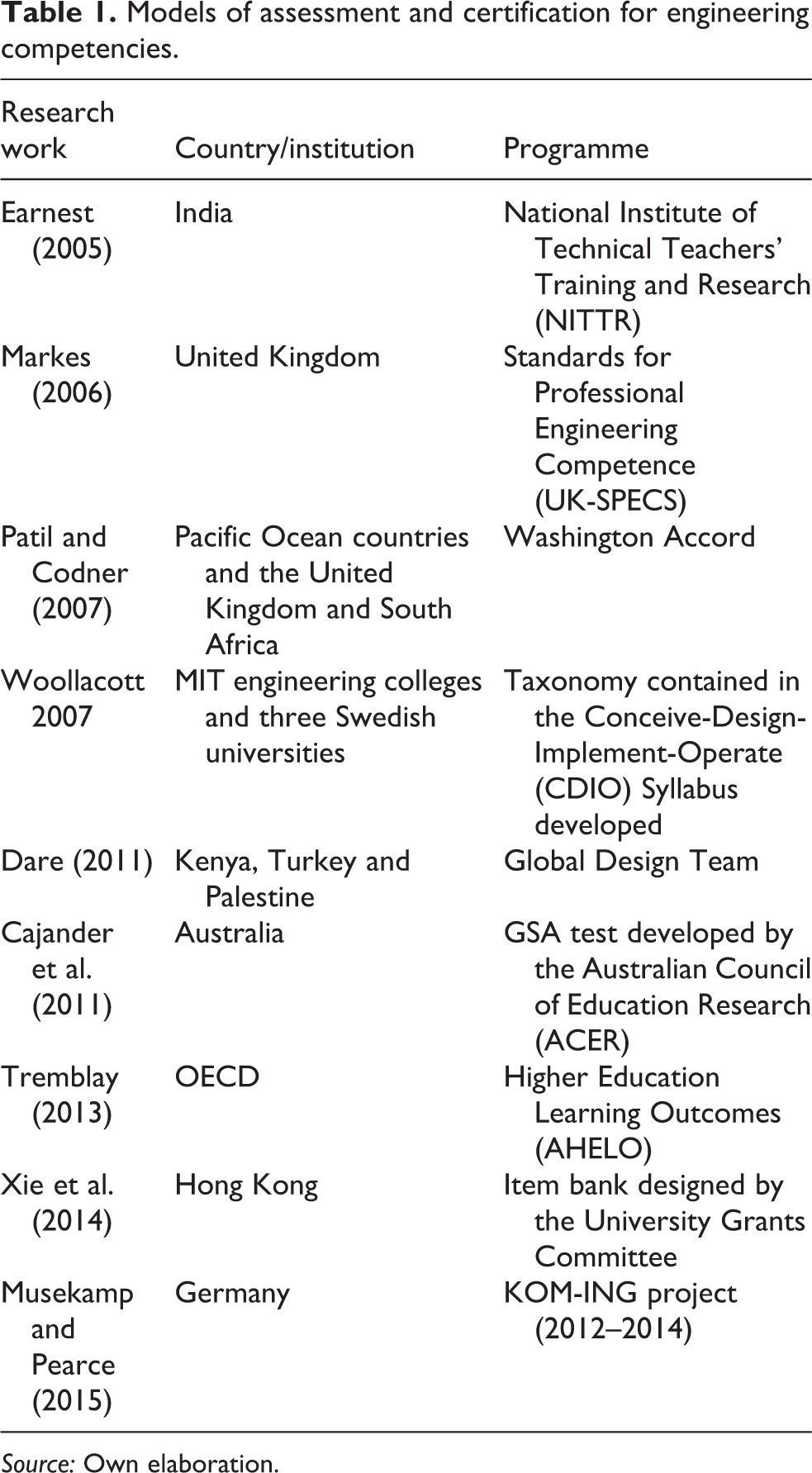
Other groups of countries have also tried to develop their own models of assessment and certification for engineering competencies (Table 1). These generally include elements that reflect the regional needs and special features of the countries themselves. They include the National Institute of Technical Teachers’ Training and Research (NITTR) programme in India (Earnest, 2005); the UK Standards for Professional Engineering Competence (UK-SPECS) (Markes, 2006); the Washington Accord, which takes in universities from a group of Pacific Ocean countries and the United Kingdom and South Africa (Patil and Codner, 2007); the taxonomy contained in the Conceive-Design-Implement-Operate (CDIO) Syllabus developed by MIT engineering colleges and three Swedish universities (Woollacott, 2007); the Global Design Team experience in Kenya, Turkey and Palestine (Dare, 2011); the graduate skills assessment (GSA) test developed by the Australian Council of Education Research (ACER) (Cajander et al., 2011); the Higher Education Learning Outcomes (AHELO) model proposed by the Organisation for Economic Co-operation and Development (OECD) for civil engineering colleges in its member countries (Tremblay, 2013); the item bank designed by the University Grants Committee of Hong Kong (Xie et al., 2014); and the KOM-ING project (2012–2014) coordinated by the German Federal Ministry for Education and Research (BMBF) for measuring competencies in German Mechanical Engineering degrees (Musekamp and Pearce, 2015).
Models of assessment and certification for engineering competencies.
Source: Own elaboration.
There are currently robust theoretical initiatives underway that aim to close the gap between the content of engineering degree courses and the practical requirements of the workplace (Lima et al., 2016). Below we look at a few of these.
Some authors have argued that the only way to reinforce these generic skills is by allowing the main employers in the university’s industrial area of influence to collaborate in some way in designing the HE curriculum – a strategy typified in the term ‘work-based learning’ (WBL) (Feldmann and Sprafke, 2015). Other researchers have suggested a guide to the HE process via project-oriented engineering education (Edström and Kolmos, 2014; Peschges and Reindel, 1998). Chryssolouris et al. (2013) propose a ‘model Teaching Factory’ in which the engineering classroom contains enterprise activity simulators and research and innovation activities that aim to reinforce technological competencies and soft skills. Finally, other authors, including Shuman et al. (2005), have highlighted the importance of online training support massive open online courses (MOOCs) for the optimal acquisition of ABET competencies in their current formulation.
Research approach
Data
The sample used to measure engineers’ employability traits was obtained from the SGCS, carried out on a population of engineers from a medium-sized representative Spanish university (the University of A Coruña). The SGCS programmes are a key part of the accreditation process for Spanish engineering schools and are carried out for various specific fields of knowledge in accordance with the methodology of the main European frameworks for measuring professional competencies and labour transition processes. As noted above, these are the CHEERS (Teichler and Schomburg, 2015), REFLEX (Allen and van der Velden, 2011), and Tuning (Gonzalez and Wagenaar, 2003) programmes. The field work began during 2011 with the search for engineers who had graduated in 2006 and 2008, providing a window of between 3 and 5 years for the analysis of the labour market transition time (Table 2).
Sample composition.

Source: SGCS, own elaboration.
The analysis takes into account the differences between three main branches of engineering that currently occupy separate curricular paths in the Spanish system. First of all, this division was made since the engineering field presents different degrees of employability and different competencies according to the specialty. The branches in question are computer engineering (BSc/MSc focusing on programming languages and IT systems engineering), naval engineering (BSc/MSc focusing on the needs of the naval industry and maritime transport) and industrial engineering (BSc/MSc including the hinterland industries and mechanical and electronic infrastructure). A random sampling process was carried out to obtain a representative sample. This was then stratified according to the year of graduation and the specific branch of engineering. The margin of error obtained was +/−2.56% and there was a confidence level of 98%. The interviews were carried out by means of the Computer-Assisted Telephone Interviewing system and with a team of survey questioners belonging to the same university and trained with very specific questionnaires which incorporated precisely focused engineering-related questions.
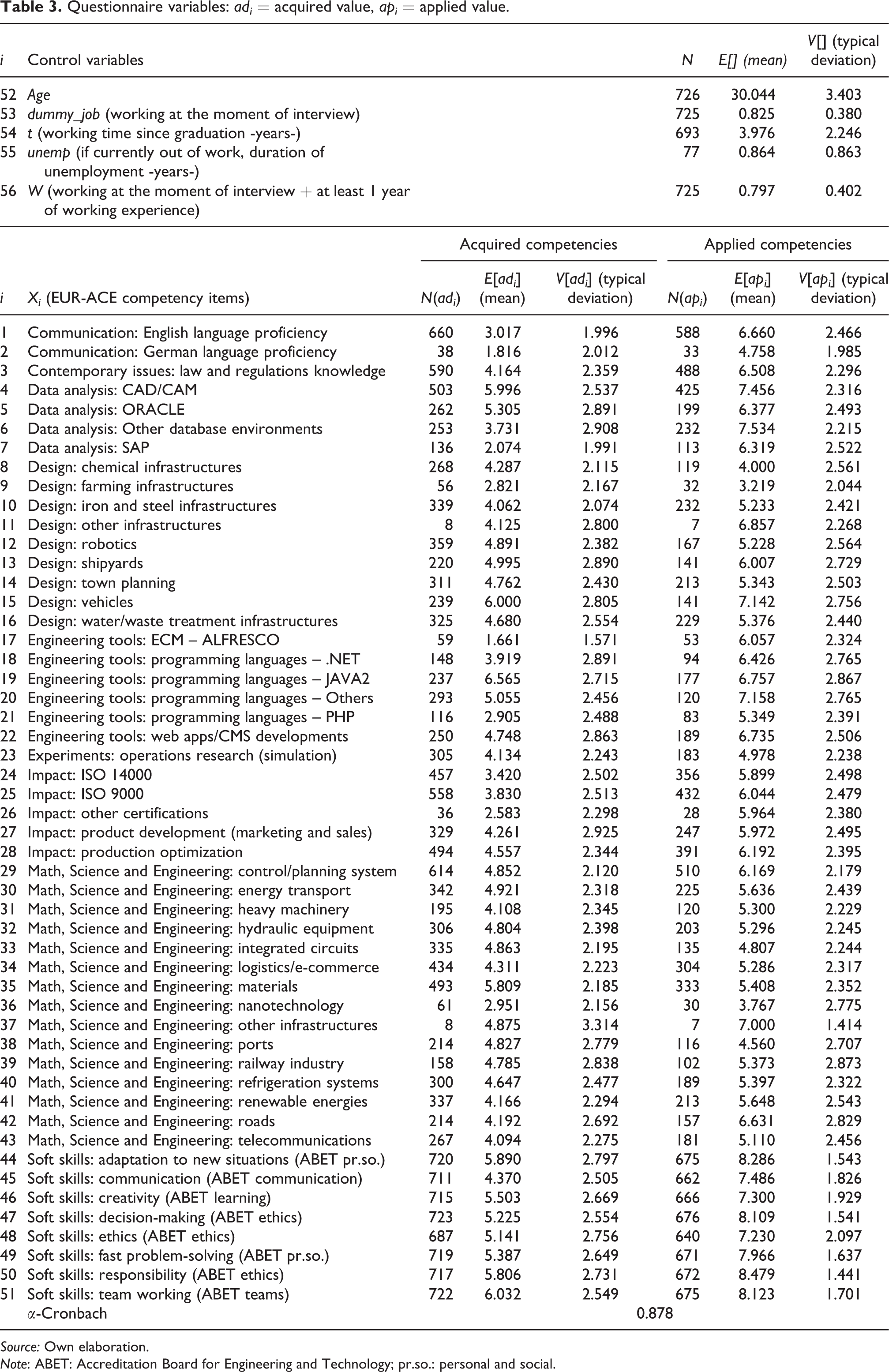
The survey carried out on the University of A Coruña was divided into three blocks: personal data; the labour status of the interviewee at the time of the survey (is the interviewee working?; if not, how many months has he or she been unemployed?; time spent working since graduation); and, in the third block, the graduates were asked about the degree to which the SGCS items had been acquired and later applied in each professional post (with a value from 0 to 10). Each of the items belonging to the final block were selected according to the criteria defined by ANECA for the accreditation of Spanish engineering degrees (Marin-Garcia et al., 2008), based on the EUR-ACE specification (ENAEE, 2017). However, as one can see from Table 3, these are highly compatible with the ABET Criterion 3 which is currently in force. All of the variables used for this research, together with their descriptive statistics, are shown in Table 3. The following features should be underlined: Each of the EUR-ACE items (communication, contemporary issues, data analysis, design, engineering tools, experiments, impact, math/science/engineering and soft skills) is divided into subcategories closely related to the specific curricular paths of the University of A Coruña’s engineering courses, which attempt to adapt theoretical and practical content to the needs of hinterland companies. There was a global α-Cronbach
6
score of 0.878 for the entire sample and the whole questionnaire. In spite of possible bias due to the large number of items, the result suggests that the measuring instrument performs well (Bland and Altman, 1997). 82.5% of graduates were working, and 79.7% had been working for at least 1 year. Henceforth, the latter measure will be taken to be a measure of ‘employability’ (i.e. currently in work and with some experience). The average time in work was 3.976 years. 47 items have positive applied–acquired differentials, and only four display negative differences. This indicates that the capacities put into practice by individuals in the workplace are, generally, greater than skills learned during HE studies.
Questionnaire variables: adi = acquired value, api = applied value.
Source: Own elaboration.
Note: ABET: Accreditation Board for Engineering and Technology; pr.so.: personal and social.
Descriptive analysis
The descriptive approach was used to analyse each of the three HE engineering branches and three restrictions were applied: competence items with low response frequency N(adi ) were discarded (threshold of 10% respect max[N(adi )]); non-significant gaps (Wilcoxon test) 7 were rejected; and the α-Cronbach instrument accuracy had to give acceptable values.
The 51 generic and specific items were all assessed together at the same priority level, thus allowing a comparison between the influence exerted by an individual item and that exerted by the whole of the competence group. The results for the three engineering branches will show how soft skills are always those that are most commonly used in the workplace and, in contrast, hard skills (EUR-ACE communication, contemporary issues, data analysis, design, engineering tools, experiments, impact, math/science/engineering) are always those items most readily acquired during HE training.
Computer engineers
Figure 1 shows the acquired and applied scores assigned by computer engineers to each item. Six skills obtain scores that reveal significant high applied–acquired differentials. 8 First in the ranking was ‘engineering tools: ECM – ALFRESCO’, which obtained a score of 4.497. This open source software (OSS) enterprise content management (ECM) platform is renowned for its file management capacities (Red Herring Global, 2014), which is widely considered to be an important ECM environment that is predicted to expand and become more innovative in the future (Parashift, 2015). This dynamic provides a gateway to a highly attractive labour market for those computer engineers who build commercial off-the-shelf, third-party ALFRESCO-based components (Hawthorne and Perry, 2006). The differential obtained clearly shows that this area is practically ignored in Spanish computer engineering HE courses.

EUR-ACE competencies for computer engineers: Acquired, applied and Wilcoxon test for mean difference.
In second place, there was a differential of 4.209 in ‘maths, science and engineering: logistics/e-commerce’, a heading which is related to a specific family of software techniques designed to supply the needs of the transport industry and to satisfy the healthy, increasing demand generated by online e-commerce webs. These channels are starting to compete directly with traditional sales outlets (Lantz, 2015) and are helping to increase revenue for small and medium-sized enterprises (Grandon et al., 2011).
Third and fourth in the ranking in terms of the gap between applied and acquired skills are ‘impact: product development (marketing and sales)’ with a differential of 3.824 and ‘communication: English language proficiency’ with 3.598. Both of these categories clearly refer to global engineering competencies (Ayokanmbi, 2011; Patil and Codner, 2007) and are directly related to the capacity of firms to nurture foreign markets for software products. The knowledge that springs from cultural context, and which should be understood as a catalyser of potential commercial success (Jesiek et al., 2013), comes under the heading of ‘soft skills: communication’ and obtained a score of 3.060.
Finally, it is important to highlight the role of specific knowledge from database environments other than the ORACLE and SAP platforms. This information is given in ‘data analysis: alternative database environments’, which obtains an applied–acquired differential of 3.210. This category refers to the importance in the labour market of OSS systems such as MySQL, postgreSQL or systems with protected licences such as the Microsoft SQL server. There is a clear logical connection between the emergence of entrepreneurial analytics or ‘big data’ (Chen et al., 2012, 2014) and the growing reliance of postgreSQL on related applications (Deger, 2014; Vaughan-Nichols, 2014). Outside the percentile threshold, OSS technologies such as ‘engineering tools: programming languages – .NET’ or ‘engineering tools: programming languages – PHP’, which are very popular with regard to web programming, are also characterized by an imbalance between HE-acquired and vocationally applied skills. Together with ‘engineering tools: programming languages – Others’ (i.e. Ruby or Python), the former categories constitute important areas in which curricular competencies – that is, specific skills taught in HE – may be better aligned to the requirements of the specific labour market.
The category of the most acquired competencies for computer software engineering degrees typically includes subjects such as ‘engineering tools: programming languages – JAVA2’ and ‘data analysis: ORACLE’. These items reflect no significant applied–acquired differential, which is evidence of a good fit between labour market requirements and HE theoretical content.
The most required items in job positions (most applied) are in all cases generic competencies: ‘responsibility’, ‘teamworking’, ‘adaptation to new situations’ and ‘fast problem-solving’. These data underline the importance of both attitude and professionalism when recruiting computer engineers, particularly with regard to the optimal performance of teams (Figl and Motschnig, 2008), which is a critical factor in the design of enterprise software applications (Passow, 2012).
Naval engineers
Figure 2 presents naval engineers’ acquired and applied scores for the competency items. The differential obtained between applied–acquired values is significantly higher in computer tools, language and soft skills–‘data analysis: SAP’, with a differential of 5.118, and ‘data analysis: ORACLE’, with 4.357, are significant IT weaknesses, and are only touched in most of the HE courses. They are, however, in great demand in the labour market; enterprise resource planning (ERP) systems for shipyards, for example, use these two big IT environments (Boat Design, 2008; Saha, 2013; Top10ERP, 2015).
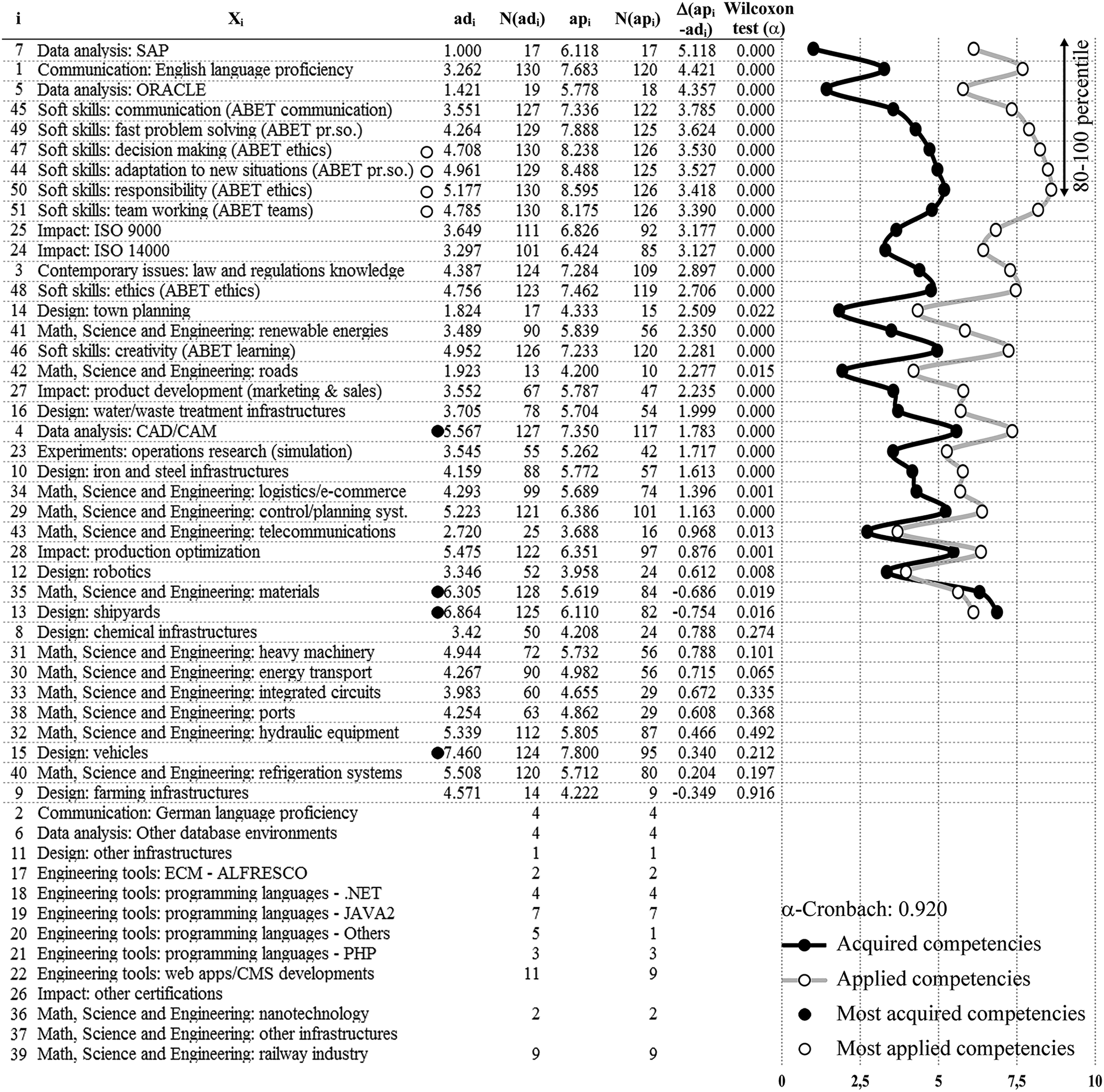
EUR-ACE competencies for naval engineers: Acquired, applied and Wilcoxon test for mean difference.
Also deficient is ‘Communication: English language proficiency’, with a score of 4.421 – this is particularly problematic since maritime sector companies use English as a global tool.
Finally, in spite of the fact that their acquired scores are between 3.5 and 5 (not particularly low), ‘communication’, ‘fast problem-solving’, ‘decision-making’, ‘adaptation to new situations’ and ‘responsibility’ reveal a substantial gap between their applied and acquired scores, with differentials of 3.785, 3.624, 3.530, 3.527 and 3.418, respectively. The three last soft skills correspond to those that are most readily applied in the labour market, underlining their status as curricular weaknesses in naval engineering degrees.
The items with most acquired scores, ‘design: vehicles’, ‘design: shipyards’ and ‘maths, science and engineering: materials’ all have negative or non-significant differentials. This may indicate that the HE training received was well-aligned with the requirements of the market, but only when the demand for these skills is high. What is certainly true is that the maximum score achieved by ‘design: vehicles’, in conjunction with higher applied scores (located at the 87th percentile for applied assessments), suggests that the demand for naval engineers with these abilities is high, in contrast to the negative, significant differentials for ‘design: shipyards’ and ‘maths, science and engineering: materials’ which indicate that there is a surfeit in the supply of people claiming to have these skills, a scenario that is all too evident in the case of some European shipyards (Cornel et al., 2013).
Finally, Spanish naval engineers stand out when it comes to ‘data analysis: CAD/CAM’, which is fourth in a ranking of most commonly acquired competences during HE. At the same time, this is a skill which is readily put into practice within the industry itself, 9 a factor that is linked to the demand for computer-assisted design and manufacturing specializations in this specific labour market.
Industrial engineers
Figure 3 presents scores relative to both the acquired and applied competencies reported by the industrial engineers interviewed. The items that produce the biggest differentials between applied and acquired skills are those linked to IT, language, soft skills, ‘design: shipyards’ and ‘impact: ISO 14000’.

EUR-ACE competencies for industry engineers: Acquired, applied and Wilcoxon test for mean difference.
Specifically, the areas with the highest scores were ‘data analysis: other database environments’, ‘data analysis: SAP’ and ‘data analysis: ORACLE’, with gaps of 5.108, 5.602 and 3.428, respectively, all of which are critical skills for the job performance of an industrial engineer since they are essential features of ERP and customer relationship management environments (Greenberg, 2015; Kimberling, 2014)
The next highest differential in the ranking fell to ‘communication: English language proficiency’, where the gap between acquired and applied skills obtained a score of 3.337, once again underlining the relevant imbalance that still exists between labour market requirements and the courses offered in Spanish university engineering faculties.
The item ‘design: shipyards’ received a low acquired score of 2.537 for industrial engineers who, in contrast, gave the item a considerably higher applied value, creating a differential of 3.327.
There are also important imbalances with respect to three soft skills: ‘communication’, ‘decision-making’ and ‘responsibility’, with differentials of 2.930, 2.922 and 2.550, respectively. These scores are directly related to the fact that industrial engineers often have to communicate sensitive data or decisions (Hoch and Peck, 1985) that deal with complicated problems, such as the structural analysis.
Finally, the competence that corresponds to ‘impact: ISO 14000’ obtains a score of 2.459, indicating that it too falls into the group for which there is much room for improvement. It also underlines how important industrial engineers are when consulting on the environment or sustainability (Köhler et al., 2013; Morris, 2004).
Certain areas in which HE curricular content appears to come off well, in that they obtain negative differentials, include ‘design: chemical infrastructures’ and ‘math, science and engineering: materials’. Industrial engineers also claim to have high acquired competencies in ‘data analysis: CAD/CAM’, ‘adapting to new situations’, ‘responsibility’ and ‘teamworking’.
The competency that comes under the heading ‘responsibility’ is of particular importance since the maximum acquired score matches with that obtained for applied competencies. This, in conjunction with the fact that the applied–acquired differential is large, reveals the extent of the liability to which industrial engineers are subject on a day-to-day basis in the design, building and supervision of infrastructures (Hoch and Peck, 1985). In addition, ‘adaptation to new situations’ and ‘teamworking’ obtain maximum applied scores, giving rise to a large gap between the two types of competence, creating differentials that are higher than average (between the 65 and 70 percentiles).
Empirical analysis
The aim of the empirical analysis was to identify competencies that are key in determining the probability of graduate recruitment. As noted earlier, for the purposes of this study ‘employed graduates’ are those that responded to the questionnaire by stating that they were currently employed and had a minimum of 1 year’s experience.
In order to carry out this search, a statistical technique was used to compute the likelihood of a recent graduate being employed and, by extension, what constitutes ‘employability’. A logit multivariate specification choice model was applied to the acquired competence scores obtained for each of the three branches of engineering and the results were then subjected to a set of goodness-of-fit conditions. The model is as follows (Mancinelli et al., 2010)
Given Wj
= {

with j ∈ {1 = com = ‘computer engineers’, 2 = nav = ‘naval engineers’, 3 = ind = ‘industry engineers’}, then

where
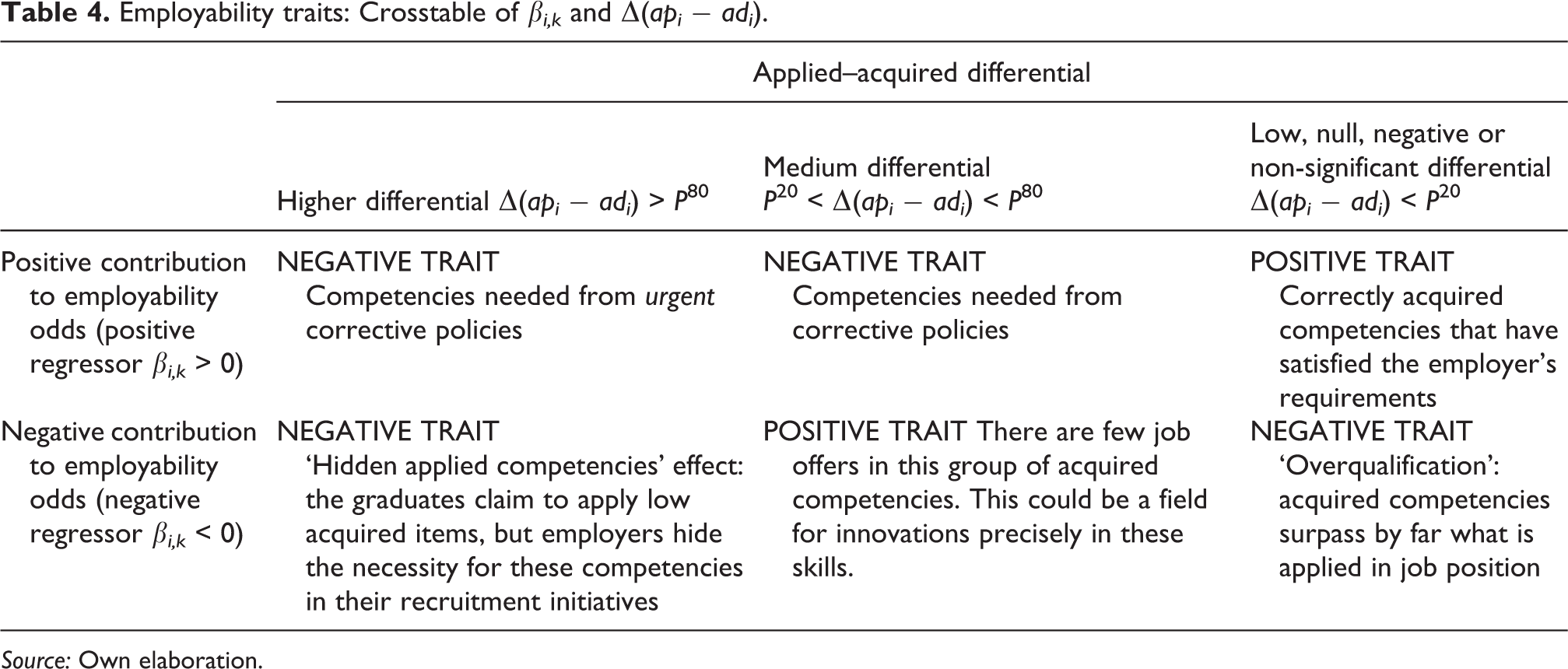
Interpretation of the results for each of the three models can be done on the basis of six groups of different employability patterns, defined by the sign of the regressors and the applied–acquired differential obtained (Table 4). Two can be interpreted as positive influences on employability and the other four are clearly prejudicial to the likelihood of a graduate being recruited.
Employability traits: Crosstable of βi,k and Δ(api − adi ).
Source: Own elaboration.
The two positive types of influence on employability appear when:
Correctly acquired competencies have satisfied the employer’s requirements. The competence item yields a positive regressor (‘βi,k > 0’ = ‘positive and significant influence of the acquired competency item on employability’) and low, null, negative or non-significant acquired–applied differentials; that is, well-balanced competencies from the point of view of the acquired–applied differential. 11
There is a gap between the acquired and required scores of competencies, but the competencies are not in high demand in the labour market. The competence item yields a positive regressor (‘βi,k < 0’ = ‘negative and significant influence of the acquired competency item on employability’). At the same time, there is a mean gap between the acquired and required scores. While the influence of this indicator on the demand for employees is negative (there are no companies offering this kind of post), this gap should not be interpreted as a negative trait, but as an indicator that some level in this kind of skill might be contingent with the future needs of firms in terms of their capacity for innovation.
The four possibilities for a negative influence of the competency item on employability appear when the following scenarios occur: a positive regressor in the competency item (βi,k
> 0) in conjunction with higher or medium acquired–applied differentials; a possible ‘hidden applied competencies’ effect, which would denote a demand for non-explicit competencies when being hired; and ‘overqualification’ patterns characterized by an excess of competency training in fields with poor employment perspectives (Budria and Moro-Egido, 2014).
Table 5 shows the regressors obtained after applying specification (1) to each set of acquired competencies for the three branches of engineering. The logit specification is a feasible alternative as indicated by the goodness-of-fit conditions obtained: (a) regressors which are significantly different from zero; (b) the rejection of the hypothesis that the observed probability is significantly different than the estimated probability (Hosmer–Lemeshow test); (c) reasonably higher pseudo-R 2 measures; and (d) sensitivity and percentage of correctly classified data.
Logit model outcomes and solving conditions.

Source: Own elaboration.
Note: Variables omitted: collinearity dropping or low N(adi ). Significant regressors: shaded cells positive, bold type negative. ABET: Accreditation Board for Engineering and Technology; pr.so.: personal and social.
In order to obtain an overall frame of reference for the employability measured by the model, P(W = 1) was estimated and took values of E[adi ] for all items. The probabilities of this hypothetical ‘mean’ graduate being employed are as follows: 98.42% for computer engineers, 92.95% for naval engineers and 80.93% for industrial engineers. This approach confirms the fact that average employability is lower for industrial engineers, where there is less specialization.
Results and discussion
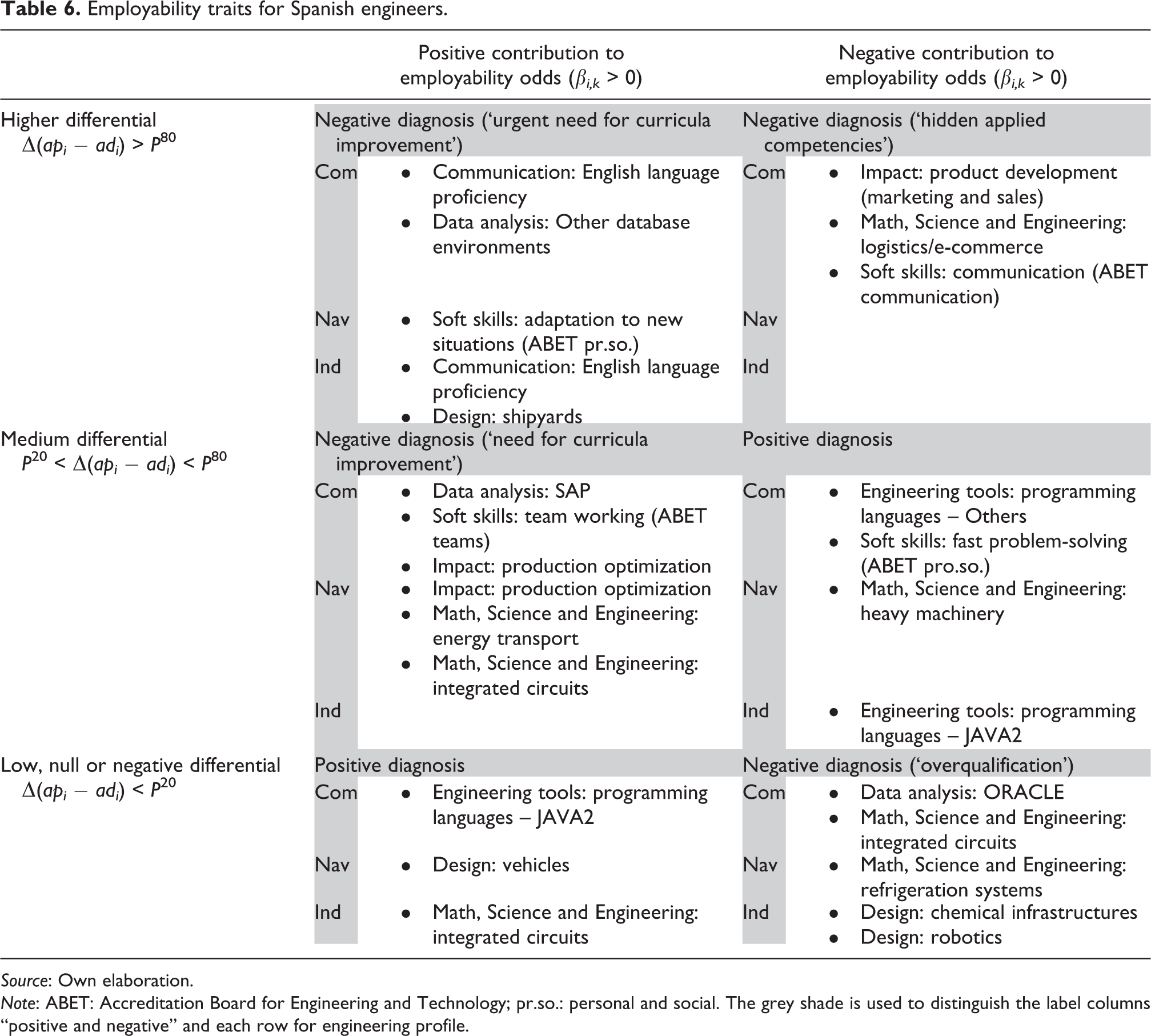
Table 6 provides the six employability patterns generated, which combine the information of the regressors’ signature (Table 5) and the applied–acquired differential for the competencies in each of the three branches of engineering (Figures 1 to 3), thus determining: (i) the strengths and weaknesses of each degree and (ii) the items that are significant for two or three of the branches of engineering simultaneously.
Employability traits for Spanish engineers.
Source: Own elaboration.
Note: ABET: Accreditation Board for Engineering and Technology; pr.so.: personal and social. The grey shade is used to distinguish the label columns “positive and negative” and each row for engineering profile.
First, it is apparent that computer engineers graduate with serious weaknesses in certain specific areas of competency. Hence, there is an urgent need for policy measures that aim to address deficits in ‘communication: English language proficiency’ and ‘data analysis: other database environments’. Less urgent, but nonetheless troubling, is the paucity of ‘data analysis: SAP’, ‘teamworking’ and ‘impact: production optimization’.
Potential recruitment candidates were also overqualified in ‘data analysis: ORACLE’ and ‘math, science and engineering: integrated circuits’. This trait is not necessarily negative but reveals a depth of theoretical training in these two areas which, given current labour market volatility, might become competencies that are more attractive for employers in the future.
Some of the strengths of Spanish computer engineering graduates include competences that come under the headings of ‘engineering tools: programming languages – JAVA2’ and, to a lesser extent, ‘engineering tools: programming languages – others’ and ‘fast problem-solving’. Spanish computer engineers are therefore efficient in J2EE programming and in other languages, such as Visual Basic, Ruby, Python and C family.
The ‘hidden applied competencies’ phenomenon is evident only in computer engineering. These competencies are items that are not explicitly mentioned in relevant job offer requirements, and so impact negatively on employability. However, computer engineers report that these are competencies that are used on a daily basis in the workplace. All these skills are directly related to commercial aspects of the IT industry and are as follows: ‘impact: product development (marketing and sales)’, ‘math, science and engineering: logistics/e-commerce’ and ‘communication’. This can be interpreted as further evidence of a precarious labour market, particularly for certain kinds of computer programmers (Gill and Pratt, 2008; Lodovici and Semenza, 2012). Nevertheless, this employability profile also reveals that there are infra-utilized commercial abilities which only come to the fore after the engineer has been hired, after which he or she is probably subject to greater pressure.
Second, naval engineers are characterized by deficits in areas that include ‘adaptation to new situations’, an essential skill for maritime environments; ‘impact: production optimization’, related to input–output efficiency and cost savings in shipbuilding schedules; ‘math, science and engineering: energy transport’, directly linked to vessel propulsion systems; and ‘math, science and engineering: integrated circuits’, linked to the degree of electronic automation. There is overqualification in ‘math, science and engineering: refrigeration systems’, for which naval engineers have high levels of expertise and appear to have reached a critical demand threshold. Two of the strengths of these graduates’ training are ‘design: vehicles’ and ‘math, science and engineering: heavy machinery’, defining job environments in which naval engineers are highly skilled.
Finally, industrial engineers display manifest weaknesses in the areas of ‘communication: English language proficiency’ and ‘design: shipyards’, both of which obtain particularly high differentials. The item ‘design: shipyards’, for which naval engineers scored highly, received a low acquired score for industrial engineers who, in contrast, gave the item a considerably higher applied value. This reflects a significant weakness in the HE curriculum, one that may have been exacerbated by the reconversion process affecting the whole of the EU’s naval construction industry. The future of shipbuilding will be closely linked to specialized innovation and high-end technology (Gualtieri, 2013; Pérez-Labajos et al., 2014; Ruiz-Navarro, 1998). This will inevitably lead to the recruitment of engineers from a plethora of sectors with competence levels in hinterland/foreland logistics, robotics, nanotechnology and integrated circuits, for example.
Industrial engineering graduates appear to be overqualified in ‘design: chemical infrastructures’ and ‘design: robotics’. The latter should prompt engineering degree planners to ask themselves which labour market is absorbing the high levels of expertise in robotics shown by Spanish industrial engineers, and why this vanguard competence is seemingly ignored by companies in the graduates’ area of influence.
Finally, performance in ‘maths, science and engineering: integrated circuits’ is positive, which augments employability while reflecting a good balance between applied and acquired competencies. This contrasts sharply with the overqualification that computer engineers would seem to have for the same item, prompting the speculation that the labour market might currently prefer industrial engineers specialized in microprocessors as opposed to computer engineers.
The abilities of Spanish industrial engineers with respect to ‘engineering tools: programming languages – JAVA2’ constitute a strength which, together with computer engineers, makes them good candidates for employment positions in which this very specific demand for human capital is satisfied.
The logit probabilities supplied by the solution to model (1) were computed for each of the three branches of engineering. The competencies give significant levels of elasticity for two or three of the engineering degrees when considered simultaneously (Figure 4). 12 In order to carry out this procedure, the ceteris paribus restriction for the rest of the competencies has taken the form of the skill level found within percentile 75 (P 75[Xi ]). However, the item varies between the minimum assessment (= 0) and the maximum (= 10).
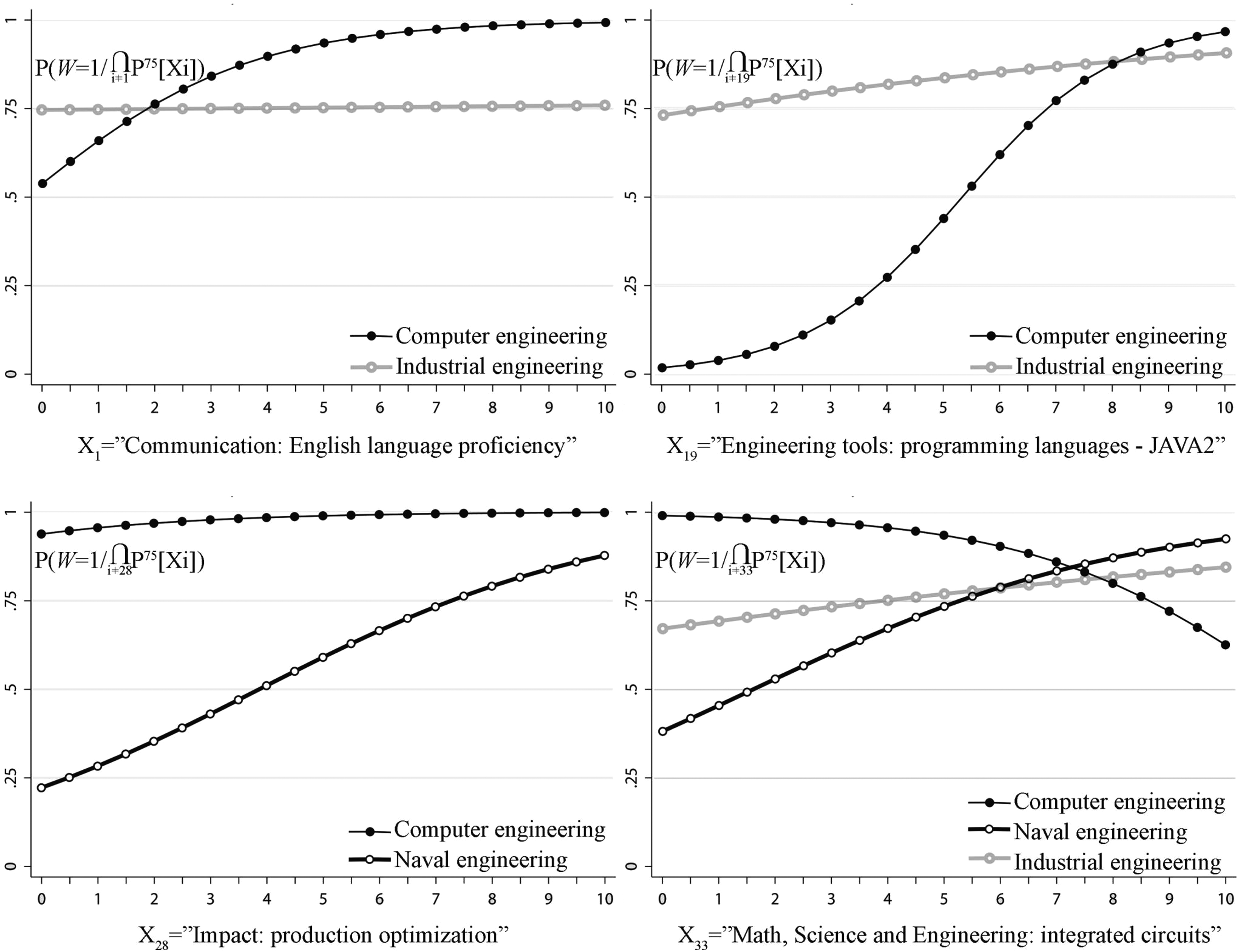
Employability odds for shared regressors.
In ‘communication: English language proficiency’ it can be observed that, for low levels (lower than 2), the labour market prefers industrial engineers to computer engineers, but as proficiency in English increases, programmers become more ‘employable’, while for industrial engineers this influence is minimal. The ‘engineering tools: programming languages – JAVA2’ item is also significant for these two qualifications, but in this case the dynamics are very different. It should be emphasized that, although the labour market is rather larger for industrial engineers than for computer engineers, who should already be highly skilled in this programming language, the former will only be seen to be more employable than the latter when they are capable of demonstrating much higher levels of expertise (higher than 8).
In contrast, with respect to ‘impact: production optimization’, computer engineers and naval engineers are effectively competitors, with the former being more employable. At the highest acquired levels, employability for the two branches tends to converge, although computer engineers maintain a slight advantage.
Finally, it seems that the labour market receives signals that all engineers claim to have high levels of HE training when it comes to ‘math, science and engineering: integrated circuits’. As one might expect, as the reported skill level increases, the employability of computer engineers decreases in favour of naval and industrial engineers, who are preferred because of the higher skill requirements.
Conclusions
Despite the existence of different international accreditation standards for HE engineering degrees, each economic region has been able to find adequate procedures to measure the quality of these degrees, procedures that are deemed important for the economic growth of the countries in which these young engineers perform their jobs.
The analysis provides an accurate assessment of those competencies acquired during engineering degrees, those that are utilized in the workplace, and the apparent mismatch between some areas of competency in particular. The study also reveals that each of the three engineering branches has a very different competency profile. Additional criteria, defined by the employability multivariate model, allow us to contrast the applied–acquired differentials obtained by taking into account the cross-sectional positive or negative contribution of each item to the recruitment processes. This procedure allows us to set out an accurate map of the strengths and weaknesses of each branch of engineering.
Spanish computer engineers appear to be overqualified in ‘data analysis: ORACLE’ and ‘math, science and engineering: integrated circuits’. What also stands out for computer engineers, a trait which is exclusive to them, is the existence of ‘hidden applied competencies’ in areas such as sales and marketing, where skills are not explicitly demanded by employers, but once recruitment has taken place they are immediately valued: ‘impact: product development (marketing and sales)’, ‘math, science and engineering: logistics/e-commerce’ and ‘communication’. These competencies come to the fore only after the engineer has been hired, after which he or she is probably subject to greater pressure.
For naval engineers, the areas that impact positively on employability are ‘design: vehicles’ and ‘math, science and engineering: heavy machinery’. Those that impact negatively are ‘adaptation to new situations’, ‘impact: production optimization’, ‘math, science and engineering: energy transport’ and ‘math, science and engineering: integrated circuits’. There would appear to be overqualification in ‘math, science and engineering: refrigeration systems’.
Industrial engineers are strong in ‘math, science and engineering: integrated circuits’ and in ‘engineering tools: programming languages – JAVA2’, and weak in ‘communication: English language proficiency’ and in ‘design: shipyards’. Overqualification is detected in ‘design: chemical infrastructures’ and ‘design: robotics’. This analysis allows us to identify the naval reconversion plans of the EU, because of the positive demand for graduates skilled in ‘design: shipyards’, characterized by innovation that focuses on highly specialized vessel building, and the re-utilization of shipyards by other sectors such as the aeronautical industry.
Finally, according to the TIOBE index for April 2017 (TIOBE, 2017), the Java2 programming language (and its associated frameworks) is currently the most commonly used platform in the world for developing software products. Hence, the results of this part of the analysis can be extrapolated to HE learning in Europe and even further afield. In contrast, the apparent weaknesses in other database environments and in SAP may indicate a lack of training in two highly pervasive areas of IT: big data and SAP-based ERP. Whether or not this shortfall is international must remain an object of speculation, but the two techniques are unquestionably central to the current production patterns of the globalized world (Chen et al., 2014; Columbus, 2014). The lack of proficiency in English for this branch of engineering contrasts starkly with the competency obtained in other countries and raises the question of how the standard of linguistic proficiency, particularly in English, can be raised since it clearly impacts on employability.
Limitations and future lines of research
This research has been carried out with certain limitations, among which we can highlight the late availability of data for analysis, the fact that the sample is for only one university (regional analysis), and the possibility that technological evolution and certain changes in industrial demand may not have been reflected in the competency items analysed.
Futures lines of investigation might involve the application of this methodology to a wider sample of European universities to clarify the general and regional traits of the current labour market demand for young engineers. Future analysis might also include the dissemination of active learning approaches (Lima et al., 2016), problem/project-based learning and CDIO initiatives (Edström and Kolmos, 2014), or WBL patterns (Allan and Chisholm, 2008). In short, pedagogue-centred curricular content should give way to more student-focused learning.
Footnotes
Acknowledgements
The authors thank the anonymous reviewers for their comments and suggestions, which have undoubtedly contributed to the improvement of the article.
Declaration of conflicting interests
The author(s) declared no potential conflicts of interest with respect to the research, authorship, and/or publication of this article.
Funding
The author(s) received no financial support for the research, authorship, and/or publication of this article.
