




Abstract
The experiment tested overconfidence in number skills among British graduates and non-graduates. The data were collected at a residential management training programme for part-time professional students. The aim of the research was to test whether graduate professionals, due to their higher qualifications, overstated their numeracy abilities compared to non-graduates. The experiment, conducted using E-prime, showed a significant interaction between the level of qualification and the overstatement of numerical abilities. The results support the hypotheses and showed that graduates rated themselves higher than their actual abilities: their test performance was not consistent with their confidence estimates. The findings are significant in relation to rethinking higher education curricula, which are currently under pressure to align with the needs of the economy. The authors advocate more inclusive and interpretive research for a greater understanding of the relevant issues to offer useful policy data and help higher education institutions prepare their graduates for task fulfilment and decision-making in a dynamic workplace. To date, few experiments have tested the numeracy level of graduates to corroborate the narrative communicated by employers. This study, despite the limited sample, is a first attempt and will serve as a reference for future, wider studies.
Keywords
Graduate employability has been high on both the government and the higher education agendas for the past two decades in the United Kingdom and the developed world generally. There is increasing concern that, while graduates acquire significant subject knowledge when they leave universities and colleges, a significant proportion may lack basic skills. Some of the areas in which graduates are considered to lack skills are planning, information technology, literacy and communication (Okolie et al., 2019; Raybould and Sheedy, 2005; Shultz, 2008). Numeracy is a critical skill if graduates are to fulfil other employers’ requirements, such as project management, planning and the ability to work with uncertainty (Black and Yasukawa, 2010; Raybould and Sheedy, 2005; Tymon, 2013). However, the Financial Times (2015) reports on an OECD study showing that US and UK graduates are weaker in literacy and numeracy than their peers in other developed nations. Kuczera et al. (2016) found that over nine million adults in the United Kingdom had low basic skills, mainly in the areas of numeracy and literacy. Despite these figures, when graduates are interviewed, they appear to display confidence that is at odds with the research evidence, which indicates that employers take a different view (Tymon, 2013). This suggests that the attitudes and responses of the graduates may be an expression of overconfidence.
Overconfidence has emerged as an important area in cognitive psychology (Anderson et al., 2012; Bi et al., 2016; Kennedy et al., 2013; Malmendier and Tate, 2004; Saunders et al., 2009). It is an area within the much-researched field of judgement and decision-making that has fascinated and captivated the imagination of cognitive psychologists for a few decades now (Malmendier and Tate, 2004; Schulz and Thöni, 2016). Much of the literature on judgement and decision-making acknowledges that, while we cannot necessarily teach people how to make objective decisions (Ayton, 2005; in Braisby and Gellaty, 2005), it is important to understand the rationale for choosing one solution over another. Psychological research in decision-making aims to bridge the gap between normative and descriptive approaches to help people make better decisions. Overconfidence can present difficulties for learning in that it can operate as a barrier to recognizing personal needs – as found in Anzalone’s (2009) study of college learners in the United States.
The aim of this research is to assess the degree to which graduates’ expressed confidence in their numerical skills is justified by their capabilities in practice. Overconfidence (‘I think I can do it’) is a cognitive bias, defined as an individual’s tendency to overestimate ability and the probability of gaining positive outcomes (Giacomin et al., 2016). Overconfidence also occurs when individuals believe themselves to be better than others (Bell and Volckmann, 2011; Bi et al., 2016; Mertins and Hoffeld, 2015). Thus, university graduates often overestimate their own ability, performance, control or chances of success (Anderson et al., 2012; Bortolotti and Antrobus, 2015; Herz et al., 2014; Johnson and Fowler, 2011). In relation to graduate employability (Minocha et al. (2017), as noted above, there is increasing concern that, while graduates acquire significant subject knowledge when they leave universities and colleges, an important proportion may lack basic skills (Pitan, 2017).
The main research question for this study was to what extent do university graduates overestimate their abilities to deal with numbers due to higher-level education experience? The study had three objectives: to assess graduates’ and non-graduates’ evaluation of their skills in numeracy (a pretest confidence rating question was put to participants – see ‘Method’ section below); to determine whether a higher-level education (particularly completion of higher education) leads to overconfidence about numeracy skills; and to ascertain whether the level of overconfidence varies with levels of difficulty of the numerical test questions.
With these objectives in mind, three hypotheses were developed: Graduates are more likely than non-graduates to overrate their basic mathematical skills and use graduate status to legitimize such a claim. Graduates’ real basic mathematical skills can be lower than their estimates of their skills (the value and disadvantages of overconfidence are further discussed in the section ‘Literature review’). In a basic number test, the performance of graduates will not be higher than that of their non-graduate counterparts.
To conceptualize overconfidence in numerical skills, this empirical research adopts Brunswik’s (1955) theory of overconfidence. Gigerenzer et al. (1991) and Hammond (1965) outlined how this cognitive conflict could be construed within Brunswik’s (1955) model framework, as well as the experimental methods that researchers could use to study the nature, source and resolution of disagreement between parties performing judgement tasks. Using a simple test of confidence with numbers, the research attempts to establish whether graduates and non-graduates show the overconfidence effect (i.e. if the confident judgements about their mathematical abilities are larger than the average of right answers that they produce in a simple numerical test). The study seeks to establish whether the fact of possessing higher qualifications leads graduates to overestimate their basic mathematical skills compared to those who do not have a university degree. More importantly, we examine the implications of this, if it occurs.
Literature review
Conceptualizing overconfidence
Existing research evidence shows that optimism and overconfidence are common among university students (Bi et al., 2016; Giacomin et al., 2016).
Studies of overconfidence have examined whether people know as much as they claim to, and if some individuals think they can do it better than others (Bortolotti and Antrobus, 2015; Herz et al., 2014; Hmieleski and Baron, 2009; Mertins and Hoffeld, 2015). Although it depends on what and whom you ask, overconfidence occurs when people rate themselves better than the median (Bi et al., 2016; Moore and Healy, 2008) or overestimate their own ability, performance, control or chances of success (Bi et al., 2016; Johnson and Fowler, 2011). In other terms, these studies raise the question of whether people suffer from an overinflation of self-value when rating their own knowledge of reality (Chiu and Klassen, 2010; Christensen-Szalanski and Bushyhead, 1981). For Harvey (1997), this means that people’s judgements and decisions are based on their own estimates of probabilities that particular outcomes will materialize. Such estimates are quantified by cognitive psychologist researchers with rates between 0% and 100% (which are referred to as ‘full-range tasks’) or, often, between 50% and 100% (‘half-range tasks’).
Research using these rating scales has found that, in general, when presented with two items and asked to choose the right answer and rate their level of confidence (or certainty), people tend to rate themselves higher than their actual ability to produce right answers. This is a bias that is, for Gigerenzer et al. (1991), a manifestation of overconfidence. Research in the field also finds that people become less overconfident when the question is harder – suggesting that they are more overconfident for simple questions and more realistic in their estimates of their knowledge of more difficult questions. In the context of overconfidence research, this has been termed the ‘Hard–Easy Effect’ (Brunswik, 1955).
Overconfidence and learning
The significance of the study of overconfidence in education is evidenced in a number of studies. For instance, Anzolone (2009) found that overconfidence could impair learning in students because it created a false sense of knowledge that led the learner to disengage with the learning process. Similar findings appear in Gustavson and Nall’s (2011) study of graduates’ confidence in their research skills. These authors found in their survey that students who rated their research skills as expert-level scored only 50% in the research skills test, which was lower than the score of the students who rated themselves as only good. Chiu and Klassen (2010: 3) posit that overconfidence (which they refer to as overestimation) of ‘one’s potential performance or self-efficacy can lead to poor preparation and lower performance’. Similar findings are reported by Ackerman and Wolman (2007). In the context of employment and organizations in the financial sector, the negative consequences of overconfidence have been elaborated by Menkhoffa et al. (2006). They found that less-experienced fund managers had higher returns than those who had worked for longer because the latter had developed overconfidence and complacency over the years, while the less-experienced workers did not take anything for granted and therefore deployed greater diligence. De la Rosa (2011) study of ‘Overconfidence and moral hazard’ yielded very similar results and asserted that ‘an overconfident agent disproportionately values success-contingent payments’ (p. 429). This is consistent with Brunswik’s (1955) ‘Hard–Easy Effect’ since familiar tasks are treated by the experienced agent as ‘easy’ ones that can be completed with minimum effort. These studies demonstrate that overconfidence is an ill with far-reaching negative consequences and one that is therefore worth tackling vigorously at personal and institutional levels.
The importance of overconfidence for managers and entrepreneurs has been highlighted in many studies (Bi et al., 2016; Bortolotti and Antrobus, 2015; Johnson and Fowler, 2011; Kennedy et al., 2013; Giacomin et al., 2016). Some focus on the mental advantages of overconfidence, including increased motivation, higher goals, strengthened coping mechanisms in the face of negative feedback (e.g. Bortolotti and Antrobus, 2015) and increased competitiveness (Johnson and Fowler, 2011). Giacomin et al. (2016: 927) argue that both optimism and overconfidence are beneficial when deciding to become an entrepreneur as they ‘downplay uncertainty or setbacks and focus on what is good in a situation’, further pointing out that optimistic entrepreneurs are more likely to pursue entrepreneurial activities and persist when faced with challenges.
The overconfidence shown by students (Bi et al., 2016; Bell and Volckmann, 2011; Kennedy et al., 2013) generally poses a problem for the higher education system and employers because it blurs potential support mechanisms to help students attain greater basic skills and improve their employability on graduation. Black and Yasukawa (2010) found low levels of literacy and numeracy among adults, including graduates. Yet, Durrani and Tariq (2012) stress the importance of developing numerical skills in undergraduates, pointing out that these have become core employability skills and constitute an essential selection criterion in the modern labour markets and the knowledge economy (Browne, 2010). A study by Saunders et al. (2009) on Australian undergraduate students also provides ‘evidence that suggests that poor performance (among students) might, in fact, be associated with overly optimistic attributions based on past successes’ (p. 1). Given such critical findings with far-reaching implications, the need for sustained investigations into how greater numerical literacy could be developed by graduates is clear. This view is echoed by Hernández-Fernaud et al. (2017) and the Learning and Skills Council (LSC) (2006). Therefore, there have been calls from educationalists, policymakers, government departments and universities to pay greater attention to generic skills (McLarty, 2005), communication skills (writing and speaking), team working skills (Krassadaki et al., 2014) and numeracy skills (Black and Yasukawa, 2010; Raybould and Sheedy, 2005).
Impact of overconfidence on employers and employment
Hillage and Pollard (1998) define employability not just in terms of being employed after graduation but also in terms of the graduate’s ability to secure and hold on to a job in an increasingly competitive marketplace. Employability has often been defined from the employer’s perspective and the student’s views have been ignored (Tymon, 2013). While graduates view technical skills as pre-eminent, employers look at other transferable skills, including basic skills and personal qualities. However, if employability interventions are to be targeted and effective, it is important to understand the standpoint of the recipient. The divergence of perceptions of employability do not relate only to employers’ and students’ definitions; academics also display divergence in articulating a definition of employability (Tymon, 2013). Some academics emphasize skills (Hillage and Pollard, 1998; Poole and Sewell, 2007), while others take a broader perspective (Tymon, 2013; Yorke, 2004) by including personal attributes; and other researchers consider employability as closely associated with education–employment trajectories as well as students’ biographical trajectories, which influence whether they gain or fail to gain employment outcomes (Holmes, 2013). With millions of graduates exiting universities every year, the competitiveness of the aspiring professional is no longer established only by the classification of their degree or the subject studied. Extracurricular activities and skills gained have become assets (Poole and Sewell, 2007) that employers seek in a good graduate. While soft skills feature significantly in the requirements of modern employers, Pegg et al. (2012) and Black and Yasukawa (2010) found that numeracy was equally significant among what employers considered to be fundamental graduate assets. Pegg et al. (2012: 407) note that, since 2010, higher education institutions in England have been ‘required to articulate their position in relation to student employability through the provision of an “employability statement”’.
Adult basic skills, particularly in numeracy and literacy, have been the subject of debate in the United Kingdom for several decades. Kuczera et al. (2016) found that in excess of nine million adults in the United Kingdom lacked numeracy, a figure that includes a sizeable proportion of those completing university education. In fact, the OECD (2013) has produced evidence indicating that graduates’ level of numeracy in the United Kingdom is below that of graduates from several competing nations. This is a surprising finding since the OECD found in 2013 that the number of young people who were not in education, employment or training had not changed in the current decade and that the figure was lower than that for a number of other European Union countries. Faced with such apparent contradictions between reality and research findings, it is important to undertake further inclusive and interpretive research (Karadağ, 2017), which may be useful to policymakers and higher education institutions alike.
The merits and demerits associated with an overconfident attitude have been the subject of several studies (Bi et al., 2016; Hmieleski and Baron, 2009). Higher education stakeholders need to be concerned about overconfidence in numerical skills (Green and Zhu, 2010; Mavromaras and McGuinness, 2012) as this can be a significant disadvantage in the sense that overconfidence can lead graduates to overstate their abilities at the recruitment stage, leading to poor individual and organizational performance when a candidate is appointed (Chiu and Klassen, 2010; Johnston et al., 2015; Mavromaras and McGuinness, 2012; Nielsen, 2011). Overconfident graduates who overrate themselves are also prone to pursue unreasonable goals (Bi et al., 2016) and experience lower levels of job satisfaction (Green and Zhu, 2010). Those who scrape through still require significant employer support once employed, particularly in areas such as project management or budgeting.
There has been sustained research connecting employability skills, especially numeracy, with productivity (Álvarez-González et al., 2017; Huselid, 1995; Jones et al., 2017; Keep et al., 2006; Tymon, 2013). The LSC, which works with employers and communities to improve skills in England and Wales, has acknowledged that there are skills gaps in the United Kingdom. There is some consensus that investment in the development of basic skills is a precondition for steering and maintaining productivity (House of Commons, 2015; Kuczera et al., 2016; LSC, 2006). Other studies advocate a link between employee creativity and organizational innovation and performance. For instance, supporting the skills–productivity link, Dedahanov et al. (2017: 343) contend that ‘in dynamic marketplaces, innovativeness is necessary to create and sustain superior performance’. This is achieved partly through the effectiveness of a numerate and skilled workforce. Studying graduate-level numeracy in particular, and basic skills in general, is a significant step towards attaining greater organizational performance and national productivity, benefiting all stakeholders. Huizinga et al. (2008) contend that poor numeracy has implications not only for the economy and productivity but also for health issues: they established a correlation between low numeracy and obesity.
The role of higher education
Temple (2012) and Shaheen (2011), highlighting the crucial role that higher education can play in skilling the nation, propose a skills-based approach to the curriculum to effectively support economic growth. Temple (2012) contends that modern universities need to move beyond their traditional roles of teaching and research such that they are located at the heart of regional development and regeneration. In approaching this new role, universities need to focus on graduate employability (Álvarez-González et al., 2017; Hernández-Fernaud et al., 2017) and produce graduates who can articulate basic skills, including numeracy and literacy. From the same perspective, Mason et al. (2009) find that numeracy is one of the greatest assets with regard to graduate employability, and that, in the development of such assets, employer involvement in curriculum design is important. From a utilitarian standpoint, employer involvement will render curricula relevant to the needs of the economy and will enable universities to demonstrate their embeddedness in society and the locality (Batistic and Tymon, 2017). Increasing research examines the importance of collaboration between higher education institutions (HEIs) with a view to delivering higher education that responds to the needs of contemporary organizations and economies (Johnson and Peifer, 2017; Batistic and Tymon, 2017) found evidence of decreasing confidence in university graduates, though varies according different social contexts. Hunsaker and Thomas (2014) suggest that confidence in higher education is diminishing, with a corresponding need for a significant change in the higher education system.
Method
Design
The study involved two groups of participants (graduates and non-graduates), selected from a residential weekend school to experience the same conditions (i.e. to perform a numerical test). The independent variable was the level of qualification (graduate versus non-graduate). The participants were administered a two-part basic mathematical test consisting of simple multiplications (see Appendix 1). The questions in the first part required one-digit numbers to be multiplied by a two-digit number; in the second part, two-digit numbers had to be multiplied by two-digit numbers. Thus, it was assumed that operations in the second part of the test would be harder for participants than those in the first part. The dependent variables were the rating of confidence (expressed using the scale 50–100), the percentage of right answers and the average of correct answers. The basic design did not set a specific time limit for participants to respond to the stimuli, but they were strongly encouraged to respond within 20 s. The responses participants provided to each stimulus were twofold: (1) they answered ‘True/False’ to suggested estimates of multiplication operations, and (2) they estimated their level of confidence in their answer. For instance, a stimulus such as ‘22 × 31 = 650’ would be judged true or false and then a percentage level of confidence would be attributed to the answer. The E-prime software was used to record participants’ response time and correct answers.
Participants
The study participants were part-time ‘student’ managers attending a residential weekend course: the sample included all participants in the course. They had similar educational experience in that they had all attended UK higher education institutions. All were from social science (including business studies) and humanities backgrounds. We therefore assumed that they would not have the expert mathematical backgrounds of graduates of, for example, engineering, mathematics and science. One of the two participant groups comprised 11 ‘students’ who were graduate managers in various companies. The second group comprised 11 respondents who had also attended higher education but who did not have a university degree – they had other lower qualifications, such as Higher National Certificates or Levels 4 and 5 of the National Vocational Qualifications. The participants had completed their education and had been working as managers for between 2 years and 5 years. They were pursuing a part-time Master’s programme which included a compulsory residential weekend. The groups were equal in number that reasonable comparisons could be made. The two groups of participants were in different rooms and could not talk to one another; each group’s members sat in the same room at a different desk and were required not to communicate with one another.
Apparatus
As already noted, the experiment was conducted using E-prime, which allowed us to record participants’ correct answers as well as their response times for the purpose of comparisons between the two groups. Major factors for analysis were the overall confidence estimates of the participants in their number skills; the overall estimates of the time taken to complete the test; the percentage of accurate and inaccurate answers per group; the comparison between graduates and non-graduates; and a two-way analysis of variance (ANOVA). The results were plotted on a graph to make significance more visible. Statistics such as averages, percentages, means, mode, significance and so on were considered for data description and to support comparative frameworks.
Procedure
Four introductory questions asked participants to rate their overall confidence with numbers (between 50 and 100) and to state their qualification, age and gender. They were also asked, as a final question, to state the amount of time taken to complete the task. The main questionnaire consisted of multiplication operations with estimated values, requiring the respondent to judge the estimate as true or false and to indicate their confidence level in their respective answers. The test comprised 40 multiplication questions or stimuli, each with a question about the confidence level. As noted above, the first part of the test comprised multiplications with one digit on one side and two digits on the other and the second part comprised double digits on either side. The participants were asked not to use calculators. Estimates were deemed correct if they were within 10% of the actual result of the multiplication. It was anticipated after piloting the questionnaire that the experiment would take 6–10 min, giving participants approximately 20 s per question.
Participants were thoroughly briefed before they gave their consent and had the opportunity to withdraw at any time. Responses were anonymous to preserve confidentiality.
Results
A between-subject ANOVA test was performed. The output supports the hypothesis that graduates tend to overestimate their numerical skills as a result of higher qualification levels. The significance level of the interaction term is p = 0.305, df = 1 for ‘overall confidence’ and p = 0.542, df = 1 for ‘number of correct answers’ (NrCorrA) – significance values well above 0.05. In this section, only the significant factors and graphs from the ANOVA test are examined. Table 1 summarizes the main results, contrasting the independent variables (qualification and age) with four dependent variables (overall confidence rating, the NrCorrA, the number of incorrect answers and the time taken).
Dependent variables, by graduates and non-graduates.
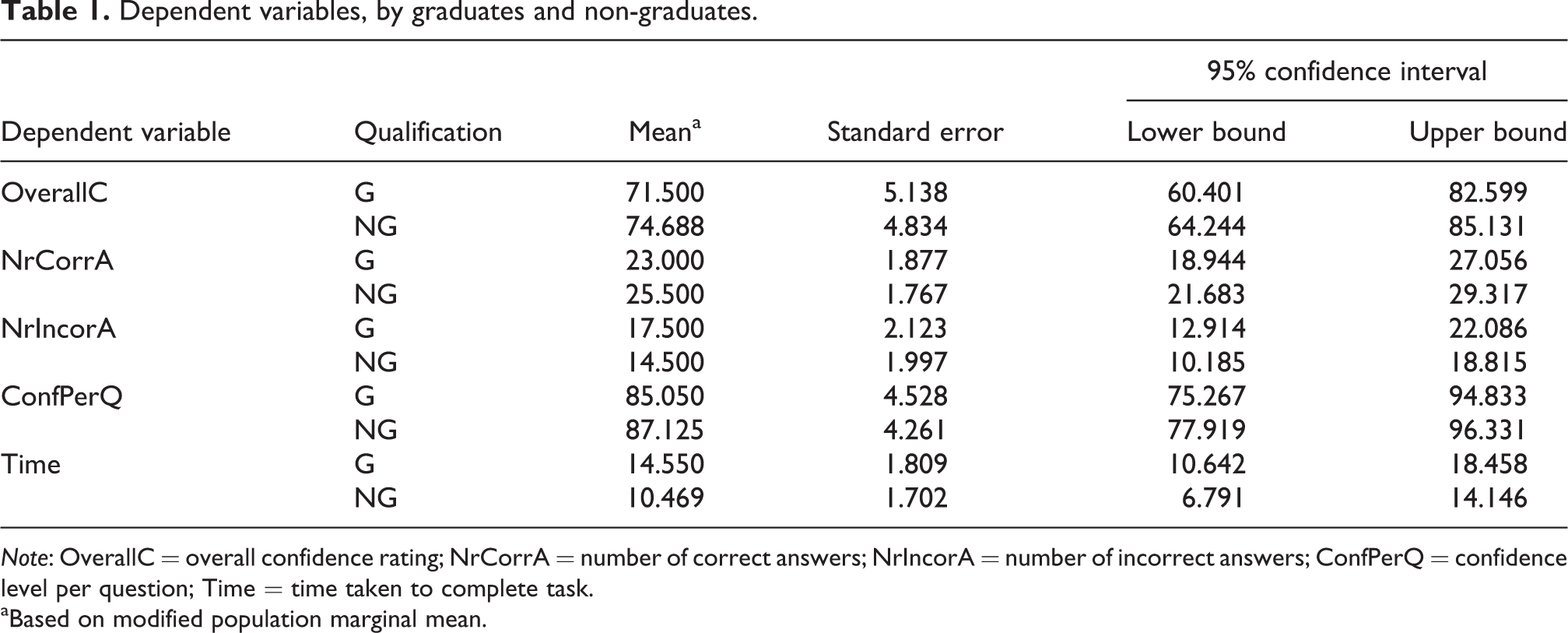
Note: OverallC = overall confidence rating; NrCorrA = number of correct answers; NrIncorA = number of incorrect answers; ConfPerQ = confidence level per question; Time = time taken to complete task.
aBased on modified population marginal mean.
The graduates estimated their overall confidence in numerical skills lower than did the non-graduates. As Figure 1 shows, graduates under 25 (age category 1) estimated their level of confidence above 90%, while the mean of confidence level for older graduates (age category 3) was 71.5%. Non-graduates were more confident about their overall numerical skills (mean = 74.6%). However, the non-graduates’ actual test scores were consistent with their expressed level of confidence, while the test scores of the graduates did not match their expressed level of confidence, thus suggesting overconfidence among graduates (hypothesis 3).

Overall confidence expressed, by qualification level (graduate and non-graduate).
With regard to the NrCorrA, the non-graduates fared much better than their graduate counterparts, achieving a minimum of 22/40 and a maximum of 28/40 right answers (mean = 25). By contrast, graduates achieved a minimum of 20/40 and a maximum of 25/40 (mean = 23). When the age factor is taken into account, Figure 2 shows that the older participants in both groups achieved a higher rate of correct answers than the younger participants. Typically, the higher scores noted above were achieved by older participants, with older non-graduates outperforming older graduates.

Number of correct answers by level of qualification and age.
With regard to the expressed confidence rating, graduates rated their confidence level lower, ranging from 70% to 100% (mean = 85). Again, non-graduates were more confident, with their rating ranging from 75% to 97% (mean = 87). Younger graduates were more confident per question, often indicating ratings of 100%. In contrast, the older non-graduates rated their confidence level higher than the younger non-graduates (97 for over 40-year-olds compared to 77 for 25- to 40-year-olds) – see Figure 3.

Individual estimates of confidence per question.
A more significant level of contrast is observed when the results are interpreted in terms of time taken. Graduates, unexpectedly, spent considerably more time than non-graduates, taking an average time of 14.5 min, with a maximum average time of 18.5 min. Non-graduates took only 10.5 min on average and a maximum of 14.1 min to complete the task. When the age factor is applied, another significant contrast emerges: younger graduates (age group 1), who had earlier expressed higher confidence in their numerical skills, took the longest time (17 min maximum) to complete the task – see Figure 4.
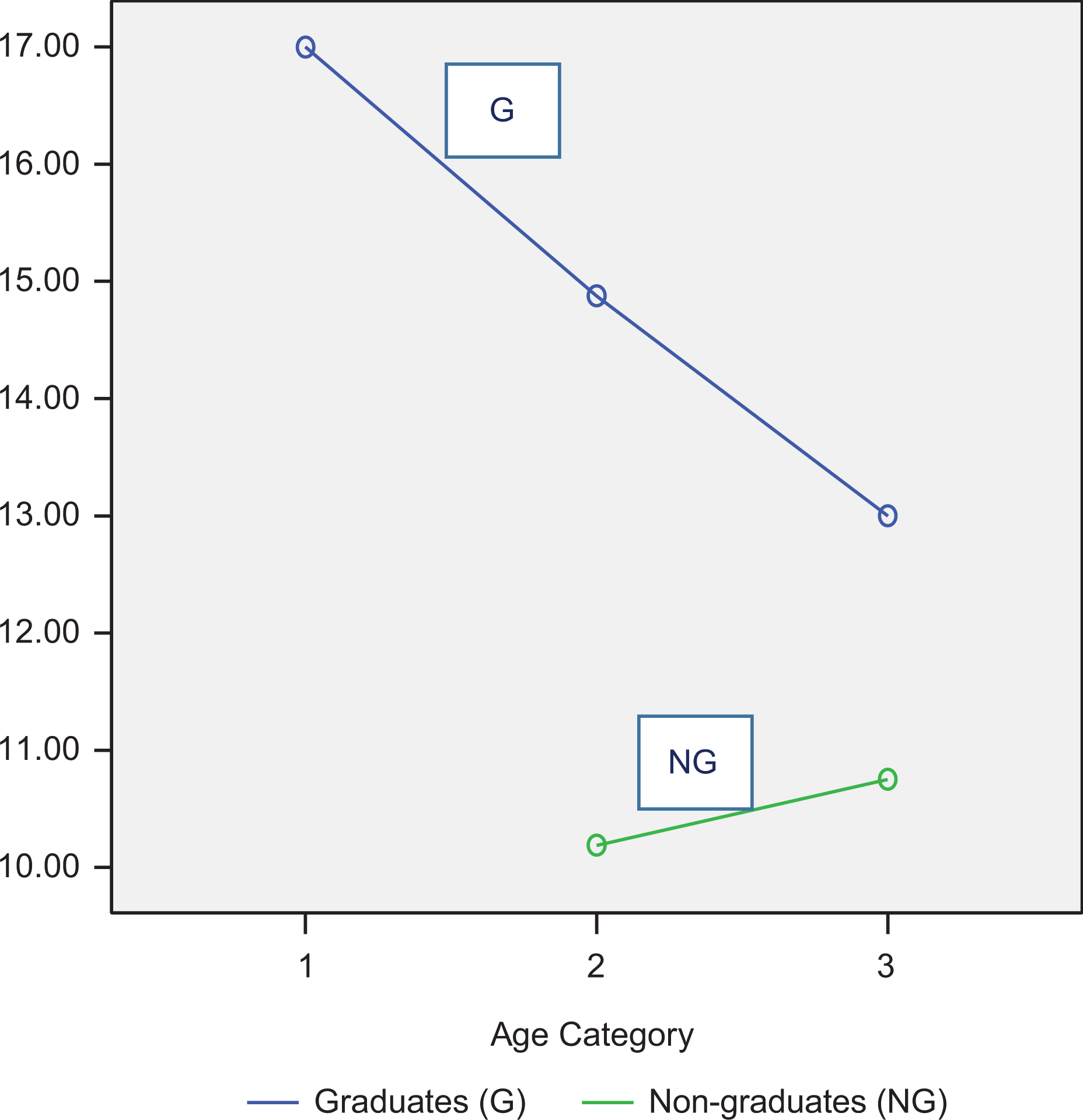
Time taken to complete the test by graduates and non-graduates.
Discussion
The research hypotheses were (1) graduates are more likely than non-graduates to overrate their basic mathematical skills; (2) graduates’ real basic mathematical skills can be lower than their estimates of their skills; and (3) in a basic number test, the performance of graduates will not be higher than that of their non-graduate counterparts. The general findings from the data are that graduates’ performance in the test was lower than that of non-graduates and that graduates’ performance was typically not commensurate with their estimate of their numerical skills. These findings support the research hypotheses.
In this experiment, graduates estimated their numerical capabilities almost 20% higher than their test performance (confidence estimate = 71.5%, compared with an average test achievement of just 57.5%). The results therefore show overconfidence in numerical skills. Overconfidence here is based on Christensen-Szelanski and Bushyhead’s (1981) theorization, according to which people do not know as much in reality as they claim to know. This is also evident in Malmendier and Tate’s (2015) study of overconfidence in forecasting among CEOs. When presented with two elements of choice and asked to evaluate themselves in terms of certainty about their answers, people rate their levels of confidence higher than their actual abilities (Gigerenzer et al., 1991). In the context of our experiment, Gigerenzer et al.’s (1991) theory is also consistent with the finding for non-graduates, though to a lesser extent than with the finding for graduates. These slightly different results suggest that, while Gigerenzer et al.’s framework could form an interesting starting point for the study of overconfidence, it cannot be regarded as an axiomatic prescription.
Though not apparent from the ANOVA test, because it was not the focus of the experiment, a manual analysis of the results shows that most of the wrong answers for graduates and non-graduates came in the latter part of the test (multiplication operations with double digits on either side). These multiplications were harder and consequently attracted lower confidence ratings on the 50–100 scale. If this were confirmed in a separate ANOVA test, it would be plausible to argue that the findings also support Brunswik’s (1955) Hard–Easy theory. Brunswik argues that overconfidence becomes lower as the questions to be answered become harder; in other terms, people become more objective about the assessment of their capabilities when the questions they are asked become harder. In a similar assessment, Sieck and Arkes (2005), investigating managerial decision-making, found that managers tended to be more complacent in decisions relating to routine matters as opposed to those about novel ones.
The fact that the graduates in our experiment were overconfident could suggest that they use their graduate status to legitimize and overrate their abilities. Similarly, Sieck and Arkes believed that more attention ought to be paid to the development of managers in relation to routine decision-making. We might add that, despite their graduate status, managers should not be exempted from numeracy and literacy development programmes in work settings or educational environments. Bullough et al. (2013) found that the continuous development of managers produces growing resilience and a greater entrepreneurial spirit.
Conclusion
In summary, the results demonstrate that, as predicted, graduates show overconfidence in their numerical skills; in line with previous studies, undergraduates rate themselves considerably higher than do their industry counterparts (Jackson, 2012). The findings confirm Harvey’s (1997) view that people make such judgements based on their subjective self-assessment. Both graduates and non-graduates exhibited overconfidence, but the degree of overconfidence in graduates was higher than that in non-graduates. The findings support our hypotheses and Gigerenzer et al.’s (1991) overconfidence theory, indicating that generally people pretend to know more than they actually do. Should a larger study confirm these results, the conclusion will be consistent with employers’ claims that graduates tend to overstate their basic skills competence.
The findings have implications for higher education institutions and learning and development managers in organizations. They emphasize the critical importance of development in organizations (Harrison, 2009), but they also call for a degree of caution when addressing the learning and development needs of students in higher education and the professional development of employees. The results indicate that there is a need for equal emphasis on graduate and non-graduate manager training in organizations. The assumption that graduate managers’ higher level of qualification should exempt them from basic professional development activities is rejected by the findings of this study. Learning and development provision requires democratization to grow a more productive workforce. However, because of the limitations of this experiment, set out below, our results need to be treated with caution. Further research would enable the formulation of more authoritative conclusions (Karadağ, 2017).
Greater attention should be devoted in UK higher education to stimulating the demand for graduates in the wider economy by providing students with better and more relevant skills (Copley, 2013; Escudeiro and Escudeiro, 2012; Okunuga and Ajeyalemi, 2018) that are not usually addressed in curricula (Escudeiro and Escudeiro, 2012). Specifically, the role of universities in developing softer skills is now crucial for enhanced graduate employability (Evans et al., 2012; Jackson, 2012; Mattern, 2016).
Given the evidence of this research and the findings of Kuczera et al. (2016), exposing lower than expected levels of numeracy, we propose that the teaching of numeracy should be embedded throughout higher education curricula. Though some academics may disagree with the implementation of the skills agenda in universities (Holmes, 2013), in the United Kingdom, as in many developed nations, the employability agenda is driven by the government and universities must comply with government requirements since enhanced funding may be contingent on an institution’s graduate employability record. In addition, various ranking systems take into account employability data.
Employer input into curriculum design will enhance higher education’s ability to fill this skills gap (Jones et al., 2017; Mason et al., 2009; Purcell, 2008). It is equally important that organizations consider sharpening the numeracy level of their graduate employees through systematic training programmes during the early period of their employment. Such early engagement with training needs will help prepare the graduate workforce for both routine and complex decision-making (Bullough et al., 2013; Sieck and Arkes, 2005), especially with regard to project management, forecasting and the management of change. Jones et al. (2017) suggest that higher education institutions must evaluate their provision in terms of employability to ensure that it evolves with dynamic workplace requirements.
Study limitations and future research
This study is an initial investigation into overconfidence in numeracy skills among graduates and non-graduates. We recognize the need for further study to address the limitations of the study. Future research might consider a wider sample from diverse disciplines and might, further, examine the implications of overconfidence among learners (young versus mature or male versus female students at university level and at different stages of a degree programme, for example). A larger sample of respondents from a more geographically diverse background would allow for closer statistical analysis of the emergent themes (Pearl et al., 2019). More complex statistical analysis would create a more accurate picture of graduate overconfidence to establish targeted remedial actions. We believe that such further studies would strengthen the findings from this study. The experiment produced some interesting results that largely supported our hypotheses.
Footnotes
Declaration of conflicting interests
The author(s) declared no potential conflicts of interest with respect to the research, authorship, and/or publication of this article.
Funding
The author(s) received no financial support for the research, authorship, and/or publication of this article.
